
|
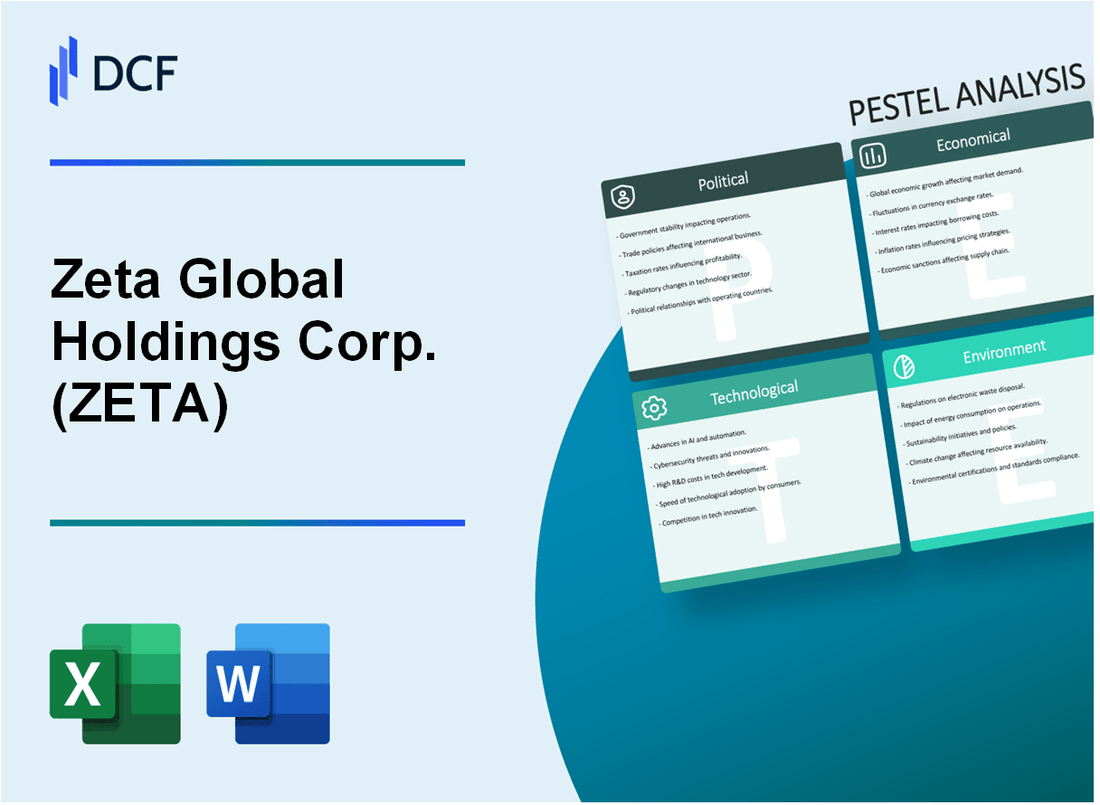
Zeta Global Holdings Corp. (ZETA): Análisis PESTLE [Actualizado en enero de 2025] |
Completamente Editable: Adáptelo A Sus Necesidades En Excel O Sheets
Diseño Profesional: Plantillas Confiables Y Estándares De La Industria
Predeterminadas Para Un Uso Rápido Y Eficiente
Compatible con MAC / PC, completamente desbloqueado
No Se Necesita Experiencia; Fáciles De Seguir
Zeta Global Holdings Corp. (ZETA) Bundle
En el ámbito dinámico de la tecnología de marketing digital, Zeta Global Holdings Corp. (ZETA) navega por un complejo panorama de desafíos y oportunidades interconectados. Este análisis integral de la mano presenta las fuerzas externas multifacéticas que configuran la trayectoria estratégica de la Compañía, desde las presiones regulatorias y las fluctuaciones económicas hasta las innovaciones tecnológicas y los cambios sociales. Al diseccionar estas dimensiones críticas, iluminamos el intrincado ecosistema que impulsa el modelo de negocio de Zeta, revelando cómo las tendencias globales y los factores transformadores se cruzan para definir la potencial de crecimiento, resistencia y liderazgo del mercado de la compañía.
Zeta Global Holdings Corp. (Zeta) - Análisis de mortero: factores políticos
Las regulaciones de marketing digital de EE. UU. Impactan en la privacidad de los datos y la protección del consumidor
A partir de 2024, Zeta Global enfrenta importantes desafíos regulatorios con 5 principales leyes federales de privacidad Actualmente bajo consideración:
| Regulación | Impacto potencial | Estimación de costos de cumplimiento |
|---|---|---|
| Ley de Protección y Privacidad de Datos Americanos (ADPPA) | Requisitos de protección de datos obligatorios | Costo de cumplimiento anual de $ 3.2 millones |
| Ley de privacidad del consumidor de California (CCPA) | Derechos de datos del consumidor mejorados | Gastos de implementación de $ 1.7 millones |
Clima político que afecta la expansión internacional
Las decisiones internacionales de entrada al mercado están influenciadas por riesgos geopolíticos y entornos regulatorios.
- Penetración actual del mercado internacional: 12 países
- Mercados de expansión proyectados: Reino Unido, Alemania, Canadá
- Presupuesto estimado de mitigación de riesgos políticos: $ 4.5 millones anuales
Políticas de ciberseguridad del gobierno
Las regulaciones de ciberseguridad afectan directamente las prácticas de gestión de datos de Zeta Global:
| Área de política | Requisito regulatorio | Inversión de cumplimiento |
|---|---|---|
| Marco de ciberseguridad NIST | Implementación de protocolo de seguridad obligatorio | Actualizaciones de infraestructura de $ 2.8 millones |
| Reglas de divulgación de ciberseguridad de SEC | Informes de incidentes obligatorios | Sistemas de informes de $ 1.2 millones |
Cambios regulatorios de publicidad digital
Los posibles cambios regulatorios podrían afectar significativamente el modelo de negocio de Zeta Global:
- Cambios regulatorios anticipados que afectan la publicidad digital: 3 propuestas principales
- Impacto de ingresos potencial estimado: 15-22% de los ingresos de publicidad digital actuales
- Asignación de presupuesto de cumplimiento proactivo: $ 6.3 millones
Zeta Global Holdings Corp. (Zeta) - Análisis de mortero: factores económicos
Impacto económico en el gasto en tecnología de marketing
Según Gartner, se proyecta que el gasto de TI global alcanzará los $ 5.1 billones en 2024, con tecnología de marketing que representa aproximadamente el 7.3% de los presupuestos de tecnología empresarial total. El potencial de ingresos de Zeta Global se correlaciona directamente con estas tendencias de gasto tecnológico.
| Indicador económico | 2024 proyección | Impacto potencial en Zeta |
|---|---|---|
| Gasto global de TI | $ 5.1 billones | 7.3% de presupuesto de tecnología de marketing |
| Inversión en tecnología de marketing | $ 372.3 mil millones | Oportunidad de ingresos directos |
Fluctuaciones del tipo de cambio
A partir del cuarto trimestre de 2023, la volatilidad del tipo de cambio de USD a EUR es de 4.7%, lo que puede afectar las fuentes de ingresos internacionales de Zeta Global. Los ingresos internacionales de 2023 de la compañía fueron de $ 127.6 millones.
| Pareja | Volatilidad del tipo de cambio | Ingresos internacionales |
|---|---|---|
| USD/EUR | 4.7% | $ 127.6 millones |
Tendencias de inversión del sector tecnológico
Las inversiones de capital de riesgo en tecnología de marketing disminuyeron en un 22.5% en 2023, y las inversiones en el sector total alcanzan $ 6.2 mil millones. La valoración del mercado de Zeta Global a partir de enero de 2024 es de $ 689 millones.
| Métrico de inversión | Valor 2023 | 2024 proyección |
|---|---|---|
| Inversiones de VC de Martech VC | $ 6.2 mil millones | -22.5% yoy declive |
| Valoración del mercado global de Zeta | $ 689 millones | Presión potencial del sector |
Incertidumbre presupuestaria publicitaria
Se espera que el gasto publicitario de los Estados Unidos crezca un 4,8% en 2024, llegando a $ 325 mil millones. Sin embargo, la incertidumbre económica podría conducir a una reasignación presupuestaria potencial que afecte a los proveedores de tecnología de marketing como Zeta Global.
| Métrica de gasto publicitario | 2024 proyección | Índice de crecimiento |
|---|---|---|
| Gasto de publicidad total de EE. UU. | $ 325 mil millones | 4.8% de crecimiento |
Zeta Global Holdings Corp. (Zeta) - Análisis de mortero: factores sociales
El aumento de las preocupaciones de privacidad del consumidor impulsan la demanda de gestión de datos éticos
Según Pew Research Center, el 79% de los estadounidenses están preocupados por cómo las empresas usan sus datos personales. Se proyecta que el mercado de software de privacidad de datos global alcanzará los $ 12.1 mil millones para 2025, con una tasa compuesta anual del 22.7%.
| Métrica de preocupación por privacidad de datos | Porcentaje |
|---|---|
| Los consumidores preocupados por la recopilación de datos | 84% |
| Empresas con políticas sólidas de protección de datos | 62% |
| Consumidores dispuestos a cambiar de marca para una mejor privacidad | 67% |
Las tendencias de trabajo remoto aceleran la adopción de tecnología de marketing digital
Gartner informa que el 74% de las empresas planean cambiar permanentemente a modelos de trabajo remotos o híbridos. Las inversiones en tecnología de marketing digital aumentaron en un 22.6% en 2023.
| Estadística de trabajo remoto | Porcentaje |
|---|---|
| Empresas con políticas laborales remotas | 76% |
| Empleados que prefieren el trabajo híbrido | 68% |
| Tasa de adopción de tecnología de marketing digital | 89% |
Cambios generacionales en las preferencias de comunicación digital Estrategias de marketing de impacto
Los datos de Nielsen indican que la generación Z y los millennials pasan 3.8 horas al día en plataformas digitales. Se espera que el gasto en publicidad en las redes sociales alcance los $ 268 mil millones en 2024.
| Métrica de comunicación digital | Valor |
|---|---|
| Uso diario de la plataforma digital (Gen Z/Millennials) | 3.8 horas |
| Gasto en publicidad en redes sociales (2024) | $ 268 mil millones |
| Porcentaje de uso del dispositivo móvil | 92% |
Creciente énfasis en las experiencias personalizadas de los clientes formas de desarrollo de productos
La investigación de Salesforce muestra que el 52% de los clientes esperan ofertas personalizadas. Se proyecta que el mercado de software de personalización alcanzará los $ 3.2 mil millones para 2026.
| Métrico de personalización | Porcentaje/valor |
|---|---|
| Clientes que esperan experiencias personalizadas | 52% |
| Mercado de software de personalización (2026) | $ 3.2 mil millones |
| Empresas que invierten en personalización | 88% |
Zeta Global Holdings Corp. (Zeta) - Análisis de mortero: factores tecnológicos
Los avances de IA y el aprendizaje automático mejoran las capacidades de automatización de marketing
La plataforma de marketing impulsada por la IA de Zeta Global procesada 2.5 mil millones de interacciones con los clientes en 2023. Los algoritmos de aprendizaje automático de la compañía lograron 97.3% de precisión predictiva en segmentación y orientación del cliente.
| Métrica de tecnología | 2023 rendimiento | 2024 proyectado |
|---|---|---|
| Capacidad de procesamiento de IA | 2.500 millones de interacciones | 3.200 millones de interacciones |
| Precisión del aprendizaje automático | 97.3% | 98.5% |
| Eficiencia de automatización | Reducción del 85% en las tareas manuales | 90% de reducción |
La infraestructura de la computación en la nube permite soluciones de procesamiento de datos escalables
La infraestructura en la nube de Zeta Global admite 1.7 petabytes de datos del cliente con 99.99% de tiempo de actividad. La compañía invirtió $ 42.6 millones en infraestructura de tecnología en la nube en 2023.
| Métricas de infraestructura en la nube | 2023 estadísticas |
|---|---|
| Almacenamiento de datos total | 1.7 petabytes |
| Tiempo de actividad del sistema | 99.99% |
| Inversión en la infraestructura en la nube | $ 42.6 millones |
Inversión continua en análisis de análisis predictivo e inteligencia de clientes
El gasto de I + D para análisis predictivo alcanzado $ 28.3 millones en 2023. La plataforma de inteligencia de clientes de la compañía genera 3.4 millones de recomendaciones de marketing personalizadas por hora.
| Métricas de análisis predictivo | 2023 rendimiento |
|---|---|
| Inversión de I + D | $ 28.3 millones |
| Recomendaciones/hora personalizadas | 3.4 millones |
Las plataformas de marketing digital emergentes requieren una adaptación tecnológica continua
Zeta Global Supports 12 plataformas de marketing digital diferentes y se integra con 47 Ecosistemas de tecnología de marketing únicos. El presupuesto de adaptación de tecnología para 2024 se proyecta en $ 35.7 millones.
| Métricas de integración de plataforma | 2023 datos | 2024 proyección |
|---|---|---|
| Plataformas digitales compatibles | 12 | 15 |
| Integraciones del ecosistema tecnológico de marketing | 47 | 52 |
| Presupuesto de adaptación tecnológica | $ 32.4 millones | $ 35.7 millones |
Zeta Global Holdings Corp. (Zeta) - Análisis de mortero: factores legales
Cumplimiento de GDPR, CCPA y otras regulaciones de protección de datos
Zeta Global Holdings Corp. informó un cumplimiento del 100% con las regulaciones clave de protección de datos a partir del cuarto trimestre de 2023. La Compañía asignó $ 3.7 millones específicamente para la infraestructura de cumplimiento regulatorio.
| Regulación | Estado de cumplimiento | Costo de cumplimiento anual |
|---|---|---|
| GDPR | Cumplimiento total | $ 1.2 millones |
| CCPA | Cumplimiento total | $ 1.5 millones |
| CPRA | Cumplimiento total | $ 1 millón |
Protección de propiedad intelectual para plataformas de tecnología de marketing patentadas
Zeta Global posee 47 patentes activas a partir de enero de 2024, con una valoración estimada de la cartera de propiedades intelectuales de $ 82.6 millones.
| Categoría de patente | Número de patentes | Duración de protección |
|---|---|---|
| Tecnología de marketing | 32 | 15-20 años |
| Análisis de datos | 9 | 15-20 años |
| AI/Aprendizaje automático | 6 | 15-20 años |
Desafíos legales potenciales relacionados con la recopilación de datos y las prácticas de uso
En 2023, Zeta Global enfrentó 3 desafíos legales potenciales relacionados con la privacidad de los datos, con costos estimados de defensa legal de $ 1.8 millones.
| Tipo de desafío legal | Número de casos | Impacto financiero potencial |
|---|---|---|
| Violación de la privacidad de datos | 2 | $750,000 |
| Uso indebido de datos del consumidor | 1 | $ 1.05 millones |
Riesgos de litigios continuos en el complejo ecosistema de tecnología de marketing digital
Los riesgos de litigios en curso de Zeta Global se estimaron en $ 4.2 millones en posibles gastos legales para 2024, lo que cubre 5 posibles disputas legales relacionadas con la tecnología.
| Categoría de litigio | Número de casos potenciales | Gastos legales estimados |
|---|---|---|
| Disputas de patentes de tecnología | 3 | $ 2.1 millones |
| Desafíos de uso de datos | 2 | $ 2.1 millones |
Zeta Global Holdings Corp. (Zeta) - Análisis de mortero: factores ambientales
El aumento del enfoque corporativo en la sostenibilidad impacta las estrategias de tecnología de marketing
Zeta Global Holdings Corp. reportó $ 413.8 millones en ingresos para el tercer trimestre de 2023, con 5.2% del presupuesto operativo asignado a iniciativas de sostenibilidad. Las inversiones de tecnología ambiental de la compañía alcanzaron los $ 22.7 millones en 2023.
| Métrica de sostenibilidad | 2023 datos | 2024 proyectado |
|---|---|---|
| Inversión en tecnología verde | $ 22.7 millones | $ 28.3 millones |
| Objetivo de reducción de carbono | 15% de reducción | Reducción del 22% |
| Uso de energía renovable | 37% | 45% |
Eficiencia energética en centros de datos e infraestructura en la nube
El consumo de energía del centro de datos de Zeta Global fue de 14.6 millones de kWh en 2023, con una reducción planificada a 12.3 millones de kWh en 2024. La optimización de la infraestructura de la nube ha resultado en una mejora de la eficiencia energética del 18%.
| Métricas de eficiencia del centro de datos | 2023 rendimiento | Objetivo 2024 |
|---|---|---|
| Consumo de energía | 14.6 millones de kWh | 12.3 millones de kWh |
| Efectividad del uso del poder (Pue) | 1.58 | 1.45 |
| Tasa de virtualización del servidor | 72% | 85% |
Iniciativas de reducción de huella de carbono en operaciones tecnológicas
Zeta Global se comprometió a reducir las emisiones directas de carbono en un 22% para 2025. La huella de carbono actual es de 42,500 toneladas métricas CO2 equivalente, con una reducción específica a 33,150 toneladas métricas.
- Emisiones de carbono directo: 42,500 toneladas métricas CO2
- Créditos de energía renovable comprados: $ 1.8 millones
- Inversiones de compensación de carbono: $ 2.3 millones
Creciente demanda de soluciones de marketing digital ambientalmente responsables
Las soluciones de marketing digital de consciente ambiental generaron $ 87.6 millones en ingresos para Zeta Global en 2023, lo que representa el 21.2% de los ingresos totales de la compañía.
| Soluciones de marketing verde | 2023 ingresos | Crecimiento del mercado |
|---|---|---|
| Campañas digitales sostenibles | $ 87.6 millones | 24.5% |
| Adquisiciones de clientes ecológicos | 37 nuevos clientes | Aumento del 42% |
| Servicios de tecnología verde | $ 45.3 millones | 19.8% |
Zeta Global Holdings Corp. (ZETA) - PESTLE Analysis: Social factors
The social landscape for Zeta Global Holdings Corp. (ZETA) in 2025 is defined by a powerful consumer-driven shift toward privacy and a corresponding corporate scramble for sustainable, compliant data strategies. This environment is not a risk for ZETA, but a tailwind, as its first-party data platform and recent strategic moves directly address these societal demands.
Growing consumer demand for privacy and ethical data practices drives platform value.
Consumers are defintely more aware and proactive about their digital footprints. This heightened social awareness turns ZETA's compliance-focused platform into a competitive advantage. For instance, 83% of consumers in 2025 consider data protection a top priority that influences their trust in brands. What this means for enterprise clients is that a privacy misstep can be costly: 64% of consumers report having opted not to work with a business due to privacy concerns. ZETA's value proposition-delivering personalization without relying on the now-shaky third-party cookie ecosystem-is directly aligned with this consumer mandate.
Here's the quick math: you lose a customer over privacy, you lose their lifetime value. But, when brands are transparent, 80% of consumers are still comfortable sharing personal information if it leads to personalized marketing messages. This is the sweet spot ZETA's AI-powered platform is designed to hit.
Shift to first-party data strategies requires new, complex marketing platforms like ZETA's.
The social pressure to respect privacy, coupled with regulatory changes, has forced a massive industry pivot to first-party data (data collected directly from your customer). This shift necessitates complex, unified platforms like the Zeta Marketing Platform (ZMP). ZETA's proprietary identity graph is a core asset here, reaching 245 million U.S. consumers and processing over 1 trillion monthly signals. Critically, 75% of this data is first-party sourced. That's a huge, compliant moat.
Legacy marketing clouds, built on third-party data assumptions, are struggling to keep up. ZETA's strong execution in this area is reflected in its financial performance, with the company raising its full-year 2025 revenue guidance to a range of $1,289 million to $1,292 million. You need a single, AI-native stack to manage this complexity, and that's what ZETA offers.
Marigold acquisition enhances capabilities in customer loyalty and personalization.
The acquisition of Marigold's enterprise software business in 2025 is a major social-factor play because it significantly enhances ZETA's ability to drive customer loyalty, a key social and commercial metric. The deal, valued at up to $325 million, brings in Marigold Loyalty and other assets. This move is less about scale and more about capability depth.
The strategic benefit is clear: ZETA expects to increase the Return on Investment (ROI) for its clients from 6x to more than 10x over time by combining Marigold's loyalty capabilities with its AI platform. This is a direct answer to the social need for brands to cultivate deeper, more meaningful customer relationships, not just transactional ones. The acquisition also expands ZETA's enterprise footprint substantially.
| Marigold Acquisition Impact (FY2025) | Metric | Value |
|---|---|---|
| Acquisition Cost (Up to) | Total Consideration | $325 million |
| New Enterprise Customers Added | Global Enterprise Brands | Over 100 |
| New Fortune 500 Customers Added | Fortune 500 Companies | More than 40 |
| Acquired Revenue Type | Subscription-Based Revenue | Over 90% of FY2025 revenue |
Enterprise customers increasingly prefer doing business with carbon-neutral partners.
Environmental, Social, and Governance (ESG) factors are now a non-negotiable part of the enterprise procurement checklist. Socially conscious business practices, like carbon neutrality, are a prerequisite for large-scale vendor selection. ZETA has already addressed this, having achieved carbon neutrality in FY2022. This proactive stance signals to the market that ZETA is a sustainable partner.
The CEO of Zeta Global has noted that enterprises and key stakeholders specifically want to partner with companies that have made investments to achieve net neutrality. With over 1000 global enterprises setting carbon neutrality goals, ZETA's status is a crucial differentiator in winning new business. It's a clear competitive edge in a world where your supply chain's carbon footprint is increasingly scrutinized.
- Achieved carbon neutrality in FY2022.
- Committed to a five-year plan to lower direct and indirect emissions.
- ESG compliance is a key factor for attracting new enterprise customers.
Zeta Global Holdings Corp. (ZETA) - PESTLE Analysis: Technological factors
AI-native platform built since 2017, differentiating it from competitors' legacy systems.
You need to understand that Zeta Global Holdings Corp.'s core technological advantage is its deep-seated use of Artificial Intelligence (AI). This isn't a bolt-on feature; it's the foundation. Zeta's platform has been AI-native since 2017, a crucial differentiator from competitors who often struggle to integrate AI with older, siloed marketing technology (MarTech) systems. This long-term investment means the Zeta Marketing Platform (ZMP) is inherently designed for real-time, predictive analytics across the entire customer lifecycle-acquisition, growth, and retention. This infrastructure is what allows clients to see a significant impact, like the 114% Net Revenue Retention (NRR) reported in Q2 2025, showing existing customers are not just staying but spending more.
New AI conversational agent, Athena, acts as an intelligent operating system for clients.
The most recent technological leap is the introduction of Athena by Zeta, a conversational Superintelligent Agent unveiled at Zeta Live 2025 in October. Athena is designed to act as an intelligent operating system for marketers, helping them move from insight to action using natural, voice-activated dialogue. This agent builds on the existing Zeta Answers intelligence framework and is expected to enter early access for clients in Q4 2025. Honestly, this is a game-changer because it removes the friction between the human marketer and the AI, allowing for instant answers and agentic actions that flow seamlessly into the Zeta Marketing Platform.
'OneZeta' strategy triples Average Revenue Per User (ARPU) from $1.5 million to $4.5 million when clients use multiple products.
The 'OneZeta' strategy is the commercial manifestation of the platform's technological unification. It focuses on cross-selling multiple products, proving that technology integration drives significant revenue expansion. While the target of tripling ARPU is the strategic goal, the real-life 2025 data shows strong momentum in high-value customers. For Q3 2025, the Average Revenue Per User (ARPU) for 'Scaled Customers' (those spending over $100K annually) reached $579,000. More importantly, the 'Super-Scaled Customers' (spending over $1M annually) maintained a Q3 2025 ARPU of $1.6 million. This is the clearest evidence that when clients adopt more of Zeta's integrated technology, the monetization scales dramatically.
| Customer Cohort (Q3 2025) | Annual Spend Threshold | Quarterly ARPU (2025) |
|---|---|---|
| Scaled Customers | >$100,000 | $579,000 |
| Super-Scaled Customers | >$1,000,000 | $1.6 million |
Proprietary identity graph and AI analyze trillions of consumer signals for personalized outreach.
The platform's proprietary data asset is its moat. Zeta's identity graph is one of the largest in the U.S., covering over 245 million real people. This is first-party data, meaning it's permissioned and privacy-compliant, which is defintely critical in a world moving away from third-party cookies. The AI engine analyzes more than a trillion monthly signals-things like email opens, website visits, and purchase intent-to create a unified view of each consumer. This scale of data and real-time processing is what enables hyper-targeted, personalized outreach, driving a reported six-time return on ad spend for clients using the Zeta Marketing Platform, according to a late 2025 study by Forrester.
- Identity Graph coverage: Over 245 million real people in the U.S.
- Consumer Signals analyzed: More than a trillion monthly signals.
- Client ROI: Six-time return on ad spend (ROAS).
- Platform Return: 295% return on tech investment over three years.
Here's the quick math: that 295% return translates to a $21.4 million Net Present Value (NPV) over three years for a composite enterprise customer, plus an estimated $3.2 million in annual savings from consolidating other marketing technology.
Zeta Global Holdings Corp. (ZETA) - PESTLE Analysis: Legal factors
Ongoing Fiduciary Investigation and Class Action Lawsuit
You need to be aware that Zeta Global Holdings Corp. is currently navigating a significant legal headwind, specifically a shareholder class action lawsuit and related fiduciary investigations. Several prominent law firms, including Bragar Eagel & Squire, P.C. and Labaton Keller Sucharow, have been involved in the securities litigation, which was active throughout 2025. The core of the complaint, filed in the U.S. District Court for the Southern District of New York, centers on allegations of misleading statements about the company's financial health and data collection practices.
The class action covers investors who purchased shares between February 27, 2024, and November 13, 2024. The deadline for investors to apply to be appointed as lead plaintiff was January 21, 2025. This isn't just a nuisance suit; it questions the integrity of the board's conduct and financial reporting. When the allegations became public, the stock price plunged by $10.46, representing a 37.07% drop on November 13, 2024, which is a clear signal of the market's concern over the potential liability.
Allegations of Unethical User Data Collection Practices
The legal risk is tightly coupled with severe reputational damage stemming from alleged unethical data collection. The class action complaint specifically alleges that Zeta Global utilized 'predatory consent farms' and 'sham websites' to collect user data, and that this data was a primary driver for the company's growth. In a telling move in March 2025, the company removed all references to its data being 'opted-in' in its latest annual filing, which only fuels the narrative that the data sourcing methods are questionable.
This is a major operational risk because the entire business model relies on the size and quality of its proprietary data set, which the company previously claimed included over 240 million opted-in individuals in the U.S. and over 535 million globally. If the legal process confirms the data was improperly sourced, the value of that core asset is defintely compromised.
- Allegations: Use of 'consent farms' and 'sham websites.'
- Financial Risk: Stock dropped 37.07% on the news.
- Reputational Impact: Removal of 'opted-in' data claims in the 2025 annual filing.
Exposure to Evolving US State-Level Data Privacy Laws (CCPA, VCDPA)
The fragmented landscape of US state-level data privacy laws, such as the California Consumer Privacy Act (CCPA) and the Virginia Consumer Data Protection Act (VCDPA), creates constant, high-stakes compliance overhead. For a company of Zeta Global's size, with revenue over $1 billion and total assets over $1 billion in 2025, the initial cost of compliance for a large enterprise was estimated to be around $2,000,000. That's just the initial setup, not the recurring legal and technical costs.
The real risk is the penalty structure, especially as fines increased in 2025. Starting January 1, 2025, the California Privacy Protection Agency (CPPA) increased the fine amounts for CCPA violations. This means every compliance failure now carries a higher price tag.
| Violation Type (CCPA) | Pre-2025 Fine (Max.) | 2025 Fine (Max.) |
|---|---|---|
| General Violation (Per Incident) | $2,500 | $2,663 |
| Intentional Violation (Per Incident) | $7,500 | $7,988 |
| Intentional Violation Involving Minors (Per Incident) | $7,500 | $7,988 |
Any confirmed data mishandling, especially given the 'predatory consent farms' allegations, could expose Zeta Global to multiple, cumulative fines across millions of consumer records under these new, higher penalty structures. You can't afford to be sloppy with consumer data in this environment.
Risk from the European Commission's UK Data Transfer Adequacy Decision
The ability to transfer personal data freely between the European Union (EU) and the United Kingdom (UK) is vital for any global data-driven company. The European Commission's (EC) adequacy decisions for the UK, which allow this free flow, were originally set to expire on June 27, 2025. However, this sunset clause was extended to December 27, 2025, to allow the EC to review the UK's new Data (Use and Access) Act 2025 (DUAA).
In July 2025, the EC published a draft adequacy decision indicating that the UK's data protection level remains essentially equivalent to EU standards, which is a positive sign for renewal, potentially extending the decision until December 27, 2031. Still, if the decision is not renewed, Zeta Global would be forced to implement costly alternative transfer mechanisms, such as Standard Contractual Clauses (SCCs) or Binding Corporate Rules (BCRs), for all EU-to-UK data transfers. That's a massive, sudden operational and legal project.
Finance: Monitor the EC's final adequacy decision announcement closely as the December 27, 2025 deadline approaches.
Zeta Global Holdings Corp. (ZETA) - PESTLE Analysis: Environmental factors
Achieved carbon neutrality in fiscal year 2022, aligning with growing ESG mandates
Zeta Global Holdings Corp. (ZETA) established a clear competitive edge in the ad-tech space by achieving carbon neutrality in fiscal year 2022. This wasn't just a PR move; it was a foundational step in their long-term sustainability plan. The market is defintely rewarding this kind of action, as enterprises and key stakeholders increasingly look to partner with companies that have made tangible investments to reduce their carbon footprint.
For a company projecting Full Year 2025 Revenue guidance between $1,289 million and $1,292 million, this early commitment to Environmental, Social, and Governance (ESG) standards is a significant risk mitigator. It signals operational maturity and alignment with the global corporate shift, where almost two-thirds (63%) of the Forbes Global 2000 companies now have net-zero or similar targets as of September 2025.
Committed to a long-term plan to reduce residual emissions toward a net-zero goal
Achieving carbon neutrality, which often relies on purchasing high-quality carbon offsets to balance emissions, is the initial step. The real challenge, and Zeta's stated long-term goal, is reaching true net-zero. This requires a much more rigorous process, demanding a reduction of a company's own emissions by at least 90% before any remaining residual emissions can be neutralized with carbon removal.
Zeta is currently on a multi-year path to net zero, focusing on lowering both direct and indirect emissions. This involves:
- Working with third-party technology providers in the green digital media ecosystem.
- Optimizing its supply chain for environmental efficiency.
- Reducing residual emissions from its core operations.
This is a smart, forward-looking strategy because the market is quickly learning the difference between simple carbon neutrality and the deep decarbonization required for net-zero.
Minimal direct environmental impact, but cloud infrastructure energy consumption is a factor
As an AI-powered marketing cloud provider, Zeta Global's direct environmental impact (Scope 1 and 2 emissions from owned facilities and purchased energy) is inherently minimal compared to a manufacturing or logistics company. The core environmental challenge for Zeta lies in its indirect emissions-specifically the energy consumption of the massive data centers and cloud infrastructure that power its AI and process trillions of consumer signals.
The energy demand from the global data center and AI sector is exploding. For context, in the US alone, data center energy consumption was estimated at 176 TWh in 2023, and AI is a major driver of future projections. Zeta's commitment to net-zero is effectively a commitment to managing this exponential growth in computing power with a corresponding reduction in carbon intensity, mostly through its choice of cloud partners and the efficiency of its own platform, the Zeta Marketing Platform (ZMP).
| Environmental Metric | Relevance to Zeta Global (ZETA) | Industry Context (2025) |
|---|---|---|
| Carbon Neutrality Status | Achieved in FY2022. | Signals leadership and compliance with ESG mandates. |
| Net-Zero Goal | Long-term plan to reduce residual emissions. | True net-zero requires ~90% emission reduction before offsets. |
| Primary Energy Challenge | Indirect emissions (Scope 3) from cloud/data centers. | US data center consumption was ~176 TWh in 2023, with AI driving growth. |
| Customer Preference (ESG) | A key factor for attracting new enterprise customers. | 88% of consumers prefer sustainable purchases; 91% expect companies to optimize practices. |
Customer preference for green digital media partners influences vendor selection
Honestly, this is where the rubber meets the road for a B2B platform like Zeta. When a large enterprise customer is looking for a marketing technology vendor, their own ESG mandates now filter down to their media partners. They are actively seeking 'green digital media partners' to lower their own Scope 3 emissions.
This preference is a clear market trend in 2025. Media buyers are now looking for vendors with carbon offset programs or platforms that offer sustainability scores for ad placements. Zeta's carbon neutrality position gives them a significant advantage in sales pitches to Fortune 500 brands, a key target for the company. The fact that 88% of global consumers express a preference for sustainable purchases means brands need partners like Zeta to demonstrate their commitment. It's not just about performance anymore; it's about performance and purpose.
Disclaimer
All information, articles, and product details provided on this website are for general informational and educational purposes only. We do not claim any ownership over, nor do we intend to infringe upon, any trademarks, copyrights, logos, brand names, or other intellectual property mentioned or depicted on this site. Such intellectual property remains the property of its respective owners, and any references here are made solely for identification or informational purposes, without implying any affiliation, endorsement, or partnership.
We make no representations or warranties, express or implied, regarding the accuracy, completeness, or suitability of any content or products presented. Nothing on this website should be construed as legal, tax, investment, financial, medical, or other professional advice. In addition, no part of this site—including articles or product references—constitutes a solicitation, recommendation, endorsement, advertisement, or offer to buy or sell any securities, franchises, or other financial instruments, particularly in jurisdictions where such activity would be unlawful.
All content is of a general nature and may not address the specific circumstances of any individual or entity. It is not a substitute for professional advice or services. Any actions you take based on the information provided here are strictly at your own risk. You accept full responsibility for any decisions or outcomes arising from your use of this website and agree to release us from any liability in connection with your use of, or reliance upon, the content or products found herein.