

|
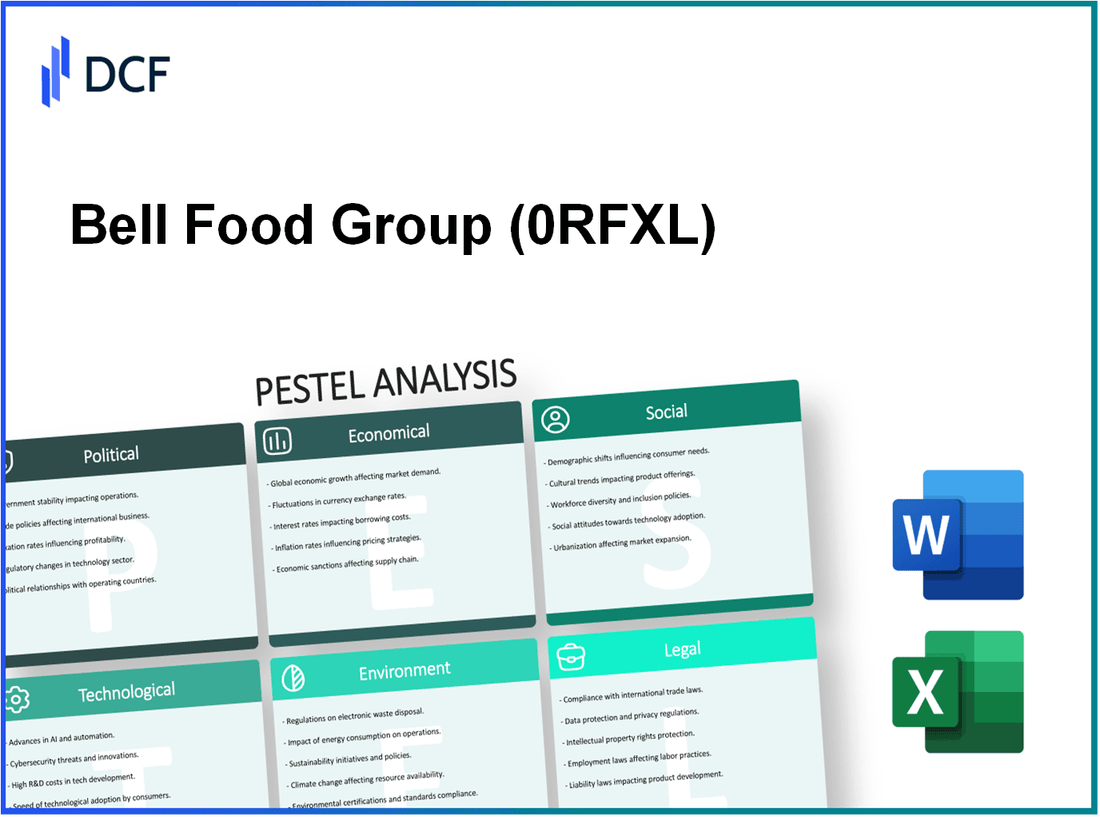
Bell Food Group AG (0RFX.L): PESTLE Analysis [Apr-2026 Updated] |
Entièrement Modifiable: Adapté À Vos Besoins Dans Excel Ou Sheets
Conception Professionnelle: Modèles Fiables Et Conformes Aux Normes Du Secteur
Pré-Construits Pour Une Utilisation Rapide Et Efficace
Compatible MAC/PC, entièrement débloqué
Aucune Expertise N'Est Requise; Facile À Suivre
Bell Food Group AG (0RFX.L) Bundle
Bell Food Group sits at a strategic crossroads-leveraging Swiss premium brands, advanced automation, and strong traceability to capture growing convenience and alternative-protein demand, while contending with high domestic pricing, rising labor and compliance costs, and commodity and energy volatility; its investments in plant‑based and cultivated meat, e‑commerce and circularity offer clear growth levers, but geopolitical trade shifts, tightening EU/Swiss regulations and climate risks could quickly erode margins-making Bell's ability to scale innovation and diversify sourcing the decisive test of its future resilience.
Bell Food Group AG (0RFX.L) - PESTLE Analysis: Political
Switzerland's bilateral relations with the EU directly influence Bell Food Group's cross-border logistics, labor access and regulatory alignment. Switzerland imports roughly 60-70% of meat processing inputs and employs an estimated 18-25% of frontline processing staff who are EU nationals in key sites; restrictions or changes to mobility agreements could increase labor costs by 5-12% and raise recruitment lead times by months. Tariff-free trade on many agri-food items is dependent on negotiation outcomes; a disruption could introduce ad-valorem equivalent costs of 1-6% on certain processed products.
Swiss agricultural subsidies provide a material buffer for domestic producers that stabilizes raw material prices and supports national food security objectives. In 2023 Switzerland allocated approximately CHF 2.6 billion to agricultural direct payments; meat and livestock related payments account for an estimated CHF 300-450 million annually. For Bell, these subsidies help limit volatility in domestic procurement prices-reducing year-on-year pork and poultry raw-material cost swings historically from +/-18% to +/-6-8%-and underpin long-term supplier viability in regional sourcing areas.
Swiss market protection and mandatory domestic labeling contribute to a persistent Swiss meat price premium. Average retail meat prices in Switzerland are approximately 40-60% higher than EU averages (e.g., average beef price CHF 24/kg vs EU €15/kg equivalent in recent periods). This premium is driven by import restrictions, sanitary rules and compulsory origin labeling; for Bell this translates into higher gross margins on domestic branded lines but constrains price competitiveness for export-oriented SKUs.
EU trade standards, including the European Green Deal and Farm to Fork initiatives, raise compliance and administrative costs for cross-border operations. Estimated incremental compliance costs for exporters/importers in the near term are in the range of 0.5-2.0% of revenue for companies adapting traceability, labeling and sustainability reporting systems. Bell faces specific cost exposures from:
- Expanded traceability and digital labeling requirements (investment in IT and supply-chain upgrades: CHF 5-15 million projected over 3 years)
- Stricter Maximum Residue Limits and animal welfare standards leading to supplier audits and potential sourcing shifts (audit and certification costs ~CHF 0.5-1.5 million annually)
- Carbon and methane mitigation reporting obligations that can raise production costs by 1-3% per kg of meat product if passed to processors
Nitrogen emission reduction policies enacted regionally (Swiss cantonal targets and EU-linked cross-border agricultural air quality measures) are reducing permitted livestock densities and altering sourcing availability. Switzerland targets a reduction in agricultural reactive nitrogen of ~30% by 2030 in several regions; this is projected to reduce regional swine and cattle headcounts by up to 10-15% in affected cantons. For Bell this implies:
| Metric | Current Value / Estimate | Projected Change | Implication for Bell |
|---|---|---|---|
| Swiss agricultural subsidies (annual) | CHF 2.6 billion | Stable to modest increase (+0-3%/yr) | Price stability for domestic suppliers; predictable sourcing base |
| Domestic meat price premium vs EU | +40-60% | Likely persistent | Higher domestic margins; limited export price competitiveness |
| EU compliance incremental cost | 0.5-2.0% of revenue | Upfront IT/certification investments CHF 6-17M | Increased operating costs; need for price adjustments or efficiency gains |
| Labor dependence on EU nationals | 18-25% of processing staff | Vulnerable to mobility policy changes | Potential wage inflation +5-12%; recruitment risk |
| Nitrogen reduction target (regional) | ~30% reduction target by 2030 in some cantons | Livestock reductions of 10-15% locally | Constrained domestic supply; need to diversify sourcing/imports |
Political risk factors to monitor include negotiations on the EU-Switzerland institutional framework, canton-level environmental regulations, potential shifts in subsidy allocation, and sanitary/trade policy changes following EU Green Deal implementation. These factors collectively influence sourcing strategies, capital allocation for compliance, and short-to-medium-term margin dynamics.
Bell Food Group AG (0RFX.L) - PESTLE Analysis: Economic
Swiss macro stability supports premium meat demand: Switzerland's low unemployment, high real wages and resilient GDP underpin continued consumer willingness to pay for premium and convenience meat products. Real median household income in Switzerland remains among the highest in Europe, supporting Bell's value-added product lines and margin resilience.
| Indicator | Value (approx.) | Period |
|---|---|---|
| Swiss GDP growth | +0.8% to +1.5% (estimated) | 2023-H1 2024 |
| Swiss CPI inflation | ~1.5% (year-on-year) | Mid-2024 |
| Unemployment rate | ~2.5%-3.0% | 2024 |
| Median disposable income (annual, CHF) | ~CHF 60,000-CHF 70,000 | Latest available |
Implications for Bell:
- Premium brand and convenience segments retain pricing power, supporting EBIT margin stability.
- Higher per-capita meat consumption of upmarket products in Switzerland mitigates some cyclical volume risk in core domestic markets.
Private label shift driven by rising EU living costs: Elevated living costs across the EU have accelerated retailer focus on private-label, lower-priced meat and convenience offerings. This dynamic pressures branded players in continental Europe, increasing competition on price and volume for Bell's cross-border business operations.
| Indicator | Value / Trend | Implication for Bell |
|---|---|---|
| EU consumer price pressures | Persistent above-target inflation in many EU states (2022-24) | Shift to private-label demand; margin compression risk |
| Private-label penetration (food retail) | Rising by 1-3 percentage points in key markets | Increased volume competition; need for cost efficiency |
| Retailer bargaining power | High in western Europe | Price pressure on branded SKUs |
Financing costs rise as SNB tightens monetary policy: The Swiss National Bank's tightening cycle has lifted short-term interest rates and bank lending margins. Higher refinancing and covenant pressure affect Bell's debt costs and capital allocation, particularly for acquisitions and working-capital financing.
- SNB policy rate moved materially higher from near-zero post-2021; Swiss short-term rates rose accordingly (policy and interbank rates increased by several hundred basis points through 2022-2023).
- Corporate bond and bank loan spreads for food processors have widened modestly; incremental borrowing costs for investment-grade borrowers rose by an estimated 50-150 bps vs. the low-rate environment.
| Financing item | Estimate / Range | Notes |
|---|---|---|
| SNB policy rate (approx.) | ~1.5%-2.0% | Mid-2024 estimate after tightening cycle |
| Corporate loan rate impact | +50-150 bps vs. 2021 | Depends on maturity and credit quality |
| Short-term commercial paper / working capital cost | Lifted in line with market rates | Increases financing charges, affecting cash conversion |
Commodity price volatility increases feed and energy costs: Global volatility in maize, soy, and energy markets has resulted in variable input costs for Bell's supply chain. Feed, packaging and energy represent meaningful cost components; volatility compresses gross margins when hedging gaps exist or when pass-through to retail prices is limited.
- Feed input costs (maize/soy) experienced multi-year volatility with price swings of 10-40% in some seasons.
- Energy and logistics costs spiked during 2021-23 events, raising processing and transport unit costs by double digits at peaks.
- Hedging and procurement strategies reduce but do not eliminate exposure; margins remain sensitive to commodity shocks.
| Cost category | Typical share of COGS | Recent volatility impact |
|---|---|---|
| Feed/raw materials | 20%-35% | Price swings ±10-30% year-on-year |
| Energy (processing, heat) | 5%-10% | Spikes increased absolute costs by up to 20% in stress periods |
| Packaging & transport | 5%-10% | Logistics disruptions and fuel cost volatility raised unit costs |
Strong CHF mitigates some euro area financing risk: A robust Swiss franc reduces the local-currency cost of euro-denominated imported inputs and euro-area debt service when Bell earns CHF revenue. However, CHF strength can make Swiss exports and pricing less competitive in foreign markets, partially offsetting financing gains.
| FX factor | Effect | Implication for Bell |
|---|---|---|
| CHF/EUR exchange rate (approx.) | CHF strong vs. EUR in 2022-24 (EUR/CHF often below 1.10) | Reduces CHF cost of EUR-denominated inputs & debt; squeezes export price competitiveness |
| Euro-denominated debt exposure | Variable depending on financing mix | CHF appreciation lowers CHF-equivalent debt service burden |
| Cross-border pricing | Competitive pressure when CHF strong | May require margin or price adjustments in export markets |
Bell Food Group AG (0RFX.L) - PESTLE Analysis: Social
Sociological
Plant-based and flexitarian trends rise in DACH region: Retail and foodservice demand for plant-based protein alternatives in Germany, Austria and Switzerland (DACH) has expanded markedly. Retail sales of plant-based foods in Germany increased by an estimated 15-20% CAGR between 2019 and 2023; Switzerland and Austria report comparable double-digit growth. Flexitarian behavior is widespread - surveys indicate 30-40% of consumers in DACH describe themselves as reducing meat consumption intermittently, creating substitution demand rather than full veganization.
| Metric | DACH Value / Estimate | Implication for Bell |
|---|---|---|
| Plant-based retail CAGR (2019-2023) | ~15-20% | Need to expand plant-based portfolio and R&D; reallocate capex to alternative-protein lines |
| Flexitarian population share | ~30-40% | Opportunities for hybrid/meat-reduced products and price/value propositions |
| Meat consumption per capita (Germany, 2022) | ~57 kg/year | Market still large - transition likely gradual; maintain core meat offerings while diversifying |
Urbanization boosts convenience food demand: Urban population penetration in the DACH markets is high - Germany ~77%, Switzerland ~74%, Austria ~58% - driving growth in convenience, ready-to-eat and chilled prepared foods sold through supermarkets, discounters and foodservice channels. Time-poor urban households and single-person households (rising to ~40%+ in major cities) increase per-capita spend on convenience and premium prepared meals.
- Higher SKU velocity in metropolitan supermarkets; demand for smaller pack sizes and single-serve options
- Increased foodservice delivery and retail-ready chilled products - opportunity for co-packed/private label contracts
- Logistics and cold-chain investment required to serve urban micro-fulfillment
Health labeling and nutrition scores drive product reformulation: Front-of-pack labels, Nutri-Score adoption in parts of Europe and rising consumer attention to salt, saturated fat and additives are pushing manufacturers to reformulate. Evidence: products reformulated to improve nutrition profiles saw higher shelf acceptance and listing success with major retailers. Bell faces pressure to reduce sodium and saturated fat content across processed meat ranges while maintaining taste and price points.
| Labeling / Health Metric | Trend / Regulatory Status | Operational Impact |
|---|---|---|
| Nutri-Score visibility | Voluntary in many countries but increasing retailer adoption | Reformulation, recipe alteration, marketing of higher-score SKUs |
| Reduced-salt / reduced-fat demand | Growing consumer preference; >30% of health-focused shoppers consider it when buying | R&D investment, possible cost increases for ingredient replacement |
Transparency and origin tracing pressure premium pricing: Consumers in DACH value provenance; surveys show over 60% willing to pay a premium for locally sourced or traceable meat. Traceability requirements from retailers and NGOs demand investments in blockchain/trace systems, supplier audits and marketing claims verification. These increase per-unit cost but justify premium positioning for branded products and foodservice sourcing contracts.
- Traceability investment: supplier audits, digital tracking, labeling costs
- Premium pricing elasticity: a segment (15-25% of shoppers) accepts 10-25% premiums for certified-origin products
- Risk: commoditized private-label volumes may resist price increases despite transparent sourcing
Ethical consumption and animal welfare elevate brand loyalty: Animal welfare certifications (e.g., higher-welfare labels, RSPCA-equivalent, region-specific schemes) and ethical sourcing narratives drive repeat purchase and brand preference. Younger cohorts (Gen Z, Millennials) show stronger loyalty to brands with verifiable welfare standards; churn risk for brands that lag in welfare improvements rises. Bell can leverage welfare improvements to protect margins and reduce reputational risk, but must balance cost implications in the supply chain.
| Consumer Concern | Estimated Influence | Strategic Response |
|---|---|---|
| Animal welfare | High - >50% cite as purchase factor in premium segments | Adopt higher-welfare sourcing, certification, and marketing transparency |
| Environmental footprint | Growing - younger consumers prioritize sustainability | Communicate lifecycle data, reduce emissions in value chain |
| Ethical supply chains | Material for institutional buyers and retailers | Implement supplier KPIs and audited compliance programs |
Bell Food Group AG (0RFX.L) - PESTLE Analysis: Technological
Automation and Industry 4.0 boost efficiency and reduce labor costs. Bell Food Group's processing lines can achieve 20-40% throughput increases and 10-25% labor cost reductions through robotic cutting, automated packaging, and machine-vision quality control. Capital expenditure for medium-scale automation retrofits is typically CHF 5-25 million per plant; expected simple payback ranges 3-6 years depending on product mix and utilization. Predictive maintenance using IIoT sensors reduces unplanned downtime by 30-50% and spare-parts inventory by up to 20%.
| Technology | Typical CapEx (CHF) | Expected Efficiency Gain | Payback Period |
|---|---|---|---|
| Robotic cutting & portioning | 2,000,000 - 10,000,000 | 20% - 40% throughput | 2 - 5 years |
| Automated packaging lines | 1,000,000 - 6,000,000 | 15% - 30% labor reduction | 3 - 6 years |
| IIoT & predictive maintenance | 200,000 - 1,500,000 | 30% - 50% less downtime | 1 - 4 years |
Blockchain enables full product traceability from farm to fork. Pilot projects within meat supply chains have shown traceable provenance records reduce recall scope by up to 60% and accelerate incident response times by 50%. Implementing blockchain-backed traceability across 100 SKU lines typically requires integration costs CHF 250k-750k plus annual ledger/hosting and maintenance of CHF 50k-200k. Consumers indicate a willingness-to-pay premium of 3-7% for verifiable origin and welfare labels, supporting margin improvement on branded SKUs.
- Traceability metrics: 100% batch-level traceability achievable with RFID + blockchain.
- Recall cost reduction estimates: up to CHF 2-5 million saved per major recall with rapid isolation.
- Adoption status: 10-20% of EU meat processors in pilot/early production (2023-2024).
Cultivated and hybrid proteins enter pilot phases and growth forecasts. Bell Food Group faces both opportunity and disruption: hybrid products (meat + plant proteins) already address price and taste gaps while cultivated meat pilots are progressing toward regulatory approvals. Market forecasts estimate alternative protein segment CAGR of 18%-25% through 2030; cultivated meat alone projects a multi-billion CHF addressable market by 2035 but from a low base. R&D and strategic partnerships typically require initial investments CHF 1-10 million for pilots; commercial-scale facilities for cultivated protein often exceed CHF 100 million capex when matured.
| Segment | 2024 Estimated Market Size (CHF) | Projected CAGR to 2030 | Typical Industry CapEx for Scale |
|---|---|---|---|
| Hybrid proteins (meat + plant) | ~500 million (EU fresh & chilled) | 12% - 18% | 5 - 30 million |
| Cultivated proteins | ~100 million (pilot stage) | 20% - 30%+ | 100+ million (commercial) |
E-commerce and last-mile packaging expand direct-to-consumer reach. Online grocery penetration for fresh meat increased to ~12-18% of sales in key Swiss markets post-2020; targeted D2C strategies can raise Bell's margin by 2-6 percentage points versus wholesale. Last-mile packaging innovations (recyclable vacuum packs, insulated active-cool systems) reduce spoilage rates in home deliveries by 40-70% and extend shelf life by 1-4 days. Investments in dedicated e-fulfillment hubs cost CHF 1-8 million per site, with unit economics improving after ~18-36 months of operation.
- E-commerce sales share (meat & chilled): 12%-18% in urban Swiss markets (2023).
- Last-mile spoilage reduction via active packaging: up to 70% improvement.
- D2C margin uplift potential: +2-6 percentage points.
Real-time cold chain monitoring via widespread 5G connectivity enhances product safety and reduces waste. Deploying 5G-enabled sensors yields continuous temperature and humidity telemetry, geo-fencing and route-optimization, lowering cold-chain failures by 25-50%. Typical sensor and connectivity OPEX is CHF 0.10-0.40 per shipment per day; annualized savings from reduced spoilage and claims can exceed CHF 0.5-2.0 million for national-scale operators. 5G latency and bandwidth allow onboard edge analytics for immediate corrective action, improving compliance with HACCP and EU/Swiss cold-chain regulations.
| Cold Chain Metric | Before 5G/Real-time | After 5G/Real-time |
|---|---|---|
| Unplanned cold-chain failures | ~6%-12% of shipments | ~2%-6% of shipments |
| Average spoilage cost (annual, national operator) | CHF 1.5M - 4.0M | CHF 0.8M - 2.0M |
| Sensor & connectivity OPEX | n/a | CHF 0.10 - 0.40 per shipment per day |
Bell Food Group AG (0RFX.L) - PESTLE Analysis: Legal
EU corporate sustainability due diligence rules (CSDDD and related national transpositions) increase mandatory supply-chain reporting and create new liability risks. Expected obligations include human-rights and environmental due diligence across upstream suppliers, mandatory remediation measures, and public reporting; member states typically allow 1-3 years for transposition. Compliance implementation for a food processor with complex global sourcing like Bell can raise procurement and reporting costs by an estimated 1-3% of COGS in year 1 and ongoing administrative costs equivalent to 0.2-0.7% of sales, plus potential litigation/penalty exposure (fines up to a percentage of turnover in some regimes).
Strict animal-welfare and antibiotic-use regulations apply across EU markets and key export regions, driving operational changes on sourcing, traceability, and supplier auditing. EU rules on animal welfare (transport, slaughter, housing) and antimicrobial use reduction targets (e.g., EU target reductions vs baseline years and national enforcement programs) require veterinary oversight, batch-level antibiotic records and often restrict certain growth-promoting substances. Non-compliance can trigger product recalls, export bans and fines; increased supplier audit frequency (e.g., annual third‑party audits) and certification costs are typical.
Germany's higher statutory minimum wage and related labor regulations materially impact production and processing costs at Bell's German facilities. With statutory hourly minima moved above €12/hour in recent years and indexed adjustments in collective bargaining areas, direct wage costs for manufacturing and logistics rise by an estimated 4-9% relative to lower-wage EU locations. Payroll-related social contributions and increased overtime/shift-premium liabilities further raise unit labor costs and may necessitate partial automation or price adjustments.
EU-level front-of-pack nutrition labeling initiatives (Nutri-Score harmonization discussions) and emerging climate/carbon labeling mandates increase packaging compliance obligations. Anticipated requirements include standardized FOP nutrition labels, mandatory origin and climate footprint declarations for certain product categories, and frequent label-change cycles tied to reformulation or recipe transparency. Label non-conformity carries risk of market access restrictions and rework costs estimated at €0.5-€2.0 million per major SKU relaunch for design, printing and logistics updates for a company of Bell's scale.
Packaging-plastic reduction rules and global labeling regulations tighten compliance and raise packaging-cost and design constraints. The EU Packaging and Packaging Waste Regulation (PPWR) and Single-Use Plastics restrictions impose reuse targets, recycled content minimums, restrictive design rules (eco-modulation), and extended producer responsibility (EPR) fee structures. Expected impacts include higher per-unit packaging materials costs (0-6% incremental), increased EPR fees (variable by market, potentially €0.01-€0.10 per pack), and capital expenditure to adapt packing lines for recycled-content materials.
| Legal Area | Key Requirements | Typical Timeline | Enforcement / Penalties | Estimated Impact on Bell |
|---|---|---|---|---|
| EU due diligence (CSDDD) | Supply-chain reporting, risk assessments, remediation, public disclosure | Transposition 1-3 years; phased enforcement | Fines, civil liability, market restrictions | Admin costs +0.2-0.7% of sales; procurement cost rise 1-3% of COGS |
| Animal welfare & antibiotics | Traceability, reduced antibiotic use, animal housing/transport rules | Existing; periodic tightening by member states | Fines, supplier bans, recalls | Higher supplier audit costs; potential price premiums of 3-8% on premium animal-sourced inputs |
| Germany minimum wage | Statutory hourly minimums, collective bargaining compliance | Implemented; indexed updates annually/biannually | Back pay, fines, increased labor inspections | Direct labor cost rise 4-9% at German sites; upward pressure on overall manufacturing margins |
| Nutri-Score / climate labels | Mandatory FOP labeling, nutrition/classification standards, climate footprint declarations | Harmonization likely 2025-2028 for many categories | Market access restrictions, rework costs | SKU relaunch costs €0.5-2.0M per major product line; ongoing labeling admin |
| Packaging & global labeling rules | PPWR targets, recycled content, EPR fees, single-use restrictions | Progressive targets through 2025-2030 | Penalties, increased EPR fees, sales restrictions | Packaging cost uplifts 0-6%; EPR fees €0.01-0.10/pack; capex for line conversion |
Operational and legal mitigation measures Bell typically must implement include enhanced supplier contracts with compliance clauses, expanded internal legal and compliance headcount, digital traceability systems, increased frequency of third‑party audits and certifications (e.g., animal-welfare labels), and scenario budgeting for label/packaging redesign cycles.
- Contractual updates: insertion of mandatory due-diligence clauses and audit rights across ~80-90% of primary protein suppliers within 12-24 months.
- Traceability: investment in batch-level traceability and e-certificates covering >95% of EU-sold SKUs.
- Compliance costs: projected incremental legal/compliance spend equivalent to 0.1-0.5% of revenue in first two years of major rule rollouts.
- Capital expenditure: packaging-line upgrades and automation to offset wage pressure-estimated CAPEX range €5-15 million depending on rollout speed.
Bell Food Group AG (0RFX.L) - PESTLE Analysis: Environmental
Bell Food Group has publicly aligned its environmental strategy with science-based decarbonisation pathways, targeting net-zero greenhouse gas (GHG) emissions by 2050 with interim reduction commitments for 2030-2035 across Scopes 1-3. Rising carbon prices in the EU Emissions Trading System (EU ETS) and regional carbon mechanisms increase operational cost exposure: EU ETS carbon prices traded in the range of approximately €70-€110/tonne CO2e in 2023-2024, elevating fuel- and process-related cost burdens for meat processing, cold-chain logistics and heat generation.
| Metric | Value / Status | Implication for Bell |
|---|---|---|
| Net-zero target | Net-zero by 2050; interim targets to 2035 (company-aligned) | Capital allocation to energy efficiency, electrification, renewable heat |
| EU ETS price (recent range) | €70-€110 / tCO2e (2023-2024) | Marginal cost increases for fossil fuel use; payback pressure for decarbonisation investments |
| Estimated direct energy share | Processing & refrigeration ~30-40% of site operating costs (sector estimate) | Focus on refrigeration efficiency and low-carbon electricity sourcing |
| Packaging recycling rate target | High adoption target; move toward >70% recyclable/ reusable packaging by 2030 | Capex and supplier redesign costs; potential material cost reductions long-term |
| Zero-landfill goal | Company-wide aim: zero landfill (target timeline varies by site, progressive roll-out) | Investment in waste sorting, anaerobic digestion, recycling partnerships |
| Supply chain deforestation policy | Deforestation-free sourcing mandates across key commodities (soy, palm, feed) | Traceability systems, supplier audits, potential sourcing cost premiums |
| Biodiversity & regenerative farming | Pilot/regenerative programmes across supplier farms (percentage expanding) | Long-term resilience, potential yield and quality changes, incentive schemes |
- Carbon cost exposure: At ~€80-€100/tCO2e, a 10,000 tCO2e annual emissions footprint implies an annual ETS-equivalent tax of €0.8-€1.0 million, creating clear financial drivers for electrification and fuel switching.
- Energy & refrigeration: Refrigeration and cold storage are estimated to contribute 25-40% of site energy consumption; improvements (e.g., heat recovery, variable-speed compressors) can reduce energy intensity 10-30% per site.
- Packaging transition: Moving to >70% recyclable or reusable packaging typically increases short-term material or redesign costs by 3-8% but can reduce waste disposal costs and improve brand positioning.
- Waste management: Achieving zero-landfill commonly requires diverting >90% of solid waste to recycling/anaerobic digestion; this reduces site landfill fees (average €50-€150/tonne) and may generate energy from biowaste.
Climate change increases frequency of extreme weather (floods, heatwaves) and pest/disease pressures in primary production regions. Quantitatively, agricultural yield volatility for livestock feed crops can increase by an estimated ±5-15% under near-term regional climate stress scenarios, driving feed cost volatility and necessitating buffer procurement, localised sourcing and supplier resilience measures.
- Supply continuity measures: regional diversification, forward contracting, and feedstock substitution to mitigate ±10-20% seasonal volume swings.
- Operational resilience: backup refrigeration capacity, flood-proofing of processing sites, and insurance premium adjustments (insurance cost increases observed up to 20-40% in high-risk areas).
Deforestation-free and sustainable sourcing mandates are being enforced through supplier contracts, traceability systems and third-party verification (e.g., RTRS, ISCC or equivalent). For feed commodities such as soy and palm, traceability to farm or municipality is increasingly required; premiums for certified deforestation-free feed can range from 5-20% depending on region and certification.
| Sourcing Element | Current Industry Benchmark | Operational Actions |
|---|---|---|
| Soy/palm traceability | Partial traceability common; full farm-level traceability <30% across sector | Supplier mapping, satellite monitoring, certification premiums |
| Certified feed share | Certified/deforestation-free feed target: 60-100% by 2030 in leading companies | Increase certified purchases, long-term contracts, supplier development |
| Cost premium | 5-20% extra per tonne for certified feed | Pass-through risk to margins or price adjustments |
Biodiversity emphasis and regenerative farming practices are being integrated across Bell's supply base to reduce ecosystem risks and improve long-term productivity. Typical regenerative interventions (cover cropping, reduced tillage, integrated pest management, hedgerows) can deliver soil carbon increases of 0.2-1.0 tC/ha/year and improve feed resilience, but require multi-year supplier engagement and potential incentives (payments for ecosystem services) estimated at €5-€50/ha/year depending on scheme intensity.
- Supplier incentives and CAPEX: Contracts, premium payments and co-investment in farm-level practices to drive adoption; early-stage programmes often start with 5-15% of supplier base.
- Monitoring & reporting: Remote sensing, field audits and farm-level KPIs (soil organic carbon, biodiversity indices) required to demonstrate impact and meet buyer commitments.
- Financial impacts: Short-term supply-chain cost increases (feed, certification) vs. long-term risk reduction in feed volatility and reputational value.
Disclaimer
All information, articles, and product details provided on this website are for general informational and educational purposes only. We do not claim any ownership over, nor do we intend to infringe upon, any trademarks, copyrights, logos, brand names, or other intellectual property mentioned or depicted on this site. Such intellectual property remains the property of its respective owners, and any references here are made solely for identification or informational purposes, without implying any affiliation, endorsement, or partnership.
We make no representations or warranties, express or implied, regarding the accuracy, completeness, or suitability of any content or products presented. Nothing on this website should be construed as legal, tax, investment, financial, medical, or other professional advice. In addition, no part of this site—including articles or product references—constitutes a solicitation, recommendation, endorsement, advertisement, or offer to buy or sell any securities, franchises, or other financial instruments, particularly in jurisdictions where such activity would be unlawful.
All content is of a general nature and may not address the specific circumstances of any individual or entity. It is not a substitute for professional advice or services. Any actions you take based on the information provided here are strictly at your own risk. You accept full responsibility for any decisions or outcomes arising from your use of this website and agree to release us from any liability in connection with your use of, or reliance upon, the content or products found herein.