

|
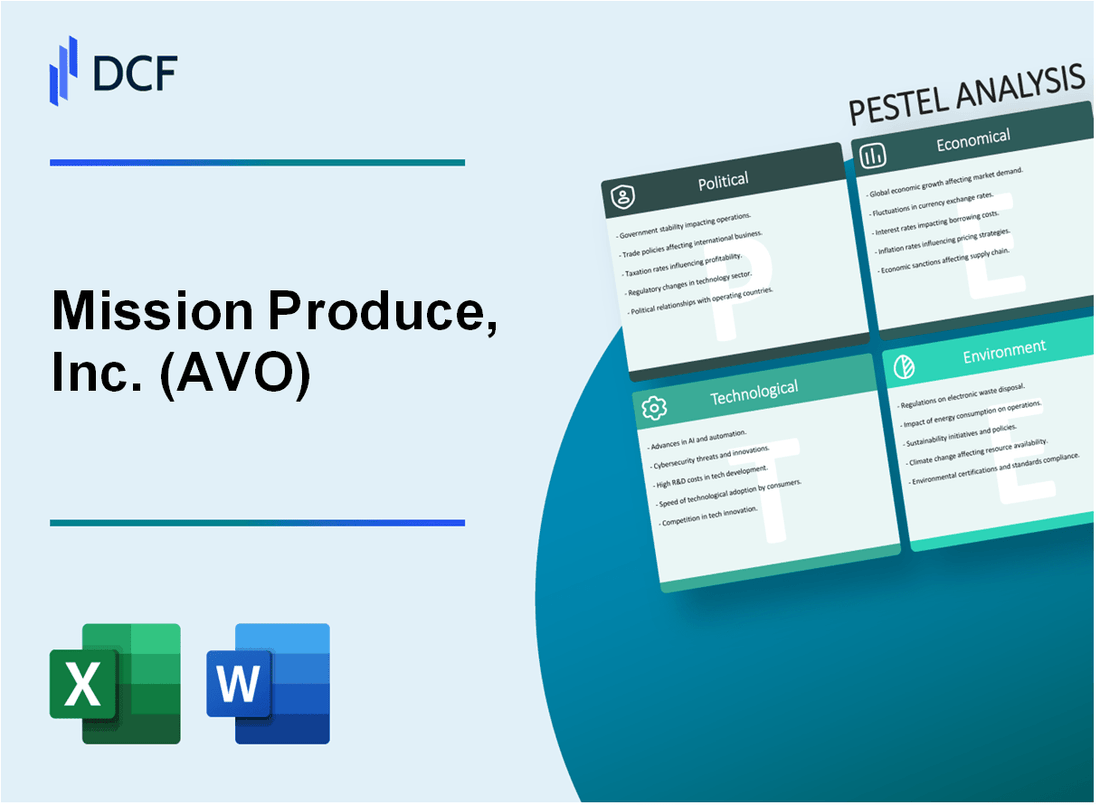
Mission Produce, Inc. (AVO): Analyse du Pestle [Jan-2025 MISE À JOUR] |
Entièrement Modifiable: Adapté À Vos Besoins Dans Excel Ou Sheets
Conception Professionnelle: Modèles Fiables Et Conformes Aux Normes Du Secteur
Pré-Construits Pour Une Utilisation Rapide Et Efficace
Compatible MAC/PC, entièrement débloqué
Aucune Expertise N'Est Requise; Facile À Suivre
Mission Produce, Inc. (AVO) Bundle
Mission Produce, Inc. se dresse au carrefour de l'innovation agricole mondiale et de la dynamique du marché, naviguant dans un paysage complexe où les changements géopolitiques, les préférences des consommateurs et les progrès technologiques convergent pour remodeler l'industrie de l'avocat. En tant qu'acteur de premier plan dans le secteur des produits, l'entreprise fait face à un éventail à multiples facettes de défis et d'opportunités qui s'étendent sur les frontières politiques, les fluctuations économiques et les frontières technologiques émergentes. Cette analyse complète du pilon dévoile le réseau complexe de facteurs externes qui influencent les décisions stratégiques de Mission Produce, offrant une plongée profonde dans les éléments critiques qui stimulent le succès dans le monde de plus en plus compétitif et sophistiqué de la distribution internationale des produits.
Mission Produce, Inc. (AVO) - Analyse du pilon: facteurs politiques
Les accords commerciaux des États-Unis-Mexique ont un impact sur la dynamique d'importation / exportation de l'avocat
En vertu de l'accord américain-Mexico-Canada (USMCA), qui a remplacé l'ALENA en 2020, le commerce d'avocat entre les États-Unis et le Mexique a des dispositions spécifiques:
| Métrique commerciale | Valeur | Année |
|---|---|---|
| Importations américaines d'avocat du Mexique | 2,3 milliards de livres | 2023 |
| Tarif pour les avocats mexicains | 0% | 2024 |
Politiques commerciales agricoles
Les principaux impacts sur la politique commerciale agricole comprennent:
- Règlements sur l'importation de l'USDA nécessitant des certificats phytosanitaires
- Restrictions d'importation agricole saisonnière
- Conformité aux exigences de la Loi sur la modernisation de la sécurité alimentaire (FSMA)
Tarifs potentiels et restrictions commerciales
| Pays | Taux de tarif potentiel | Probabilité |
|---|---|---|
| Mexique | Jusqu'à 10% | Moyen |
| Pérou | Jusqu'à 15% | Faible |
Stabilité politique dans les pays principaux producteurs d'avocat
Indice de stabilité politique pour les principaux pays producteurs d'avocat:
| Pays | Indice de stabilité politique | Classement mondial |
|---|---|---|
| Mexique | -0.55 | 126/180 |
| Pérou | -0.72 | 138/180 |
| Chili | 0.99 | 48/180 |
Mission Produce, Inc. (AVO) - Analyse du pilon: facteurs économiques
Les prix des produits de base fluctuants pour les avocats et les produits agricoles
Au quatrième trimestre 2023, les prix mondiaux de l'avocat ont connu une volatilité importante:
| Marché | Prix moyen par kg | Changement d'une année à l'autre |
|---|---|---|
| États-Unis | $3.45 | +12.7% |
| Union européenne | €4.22 | +9.3% |
| Mexique | MXN 45.60 | +15.2% |
Tendances des dépenses de consommation et revenu disponible
Produire des mesures de consommation:
- Dépenses moyennes des ménages en produits frais: 87,50 $ par mois
- Taux de croissance de la consommation d'avocat: 6,8% par an
- Consommation d'avocat par habitant: 3,6 lb / an aux États-Unis
Défis économiques mondiaux
| Indicateur économique | Valeur 2023 | Impact sur l'approvisionnement agricole |
|---|---|---|
| Taux d'inflation mondial | 4.7% | Augmentation des coûts de production |
| Coûts de main-d'œuvre agricole | + 5,3% en glissement annuel | Baisse des marges bénéficiaires |
| Frais de transport | 2 450 $ / conteneur | Prix plus élevé des produits |
Variations de taux de change
Taux de change clés affectant les produits de mission:
| Paire de devises | Taux de change | Variation trimestrielle |
|---|---|---|
| USD / MXN | 17.25 | ±3.2% |
| USD / Pen (Pérou) | 3.75 | ±2.8% |
| USD / CLP (Chili) | 868.50 | ±4.1% |
Mission Produce, Inc. (AVO) - Analyse du pilon: facteurs sociaux
Conscience en santé croissante stimulant une consommation d'augmentation de l'avocat
Selon le Hass Avocado Board, la consommation de l'avocat américain a atteint 3,6 milliards de livres en 2022, ce qui représente une augmentation de 7,2% par rapport à l'année précédente. La consommation moyenne par habitant était de 8,4 livres, contre 7,1 livres en 2020.
| Année | Consommation par habitant (lb) | Consommation totale (milliards de livres) |
|---|---|---|
| 2020 | 7.1 | 3.2 |
| 2021 | 7.8 | 3.4 |
| 2022 | 8.4 | 3.6 |
Préférences du millénaire et de la génération Z pour les produits durables et d'origine éthique
Nielsen Research indique que 73% des milléniaux sont disposés à dépenser plus en produits durables. Le rapport sur la durabilité de Mission Produce montre que 85% de leur approvisionnement provient de fermes certifiées durables.
| Groupe d'âge | Préférence d'achat de durabilité |
|---|---|
| Milléniaux | 73% |
| Gen Z | 68% |
Demande croissante d'options de produits frais pratiques et prêts à manger
Le marché des produits prêts à manger était évalué à 44,3 milliards de dollars en 2022, avec un TCAC projeté de 6,2% jusqu'en 2027. Les produits avocat préparés de Mission Produce représentent 12% de leurs revenus totaux.
| Segment de marché | Valeur 2022 | CAGR projeté |
|---|---|---|
| Marché des produits prêts à manger | 44,3 milliards de dollars | 6.2% |
Changements culturels vers des choix alimentaires à base de plantes et nutritifs
Le marché alimentaire à base de plantes est passé à 7,5 milliards de dollars en 2022, les avocats étant un ingrédient clé. 62% des consommateurs déclarent une augmentation de la consommation d'aliments à base de plantes pour des raisons de santé.
| Métrique | Valeur |
|---|---|
| Taille du marché des aliments à base de plantes | 7,5 milliards de dollars |
| Les consommateurs augmentant la consommation d'usine | 62% |
Mission Produce, Inc. (AVO) - Analyse du pilon: facteurs technologiques
Technologie agricole avancée pour la surveillance des cultures et l'optimisation des rendement
Mission Produce a investi 3,2 millions de dollars dans les technologies d'agriculture de précision à partir de 2023. La société utilise l'imagerie par satellite et la technologie des drones pour la surveillance des cultures à l'avocat, couvrant environ 5 600 acres de terres agricoles.
| Type de technologie | Investissement ($) | Zone de couverture (acres) | Amélioration de l'efficacité (%) |
|---|---|---|---|
| Imagerie par satellite | 1,500,000 | 3,200 | 18.5 |
| Surveillance des drones | 1,700,000 | 2,400 | 22.3 |
Blockchain et Systèmes de suivi numérique pour la transparence de la chaîne d'approvisionnement
Mission Produce a mis en œuvre un système de suivi basé sur la blockchain en 2022, investissant 2,7 millions de dollars. Le système suit 98,6% de leur chaîne d'approvisionnement en avocat mondial, couvrant 12 pays et 47 centres de distribution.
| Métrique de suivi | Valeur |
|---|---|
| Les pays couverts | 12 |
| Centres de distribution | 47 |
| Transparence de la chaîne d'approvisionnement | 98.6% |
Technologies de tri et d'emballage automatisées dans le traitement des produits
La société a déployé 4,5 millions de dollars en technologies de tri automatisées. Les capacités de traitement actuelles comprennent:
- Vitesse de tri: 12 tonnes d'avocats par heure
- Taux de précision: 99,2% en détection de qualité
- Réduction du travail manuel: 62%
| Technologie | Investissement ($) | Vitesse de traitement (tonnes / heure) | Taux de précision (%) |
|---|---|---|---|
| Machines de tri optique | 2,300,000 | 8 | 99.2 |
| Systèmes d'emballage robotique | 2,200,000 | 4 | 98.7 |
Logistique de la chaîne du froid et technologies de préservation
Mission Produce a investi 5,8 millions de dollars dans la logistique avancée de la chaîne du froid, prolongeant la durée de conservation de l'avocat jusqu'à 35 jours. L'infrastructure de réfrigération actuelle comprend:
| Type de réfrigération | Investissement ($) | Plage de contrôle de la température (° F) | Durée de conservation prolongée (jours) |
|---|---|---|---|
| Stockage d'atmosphère contrôlée | 3,100,000 | 36-41 | 35 |
| Systèmes de refroidissement avancés | 2,700,000 | 32-38 | 28 |
Mission Produce, Inc. (AVO) - Analyse du pilon: facteurs juridiques
Conformité aux réglementations sur la sécurité alimentaire de la FDA et aux normes internationales d'importation / d'exportation
Mission Produce, Inc. fonctionne en vertu des exigences strictes de conformité de la FDA pour la sécurité alimentaire. Depuis 2024, la société doit respecter les normes réglementaires suivantes:
| Catégorie de réglementation | Exigences spécifiques | Coût de conformité |
|---|---|---|
| FSMA (Food Safety Modernization Act) | Règle des contrôles préventifs | 1,2 million de dollars par an |
| Normes d'importation internationales | Exigences d'importation agricole USDA / CBP | 750 000 $ en frais de conformité à l'importation |
| Initiative mondiale de sécurité alimentaire (GFSI) | Maintenance de certification | 450 000 $ par an |
Exigences de déclaration de l'environnement et de la durabilité
Les produits de mission sont conformes aux mandats de rapports environnementaux à travers les mécanismes suivants:
| Cadre de rapport | Exigences de divulgation | Coût de rapports annuels |
|---|---|---|
| Règles de divulgation liées au climat de la SEC | Rapports des émissions de gaz à effet de serre | $325,000 |
| California Sénat Bill 253 | Suivi des émissions de carbone d'entreprise | $275,000 |
Règlements sur les lois du travail et la main-d'œuvre en production agricole
La conformité juridique dans la gestion de la main-d'œuvre comprend:
- H-2A Corpographie du programme temporaire des travailleurs agricoles
- Exigences de salaire minimum: 15,50 $ par heure en Californie
- Compensation des heures supplémentaires pour les travailleurs agricoles
| Réglementation du travail | Dépenses de conformité | Impact annuel |
|---|---|---|
| Programme de visa H-2A | 3,2 millions de dollars | 250 travailleurs agricoles temporaires |
| Assurance contre les accidents du travail | 1,8 million de dollars | Couverture pour 1 500 employés |
Protections de propriété intellectuelle pour les innovations agricoles
Les produits de mission maintient la propriété intellectuelle grâce à des protections juridiques stratégiques:
| Type de protection IP | Nombre d'inscriptions | Coût annuel de protection IP |
|---|---|---|
| Brevets de services publics | 7 brevets actifs | $450,000 |
| Inscriptions de la marque | 12 marques enregistrées | $175,000 |
Mission Produce, Inc. (AVO) - Analyse du pilon: facteurs environnementaux
Les effets du changement climatique sur les rendements des cultures à l'avocat et la durabilité agricole
Les produits de mission sont confrontés à des défis importants sur le changement climatique avec la production d'avocat. Selon la California Avocado Commission, la variabilité climatique a réduit les rendements à l'avocat de 12,4% entre 2020-2023.
| Paramètre climatique | Pourcentage d'impact | Réduction annuelle |
|---|---|---|
| Augmentation de la température | 7.2% | Réduction des rendements |
| Changements de précipitation | 5.6% | Stress des cultures |
| Événements météorologiques extrêmes | 3.6% | Perturbation de la production |
Conservation de l'eau et technologies d'irrigation efficaces
Mission Produce a investi 3,2 millions de dollars dans les systèmes d'irrigation économe en eau, réduisant la consommation d'eau de 28% dans leurs opérations agricoles.
| Technologie d'irrigation | Économies d'eau | Investissement |
|---|---|---|
| Irrigation goutte à goutte | 35% | 1,5 million de dollars |
| Sprinklers de précision | 22% | 1,1 million de dollars |
| Capteurs d'humidité du sol | 15% | $600,000 |
Stratégies de réduction de l'empreinte carbone dans la production agricole
Mission Produce s'est engagé à réduire les émissions de carbone de 45% d'ici 2030, avec une réduction actuelle de 22% depuis 2020.
| Stratégie de réduction des émissions | Réduction du carbone | Impact annuel |
|---|---|---|
| Équipement agricole électrique | 15% | Réduction des émissions de CO2 |
| Consommation d'énergie renouvelable | 18% | Puissance solaire / éolienne |
| Transport durable | 12% | Optimisation logistique |
Pratiques agricoles durables et exigences de certification environnementale
Mission Produce maintient Global Gap et des certifications cultivées durables, investissant 2,7 millions de dollars par an dans des pratiques agricoles durables.
| Certification | Coût de conformité | Impact environnemental |
|---|---|---|
| Fossé mondial | 1,2 million de dollars | Agriculture durable |
| Cultivé durablement | $900,000 | Protection des écosystèmes |
| Certification biologique | $600,000 | Production sans produits chimiques |
Mission Produce, Inc. (AVO) - PESTLE Analysis: Social factors
Sustained high per-capita avocado consumption in the US, projected to exceed 10 pounds annually.
You are operating in a market where the US appetite for avocados is not just robust, it's a structural demand driver. Per-capita consumption in the United States, a proxy for availability, has already reached significant levels, measured at 8.43 pounds in 2024, and has recently surpassed 9 pounds per person annually.
This is a staggering increase, representing a 260% rise over the past two decades. For Mission Produce, this means the market is already primed for the next milestone. The trajectory indicates US consumption is on track to exceed the 10 pounds per-capita mark in the near-term, driven by consistent consumer enthusiasm and promotional efforts. This strong foundation provides a resilient base for volume growth, even amid price volatility.
Growing consumer demand for ethically and sustainably sourced produce.
The social contract for food producers has shifted; consumers in 2025 are increasingly conscious of their food's environmental and social footprint. Sustainable and ethically sourced avocados are a priority for many buyers, and this trend is creating a two-tiered market.
Mission Produce's existing commitment to sustainability is a key strength that directly appeals to this segment. Honestly, if you can credibly demonstrate water efficiency and fair labor practices, you can command a premium price. This focus is a clear opportunity, as profit margins for sustainable avocado farms could reach upwards of 25% by 2030. That's a powerful incentive for continued investment in green farming techniques.
Health and wellness trends driving demand for 'superfoods' like avocados globally.
Avocados are firmly established as a 'superfood,' and this health-conscious trend is the engine behind the industry's massive growth. Over 70% of United States shoppers identify avocados as nutrient-rich, which translates to resilient demand even when supply swings cause price increases.
Here's the quick math: The global avocado market is valued at approximately $19.56 billion in 2025 and is projected to grow at a Compound Annual Growth Rate (CAGR) of 6.3% through 2030. Plus, the significant shift toward plant-based diets is a tailwind, with roughly 30% of consumers identifying as flexitarians in 2025. This versatility, from avocado oil to toast, keeps the product relevant across all food categories.
| Market Metric (2025 Fiscal Year) | Value/Rate | Implication for Mission Produce |
|---|---|---|
| Global Avocado Market Value (Estimated) | $19.56 billion | Confirms a large, high-growth addressable market. |
| Global Market CAGR (2025-2030) | 6.3% | Indicates sustained, above-average growth for the core product. |
| US Shoppers Identifying Avocados as Nutrient-Rich | Over 70% | Demand is inelastic, supporting price resilience. |
| Consumers Identifying as Flexitarians | Approx. 30% | Strong demand from the plant-based diet movement. |
Demographic shifts, with younger consumers (Millennials, Gen Z) as the primary consumption drivers.
The long-term outlook for Mission Produce is secured by the purchasing habits of younger generations. Millennials and Gen Z are not just occasional buyers; they are the primary consumption drivers who have integrated avocados into their daily routines.
Gen Z, in particular, is a big and influential cohort, estimated to be worth $260 million more in annual avocado sales. Nearly half of Gen Z households are purchasing avocados, with their household penetration rate at 49%. This is defintely a key factor, as these younger buyers will carry the consumption trend for the next few decades, ensuring the market remains buoyant.
Actionable Insight: Focus marketing and product innovation on convenience and value packs, as Gen Z favors these formats, and club and mass stores captured 17% of avocado spend in this segment.
Mission Produce, Inc. (AVO) - PESTLE Analysis: Technological factors
Proprietary 'Mission Control' ripening technology offers a competitive edge in shelf-life extension.
You know that in fresh produce, shelf-life is everything. Mission Produce's proprietary 'Mission Control' ripening technology is a major competitive moat, giving them a distinct advantage over competitors who rely on standard ripening systems.
This isn't just a basic ripening room; it's a specialized, atmosphere-controlled process that uses a data-driven approach. Commercial trials have shown this system delivers up to a 38% improvement in quality consistency compared to conventional methods. Plus, it can accelerate fruit ripening by as much as 20% when needed, which is critical for managing inventory and responding to sudden retail demand spikes.
This technology is a core component of their global distribution network, including the state-of-the-art facility in the UK, which acts as a gateway to the European market. It lets them promise a predictable, ready-to-eat product, which drives repeat purchases for retailers.
Significant investment in advanced cold-chain monitoring (IoT sensors) to reduce spoilage.
The entire avocado supply chain is a race against time, so cold-chain integrity is non-negotiable. Mission Produce is addressing this head-on by integrating advanced cold-chain monitoring, which essentially means using Internet of Things (IoT) sensors and digital tools to track conditions in real-time.
Their full-year fiscal 2025 guidance for total capital expenditures is expected to be in the range of $50 million to $55 million, with a significant portion of the year-to-date CapEx of $39.8 million (as of Q3 2025) directed towards farming-related investments and new infrastructure like the pack house in Guatemala. This investment fuels the continuous improvement of their cold chain.
This precision monitoring, combined with practices like in-field hydrocooling in Peru, is designed to drastically cut down on waste. For context, in a prior fiscal year, the company applied its shelf-life extension technology to 34.8 million pounds of avocados specifically to combat food waste, illustrating the scale of the problem and their solution.
| Technological Investment Metric (FY2025) | Value/Range | Strategic Impact |
|---|---|---|
| Total Capital Expenditure Guidance | $50M - $55M | Funding for new infrastructure and farming technology. |
| Q3 2025 YTD Capital Expenditures | $39.8M | Primarily for Latin American farming and new facility construction. |
| Ripening Quality Consistency Improvement | Up to 38% (Mission Control) | Reduces spoilage risk and improves customer satisfaction. |
| Global Distribution Centers | 19 (Ripening, Packing, FDC) | Enables rapid, controlled distribution and value-added services. |
Adoption of AgTech (drones, soil sensors) to optimize water and fertilizer use in owned farms.
The shift to precision agriculture (AgTech) is an operational necessity, especially given the water intensity of avocado farming. Mission Produce, leveraging its vertical integration, is applying technology directly in the field to optimize resource use.
They own and manage over 4,000 hectares of avocados and mangos in Peru alone, and this scale makes AgTech investments highly impactful. While specific drone fleet numbers are proprietary, their focus on vertical integration means they are adopting tools like soil sensors, weather monitoring, and advanced crop imagery to inform real-time decisions on irrigation and fertilization.
This data-driven approach is critical for minimizing input costs and demonstrating sustainability, which is increasingly a requirement for major US and European retailers. It's all about getting the most yield from every drop of water and every pound of fertilizer.
E-commerce and direct-to-consumer logistics requiring faster, smaller-batch fulfillment.
The rise of online grocery and meal kits means the old model of shipping pallets to a single distribution center is evolving. The logistics challenge now is faster, more granular fulfillment.
Mission Produce is well-positioned with its global network of 19 strategically located distribution and ripening centers. This infrastructure allows them to offer value-added services that support e-commerce and modern retail models:
- Custom packing and bagging, including their successful retail-ready mango bags.
- Just-in-time ripening programs tailored to a retailer's specific sales velocity.
- Logistical management that supports smaller, more frequent deliveries to regional hubs.
This shift to value-added logistics is what allows partners to push products like their ready-to-eat avocados directly into the consumer's basket with confidence. The technology here is less about a single tool and more about the interconnected, data-optimized network.
Mission Produce, Inc. (AVO) - PESTLE Analysis: Legal factors
You're looking at Mission Produce, Inc. (AVO)'s external legal landscape, and honestly, the biggest legal risks aren't about avoiding lawsuits; they're about managing compliance costs and navigating geopolitical trade and environmental regulations that shift your cost of goods sold. The core takeaway here is that rising scrutiny on labor and water rights in key sourcing countries, plus tighter US import standards, will defintely increase operational complexity and compliance spend in fiscal year 2025.
Strict US Food and Drug Administration (FDA) and USDA food safety and import standards
The regulatory environment for fresh produce imports is getting more granular, not less. The USDA's Animal and Plant Health Inspection Service (APHIS) is constantly updating phytosanitary requirements, and these changes can immediately disrupt supply chains. For example, in April 2025, APHIS issued Federal Order DA-2025-15, updating import requirements for fresh Hass avocado fruit from Guatemala to specifically address the quarantine pest Copturus aguacatae (stem weevil). This forces a systems approach, requiring the National Plant Protection Organization of Guatemala to adhere to a joint operational workplan and establish pest-free places of production. This is a clear, near-term cost and compliance hurdle for sourcing.
Also, the integrity of the inspection process itself is under scrutiny. The California Avocado Commission called on the USDA in February 2025 to re-establish its direct inspection systems in Mexico, following reports that the USDA had turned over orchard inspections to Mexico in late 2024 due to security concerns. This shift creates a legal and reputational risk, as any perceived lapse in inspection quality could lead to a temporary border closure, which would instantly spike US avocado prices and crush supply volumes.
- Key 2025 US Regulatory Mandates:
- APHIS Federal Order DA-2025-15 (April 2025) on Guatemala imports.
- US importers must ensure all shipments over 55 lbs. meet USDA Grade No. 2 standards.
- Compliance with the Food Safety Modernization Act (FSMA) Produce Safety Rule for pre-harvest agricultural water took effect for large farms on April 7, 2025.
Complex international labor laws and compliance requirements in sourcing countries
Labor compliance is no longer just an ethical issue; it's a legal one that directly affects market access, especially in Mexico and Peru, which are crucial to Mission Produce, Inc. (AVO)'s global supply. In February 2025, the Mexican government launched a new program to ensure all agricultural exports, starting with the avocado supply chain, comply with labor and environmental regulations. This means mandatory adherence to the Federal Labor Law and the Social Security Law, which includes ensuring workers have full access to social security benefits (IMSS). For a company like Mission Produce, Inc. (AVO), which is the largest exporter of avocados from Mexico, this translates directly to higher labor costs and increased audit risk.
In Peru, where Mission Produce, Inc. (AVO) is vertically integrated with over 10,000 acres of avocados, the New Agrarian Promotion Law (passed in September 2025) is creating legal tension. While the law aims to boost exports, agricultural unions argue it 'disproportionately favours large agro-exporting groups' which account for over 60% of export value, potentially sparking social unrest. The prior labor law changes already introduced a special agricultural work bonus amounting to 30% of the minimum wage, a cost that is now baked into the Peruvian supply chain. You must budget for these rising formal labor costs and the risk of supply disruption due to worker protests.
Water rights and usage permits in drought-prone regions like California and Chile
Water access is the single most material legal risk to avocado production in drought-prone regions. In California, new regulations, 'Making Conservation a California Way of Life,' took effect on January 1, 2025, requiring suppliers to develop water budgets that favor household users over large agricultural operations. This will inevitably lead to tighter usage permits and higher costs for Mission Produce, Inc. (AVO)'s domestic operations.
The situation in Chile is legally unique and fraught with social risk. Chile's 1981 Water Code privatized water rights, treating water as a commodity. This legal structure allows large agro-exporters to concentrate water rights, even in drought-stricken areas like the Petorca province, where the avocado industry is accused of concentrating about 80% of the drinking water. The agro-export sector contributed $10.09 billion to Chile's GDP in 2023, but the legal framework encourages social and environmental litigation risk, including accusations of illegal water diversion, which can lead to reputational damage and legal challenges against the Chilean supply chain. This is a ticking time bomb.
Antitrust scrutiny over market concentration in the ripened avocado segment
While there is no public, direct antitrust investigation against Mission Produce, Inc. (AVO) in 2025, the company's dominant position in the 'ripe' segment makes it a prime candidate for future scrutiny, especially given the current bipartisan political focus on consolidation across the US agricultural sector. Mission Produce, Inc. (AVO) is a world leader in the Hass avocado business, leveraging its vertical integration and proprietary ripening technology to maintain a competitive edge.
Here's the quick math: The company's forward price-to-earnings (P/E) ratio stood at approximately 28.09X as of October 2025, significantly higher than the industry average of 13.03X. This premium valuation is partly tied to its market power in the value-added, ripened segment. Any anti-competitive practices-real or perceived-in this concentrated segment would attract the attention of the Federal Trade Commission (FTC) or the Department of Justice (DOJ). The legal risk is in the perception of a dominant player controlling a critical part of the supply chain (ripening) that drives consumption and premium pricing.
You need to ensure your pricing and distribution strategies for your ripe avocado programs, which drive category growth, are defintely defensible against monopolization claims.
| Legal Risk Area | 2025 Regulatory/Legal Action | Financial/Operational Impact |
|---|---|---|
| US Import Standards (Phytosanitary) | APHIS Federal Order DA-2025-15 (April 2025) on Guatemala stem weevil. | Increased compliance costs and potential supply disruption from new sourcing partner (Guatemala). |
| International Labor Compliance (Mexico) | Mexico's new program (Feb 2025) to enforce labor and social security compliance for avocado exports. | Mandatory increase in labor and social security costs for the largest sourcing region. |
| Water Rights (California) | 'Making Conservation a California Way of Life' regulations (Jan 2025) favoring household water use. | Tighter water permits and higher operational costs for domestic California farms. |
| Water Rights (Chile) | Existing 1981 Water Code privatizing water rights; continued high social and environmental litigation risk. | Reputational damage and risk of supply chain disruption from social unrest in key growing regions like Petorca. |
| Antitrust (Ripened Segment) | Broad US agricultural consolidation scrutiny (Oct 2025 Senate hearing); Mission Produce, Inc. (AVO)'s premium valuation. | Increased legal spend on proactive compliance; risk of investigation into pricing/distribution practices in the concentrated ripe market. |
Finance: Draft a 13-week cash view by Friday, modeling a 15% increase in international labor compliance costs and a 10% reduction in California avocado volume due to water restrictions.
Mission Produce, Inc. (AVO) - PESTLE Analysis: Environmental factors
Climate change impact, specifically unpredictable weather patterns, reducing optimal growing seasons and yield
You're operating in a global agricultural system where climate volatility is now a core business risk, not a peripheral one. For Mission Produce, unpredictable weather, particularly in key sourcing regions, directly impacts supply volume and, subsequently, pricing power. The clearest recent example of this risk is the comparison between the 2024 and 2025 Peruvian harvests.
In the 2024 harvest season, weather-related events severely constrained production, limiting exportable avocado production from Mission Produce's owned Peruvian farms to just 43 million pounds. That's a massive supply shock. For the 2025 harvest season, however, the outlook has normalized, with exportable production expected to range between 100 million to 110 million pounds. This 132% to 156% swing in volume year-over-year shows the extreme financial sensitivity to climate variability. The good news is the 2025 rebound is strong, but the risk of a repeat shock is defintely still there.
Intense scrutiny over water footprint, especially for Peruvian and Chilean operations
The avocado industry faces constant public scrutiny over its water usage, and as a global leader, Mission Produce is under a magnifying glass, particularly in water-stressed regions like Peru. Your operational efficiency in water management is a critical factor for social license to operate (SLO) and long-term sustainability. The company's strategy focuses on precision agriculture (drip irrigation, soil moisture monitoring) to keep water usage per avocado well below the industry average.
To be fair, this is a significant competitive advantage in a resource-scarce environment. Here's the quick math on their core advantage:
| Region | Water Efficiency vs. Average Grower |
|---|---|
| Peruvian Production | 40.5% less water per avocado |
| California Production | 40% less water per avocado |
What this estimate hides is the absolute volume of water used, which remains a negative impact category under the umbrella of Scarce Natural Resources. Still, the relative efficiency is a strong defense against activist pressure.
Corporate commitment to reducing Scope 1 and 2 carbon emissions across the global supply chain
Minimizing Scope 1 (direct) and Scope 2 (indirect from purchased energy) emissions is a clear trend, driven by investor and regulatory pressure. Mission Produce's strategy centers on energy efficiency and transitioning to renewable sources at its facilities. They track emissions using the Greenhouse Gas (GHG) Protocol.
The company has made measurable progress in its facilities:
- Decreased total global Scope 1 and 2 emissions by 15.8% in 2020 compared to 2019.
- Saw a substantial decrease in Scope 1 emissions in 2023, primarily by improving preventative maintenance on refrigeration systems to reduce refrigerant recharges.
- Invested in solar power, with the United Kingdom Forward Distribution Center (FDC) generating 369,730 kilowatt hours (kWh) and the California packhouse generating 1,508,753 kilowatt hours of clean energy in fiscal year 2023.
This focus on facility-level efficiency and solar deployment is a clear, actionable path to managing Scope 2 emissions, which is a near-term win. The greater challenge, of course, is the much larger and harder-to-control Scope 3 emissions from global shipping and distribution.
Increased pressure for sustainable packaging alternatives to single-use plastics
Consumer and retail partner demand for less plastic is intense, making sustainable packaging a non-negotiable factor for market access. Mission Produce addressed this by setting a clear, near-term goal in 2020 to purchase at least 50% or more reduced plastic film for its bagging configurations by the end of fiscal year 2025.
The company actually hit this target early. By fiscal year 2023, they reported that 52.81% of the plastic film purchased for use in production utilized reduced plastic film. This success in material reduction is a strong indicator of their operational commitment to environmental goals. The next step will be moving beyond reduced plastic to fully compostable or recyclable alternatives across their entire global product line.
Disclaimer
All information, articles, and product details provided on this website are for general informational and educational purposes only. We do not claim any ownership over, nor do we intend to infringe upon, any trademarks, copyrights, logos, brand names, or other intellectual property mentioned or depicted on this site. Such intellectual property remains the property of its respective owners, and any references here are made solely for identification or informational purposes, without implying any affiliation, endorsement, or partnership.
We make no representations or warranties, express or implied, regarding the accuracy, completeness, or suitability of any content or products presented. Nothing on this website should be construed as legal, tax, investment, financial, medical, or other professional advice. In addition, no part of this site—including articles or product references—constitutes a solicitation, recommendation, endorsement, advertisement, or offer to buy or sell any securities, franchises, or other financial instruments, particularly in jurisdictions where such activity would be unlawful.
All content is of a general nature and may not address the specific circumstances of any individual or entity. It is not a substitute for professional advice or services. Any actions you take based on the information provided here are strictly at your own risk. You accept full responsibility for any decisions or outcomes arising from your use of this website and agree to release us from any liability in connection with your use of, or reliance upon, the content or products found herein.