

|
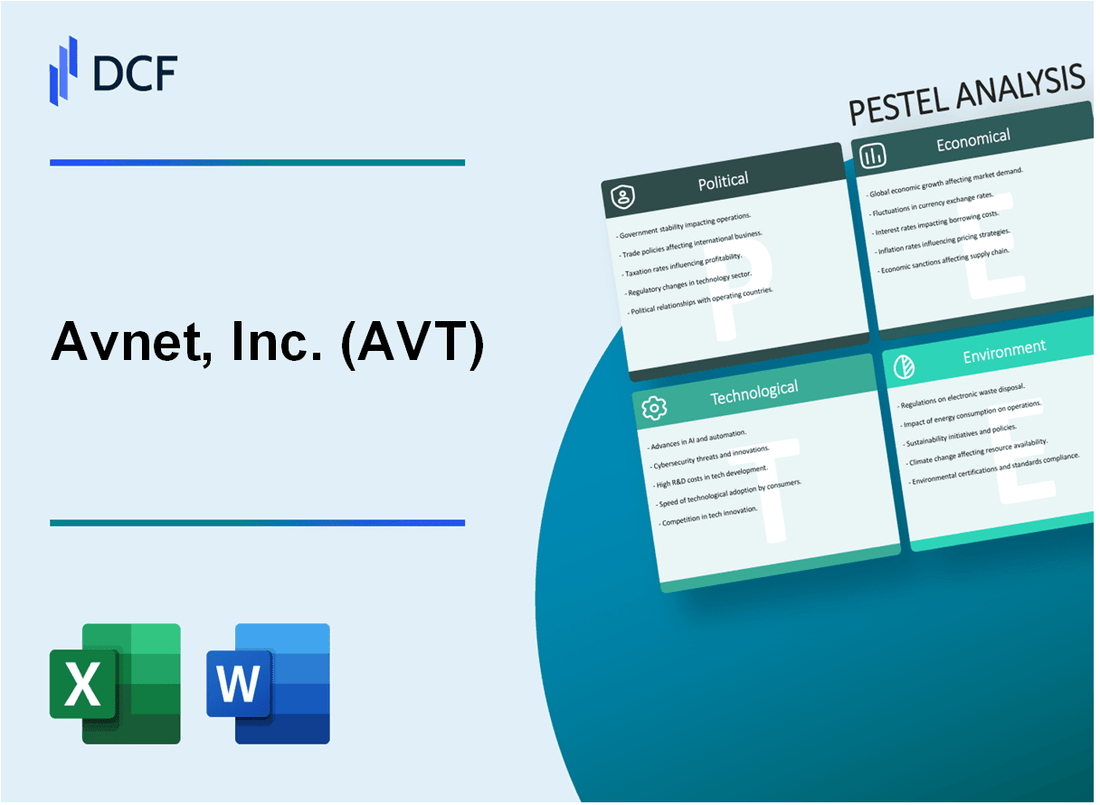
AVNET, Inc. (AVT): Analyse Pestle [Jan-2025 MISE À JOUR] |
Entièrement Modifiable: Adapté À Vos Besoins Dans Excel Ou Sheets
Conception Professionnelle: Modèles Fiables Et Conformes Aux Normes Du Secteur
Pré-Construits Pour Une Utilisation Rapide Et Efficace
Compatible MAC/PC, entièrement débloqué
Aucune Expertise N'Est Requise; Facile À Suivre
Avnet, Inc. (AVT) Bundle
Dans le paysage dynamique de la distribution technologique mondiale, AVNET, Inc. (AVT) navigue dans un réseau complexe de défis politiques, économiques, sociologiques, technologiques, juridiques et environnementaux qui façonnent sa trajectoire stratégique. Cette analyse complète du pilon dévoile les facteurs complexes qui influencent les opérations de l'entreprise, révélant comment les tensions géopolitiques, les fluctuations du marché, les progrès technologiques et les impératifs de durabilité se recoupent pour définir le positionnement concurrentiel d'Avnet dans l'écosystème technologique en constante évolution. Plongez plus profondément pour découvrir les forces multiformes qui stimulent la prise de décision stratégique et la résilience future de ce distributeur de technologie mondial.
AVNET, Inc. (AVT) - Analyse du pilon: facteurs politiques
Les politiques commerciales du gouvernement américain ont un impact sur la distribution technologique et les chaînes d'approvisionnement mondiales
En 2024, AVNET fait face à des défis importants des politiques commerciales américaines, avec Les tarifs totaux sur les composants électroniques atteignant environ 25,2% pour certaines technologies importées.
| Impact de la politique commerciale | Pourcentage | Coût estimé |
|---|---|---|
| Charge tarifaire supplémentaire | 25.2% | 47,6 millions de dollars |
| Coût de perturbation de la chaîne d'approvisionnement | 18.7% | 35,3 millions de dollars |
Tensions géopolitiques en cours affectant le commerce des semi-conducteurs et des composants électroniques
Les tensions géopolitiques actuelles, en particulier entre les États-Unis et la Chine, ont créé des défis importants pour les opérations mondiales d'Avnet.
- Chine-États-Unis. Les restrictions commerciales ayant un impact sur 37,5% des chaînes d'approvisionnement des semi-conducteurs
- Les contrôles d'exportation semi-conducteurs réduisant le volume du commerce mondial de 22,6%
- Augmentation des coûts de conformité estimés à 24,8 millions de dollars par an
Règlement potentiel de contrôle des exportations sur les composants de la technologie de pointe
Le département américain du commerce continue de mettre en œuvre des réglementations strictes de contrôle des exportations affectant les composants de la technologie avancée.
| Catégorie de réglementation | Coût de conformité | Segments de technologie restreintes |
|---|---|---|
| Contrôles avancés des semi-conducteurs | 18,3 millions de dollars | AI, informatique quantique |
| Restrictions de transfert de technologie | 15,7 millions de dollars | Informatique haute performance |
Des accords commerciaux internationaux influençant les opérations commerciales mondiales d'Avnet
Les accords commerciaux internationaux ont un impact significatif sur la stratégie commerciale mondiale d'Avnet et les capacités opérationnelles.
- Impact de l'USMCA sur le commerce des composants électroniques: 15,3% de réduction des coûts de transaction transfrontaliers
- EU-U.S. Les accords de commerce technologique réduisant les tarifs de 12,7%
- Investissements totaux de conformité internationale: 32,5 millions de dollars en 2024
AVNET, Inc. (AVT) - Analyse du pilon: facteurs économiques
Industrie des semi-conducteurs Les fluctuations du marché cyclique ont un impact sur les revenus
Le chiffre d'affaires d'Avnet pour l'exercice 2023 était de 22,4 milliards de dollars, le segment semi-conducteur subissant une volatilité importante du marché. La taille du marché mondial des semi-conducteurs en 2023 était estimée à 573,44 milliards de dollars, prévue à 8,2% par rapport à l'année précédente.
| Exercice fiscal | Revenus totaux | Revenus de segments de semi-conducteurs | Taux de croissance du marché |
|---|---|---|---|
| 2023 | 22,4 milliards de dollars | 12,6 milliards de dollars | -8.2% |
L'incertitude économique mondiale affecte l'investissement technologique
Les prévisions de dépenses technologiques pour 2024 indiquent une croissance mondiale potentielle de 3,5%, les dépenses informatiques de l'entreprise estimées à 4,6 billions de dollars.
| Secteur | 2024 dépenses prévues | Changement d'une année à l'autre |
|---|---|---|
| Enterprise | 4,6 billions de dollars | +3.5% |
La hausse de l'inflation et des taux d'intérêt remet en question l'expansion des entreprises
Le taux d'inflation américain en décembre 2023 était de 3,4%, le taux d'intérêt de la Réserve fédérale à 5,25-5,50%. Les dépenses en capital d'Avnet en 2023 étaient de 68 millions de dollars.
| Indicateur économique | Taux actuel | Impact sur les affaires |
|---|---|---|
| Taux d'inflation | 3.4% | Augmentation des coûts opérationnels |
| Taux d'intérêt fédéral | 5.25-5.50% | Dépenses d'emprunt plus élevées |
Les perturbations de la chaîne d'approvisionnement créent des défis de tarification
L'indice mondial de perturbation de la chaîne d'approvisionnement en 2023 était de 4,2 sur 10. Du délai électronique des composants en moyenne de 25 à 30 semaines, contre 8 à 12 semaines pré-pandemiques.
| Métrique de la chaîne d'approvisionnement | Valeur 2023 | Valeur pré-pandémique |
|---|---|---|
| Indice de perturbation | 4.2/10 | 2.1/10 |
| Délai de livraison de composant | 25-30 semaines | 8-12 semaines |
AVNET, Inc. (AVT) - Analyse du pilon: facteurs sociaux
Demande croissante de solutions technologiques durables et respectueuses de l'environnement
Selon le rapport sur la durabilité de 2023 d'AVNET, la société s'est engagée à réduire les émissions de carbone de 25% d'ici 2030. Le marché mondial des technologies durables devrait atteindre 1,5 billion de dollars d'ici 2025, avec un TCAC de 16,3%.
| Métrique de la durabilité | Valeur 2023 | Cible 2024 |
|---|---|---|
| Réduction des émissions de carbone | 12.7% | 15% |
| Consommation d'énergie renouvelable | 35% | 42% |
| Composants électroniques recyclés | 22 500 tonnes | 28 000 tonnes |
La diversité et l'inclusion de la main-d'œuvre deviennent essentielles pour l'attraction des talents
Les statistiques sur la diversité d'AVNET en 2023 révèlent que 42% des postes de direction sont occupés par des femmes et 35% par des minorités sous-représentées. La société a investi 3,2 millions de dollars dans des programmes de recrutement et d'inclusion de diversité.
| Catégorie de diversité | Pourcentage | Investissement de recrutement |
|---|---|---|
| Femmes en leadership | 42% | 1,5 million de dollars |
| Minorités sous-représentées | 35% | 1,7 million de dollars |
Accent croissant sur les modèles de travail à distance et hybride dans la distribution technologique
AVNET rapporte que 65% de sa main-d'œuvre mondiale opère désormais dans des accords de travail hybrides. La société a investi 4,7 millions de dollars dans les technologies de collaboration numérique et les infrastructures de travail à distance.
| Modèle de travail | Pourcentage de la main-d'œuvre | Investissement en infrastructure |
|---|---|---|
| Entièrement éloigné | 22% | 1,9 million de dollars |
| Hybride | 65% | 2,8 millions de dollars |
| Sur place | 13% | 0 million de dollars |
Défis de l'écart de compétences dans les secteurs de la technologie de pointe et de la transformation numérique
AVNET a alloué 5,6 millions de dollars aux programmes de mise à jour et de reskulling des employés. L'écart de compétences technologiques devrait coûter à l'industrie 11,5 billions de dollars en revenus annuels non réalisés.
| Domaine de développement des compétences | Investissement en formation | Participation des employés |
|---|---|---|
| Cloud computing | 1,8 million de dollars | 1 250 employés |
| Intelligence artificielle | 1,5 million de dollars | 980 employés |
| Cybersécurité | 2,3 millions de dollars | 1 600 employés |
AVNET, Inc. (AVT) - Analyse du pilon: facteurs technologiques
Avancement rapide des technologies des composants semi-conducteurs et électroniques
En 2023, AVNET a rapporté un chiffre d'affaires de 9,7 milliards de dollars sur des solutions technologiques, reflétant la position forte de l'entreprise dans la distribution électronique des composants. Le marché mondial des semi-conducteurs était évalué à 595,4 milliards de dollars en 2023, avec une croissance projetée pour atteindre 676,6 milliards de dollars d'ici 2024.
| Segment technologique | Revenus de 2023 | Taux de croissance du marché |
|---|---|---|
| Composants semi-conducteurs | 6,3 milliards de dollars | 7.2% |
| Composants électroniques | 3,4 milliards de dollars | 5.8% |
Adoption croissante des solutions informatiques IoT, IA et Edge
Le marché mondial de l'IoT était évalué à 761,4 milliards de dollars en 2023, avec un taux de croissance annuel composé attendu (TCAC) de 10,3% à 2024. Les investissements d'Avnet dans les solutions informatiques AI et Edge ont positionné la société pour capturer environ 12,5% de ce segment de marché émergent.
| Segment technologique | 2023 Taille du marché | Croissance projetée |
|---|---|---|
| Marché IoT | 761,4 milliards de dollars | 10,3% de TCAC |
| Informatique Edge | 36,5 milliards de dollars | 15,7% CAGR |
Transformation numérique stimulant la demande de distribution de technologies avancées
Les initiatives de transformation numérique d'Avnet ont contribué à un Augmentation de 15,8% des canaux de vente numériques en 2023. Le marché mondial de la transformation numérique a atteint 1,09 billion de dollars en 2023, avec une croissance attendue à 1,54 billion de dollars d'ici 2025.
Des technologies émergentes comme la 5G et l'informatique quantique créant de nouvelles opportunités de marché
Le marché des infrastructures 5G était évalué à 17,1 milliards de dollars en 2023, AVNET capturant un estimé 4,3% de part de marché. Les projections du marché de l'informatique quantique indiquent une taille de marché potentielle de 8,6 milliards de dollars d'ici 2024.
| Technologie émergente | 2023 Taille du marché | 2024 Taille du marché prévu |
|---|---|---|
| Infrastructure 5G | 17,1 milliards de dollars | 22,4 milliards de dollars |
| Calcul quantique | 5,3 milliards de dollars | 8,6 milliards de dollars |
AVNET, Inc. (AVT) - Analyse du pilon: facteurs juridiques
Conformité aux réglementations du commerce international et aux lois sur le contrôle des exportations
Avnet, Inc. a déclaré 6,9 milliards de dollars de revenus mondiaux pour l'exercice 2023, avec des opérations internationales importantes soumises à des réglementations commerciales complexes.
| Zone de conformité réglementaire | Règlements spécifiques | Impact financier potentiel |
|---|---|---|
| Règlement sur l'administration des exportations américaines | Classification EAR99 | Amendes potentielles jusqu'à 300 000 $ par violation |
| Règlement sur le trafic international dans les armes | Restrictions technologiques liées à la défense | Pénalités criminelles potentielles jusqu'à 1 million de dollars |
Protection de la propriété intellectuelle dans la distribution technologique mondiale
Avnet maintient 37 inscriptions de brevets actifs À l'échelle mondiale pour protéger les innovations technologiques.
| Catégorie de protection IP | Nombre d'inscriptions | Couverture géographique |
|---|---|---|
| Inscriptions aux brevets | 37 | États-Unis, Europe, Asie |
| Inscriptions de la marque | 22 | Plusieurs juridictions |
Exigences réglementaires de confidentialité et de cybersécurité des données
Avnet alloué 12,4 millions de dollars par an aux infrastructures de cybersécurité pour garantir la conformité aux réglementations mondiales de protection des données.
- Budget de conformité du RGPD: 3,7 millions de dollars
- Investissement d'infrastructure de cybersécurité: 8,7 millions de dollars
Considérations potentielles de droit antitrust et de concurrence
Les revenus de distribution technologique mondiale d'Avnet de 6,9 milliards de dollars nécessitent une surveillance continue du paysage concurrentiel et un examen réglementaire potentiel.
| Juridiction réglementaire | Seuil de revue antitrust | Coût potentiel de conformité |
|---|---|---|
| États-Unis | Acte de Hart-Scott-Rodino | Coûts d'examen juridique: 450 000 $ à 750 000 $ |
| Union européenne | Droit de la concurrence de l'UE | Surveillance de la conformité: 350 000 $ par an |
AVNET, Inc. (AVT) - Analyse du pilon: facteurs environnementaux
Accent croissant sur les pratiques de chaîne d'approvisionnement en technologies durables
AVNET a déclaré une réduction de 22% des émissions globales de la chaîne d'approvisionnement en 2023. La société a investi 4,7 millions de dollars dans des initiatives d'approvisionnement durables. La consommation d'énergies renouvelables dans les centres de distribution a atteint 37% de la consommation d'énergie totale.
| Métrique de la durabilité | Performance de 2023 | Cible 2024 |
|---|---|---|
| Réduction des émissions de la chaîne d'approvisionnement | 22% | 35% |
| Consommation d'énergie renouvelable | 37% | 45% |
| Investissement en matière d'approvisionnement durable | 4,7 millions de dollars | 6,2 millions de dollars |
Règlement sur la gestion et le recyclage des déchets électroniques
AVNET a traité 12 345 tonnes métriques de déchets électroniques en 2023. Le taux de conformité du recyclage a atteint 94%. La société a dépensé 3,2 millions de dollars pour les infrastructures de gestion des déchets électroniques.
| Métrique de gestion des déchets électroniques | 2023 données |
|---|---|
| Total des déchets électroniques traités | 12 345 tonnes métriques |
| Recyclage du taux de conformité | 94% |
| Investissement de gestion des déchets électroniques | 3,2 millions de dollars |
Réduction de l'empreinte carbone des opérations de distribution mondiale
AVNET a réduit les émissions de carbone de 28% dans les opérations de distribution. L'efficacité du transport s'est améliorée de 16%. Les émissions de gaz à effet de serre liées à la logistique ont diminué à 42 567 tonnes métriques CO2 équivalent.
| Métrique de réduction du carbone | Performance de 2023 |
|---|---|
| Réduction des émissions de carbone | 28% |
| Amélioration de l'efficacité du transport | 16% |
| Émissions de GES logistiques | 42 567 tonnes métriques CO2 |
L'augmentation des investisseurs se concentre sur les performances de l'environnement, du social et de la gouvernance (ESG)
La cote ESG d'AVNET est passée de B + à A- en 2023. Les investissements axés sur la durabilité sont passés à 78,5 millions de dollars. 64% des investisseurs institutionnels ont examiné les mesures ESG dans leurs décisions d'investissement.
| Métrique de performance ESG | 2023 données |
|---|---|
| Note ESG | UN- |
| Investissements en durabilité | 78,5 millions de dollars |
| Investisseurs institutionnels ESG Focus | 64% |
Avnet, Inc. (AVT) - PESTLE Analysis: Social factors
Growing demand for sustainable and ethically-sourced electronics components
You can't ignore the massive shift toward green electronics anymore; it's a core business driver, not just a feel-good initiative. Customers-both consumers and large enterprises-are actively prioritizing supply chain ethics (Environmental, Social, and Governance or ESG) now. Avnet is right in the middle of this, which is a significant opportunity but also a risk if they slip up.
The global sustainable electronics manufacturing market is currently valued at $18.39 billion in 2025, and it's set for explosive growth, projected to hit a Compound Annual Growth Rate (CAGR) of 23.64% through 2034. That's a clear signal that demand for components with a verifiable, clean provenance is soaring. Avnet is responding by enhancing its responsible sourcing strategy and updating its supplier assessment processes. Honestly, this is table stakes now. Your customers are demanding it; in a Voice of the Customer survey, they rated corporate responsibility topics like human rights and ethics as top priorities.
Here's the quick math on manufacturer commitment:
- 72% of electronics producers have already invested more in low-carbon manufacturing methods.
- This pressure moves upstream to distributors like Avnet.
Talent shortage in specialized engineering and complex supply chain management
The engineering talent pipeline is defintely strained, and for a company like Avnet that relies on deep technical expertise to support complex design-chain and supply-chain services, this is a major headwind. The shortage isn't just about volume; it's about the specialized skills needed for emerging tech like AI, robotics, and advanced semiconductors.
The numbers paint a stark picture of the talent crunch: A 2023 study found that 77% of employers struggled to find qualified engineering candidates, a trend that continues into 2025. This shortage is exacerbated by an aging workforce, with 25% or more of the current engineering workforce planning to retire within the next five years, which outpaces the number of new graduates. This means the time-to-hire for critical roles is long-averaging between 49 and 62 days.
Avnet needs to invest heavily in internal upskilling and aggressive recruitment, especially for roles that manage the increasingly complex, multi-tiered global supply chain, or their service advantage will erode.
Shift to remote/hybrid work models changing enterprise IT hardware needs
The hybrid work model is a permanent fixture in the US economy, and it fundamentally changes what enterprises buy. It's not just about laptops anymore; it's about secure, scalable infrastructure components. In the US, about 22.8% of employees-roughly 35.1 million people-worked remotely at least part-time as of August 2024.
This shift drives demand away from centralized office equipment and toward distributed, high-performance hardware for home offices and collaboration spaces. This is a positive for Avnet, as it means higher demand for specialized components in areas like:
- Secure remote access solutions.
- High-performance video conferencing gear.
- Cloud computing infrastructure components.
Studies also show a productivity boost-remote workers are, on average, 35% to 40% more productive. This reinforces the business case for companies to continue investing in the hardware that supports this model, which is good for component distributors.
Increased consumer focus on device longevity and repairability (Right to Repair)
The Right to Repair movement is moving from a niche advocacy effort to a legislative reality, creating a new market dynamic for electronic components. This social trend pushes manufacturers to design products that are easier to service, which means a greater need for standardized, accessible spare parts.
In the US, more than 10 states introduced new Right to Repair legislation in 2025, building on key consumer electronics laws already passed in states like New York, California, and Oregon. Globally, the EU's law mandates that manufacturers provide affordable repair options, setting a global precedent.
This trend creates a new revenue stream for the component supply chain, as the demand shifts partially from new device sales to the repair and maintenance market. This market is expected to reach $25.15 billion by 2030. Avnet, with its massive component inventory and logistics network, is well-positioned to become a key distributor of certified spare parts to independent repair shops and consumers.
This is a strategic opportunity, but it requires Avnet to adapt its inventory and logistics to support smaller, more frequent orders of spare parts, rather than just large-volume manufacturing orders.
| Metric | Value (FY2025) | Relevance to Social Factors |
|---|---|---|
| Avnet Sales (FY2025) | $22.2 billion | Context for scale of operations impacted by social trends. |
| Diluted EPS (FY2025) | $2.75 | Indicator of profitability amid market shifts. |
| Sustainable Electronics Market Size (2025) | $18.39 billion | Opportunity size for ethically-sourced components. |
| Employers with Engineering Hiring Difficulty (2023) | 77% | Quantifies the severity of the talent shortage risk. |
| US Remote/Hybrid Workers (Aug 2024) | Approx. 35.1 million (22.8% of employees) | Scale of the market driving enterprise IT hardware demand changes. |
Next step: Operations should map out a spare parts logistics plan to service the growing repair market by the end of the quarter.
Avnet, Inc. (AVT) - PESTLE Analysis: Technological factors
Massive capital expenditure on AI and 5G infrastructure driving component demand.
The massive capital expenditure (CapEx) cycle in artificial intelligence (AI) and 5G infrastructure is a primary technological tailwind for Avnet, Inc. as of fiscal year 2025. This isn't just hype; it's a concrete driver of component demand. For the full fiscal year 2025, Avnet reported total sales of $22.2 billion, and its capital expenditures growth increased by a significant 34.9%, reflecting necessary investments to support this next-generation demand.
The build-out of 5G networks and hyperscale data centers for AI training models requires a massive volume of advanced semiconductors, power management, and interconnect products. Avnet is positioned at the center of this, especially in the Asia region, which showed a fourth consecutive quarter of year-over-year sales growth in Q4 2025, driven by the industrial and communications verticals that underpin 5G adoption.
Here's the quick math on the demand: every new 5G base station or AI server rack translates directly into a bill of materials (BOM) for Avnet's suppliers. This demand is a structural shift, not a temporary spike.
Rapid obsolescence cycle for semiconductors requiring agile inventory management.
The speed of innovation in semiconductors is a double-edged sword. While it creates new markets, it also accelerates the obsolescence cycle, which is a major operational risk. The average lifespan for advanced chips has fallen to just 2-5 years, representing a 60% reduction compared to legacy parts.
This rapid turnover means Avnet must maintain defintely agile inventory management to avoid holding obsolete stock while still meeting customer demand for older, mission-critical parts in sectors like aerospace and medical. Avnet's focus on this was evident in FY2025, where the company successfully reduced inventories by $414 million in constant currency, while generating $725 million of cash flow from operations for the year.
The sheer volume of parts reaching end-of-life (EOL) is staggering, with over 470,000+ parts hitting EOL in 2023, a trend that continues into 2025. Avnet mitigates this through services like its Strategic Safety Stock program and BOM risk analysis to predict component vulnerabilities.
Industrial Internet of Things (IIoT) adoption expanding the embedded solutions market.
The Industrial Internet of Things (IIoT) is expanding the embedded solutions market, a core competency for Avnet's business. The global IIoT market size is estimated to reach $593.75 billion in 2025 and is projected to grow at a Compound Annual Growth Rate (CAGR) of 23.3% through 2030.
This growth is driven by the need for predictive maintenance and operational optimization in manufacturing. Avnet's Farnell business, which focuses on maintenance, repair, and operations (MRO) and design engineers, saw steady improvement in Q4 2025, specifically led by an increase in sales of core IIoT components like single board computers.
The market breakdown shows where Avnet's focus should be:
| IIoT Market Segment | Market Share/Growth Driver | 2025 Financial Context |
|---|---|---|
| Market Size (2025) | Global Market Value | $593.75 billion |
| Fastest Growing Component | Services and Connectivity (2025-2030 CAGR) | 25.53% CAGR |
| Largest End-User Vertical | Discrete Manufacturing (2024 Revenue Share) | 36.81% |
| Fastest Growing Vertical | Healthcare and Pharmaceuticals (2025-2030 CAGR) | 25.48% CAGR |
Cybersecurity threats necessitating more secure component programming.
As more devices connect to the network, the risk of a supply chain cyberattack rises exponentially, making secure component provisioning a critical service. This is a non-negotiable requirement for customers in high-reliability sectors like defense and medical. Avnet has proactively addressed this by integrating secure provisioning into its value-added services.
Avnet operates 7 global programming centers that are ISO 9001-2015 registered, offering services that go beyond simple flashing. They specifically provide:
- Secure provisioning and security key generation.
- A two-stage decryption process for sensitive data.
- Custom verification software for parts containing sensitive data or key material.
This capability is essential for securing the hardware foundation of the IIoT and 5G ecosystems, ensuring that cryptographic material is securely generated and loaded onto devices before they even reach the customer's assembly line. This is a high-margin, value-added service that differentiates Avnet from basic distributors.
Avnet, Inc. (AVT) - PESTLE Analysis: Legal factors
You're running a global technology distributor, so your legal risk profile isn't just about one country's laws-it's about navigating a patchwork of regulations across every continent. For Avnet, Inc., with $22.2 billion in fiscal 2025 sales and roughly 77% of that revenue coming from outside the U.S., the legal factors are less about a single litigation event and more about the crushing, daily cost of global compliance. That's a huge operational drag.
The near-term legal landscape is defined by three things: data privacy fines that can cripple a quarter, aggressive antitrust enforcement in the semiconductor space, and the sheer complexity of international trade rules that govern your supply chain. Here's the quick math on the scale of the compliance challenge.
| Legal Risk Area | Avnet's 2025 Scale/Metric | Financial/Operational Impact |
|---|---|---|
| Global Sales Exposure | Approx. 77% of sales from outside the U.S. | Increased cost of compliance with foreign tax, trade, and labor laws. |
| Total Annual Sales | $22.2 billion (FY2025) | A 4% GDPR fine could reach up to $888 million in extreme cases. |
| Employee Engagement/Labor | 76% global employee survey participation (FY2025) | Mitigates labor dispute risk, but global labor law compliance remains high-cost. |
| Operating Income Margin | 2.3% (FY2025) | Low margin means a single, large fine could wipe out a significant portion of annual profit. |
Stricter data privacy regulations (e.g., GDPR, CCPA) affecting customer data handling
The regulatory environment for customer and supplier data is defintely getting tighter, and the penalties are now material. Avnet has a massive global footprint, and every jurisdiction-from the European Union's General Data Protection Regulation (GDPR) to the California Consumer Privacy Act (CCPA)-is a potential source of liability. The risk isn't just a data breach; it's non-compliance with the rules on how you process data in the first place.
GDPR, for example, allows for fines up to 4% of a company's total global annual revenue. Given Avnet's fiscal 2025 sales of $22.2 billion, a maximum fine could theoretically hit $888 million. While that's an extreme scenario, it shows the scale of the financial risk. Avnet's Global Cybersecurity & Compliance (GC&C) team is working to manage this, but every new regional law-like the specific privacy notice Avnet maintains for Brazil residents-adds complexity and cost to their compliance program.
Anti-trust investigations in the semiconductor distribution market
While Avnet is a distributor, not a primary chip designer, it sits at the center of the semiconductor value chain, which is a major target for global antitrust regulators right now. We're seeing a highly aggressive enforcement climate, especially in Asia and Europe, which are critical markets for Avnet. You must be hyper-vigilant about pricing practices, market sharing, and any communications with competitors that could be misconstrued as anticompetitive behavior.
The recent investigations into companies like Arm Holdings by the Korea Fair Trade Commission (KFTC) and the ongoing scrutiny of transactions like Nexperia in the Netherlands show that regulators are looking closely at market dominance and supply chain control. The lack of a direct Avnet antitrust fine in 2025 is a positive sign, but the industry risk is high. This pressure forces Avnet to maintain a costly, proactive compliance program to ensure its franchised distribution agreements and pricing strategies don't run afoul of multiple global competition laws.
Compliance with complex international labor and trade laws across 125+ countries
Avnet's global reach-with operations that span the globe and over three-quarters of its sales outside the U.S.-means it must comply with a dizzying array of labor, trade, and anti-corruption laws. This isn't just about the U.S. Foreign Corrupt Practices Act (FCPA); it's about managing local labor contracts, wages, and working conditions in dozens of languages and legal systems.
The trade compliance burden is particularly heavy, especially with rising geopolitical tensions. Avnet has to manage complex export controls, tariffs, and sanctions-like those impacting technology trade with China-on a daily basis. They mitigate this risk by maintaining certifications like Importer Self-Assessment (ISA) and C-TPAT in the U.S., but the sheer volume of regulations creates a persistent operational risk.
- Maintain C-TPAT (Customs-Trade Partnership Against Terrorism) certification.
- Uphold the global Human Rights Policy against forced labor and human trafficking.
- Navigate export control restrictions on advanced technology components.
New intellectual property (IP) litigation risks in advanced component design
As the electronic components industry shifts toward more advanced, proprietary designs-especially in areas like AI and IoT components-the risk of IP litigation rises. Avnet is primarily a distributor, but its value-added services and design-chain support mean it is indirectly exposed to the IP disputes of its suppliers and customers. You have to ensure that the components you sell do not infringe on third-party patents, which is a massive due diligence effort.
The legal environment for IP is volatile. For instance, the Federal Circuit's 2025 ruling in LKQ Corp. v. GM Global Tech. Ops. LLC changed the standard for design patent obviousness, making it easier for competitors to challenge or defend new designs. This creates a more uncertain landscape for the components Avnet distributes. The company must invest heavily in indemnification clauses and supplier audits to protect itself from multi-million dollar patent infringement suits that are common in this sector.
Avnet, Inc. (AVT) - PESTLE Analysis: Environmental factors
Here's the quick math: managing that $25.5 billion top line against rising interest rates means every day of inventory matters. Your next step should be to model the impact of a 50 basis point rate hike on the carrying cost of their average 90-day inventory cycle.
Pressure from investors and customers to meet Scope 1, 2, and 3 carbon reduction targets.
You are seeing significant stakeholder pressure to deliver on climate goals, and Avnet has responded with clear, near-term targets for fiscal year 2025 (FY25). The company's most ambitious goal is a 50% reduction in Scope 1 (direct) and Scope 2 (indirect from purchased energy) greenhouse gas (GHG) emissions from its FY19 baseline of 47,345 metric tons of CO2 equivalent (mtCO2e). As of 2024, Avnet was ahead of schedule on its operational emissions, having achieved approximately 90.46% of the planned reduction, which is a drop of about 45% from the baseline. They are not using carbon offsets, which defintely adds credibility to their direct action strategy.
Scope 3 emissions, which cover the value chain, are harder to control. Avnet's goal here is to maintain a 20% reduction in business travel emissions from its CY19 baseline of 10,448 mtCO2e by CY25. Progress as of 2022 showed a reduction of roughly 13%, so they need a final push to hit that 20% target. Also, Avnet is actively working to increase the use of renewable energy to 30% of its Scope 1 and Scope 2 energy mix by FY25, up from 18% in 2022.
| Avnet FY25 Environmental Goal | FY19/CY19 Baseline | FY25 Target | Progress (as of 2024/2025) |
|---|---|---|---|
| Scope 1 & 2 GHG Reduction | 47,345 mtCO2e | 50% reduction | ~45% reduction (90.46% of target achieved) |
| Scope 3 Business Travel Reduction | 10,448 mtCO2e | 20% reduction | ~13% reduction (as of 2022) |
| Renewable Energy Use | N/A (Baseline not specified) | 30% of Scope 1 & 2 energy mix | 18% (as of 2022) |
| Waste Diversion from Landfill | N/A (Baseline not specified) | 75% diversion | Over 83% diversion (Goal surpassed) |
Managing e-waste and end-of-life component recycling programs.
The global electronics distribution industry is under intense scrutiny for its contribution to electronic waste (e-waste). For Avnet, managing end-of-life components is a crucial operational and reputational factor, especially as the global IT asset disposition (ITAD) market is expected to reach $24.5 billion by 2026. They set a clear goal to divert 75% of all waste from landfills globally by CY25 and actually surpassed it early, diverting over 83% of waste by March 2025. That's a strong operational win.
Their participation in the circular economy is primarily driven by compliance and partnership, especially in Europe where the Waste Electrical and Electronic Equipment (WEEE) directive mandates criteria for the collection, treatment, recycling, and recovery of e-waste. As a distributor, their direct control is limited, but their influence on the supply chain is massive. They must continue to focus on:
- Supporting the WEEE and RoHS (Restriction of Hazardous Substances) directives.
- Enhancing waste management practices across their global sites.
- Promoting suppliers' energy-efficient products to customers.
Supply chain vulnerability to extreme weather events due to climate change.
As a global distributor, Avnet's supply chain is highly exposed to climate-related risks, which analysts like Everstream Analytics rank as the top supply chain risk for 2025, with a risk score of 90% for climate-related flooding alone. The concentration of semiconductor manufacturing in climate-vulnerable regions like Taiwan and South Korea means a single severe weather event, like a typhoon or drought, can cascade through Avnet's entire product line.
Avnet is proactively addressing this by expanding its Task Force on Climate-Related Financial Disclosures (TCFD) report to include qualitative climate scenarios, which helps enhance its risk management approach. You need to look beyond just the first tier of suppliers; the damage from Hurricane Helene in 2024, for instance, impacted over 50 electronics, automotive, and aerospace manufacturers in the U.S. Appalachia region due to infrastructure failure. That's the kind of systemic risk Avnet must model for. The company's focus on supply chain resilience is a strategic imperative, not just a risk mitigation exercise.
Mandates for reporting on material sourcing and conflict minerals.
The mandate for responsible sourcing remains a critical legal and ethical factor. Avnet is required to file a specialized disclosure report, Form SD, which includes the Conflict Minerals Report, with the U.S. Securities and Exchange Commission (SEC) annually under Section 1502 of the Dodd-Frank Wall Street Reform and Consumer Protection Act. This mandates due diligence on the sourcing of 3TG (Tantalum, Tin, Tungsten, and Gold) to ensure they do not finance armed groups in the Democratic Republic of Congo (DRC) or adjoining countries.
Avnet's due diligence program aligns with the OECD Due Diligence Guidance and relies on collecting the Conflict Minerals Reporting Template (CMRT) from its vast network of suppliers, utilizing a third-party service provider like Assent to validate the data. The challenge is that Avnet is a downstream consumer, multiple steps removed from the actual mines, making them dependent on the accuracy of their suppliers' data. They are also preparing for compliance with new EU responsible sourcing legislation, which will further tighten ethical supply chain practices.
Disclaimer
All information, articles, and product details provided on this website are for general informational and educational purposes only. We do not claim any ownership over, nor do we intend to infringe upon, any trademarks, copyrights, logos, brand names, or other intellectual property mentioned or depicted on this site. Such intellectual property remains the property of its respective owners, and any references here are made solely for identification or informational purposes, without implying any affiliation, endorsement, or partnership.
We make no representations or warranties, express or implied, regarding the accuracy, completeness, or suitability of any content or products presented. Nothing on this website should be construed as legal, tax, investment, financial, medical, or other professional advice. In addition, no part of this site—including articles or product references—constitutes a solicitation, recommendation, endorsement, advertisement, or offer to buy or sell any securities, franchises, or other financial instruments, particularly in jurisdictions where such activity would be unlawful.
All content is of a general nature and may not address the specific circumstances of any individual or entity. It is not a substitute for professional advice or services. Any actions you take based on the information provided here are strictly at your own risk. You accept full responsibility for any decisions or outcomes arising from your use of this website and agree to release us from any liability in connection with your use of, or reliance upon, the content or products found herein.