

|
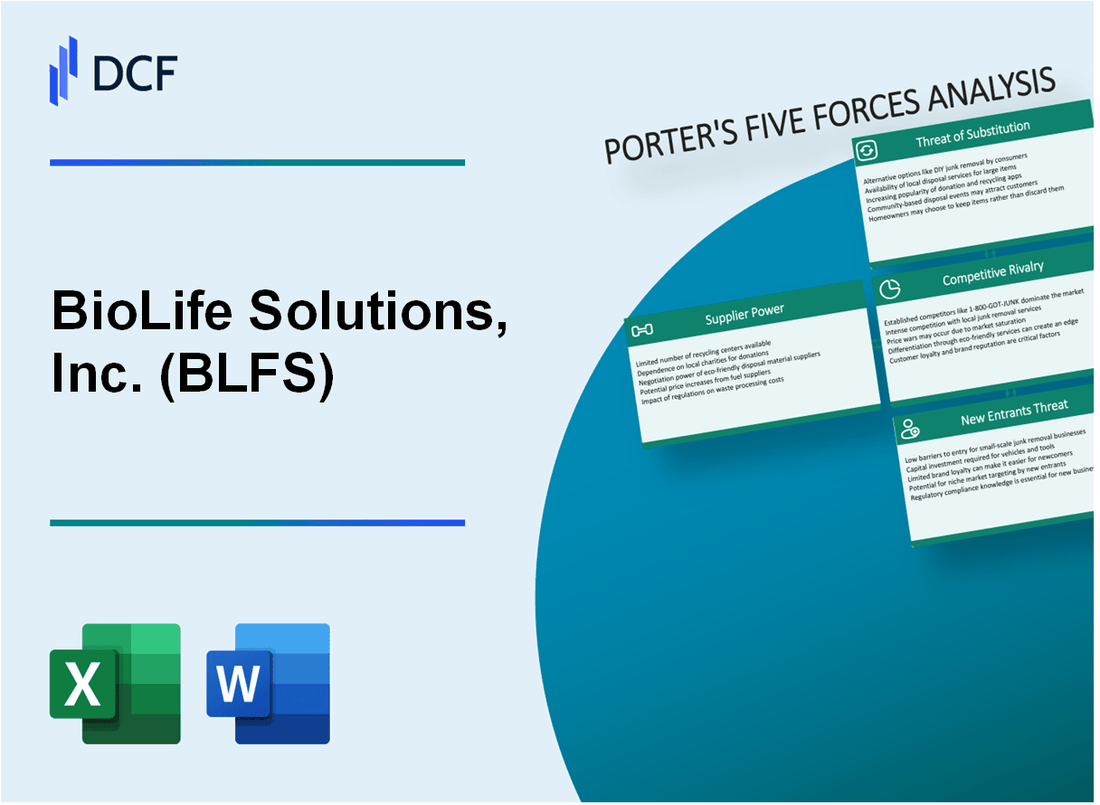
Biolife Solutions, Inc. (BLFS): 5 Analyse des forces [Jan-2025 MISE À JOUR] |
Entièrement Modifiable: Adapté À Vos Besoins Dans Excel Ou Sheets
Conception Professionnelle: Modèles Fiables Et Conformes Aux Normes Du Secteur
Pré-Construits Pour Une Utilisation Rapide Et Efficace
Compatible MAC/PC, entièrement débloqué
Aucune Expertise N'Est Requise; Facile À Suivre
BioLife Solutions, Inc. (BLFS) Bundle
Dans le paysage dynamique des technologies de bioponservation et de stockage cellulaire, Biolife Solutions, Inc. (BLFS) se dresse au carrefour de l'innovation et de la complexité du marché. Alors que les industries de la médecine biopharmaceutique et régénérative continuent d'évoluer, la compréhension des forces stratégiques qui façonnent le positionnement concurrentiel de Biolife devient crucial. À travers le cadre des cinq forces de Michael Porter, nous plongerons profondément dans la dynamique complexe qui définit le potentiel de marché de l'entreprise, révélant l'équilibre délicat des fournisseurs, des clients, des pressions concurrentielles, des substituts technologiques et des nouveaux entrants potentiels qui détermineront la trajectoire future de Biolife dans ce domaine dans ce Écosystème de biotechnologie à enjeux élevés.
Biolife Solutions, Inc. (BLFS) - Five Forces de Porter: Pouvoir de négociation des fournisseurs
Nombre limité de fabricants spécialisés de supports de biopreservation et de stockage cellulaire
En 2024, le marché mondial des médias bioponservation est caractérisé par un paysage de fournisseur concentré. Environ 5-7 fabricants clés dominent le segment de marché spécialisé.
| Fabricant | Part de marché | Revenus annuels |
|---|---|---|
| Thermo Fisher Scientific | 32% | 44,9 milliards de dollars |
| Merck Kgaa | 22% | 21,3 milliards de dollars |
| Groupe Lonza | 18% | 6,8 milliards de dollars |
Dépendance des matières premières de haute qualité
Biolife Solutions nécessite des matières premières spécialisées avec des spécifications de qualité strictes.
- Produits chimiques de qualité pharmaceutique: coût moyen de 850 $ à 1 200 $ par kg
- Composantes des médias de culture cellulaire spécialisés: gamme de prix 500 $ - 2 500 $ par litre
- Réactifs de la biopréservation: coût entre 300 $ et 1 800 $ par lot
Stratégie d'intégration verticale
Biolife Solutions a investi 12,3 millions de dollars dans les technologies de fabrication propriétaires à partir de 2023 rapports financiers.
| Investissement technologique | Montant | Année |
|---|---|---|
| Capacités de fabrication de R&D | 12,3 millions de dollars | 2023 |
| Portefeuille de brevets | 17 brevets enregistrés | 2024 |
Évaluation des risques de la chaîne d'approvisionnement
Potentiel de perturbation de la chaîne d'approvisionnement pour les composants spécialisés de la biopreservation:
- Risque de concentration géographique: 65% des fournisseurs critiques situés en Amérique du Nord
- Risque de composant à source unique: 42% des matériaux spécialisés de fabricants uniques
- Délai de livraison moyen pour les composants critiques: 8-12 semaines
Biolife Solutions, Inc. (BLFS) - Porter's Five Forces: Bargaining Power of Clients
Clientèle concentré
Depuis le quatrième trimestre 2023, Biolife Solutions sert environ 525 clients directs dans les industries de médecine biopharmaceutique et régénérative. Les 10 principaux clients représentaient 43,2% des revenus totaux en 2023, une concentration du client indiquant une dépendance significative du marché.
| Segment de clientèle | Nombre de clients | Contribution des revenus |
|---|---|---|
| Sociétés biopharmaceutiques | 375 | 62.5% |
| Entreprises de médecine régénérative | 150 | 37.5% |
Changement de coûts et de défis réglementaires
Les coûts de validation réglementaire des solutions de biopreservation alternatives varient entre 250 000 $ et 1,2 million de dollars, créant des obstacles substantiels à la commutation des clients.
- Processus de validation de la FDA: 18-24 mois
- Coût de documentation de conformité moyenne: 475 000 $
- Dépenses techniques de requalification: 150 000 $ - 350 000 $
Demandes de qualité client
En 2023, Biolife Solutions a maintenu un Taux de conformité de la qualité du produit à 99,7% à travers les spécifications critiques de la qualité des clients.
| Métrique de qualité | Performance |
|---|---|
| Cohérence des produits | 99.5% |
| Conformité à la stérilité | 99.9% |
| Variabilité de lot à lot | 0.3% |
Partenariat et support technique
Biolife Solutions a investi 12,3 millions de dollars dans l'infrastructure de support technique client en 2023, avec une durée moyenne de la relation client de 4,7 ans.
- Équipe de support technique: 87 professionnels spécialisés
- Temps de réponse moyen: 4,2 heures
- Programmes de formation client: 6 modules complets
Biolife Solutions, Inc. (BLFS) - Five Forces de Porter: Rivalité compétitive
Paysage concurrentiel du marché
Depuis le quatrième trimestre 2023, Biolife Solutions fait face à la concurrence des principaux acteurs suivants sur les marchés de la bioponservation et de la chaîne du froid:
| Concurrent | Segment de marché | Revenus annuels |
|---|---|---|
| Thermo Fisher Scientific | Médias de biopréservation | 44,9 milliards de dollars |
| Merck Kgaa | Solutions de stockage cellulaire | 21,4 milliards de dollars |
| Corning Incorporated | Technologies de bioprocédés | 14,2 milliards de dollars |
Positionnement concurrentiel
Biolife Solutions a déclaré un chiffre d'affaires annuel de 2023 de 204,1 millions de dollars, avec une capitalisation boursière d'environ 1,1 milliard de dollars.
Investissement de la recherche et du développement
Dépenses de R&D pour les solutions Biolife en 2023:
- Dépenses totales de R&D: 16,3 millions de dollars
- Pourcentage de revenus: 8,0%
- Demandes de brevet déposées: 12
Métriques de différenciation compétitive
| Métrique technologique | Biolife Solutions Performance |
|---|---|
| Formulations de médias de stockage cellulaire propriétaire | 17 formulations uniques |
| Part de marché dans la biopréservation | Environ 22% |
| Taux de rétention de la clientèle | 89.5% |
Activité de fusion et d'acquisition
Transactions stratégiques récentes en 2023-2024:
- Acquisition de la plateforme de technologie de préservation de l'hypothermosol
- Partenariat stratégique avec Advanced Cell Diagnostics
- Capacités de fabrication élargies dans l'État de Washington
Biolife Solutions, Inc. (BLFS) - Five Forces de Porter: Menace de substituts
Technologies émergentes de préservation des cellules
En 2024, le marché mondial de la préservation des cellules est évalué à 2,3 milliards de dollars, avec un TCAC projeté de 7,5%. Biolife Solutions fait face à la concurrence de plusieurs technologies émergentes:
| Technologie alternative | Part de marché (%) | Taux de croissance |
|---|---|---|
| Solutions de vitrification | 22.4% | 8.3% |
| Supports de préservation synthétique | 15.7% | 6.9% |
| Préservation de la nanotechnologie | 9.2% | 12.5% |
Avansions potentielles dans les techniques de cryoconservation
Les progrès technologiques clés comprennent:
- Technologies de conservation sans DMSO
- Protocoles de préservation améliorés par l'apprentissage
- Méthodes avancées de préservation du génie génétique
Risque de perturbation technologique dans les méthodes de biopreservation
Mesures de perturbation technologique:
| Catégorie de perturbation | Investissement ($ m) | Demandes de brevet |
|---|---|---|
| Conservation dirigée par l'IA | 87,5 M $ | 42 |
| Solutions de nanotechnologie | 65,3 M $ | 28 |
Augmentation de la concurrence des solutions de préservation innovantes
Données compétitives du paysage:
- Concurrents du marché: 6 acteurs majeurs
- Investissement en R&D: 124,6 millions de dollars en 2024
- Lancements de nouveaux produits: 17 au cours des 12 derniers mois
Biolife Solutions, Inc. (BLFS) - Five Forces de Porter: Menace de nouveaux entrants
Barrières réglementaires à l'entrée
Biolife Solutions opère dans un marché de bioponservation et de préservation cellulaire hautement réglementé avec des exigences strictes de réglementation de la FDA et de l'EMA. La société est confrontée à des obstacles réglementaires complexes qui limitent considérablement les nouveaux entrants du marché.
| Métriques d'approbation réglementaire | Points de données |
|---|---|
| Temps d'approbation moyen de la FDA pour les technologies de biopréservation | 36-48 mois |
| Coûts de conformité réglementaire estimés | 2,3 millions de dollars - 4,7 millions de dollars |
| Approbation réussie des dispositifs médicaux en 2023 | 17,6% du total des applications |
Exigences de capital
La fabrication spécialisée de la biopreservation exige des investissements initiaux substantiels.
| Catégories d'investissement en capital | Coûts estimés |
|---|---|
| Configuration initiale de l'installation de fabrication | 12,5 millions de dollars - 25 millions de dollars |
| Dépenses de recherche et développement | 8,3 millions de dollars en 2023 |
| Achat d'équipement | 3,6 millions de dollars - 7,2 millions de dollars |
Exigences d'expertise technique
Les connaissances techniques avancées créent des obstacles à l'entrée importants.
- Expertise scientifique au niveau du doctorat minimum requise
- Compréhension avancée de la biotechnologie nécessaire
- Formation spécialisée en techniques de cryoconservation
Protection de la propriété intellectuelle
Biolife Solutions maintient des stratégies de propriété intellectuelle robustes.
| Catégories de brevets | Nombre de brevets actifs |
|---|---|
| Portfolio total des brevets actifs | 37 brevets |
| Demandes de brevet en instance | 12 applications |
| Durée de protection des brevets | 15-20 ans |
BioLife Solutions, Inc. (BLFS) - Porter's Five Forces: Competitive rivalry
You're looking at the competitive landscape for BioLife Solutions, Inc. (BLFS) in late 2025, and the picture for its core biopreservation media niche is quite strong. Honestly, the rivalry here is low because the company has established such a dominant position.
The data shows BioLife Solutions, Inc.'s biopreservation media is used in approximately 250 ongoing commercially sponsored clinical trials across the U.S. as of the third quarter of 2025. That translates to a market share of more than 70% in that specific segment. Digging deeper into the high-stakes area, this includes over 30 Phase III trials, which account for nearly 80% of those late-stage U.S. trials. That kind of penetration creates a significant barrier to entry for any potential competitor trying to displace them in the clinical pipeline.
Differentiation is defintely strong, which helps lock in those customer relationships. As of the first quarter of 2025, BioLife Solutions, Inc. had processed a cumulative total of 782 U.S. FDA Master Files for its biopreservation media. Furthermore, as of June 30, 2025, the biopreservation media was embedded in 16 unique commercial Cell and Gene Therapies (CGTs).
To see how the competition is fragmented across the rest of the portfolio, look at the segmentation before the recent strategic realignment. You can see the different competitive pressures across the main product lines:
| Product Line/Platform | Q3 2025 Revenue (9 Months Ended Sept 30, 2025) | Year-over-Year Growth (9M YTD) | Strategic Focus |
|---|---|---|---|
| Cell Processing Platform (Core Media) | $69.9 million | 31% | High-margin, recurring revenue |
| evo and Thaw Platform (Pre-Divestiture) | Not separately reported for 9M post-divestiture | Growth of 3% to 15% (Q1 2025 Guidance) | Being strategically streamlined/divested |
The competition is certainly fragmented when you look at the different product types. For instance, the thaw devices and shipping containers face different competitive dynamics than the core media. Still, the company is actively simplifying this by focusing on the highest-value areas.
That brings us to the strategic shift. The move to high-margin recurring revenue is explicitly designed to reduce direct competition with logistics firms. BioLife Solutions, Inc. completed the divestiture of its evo cold chain logistics business in early October 2025. This reshapes the company into a pure-play cell processing entity, centering on the core business where they hold that 70% market share. Commercial customers already accounted for approximately 40% of total biopreservation media revenue in Q1 2025, underscoring the durability of that recurring model. This focus helped drive the adjusted EBITDA margin to 28% of revenue in Q3 2025.
If you're tracking the financial impact of this focus, the Cell Processing platform revenue was raised to a guidance range of $93.0 million to $94.0 million for the full year 2025. That's a year-over-year growth rate of 26% to 28% for the core business.
Finance: draft 13-week cash view by Friday.
BioLife Solutions, Inc. (BLFS) - Porter's Five Forces: Threat of substitutes
You're looking at the competitive landscape for BioLife Solutions, Inc. (BLFS) as we head into late 2025, specifically focusing on what might replace their core biopreservation media. Honestly, the threat here isn't immediate, but it's a long-term strategic consideration you need to track.
Threat is moderate; proprietary media (CryoStor®) are defintely hard to replace once validated.
Once a proprietary media like CryoStor® is specified in a regulatory filing-especially for a commercial therapy-the switching costs become incredibly high. You're looking at years of validation work and regulatory hurdles to change that component. This 'stickiness' keeps the immediate threat of substitution low for established products.
Here's the quick math on how embedded the proprietary media is in the high-value cell and gene therapy (CGT) market:
| Metric | Value as of Late 2025 | Date Reference |
|---|---|---|
| Commercial CGTs with Embedded Media | 16 unique therapies | June 30, 2025 |
| Total Ongoing U.S. Commercial Trials Supported | Over 250 studies | September 30, 2025 |
| Market Share in Supported U.S. Clinical Trials | More than 70% | June 30, 2025 |
| Revenue from Commercial Therapy Customers (Q1 2025) | Approximately 40% of total BPM revenue | March 31, 2025 |
The growth in revenue from these established customers is clear; Cell Processing revenue in Q3 2025 hit $25.4 million, up 33% year-over-year, driven by demand from commercial customers. That's real money tied to validated processes.
Acquisition of PanTHERA CryoSolutions strengthens the company's proprietary technology moat against alternatives.
BioLife Solutions, Inc. made a strategic move on April 4, 2025, by acquiring the remaining 90% of PanTHERA CryoSolutions, Inc.. This wasn't just buying market share; it was buying next-generation intellectual property to fortify the moat around their existing products. They paid $9.3 million in cash plus 241,355 shares of common stock, with up to an additional $7.2 million contingent on future milestones.
PanTHERA's Ice Recrystallization Inhibitor (IRI) technology is key because it aims to:
- Provide superior cryopreservation outcomes for certain constructs.
- Allow for lower concentrations of Dimethyl Sulfoxide (DMSO).
- Reduce the need for liquid nitrogen in cold chain logistics.
The integration of this technology, with next-generation molecules expected to launch within 18 months of the acquisition, directly counters potential future substitutes by offering a superior, integrated solution.
Potential for large customers to develop in-house, non-proprietary media is the main long-term substitute risk.
The biggest long-term substitute risk isn't a competitor's product; it's a major customer deciding to bring the formulation process in-house to gain control or cut costs once their therapy is commercially scaled. If a customer with a blockbuster therapy decides to develop its own media, that represents a significant revenue stream at risk. BioLife Solutions, Inc. is trying to mitigate this by increasing the value proposition across the entire workflow, not just the media itself. They are raising their full-year 2025 Cell Processing revenue guidance to $93.0 million to $94.0 million, showing strong current momentum despite this theoretical risk.
Older, less effective preservation methods represent a low threat in the high-value CGT market.
When you are dealing with high-value, patient-specific therapies, the margin for error is slim. Older, less effective preservation methods simply cannot guarantee the required post-thaw viability and function. The fact that BioLife Solutions, Inc.'s media is now specified in 16 commercial CGTs and supports over 250 clinical trials shows the market has already voted with its wallet and its regulatory submissions. The value proposition of superior cell recovery far outweighs the minor cost savings of using an older, riskier alternative in this segment. It's a non-starter for commercial success. Finance: review the Q4 2025 customer retention rates against the 40% commercial revenue base to confirm this stickiness.
BioLife Solutions, Inc. (BLFS) - Porter's Five Forces: Threat of new entrants
The threat of new entrants for BioLife Solutions, Inc. in the cell and gene therapy (CGT) biopreservation space remains relatively low, primarily due to substantial structural barriers that favor established players.
High regulatory barriers exist; new entrants must validate products through lengthy and costly clinical trials. The inherent complexity of CGT development means that new competitors face immense hurdles just to get a product to market. Researchers estimate that making these advanced therapies costs over \$1.9 billion per therapy as of March 2025. Clinical trials themselves are lengthy, often spanning several years, and Phase III trials in the U.S. frequently cost tens of millions of dollars. The regulatory pathway, while sometimes expedited through designations like the FDA's Regenerative Medicine Advanced Therapy (RMAT), still demands rigorous proof of safety and efficacy, which translates directly into time and capital expenditure for any new entrant.
BioLife Solutions, Inc.'s 16 commercial CGT clients demonstrate a proven, trusted track record that is tough to replicate. This installed base represents a significant moat. As of June 30, 2025, the biopreservation media from BioLife Solutions, Inc. is embedded in 16 unique commercial CGTs. Furthermore, customers with approved commercial therapies generated approximately 40% of the total Biopreservation Media (BPM) revenue in Q2 2025. This commercial adoption suggests that switching costs-both in terms of re-validating a new supplier through regulatory bodies and the risk to ongoing commercial supply-are prohibitively high for potential competitors.
Significant capital is required for cGMP manufacturing and building a sales force to compete with a market leader. Establishing the necessary infrastructure is a massive undertaking. While some Contract Development and Manufacturing Organization (CDMO) builds might start in the low millions, fully integrated facilities covering plasmid supply, vector manufacturing, cell therapy, and testing are projected to exceed several hundred million USD after construction finishes in 2025. To compete with BioLife Solutions, Inc.'s established presence, a new entrant would need to secure similar funding, which is challenging given the current market environment where biotech IPOs saw an 80% decrease in funds between 2021 and 2023.
The company's large market share in early-stage trials acts as a significant preemptive barrier. This early adoption locks in future commercial revenue. BioLife Solutions, Inc.'s BPM is utilized in over 250 ongoing, relevant commercially sponsored clinical trials in the U.S.. This represents a more than 70% market share in this critical segment. The penetration deep into the pipeline is evident in Phase III trials, where the company holds an estimated share near 80% across more than 30 such trials.
Here's a quick look at the competitive positioning metrics as of late 2025:
| Metric | BioLife Solutions, Inc. Value (2025) | Industry/Peer Comparison (2025) |
| Commercial CGT Clients with BPM Embedded | 16 | N/A |
| Ongoing Commercially Sponsored U.S. Trials Using BPM | Over 250 | N/A |
| Market Share in Ongoing U.S. Commercially Sponsored Trials | Over 70% | N/A |
| Estimated Phase III Trial Market Share | Nearly 80% | N/A |
| Estimated Cost Per Therapy (Researchers Estimate) | Over \$1.9 billion | N/A |
| Price-to-Sales Ratio (as of Oct 2025) | 12.8 | Industry Average: 3.8 |
The depth of market penetration creates a self-reinforcing cycle that new entrants struggle to break:
- Regulatory Entrenchment: Products are specified in regulatory filings for 16 commercial therapies.
- Pipeline Dominance: Over 250 trials use the media, creating future commercial lock-in.
- Financial Scale: Full-year 2025 Cell Processing revenue guidance is \$93.0 million to \$94.0 million.
- Capital Barrier: New cGMP facilities can cost several hundred million USD.
- Valuation Premium: The P/S ratio of 12.8 signals high market expectation for incumbent performance.
The combination of high validation costs, long trial durations, and BioLife Solutions, Inc.'s commanding lead in both early-stage trials and commercial products creates a defacto barrier to entry that is difficult to overcome quickly. Finance: draft 13-week cash view by Friday.
Disclaimer
All information, articles, and product details provided on this website are for general informational and educational purposes only. We do not claim any ownership over, nor do we intend to infringe upon, any trademarks, copyrights, logos, brand names, or other intellectual property mentioned or depicted on this site. Such intellectual property remains the property of its respective owners, and any references here are made solely for identification or informational purposes, without implying any affiliation, endorsement, or partnership.
We make no representations or warranties, express or implied, regarding the accuracy, completeness, or suitability of any content or products presented. Nothing on this website should be construed as legal, tax, investment, financial, medical, or other professional advice. In addition, no part of this site—including articles or product references—constitutes a solicitation, recommendation, endorsement, advertisement, or offer to buy or sell any securities, franchises, or other financial instruments, particularly in jurisdictions where such activity would be unlawful.
All content is of a general nature and may not address the specific circumstances of any individual or entity. It is not a substitute for professional advice or services. Any actions you take based on the information provided here are strictly at your own risk. You accept full responsibility for any decisions or outcomes arising from your use of this website and agree to release us from any liability in connection with your use of, or reliance upon, the content or products found herein.