

|
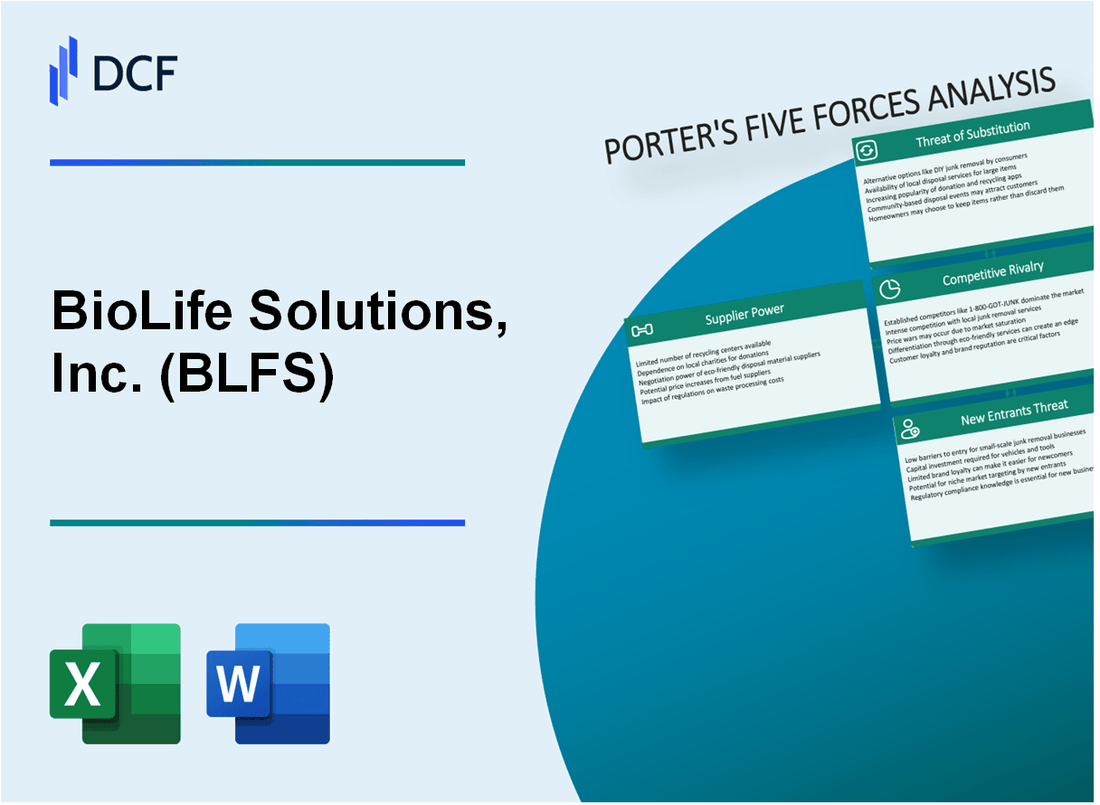
Biolife Solutions, Inc. (BLFS): 5 forças Análise [Jan-2025 Atualizada] |
Totalmente Editável: Adapte-Se Às Suas Necessidades No Excel Ou Planilhas
Design Profissional: Modelos Confiáveis E Padrão Da Indústria
Pré-Construídos Para Uso Rápido E Eficiente
Compatível com MAC/PC, totalmente desbloqueado
Não É Necessária Experiência; Fácil De Seguir
BioLife Solutions, Inc. (BLFS) Bundle
No cenário dinâmico das tecnologias de biopreservação e armazenamento de células, a Biolife Solutions, Inc. (BLFS) fica na encruzilhada da inovação e da complexidade do mercado. À medida que as indústrias de medicina biofarmacêutica e regenerativa continuam a evoluir, entender as forças estratégicas que moldam o posicionamento competitivo da biolife se torna crucial. Através da estrutura das cinco forças de Michael Porter, mergulharemos profundamente na intrincada dinâmica que definirá o potencial de mercado da empresa, revelando o delicado equilíbrio de fornecedores, clientes, pressões competitivas, substitutos tecnológicos e novos participantes em potencial que determinarão a trajetória futura da biolife neste ecossistema de biotecnologia de alto risco.
Biolife Solutions, Inc. (BLFS) - As cinco forças de Porter: poder de barganha dos fornecedores
Número limitado de fabricantes especializados de biopreservação e armazenamento de células
A partir de 2024, o mercado global de mídia de biopreservação é caracterizado por um cenário concentrado de fornecedores. Aproximadamente 5-7 fabricantes principais dominam o segmento de mercado especializado.
| Fabricante | Quota de mercado | Receita anual |
|---|---|---|
| Thermo Fisher Scientific | 32% | US $ 44,9 bilhões |
| Merck kgaa | 22% | US $ 21,3 bilhões |
| Grupo Lonza | 18% | US $ 6,8 bilhões |
Dependência de matérias-primas de alta qualidade
A Biolife Solutions requer matérias -primas especializadas com especificações rigorosas de qualidade.
- Produtos químicos de grau farmacêutico: custa média de US $ 850 a US $ 1.200 por kg
- Componentes especializados de mídia de cultura de células: faixa de preço $ 500 a US $ 2.500 por litro
- Reagentes de biopreservação: custo entre US $ 300 e US $ 1.800 por lote
Estratégia de integração vertical
A Biolife Solutions investiu US $ 12,3 milhões em tecnologias de fabricação proprietárias a partir de 2023 Relatórios Financeiros.
| Investimento em tecnologia | Quantia | Ano |
|---|---|---|
| Capacidades de fabricação de P&D | US $ 12,3 milhões | 2023 |
| Portfólio de patentes | 17 patentes registradas | 2024 |
Avaliação de risco da cadeia de suprimentos
Potencial de interrupção da cadeia de suprimentos para componentes especializados de biopreservação:
- Risco de concentração geográfica: 65% dos fornecedores críticos localizados na América do Norte
- Risco de componente de fonte única: 42% dos materiais especializados de fabricantes únicos
- Primeiro tempo médio para componentes críticos: 8 a 12 semanas
Biolife Solutions, Inc. (BLFS) - As cinco forças de Porter: poder de barganha dos clientes
Base de clientes concentrados
A partir do quarto trimestre de 2023, a Biolife Solutions atende a aproximadamente 525 clientes diretos nas indústrias de medicina biofarmacêutica e regenerativa. Os 10 principais clientes representaram 43,2% da receita total em 2023, com uma concentração de clientes indicando dependência significativa do mercado.
| Segmento de clientes | Número de clientes | Contribuição da receita |
|---|---|---|
| Empresas biofarmacêuticas | 375 | 62.5% |
| Empresas de medicina regenerativa | 150 | 37.5% |
Trocar custos e desafios regulatórios
Os custos de validação regulatória para soluções alternativas de biopreservação variam entre US $ 250.000 e US $ 1,2 milhão, criando barreiras substanciais à troca de clientes.
- Processo de validação da FDA: 18-24 meses
- Custo médio de documentação de conformidade: US $ 475.000
- Despesas de re -qualificação técnica: US $ 150.000 - US $ 350.000
Demandas da qualidade do cliente
Em 2023, a Biolife Solutions manteve um 99,7% da taxa de conformidade da qualidade do produto nas especificações críticas da qualidade do cliente.
| Métrica de qualidade | Desempenho |
|---|---|
| Consistência do produto | 99.5% |
| Conformidade com esterilidade | 99.9% |
| Variabilidade em lote a lote | 0.3% |
Parceria e suporte técnico
A Biolife Solutions investiu US $ 12,3 milhões em infraestrutura de suporte técnico de clientes em 2023, com uma duração média do relacionamento com o cliente de 4,7 anos.
- Equipe de suporte técnico: 87 profissionais especializados
- Tempo médio de resposta: 4,2 horas
- Programas de treinamento de clientes: 6 módulos abrangentes
Biolife Solutions, Inc. (BLFS) - As cinco forças de Porter: rivalidade competitiva
Cenário competitivo de mercado
A partir do quarto trimestre 2023, a Biolife Solutions enfrenta a concorrência dos seguintes players -chave nos mercados de biopreservação e armazenamento de cadeia fria:
| Concorrente | Segmento de mercado | Receita anual |
|---|---|---|
| Thermo Fisher Scientific | Mídia de biopreservação | US $ 44,9 bilhões |
| Merck kgaa | Soluções de armazenamento celular | US $ 21,4 bilhões |
| Corning incorporado | Tecnologias de bioprocessamento | US $ 14,2 bilhões |
Posicionamento competitivo
A Biolife Solutions registrou 2023 receita anual de US $ 204,1 milhões, com uma capitalização de mercado de aproximadamente US $ 1,1 bilhão.
Investimento de pesquisa e desenvolvimento
Despesas de P&D para soluções Biolife em 2023:
- Gastos totais de P&D: US $ 16,3 milhões
- Porcentagem de receita: 8,0%
- Pedidos de patente arquivados: 12
Métricas de diferenciação competitiva
| Métrica de tecnologia | Desempenho da Biolife Solutions |
|---|---|
| Formulações proprietárias de mídia de armazenamento de células | 17 formulações únicas |
| Participação de mercado na biopreservação | Aproximadamente 22% |
| Taxa de retenção de clientes | 89.5% |
Atividade de fusão e aquisição
Transações estratégicas recentes em 2023-2024:
- Aquisição da plataforma de tecnologia de preservação de hipotermosol
- Parceria estratégica com diagnóstico celular avançado
- Capacidades de fabricação expandidas no estado de Washington
Biolife Solutions, Inc. (BLFS) - As cinco forças de Porter: ameaça de substitutos
Tecnologias alternativas de preservação de células emergentes
Em 2024, o mercado global de preservação de células é avaliado em US $ 2,3 bilhões, com um CAGR projetado de 7,5%. A Biolife Solutions enfrenta a concorrência de várias tecnologias emergentes:
| Tecnologia alternativa | Quota de mercado (%) | Taxa de crescimento |
|---|---|---|
| Soluções de vitrificação | 22.4% | 8.3% |
| Meios de preservação sintética | 15.7% | 6.9% |
| Preservação de nanotecnologia | 9.2% | 12.5% |
Possíveis avanços em técnicas de criopreservação
Os principais avanços tecnológicos incluem:
- Tecnologias de preservação sem DMSO
- Protocolos de preservação aprimorados pelo aprendizado de máquina
- Métodos avançados de preservação de engenharia genética
Risco de interrupção tecnológica nos métodos de biopreservação
Métricas de interrupção tecnológica:
| Categoria de interrupção | Investimento ($ m) | Aplicações de patentes |
|---|---|---|
| Preservação orientada a IA | US $ 87,5M | 42 |
| Soluções de nanotecnologia | US $ 65,3M | 28 |
Aumentando a concorrência de soluções inovadoras de preservação
Dados da paisagem competitiva:
- Concorrentes de mercado: 6 grandes jogadores
- Investimento de P&D: US $ 124,6 milhões em 2024
- Novos produtos lançamentos: 17 nos últimos 12 meses
Biolife Solutions, Inc. (BLFS) - As cinco forças de Porter: ameaça de novos participantes
Barreiras regulatórias à entrada
A Biolife Solutions opera em um mercado altamente regulamentado de biopreservação e preservação de células, com requisitos regulatórios rigorosos da FDA e da EMA. A empresa enfrenta barreiras regulatórias complexas que limitam significativamente os novos participantes do mercado.
| Métricas de aprovação regulatória | Pontos de dados |
|---|---|
| Tempo médio de aprovação do FDA para tecnologias de biopreservação | 36-48 meses |
| Custos estimados de conformidade regulatória | US $ 2,3 milhões - US $ 4,7 milhões |
| Aprovações de dispositivos médicos bem -sucedidos em 2023 | 17,6% do total de aplicações |
Requisitos de capital
A fabricação especializada em biopreservação exige investimentos iniciais substanciais.
| Categorias de investimento de capital | Custos estimados |
|---|---|
| Configuração inicial da instalação de fabricação | US $ 12,5 milhões - US $ 25 milhões |
| Despesas de pesquisa e desenvolvimento | US $ 8,3 milhões em 2023 |
| Compra de equipamentos | US $ 3,6 milhões - US $ 7,2 milhões |
Requisitos de especialização técnica
O conhecimento técnico avançado cria barreiras de entrada significativas.
- Exigência científica de nível mínimo de doutorado necessária
- Entendimento avançado de biotecnologia necessária
- Treinamento especializado em técnicas de criopreservação
Proteção à propriedade intelectual
A Biolife Solutions mantém estratégias de propriedade intelectual robustas.
| Categorias de patentes | Número de patentes ativas |
|---|---|
| Portfólio de patentes ativos totais | 37 patentes |
| Aplicações de patentes pendentes | 12 APLICAÇÕES |
| Duração da proteção de patentes | 15-20 anos |
BioLife Solutions, Inc. (BLFS) - Porter's Five Forces: Competitive rivalry
You're looking at the competitive landscape for BioLife Solutions, Inc. (BLFS) in late 2025, and the picture for its core biopreservation media niche is quite strong. Honestly, the rivalry here is low because the company has established such a dominant position.
The data shows BioLife Solutions, Inc.'s biopreservation media is used in approximately 250 ongoing commercially sponsored clinical trials across the U.S. as of the third quarter of 2025. That translates to a market share of more than 70% in that specific segment. Digging deeper into the high-stakes area, this includes over 30 Phase III trials, which account for nearly 80% of those late-stage U.S. trials. That kind of penetration creates a significant barrier to entry for any potential competitor trying to displace them in the clinical pipeline.
Differentiation is defintely strong, which helps lock in those customer relationships. As of the first quarter of 2025, BioLife Solutions, Inc. had processed a cumulative total of 782 U.S. FDA Master Files for its biopreservation media. Furthermore, as of June 30, 2025, the biopreservation media was embedded in 16 unique commercial Cell and Gene Therapies (CGTs).
To see how the competition is fragmented across the rest of the portfolio, look at the segmentation before the recent strategic realignment. You can see the different competitive pressures across the main product lines:
| Product Line/Platform | Q3 2025 Revenue (9 Months Ended Sept 30, 2025) | Year-over-Year Growth (9M YTD) | Strategic Focus |
|---|---|---|---|
| Cell Processing Platform (Core Media) | $69.9 million | 31% | High-margin, recurring revenue |
| evo and Thaw Platform (Pre-Divestiture) | Not separately reported for 9M post-divestiture | Growth of 3% to 15% (Q1 2025 Guidance) | Being strategically streamlined/divested |
The competition is certainly fragmented when you look at the different product types. For instance, the thaw devices and shipping containers face different competitive dynamics than the core media. Still, the company is actively simplifying this by focusing on the highest-value areas.
That brings us to the strategic shift. The move to high-margin recurring revenue is explicitly designed to reduce direct competition with logistics firms. BioLife Solutions, Inc. completed the divestiture of its evo cold chain logistics business in early October 2025. This reshapes the company into a pure-play cell processing entity, centering on the core business where they hold that 70% market share. Commercial customers already accounted for approximately 40% of total biopreservation media revenue in Q1 2025, underscoring the durability of that recurring model. This focus helped drive the adjusted EBITDA margin to 28% of revenue in Q3 2025.
If you're tracking the financial impact of this focus, the Cell Processing platform revenue was raised to a guidance range of $93.0 million to $94.0 million for the full year 2025. That's a year-over-year growth rate of 26% to 28% for the core business.
Finance: draft 13-week cash view by Friday.
BioLife Solutions, Inc. (BLFS) - Porter's Five Forces: Threat of substitutes
You're looking at the competitive landscape for BioLife Solutions, Inc. (BLFS) as we head into late 2025, specifically focusing on what might replace their core biopreservation media. Honestly, the threat here isn't immediate, but it's a long-term strategic consideration you need to track.
Threat is moderate; proprietary media (CryoStor®) are defintely hard to replace once validated.
Once a proprietary media like CryoStor® is specified in a regulatory filing-especially for a commercial therapy-the switching costs become incredibly high. You're looking at years of validation work and regulatory hurdles to change that component. This 'stickiness' keeps the immediate threat of substitution low for established products.
Here's the quick math on how embedded the proprietary media is in the high-value cell and gene therapy (CGT) market:
| Metric | Value as of Late 2025 | Date Reference |
|---|---|---|
| Commercial CGTs with Embedded Media | 16 unique therapies | June 30, 2025 |
| Total Ongoing U.S. Commercial Trials Supported | Over 250 studies | September 30, 2025 |
| Market Share in Supported U.S. Clinical Trials | More than 70% | June 30, 2025 |
| Revenue from Commercial Therapy Customers (Q1 2025) | Approximately 40% of total BPM revenue | March 31, 2025 |
The growth in revenue from these established customers is clear; Cell Processing revenue in Q3 2025 hit $25.4 million, up 33% year-over-year, driven by demand from commercial customers. That's real money tied to validated processes.
Acquisition of PanTHERA CryoSolutions strengthens the company's proprietary technology moat against alternatives.
BioLife Solutions, Inc. made a strategic move on April 4, 2025, by acquiring the remaining 90% of PanTHERA CryoSolutions, Inc.. This wasn't just buying market share; it was buying next-generation intellectual property to fortify the moat around their existing products. They paid $9.3 million in cash plus 241,355 shares of common stock, with up to an additional $7.2 million contingent on future milestones.
PanTHERA's Ice Recrystallization Inhibitor (IRI) technology is key because it aims to:
- Provide superior cryopreservation outcomes for certain constructs.
- Allow for lower concentrations of Dimethyl Sulfoxide (DMSO).
- Reduce the need for liquid nitrogen in cold chain logistics.
The integration of this technology, with next-generation molecules expected to launch within 18 months of the acquisition, directly counters potential future substitutes by offering a superior, integrated solution.
Potential for large customers to develop in-house, non-proprietary media is the main long-term substitute risk.
The biggest long-term substitute risk isn't a competitor's product; it's a major customer deciding to bring the formulation process in-house to gain control or cut costs once their therapy is commercially scaled. If a customer with a blockbuster therapy decides to develop its own media, that represents a significant revenue stream at risk. BioLife Solutions, Inc. is trying to mitigate this by increasing the value proposition across the entire workflow, not just the media itself. They are raising their full-year 2025 Cell Processing revenue guidance to $93.0 million to $94.0 million, showing strong current momentum despite this theoretical risk.
Older, less effective preservation methods represent a low threat in the high-value CGT market.
When you are dealing with high-value, patient-specific therapies, the margin for error is slim. Older, less effective preservation methods simply cannot guarantee the required post-thaw viability and function. The fact that BioLife Solutions, Inc.'s media is now specified in 16 commercial CGTs and supports over 250 clinical trials shows the market has already voted with its wallet and its regulatory submissions. The value proposition of superior cell recovery far outweighs the minor cost savings of using an older, riskier alternative in this segment. It's a non-starter for commercial success. Finance: review the Q4 2025 customer retention rates against the 40% commercial revenue base to confirm this stickiness.
BioLife Solutions, Inc. (BLFS) - Porter's Five Forces: Threat of new entrants
The threat of new entrants for BioLife Solutions, Inc. in the cell and gene therapy (CGT) biopreservation space remains relatively low, primarily due to substantial structural barriers that favor established players.
High regulatory barriers exist; new entrants must validate products through lengthy and costly clinical trials. The inherent complexity of CGT development means that new competitors face immense hurdles just to get a product to market. Researchers estimate that making these advanced therapies costs over \$1.9 billion per therapy as of March 2025. Clinical trials themselves are lengthy, often spanning several years, and Phase III trials in the U.S. frequently cost tens of millions of dollars. The regulatory pathway, while sometimes expedited through designations like the FDA's Regenerative Medicine Advanced Therapy (RMAT), still demands rigorous proof of safety and efficacy, which translates directly into time and capital expenditure for any new entrant.
BioLife Solutions, Inc.'s 16 commercial CGT clients demonstrate a proven, trusted track record that is tough to replicate. This installed base represents a significant moat. As of June 30, 2025, the biopreservation media from BioLife Solutions, Inc. is embedded in 16 unique commercial CGTs. Furthermore, customers with approved commercial therapies generated approximately 40% of the total Biopreservation Media (BPM) revenue in Q2 2025. This commercial adoption suggests that switching costs-both in terms of re-validating a new supplier through regulatory bodies and the risk to ongoing commercial supply-are prohibitively high for potential competitors.
Significant capital is required for cGMP manufacturing and building a sales force to compete with a market leader. Establishing the necessary infrastructure is a massive undertaking. While some Contract Development and Manufacturing Organization (CDMO) builds might start in the low millions, fully integrated facilities covering plasmid supply, vector manufacturing, cell therapy, and testing are projected to exceed several hundred million USD after construction finishes in 2025. To compete with BioLife Solutions, Inc.'s established presence, a new entrant would need to secure similar funding, which is challenging given the current market environment where biotech IPOs saw an 80% decrease in funds between 2021 and 2023.
The company's large market share in early-stage trials acts as a significant preemptive barrier. This early adoption locks in future commercial revenue. BioLife Solutions, Inc.'s BPM is utilized in over 250 ongoing, relevant commercially sponsored clinical trials in the U.S.. This represents a more than 70% market share in this critical segment. The penetration deep into the pipeline is evident in Phase III trials, where the company holds an estimated share near 80% across more than 30 such trials.
Here's a quick look at the competitive positioning metrics as of late 2025:
| Metric | BioLife Solutions, Inc. Value (2025) | Industry/Peer Comparison (2025) |
| Commercial CGT Clients with BPM Embedded | 16 | N/A |
| Ongoing Commercially Sponsored U.S. Trials Using BPM | Over 250 | N/A |
| Market Share in Ongoing U.S. Commercially Sponsored Trials | Over 70% | N/A |
| Estimated Phase III Trial Market Share | Nearly 80% | N/A |
| Estimated Cost Per Therapy (Researchers Estimate) | Over \$1.9 billion | N/A |
| Price-to-Sales Ratio (as of Oct 2025) | 12.8 | Industry Average: 3.8 |
The depth of market penetration creates a self-reinforcing cycle that new entrants struggle to break:
- Regulatory Entrenchment: Products are specified in regulatory filings for 16 commercial therapies.
- Pipeline Dominance: Over 250 trials use the media, creating future commercial lock-in.
- Financial Scale: Full-year 2025 Cell Processing revenue guidance is \$93.0 million to \$94.0 million.
- Capital Barrier: New cGMP facilities can cost several hundred million USD.
- Valuation Premium: The P/S ratio of 12.8 signals high market expectation for incumbent performance.
The combination of high validation costs, long trial durations, and BioLife Solutions, Inc.'s commanding lead in both early-stage trials and commercial products creates a defacto barrier to entry that is difficult to overcome quickly. Finance: draft 13-week cash view by Friday.
Disclaimer
All information, articles, and product details provided on this website are for general informational and educational purposes only. We do not claim any ownership over, nor do we intend to infringe upon, any trademarks, copyrights, logos, brand names, or other intellectual property mentioned or depicted on this site. Such intellectual property remains the property of its respective owners, and any references here are made solely for identification or informational purposes, without implying any affiliation, endorsement, or partnership.
We make no representations or warranties, express or implied, regarding the accuracy, completeness, or suitability of any content or products presented. Nothing on this website should be construed as legal, tax, investment, financial, medical, or other professional advice. In addition, no part of this site—including articles or product references—constitutes a solicitation, recommendation, endorsement, advertisement, or offer to buy or sell any securities, franchises, or other financial instruments, particularly in jurisdictions where such activity would be unlawful.
All content is of a general nature and may not address the specific circumstances of any individual or entity. It is not a substitute for professional advice or services. Any actions you take based on the information provided here are strictly at your own risk. You accept full responsibility for any decisions or outcomes arising from your use of this website and agree to release us from any liability in connection with your use of, or reliance upon, the content or products found herein.