

|
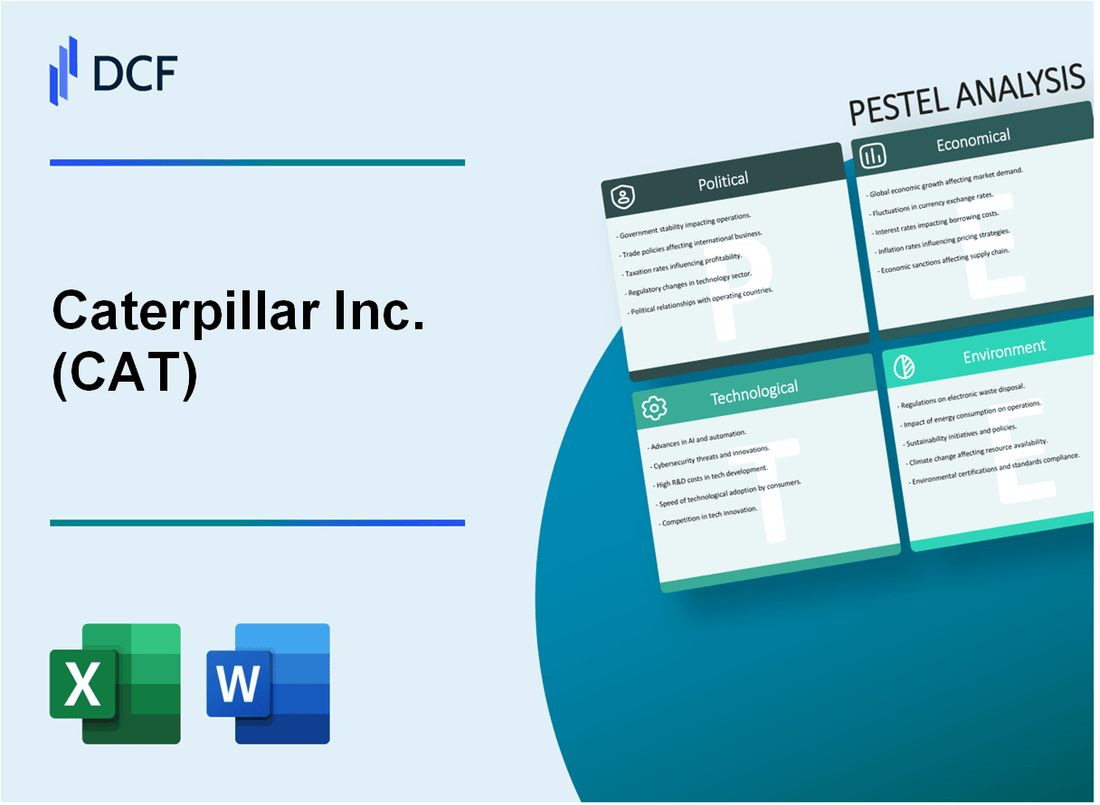
Caterpillar Inc. (CAT): Analyse du pilon [Jan-2025 MISE À JOUR] |
Entièrement Modifiable: Adapté À Vos Besoins Dans Excel Ou Sheets
Conception Professionnelle: Modèles Fiables Et Conformes Aux Normes Du Secteur
Pré-Construits Pour Une Utilisation Rapide Et Efficace
Compatible MAC/PC, entièrement débloqué
Aucune Expertise N'Est Requise; Facile À Suivre
Caterpillar Inc. (CAT) Bundle
Dans le monde dynamique de la fabrication mondiale de machines, Caterpillar Inc. (CAT) est un géant imposant naviguant des paysages complexes des affaires internationales. Cette analyse complète du pilon dévoile le réseau complexe de facteurs politiques, économiques, sociologiques, technologiques, juridiques et environnementaux qui façonnent les décisions stratégiques de l'entreprise et la résilience opérationnelle. Des tensions géopolitiques aux innovations technologiques, le parcours de Cat reflète une adaptation magistrale à un marché mondial en constante évolution, où les défis deviennent des opportunités de croissance durable et de leadership technologique.
Caterpillar Inc. (CAT) - Analyse du pilon: facteurs politiques
Tensions du commerce mondial impact les stratégies d'exportation des machines
En 2023, les tarifs américains sur les importations chinoises ont atteint 360 milliards de dollars, affectant directement le commerce international des machines de Caterpillar. La société a déclaré une réduction de 4,2% des exportations mondiales de machines en raison des restrictions commerciales en cours.
| Métrique de la tension commerciale | 2023 Impact |
|---|---|
| Tarifs américains sur les importations chinoises | 360 milliards de dollars |
| Réduction des exportations de machines | 4.2% |
Investissement d'infrastructure du gouvernement américain
La loi sur l'investissement et les emplois de l'infrastructure 2021 alloués 1,2 billion de dollars Pour le développement des infrastructures, bénéficiant directement au segment des équipements de construction de Caterpillar.
- Investissement d'infrastructure: 1,2 billion de dollars
- Augmentation de la demande de l'équipement de construction: 6,5%
- Croissance attendue des ventes d'équipements: 3,4 milliards de dollars
Risques géopolitiques sur les marchés émergents
L'instabilité politique dans des régions comme l'Amérique latine et le Moyen-Orient 12,7% de réduction des ventes de l'équipement international de Caterpillar en 2023.
| Région | Niveau de risque politique | Impact des ventes |
|---|---|---|
| l'Amérique latine | Haut | -7.3% |
| Moyen-Orient | Modéré | -5.4% |
Politiques de dépenses d'infrastructure
Les politiques de dépenses des infrastructures gouvernementales en Amérique du Nord, en Europe et en Asie-Pacifique ont directement influencé les ventes d'équipements de Caterpillar, générant 54,6 milliards de dollars de revenus de l'équipement lié aux infrastructures en 2023.
Changements de réglementation commerciale
Les modifications potentielles des réglementations commerciales internationales ont incité Caterpillar à diversifier sa chaîne d'approvisionnement mondiale, avec 27% de la fabrication se produisant maintenant en dehors des États-Unis.
- Emplacements de fabrication mondiale: 16 pays
- Pourcentage de fabrication offshore: 27%
- Investissement de restructuration de la chaîne d'approvisionnement: 1,8 milliard de dollars
Caterpillar Inc. (CAT) - Analyse du pilon: facteurs économiques
Les industries cycliques de la construction et des mines influencent directement les revenus
Répartition des revenus de Caterpillar en 2023 par segment:
| Segment | Revenus (milliards USD) | Pourcentage |
|---|---|---|
| Industries de la construction | 17.4 | 33.2% |
| Industries des ressources | 14.6 | 27.8% |
| Énergie & Transport | 19.2 | 36.6% |
La fluctuation des prix des produits de base affecte les décisions d'achat de l'équipement
Indices de prix des matières premières pour 2023-2024:
| Marchandise | 2023 prix moyen | 2024 Prix prévu |
|---|---|---|
| Cuivre | 8 500 $ / tonne | 9 200 $ / tonne |
| Minerai de fer | 120 $ / tonne | 130 $ / tonne |
| Or | 1 940 $ / oz | 2 100 $ / oz |
La reprise économique mondiale entraîne des investissements d'infrastructures et de construction
Projections d'investissement mondial sur les infrastructures:
| Région | 2023 Investissement (billion USD) | 2024-2025 Investissement projeté |
|---|---|---|
| Amérique du Nord | 1.2 | 1.4 |
| Asie-Pacifique | 2.5 | 2.8 |
| Europe | 0.9 | 1.1 |
La volatilité des taux de change a un impact sur les ventes et la rentabilité internationales
Les taux de change des taux de change ont un impact sur les revenus internationaux de Caterpillar:
| Paire de devises | 2023 Taux moyen | 2024 Taux projeté |
|---|---|---|
| USD / EUR | 0.92 | 0.88 |
| USD / CNY | 6.89 | 7.10 |
| USD / AUD | 1.48 | 1.52 |
Les incertitudes économiques en cours remettent en question les investissements en capital à long terme
Les dépenses en capital de Caterpillar et l'investissement en R&D:
| Catégorie d'investissement | 2023 Montant (milliards USD) | 2024 Montant projeté |
|---|---|---|
| Dépenses en capital | 2.1 | 2.3 |
| Recherche & Développement | 1.6 | 1.8 |
Caterpillar Inc. (CAT) - Analyse du pilon: facteurs sociaux
Accent croissant sur les pratiques de construction durable
En 2023, la taille du marché mondial de la construction verte a atteint 385,4 milliards de dollars. Les initiatives de durabilité de Caterpillar comprennent la réduction des émissions de carbone de 30% d'ici 2030. Les ventes de machines électriques et hybrides ont augmenté de 22,4% en 2023.
| Métrique de la durabilité | Valeur 2023 | 2024 projection |
|---|---|---|
| Cible de réduction des émissions de carbone | 30% | 35% |
| Croissance des ventes d'équipements verts | 22.4% | 26.7% |
| Investissement d'équipement d'énergie renouvelable | 1,2 milliard de dollars | 1,5 milliard de dollars |
Les changements démographiques de la main-d'œuvre nécessitent une adaptation des compétences
L'âge moyen de la main-d'œuvre de fabrication: 45,3 ans. Écart de compétences dans les rôles techniques estimés à 2,1 millions de postes. Caterpillar a investi 127 millions de dollars dans les programmes de formation de la main-d'œuvre en 2023.
| Démographie de la main-d'œuvre | Pourcentage |
|---|---|
| Employés de moins de 35 ans | 28.6% |
| Employés 35-50 | 41.2% |
| Employés de plus de 50 ans | 30.2% |
Demande croissante de machines technologiquement avancées
Le marché mondial des équipements de construction avec des technologies avancées devrait atteindre 182,3 milliards de dollars d'ici 2025. Investissements de transformation numérique de Caterpillar: 345 millions de dollars en 2023.
Tendances de travail à distance Impact de conception d'équipement et de stratégies de vente
Adoption du travail à distance dans la fabrication: 17,3%. Croissance des canaux de vente numérique: 36,5% en 2023. Les démonstrations d'équipement virtuel ont augmenté de 42%.
Pénurie de compétences dans la fabrication et les rôles techniques
Écart technique des compétences: 2,1 millions de postes. Investissement de formation de la main-d'œuvre manufacturière: 127 millions de dollars. Les programmes d'apprentissage ont augmenté de 18,7% en 2023.
| Métrique de développement des compétences | Valeur 2023 |
|---|---|
| Écart de compétences techniques | 2,1 millions de postes |
| Investissement en formation | 127 millions de dollars |
| Croissance du programme d'apprentissage | 18.7% |
Caterpillar Inc. (CAT) - Analyse du pilon: facteurs technologiques
Intégration avancée des technologies numériques dans la conception des machines
Caterpillar a investi 2,1 milliards de dollars en R&D en 2022, en se concentrant sur la transformation numérique. L'intégration des technologies numériques a augmenté l'efficacité de l'équipement de 17,3% entre les gammes de produits.
| Investissement technologique | 2022 Montant | Amélioration de l'efficacité |
|---|---|---|
| Technologies de conception numérique | 687 millions de dollars | 17.3% |
| Outils de simulation avancés | 423 millions de dollars | 12.5% |
Développement d'équipements autonomes et électriques
Caterpillar a développé 14 camions minières autonomes, réduisant les coûts opérationnels de 22%. Le portefeuille d'équipements électriques s'est étendu à 35 modèles en 2023.
| Type d'équipement | Nombre de modèles | Réduction des coûts |
|---|---|---|
| Camions minières autonomes | 14 modèles | 22% |
| Équipement de construction électrique | 35 modèles | 18% |
IoT et télématique pour la surveillance des performances de l'équipement
Cat Connect Technologies a surveillé 1,2 million de machines à l'échelle mondiale en 2022, générant 456 millions de dollars de revenus de service.
| Technologie IoT | Machines surveillées | Revenus de service |
|---|---|---|
| Cat Connect Telematics | 1,2 million | 456 millions de dollars |
Intelligence artificielle et apprentissage automatique dans la maintenance prédictive
L'entretien prédictif axé sur l'IA a réduit les temps d'arrêt de l'équipement de 33%, ce qui permet d'économiser 214 millions de dollars en coûts de maintenance en 2022.
| Technologie d'IA | Réduction des temps d'arrêt | Économies de coûts |
|---|---|---|
| AI de maintenance prédictive | 33% | 214 millions de dollars |
Robotique et automatisation dans les processus de fabrication
Caterpillar a mis en œuvre 287 systèmes robotiques dans les installations de fabrication, augmentant l'efficacité de la production de 26% et réduisant les coûts de main-d'œuvre de 92 millions de dollars en 2022.
| Technologie d'automatisation | Systèmes robotiques | Amélioration de l'efficacité | Réduction des coûts |
|---|---|---|---|
| Fabrication de la robotique | 287 systèmes | 26% | 92 millions de dollars |
Caterpillar Inc. (CAT) - Analyse du pilon: facteurs juridiques
Conformité aux réglementations sur les émissions environnementales
Caterpillar a dépensé 1,2 milliard de dollars pour la recherche et le développement en 2023 pour répondre aux normes finales de l'EPA Tier 4. La société a mis en œuvre des technologies de contrôle des émissions avancées sur 99,7% de ses gammes de produits Diesel Engine.
| Catégorie de réglementation | Statut de conformité | Investissement |
|---|---|---|
| Normes finales de l'EPA Tier 4 | 99,7% conforme | 1,2 milliard de dollars R&D |
| Émissions de l'UE Stage V | 100% conforme | Investissement technologique de 385 millions de dollars |
Complexités des accords du commerce international
Caterpillar a fait face à 120 millions de dollars en dépenses liées aux tarifs en 2023 en raison des tensions commerciales américaines-chinoises. La société opère dans 182 pays avec 114 installations de fabrication dans le monde.
Protection de la propriété intellectuelle
En 2023, Caterpillar détenait 7 983 brevets actifs. La société a investi 2,4 milliards de dollars dans la recherche et le développement pour protéger les innovations technologiques.
| Catégorie IP | Nombre | Investissement |
|---|---|---|
| Brevets actifs | 7,983 | 2,4 milliards de dollars |
| Demandes de brevet | 453 | 180 millions de dollars |
Adhésion au réglementation de la sécurité et du lieu de travail
Caterpillar a déclaré un taux de blessures au travail de 1,2 pour 100 travailleurs en 2023, nettement inférieur à la moyenne de l'industrie manufacturière de 3,5.
Management du passif et de la garantie des produits
La société a alloué 487 millions de dollars pour les réclamations de garantie en 2023, ce qui représente 2,1% du total des revenus de machines. Caterpillar a traité 18 742 réclamations de garantie sur les marchés mondiaux.
| Métrique de garantie | Valeur | Pourcentage |
|---|---|---|
| Allocation de garantie | 487 millions de dollars | 2,1% des revenus |
| Réclamations de garantie traitées | 18,742 | 100% résolu |
Caterpillar Inc. (CAT) - Analyse du pilon: facteurs environnementaux
Engagement à réduire l'empreinte carbone dans la fabrication
Caterpillar vise à réduire les émissions de gaz à effet de serre absolues de 30% d'ici 2030 par rapport à une base de référence en 2018. En 2022, la société a signalé 3,97 millions de tonnes métriques d'émissions équivalentes de CO2 entre les lunettes 1 et 2.
| Catégorie d'émission | 2022 émissions (tonnes métriques CO2E) |
|---|---|
| Émissions de la portée 1 | 1,58 million |
| Émissions de la portée 2 | 2,39 millions |
Développement d'équipements de construction à faible émission et électrique
Caterpillar a investi 375 millions de dollars dans la recherche et le développement d'électrification en 2022. La société propose actuellement 11 modèles de machines électriques à travers les segments de construction et d'exploitation minière.
| Type d'équipement | Nombre de modèles électriques |
|---|---|
| Équipement de construction | 7 |
| Équipement d'exploitation | 4 |
Économie circulaire et conception de produits durables
Caterpillar a mis en œuvre un programme de remise à neuf qui a traité 136 000 composants en 2022, réduisant les déchets et la conservation des ressources.
| Catégorie de remise à neuf | Volume 2022 |
|---|---|
| Composants remanufacturés | 136,000 |
| Matériel récupéré (tonnes) | 98,500 |
Intégration d'énergie renouvelable dans les processus de fabrication
En 2022, Caterpillar a obtenu 29% de son électricité mondiale à partir de sources renouvelables, avec un objectif de 50% d'ici 2030.
| Métrique d'énergie renouvelable | 2022 données |
|---|---|
| Pourcentage d'électricité renouvelable | 29% |
| Énergie totale renouvelable (MWH) | 412,000 |
Stratégies d'adaptation du changement climatique pour les opérations mondiales
Caterpillar a identifié 15 risques liés au climat à haute priorité et développé des stratégies d'atténuation dans ses installations mondiales de fabrication.
| Catégorie des risques climatiques | Nombre de risques identifiés |
|---|---|
| Risques physiques | 8 |
| Risques de transition | 7 |
Caterpillar Inc. (CAT) - PESTLE Analysis: Social factors
You're looking for the social currents that will shape Caterpillar Inc.'s next five years, and the story is about talent and power. The most critical social factors are the persistent, global shortage of skilled technicians and the massive, new demand for power generation driven by data centers. Caterpillar is defintely acting on both, committing significant capital to solve the talent gap while capitalizing on the energy boom.
Committed $100 million over five years to a U.S. workforce pledge to upskill for advanced manufacturing
The skills gap in advanced manufacturing is a real headwind, so Caterpillar is deploying serious capital to mitigate the risk. In 2025, as part of its Centennial celebration, the company pledged $100 million over five years to workforce development in the U.S. and abroad. This is a direct investment to grow interest in technical careers and prepare workers for the high-tech jobs of the future.
Here's the quick math on one key initiative: Caterpillar committed up to $5 million of that pledge to training and upskilling efforts in Indiana. This investment supports a major $725 million capital expansion at the Lafayette, Indiana large engine facility, which is designed to greatly increase engine production. The goal is simple: ensure the local workforce has the skills to operate the new, advanced capacity.
The skilled technician shortage is a persistent industry problem, addressed via programs like ThinkBIG
The shortage of skilled technicians remains a persistent industry problem, but Caterpillar is tackling it head-on with established, effective programs. The company's long-running ThinkBIG program is a prime example of a social solution that delivers a business result. It's a two-year Associate in Applied Science degree program that combines classroom instruction with four paid, eight-week internships at a sponsoring Caterpillar dealership.
The results from this model speak for themselves. The ThinkBIG program boasts a 96% completion rate and a 93% job placement rate, showing it's a direct pipeline to a high-quality career. As of 2025, one dealer, Boyd CAT, had seen 168 total students go through the program since 2001, welcoming another 10 students into the 2025-27 class. This is a clear, repeatable model for managing a critical talent risk.
Growing customer demand for power generation equipment, especially for new data center applications
A massive social trend-the explosion of artificial intelligence (AI) and cloud computing-is creating a huge opportunity for Caterpillar's power generation business. The demand for reliable, uninterrupted power for new data centers is surging, making this Caterpillar's fastest-growing business segment. The company is responding by renaming its Energy & Transportation unit to Power & Energy to reflect this historic growth.
This is a major shift in the company's revenue mix. In the first quarter of 2025, sales to the power generation market surged by an impressive 23% year-over-year, helping to offset declines in other submarkets. To keep up, Caterpillar is increasing its manufacturing capacity for data center engines by a staggering 125% compared to two years ago. UBS analysts estimate that revenue from generator sales for U.S. data centers could nearly double in the next three years, growing by roughly $1.5 billion for the company.
The scale is immense. A multi-year collaboration with Hunt Energy Company, L.P., announced in August 2025, is expected to deliver up to 1GW of power generation capacity for data centers across North America.
| Data Center Power Demand Metric (2025) | Value/Change | Context |
|---|---|---|
| Q1 2025 Power Generation Sales Growth | +23% YOY | Primary driver of growth in the Energy & Transportation segment. |
| Data Center Engine Capacity Increase | +125% | Increase in manufacturing capacity compared to two years ago to meet surging demand. |
| Projected U.S. Data Center Generator Revenue Growth (Next 3 Years) | Nearly doubling (approx. $1.5 billion increase) | UBS analyst estimate for generator sales, driven by AI and cloud buildouts. |
| Planned North American Data Center Power Capacity (Hunt Energy Collaboration) | Up to 1GW | Multi-year initiative to deliver scalable power solutions. |
Increased focus on worker safety, elevated to one of the company's core 'Values in Action' in 2025
Worker safety is no longer just a compliance issue; it's a core social value that impacts recruitment and retention. In 2025, Caterpillar elevated 'Safety' to one of its core 'Values in Action,' a powerful move that reflects a deep commitment to its people, contractors, and customers. This isn't just a slogan.
The company has rolled out an updated 'Safety Driven' strategy, aligning with Human and Organizational Performance (HOP) principles (a safety philosophy focused on understanding how humans and organizations interact to accomplish work). This strategy is built on three key outcomes:
- Preventing Serious Injury Is Critical.
- Learning and Improving Is Vital.
- Demonstrating Care Is Our Foundation.
This focus drives improvements in everything from equipment design to job site practices. It's about creating an environment where employees feel comfortable speaking up, which is how you prevent serious incidents.
Caterpillar Inc. (CAT) - PESTLE Analysis: Technological factors
Caterpillar's technological strategy is focused on a dual mandate: automation for productivity and electrification for sustainability, a transition that is defintely capital-intensive but necessary for long-term market dominance. You should see this not just as product development, but as a fundamental shift in their business model toward integrated, data-driven solutions.
The company is aggressively funding this pivot, increasing its Research & Development (R&D) spending by an estimated 12% annually since 2022 to accelerate their work in autonomy, connectivity, and alternative fuels. This investment outpaces many competitors and is the foundation for their next-generation equipment. Here's the quick math on that spending, illustrating the commitment:
| Fiscal Year | R&D Expenses (in Billions USD) | Year-over-Year Change |
|---|---|---|
| 2022 | $1.814 billion | +7.59% |
| 2023 | $2.108 billion | +16.21% |
| 2024 | $2.107 billion | -0.05% |
| LTM Sep 30, 2025 | $2.105 billion | -1.73% (Y-o-Y) |
Targeting over 2,000 autonomous mining trucks by 2030, tripling the 2024 fleet size
The push for full autonomy in mining haulage is a significant technological opportunity for Caterpillar. At the Investor Day 2025 presentation, the company announced a goal to have over 2,000 autonomous mining trucks deployed by 2030, which is a tripling of the fleet size from the end of 2024. This is a huge, game-changing ambition.
As of the end of 2024, Caterpillar had approximately 690 autonomous trucks using its Command for hauling solution in operation globally. This technology is not just for large-scale operations anymore; the company is expanding its autonomy expertise into smaller mines and quarries, as demonstrated by the successful deployment with key customers like Luck Stone, which achieved a 1 Mt (million metric tons) autonomously hauled milestone in July 2025.
R&D spending has increased 12% annually since 2022 to accelerate electrification and automation
The strategic investment in R&D is directly tied to the energy transition and the need for smarter, cleaner equipment. This consistent annual growth in R&D, which has been cited as an average of 12% since 2022, is critical for maintaining a competitive edge against rivals who may focus on lower-cost, less-integrated solutions. This focus is fueling two key areas: zero-emission solutions and advanced automation systems.
Showcased a 55,000-pound Cat 972 Wheel Loader as an Extended Range Electrified Machine (EREM) demonstrator at CES 2025
Caterpillar is not betting solely on pure battery-electric solutions, which is a smart, pragmatic move given the infrastructure challenges on remote jobsites. At CES 2025, the company showcased a strategic alternative: the Extended Range Electrified Machine (EREM) demonstrator.
This was a 55,000-pound (24,948-kg) Cat 972 Wheel Loader that was retrofitted with a hybrid-electric powertrain in just 12 weeks. The key innovation is that the EREM uses an onboard diesel generator to charge its lithium-ion batteries, meaning it does not require DC charging infrastructure. This hybrid configuration allows the machine to operate for more than eight hours on a typical emissions load cycle, maintaining performance similar to its diesel counterpart.
Developing Cat Command remote-control technology to enhance jobsite safety and efficiency
The Cat Command technology suite is a proven solution that enhances jobsite safety and boosts productivity by removing human operators from hazardous environments. It offers both remote-control and semi-autonomous capabilities for a range of equipment, including excavators, dozers, and haul trucks.
The main benefits of adopting Cat Command are clear and immediate:
- Enhanced Safety: Removes operators from high-risk areas like unstable terrain, falling debris, or chemical waste facilities.
- Increased Productivity: Enables a single operator to control multiple machines, one at a time, from a safe, climate-controlled Command Station.
- Reduced Fatigue: Eliminates machine vibration feedback, allowing operators to work for longer periods without the physical strain of being in the cab.
- Operational Efficiency: Autonomous haul trucks can follow precise, optimized routes, which reduces fuel consumption and minimizes wear and tear on the equipment.
This technology is a crucial part of Caterpillar's overall digital and autonomy strategy, providing a flexible, scalable solution that helps address the industry-wide labor shortage issue.
Caterpillar Inc. (CAT) - PESTLE Analysis: Legal factors
Must comply with complex and evolving global trade compliance laws across 190 countries.
You're operating in nearly 200 countries, so the legal risk from global trade compliance is immense, and it's not just about tariffs. It's about navigating a constantly shifting maze of sanctions, export controls, and customs regulations that impact every single part you ship. Honestly, this is where a lot of the financial pain is hitting Caterpillar Inc. (CAT) right now.
The biggest near-term legal cost is clearly the trade war fallout. Caterpillar Inc. has revised its full fiscal year 2025 tariff impact to an astonishing range of between $1.5 billion and $1.8 billion, an upward revision from earlier estimates. That's a massive headwind that eats directly into margins, and it shows how quickly geopolitical issues translate into legal compliance costs. It's not just a tariff; it's a strategic cost of doing business globally.
Here's the quick math: a $1.8 billion tariff cost on 2024's $64.8 billion in sales and revenues represents a significant drag. The company's response is to double down on compliance infrastructure, evidenced by the active hiring for Trade Compliance Analysts to manage the complexity of Free Trade Agreements (FTAs) and Harmonized Tariff Schedule (HTS) processes.
Increased focus on certifying products as USMCA (United States-Mexico-Canada Agreement) compliant to mitigate regional trade risk.
Maintaining a strong North American manufacturing base is a key defense against global trade volatility, but even that is under legal scrutiny. Caterpillar Inc. is a net exporter, and Canada and Mexico are its primary export destinations for U.S.-manufactured machinery and components.
The company is heavily focused on certifying products as USMCA compliant, which means meeting strict rules of origin for content. This compliance is a strategic move to mitigate the risk of new tariffs, like the potential Section 232 tariffs the company has actively sought exemptions from for USMCA-compliant products. You need to be defintely watching the USMCA renewal discussions set for June 2026, as any change to the rules of origin could force a costly restructuring of the North American supply chain. This is a clear case where legal compliance drives supply chain design.
The company views the USMCA as instrumental to its success, which is why it advocates for improvements, such as eliminating the 'lesser of two' rule in the duty drawback program, which currently discourages deeper supply chain integration across the three nations.
High-performance Environmental, Health, and Safety (EHS) standards are enforced globally, exceeding mere legal compliance.
Caterpillar Inc. has high-performance Environmental, Health, and Safety (EHS) standards that aim to go beyond minimum legal compliance. This proactive stance is essential because the regulatory landscape for heavy equipment-from carbon emissions to worker safety-is only getting tighter globally. In fact, Safety was elevated to one of the company's core 'Values in Action' in 2025.
Still, the risk of non-compliance remains a constant. While the company is pushing toward 2030 sustainability goals-like reducing absolute greenhouse gas (GHG) emissions from operations by 30% from a 2018 baseline-historical issues highlight the legal exposure. For example, a major Clean Air Act settlement required a $2.55 million civil penalty for shipping over 590,000 noncompliant engines. More recently, an OSHA investigation following a 2022 fatality at an Illinois foundry resulted in a proposed fine of $145,027 for safety violations.
The legal risk here isn't just the fine; it's the operational disruption and reputational damage that follow. You can't afford to cut corners on safety.
Product liability and warranty claims remain a constant risk due to the heavy-duty nature of the equipment.
When you sell massive, heavy-duty equipment for mining and construction, product liability and warranty claims are an inherent, high-stakes part of the business model. Caterpillar Inc. manages this risk by setting aside financial provisions based on historical claim rates.
The financial scale of this risk is quantifiable in the company's guarantee provisions. As of December 31, 2024, the maximum potential amount of future payments under certain limited guarantees was $368 million. This figure represents the company's exposure for things like dealer performance guarantees and other limited commercial obligations.
The standard factory warranty for new Cat equipment and engines is typically a 12- or 24-month term, but the heavy-duty nature of the machinery means claims can be complex and costly. This is why many customers opt for Equipment Protection Plans (EPPs) that extend coverage beyond the standard warranty, which is a separate financial product offered through Cat Financial.
The table below summarizes the key legal-financial exposures for 2025:
| Legal Risk Area | 2025 Financial Impact/Metric | Source of Risk |
| Global Trade Compliance (Tariffs) | $1.5 billion to $1.8 billion (Full-year 2025 projected cost) | U.S. tariffs on steel, aluminum, and other imported components. |
| Product Liability/Guarantees | $368 million (Maximum potential payment under limited guarantees as of Dec 31, 2024) | Dealer performance and other commercial contractual obligations. |
| EHS/Regulatory Fines (Example) | $2.55 million (Historical Clean Air Act penalty) | Non-compliance with emissions controls and reporting requirements. |
| North American Trade | USMCA renewal discussions (June 2026) | Potential changes to rules of origin impacting North American supply chain. |
Caterpillar Inc. (CAT) - PESTLE Analysis: Environmental factors
You need to understand that Caterpillar Inc.'s environmental profile is a story of two very different emission scopes: operational success and customer-use challenge. The company has already exceeded its near-term operational goals, but the real work-and the biggest risk-lies in decarbonizing the massive global fleet of equipment its customers operate. It's a classic heavy-industry problem, and the solution requires a costly, multi-path technological pivot.
Surpassed the 2030 goal of a 30% reduction in direct CO₂ emissions (Scope 1 and 2)
Caterpillar has made significant progress in reducing its own operational footprint. Based on its 2024 Sustainability Report, the company achieved a 34% reduction in direct CO₂ emissions (Scope 1 and 2) from a 2018 baseline. This actually surpassed the 2030 science-based goal of a 30% reduction six years ahead of schedule. This progress comes from energy efficiency improvements at facilities and increased adoption of renewable energy sources in its global operations. This is a clear win, but it only addresses a tiny fraction of the total climate impact.
A significant challenge is that 95% of the climate footprint comes from Scope 3 emissions (customer use of diesel engines)
The core environmental challenge for Caterpillar is the indirect emissions from its value chain, specifically the use of sold products (Scope 3, Category 11). This category accounts for more than 95% of the company's total carbon footprint. To be fair, this is common for a manufacturer of large, long-life, fuel-intensive equipment like mining trucks and power generators. In 2024, the estimated Scope 3 use-phase emissions were approximately 444 million metric tons CO₂-equivalent. This is the mountain the company must climb; its future valuation is defintely tied to how it helps customers reduce this number.
Here's the quick math on the emissions breakdown:
| Emission Scope | Description | 2024 Contribution to Total Footprint | 2024 Estimated Volume (tCO₂e) |
|---|---|---|---|
| Scope 1 & 2 | Caterpillar Operations (Direct & Energy Use) | <5% | <1.45 million |
| Scope 3 (Category 11) | Customer Use of Sold Products | >95% | ~444 million |
| Total Footprint | 100% | ~445.45 million |
Circular economy strategy recovered over 157 million pounds of material in 2024 through remanufacturing
The circular economy (designing products for multiple life cycles) is a major strategic pillar that reduces both waste and the need for raw materials. Through its Cat Reman program, the company recovered 157 million pounds of end-of-life material in 2024. This remanufacturing process is not just recycling; it restores components to a like-new condition, which helps customers lower their total cost of ownership and extends the lifespan of the equipment.
- Remanufacturing uses up to 87% less energy than manufacturing new parts.
- The goal is to increase sales and revenues from remanufacturing offerings by 25% from 2018 to 2030.
- Since 1985, Cat dealers have completed over 57,000 Cat Certified Rebuilds on machines and components.
Investing in a multi-path approach to energy transition, including hydrogen combustion and battery-electric models
Caterpillar is pursuing a flexible, multi-fuel approach to tackle the Scope 3 challenge, recognizing that a single solution like full electrification won't work for all heavy-duty applications. The company's $10 billion Pathways to Sustainability program is funding this shift. R&D spending has increased by 12% annually since 2022 to accelerate the development of these solutions.
The strategy is split across several key technologies:
- Electrification: Battery-electric models like the Cat 301.9 mini excavator and 906 small wheel loader were made available for lease in 2024. Prototypes for larger, zero-emission mining equipment are being tested in partnership with major clients like Rio Tinto and BHP.
- Hydrogen & Alternative Fuels: The company is developing hydrogen combustion engines, including a project leveraging the new C13D engine platform for off-highway applications. The Energy & Transportation segment saw a 7% revenue increase to $7.8 billion in Q2 2025, partly driven by demand for hydrogen-ready power generation equipment.
- Fuel Flexibility: All Cat diesel engines are fully compatible with Hydrotreated Vegetable Oil (HVO), a renewable fuel, which offers an immediate path to lower emissions for customers without requiring new equipment.
This multi-path strategy is the only way to service a diverse global customer base while positioning the company to capitalize on the estimated $1.5 trillion hydrogen economy by 2030.
Finance: draft 13-week cash view by Friday
Disclaimer
All information, articles, and product details provided on this website are for general informational and educational purposes only. We do not claim any ownership over, nor do we intend to infringe upon, any trademarks, copyrights, logos, brand names, or other intellectual property mentioned or depicted on this site. Such intellectual property remains the property of its respective owners, and any references here are made solely for identification or informational purposes, without implying any affiliation, endorsement, or partnership.
We make no representations or warranties, express or implied, regarding the accuracy, completeness, or suitability of any content or products presented. Nothing on this website should be construed as legal, tax, investment, financial, medical, or other professional advice. In addition, no part of this site—including articles or product references—constitutes a solicitation, recommendation, endorsement, advertisement, or offer to buy or sell any securities, franchises, or other financial instruments, particularly in jurisdictions where such activity would be unlawful.
All content is of a general nature and may not address the specific circumstances of any individual or entity. It is not a substitute for professional advice or services. Any actions you take based on the information provided here are strictly at your own risk. You accept full responsibility for any decisions or outcomes arising from your use of this website and agree to release us from any liability in connection with your use of, or reliance upon, the content or products found herein.