

|
Caterpillar Inc. (CAT): Análise de Pestle [Jan-2025 Atualizado] |
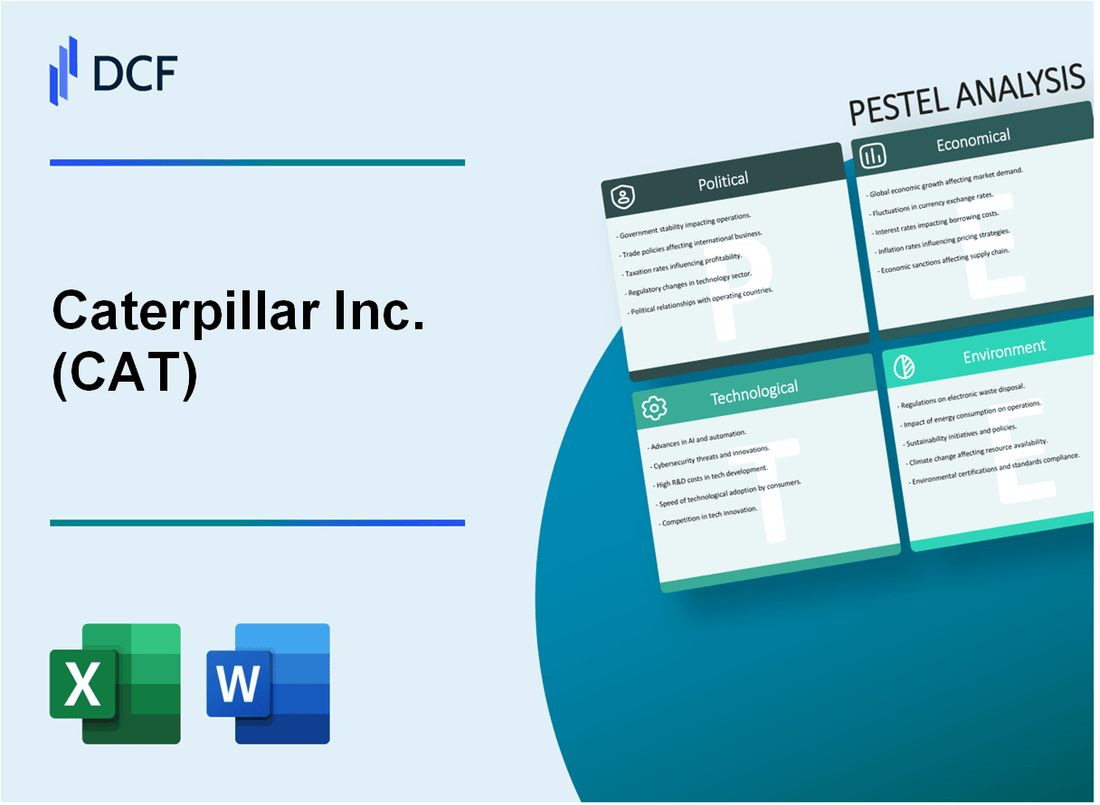
Totalmente Editável: Adapte-Se Às Suas Necessidades No Excel Ou Planilhas
Design Profissional: Modelos Confiáveis E Padrão Da Indústria
Pré-Construídos Para Uso Rápido E Eficiente
Compatível com MAC/PC, totalmente desbloqueado
Não É Necessária Experiência; Fácil De Seguir
Caterpillar Inc. (CAT) Bundle
No mundo dinâmico da fabricação global de máquinas, a Caterpillar Inc. (CAT) se destaca como uma gigante imponente de paisagens complexas de negócios internacionais. Essa análise abrangente de pestles revela a intrincada rede de fatores políticos, econômicos, sociológicos, tecnológicos, legais e ambientais que moldam as decisões estratégicas e a resiliência operacional da empresa. De tensões geopolíticas a inovações tecnológicas, a jornada de Cat reflete uma adaptação magistral a um mercado global em constante mudança, onde os desafios se tornam oportunidades de crescimento sustentável e liderança tecnológica.
Caterpillar Inc. (CAT) - Análise de pilão: Fatores políticos
As tensões comerciais globais afetam estratégias de exportação de máquinas
Em 2023, as tarifas dos EUA sobre as importações chinesas atingiram US $ 360 bilhões, afetando diretamente o comércio internacional de máquinas da Caterpillar. A empresa relatou uma redução de 4,2% nas exportações globais de máquinas devido a restrições comerciais em andamento.
| Métrica de tensão comercial | 2023 Impacto |
|---|---|
| Tarifas dos EUA sobre importações chinesas | US $ 360 bilhões |
| Redução de exportação de máquinas | 4.2% |
Investimento de infraestrutura do governo dos EUA
A Lei de Investimentos e Empregos de Infraestrutura de 2021 US $ 1,2 trilhão Para o desenvolvimento da infraestrutura, beneficiando diretamente o segmento de equipamentos de construção da Caterpillar.
- Investimento de infraestrutura: US $ 1,2 trilhão
- Aumento da demanda de equipamentos de construção: 6,5%
- Crescimento esperado das vendas de equipamentos: US $ 3,4 bilhões
Riscos geopolíticos em mercados emergentes
Instabilidade política em regiões como a América Latina e Oriente Médio resultou em um 12,7% de redução nas vendas internacionais de equipamentos da Caterpillar durante 2023.
| Região | Nível de risco político | Impacto de vendas |
|---|---|---|
| América latina | Alto | -7.3% |
| Médio Oriente | Moderado | -5.4% |
Políticas de gastos com infraestrutura
Políticas de gastos com infraestrutura do governo nas regiões da América do Norte, Europa e Ásia -Pacífico influenciaram diretamente as vendas de equipamentos da Caterpillar, gerando US $ 54,6 bilhões em receita De equipamentos relacionados à infraestrutura em 2023.
Mudanças de regulamentação comercial
Modificações potenciais nos regulamentos comerciais internacionais levaram à Caterpillar a diversificar sua cadeia de suprimentos global, com 27% da fabricação agora ocorrendo fora dos Estados Unidos.
- Locais globais de fabricação: 16 países
- Porcentagem de fabricação offshore: 27%
- Investimento de reestruturação da cadeia de suprimentos: US $ 1,8 bilhão
Caterpillar Inc. (CAT) - Análise de pilão: Fatores econômicos
As indústrias cíclicas de construção e mineração influenciam diretamente a receita
A quebra de receita de 2023 da Caterpillar por segmento:
| Segmento | Receita (bilhão de dólares) | Percentagem |
|---|---|---|
| Indústrias de construção | 17.4 | 33.2% |
| Indústrias de recursos | 14.6 | 27.8% |
| Energia & Transporte | 19.2 | 36.6% |
Os preços flutuantes das commodities afetam as decisões de compra de equipamentos
Índices de preços de commodities para 2023-2024:
| Mercadoria | 2023 Preço médio | 2024 Preço projetado |
|---|---|---|
| Cobre | US $ 8.500/tonelada | US $ 9.200/tonelada |
| Minério de ferro | US $ 120/tonelada | US $ 130/tonelada |
| Ouro | $ 1.940/oz | US $ 2.100/oz |
A recuperação econômica global impulsiona a infraestrutura e os investimentos em construção
Projeções globais de investimento em infraestrutura:
| Região | 2023 Investimento (trilhão USD) | 2024-2025 Investimento projetado |
|---|---|---|
| América do Norte | 1.2 | 1.4 |
| Ásia-Pacífico | 2.5 | 2.8 |
| Europa | 0.9 | 1.1 |
A volatilidade da taxa de câmbio afeta as vendas e lucratividade internacionais
As taxas de câmbio das taxas de câmbio impactam na receita internacional da Caterpillar:
| Par de moeda | 2023 taxa média | 2024 Taxa projetada |
|---|---|---|
| USD/EUR | 0.92 | 0.88 |
| USD/CNY | 6.89 | 7.10 |
| USD/AUD | 1.48 | 1.52 |
As incertezas econômicas em andamento desafiam investimentos de capital de longo prazo
Despesas de capital da Caterpillar e investimento em P&D:
| Categoria de investimento | 2023 Montante (bilhão de dólares) | 2024 Valor projetado |
|---|---|---|
| Gasto de capital | 2.1 | 2.3 |
| Pesquisar & Desenvolvimento | 1.6 | 1.8 |
Caterpillar Inc. (CAT) - Análise de pilão: Fatores sociais
Ênfase crescente nas práticas de construção sustentáveis
Em 2023, o tamanho do mercado global de construção verde atingiu US $ 385,4 bilhões. As iniciativas de sustentabilidade da Caterpillar incluem reduzir as emissões de carbono em 30% até 2030. As vendas de máquinas elétricas e híbridas aumentaram 22,4% em 2023.
| Métrica de sustentabilidade | 2023 valor | 2024 Projeção |
|---|---|---|
| Alvo de redução de emissão de carbono | 30% | 35% |
| Crescimento de vendas de equipamentos verdes | 22.4% | 26.7% |
| Investimento de equipamentos de energia renovável | US $ 1,2 bilhão | US $ 1,5 bilhão |
As mudanças demográficas da força de trabalho requerem adaptação de habilidades
Manufatura Força de trabalho Idade média: 45,3 anos. Lacuna de habilidades em funções técnicas estimadas em 2,1 milhões de posições. A Caterpillar investiu US $ 127 milhões em programas de treinamento da força de trabalho em 2023.
| Demografia da força de trabalho | Percentagem |
|---|---|
| Funcionários com menos de 35 anos | 28.6% |
| Funcionários 35-50 | 41.2% |
| Funcionários com mais de 50 anos | 30.2% |
Crescente demanda por máquinas tecnologicamente avançadas
Mercado global de equipamentos de construção, com tecnologias avançadas que atingem US $ 182,3 bilhões até 2025. Investimentos de transformação digital da Caterpillar: US $ 345 milhões em 2023.
Tendências de trabalho remotas Impacto de design de equipamentos e estratégias de vendas
Adoção remota do trabalho na fabricação: 17,3%. Crescimento dos canais de vendas digitais: 36,5% em 2023. As demonstrações de equipamentos virtuais aumentaram 42%.
Escassez de habilidades em funções de fabricação e técnico
Habilidades técnicas lacuna: 2,1 milhões de posições. Investimento de treinamento da força de trabalho de fabricação: US $ 127 milhões. Os programas de aprendizagem expandidos em 18,7% em 2023.
| Métrica de desenvolvimento de habilidades | 2023 valor |
|---|---|
| Lacuna de habilidades técnicas | 2,1 milhões de posições |
| Investimento de treinamento | US $ 127 milhões |
| Crescimento do programa de aprendizagem | 18.7% |
Caterpillar Inc. (CAT) - Análise de pilão: Fatores tecnológicos
Integração avançada de tecnologias digitais no design de máquinas
A Caterpillar investiu US $ 2,1 bilhões em P&D em 2022, com foco na transformação digital. A integração das tecnologias digitais aumentou a eficiência do equipamento em 17,3% nas linhas de produtos.
| Investimento em tecnologia | 2022 quantidade | Melhoria de eficiência |
|---|---|---|
| Tecnologias de design digital | US $ 687 milhões | 17.3% |
| Ferramentas de simulação avançada | US $ 423 milhões | 12.5% |
Desenvolvimento de equipamentos autônomos e elétricos
A Caterpillar desenvolveu 14 caminhões de mineração autônomos, reduzindo os custos operacionais em 22%. O portfólio de equipamentos elétricos expandiu -se para 35 modelos em 2023.
| Tipo de equipamento | Número de modelos | Redução de custos |
|---|---|---|
| Caminhões de mineração autônomos | 14 modelos | 22% |
| Equipamento de construção elétrica | 35 modelos | 18% |
IoT e telemática para monitoramento de desempenho do equipamento
As tecnologias CAT Connect monitoraram 1,2 milhão de máquinas globalmente em 2022, gerando US $ 456 milhões em receitas de serviço.
| Tecnologia da IoT | Máquinas monitoradas | Receita de serviço |
|---|---|---|
| CAT Connect Telematics | 1,2 milhão | US $ 456 milhões |
Inteligência artificial e aprendizado de máquina em manutenção preditiva
A manutenção preditiva reduzida pelo tempo de manutenção reduzida por IA em 33%, economizando US $ 214 milhões em custos de manutenção em 2022.
| Tecnologia da IA | Redução de tempo de inatividade | Economia de custos |
|---|---|---|
| Manutenção preditiva AI | 33% | US $ 214 milhões |
Robótica e automação em processos de fabricação
A Caterpillar implementou 287 sistemas robóticos nas instalações de fabricação, aumentando a eficiência da produção em 26% e reduzindo os custos de mão -de -obra em US $ 92 milhões em 2022.
| Tecnologia de automação | Sistemas robóticos | Melhoria de eficiência | Redução de custos |
|---|---|---|---|
| Robótica de fabricação | 287 sistemas | 26% | US $ 92 milhões |
Caterpillar Inc. (CAT) - Análise de pilão: fatores legais
Conformidade com regulamentos de emissões ambientais
A Caterpillar gastou US $ 1,2 bilhão em pesquisa e desenvolvimento em 2023 para atender aos padrões de emissões finais da EPA Tier 4. A empresa implementou tecnologias avançadas de controle de emissões em 99,7% de suas linhas de produtos de motor a diesel.
| Categoria de regulamentação | Status de conformidade | Investimento |
|---|---|---|
| Padrões finais da EPA Tier 4 | 99,7% compatível | US $ 1,2 bilhão em P&D |
| Emissões de estágio V da UE | 100% compatível | US $ 385 milhões em investimento tecnológico |
Complexidades internacionais de acordo comercial
A Caterpillar enfrentou US $ 120 milhões em despesas relacionadas à tarifa em 2023 devido a tensões comerciais dos EUA-China. A empresa opera em 182 países com 114 instalações de fabricação globalmente.
Proteção à propriedade intelectual
Em 2023, a Caterpillar detinha 7.983 patentes ativas. A empresa investiu US $ 2,4 bilhões em pesquisa e desenvolvimento para proteger as inovações tecnológicas.
| Categoria IP | Número | Investimento |
|---|---|---|
| Patentes ativas | 7,983 | US $ 2,4 bilhões |
| Aplicações de patentes | 453 | US $ 180 milhões |
A aderência à regulamentação de segurança e no local de trabalho
A Caterpillar relatou uma taxa de lesão no local de trabalho de 1,2 por 100 trabalhadores em 2023, significativamente abaixo da média da indústria de manufatura de 3,5.
Responsabilidade do produto e gerenciamento de garantia
A empresa alocou US $ 487 milhões para reivindicações de garantia em 2023, representando 2,1% da receita total de máquinas. A Caterpillar processou 18.742 reivindicações de garantia nos mercados globais.
| Métrica de garantia | Valor | Percentagem |
|---|---|---|
| Alocação de garantia | US $ 487 milhões | 2,1% da receita |
| Reivindicações de garantia processadas | 18,742 | 100% resolvido |
Caterpillar Inc. (CAT) - Análise de Pestle: Fatores Ambientais
Compromisso de reduzir a pegada de carbono na fabricação
A Caterpillar visa reduzir as emissões absolutas de gases de efeito estufa em 30% até 2030 de uma linha de base de 2018. Em 2022, a empresa registrou 3,97 milhões de toneladas de emissões equivalentes a CO2 entre o escopo 1 e 2.
| Categoria de emissão | 2022 emissões (toneladas métricas) |
|---|---|
| Escopo 1 emissões | 1,58 milhão |
| Escopo 2 emissões | 2,39 milhões |
Desenvolvimento de equipamentos de baixa emissão e construção elétrica
A Caterpillar investiu US $ 375 milhões em pesquisa e desenvolvimento de eletrificação em 2022. A empresa atualmente oferece 11 modelos de máquinas elétricas de bateria nos segmentos de construção e mineração.
| Tipo de equipamento | Número de modelos elétricos |
|---|---|
| Equipamento de construção | 7 |
| Equipamento de mineração | 4 |
Economia circular e design de produto sustentável
A Caterpillar implementou um programa de remanufatura que processou 136.000 componentes em 2022, reduzindo o desperdício e conservando recursos.
| Categoria de remanufatura | 2022 Volume |
|---|---|
| Componentes remanufaturados | 136,000 |
| Material recuperado (toneladas) | 98,500 |
Integração de energia renovável nos processos de fabricação
Em 2022, a Caterpillar adquiriu 29% de sua eletricidade global de fontes renováveis, com uma meta de 50% até 2030.
| Métrica de energia renovável | 2022 dados |
|---|---|
| Porcentagem de eletricidade renovável | 29% |
| Energia renovável total (MWH) | 412,000 |
Estratégias de adaptação para mudanças climáticas para operações globais
A Caterpillar identificou 15 riscos relacionados ao clima de alta prioridade e desenvolveu estratégias de mitigação em suas instalações de fabricação global.
| Categoria de risco climático | Número de riscos identificados |
|---|---|
| Riscos físicos | 8 |
| Riscos de transição | 7 |
Caterpillar Inc. (CAT) - PESTLE Analysis: Social factors
You're looking for the social currents that will shape Caterpillar Inc.'s next five years, and the story is about talent and power. The most critical social factors are the persistent, global shortage of skilled technicians and the massive, new demand for power generation driven by data centers. Caterpillar is defintely acting on both, committing significant capital to solve the talent gap while capitalizing on the energy boom.
Committed $100 million over five years to a U.S. workforce pledge to upskill for advanced manufacturing
The skills gap in advanced manufacturing is a real headwind, so Caterpillar is deploying serious capital to mitigate the risk. In 2025, as part of its Centennial celebration, the company pledged $100 million over five years to workforce development in the U.S. and abroad. This is a direct investment to grow interest in technical careers and prepare workers for the high-tech jobs of the future.
Here's the quick math on one key initiative: Caterpillar committed up to $5 million of that pledge to training and upskilling efforts in Indiana. This investment supports a major $725 million capital expansion at the Lafayette, Indiana large engine facility, which is designed to greatly increase engine production. The goal is simple: ensure the local workforce has the skills to operate the new, advanced capacity.
The skilled technician shortage is a persistent industry problem, addressed via programs like ThinkBIG
The shortage of skilled technicians remains a persistent industry problem, but Caterpillar is tackling it head-on with established, effective programs. The company's long-running ThinkBIG program is a prime example of a social solution that delivers a business result. It's a two-year Associate in Applied Science degree program that combines classroom instruction with four paid, eight-week internships at a sponsoring Caterpillar dealership.
The results from this model speak for themselves. The ThinkBIG program boasts a 96% completion rate and a 93% job placement rate, showing it's a direct pipeline to a high-quality career. As of 2025, one dealer, Boyd CAT, had seen 168 total students go through the program since 2001, welcoming another 10 students into the 2025-27 class. This is a clear, repeatable model for managing a critical talent risk.
Growing customer demand for power generation equipment, especially for new data center applications
A massive social trend-the explosion of artificial intelligence (AI) and cloud computing-is creating a huge opportunity for Caterpillar's power generation business. The demand for reliable, uninterrupted power for new data centers is surging, making this Caterpillar's fastest-growing business segment. The company is responding by renaming its Energy & Transportation unit to Power & Energy to reflect this historic growth.
This is a major shift in the company's revenue mix. In the first quarter of 2025, sales to the power generation market surged by an impressive 23% year-over-year, helping to offset declines in other submarkets. To keep up, Caterpillar is increasing its manufacturing capacity for data center engines by a staggering 125% compared to two years ago. UBS analysts estimate that revenue from generator sales for U.S. data centers could nearly double in the next three years, growing by roughly $1.5 billion for the company.
The scale is immense. A multi-year collaboration with Hunt Energy Company, L.P., announced in August 2025, is expected to deliver up to 1GW of power generation capacity for data centers across North America.
| Data Center Power Demand Metric (2025) | Value/Change | Context |
|---|---|---|
| Q1 2025 Power Generation Sales Growth | +23% YOY | Primary driver of growth in the Energy & Transportation segment. |
| Data Center Engine Capacity Increase | +125% | Increase in manufacturing capacity compared to two years ago to meet surging demand. |
| Projected U.S. Data Center Generator Revenue Growth (Next 3 Years) | Nearly doubling (approx. $1.5 billion increase) | UBS analyst estimate for generator sales, driven by AI and cloud buildouts. |
| Planned North American Data Center Power Capacity (Hunt Energy Collaboration) | Up to 1GW | Multi-year initiative to deliver scalable power solutions. |
Increased focus on worker safety, elevated to one of the company's core 'Values in Action' in 2025
Worker safety is no longer just a compliance issue; it's a core social value that impacts recruitment and retention. In 2025, Caterpillar elevated 'Safety' to one of its core 'Values in Action,' a powerful move that reflects a deep commitment to its people, contractors, and customers. This isn't just a slogan.
The company has rolled out an updated 'Safety Driven' strategy, aligning with Human and Organizational Performance (HOP) principles (a safety philosophy focused on understanding how humans and organizations interact to accomplish work). This strategy is built on three key outcomes:
- Preventing Serious Injury Is Critical.
- Learning and Improving Is Vital.
- Demonstrating Care Is Our Foundation.
This focus drives improvements in everything from equipment design to job site practices. It's about creating an environment where employees feel comfortable speaking up, which is how you prevent serious incidents.
Caterpillar Inc. (CAT) - PESTLE Analysis: Technological factors
Caterpillar's technological strategy is focused on a dual mandate: automation for productivity and electrification for sustainability, a transition that is defintely capital-intensive but necessary for long-term market dominance. You should see this not just as product development, but as a fundamental shift in their business model toward integrated, data-driven solutions.
The company is aggressively funding this pivot, increasing its Research & Development (R&D) spending by an estimated 12% annually since 2022 to accelerate their work in autonomy, connectivity, and alternative fuels. This investment outpaces many competitors and is the foundation for their next-generation equipment. Here's the quick math on that spending, illustrating the commitment:
| Fiscal Year | R&D Expenses (in Billions USD) | Year-over-Year Change |
|---|---|---|
| 2022 | $1.814 billion | +7.59% |
| 2023 | $2.108 billion | +16.21% |
| 2024 | $2.107 billion | -0.05% |
| LTM Sep 30, 2025 | $2.105 billion | -1.73% (Y-o-Y) |
Targeting over 2,000 autonomous mining trucks by 2030, tripling the 2024 fleet size
The push for full autonomy in mining haulage is a significant technological opportunity for Caterpillar. At the Investor Day 2025 presentation, the company announced a goal to have over 2,000 autonomous mining trucks deployed by 2030, which is a tripling of the fleet size from the end of 2024. This is a huge, game-changing ambition.
As of the end of 2024, Caterpillar had approximately 690 autonomous trucks using its Command for hauling solution in operation globally. This technology is not just for large-scale operations anymore; the company is expanding its autonomy expertise into smaller mines and quarries, as demonstrated by the successful deployment with key customers like Luck Stone, which achieved a 1 Mt (million metric tons) autonomously hauled milestone in July 2025.
R&D spending has increased 12% annually since 2022 to accelerate electrification and automation
The strategic investment in R&D is directly tied to the energy transition and the need for smarter, cleaner equipment. This consistent annual growth in R&D, which has been cited as an average of 12% since 2022, is critical for maintaining a competitive edge against rivals who may focus on lower-cost, less-integrated solutions. This focus is fueling two key areas: zero-emission solutions and advanced automation systems.
Showcased a 55,000-pound Cat 972 Wheel Loader as an Extended Range Electrified Machine (EREM) demonstrator at CES 2025
Caterpillar is not betting solely on pure battery-electric solutions, which is a smart, pragmatic move given the infrastructure challenges on remote jobsites. At CES 2025, the company showcased a strategic alternative: the Extended Range Electrified Machine (EREM) demonstrator.
This was a 55,000-pound (24,948-kg) Cat 972 Wheel Loader that was retrofitted with a hybrid-electric powertrain in just 12 weeks. The key innovation is that the EREM uses an onboard diesel generator to charge its lithium-ion batteries, meaning it does not require DC charging infrastructure. This hybrid configuration allows the machine to operate for more than eight hours on a typical emissions load cycle, maintaining performance similar to its diesel counterpart.
Developing Cat Command remote-control technology to enhance jobsite safety and efficiency
The Cat Command technology suite is a proven solution that enhances jobsite safety and boosts productivity by removing human operators from hazardous environments. It offers both remote-control and semi-autonomous capabilities for a range of equipment, including excavators, dozers, and haul trucks.
The main benefits of adopting Cat Command are clear and immediate:
- Enhanced Safety: Removes operators from high-risk areas like unstable terrain, falling debris, or chemical waste facilities.
- Increased Productivity: Enables a single operator to control multiple machines, one at a time, from a safe, climate-controlled Command Station.
- Reduced Fatigue: Eliminates machine vibration feedback, allowing operators to work for longer periods without the physical strain of being in the cab.
- Operational Efficiency: Autonomous haul trucks can follow precise, optimized routes, which reduces fuel consumption and minimizes wear and tear on the equipment.
This technology is a crucial part of Caterpillar's overall digital and autonomy strategy, providing a flexible, scalable solution that helps address the industry-wide labor shortage issue.
Caterpillar Inc. (CAT) - PESTLE Analysis: Legal factors
Must comply with complex and evolving global trade compliance laws across 190 countries.
You're operating in nearly 200 countries, so the legal risk from global trade compliance is immense, and it's not just about tariffs. It's about navigating a constantly shifting maze of sanctions, export controls, and customs regulations that impact every single part you ship. Honestly, this is where a lot of the financial pain is hitting Caterpillar Inc. (CAT) right now.
The biggest near-term legal cost is clearly the trade war fallout. Caterpillar Inc. has revised its full fiscal year 2025 tariff impact to an astonishing range of between $1.5 billion and $1.8 billion, an upward revision from earlier estimates. That's a massive headwind that eats directly into margins, and it shows how quickly geopolitical issues translate into legal compliance costs. It's not just a tariff; it's a strategic cost of doing business globally.
Here's the quick math: a $1.8 billion tariff cost on 2024's $64.8 billion in sales and revenues represents a significant drag. The company's response is to double down on compliance infrastructure, evidenced by the active hiring for Trade Compliance Analysts to manage the complexity of Free Trade Agreements (FTAs) and Harmonized Tariff Schedule (HTS) processes.
Increased focus on certifying products as USMCA (United States-Mexico-Canada Agreement) compliant to mitigate regional trade risk.
Maintaining a strong North American manufacturing base is a key defense against global trade volatility, but even that is under legal scrutiny. Caterpillar Inc. is a net exporter, and Canada and Mexico are its primary export destinations for U.S.-manufactured machinery and components.
The company is heavily focused on certifying products as USMCA compliant, which means meeting strict rules of origin for content. This compliance is a strategic move to mitigate the risk of new tariffs, like the potential Section 232 tariffs the company has actively sought exemptions from for USMCA-compliant products. You need to be defintely watching the USMCA renewal discussions set for June 2026, as any change to the rules of origin could force a costly restructuring of the North American supply chain. This is a clear case where legal compliance drives supply chain design.
The company views the USMCA as instrumental to its success, which is why it advocates for improvements, such as eliminating the 'lesser of two' rule in the duty drawback program, which currently discourages deeper supply chain integration across the three nations.
High-performance Environmental, Health, and Safety (EHS) standards are enforced globally, exceeding mere legal compliance.
Caterpillar Inc. has high-performance Environmental, Health, and Safety (EHS) standards that aim to go beyond minimum legal compliance. This proactive stance is essential because the regulatory landscape for heavy equipment-from carbon emissions to worker safety-is only getting tighter globally. In fact, Safety was elevated to one of the company's core 'Values in Action' in 2025.
Still, the risk of non-compliance remains a constant. While the company is pushing toward 2030 sustainability goals-like reducing absolute greenhouse gas (GHG) emissions from operations by 30% from a 2018 baseline-historical issues highlight the legal exposure. For example, a major Clean Air Act settlement required a $2.55 million civil penalty for shipping over 590,000 noncompliant engines. More recently, an OSHA investigation following a 2022 fatality at an Illinois foundry resulted in a proposed fine of $145,027 for safety violations.
The legal risk here isn't just the fine; it's the operational disruption and reputational damage that follow. You can't afford to cut corners on safety.
Product liability and warranty claims remain a constant risk due to the heavy-duty nature of the equipment.
When you sell massive, heavy-duty equipment for mining and construction, product liability and warranty claims are an inherent, high-stakes part of the business model. Caterpillar Inc. manages this risk by setting aside financial provisions based on historical claim rates.
The financial scale of this risk is quantifiable in the company's guarantee provisions. As of December 31, 2024, the maximum potential amount of future payments under certain limited guarantees was $368 million. This figure represents the company's exposure for things like dealer performance guarantees and other limited commercial obligations.
The standard factory warranty for new Cat equipment and engines is typically a 12- or 24-month term, but the heavy-duty nature of the machinery means claims can be complex and costly. This is why many customers opt for Equipment Protection Plans (EPPs) that extend coverage beyond the standard warranty, which is a separate financial product offered through Cat Financial.
The table below summarizes the key legal-financial exposures for 2025:
| Legal Risk Area | 2025 Financial Impact/Metric | Source of Risk |
| Global Trade Compliance (Tariffs) | $1.5 billion to $1.8 billion (Full-year 2025 projected cost) | U.S. tariffs on steel, aluminum, and other imported components. |
| Product Liability/Guarantees | $368 million (Maximum potential payment under limited guarantees as of Dec 31, 2024) | Dealer performance and other commercial contractual obligations. |
| EHS/Regulatory Fines (Example) | $2.55 million (Historical Clean Air Act penalty) | Non-compliance with emissions controls and reporting requirements. |
| North American Trade | USMCA renewal discussions (June 2026) | Potential changes to rules of origin impacting North American supply chain. |
Caterpillar Inc. (CAT) - PESTLE Analysis: Environmental factors
You need to understand that Caterpillar Inc.'s environmental profile is a story of two very different emission scopes: operational success and customer-use challenge. The company has already exceeded its near-term operational goals, but the real work-and the biggest risk-lies in decarbonizing the massive global fleet of equipment its customers operate. It's a classic heavy-industry problem, and the solution requires a costly, multi-path technological pivot.
Surpassed the 2030 goal of a 30% reduction in direct CO₂ emissions (Scope 1 and 2)
Caterpillar has made significant progress in reducing its own operational footprint. Based on its 2024 Sustainability Report, the company achieved a 34% reduction in direct CO₂ emissions (Scope 1 and 2) from a 2018 baseline. This actually surpassed the 2030 science-based goal of a 30% reduction six years ahead of schedule. This progress comes from energy efficiency improvements at facilities and increased adoption of renewable energy sources in its global operations. This is a clear win, but it only addresses a tiny fraction of the total climate impact.
A significant challenge is that 95% of the climate footprint comes from Scope 3 emissions (customer use of diesel engines)
The core environmental challenge for Caterpillar is the indirect emissions from its value chain, specifically the use of sold products (Scope 3, Category 11). This category accounts for more than 95% of the company's total carbon footprint. To be fair, this is common for a manufacturer of large, long-life, fuel-intensive equipment like mining trucks and power generators. In 2024, the estimated Scope 3 use-phase emissions were approximately 444 million metric tons CO₂-equivalent. This is the mountain the company must climb; its future valuation is defintely tied to how it helps customers reduce this number.
Here's the quick math on the emissions breakdown:
| Emission Scope | Description | 2024 Contribution to Total Footprint | 2024 Estimated Volume (tCO₂e) |
|---|---|---|---|
| Scope 1 & 2 | Caterpillar Operations (Direct & Energy Use) | <5% | <1.45 million |
| Scope 3 (Category 11) | Customer Use of Sold Products | >95% | ~444 million |
| Total Footprint | 100% | ~445.45 million |
Circular economy strategy recovered over 157 million pounds of material in 2024 through remanufacturing
The circular economy (designing products for multiple life cycles) is a major strategic pillar that reduces both waste and the need for raw materials. Through its Cat Reman program, the company recovered 157 million pounds of end-of-life material in 2024. This remanufacturing process is not just recycling; it restores components to a like-new condition, which helps customers lower their total cost of ownership and extends the lifespan of the equipment.
- Remanufacturing uses up to 87% less energy than manufacturing new parts.
- The goal is to increase sales and revenues from remanufacturing offerings by 25% from 2018 to 2030.
- Since 1985, Cat dealers have completed over 57,000 Cat Certified Rebuilds on machines and components.
Investing in a multi-path approach to energy transition, including hydrogen combustion and battery-electric models
Caterpillar is pursuing a flexible, multi-fuel approach to tackle the Scope 3 challenge, recognizing that a single solution like full electrification won't work for all heavy-duty applications. The company's $10 billion Pathways to Sustainability program is funding this shift. R&D spending has increased by 12% annually since 2022 to accelerate the development of these solutions.
The strategy is split across several key technologies:
- Electrification: Battery-electric models like the Cat 301.9 mini excavator and 906 small wheel loader were made available for lease in 2024. Prototypes for larger, zero-emission mining equipment are being tested in partnership with major clients like Rio Tinto and BHP.
- Hydrogen & Alternative Fuels: The company is developing hydrogen combustion engines, including a project leveraging the new C13D engine platform for off-highway applications. The Energy & Transportation segment saw a 7% revenue increase to $7.8 billion in Q2 2025, partly driven by demand for hydrogen-ready power generation equipment.
- Fuel Flexibility: All Cat diesel engines are fully compatible with Hydrotreated Vegetable Oil (HVO), a renewable fuel, which offers an immediate path to lower emissions for customers without requiring new equipment.
This multi-path strategy is the only way to service a diverse global customer base while positioning the company to capitalize on the estimated $1.5 trillion hydrogen economy by 2030.
Finance: draft 13-week cash view by Friday
Disclaimer
All information, articles, and product details provided on this website are for general informational and educational purposes only. We do not claim any ownership over, nor do we intend to infringe upon, any trademarks, copyrights, logos, brand names, or other intellectual property mentioned or depicted on this site. Such intellectual property remains the property of its respective owners, and any references here are made solely for identification or informational purposes, without implying any affiliation, endorsement, or partnership.
We make no representations or warranties, express or implied, regarding the accuracy, completeness, or suitability of any content or products presented. Nothing on this website should be construed as legal, tax, investment, financial, medical, or other professional advice. In addition, no part of this site—including articles or product references—constitutes a solicitation, recommendation, endorsement, advertisement, or offer to buy or sell any securities, franchises, or other financial instruments, particularly in jurisdictions where such activity would be unlawful.
All content is of a general nature and may not address the specific circumstances of any individual or entity. It is not a substitute for professional advice or services. Any actions you take based on the information provided here are strictly at your own risk. You accept full responsibility for any decisions or outcomes arising from your use of this website and agree to release us from any liability in connection with your use of, or reliance upon, the content or products found herein.