

|
CBAK Energy Technology, Inc. (CBAT): Analyse Pestle [Jan-2025 MISE À JOUR] |
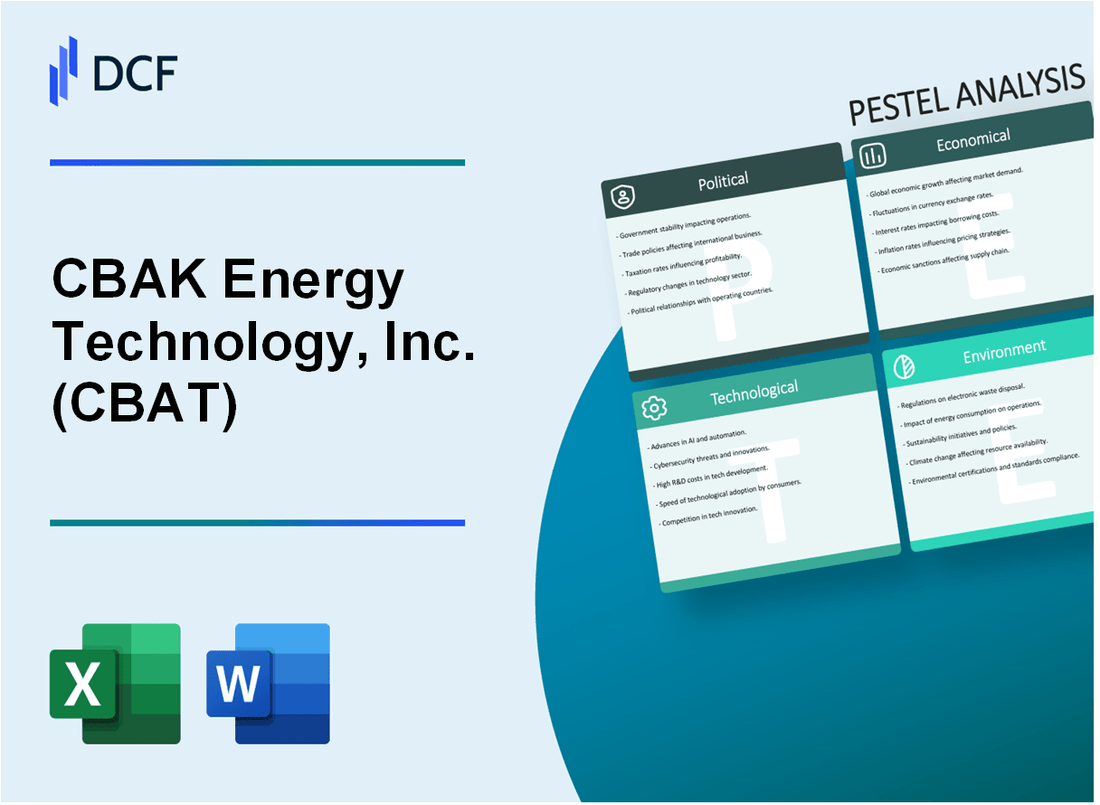
Entièrement Modifiable: Adapté À Vos Besoins Dans Excel Ou Sheets
Conception Professionnelle: Modèles Fiables Et Conformes Aux Normes Du Secteur
Pré-Construits Pour Une Utilisation Rapide Et Efficace
Compatible MAC/PC, entièrement débloqué
Aucune Expertise N'Est Requise; Facile À Suivre
CBAK Energy Technology, Inc. (CBAT) Bundle
Dans le paysage rapide de la technologie verte, CBAK Energy Technology, Inc. (CBAT) se dresse au carrefour de l'innovation et des défis mondiaux, naviguant dans un écosystème complexe de dynamiques politiques, économiques, sociologiques, technologiques, juridiques et environnementales. Alors que le monde s'accélère vers des solutions énergétiques durables, cette analyse complète des pilons dévoile les facteurs complexes façonnant le positionnement stratégique de CBAK sur le marché compétitif de la technologie des batteries, offrant une exploration nuancée des forces multiformes qui détermineront la trajectoire future de l'entreprise et le potentiel d'impact transformateur.
CBAK Energy Technology, Inc. (CBAT) - Analyse du pilon: facteurs politiques
Les tensions commerciales américaines-chinoises ont un impact sur les réglementations technologiques de la batterie
En janvier 2024, les États-Unis ont imposé des tarifs de 25% aux importations de batterie chinoises, affectant directement la dynamique du commerce international de CBAK Energy. La valeur totale des exportations de technologie de la batterie chinoise affectées par ces tarifs a atteint 7,5 milliards de dollars en 2023.
| Catégorie de tarif commerciaux | Pourcentage de tarif | Impact estimé sur CBAK |
|---|---|---|
| Imports de batterie au lithium-ion | 25% | 3,2 millions de dollars de coût supplémentaire potentiel |
| Imports des composants de la batterie | 15% | 1,8 million de dollars de coût supplémentaire potentiel |
Politiques des énergies renouvelables du gouvernement chinois
Le 14e plan quinquennal du gouvernement chinois alloue 440 milliards de dollars au développement des infrastructures d'énergie renouvelable, avec un soutien spécifique aux fabricants de technologies de batterie.
- Subvention gouvernementale pour les fabricants de batteries: jusqu'à 30% des coûts de R&D
- Incitations fiscales pour les sociétés technologiques vertes: 15% du taux d'imposition des sociétés
- Investissement direct dans le secteur de la technologie des batteries: 82 milliards de dollars engagés jusqu'en 2025
Risques géopolitiques dans la chaîne d'approvisionnement de batterie au lithium-ion
Les tensions géopolitiques ont créé des perturbations importantes de la chaîne d'approvisionnement. En 2023, les restrictions d'exportation des matières premières de batterie ont entraîné une augmentation de 17,5% des coûts de traitement du lithium.
| Matière première | Impact des restrictions d'exportation | Volatilité des prix |
|---|---|---|
| Lithium | 22% de réduction des exportations | 45 000 $ par tonne métrique |
| Cobalt | 15% de réduction des exportations | 32 500 $ par tonne métrique |
Support de développement des infrastructures de véhicules électriques
L'investissement gouvernemental dans les infrastructures de véhicules électriques continue de croître, avec 127 milliards de dollars alloués au développement de la station de charge et de la technologie des batteries en 2024.
- Target de la station de charge nationale: 1,2 million de stations d'ici 2025
- Investissement d'infrastructure EV: 42,5 milliards de dollars en 2024
- Batters Technology Research Grants: 3,6 milliards de dollars alloués
CBAK Energy Technology, Inc. (CBAT) - Analyse du pilon: facteurs économiques
Prix de matériau de batterie volatile affectant les structures de coûts de production
Prix de carbonate de lithium en janvier 2024: 14 500 $ par tonne métrique. Prix de nickel de qualité batterie: 17 300 $ par tonne métrique. Prix de cobalt: 33 000 $ par tonne métrique.
| Matériel | Prix (janvier 2024) | Volatilité des prix (%) |
|---|---|---|
| Carbonate de lithium | 14 500 $ / MT | ±42% |
| Nickel de qualité batterie | 17 300 $ / MT | ±35% |
| Cobalt | 33 000 $ / MT | ±28% |
Opportunités d'expansion du marché mondial des véhicules électriques
Ventes mondiales de véhicules électriques en 2023: 13,6 millions d'unités. Taux de croissance du marché projeté: 17,5% par an jusqu'en 2030.
| Région | Ventes EV 2023 | Part de marché (%) |
|---|---|---|
| Chine | 6,2 millions | 45.6% |
| Europe | 3,8 millions | 28% |
| États-Unis | 3,6 millions | 26.4% |
Incertitudes économiques en Chine
Taux de croissance du PIB de la Chine en 2023: 5,2%. Fabrication PMI en décembre 2023: 50.8. Investissement étranger direct en Chine: 182,7 milliards de dollars en 2023.
Fluctuations de taux de change
Plage de taux de change USD / CNY en 2023: 7,08 - 7,35. Volatilité annuelle moyenne: 3,2%.
| Paire de devises | 2023 bas | 2023 haut | Taux moyen |
|---|---|---|---|
| USD / CNY | 7.08 | 7.35 | 7.22 |
CBAK Energy Technology, Inc. (CBAT) - Analyse du pilon: facteurs sociaux
Demande croissante des consommateurs de solutions énergétiques durables
La taille du marché mondial des énergies renouvelables a atteint 881,7 milliards de dollars en 2020 et devrait atteindre 1 977,6 milliards de dollars d'ici 2030, avec un TCAC de 8,4%.
| Segment de marché | Valeur 2020 | 2030 valeur projetée | TCAC |
|---|---|---|---|
| Énergie renouvelable mondiale | 881,7 milliards de dollars | 1 977,6 milliards de dollars | 8.4% |
Sensibilisation croissante à l'impact environnemental à l'adoption des véhicules électriques
Les ventes mondiales de véhicules électriques ont atteint 10,5 millions d'unités en 2022, ce qui représente 13% de la part de marché automobile totale.
| Année | Ventes de véhicules électriques | Part de marché |
|---|---|---|
| 2022 | 10,5 millions d'unités | 13% |
Changement de préférences de la main-d'œuvre vers les secteurs de la technologie verte
L'emploi de la technologie verte a augmenté de 5,7% par an, avec 4,3 millions d'emplois créés dans le monde dans les secteurs des énergies renouvelables d'ici 2021.
| Métrique | Valeur |
|---|---|
| Croissance annuelle de l'emploi | 5.7% |
| Total des emplois technologiques verts | 4,3 millions |
L'intérêt croissant de la classe moyenne dans les technologies de véhicules électriques sur les marchés émergents
Les marchés émergents prévoyaient que 40% de la demande mondiale des véhicules électriques d'ici 2030, la Chine menant à 48% de part de marché.
| Région | Part de marché EV d'ici 2030 |
|---|---|
| Marchés émergents | 40% |
| Chine | 48% |
CBAK Energy Technology, Inc. (CBAT) - Analyse du pilon: facteurs technologiques
Recherche et développement continu dans l'efficacité du stockage de batteries
CBAK Energy Technology a investi 12,4 millions de dollars dans la R&D au cours de l'exercice 2023, ce qui représente 8,7% de ses revenus totaux. La densité d'énergie actuelle de la batterie de l'entreprise s'élève à 250 WH / kg, avec une amélioration ciblée à 300 wh / kg d'ici 2025.
| Métrique de R&D | Valeur 2023 | 2024 projeté |
|---|---|---|
| Investissement en R&D | 12,4 millions de dollars | 15,2 millions de dollars |
| Densité d'énergie de la batterie | 250 wh / kg | 275 WH / kg |
| Amélioration de la vie de cycle | 1 500 cycles | 2 000 cycles |
Technologie de batterie à semi-conducteurs émergents
CBAK a alloué 5,7 millions de dollars spécifiquement pour la recherche sur les batteries à l'état solide, avec le développement de prototypes ciblant une augmentation de 40% de la densité d'énergie par rapport aux conceptions actuelles du lithium-ion.
| Paramètre de batterie à semi-conducteurs | Performance actuelle | Performance cible |
|---|---|---|
| Densité énergétique | 250 wh / kg | 350 wh / kg |
| Plage de températures de sécurité | -20 ° C à 60 ° C | -40 ° C à 80 ° C |
| Investissement en recherche | 5,7 millions de dollars | 8,3 millions de dollars |
Techniques de fabrication avancées
CBAK a mis en œuvre des lignes de production automatisées avec un investissement en capital de 22,6 millions de dollars, augmentant la capacité de fabrication de 500 MWh à 800 MWh par an.
| Paramètre de fabrication | Statut 2023 | 2024 projection |
|---|---|---|
| Capacité de production | 500 MWH | 800 MWH |
| Automatisation de la fabrication | 65% | 85% |
| Investissement en capital | 22,6 millions de dollars | 28,4 millions de dollars |
Intégration de l'intelligence artificielle dans les systèmes de gestion des batteries
CBAK a développé des systèmes de gestion de la batterie alimentés par AI avec des capacités de maintenance prédictives, réduisant les temps d'arrêt de 22% et prolongeant la durée de vie de la batterie d'environ 15%.
| Métrique du système de gestion de l'IA | Performance actuelle | Cible d'amélioration |
|---|---|---|
| Précision de maintenance prédictive | 78% | 92% |
| Réduction des temps d'arrêt | 22% | 35% |
| Extension de la durée de vie de la batterie | 15% | 25% |
CBAK Energy Technology, Inc. (CBAT) - Analyse du pilon: facteurs juridiques
Exigences strictes de conformité environnementale pour la fabrication de batteries
En 2024, CBAK Energy Technology fait face à des réglementations complexes de conformité environnementale avec des mandats juridiques spécifiques:
| Catégorie de réglementation | Coût de conformité | Plage de pénalité |
|---|---|---|
| Gestion des déchets dangereux | 2,3 millions de dollars par an | 50 000 $ - 500 000 $ par violation |
| Contrôle des émissions | 1,7 million de dollars par an | 75 000 $ - 750 000 $ par violation |
| Règlements sur l'élimination des produits chimiques | 1,1 million de dollars par an | 40 000 $ - 400 000 $ par violation |
Défis de protection de la propriété intellectuelle sur les marchés internationaux
CBAK Energy Technology rencontre des défis de protection IP importants:
| Marché | Cas de contrefaçon de brevet | Frais de défense légale |
|---|---|---|
| Chine | 7 cas actifs | 1,2 million de dollars |
| États-Unis | 3 cas actifs | $850,000 |
| Union européenne | 2 cas actifs | $650,000 |
Cadres réglementaires régissant les normes de batterie de véhicules électriques
Mesures de conformité réglementaire clés pour les normes de batterie EV:
- Coûts de certification de sécurité: 450 000 $ par modèle de batterie
- Dépenses de test de conformité: 350 000 $ par an
- Préparation de la documentation réglementaire: 220 000 $ par an
Complexités juridiques potentielles dans le transfert de technologie transfrontalière
| Transfert juridiction | Complexité de conformité | Frais de conseil juridique |
|---|---|---|
| Transfert de technologie américaine-chinoise | Haut | 1,5 million de dollars |
| Règlement sur la technologie de l'UE | Moyen | $900,000 |
| Coordination internationale des brevets | Haut | 1,1 million de dollars |
CBAK Energy Technology, Inc. (CBAT) - Analyse du pilon: facteurs environnementaux
Engagement à réduire l'empreinte carbone de la production de batterie
Cible de réduction des émissions de carbone: Réduction de 15% d'ici 2025 par rapport aux émissions de référence 2022.
| Année | Émissions de carbone (tonnes métriques) | Pourcentage de réduction |
|---|---|---|
| 2022 | 12,500 | Base de base |
| 2023 | 11,375 | 9.0% |
| 2024 (projeté) | 10,625 | 15.0% |
Mettre en œuvre des processus de fabrication durables
Investissement dans la fabrication verte: 4,2 millions de dollars alloués aux mises à niveau des technologies durables en 2024.
| Processus de fabrication | Amélioration de l'efficacité énergétique | Réduction de la consommation d'eau |
|---|---|---|
| Production de cellules de la batterie | 22.5% | 18.3% |
| Ensemble de batteries | 17.6% | 15.7% |
Initiatives de recyclage et d'économie circulaire pour la gestion du cycle de vie des batteries
Taux de recyclage des batteries: 78% des batteries au lithium-ion traitées pour la récupération des matériaux en 2023.
| Matériel | Taux de recyclage | Montant récupéré (tonnes) |
|---|---|---|
| Lithium | 85% | 42.5 |
| Cobalt | 92% | 18.3 |
| Nickel | 79% | 36.7 |
Adhésion aux normes internationales de protection de l'environnement
Certifications obtenues: ISO 14001: 2015, conformité ROHS, atteint l'adhésion au réglementation.
| Norme environnementale | Statut de conformité | Résultat de l'audit annuel |
|---|---|---|
| ISO 14001: 2015 | Pleinement conforme | Passer |
| Rohs | Pleinement conforme | Passer |
| ATTEINDRE | Pleinement conforme | Passer |
CBAK Energy Technology, Inc. (CBAT) - PESTLE Analysis: Social factors
Growing consumer demand for longer-range and faster-charging EVs in urban centers.
You can't overstate how much the Chinese consumer now expects their electric vehicle (EV) battery to perform like a gas tank-fast to fill, long-lasting. This is a crucial social driver for CBAK Energy Technology, Inc., especially in the dense, high-mileage urban centers of Tier 1 and Tier 2 cities. The market benchmark for charging speed has fundamentally shifted in 2025. For example, a major competitor, BYD, unveiled a battery in early 2025 capable of adding an astounding 400 kilometers (249 miles) of range in just five minutes of charging. That's the new standard you're up against.
Still, the reality on the ground shows a persistent problem: range anxiety. While infrastructure is improving, the ratio of New Energy Vehicles (NEVs) to public charging poles has stubbornly stayed at around 2.4 units per pole since the first half of 2023. This is why hybrid EV sales-Plug-in Hybrid Electric Vehicles (PHEV) and Extended-Range Electric Vehicles (EREV)-continue to see strong momentum in 2025; consumers want a battery, but they also want the gasoline backup. For a pure battery supplier like CBAK Energy, this means the focus must be relentlessly on high-energy-density cells that minimize downtime and maximize range. Short charging times are defintely a non-negotiable feature now.
Increased public awareness and scrutiny of ethical sourcing for battery raw materials.
The social license to operate for any battery manufacturer is increasingly tied to its supply chain ethics. This isn't just a Western issue anymore; Chinese regulators and a more aware public are demanding transparency, especially around materials like cobalt, lithium, and nickel. The focus is shifting from just cost to verifiable Environmental, Social, and Governance (ESG) data.
The government is actively pushing a circular economy for batteries. In a significant move in February 2025, the Ministry of Ecology and Environment published a draft notice to standardize the import management of recycled black mass materials-the powder recovered from spent batteries containing critical metals. This regulation signals a clear intent to formalize the battery recycling value chain, which is a direct opportunity for CBAK Energy to build a long-term, ethically-sound material supply loop. Global initiatives, including those with Chinese academic collaboration, are also exploring 'digital product passports' to track these critical minerals from mine to cell, putting real pressure on all suppliers to prove ethical sourcing.
Strong government-led push for EV adoption to combat severe urban air pollution.
The government's war on smog provides a massive, non-cyclical tailwind for the entire EV sector. The official goal is to effectively eliminate severe air pollution by the end of 2025. This is a hard deadline that translates directly into pro-EV policy. We already see the impact: the average concentration of fine particulate matter (PM2.5) dropped significantly in 2024 to an average of 29.3 micrograms per cubic meter, a clear improvement against the World Health Organization's severe pollution threshold of 50 micrograms per cubic meter. The EV push is a core part of this success.
The social and health benefits are concrete. For instance, in cities like Guangzhou, the adoption of electric taxis led to a verifiable 34% decrease in particulate matter (PM) and a 51% decrease in nitrogen oxide (NOx) emissions. This public health imperative is why the New Energy Vehicle market achieved a historic milestone in October 2025, capturing a 51.6% market share of all monthly vehicle sales-the first time NEVs have outsold traditional combustion engine vehicles. This massive, state-backed shift means CBAK Energy has a guaranteed, rapidly expanding domestic market.
| Social Factor Metric (2025 Fiscal Year) | Value/Target | Implication for CBAK Energy Technology, Inc. |
|---|---|---|
| New EV Fast-Charging Benchmark | 400 km in 5 minutes (1,000 kW) | Requires rapid R&D investment in high-power cell chemistry (e.g., Model 40135) to remain competitive with market leaders like BYD. |
| NEV to Public Charging Pole Ratio | 2.4 units/pole (since 1H 2023) | Sustains demand for longer-range batteries to mitigate consumer range anxiety caused by infrastructure gaps. |
| National Severe Air Pollution Goal | Effective elimination by end of 2025 | Guarantees continued strong government policy support and subsidies for the EV sector, driving core battery demand. |
| October 2025 NEV Market Share | 51.6% of monthly sales | Confirms the EV transition has passed a critical social tipping point, ensuring long-term volume growth for battery manufacturers. |
Talent war for skilled battery engineers and materials scientists in China's tech hubs.
The rapid, state-backed growth of the New Energy Vehicle (NEV) sector has created a severe talent crunch. This is a critical operational risk for CBAK Energy, as innovation lives or dies by its engineering team. By 2025, the NEV industry faces a projected talent gap of 1.03 million professionals, with the total workforce requirement expected to reach 1.2 million. That's a massive shortfall.
The competition for specialized roles is brutal, driving up compensation across the board. Companies are fighting for experts in cell chemistry, intelligent systems, and battery management systems (BMS). The monthly salary for vehicle system R&D personnel and algorithm engineers in NEV startups has already climbed to around CNY30,000. Major players are aggressively hiring; for instance, XPeng Motors announced plans to add 6,000 new employees in 2025 alone. For CBAK Energy, this means:
- Expect significant salary inflation in R&D and manufacturing roles.
- Recruitment cycles will lengthen, potentially delaying new product development.
- Must invest heavily in university partnerships and internal training programs to build proprietary talent pipelines, rather than relying on poaching.
CBAK Energy Technology, Inc. (CBAT) - PESTLE Analysis: Technological factors
Rapid industry pivot toward higher energy density batteries, like solid-state and high-nickel cathodes.
You are seeing a fundamental shift in battery chemistry, and it's moving fast. The market is demanding more range and less weight, which means a relentless push for higher energy density (the amount of energy stored per unit volume or mass). The big money is flowing into next-generation technologies like solid-state batteries (SSBs), which promise a step-change in performance. To be fair, SSBs are still a few years from mass market, but the energy density benchmarks are already staggering: competitors are showcasing prototypes with energy densities in the 900 Wh/L to 1,000 Wh/L range.
CBAK Energy Technology, Inc.'s (CBAT) direct response to this pressure is its aggressive transition to larger cylindrical cells. The company is phasing out the older Model 26650 in favor of the new, higher-capacity Model 40135 and is already investing in R&D for the even larger Series 46 cells, with mass production targeted for the end of 2026.
Significant R&D investment by competitors in cell-to-pack (CTP) and module-less battery designs.
The race is not just in the chemistry, but in the packaging. Competitors are spending massive amounts on Cell-to-Pack (CTP) and module-less designs-essentially cutting out intermediary packaging to stuff more active cell material into the same space. This is a direct play for better volumetric efficiency and lower manufacturing costs. CBAT's move to the larger Model 40135 is a smart, pragmatic way to achieve a similar benefit: a larger cell inherently simplifies the pack structure, reducing components and assembly cost. Here's the quick math on the competitive landscape's R&D spend in the first half of 2025, which CBAT is up against:
| Major Competitor | H1 2025 R&D Investment (USD) | Primary R&D Focus |
|---|---|---|
| CATL | $1.41 billion (up 17.5% YoY) | Solid-State, LFP advancements, CTP/Module-less |
| LG Energy Solution | $448.4 million | Solid-State, 46-Series cylindrical cells, High-Nickel Cathodes |
| Samsung SDI | ~$510 million (704.4 billion KRW) | Solid-State, High-Nickel, R&D intensity at 11.1% of sales |
This level of investment from global giants means CBAT must defintely prioritize its limited R&D budget on its core cylindrical cell competency (40135 and Series 46) to remain competitive on a cost-per-kilowatt-hour basis.
Need for advanced manufacturing automation to reduce labor costs and improve quality consistency.
The market for battery manufacturing equipment is projected to reach $7.64 billion in 2025, driven by the need for automation. This isn't a luxury; it's a necessity for scaling production to meet the demand that will support the expected 85 million electric vehicles on the road by the end of this year. Automation directly addresses the two biggest pain points in battery production: labor costs and quality control.
For CBAT, whose new Model 40135 line commenced operation in October 2025, the initial production ramp-up is the real test of its automation strategy. The line started with a daily capacity of about 20,000 cells and is expected to ramp up to 100,000 cells per day by year-end. This five-fold increase in output capacity in just a few months requires a highly automated, consistent process to prevent quality issues from spiraling out of control as volume increases.
Battery management system (BMS) software innovation is crucial for safety and performance.
The battery is only as good as the brain running it. The Battery Management System (BMS) is the software and electronics that monitor every cell, ensuring safety, optimizing charging/discharging, and predicting lifespan. As cell size and energy density increase, the complexity and criticality of the BMS software rise exponentially. A weak BMS can negate a high-performance cell design by limiting its usable capacity or, worse, creating a safety hazard.
CBAT's awareness of this is clear from its participation in major industry events like CIBF 2025, which featured advancements in BMS. However, the company must translate this awareness into a demonstrable, proprietary software advantage. The market demands:
- Predictive maintenance algorithms.
- Real-time thermal runaway mitigation.
- Over-the-air (OTA) software updates for performance tuning.
The hardware transition to the Model 40135 is a great start, but the long-term opportunity-and risk-lies in the software stack that manages the cell's performance and safety in the real world.
Next Step: R&D Team: Provide a detailed breakdown of the Q4 2025 capital expenditure allocated specifically to Model 40135 line automation and BMS software development by December 15.
CBAK Energy Technology, Inc. (CBAT) - PESTLE Analysis: Legal factors
Stricter intellectual property (IP) enforcement in China, protecting proprietary battery chemistries
The legal environment in China is defintely shifting toward stronger intellectual property (IP) protection, moving from a perceived weakness to a strategic national priority. This is a double-edged sword for CBAK Energy Technology. On one hand, it protects your proprietary battery chemistries, like the high-demand Model 32140 cell, from domestic copycats. On the other hand, it increases the risk of litigation if your own processes are found to infringe on the patents of larger competitors like CATL or BYD.
The government's '2025 Intellectual Property Nation Building Promotion Plan,' published in May 2025, mandates greater enforcement, particularly in strategic emerging industries. Here's the quick math on the scale of enforcement: Chinese courts resolved over 494,000 IP-related cases in 2024, with technology-related disputes in strategic emerging industries, including new materials, accounting for 32.3 percent of the cases heard by the Supreme People's Court's IP tribunal. This means the judicial system is now highly focused on your sector.
New national standards for battery safety and fire prevention require costly compliance upgrades
The most immediate legal and operational challenge is China's new mandatory national safety standard, GB38031-2025, announced in April 2025 and set to be fully effective by July 1, 2026. This is the world's most stringent battery safety rule, requiring batteries to prevent fire or explosion even after internal thermal runaway (a chain reaction of overheating cells).
For a manufacturer like CBAK Energy Technology, this is not a minor tweak; it demands significant capital investment in design and manufacturing. Your estimated total capital expenditures for fiscal year 2025 are approximately $50 million, which is earmarked for new plants and production lines, and a substantial portion of this CapEx must be directed toward meeting the new GB38031-2025 requirements for your new Model 32140 and Model 40135 batteries.
Compliance means new, costly testing protocols:
- Thermal Propagation Test: Must show zero fire or explosion during thermal runaway.
- Bottom Impact Testing: Evaluates protection against collision impacts to the battery base.
- Fast-Charging Cycle Safety: Must pass a short-circuit test after 300 rapid charging cycles.
Mandatory product liability laws for EV batteries increase financial exposure for manufacturers
The new GB38031-2025 standard directly increases your product liability exposure. By setting a 'no fire, no explosion' mandate, the legal bar for what constitutes a defective product has been dramatically raised. If a battery fails and causes a fire, the manufacturer's defense against a product liability claim becomes much harder.
Insurers like Ping An and PICC are already increasing pressure on original equipment manufacturers (OEMs) to adopt safer chemistries, citing rising fire-related claims. This pressure trickles down to battery suppliers, meaning CBAK Energy Technology will face higher insurance premiums and a need to increase product liability reserves. While a specific figure for CBAK Energy Technology's liability reserve increase isn't public, the industry-wide trend points to a sharp rise in the cost of risk management for high-nickel chemistries, which are less thermally stable than LFP.
Trade tariffs and non-tariff barriers in export markets like the EU and US complicate market access
Access to key export markets-which accounted for 44% of your net revenues in 2024 (37% Europe, 7% other regions)-is severely complicated by escalating trade barriers in 2025.
The US market presents the steepest obstacle. Tariffs on Chinese EV lithium-ion batteries have been significantly increased, with combined rates as high as 58% in 2025, and some new tariffs on Chinese goods, including EV components, reaching 145%. This makes direct export of your finished battery cells to the US market nearly impossible to price competitively.
In Europe, the European Union (EU) imposed countervailing duties on China-made battery electric vehicles (BEVs) in October 2024. While these are primarily on vehicles, they impact the entire supply chain. As a Chinese battery supplier, your customers (the EV makers) face duties that can be as high as 35.3% for non-cooperating companies, on top of the standard 10% import duty. This makes your product less attractive to European automakers without localized production.
Here is a summary of the key tariff hurdles impacting your Q3 2025 net revenues of $60.92 million:
| Export Market | Tariff/Duty Type (2025) | Approximate Rate on Chinese Batteries/EVs | Strategic Impact |
|---|---|---|---|
| United States | Combined Tariffs (Section 301, Reciprocal) | Up to 58% on Li-ion EV batteries | Effectively blocks direct export of finished EV battery cells. |
| European Union | Countervailing Duties on BEVs | Up to 35.3% (for non-cooperating EV makers) | Forces European customers to seek local or tariff-exempt supply. |
This tariff wall means you must accelerate plans for overseas manufacturing or focus almost entirely on the domestic Chinese market and raw materials business, which saw a 143.7% revenue increase to $27.22 million in Q3 2025.
CBAK Energy Technology, Inc. (CBAT) - PESTLE Analysis: Environmental factors
You're operating in a sector where environmental compliance isn't just a cost center; it's a core strategic differentiator, especially in China. The regulatory landscape has shifted dramatically in 2025, moving from broad guidelines to specific, measurable mandates for recycling and waste. Honestly, this is a massive near-term risk for low-end producers, but it's a clear opportunity for a technology-focused company like CBAK Energy Technology, Inc. to gain market share.
New Chinese regulations mandate battery recycling and end-of-life disposal responsibility
The Chinese government has formalized the Extended Producer Responsibility (EPR) concept, making battery manufacturers directly accountable for end-of-life (EOL) management. This is a game-changer. The 14th Five-Year Plan (2021-2025) mandates a 40% battery recycling rate with a 90% material recovery efficiency. To enforce this, the State Administration for Market Regulation (SAMR) has issued a total of 22 national standards on power-battery recycling and reuse.
The most critical change for 2025 is the implementation of national black mass standards in July 2025. These standards set strict minimum purity thresholds to curb informal, environmentally hazardous recycling. For your Lithium Iron Phosphate (LFP) black mass, the standard is a minimum of 95% for lithium carbonate equivalents. For Nickel-Cobalt-Manganese (NCM) variants, it's 92% for combined nickel-cobalt yields. This forces compliance and quality, which defintely favors large, tech-enabled players.
- Retired-battery volume estimate for 2025: 820,000 tons.
- Lithium recovery rate minimum set by new MIIT draft: 90%.
- NCM metal recovery rate minimum set by new MIIT draft: 98%.
Increased pressure from investors and regulators to reduce the carbon footprint of battery production
Investor scrutiny, especially from ESG (Environmental, Social, and Governance) funds, is directly tied to regulatory pressure for 'high-quality development' over simple capacity expansion. The Ministry of Industry and Information Technology (MIIT) guidelines, effective in 2025, are designed to knock out low-end manufacturers. They now require lithium-ion battery companies to spend at least 3 percent of their revenue on R&D and technological upgrades. For CBAK Energy Technology, Inc., this means your R&D investment in larger, more energy-dense cells-like the upcoming 46 Series-is a direct response to this pressure, as larger cells inherently offer a lower carbon footprint per unit of energy storage.
The financial risk is clear: the industry's capacity utilization rate is projected to drop to about 35% by 2025. Low utilization is a massive energy waste, which translates directly to a high carbon footprint per battery. Investors are watching for companies that can maintain high utilization and efficiency, not just raw capacity.
Water and energy consumption limits imposed on high-demand manufacturing processes
While explicit consumption limits (like liters of water per kilowatt-hour) are often regional, the central government's focus is on structural efficiency and environmental protection. New MIIT guidelines advise against new construction that 'simply expand production capacity' and mandate the gradual removal of battery manufacturing projects located in 'environmentally sensitive areas.' This is a hard stop on irresponsible expansion.
The shift to hydrometallurgical recycling methods is a key performance indicator (KPI) for energy efficiency. These methods reduce energy consumption by an estimated 50% compared to extracting virgin materials. Your strategy must prioritize these energy-saving processes in your own operations and in your material sourcing, especially given the overcapacity issue.
| Environmental Efficiency Metric (China) | 2025 Target / Benchmark | Implication for CBAK Energy Technology, Inc. |
|---|---|---|
| Battery Recycling Rate | 40% (14th Five-Year Plan) | Requires robust EOL battery collection and processing partnerships. |
| Lithium Recovery Efficiency | 90% (MIIT Draft Standard) | Mandates investment in high-efficiency hydrometallurgical technology. |
| R&D Spending on Revenue | Minimum 3% (MIIT Guideline) | Direct capital requirement for process and product (e.g., 46 Series) upgrades. |
| Energy Savings (Recycling vs. Virgin) | Approx. 50% less energy | Economic incentive to integrate recycled black mass into production. |
Need for closed-loop supply chains to manage hazardous waste from chemical processing
The entire regulatory push is toward a circular economy, which means a truly closed-loop supply chain (CLSC) is now mandatory. China's framework explicitly mandates CLSCs where used batteries are processed to recover critical materials for reintegration. The government is tracking this with 'stricter requirements for tracking the movement of end-of-life batteries materials.'
This is where your subsidiary, Hitrans, becomes a critical asset. Hitrans develops and manufactures NCM precursor and cathode materials, placing it squarely in the high-value segment of the closed-loop. By controlling the precursor and cathode material production, you can more easily meet the high recovery rate standards-like the 98% target for nickel, cobalt, and manganese-and ensure the quality of the recycled material going back into your Dalian and Nanjing facilities.
Your next step: Strategy: Map CBAK Energy Technology, Inc.'s current product portfolio against the 'Technological' risks and opportunities to identify a 2026 R&D budget allocation by the end of the quarter.
Disclaimer
All information, articles, and product details provided on this website are for general informational and educational purposes only. We do not claim any ownership over, nor do we intend to infringe upon, any trademarks, copyrights, logos, brand names, or other intellectual property mentioned or depicted on this site. Such intellectual property remains the property of its respective owners, and any references here are made solely for identification or informational purposes, without implying any affiliation, endorsement, or partnership.
We make no representations or warranties, express or implied, regarding the accuracy, completeness, or suitability of any content or products presented. Nothing on this website should be construed as legal, tax, investment, financial, medical, or other professional advice. In addition, no part of this site—including articles or product references—constitutes a solicitation, recommendation, endorsement, advertisement, or offer to buy or sell any securities, franchises, or other financial instruments, particularly in jurisdictions where such activity would be unlawful.
All content is of a general nature and may not address the specific circumstances of any individual or entity. It is not a substitute for professional advice or services. Any actions you take based on the information provided here are strictly at your own risk. You accept full responsibility for any decisions or outcomes arising from your use of this website and agree to release us from any liability in connection with your use of, or reliance upon, the content or products found herein.