

|
CBAK Energy Technology, Inc. (CBAT): Análisis PESTLE [Actualizado en enero de 2025] |
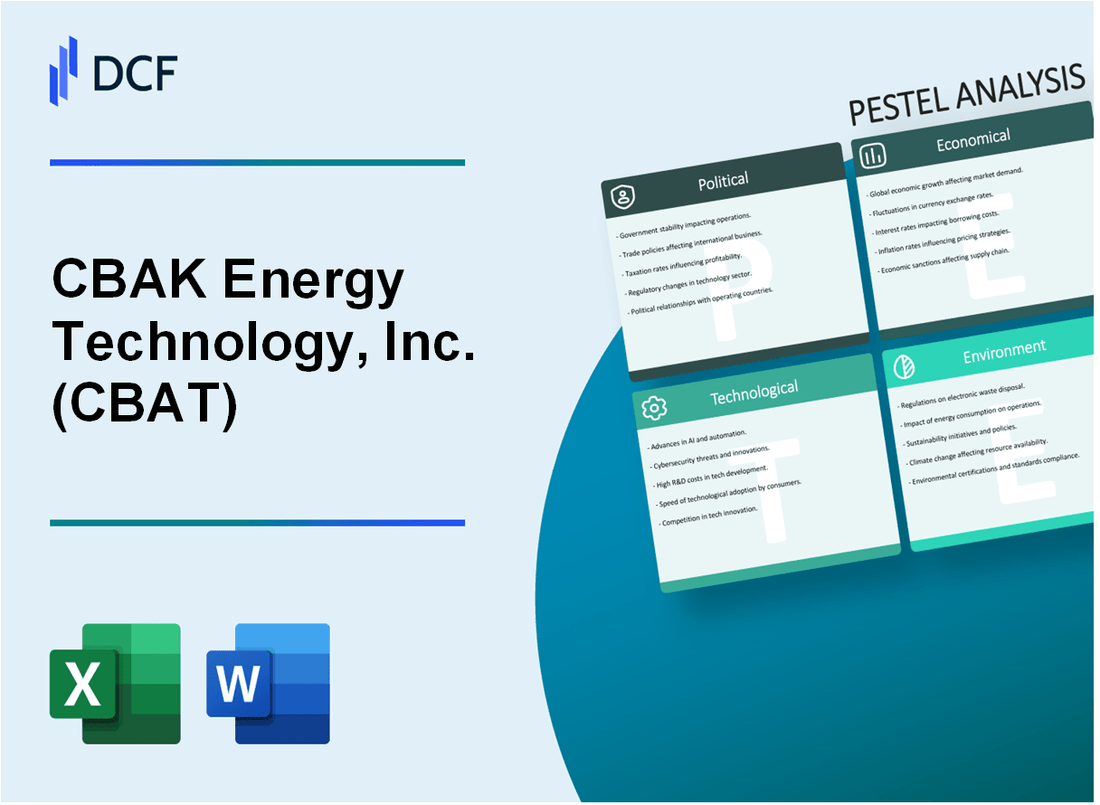
Completamente Editable: Adáptelo A Sus Necesidades En Excel O Sheets
Diseño Profesional: Plantillas Confiables Y Estándares De La Industria
Predeterminadas Para Un Uso Rápido Y Eficiente
Compatible con MAC / PC, completamente desbloqueado
No Se Necesita Experiencia; Fáciles De Seguir
CBAK Energy Technology, Inc. (CBAT) Bundle
En el panorama en rápida evolución de la tecnología verde, CBAK Energy Technology, Inc. (CBAT) se encuentra en la encrucijada de la innovación y los desafíos globales, navegando por un complejo ecosistema de dinámica política, económica, sociológica, tecnológica, legal y ambiental. A medida que el mundo se acelera hacia soluciones de energía sostenible, este análisis integral de mortero revela los intrincados factores que dan forma al posicionamiento estratégico de CBAK en el mercado competitivo de tecnología de baterías, ofreciendo una exploración matizada de las fuerzas multifacéticas que determinarán la futura trayectoria y el potencial de la compañía para el impacto transformador.
CBAK Energy Technology, Inc. (CBAT) - Análisis de mortero: factores políticos
Tensiones comerciales de US-China Impacto en las regulaciones de tecnología de baterías
A partir de enero de 2024, Estados Unidos impuso aranceles del 25% a las importaciones de baterías chinas, afectando directamente la dinámica del comercio internacional de CBAK Energy. El valor total de las exportaciones de tecnología de baterías chinas afectadas por estos aranceles alcanzó los $ 7.5 mil millones en 2023.
| Categoría de tarifa comercial | Porcentaje arancelario | Impacto estimado en CBAK |
|---|---|---|
| Importaciones de batería de iones de litio | 25% | Costo adicional potencial de $ 3.2 millones |
| Importaciones de componentes de la batería | 15% | Costo adicional potencial de $ 1.8 millones |
Políticas de energía renovable del gobierno chino
El 14º plan de cinco años del gobierno chino asigna $ 440 mil millones para el desarrollo de la infraestructura de energía renovable, con soporte específico para los fabricantes de tecnología de baterías.
- Subsidio gubernamental para fabricantes de baterías: hasta el 30% de los costos de I + D
- Incentivos fiscales para empresas de tecnología verde: 15% de tasa de impuestos corporativos
- Inversión directa en sector de tecnología de baterías: $ 82 mil millones comprometidos hasta 2025
Riesgos geopolíticos en la cadena de suministro de baterías de iones de litio
Las tensiones geopolíticas han creado importantes interrupciones de la cadena de suministro. En 2023, las restricciones de exportación de materias primas de batería dieron como resultado un aumento del 17.5% en los costos de procesamiento de litio.
| Materia prima | Impacto de restricción de exportación | Volatilidad de los precios |
|---|---|---|
| Litio | 22% de reducción de exportación | $ 45,000 por tonelada métrica |
| Cobalto | 15% de reducción de exportación | $ 32,500 por tonelada métrica |
Soporte de desarrollo de infraestructura de vehículos eléctricos
La inversión gubernamental en infraestructura de vehículos eléctricos continúa creciendo, con $ 127 mil millones asignados para la estación de carga y el desarrollo de tecnología de baterías en 2024.
- Objetivo nacional de la estación de carga: 1.2 millones de estaciones para 2025
- EV Inversión de infraestructura: $ 42.5 mil millones en 2024
- Subvenciones de investigación de tecnología de baterías: $ 3.6 mil millones asignados
CBAK Energy Technology, Inc. (CBAT) - Análisis de mortero: factores económicos
Precio de material de batería volátil que afecta las estructuras de costos de producción
Precio de carbonato de litio a partir de enero de 2024: $ 14,500 por tonelada métrica. Precio de níquel de grado de batería: $ 17,300 por tonelada métrica. Precio de cobalto: $ 33,000 por tonelada métrica.
| Material | Precio (enero de 2024) | Volatilidad de los precios (%) |
|---|---|---|
| Carbonato de litio | $ 14,500/mt | ±42% |
| Níquel de grado de batería | $ 17,300/mt | ±35% |
| Cobalto | $ 33,000/mt | ±28% |
Oportunidades de expansión del mercado mundial de vehículos eléctricos
Ventas de vehículos eléctricos globales en 2023: 13.6 millones de unidades. Tasa de crecimiento del mercado proyectado: 17.5% anual hasta 2030.
| Región | EV Sales 2023 | Cuota de mercado (%) |
|---|---|---|
| Porcelana | 6.2 millones | 45.6% |
| Europa | 3.8 millones | 28% |
| Estados Unidos | 3.6 millones | 26.4% |
Incertidumbres económicas en China
Tasa de crecimiento del PIB de China en 2023: 5.2%. Fabricación PMI en diciembre de 2023: 50.8. Inversión extranjera directa en China: $ 182.7 mil millones en 2023.
Fluctuaciones del tipo de cambio de divisas
Rango de tipo de cambio USD/CNY en 2023: 7.08 - 7.35. Volatilidad anual promedio: 3.2%.
| Pareja | 2023 bajo | 2023 alto | Tasa promedio |
|---|---|---|---|
| USD/CNY | 7.08 | 7.35 | 7.22 |
CBAK Energy Technology, Inc. (CBAT) - Análisis de mortero: factores sociales
Creciente demanda de consumidores de soluciones de energía sostenible
El tamaño del mercado mundial de energía renovable alcanzó los $ 881.7 mil millones en 2020 y se proyecta que crecerá a $ 1,977.6 mil millones para 2030, con una tasa compuesta anual del 8.4%.
| Segmento de mercado | Valor 2020 | 2030 Valor proyectado | Tocón |
|---|---|---|---|
| Energía renovable global | $ 881.7 mil millones | $ 1,977.6 mil millones | 8.4% |
Aumento de la conciencia del impacto ambiental conduciendo la adopción de vehículos eléctricos
Las ventas globales de vehículos eléctricos alcanzaron 10.5 millones de unidades en 2022, lo que representa el 13% del total de participación en el mercado automotriz.
| Año | Ventas de EV | Cuota de mercado |
|---|---|---|
| 2022 | 10.5 millones de unidades | 13% |
Cambiando las preferencias de la fuerza laboral hacia los sectores de tecnología verde
El empleo en tecnología verde aumentó un 5,7% anual, con 4.3 millones de empleos creados a nivel mundial en sectores de energía renovable para 2021.
| Métrico | Valor |
|---|---|
| Crecimiento del empleo anual | 5.7% |
| Trabajos de tecnología verde total | 4.3 millones |
Interior de clase media en tecnologías de vehículos eléctricos en los mercados emergentes
Los mercados emergentes proyectados para contribuir al 40% de la demanda mundial de vehículos eléctricos para 2030, con China liderando con una participación de mercado del 48%.
| Región | Cuota de mercado de EV para 2030 |
|---|---|
| Mercados emergentes | 40% |
| Porcelana | 48% |
CBAK Energy Technology, Inc. (CBAT) - Análisis de mortero: factores tecnológicos
Investigación y desarrollo continuos en eficiencia de almacenamiento de baterías
CBAK Energy Technology ha invertido $ 12.4 millones en I + D durante el año fiscal 2023, lo que representa el 8,7% de sus ingresos totales. La densidad de energía de la batería actual de la compañía es de 250 wh/kg, con una mejora dirigida a 300 wh/kg para 2025.
| I + D Métrica | Valor 2023 | 2024 proyectado |
|---|---|---|
| Inversión de I + D | $ 12.4 millones | $ 15.2 millones |
| Densidad de energía de la batería | 250 wh/kg | 275 wh/kg |
| Mejora de la vida del ciclo | 1.500 ciclos | 2,000 ciclos |
Tecnología de batería de estado sólido emergente
CBAK ha asignado $ 5.7 millones específicamente para la investigación de baterías de estado sólido, con un desarrollo de prototipos apuntando a un aumento del 40% en la densidad de energía en comparación con los diseños actuales de iones de litio.
| Parámetro de batería de estado sólido | Rendimiento actual | Rendimiento objetivo |
|---|---|---|
| Densidad de energía | 250 wh/kg | 350 wh/kg |
| Rango de temperatura de seguridad | -20 ° C a 60 ° C | -40 ° C a 80 ° C |
| Inversión de investigación | $ 5.7 millones | $ 8.3 millones |
Técnicas de fabricación avanzadas
CBAK ha implementado líneas de producción automatizadas con una inversión de capital de $ 22.6 millones, aumentando la capacidad de fabricación de 500 MWh a 800 MWh anualmente.
| Parámetro de fabricación | Estado 2023 | 2024 proyección |
|---|---|---|
| Capacidad de producción | 500 MWh | 800 MWh |
| Automatización de fabricación | 65% | 85% |
| Inversión de capital | $ 22.6 millones | $ 28.4 millones |
Integración de inteligencia artificial en sistemas de gestión de baterías
CBAK ha desarrollado sistemas de gestión de baterías con IA con capacidades de mantenimiento predictivo, reduciendo el tiempo de inactividad en un 22% y extendiendo la vida útil de la batería en un 15% estimado.
| Métrica del sistema de gestión de IA | Rendimiento actual | Objetivo de mejora |
|---|---|---|
| Precisión de mantenimiento predictivo | 78% | 92% |
| Reducción del tiempo de inactividad | 22% | 35% |
| Extensión de la duración de la batería | 15% | 25% |
CBAK Energy Technology, Inc. (CBAT) - Análisis de mortero: factores legales
Requisitos estrictos de cumplimiento ambiental para la fabricación de baterías
A partir de 2024, CBAK Energy Technology enfrenta regulaciones complejas de cumplimiento ambiental con mandatos legales específicos:
| Categoría de regulación | Costo de cumplimiento | Rango de penalización |
|---|---|---|
| Gestión de residuos peligrosos | $ 2.3 millones anualmente | $ 50,000 - $ 500,000 por violación |
| Control de emisiones | $ 1.7 millones anuales | $ 75,000 - $ 750,000 por violación |
| Regulaciones de eliminación de productos químicos | $ 1.1 millones anualmente | $ 40,000 - $ 400,000 por violación |
Desafíos de protección de propiedad intelectual en los mercados internacionales
CBAK Energy Technology encuentra desafíos significativos de protección de IP:
| Mercado | Casos de infracción de patentes | Costos de defensa legal |
|---|---|---|
| Porcelana | 7 casos activos | $ 1.2 millones |
| Estados Unidos | 3 casos activos | $850,000 |
| unión Europea | 2 casos activos | $650,000 |
Marcos regulatorios que rigen los estándares de batería de vehículos eléctricos
Clave Métricas de cumplimiento regulatorio para estándares de batería EV:
- Costos de certificación de seguridad: $ 450,000 por modelo de batería
- Gastos de pruebas de cumplimiento: $ 350,000 anualmente
- Preparación de documentación regulatoria: $ 220,000 por año
Posibles complejidades legales en la transferencia de tecnología transfronteriza
| Transferir jurisdicción | Complejidad de cumplimiento | Costos de asesoramiento legal |
|---|---|---|
| Transferencia de tecnología US-China | Alto | $ 1.5 millones |
| Regulaciones de tecnología de la UE | Medio | $900,000 |
| Coordinación internacional de patentes | Alto | $ 1.1 millones |
CBAK Energy Technology, Inc. (CBAT) - Análisis de mortero: factores ambientales
Compromiso de reducir la huella de carbono en la producción de baterías
Objetivo de reducción de emisiones de carbono: Reducción del 15% para 2025 en comparación con las emisiones de referencia de 2022.
| Año | Emisiones de carbono (toneladas métricas) | Porcentaje de reducción |
|---|---|---|
| 2022 | 12,500 | Base |
| 2023 | 11,375 | 9.0% |
| 2024 (proyectado) | 10,625 | 15.0% |
Implementación de procesos de fabricación sostenibles
Inversión en fabricación verde: $ 4.2 millones asignados para actualizaciones de tecnología sostenible en 2024.
| Proceso de fabricación | Mejora de la eficiencia energética | Reducción del consumo de agua |
|---|---|---|
| Producción de celdas de batería | 22.5% | 18.3% |
| Montaje de la batería | 17.6% | 15.7% |
Iniciativas de reciclaje y economía circular para la gestión del ciclo de vida de la batería
Velocidad de reciclaje de la batería: 78% de las baterías de iones de litio procesadas para la recuperación del material en 2023.
| Material | Tasa de reciclaje | Cantidad recuperada (toneladas) |
|---|---|---|
| Litio | 85% | 42.5 |
| Cobalto | 92% | 18.3 |
| Níquel | 79% | 36.7 |
Adherencia a los estándares internacionales de protección del medio ambiente
Certificaciones obtenidas: ISO 14001: 2015, Cumplimiento de ROHS, Adherencia de la regulación Reach.
| Estándar ambiental | Estado de cumplimiento | Resultado de auditoría anual |
|---|---|---|
| ISO 14001: 2015 | Totalmente cumplido | Aprobar |
| ROHS | Totalmente cumplido | Aprobar |
| ALCANZAR | Totalmente cumplido | Aprobar |
CBAK Energy Technology, Inc. (CBAT) - PESTLE Analysis: Social factors
Growing consumer demand for longer-range and faster-charging EVs in urban centers.
You can't overstate how much the Chinese consumer now expects their electric vehicle (EV) battery to perform like a gas tank-fast to fill, long-lasting. This is a crucial social driver for CBAK Energy Technology, Inc., especially in the dense, high-mileage urban centers of Tier 1 and Tier 2 cities. The market benchmark for charging speed has fundamentally shifted in 2025. For example, a major competitor, BYD, unveiled a battery in early 2025 capable of adding an astounding 400 kilometers (249 miles) of range in just five minutes of charging. That's the new standard you're up against.
Still, the reality on the ground shows a persistent problem: range anxiety. While infrastructure is improving, the ratio of New Energy Vehicles (NEVs) to public charging poles has stubbornly stayed at around 2.4 units per pole since the first half of 2023. This is why hybrid EV sales-Plug-in Hybrid Electric Vehicles (PHEV) and Extended-Range Electric Vehicles (EREV)-continue to see strong momentum in 2025; consumers want a battery, but they also want the gasoline backup. For a pure battery supplier like CBAK Energy, this means the focus must be relentlessly on high-energy-density cells that minimize downtime and maximize range. Short charging times are defintely a non-negotiable feature now.
Increased public awareness and scrutiny of ethical sourcing for battery raw materials.
The social license to operate for any battery manufacturer is increasingly tied to its supply chain ethics. This isn't just a Western issue anymore; Chinese regulators and a more aware public are demanding transparency, especially around materials like cobalt, lithium, and nickel. The focus is shifting from just cost to verifiable Environmental, Social, and Governance (ESG) data.
The government is actively pushing a circular economy for batteries. In a significant move in February 2025, the Ministry of Ecology and Environment published a draft notice to standardize the import management of recycled black mass materials-the powder recovered from spent batteries containing critical metals. This regulation signals a clear intent to formalize the battery recycling value chain, which is a direct opportunity for CBAK Energy to build a long-term, ethically-sound material supply loop. Global initiatives, including those with Chinese academic collaboration, are also exploring 'digital product passports' to track these critical minerals from mine to cell, putting real pressure on all suppliers to prove ethical sourcing.
Strong government-led push for EV adoption to combat severe urban air pollution.
The government's war on smog provides a massive, non-cyclical tailwind for the entire EV sector. The official goal is to effectively eliminate severe air pollution by the end of 2025. This is a hard deadline that translates directly into pro-EV policy. We already see the impact: the average concentration of fine particulate matter (PM2.5) dropped significantly in 2024 to an average of 29.3 micrograms per cubic meter, a clear improvement against the World Health Organization's severe pollution threshold of 50 micrograms per cubic meter. The EV push is a core part of this success.
The social and health benefits are concrete. For instance, in cities like Guangzhou, the adoption of electric taxis led to a verifiable 34% decrease in particulate matter (PM) and a 51% decrease in nitrogen oxide (NOx) emissions. This public health imperative is why the New Energy Vehicle market achieved a historic milestone in October 2025, capturing a 51.6% market share of all monthly vehicle sales-the first time NEVs have outsold traditional combustion engine vehicles. This massive, state-backed shift means CBAK Energy has a guaranteed, rapidly expanding domestic market.
| Social Factor Metric (2025 Fiscal Year) | Value/Target | Implication for CBAK Energy Technology, Inc. |
|---|---|---|
| New EV Fast-Charging Benchmark | 400 km in 5 minutes (1,000 kW) | Requires rapid R&D investment in high-power cell chemistry (e.g., Model 40135) to remain competitive with market leaders like BYD. |
| NEV to Public Charging Pole Ratio | 2.4 units/pole (since 1H 2023) | Sustains demand for longer-range batteries to mitigate consumer range anxiety caused by infrastructure gaps. |
| National Severe Air Pollution Goal | Effective elimination by end of 2025 | Guarantees continued strong government policy support and subsidies for the EV sector, driving core battery demand. |
| October 2025 NEV Market Share | 51.6% of monthly sales | Confirms the EV transition has passed a critical social tipping point, ensuring long-term volume growth for battery manufacturers. |
Talent war for skilled battery engineers and materials scientists in China's tech hubs.
The rapid, state-backed growth of the New Energy Vehicle (NEV) sector has created a severe talent crunch. This is a critical operational risk for CBAK Energy, as innovation lives or dies by its engineering team. By 2025, the NEV industry faces a projected talent gap of 1.03 million professionals, with the total workforce requirement expected to reach 1.2 million. That's a massive shortfall.
The competition for specialized roles is brutal, driving up compensation across the board. Companies are fighting for experts in cell chemistry, intelligent systems, and battery management systems (BMS). The monthly salary for vehicle system R&D personnel and algorithm engineers in NEV startups has already climbed to around CNY30,000. Major players are aggressively hiring; for instance, XPeng Motors announced plans to add 6,000 new employees in 2025 alone. For CBAK Energy, this means:
- Expect significant salary inflation in R&D and manufacturing roles.
- Recruitment cycles will lengthen, potentially delaying new product development.
- Must invest heavily in university partnerships and internal training programs to build proprietary talent pipelines, rather than relying on poaching.
CBAK Energy Technology, Inc. (CBAT) - PESTLE Analysis: Technological factors
Rapid industry pivot toward higher energy density batteries, like solid-state and high-nickel cathodes.
You are seeing a fundamental shift in battery chemistry, and it's moving fast. The market is demanding more range and less weight, which means a relentless push for higher energy density (the amount of energy stored per unit volume or mass). The big money is flowing into next-generation technologies like solid-state batteries (SSBs), which promise a step-change in performance. To be fair, SSBs are still a few years from mass market, but the energy density benchmarks are already staggering: competitors are showcasing prototypes with energy densities in the 900 Wh/L to 1,000 Wh/L range.
CBAK Energy Technology, Inc.'s (CBAT) direct response to this pressure is its aggressive transition to larger cylindrical cells. The company is phasing out the older Model 26650 in favor of the new, higher-capacity Model 40135 and is already investing in R&D for the even larger Series 46 cells, with mass production targeted for the end of 2026.
Significant R&D investment by competitors in cell-to-pack (CTP) and module-less battery designs.
The race is not just in the chemistry, but in the packaging. Competitors are spending massive amounts on Cell-to-Pack (CTP) and module-less designs-essentially cutting out intermediary packaging to stuff more active cell material into the same space. This is a direct play for better volumetric efficiency and lower manufacturing costs. CBAT's move to the larger Model 40135 is a smart, pragmatic way to achieve a similar benefit: a larger cell inherently simplifies the pack structure, reducing components and assembly cost. Here's the quick math on the competitive landscape's R&D spend in the first half of 2025, which CBAT is up against:
| Major Competitor | H1 2025 R&D Investment (USD) | Primary R&D Focus |
|---|---|---|
| CATL | $1.41 billion (up 17.5% YoY) | Solid-State, LFP advancements, CTP/Module-less |
| LG Energy Solution | $448.4 million | Solid-State, 46-Series cylindrical cells, High-Nickel Cathodes |
| Samsung SDI | ~$510 million (704.4 billion KRW) | Solid-State, High-Nickel, R&D intensity at 11.1% of sales |
This level of investment from global giants means CBAT must defintely prioritize its limited R&D budget on its core cylindrical cell competency (40135 and Series 46) to remain competitive on a cost-per-kilowatt-hour basis.
Need for advanced manufacturing automation to reduce labor costs and improve quality consistency.
The market for battery manufacturing equipment is projected to reach $7.64 billion in 2025, driven by the need for automation. This isn't a luxury; it's a necessity for scaling production to meet the demand that will support the expected 85 million electric vehicles on the road by the end of this year. Automation directly addresses the two biggest pain points in battery production: labor costs and quality control.
For CBAT, whose new Model 40135 line commenced operation in October 2025, the initial production ramp-up is the real test of its automation strategy. The line started with a daily capacity of about 20,000 cells and is expected to ramp up to 100,000 cells per day by year-end. This five-fold increase in output capacity in just a few months requires a highly automated, consistent process to prevent quality issues from spiraling out of control as volume increases.
Battery management system (BMS) software innovation is crucial for safety and performance.
The battery is only as good as the brain running it. The Battery Management System (BMS) is the software and electronics that monitor every cell, ensuring safety, optimizing charging/discharging, and predicting lifespan. As cell size and energy density increase, the complexity and criticality of the BMS software rise exponentially. A weak BMS can negate a high-performance cell design by limiting its usable capacity or, worse, creating a safety hazard.
CBAT's awareness of this is clear from its participation in major industry events like CIBF 2025, which featured advancements in BMS. However, the company must translate this awareness into a demonstrable, proprietary software advantage. The market demands:
- Predictive maintenance algorithms.
- Real-time thermal runaway mitigation.
- Over-the-air (OTA) software updates for performance tuning.
The hardware transition to the Model 40135 is a great start, but the long-term opportunity-and risk-lies in the software stack that manages the cell's performance and safety in the real world.
Next Step: R&D Team: Provide a detailed breakdown of the Q4 2025 capital expenditure allocated specifically to Model 40135 line automation and BMS software development by December 15.
CBAK Energy Technology, Inc. (CBAT) - PESTLE Analysis: Legal factors
Stricter intellectual property (IP) enforcement in China, protecting proprietary battery chemistries
The legal environment in China is defintely shifting toward stronger intellectual property (IP) protection, moving from a perceived weakness to a strategic national priority. This is a double-edged sword for CBAK Energy Technology. On one hand, it protects your proprietary battery chemistries, like the high-demand Model 32140 cell, from domestic copycats. On the other hand, it increases the risk of litigation if your own processes are found to infringe on the patents of larger competitors like CATL or BYD.
The government's '2025 Intellectual Property Nation Building Promotion Plan,' published in May 2025, mandates greater enforcement, particularly in strategic emerging industries. Here's the quick math on the scale of enforcement: Chinese courts resolved over 494,000 IP-related cases in 2024, with technology-related disputes in strategic emerging industries, including new materials, accounting for 32.3 percent of the cases heard by the Supreme People's Court's IP tribunal. This means the judicial system is now highly focused on your sector.
New national standards for battery safety and fire prevention require costly compliance upgrades
The most immediate legal and operational challenge is China's new mandatory national safety standard, GB38031-2025, announced in April 2025 and set to be fully effective by July 1, 2026. This is the world's most stringent battery safety rule, requiring batteries to prevent fire or explosion even after internal thermal runaway (a chain reaction of overheating cells).
For a manufacturer like CBAK Energy Technology, this is not a minor tweak; it demands significant capital investment in design and manufacturing. Your estimated total capital expenditures for fiscal year 2025 are approximately $50 million, which is earmarked for new plants and production lines, and a substantial portion of this CapEx must be directed toward meeting the new GB38031-2025 requirements for your new Model 32140 and Model 40135 batteries.
Compliance means new, costly testing protocols:
- Thermal Propagation Test: Must show zero fire or explosion during thermal runaway.
- Bottom Impact Testing: Evaluates protection against collision impacts to the battery base.
- Fast-Charging Cycle Safety: Must pass a short-circuit test after 300 rapid charging cycles.
Mandatory product liability laws for EV batteries increase financial exposure for manufacturers
The new GB38031-2025 standard directly increases your product liability exposure. By setting a 'no fire, no explosion' mandate, the legal bar for what constitutes a defective product has been dramatically raised. If a battery fails and causes a fire, the manufacturer's defense against a product liability claim becomes much harder.
Insurers like Ping An and PICC are already increasing pressure on original equipment manufacturers (OEMs) to adopt safer chemistries, citing rising fire-related claims. This pressure trickles down to battery suppliers, meaning CBAK Energy Technology will face higher insurance premiums and a need to increase product liability reserves. While a specific figure for CBAK Energy Technology's liability reserve increase isn't public, the industry-wide trend points to a sharp rise in the cost of risk management for high-nickel chemistries, which are less thermally stable than LFP.
Trade tariffs and non-tariff barriers in export markets like the EU and US complicate market access
Access to key export markets-which accounted for 44% of your net revenues in 2024 (37% Europe, 7% other regions)-is severely complicated by escalating trade barriers in 2025.
The US market presents the steepest obstacle. Tariffs on Chinese EV lithium-ion batteries have been significantly increased, with combined rates as high as 58% in 2025, and some new tariffs on Chinese goods, including EV components, reaching 145%. This makes direct export of your finished battery cells to the US market nearly impossible to price competitively.
In Europe, the European Union (EU) imposed countervailing duties on China-made battery electric vehicles (BEVs) in October 2024. While these are primarily on vehicles, they impact the entire supply chain. As a Chinese battery supplier, your customers (the EV makers) face duties that can be as high as 35.3% for non-cooperating companies, on top of the standard 10% import duty. This makes your product less attractive to European automakers without localized production.
Here is a summary of the key tariff hurdles impacting your Q3 2025 net revenues of $60.92 million:
| Export Market | Tariff/Duty Type (2025) | Approximate Rate on Chinese Batteries/EVs | Strategic Impact |
|---|---|---|---|
| United States | Combined Tariffs (Section 301, Reciprocal) | Up to 58% on Li-ion EV batteries | Effectively blocks direct export of finished EV battery cells. |
| European Union | Countervailing Duties on BEVs | Up to 35.3% (for non-cooperating EV makers) | Forces European customers to seek local or tariff-exempt supply. |
This tariff wall means you must accelerate plans for overseas manufacturing or focus almost entirely on the domestic Chinese market and raw materials business, which saw a 143.7% revenue increase to $27.22 million in Q3 2025.
CBAK Energy Technology, Inc. (CBAT) - PESTLE Analysis: Environmental factors
You're operating in a sector where environmental compliance isn't just a cost center; it's a core strategic differentiator, especially in China. The regulatory landscape has shifted dramatically in 2025, moving from broad guidelines to specific, measurable mandates for recycling and waste. Honestly, this is a massive near-term risk for low-end producers, but it's a clear opportunity for a technology-focused company like CBAK Energy Technology, Inc. to gain market share.
New Chinese regulations mandate battery recycling and end-of-life disposal responsibility
The Chinese government has formalized the Extended Producer Responsibility (EPR) concept, making battery manufacturers directly accountable for end-of-life (EOL) management. This is a game-changer. The 14th Five-Year Plan (2021-2025) mandates a 40% battery recycling rate with a 90% material recovery efficiency. To enforce this, the State Administration for Market Regulation (SAMR) has issued a total of 22 national standards on power-battery recycling and reuse.
The most critical change for 2025 is the implementation of national black mass standards in July 2025. These standards set strict minimum purity thresholds to curb informal, environmentally hazardous recycling. For your Lithium Iron Phosphate (LFP) black mass, the standard is a minimum of 95% for lithium carbonate equivalents. For Nickel-Cobalt-Manganese (NCM) variants, it's 92% for combined nickel-cobalt yields. This forces compliance and quality, which defintely favors large, tech-enabled players.
- Retired-battery volume estimate for 2025: 820,000 tons.
- Lithium recovery rate minimum set by new MIIT draft: 90%.
- NCM metal recovery rate minimum set by new MIIT draft: 98%.
Increased pressure from investors and regulators to reduce the carbon footprint of battery production
Investor scrutiny, especially from ESG (Environmental, Social, and Governance) funds, is directly tied to regulatory pressure for 'high-quality development' over simple capacity expansion. The Ministry of Industry and Information Technology (MIIT) guidelines, effective in 2025, are designed to knock out low-end manufacturers. They now require lithium-ion battery companies to spend at least 3 percent of their revenue on R&D and technological upgrades. For CBAK Energy Technology, Inc., this means your R&D investment in larger, more energy-dense cells-like the upcoming 46 Series-is a direct response to this pressure, as larger cells inherently offer a lower carbon footprint per unit of energy storage.
The financial risk is clear: the industry's capacity utilization rate is projected to drop to about 35% by 2025. Low utilization is a massive energy waste, which translates directly to a high carbon footprint per battery. Investors are watching for companies that can maintain high utilization and efficiency, not just raw capacity.
Water and energy consumption limits imposed on high-demand manufacturing processes
While explicit consumption limits (like liters of water per kilowatt-hour) are often regional, the central government's focus is on structural efficiency and environmental protection. New MIIT guidelines advise against new construction that 'simply expand production capacity' and mandate the gradual removal of battery manufacturing projects located in 'environmentally sensitive areas.' This is a hard stop on irresponsible expansion.
The shift to hydrometallurgical recycling methods is a key performance indicator (KPI) for energy efficiency. These methods reduce energy consumption by an estimated 50% compared to extracting virgin materials. Your strategy must prioritize these energy-saving processes in your own operations and in your material sourcing, especially given the overcapacity issue.
| Environmental Efficiency Metric (China) | 2025 Target / Benchmark | Implication for CBAK Energy Technology, Inc. |
|---|---|---|
| Battery Recycling Rate | 40% (14th Five-Year Plan) | Requires robust EOL battery collection and processing partnerships. |
| Lithium Recovery Efficiency | 90% (MIIT Draft Standard) | Mandates investment in high-efficiency hydrometallurgical technology. |
| R&D Spending on Revenue | Minimum 3% (MIIT Guideline) | Direct capital requirement for process and product (e.g., 46 Series) upgrades. |
| Energy Savings (Recycling vs. Virgin) | Approx. 50% less energy | Economic incentive to integrate recycled black mass into production. |
Need for closed-loop supply chains to manage hazardous waste from chemical processing
The entire regulatory push is toward a circular economy, which means a truly closed-loop supply chain (CLSC) is now mandatory. China's framework explicitly mandates CLSCs where used batteries are processed to recover critical materials for reintegration. The government is tracking this with 'stricter requirements for tracking the movement of end-of-life batteries materials.'
This is where your subsidiary, Hitrans, becomes a critical asset. Hitrans develops and manufactures NCM precursor and cathode materials, placing it squarely in the high-value segment of the closed-loop. By controlling the precursor and cathode material production, you can more easily meet the high recovery rate standards-like the 98% target for nickel, cobalt, and manganese-and ensure the quality of the recycled material going back into your Dalian and Nanjing facilities.
Your next step: Strategy: Map CBAK Energy Technology, Inc.'s current product portfolio against the 'Technological' risks and opportunities to identify a 2026 R&D budget allocation by the end of the quarter.
Disclaimer
All information, articles, and product details provided on this website are for general informational and educational purposes only. We do not claim any ownership over, nor do we intend to infringe upon, any trademarks, copyrights, logos, brand names, or other intellectual property mentioned or depicted on this site. Such intellectual property remains the property of its respective owners, and any references here are made solely for identification or informational purposes, without implying any affiliation, endorsement, or partnership.
We make no representations or warranties, express or implied, regarding the accuracy, completeness, or suitability of any content or products presented. Nothing on this website should be construed as legal, tax, investment, financial, medical, or other professional advice. In addition, no part of this site—including articles or product references—constitutes a solicitation, recommendation, endorsement, advertisement, or offer to buy or sell any securities, franchises, or other financial instruments, particularly in jurisdictions where such activity would be unlawful.
All content is of a general nature and may not address the specific circumstances of any individual or entity. It is not a substitute for professional advice or services. Any actions you take based on the information provided here are strictly at your own risk. You accept full responsibility for any decisions or outcomes arising from your use of this website and agree to release us from any liability in connection with your use of, or reliance upon, the content or products found herein.