

|
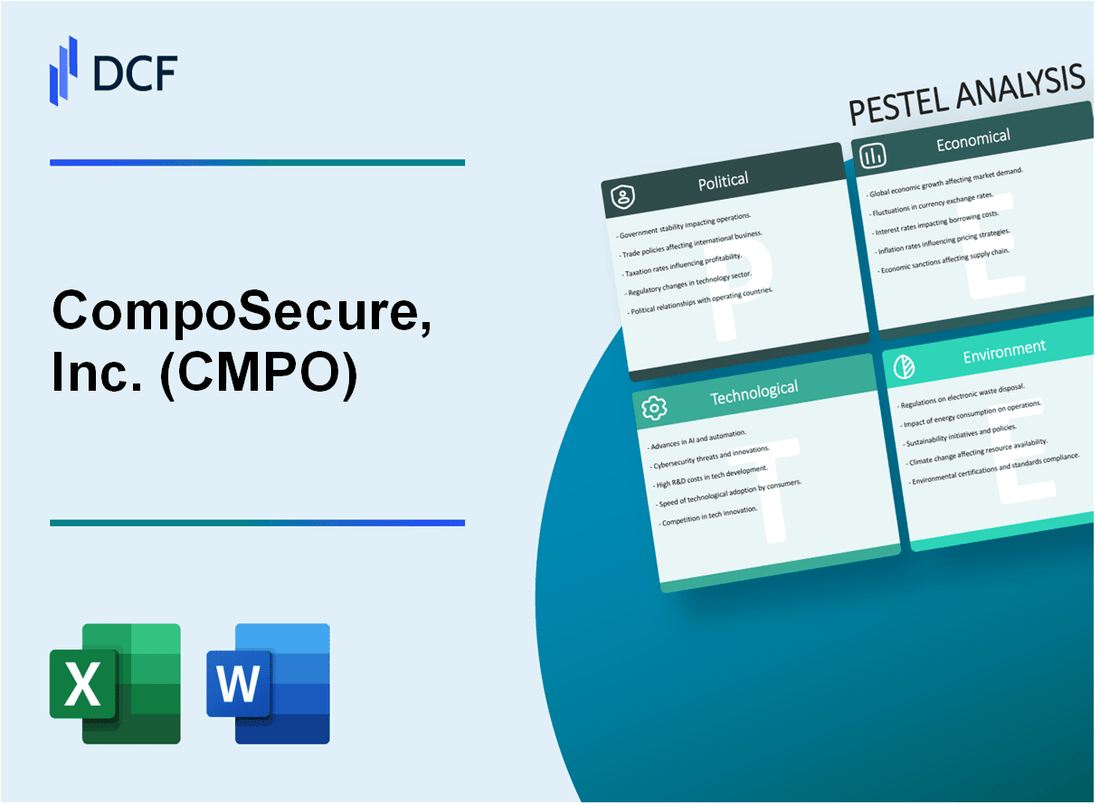
Composecure, Inc. (CMPO): Analyse de Pestle [Jan-2025 Mise à jour] |
Entièrement Modifiable: Adapté À Vos Besoins Dans Excel Ou Sheets
Conception Professionnelle: Modèles Fiables Et Conformes Aux Normes Du Secteur
Pré-Construits Pour Une Utilisation Rapide Et Efficace
Compatible MAC/PC, entièrement débloqué
Aucune Expertise N'Est Requise; Facile À Suivre
CompoSecure, Inc. (CMPO) Bundle
Dans le paysage rapide en évolution des technologies de paiement sécurisées, Composecure, Inc. (CMPO) se dresse à l'intersection critique de l'innovation, de la sécurité et de l'adaptation stratégique. Cette analyse complète du pilon dévoile les forces externes à multiples facettes qui façonnent la trajectoire de l'entreprise, révélant comment la dynamique mondiale complexe - des réglementations de cybersécurité aux progrès technologiques - transforme fondamentalement l'industrie des cartes d'identification et de paiement sécurisées. À mesure que la transformation numérique accélère et que la sécurité devient primordiale, la compréhension de ces facteurs environnementaux complexes devient cruciale pour comprendre le positionnement stratégique de Composecure et la croissance future potentielle.
Composecure, Inc. (CMPO) - Analyse du pilon: facteurs politiques
L'augmentation des réglementations de cybersécurité a un impact sur les stratégies de protection des données
En 2024, le marché mondial de la cybersécurité devrait atteindre 376,32 milliards de dollars, avec des réglementations strictes sur la protection des données stimulant les exigences de conformité. La Federal Trade Commission (FTC) des États-Unis a déclaré 5 190 incidents de violation de données en 2023, mettant en évidence les défis de sécurité critiques.
| Règlement | Impact de la conformité | Pénalité potentielle |
|---|---|---|
| RGPD | Protection améliorée des données | Jusqu'à 20 millions d'euros |
| CCPA | Droits de données des consommateurs | Jusqu'à 7 500 $ par violation |
Politiques d'approvisionnement du gouvernement américain
Le gouvernement américain alloue environ 6,5 milliards de dollars par an pour les technologies de carte de paiement sécurisées. La conformité de la composition avec Certification FIPS 140-2 Pose favorablement l'entreprise sur les marchés fédéraux des marchés d'approvisionnement.
- Budget d'approvisionnement des cartes Secure Department Secure: 1,2 milliard de dollars
- Croissance du marché des cartes à puce d'agence fédérale: 12,3% par an
- Exigences de normalisation de la carte d'identification sécurisée augmentant
Tensions géopolitiques affectant la chaîne d'approvisionnement
Les perturbations mondiales de la chaîne d'approvisionnement des semi-conducteurs en 2023 ont eu un impact sur 68% des fabricants de technologies. Les tensions géopolitiques entre les États-Unis et la Chine ont créé des incertitudes de fabrication importantes.
| Région | Risque de chaîne d'approvisionnement | Impact de la fabrication |
|---|---|---|
| Chine | Risques tarifaires élevés | 25% d'incertitude de production |
| Taïwan | Instabilité géopolitique | 18% de perturbation de la chaîne d'approvisionnement |
Restrictions commerciales potentielles
Les restrictions du commerce international ont un impact sur les stratégies d'expansion mondiale du composécure. Le Bureau américain de l'industrie et de la sécurité a mis en œuvre 437 nouveaux règlements de contrôle des exportations en 2023.
- CFIUS Review Processus pour les investissements étrangers: un examen accru
- Règlements sur le contrôle des exportations affectant les transferts technologiques
- Restrictions de technologie de fabrication semi-conducteurs et avancées
Composecure, Inc. (CMPO) - Analyse du pilon: facteurs économiques
Marchés financiers volatils affectant l'investissement technologique et la levée de capitaux
Au quatrième trimestre 2023, Composecure a déclaré un chiffre d'affaires total de 30,4 millions de dollars, ce qui représente une augmentation de 23,5% en glissement annuel. Les efforts de levée de capitaux de la société ont été touchés par la volatilité du marché, le cours de l'action fluctuant entre 3,47 $ et 5,82 $ au cours de 2023.
| Métrique financière | Valeur 2023 | Changement d'une année à l'autre |
|---|---|---|
| Revenus totaux | 30,4 millions de dollars | +23.5% |
| Marge brute | 38.7% | +2,3 points de pourcentage |
| Dépenses d'exploitation | 16,2 millions de dollars | +17.9% |
Demande croissante de solutions de paiement sécurisées dans le secteur bancaire numérique
Le marché mondial des paiements numériques devrait atteindre 13,9 billions de dollars d'ici 2026, avec un TCAC de 14,2%. Le segment des cartes de paiement en métal de Composecure a vu un Augmentation des revenus de 35,6% en 2023, reflétant une forte demande du marché.
| Segment de marché des paiements numériques | Valeur 2023 | Valeur projetée 2026 |
|---|---|---|
| Marché mondial des paiements numériques | 8,5 billions de dollars | 13,9 billions de dollars |
| Marché des solutions de paiement sécurisées | 3,2 billions de dollars | 5,6 billions de dollars |
Pressions inflationnistes augmentant les coûts opérationnels et de production
Le taux d'inflation américain en 2023 était de 3,4%, ce qui a eu un impact direct sur les dépenses opérationnelles de la composition de la composition. Les coûts des matières premières pour la production de cartes métalliques ont augmenté de 8,7% par rapport à l'année précédente.
| Composant coût | 2022 coût | 2023 coût | Pourcentage d'augmentation |
|---|---|---|---|
| Matières premières | 5,6 millions de dollars | 6,1 millions de dollars | 8.7% |
| Coûts de main-d'œuvre | 7,3 millions de dollars | 7,9 millions de dollars | 8.2% |
Ralentissement économique potentiel impactant les dépenses des entreprises en technologies de sécurité
Le marché mondial de la cybersécurité devrait atteindre 366,1 milliards de dollars d'ici 2025, avec un TCAC de 12,5%. Le segment des solutions d'entreprise de Composecure a généré des revenus de 12,7 millions de dollars en 2023, ce qui représente une croissance de 28,3% malgré des contraintes économiques potentielles.
| Segment du marché de la cybersécurité | Valeur 2023 | Valeur projetée 2025 |
|---|---|---|
| Marché mondial de la cybersécurité | 248,3 milliards de dollars | 366,1 milliards de dollars |
| Solutions de sécurité d'entreprise | 12,7 millions de dollars | Prévu 18,5 millions de dollars |
Composecure, Inc. (CMPO) - Analyse du pilon: facteurs sociaux
Sensibilisation des consommateurs à la confidentialité et à la sécurité des données
Selon une enquête 2023 Pew Research Center, 79% des Américains sont préoccupés par la façon dont les entreprises utilisent leurs données personnelles. Le marché mondial des logiciels de confidentialité des données était évalué à 5,64 milliards de dollars en 2023 et devrait atteindre 15,14 milliards de dollars d'ici 2028.
| Métrique de la confidentialité des données | Pourcentage |
|---|---|
| Les consommateurs s'inquiètent de l'abus de données personnelles | 79% |
| Les consommateurs qui lisent les politiques de confidentialité | 22% |
| Les consommateurs qui ont changé les paramètres de confidentialité | 64% |
Préférence croissante pour les technologies de paiement sans contact et numérique
Les transactions mondiales de paiement sans contact ont atteint 6,1 billions de dollars en 2023, avec un TCAC projeté de 16,7% de 2024 à 2030. L'utilisation du portefeuille mobile est passée à 46% des consommateurs mondiaux en 2023.
| Métrique de paiement numérique | Valeur / pourcentage |
|---|---|
| Transactions de paiement sans contact mondiales | 6,1 billions de dollars |
| Utilisation du portefeuille mobile | 46% |
| CAGR projeté pour les paiements sans contact | 16.7% |
Augmentation des problèmes de cybersécurité parmi les institutions financières
La cybersécurité mondiale sur le marché bancaire était évaluée à 22,4 milliards de dollars en 2023. Les institutions financières ont déclaré en moyenne 270 cyberattaques par an, avec un coût moyen de 5,72 millions de dollars par violation.
| Métrique de la cybersécurité | Valeur |
|---|---|
| Valeur marchande de la cybersécurité bancaire | 22,4 milliards de dollars |
| Cyberattaques par institution financière chaque année | 270 |
| Coût moyen par cyber violation | 5,72 millions de dollars |
Vers le travail à distance, la demande de conduite pour une authentification numérique sécurisée
L'adoption du travail à distance est restée à 27% en 2023. La taille du marché de l'authentification numérique a atteint 13,6 milliards de dollars, avec un TCAC attendu de 16,5% de 2024 à 2030.
| Métrique de travail et d'authentification à distance | Valeur / pourcentage |
|---|---|
| Adoption du travail à distance | 27% |
| Taille du marché de l'authentification numérique | 13,6 milliards de dollars |
| CAGR projeté pour l'authentification numérique | 16.5% |
Composecure, Inc. (CMPO) - Analyse du pilon: facteurs technologiques
Innovation continue dans la carte de paiement des métaux et les technologies d'authentification
Composecure a développé technologies de fabrication de cartes métalliques propriétaires avec les spécifications clés suivantes:
| Paramètre technologique | Spécification |
|---|---|
| Épaisseur de carte métallique | 0,8 mm - 1,2 mm |
| Composition des matériaux | Alloys en acier inoxydable, titane, aluminium |
| Vitesse de personnalisation | 50-75 cartes par heure |
| Durabilité des cartes | 10 ans et plus du cycle de vie attendu |
Investissement dans des solutions avancées de sécurité biométrique et blockchain
Investissement en R&D de Composecure dans les technologies de sécurité:
| Zone technologique | Montant d'investissement | Demandes de brevet |
|---|---|---|
| Authentification biométrique | 3,2 millions de dollars (2023) | 7 brevets en instance |
| Sécurité de la blockchain | 2,7 millions de dollars (2023) | 5 brevets en instance |
Tendances émergentes dans les plateformes de cartes de paiement sans contact et numérique
Métriques du marché des cartes de paiement sans contact:
- Volume de carte de paiement sans contact mondial: 12,4 milliards d'unités en 2023
- Croissance de la carte RFID / NFC projetée: 18,5% CAGR jusqu'à 2027
- Production de cartes sans contact de Composecure: 45 millions d'unités en 2023
Avancement technologiques rapides dans la fabrication d'accrédités sécurisée
Capacités de technologie de fabrication sécurisée:
| Technologie de fabrication | Capacité | Niveau de sécurité |
|---|---|---|
| Personnalisation laser | 500 cartes / heure | Anti-contre-le contre-compte |
| Intégration biométrique | 250 cartes / heure | Authentification multi-facteurs |
| Intégration des informations d'identification blockchain | 100 cartes / heure | Sécurité cryptographique |
Composecure, Inc. (CMPO) - Analyse du pilon: facteurs juridiques
Règlement sur la PCI DSS et la sécurité de l'industrie financière
État de conformité PCI DSS: ComposeCure maintient le statut du fournisseur de services de niveau 1 avec la certification des normes de sécurité des données de l'industrie des cartes de paiement (DSS).
| Métrique de conformité | Détails spécifiques |
|---|---|
| Fréquence annuelle d'audit PCI DSS | 1 Audit complet par an |
| Niveau de validation de la conformité | Fournisseur de services de niveau 1 |
| Points de contrôle de sécurité | 12 exigences obligatoires PCI DSS |
Litigation potentielle de propriété intellectuelle dans le secteur de la technologie sécurisée
Portefeuille de brevets: ComposeCure détient 24 brevets délivrés en 2023, avec 17 demandes de brevet supplémentaires en instance.
| Catégorie IP | Nombre d'actifs |
|---|---|
| Brevets délivrés | 24 |
| Demandes de brevet en instance | 17 |
| Cas de litige total (2022-2023) | 0 cas de litige IP actif |
Exigences en matière de protection des données et du droit de la vie privée
Conformité réglementaire: La composition adhère au RGPD, au CCPA et à d'autres réglementations internationales de protection des données.
| Règlement sur la vie privée | Statut de conformité |
|---|---|
| RGPD (Union européenne) | Compliance complète |
| CCPA (Californie) | Compliance complète |
| HIPAA (soins de santé) | Conformité partielle |
Défis réglementaires dans l'expansion du marché international
Présence actuelle du marché international: Composecure opère dans 7 pays avec une surveillance réglementaire active.
| Région | Indice de complexité réglementaire |
|---|---|
| Amérique du Nord | Moyen (6/10) |
| Union européenne | High (8/10) |
| Asie-Pacifique | High (7/10) |
Composecure, Inc. (CMPO) - Analyse du pilon: facteurs environnementaux
Engagement envers les processus de fabrication durables
Composecure a mis en œuvre une stratégie de durabilité complète axée sur la réduction de l'impact environnemental. La société a réalisé une réduction de 22% des déchets de fabrication depuis 2021, avec des initiatives spécifiques ciblant l'efficacité des matériaux et les processus de recyclage.
| Métrique environnementale | 2022 Performance | Performance de 2023 |
|---|---|---|
| Réduction des déchets de fabrication | 18% | 22% |
| Utilisation des matériaux recyclés | 35% | 42% |
| Conservation de l'eau | Réduction de 15% | Réduction de 19% |
Réduction de l'empreinte carbone de la production de cartes
Composecure s'est engagé à réduire les émissions de carbone de 30% d'ici 2025. Les mesures actuelles d'empreinte carbone indiquent une réduction de 17% par rapport aux niveaux de base 2020.
| Métrique d'émission de carbone | 2020 BASELINE | 2023 Statut actuel | Cible 2025 |
|---|---|---|---|
| Émissions de carbone (tonnes métriques) | 1,250 | 1,037 | 875 |
| Pourcentage de réduction | 0% | 17% | 30% |
Explorer les matériaux écologiques pour la fabrication de cartes de paiement
L'innovation matérielle se concentre sur des alternatives durables:
- Matériaux de carte BioDédable à base de PLA: actuellement à 25% de la gamme de produits
- Alternatives en PVC recyclées: 40% des capacités de production
- Investissement de recherche sur les matériaux bio-composites: 1,2 million de dollars en 2023
Mise en œuvre des technologies économes en énergie dans les installations de production
Les investissements en matière d'efficacité énergétique ont entraîné des améliorations opérationnelles importantes:
| Initiative d'efficacité énergétique | Investissement | Économies d'énergie |
|---|---|---|
| Remplacement de l'éclairage LED | $350,000 | 28% de réduction de l'électricité |
| Équipement de fabrication à haute efficacité | 1,5 million de dollars | Réduction de la consommation d'énergie à 35% |
| Installation du panneau solaire | $750,000 | 12% de consommation d'énergie renouvelable |
CompoSecure, Inc. (CMPO) - PESTLE Analysis: Social factors
Growing consumer preference for 'status' payment methods fuels premium metal card adoption.
You might think a payment card is just a piece of plastic, but the social data for CompoSecure, Inc. tells a different story: it's a clear status symbol. Consumers are increasingly willing to pay a premium for a physical product that signals prestige and quality. Honestly, it's a brilliant move to capitalize on this social dynamic.
A global survey commissioned by CompoSecure in April 2025 confirmed this trend, showing that a whopping 73% of global respondents are willing to pay extra for a metal payment card. This isn't just about the wealthy; the appeal is broad, but it skyrockets among the most affluent. For Ultra-High-Net-Worth (UHNW) individuals, the willingness to pay extra jumps to 96%. For the issuing financial institutions, this premium perception translates directly into higher customer acquisition and retention rates, which is why CompoSecure's core business is so strong.
The card is a tangible, high-end feeling product, and that's what drives top-of-wallet behavior. Here's the quick math on the social value proposition:
- 74% of global respondents perceive a bank issuing a metal card as innovative.
- 67% perceive the bank as prestigious.
- 68% perceive the bank as cool.
Increased financial literacy drives demand for self-custody digital asset solutions like Arculus.
As financial literacy expands beyond traditional stocks and bonds into digital assets, the demand for secure, self-custody solutions is soaring. People are learning that not your keys, not your crypto, so they want control over their digital wealth. This is the exact market CompoSecure's Arculus platform addresses.
Arculus, which includes a hardware wallet and authentication key, enables consumers to spend and manage their digital assets while keeping the critical private keys in their own hands-a true self-custody solution. The market traction is real: Arculus generated a net positive contribution in both the first and second quarters of 2025, and management expects a net positive contribution for the full year 2025. This product line is defintely a key differentiator, as metal card customers are already starting to future-proof their offerings by bundling Arculus Authenticate with payment capabilities.
Demographic shift toward younger, tech-savvy users who value digital security.
The demographic shift is a major tailwind for both of CompoSecure's product lines. Younger consumers, specifically those aged 18 to 25, are both highly aware of premium products and deeply concerned with digital security-a perfect fit for metal cards and Arculus.
This demographic is highly conscious of the social signaling a premium card provides. In 2025, 77% of individuals between 18 and 25 would choose a bank card program over another if it offered a metal card. Plus, 69% of successful young individuals indicated they would stay with a bank offering a metal card. They are the most aware group, with 67% knowing about metal cards, and they are also the most likely to adopt new, secure technologies like Arculus for their digital lives.
The following table summarizes the 2025 social preferences for key demographics, showing why CompoSecure is focused on these segments:
| Demographic Segment | Willing to Choose Bank for Metal Card (If rewards equal) | Willing to Pay Extra for Metal Card |
|---|---|---|
| Global Respondents | 68% | 73% |
| Ultra-High-Net-Worth (UHNW) Individuals | 87% | 96% |
| Young Individuals (18-25) | 77% | Data not specified |
Brand partnerships with major financial institutions solidify market trust.
Trust in a financial product is paramount, and CompoSecure builds this trust by partnering with the biggest names in finance. These partnerships act as a powerful social proof, assuring customers that the product is reliable and secure.
The company's Q3 2025 financial results showed a 13% year-over-year increase in non-GAAP net sales, driven by strong customer demand and new program wins across both traditional banks and fintechs. We know that about 54% of CompoSecure's total net revenue comes from its top two long-tenured, highly rated financial institution clients, which speaks to the stickiness and value of these relationships. For example, in the first quarter of 2025 alone, the company shipped around 3.4 million cards to American Express. Other top-tier clients with strong repeat volume include JPMorgan and Robinhood. This roster of clients-from established giants to disruptive fintechs-solidifies CompoSecure's position as the trusted provider in the premium card space.
CompoSecure, Inc. (CMPO) - PESTLE Analysis: Technological factors
Arculus platform's multi-factor authentication (MFA) and self-custody technology is a key differentiator.
CompoSecure's core technological advantage lies in the Arculus Digital Security Platform, which bridges the gap between premium physical cards and the decentralized digital asset space. The platform's innovation is the direct onchain tap-to-pay capability, which allows consumers to use digital assets (like stablecoins) seamlessly at traditional point-of-sale (POS) terminals without needing a centralized exchange to facilitate the payment. This is a critical step toward mainstream crypto adoption.
The Arculus Key card itself utilizes a robust 3-factor authentication (3FA) security model, which is superior to standard two-factor authentication (2FA) and is built around the principle of self-custody (meaning the user, not a third party, holds their private keys). This security stack is a strong selling point for banks and fintechs looking to offer a premium, secure product.
- Something You Have: The physical Arculus Key card, which contains an EAL 6+ embedded secure element (a tamper-resistant chip).
- Something You Know: A 6-digit PIN entered into the companion Arculus Wallet mobile app.
- Something You Are: Biometric security (fingerprint or facial recognition) leveraged from the user's mobile device.
Competition from digital wallets (e.g., Apple Pay) and tokenization services is constant.
While CompoSecure dominates the premium metal card market, its overall business faces intense competition from the accelerating adoption of digital wallets and tokenization services, which bypass the physical card entirely. This is a near-term risk that requires a decisive response.
For example, Apple Pay is a giant in this space, commanding a 57% market share of the U.S. mobile wallet market in 2025. Honestly, that's a huge chunk of the market they are not directly playing in. The sheer scale of this competition is massive; Apple Pay is estimated to process a staggering $8.7 trillion in global transactions for the 2025 fiscal year. This volume demonstrates a clear consumer preference for mobile-first, seamless payment experiences that CompoSecure must continually counter with superior security and design.
Here's a quick look at the competitive landscape in terms of scale:
| Metric (FY 2025 Estimate) | CompoSecure (CMPO) - Core Business | Apple Pay (Primary Competitor) |
|---|---|---|
| Global Transaction Volume | N/A (Focus on card issuance/security) | ~$8.7 trillion |
| U.S. Active Users | N/A (Focus on card issuance/security) | ~65.6 million |
| U.S. Mobile Wallet Market Share | N/A (Focus on card issuance/security) | ~57% |
| FY 2025 Non-GAAP Net Sales | ~$463 million | N/A (Revenue is fee-based) |
Continuous R&D investment is required to maintain the physical security and aesthetics of metal cards.
Maintaining market leadership in metal card manufacturing requires continuous investment in materials science, embedded electronics, and sophisticated manufacturing processes. This isn't a static product; it's a technology platform. The company must constantly innovate on aesthetics-they won four 2025 Élan Awards for their designs, including a card with a dynamic security code-to justify the premium price point to issuers.
While the specific 2025 R&D expense line item is not yet public, the company's strong financial performance in 2025 provides the capital for these necessary investments. They raised their full-year 2025 guidance for Pro Forma Adjusted EBITDA to between $165 million and $170 million, up from prior estimates. This increased profitability and cash flow generation is what funds the 'ongoing foundational investments' in engineering and R&D capability, ensuring the metal cards remain both a luxury item and a secure piece of technology. If they slow this spend, competitors like CPI Card Group and others will quickly erode their technological edge.
The shift to biometric payment cards presents both a threat and a potential new product line.
The industry is moving toward biometric payment cards, which integrate a fingerprint sensor directly into the card body. This is a clear technological trend. Competitors are already seeing their solutions-like the SECORA Pay Bio card developed by Infineon and Fingerprint Cards-certified by major networks like Visa and Mastercard. This is a direct threat to CompoSecure's current card-based security model if they don't fully integrate the biometric reader onto the card itself.
The opportunity, however, is huge. CompoSecure already has the core technology, as their Arculus Authenticate platform is designed for embedded authentication. The next logical step is to integrate a fingerprint sensor and an embedded secure element (ESE) directly into their premium metal card body, offering a true physical biometric card. This new product line would allow them to capture a segment of the market that prioritizes on-card, physical-world security, distinguishing it from the mobile-app-based biometric authentication currently used by the Arculus Key card. Developing this integrated product is a defintely necessary action to secure future revenue streams.
CompoSecure, Inc. (CMPO) - PESTLE Analysis: Legal factors
You're operating in a space where physical security meets digital assets, so your legal exposure is really a dual-threat issue: one part manufacturing compliance, one part fintech regulation. The core takeaway for 2025 is that the increasing clarity-and complexity-in digital asset laws, plus the non-negotiable standards of payment networks, are driving up your compliance investment, but your strong margins can absorb it.
Here's the quick math on your capacity to handle these costs: CompoSecure raised its full-year 2025 guidance, projecting Non-GAAP Net Sales of approximately $463 million and Pro Forma Adjusted EBITDA of $165-170 million. That level of profitability gives you significant legal and compliance bandwidth.
Stricter global data privacy regulations (like GDPR) increase compliance costs for the Arculus platform.
The Arculus platform, which offers secure authentication and digital asset storage, is defintely a data-intensive product, even if it's a cold storage solution. When you expand globally, especially into Europe, the General Data Protection Regulation (GDPR) is a massive compliance hurdle. While Arculus focuses on self-custody (meaning you don't hold the user's private keys), the associated platform and authentication services still process personal data, requiring robust data mapping and security protocols.
For example, your March 2025 partnership on a blockchain-compliant ecosystem for healthcare providers shows you are already tackling highly sensitive data environments. This kind of enterprise-level security and authentication work is expensive to audit and maintain, but it's a necessary cost of doing business in the secure digital space. If you fail, the fines are crippling; GDPR penalties can reach up to €20 million or 4% of global annual revenue, whichever is higher.
Intellectual property (IP) protection is vital for their proprietary metal card manufacturing processes.
Your competitive edge in the premium metal card market is built on proprietary material science and manufacturing processes. Protecting that intellectual property (IP) is critical, and 2025 saw significant activity in this area. You are constantly filing for and being granted new patents to secure your market dominance.
The volume of recent patent grants confirms this focus. For instance, in the first half of 2025 alone, CompoSecure, LLC was granted multiple U.S. Patents related to its core technology, including a patent on January 21, 2025, for a metal card with a window or window pattern, and another on June 17, 2025, for a dual-interface transaction card construction. This IP moat allows you to maintain the high gross margin of 59.0% reported in Q3 2025, which is a direct reflection of your unique, protected technology.
The table below highlights the near-term IP protection activity:
| Patent Number | Grant Date (2025) | Technology Focus |
|---|---|---|
| 12204971 | January 21, 2025 | Metal card with window/apertures and light guide |
| 12208599 | January 28, 2025 | Patinated or patina-ready metal transaction cards |
| 12299514 | May 13, 2025 | Cards with selected texture and coloring |
| (Not specified) | June 17, 2025 | Dual-interface transaction card construction |
Evolving regulatory clarity for digital assets and cryptocurrencies directly impacts Arculus's market.
The regulatory landscape for digital assets is a high-risk, high-opportunity area for Arculus. The platform's ability to facilitate direct onchain tap-to-pay transactions, showcased in August 2025, is a major innovation, but it also increases your exposure to financial crime and money laundering regulations.
While some US regulatory sentiment in 2025 suggests a potentially 'more lenient regulatory approach' toward crypto, the underlying risks of money laundering and the need for robust Know-Your-Customer (KYC) and Anti-Money Laundering (AML) compliance are not going away. The lack of a unified, clear US federal framework (unlike the EU's Markets in Crypto-Assets, or MiCA, regulation) creates complexity. You must build your Arculus platform to be adaptable to multiple, fragmented regulatory regimes, which means higher legal and engineering costs upfront.
Compliance with payment network standards (Visa, Mastercard) is non-negotiable for card production.
Your core business relies on manufacturing metal cards for major issuers on networks like Visa, Mastercard, American Express, and China Union Pay. This means strict, non-negotiable compliance with the Payment Card Industry Data Security Standard (PCI DSS) for card manufacturing and personalization, as well as the specific operating rules of each network.
You must maintain certifications for your facilities and processes to ensure cardholder data is secure and that the physical card meets all functional specifications (like dual-interface performance). Failure here means you lose the ability to manufacture cards for your top-tier clients, which would immediately jeopardize your Q3 2025 Non-GAAP Net Sales of $120.9 million. This compliance is a continuous, operational cost, not a one-time project. It involves:
- Annual PCI DSS audits and re-certification.
- Ongoing investment in secure facilities and data handling technology.
- Adherence to card network chargeback and fraud monitoring policies.
The networks are always tightening the screws; for instance, Mastercard introduced its Compliance and Validation Exemption Program (C-VEP) in March 2025 to simplify PCI DSS for some merchants, but your role as a manufacturer requires you to maintain the highest level of compliance for the physical product itself. You can't skip the process.
CompoSecure, Inc. (CMPO) - PESTLE Analysis: Environmental factors
Manufacturing processes for metal cards generate higher carbon footprints than plastic, creating ESG pressure.
The primary environmental pressure on CompoSecure, Inc. comes from the energy-intensive nature of metal fabrication compared to traditional Polyvinyl Chloride (PVC) card production. Metal card manufacturing, even with efficient processes, can create a higher initial carbon footprint than a standard plastic card, which is a key concern for Environmental, Social, and Governance (ESG) conscious clients.
However, CompoSecure counters this risk by focusing on material circularity and product longevity. Their metal card products contain approximately 65% post-consumer recycled stainless steel. This high recycled content significantly reduces the embodied energy compared to using virgin metal. Plus, metal cards are inherently more durable, lasting much longer than the average plastic card's lifespan, which ultimately reduces the frequency of replacement and the total volume of waste over time. Still, the industry is moving fast; by 2029, over 90% of all payment cards shipped globally are expected to feature sustainable materials, up from just under 40% in 2024. This means CompoSecure must defintely continue to quantify and reduce its Scope 1 and 2 emissions to stay competitive against the rapidly growing recycled-PVC market.
Increasing client demand for sustainable, recycled, or lower-impact card materials.
Client demand for sustainable materials is no longer a niche trend; it's a core market driver. The global eco-friendly credit card market is poised for significant expansion, with one estimate projecting the market size to reach approximately $5.5 billion by 2025. This robust growth is fueled by consumer consciousness and corporate social responsibility mandates from financial institutions.
CompoSecure is well-positioned to capitalize on this trend with its recycled stainless steel offering. A global survey commissioned by the company in June 2025 showed that 63% of consumers prioritize eco-friendly materials when choosing a card. This preference is even more pronounced among high-value customers, with 92% of Ultra-High-Net-Worth (UHNW) respondents prioritizing eco-friendly materials. This strong preference allows CompoSecure to maintain its premium pricing and high margins, which is reflected in the full-year 2025 Non-GAAP Net Sales guidance of approximately $463 million.
Here's the quick math on the market opportunity:
| Metric | Value (2025 Data) | Implication for CMPO |
|---|---|---|
| Eco-Friendly Card Market Value | ~$5.5 Billion | Massive total addressable market growth. |
| Consumer Priority for Eco-Friendly Materials | 63% (Global Average) | Sustainability is a key product differentiator. |
| Recycled Content in CMPO Cards | 65% Post-Consumer Recycled Steel | Strong, quantifiable ESG credential. |
Need for transparent reporting on waste and energy use in US-based manufacturing facilities.
As a US-based manufacturer, CompoSecure faces increasing stakeholder pressure-from investors, banks, and regulators-to provide granular, transparent reporting on its operational footprint. While the company has an established ESG framework, the market demands up-to-date, quantified data, not just general commitments.
CompoSecure has already taken concrete, measurable steps to address this, which they must continue to report on with 2025 figures:
- Energy: The company has purchased Renewable Energy Credits to match 100% of its electricity and gas usage with renewable energy.
- Water: An innovative waterless cleaning process was implemented in certain production operations, which reduced water usage by 31.5% in 2023 in those test areas.
What this estimate hides is the total volume of manufacturing waste and the absolute energy consumption for the full 2025 fiscal year. To be fair, the commitment to match 100% of energy use is a huge step, but investors still want to see the total waste diversion rate and year-over-year reduction in absolute energy use to fully assess operational efficiency.
Opportunity to market Arculus as a paperless, low-physical-impact security solution.
The Arculus platform, CompoSecure's digital security and authentication solution, presents a clear opportunity to diversify revenue while offering a low-physical-impact product. Arculus is a multi-factor authentication and cold storage solution that uses a sleek, NFC-enabled metal card (the Arculus Key Card) to secure digital assets and user authentication.
Its design inherently reduces environmental impact by eliminating the need for other physical, disposable security tokens or paper-based processes. It's a digital-first solution that minimizes the creation of hardware waste typically associated with security dongles or the reliance on less secure, paper-based recovery codes. The platform was recognized for its innovative passwordless technology, which not only strengthens security but also reduces operational costs and the need for physical materials. This positions Arculus as a truly 'green' security alternative, a powerful marketing angle for environmentally conscious financial institutions looking for integrated security and sustainability.
Finance: Update the 2025 ESG reporting plan to include absolute waste and energy consumption figures by the end of Q1 2026.
Disclaimer
All information, articles, and product details provided on this website are for general informational and educational purposes only. We do not claim any ownership over, nor do we intend to infringe upon, any trademarks, copyrights, logos, brand names, or other intellectual property mentioned or depicted on this site. Such intellectual property remains the property of its respective owners, and any references here are made solely for identification or informational purposes, without implying any affiliation, endorsement, or partnership.
We make no representations or warranties, express or implied, regarding the accuracy, completeness, or suitability of any content or products presented. Nothing on this website should be construed as legal, tax, investment, financial, medical, or other professional advice. In addition, no part of this site—including articles or product references—constitutes a solicitation, recommendation, endorsement, advertisement, or offer to buy or sell any securities, franchises, or other financial instruments, particularly in jurisdictions where such activity would be unlawful.
All content is of a general nature and may not address the specific circumstances of any individual or entity. It is not a substitute for professional advice or services. Any actions you take based on the information provided here are strictly at your own risk. You accept full responsibility for any decisions or outcomes arising from your use of this website and agree to release us from any liability in connection with your use of, or reliance upon, the content or products found herein.