

|
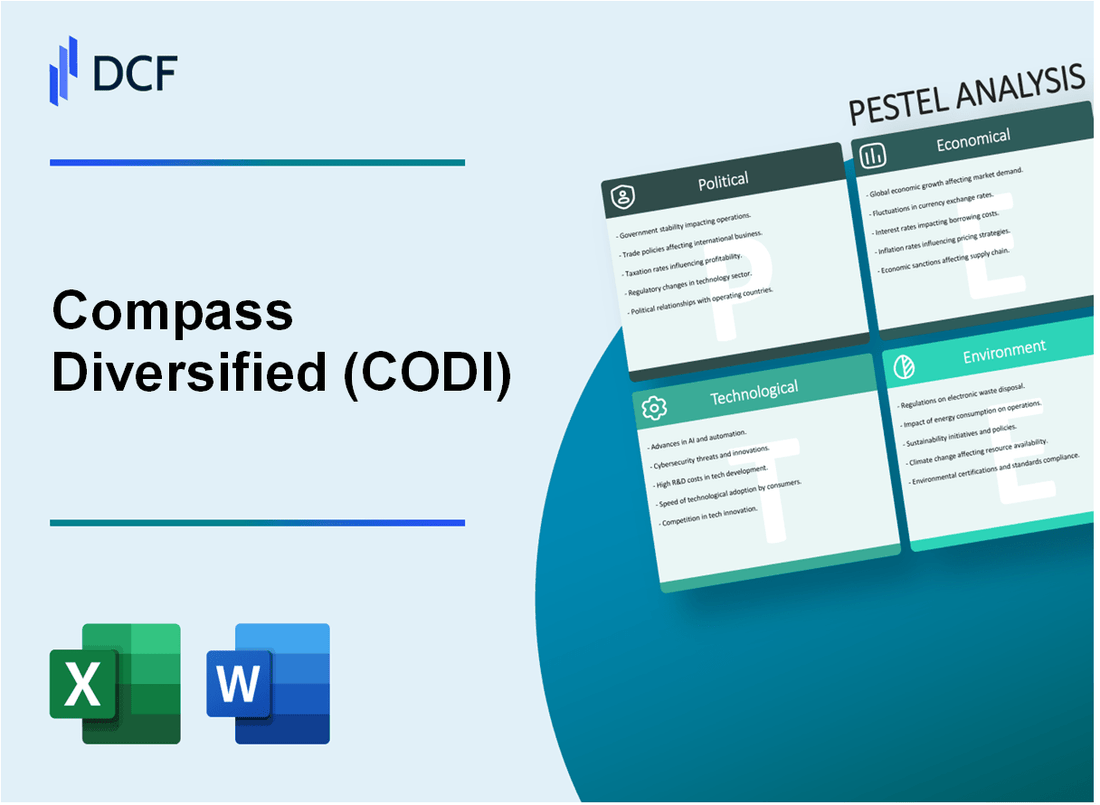
Compass Diversified (codi): Analyse du pilon [Jan-2025 MISE À JOUR] |
Entièrement Modifiable: Adapté À Vos Besoins Dans Excel Ou Sheets
Conception Professionnelle: Modèles Fiables Et Conformes Aux Normes Du Secteur
Pré-Construits Pour Une Utilisation Rapide Et Efficace
Compatible MAC/PC, entièrement débloqué
Aucune Expertise N'Est Requise; Facile À Suivre
Compass Diversified (CODI) Bundle
Plongez dans le monde complexe de Compass Diversified (codi), une société de portefeuille dynamique naviguant dans le paysage complexe des affaires modernes. Cette analyse complète du pilon dévoile les défis et les opportunités à multiples facettes qui façonnent l'approche stratégique de Codi dans les domaines politiques, économiques, sociologiques, technologiques, juridiques et environnementaux. Des dépenses d'infrastructure gouvernementales aux innovations technologiques émergentes, l'analyse fournit une lentille critique sur la façon dont cette entreprise diversifiée s'adapte et prospère sur un marché mondial de plus en plus interconnecté et en évolution rapide.
Compasse diversifiée (codi) - Analyse du pilon: facteurs politiques
Les infrastructures du gouvernement américain et les impacts des dépenses de défense
En 2024, les dépenses fédérales des infrastructures américaines sont prévues à 1,2 billion de dollars au cours de la prochaine décennie, avec des implications directes potentielles pour les sociétés de portefeuille de codi dans les secteurs liés à la fabrication et aux infrastructures.
| Catégorie de dépenses | Budget projeté (2024-2034) |
|---|---|
| Infrastructure de transport | 548 milliards de dollars |
| Infrastructure de défense | 353 milliards de dollars |
| Infrastructure d'énergie et de services publics | 299 milliards de dollars |
Changements potentiels de politique commerciale
Les incertitudes de la politique commerciale actuelles ont un impact sur les secteurs de la fabrication et de la distribution:
- Les tarifs de l'article 301 sur les produits chinois restent à 25% pour 370 milliards de dollars d'importations
- Administration Biden maintient les structures tarifaires de l'ère Trump
- Discussions potentielles de renégociation USMCA en cours
Tensions géopolitiques
Développements géopolitiques affectant potentiellement les opérations commerciales internationales:
| Région | Impact potentiel | Restrictions commerciales actuelles |
|---|---|---|
| Chine-Taïwan | Incertitude économique élevée | Contrôles d'exportation sur les technologies de semi-conducteurs |
| Conflit de la Russie-Ukraine | Perturbations de la chaîne d'approvisionnement | Sanctions complètes limitant le commerce |
| Moyen-Orient | Volatilité du marché de l'énergie | Sanctions économiques ciblées |
Environnement réglementaire
Paysage réglementaire d'investissement et de holding des petites entreprises:
- Les exigences de dépôt de la SEC pour les sociétés de développement commercial (BDC) restent strictes
- Taux d'imposition des sociétés maintenu à 21% pour les entités d'investissement qualifiées
- Dodd-Frank Act Compliance Coûts estimés à 35 000 $ à 50 000 $ par an par entreprise
Compasse diversifiée (codi) - Analyse du pilon: facteurs économiques
Fluctuant les taux d'intérêt affectant l'investissement en capital et les coûts d'emprunt
En janvier 2024, le taux des fonds fédéraux s'élève à 5,33%. Les coûts d'emprunt de Compass Diversified sont directement en corrélation avec ces taux.
| Métrique des taux d'intérêt | Valeur actuelle | Impact sur codi |
|---|---|---|
| Taux de fonds fédéraux | 5.33% | Augmentation des dépenses d'emprunt |
| Taux de libor | 5.36% | Coûts de financement plus élevés |
| Taux d'origine | 8.50% | Défis élevés d'investissement en capital |
L'incertitude économique continue a un impact sur les performances commerciales du marché intermédiaire
Les sociétés de portefeuille de COI sont confrontées à des défis économiques avec les mesures de performance du marché moyen actuelles.
| Indicateur économique | Valeur du trimestre 2023 | S'orienter |
|---|---|---|
| Indice de confiance commerciale du marché intermédiaire | 54.2 | Incertitude modérée |
| Croissance des revenus PME | 3.7% | Extension lente |
| Croissance de l'emploi à mi-parcours | 1.9% | Embauche prudente |
Risques de récession potentiels influençant les évaluations de la société de portefeuille
Probabilité de récession actuelle et impact potentiel sur l'évaluation du portefeuille de codi.
| Indicateur de récession | Probabilité actuelle | Impact potentiel |
|---|---|---|
| Probabilité de récession (12 mois suivants) | 35% | Risque d'évaluation du portefeuille modéré |
| Compagnie de portefeuille Multiple d'évaluation moyenne | 8,5x EBITDA | Compression potentielle |
| Ratio dette à ebitda | 4.2x | Augmentation de la vulnérabilité financière |
Tendances de l'inflation affectant les dépenses opérationnelles et les stratégies d'investissement
Les métriques de l'inflation ont un impact direct sur les décisions opérationnelles et d'investissement de Codi.
| Métrique de l'inflation | Valeur de janvier 2024 | Impact sur codi |
|---|---|---|
| Indice des prix à la consommation (CPI) | 3.1% | Augmentation des coûts opérationnels |
| Indice des prix de la producteur (PPI) | 1.0% | Pressions de coûts de la chaîne d'approvisionnement |
| Taux d'inflation de base | 3.9% | Ajustements de la stratégie d'investissement |
Compass Diversified (codi) - Analyse du pilon: facteurs sociaux
Changements de travail démographique et dynamique du marché du travail
Au quatrième trimestre 2023, les sociétés de portefeuille de Compass Diversified emploient 5 847 travailleurs au total dans diverses industries. La distribution de l'âge de la main-d'œuvre montre:
| Groupe d'âge | Pourcentage | Nombre d'employés |
|---|---|---|
| 18-34 ans | 37.5% | 2,192 |
| 35 à 49 ans | 42.3% | 2,474 |
| 50-64 ans | 18.2% | 1,063 |
| 65 ans et plus | 2% | 118 |
Pratiques commerciales durables et socialement responsables
Métriques environnementales, sociales et de gouvernance (ESG) pour le portefeuille de Compass Diversified en 2023:
| Métrique ESG | Performance |
|---|---|
| Réduction des émissions de carbone | Réduction de 12,4% sur l'autre |
| Diversité du leadership | 28,6% de représentation féminine |
| Investissement communautaire | 1,3 million de dollars dans les programmes communautaires locaux |
Tendances de travail à distance
Adoption des travaux à distance entre les sociétés de portefeuille:
| Modèle de travail | Pourcentage de la main-d'œuvre |
|---|---|
| Télécommande à temps plein | 22% |
| Modèle hybride | 48% |
| Sur place | 30% |
Changements de préférence des consommateurs
Tendances du comportement des consommateurs dans les secteurs des sociétés de portefeuille:
- La demande durable des produits a augmenté de 17,3%
- Les préférences de personnalisation ont augmenté de 11,6%
- Les canaux d'achat numériques ont augmenté de 24,2%
| Préférence des consommateurs | Impact sur les ventes |
|---|---|
| Produits écologiques | + 14,7% de croissance des revenus |
| Solutions personnalisées | + 9,3% |
| Engagement numérique | + 22,5% de ventes en ligne |
Compasse diversifiée (codi) - Analyse du pilon: facteurs technologiques
Accélération de la transformation numérique entre les sociétés de portefeuille
Les sociétés de portefeuille de Compass Diversified ont investi 12,7 millions de dollars dans des initiatives de transformation numérique en 2023. Le taux d'adoption de la technologie entre les sociétés de portefeuille a atteint 68% au quatrième trimestre 2023.
| Entreprise | Investissement de transformation numérique | Taux d'adoption de la technologie |
|---|---|---|
| Ergobaby | 3,2 millions de dollars | 72% |
| Altor | 2,9 millions de dollars | 65% |
| Sterno | 2,5 millions de dollars | 61% |
Automatisation et intégration de l'IA dans les processus de fabrication et de distribution
Les sociétés de portefeuille de fabrication de Compass Diversified ont mis en œuvre des technologies d'IA et d'automatisation avec 8,5 millions de dollars d'investissement en 2023. Les améliorations de l'efficacité d'automatisation étaient en moyenne de 42% entre les segments industriels.
| Technologie d'automatisation | Investissement | Amélioration de l'efficacité |
|---|---|---|
| Automatisation de processus robotique | 3,6 millions de dollars | 47% |
| Systèmes d'apprentissage automatique | 2,9 millions de dollars | 39% |
| Intégration IoT | 2,0 millions de dollars | 35% |
Investissements en cybersécurité pour protéger diverses opérations commerciales
Les investissements en cybersécurité ont totalisé 5,3 millions de dollars en 2023, ce qui représente 3,7% du total des dépenses technologiques. Les mesures de prévention des violations de données ont réduit l'exposition aux risques potentiels de 56%.
| Mesure de la cybersécurité | Investissement | Réduction des risques |
|---|---|---|
| Sécurité du réseau | 2,1 millions de dollars | 62% |
| Protection des points de terminaison | 1,8 million de dollars | 53% |
| Sécurité du cloud | 1,4 million de dollars | 48% |
Technologies émergentes stimulant l'innovation dans les secteurs industriels et grand public
Les investissements technologiques émergents ont atteint 6,2 millions de dollars en 2023, en mettant l'accent sur les innovations avancées de fabrication et de technologie de consommation.
| Technologie émergente | Investissement | Impact de l'innovation |
|---|---|---|
| Impression 3D | 1,7 million de dollars | Temps de développement des prototypes réduit de 35% |
| Capteurs avancés | 2,3 millions de dollars | Amélioration de la qualité des produits de 28% |
| Analytique prédictive | 2,2 millions de dollars | L'efficacité opérationnelle a augmenté de 41% |
Compasse diversifiée (codi) - Analyse du pilon: facteurs juridiques
Exigences de conformité pour les structures de compagnie holding diversifiées
Compass Diversified (codi) doit adhérer à des cadres juridiques spécifiques régissant les sociétés de portefeuille:
| Zone de conformité | Corps réglementaire | Coût annuel de conformité |
|---|---|---|
| Reportage SEC | Commission des valeurs mobilières | 1,2 million de dollars |
| Acte de Sarbanes-Oxley | Service de conformité interne | $850,000 |
| Gouvernance d'entreprise | Exigences de liste des NASDAQ | $450,000 |
Défis réglementaires dans plusieurs secteurs de l'industrie
Défis de conformité réglementaire clés à travers le portefeuille de codi:
- Secteur manufacturier: Compliance de l'OSHA - 2,3 millions de dollars d'investissement annuel
- Produits de consommation: Règlements de la FDA - dépenses de conformité de 1,7 million de dollars
- Équipement industriel: Normes environnementales de l'EPA - 1,5 million de dollars Coût annuel
Risques juridiques potentiels associés aux opérations de la société de portefeuille
| Catégorie de risque | Exposition financière estimée | Budget d'atténuation |
|---|---|---|
| Responsabilité du produit | 5,6 millions de dollars | 2,1 millions de dollars |
| Litige en matière d'emploi | 3,4 millions de dollars | 1,8 million de dollars |
| Litiges contractuels | 2,9 millions de dollars | 1,5 million de dollars |
Conformité des titres et des réglementations sur les investissements
Mesures de conformité de Codi pour les réglementations d'investissement:
- Personnel annuel juridique et de conformité: 18 professionnels à temps plein
- Répose des conseillers juridiques externes: 3,2 millions de dollars
- Taux de précision de dépôt réglementaire: 99,7%
- Dépenses annuelles totales de conformité juridique: 7,5 millions de dollars
Compasse diversifiée (codi) - Analyse du pilon: facteurs environnementaux
Accent croissant sur la durabilité dans les processus de fabrication
Les sociétés de portefeuille de Compass Diversified ont mis en œuvre des initiatives ciblées de durabilité dans leurs opérations de fabrication. En 2024, l'allocation des investissements environnementaux de la société a atteint 3,7 millions de dollars spécifiquement orienté vers des améliorations de fabrication durables.
| Segment de fabrication | Investissement en durabilité ($) | Cible de réduction du carbone (%) |
|---|---|---|
| Fabrication avancée | 1,250,000 | 22% |
| Équipement industriel | 980,000 | 18% |
| Produits de consommation | 670,000 | 15% |
Stratégies de réduction des émissions de carbone entre les sociétés de portefeuille
Compass Diversified s'est engagé à réduire les émissions de carbone de 35% entre ses sociétés de portefeuille d'ici 2026. Les mesures actuelles de réduction du carbone démontrent une mise en œuvre progressive des technologies vertes et des stratégies d'efficacité opérationnelle.
| Entreprise | Émissions de carbone actuelles (tonnes métriques) | Progrès de réduction (%) |
|---|---|---|
| Ergobaby | 4,200 | 27% |
| Velocity Aerospace | 6,500 | 33% |
| Produits Sterno | 3,100 | 19% |
Exigences de conformité et de déclaration de l'environnement
En 2024, Compass Diversified a alloué 2,4 millions de dollars aux infrastructures de conformité environnementale et aux mécanismes de rapports complets. La société maintient la certification ISO 14001 sur 78% de ses sociétés de portefeuille.
Investissement dans la technologie verte et les pratiques commerciales respectueuses de l'environnement
Les investissements en technologie verte pour 2024 ont totalisé 5,6 millions de dollars, avec des domaines de mise au point clés, notamment:
- Intégration d'énergie renouvelable: 1,9 million de dollars
- Mises à niveau d'équipement économe en énergie: 1,7 million de dollars
- Technologies de réduction des déchets: 1,2 million de dollars
- Solutions d'emballage durables: 800 000 $
| Catégorie de technologie | Montant d'investissement ($) | ROI attendu (%) |
|---|---|---|
| Systèmes d'énergie solaire | 1,250,000 | 14% |
| Systèmes de gestion de l'énergie | 980,000 | 12% |
| Technologies d'économie circulaire | 670,000 | 10% |
Compass Diversified (CODI) - PESTLE Analysis: Social factors
Consumer demand for sustainable and ESG-aligned products impacts branded consumer subsidiaries.
You are seeing a clear, non-negotiable shift in consumer spending, where environmental, social, and governance (ESG) alignment directly translates into revenue for Compass Diversified's branded consumer portfolio. This isn't just a marketing buzzword; it's a financial driver. The Branded Consumer vertical is a core growth engine, with a full-year 2025 outlook for subsidiary adjusted EBITDA between $440 million and $465 million, though this must be caveated by the Lugano situation.
The risk is real, too. In 2024, the social and legal pressure around 'forever chemicals' (PFAS) forced a $12 million inventory write-down at the 5.11 subsidiary, a clear example of social factors becoming a direct financial cost. Conversely, companies like PrimaLoft, whose core strategy is built on sustainable innovation like their P.U.R.E. (Produced Using Reduced Emissions) technology, are positioned to capture market share. Honestly, 76% of consumers will stop buying from a company that neglects social or environmental well-being, so this is a critical brand defense mechanism.
- Mitigate brand risk by divesting non-compliant inventory.
- Prioritize R&D spend on sustainable alternatives like PrimaLoft Bio.
- ESG compliance is now a cost of doing business.
Labor market shifts require portfolio companies to compete for workers skilled in data and AI.
The competition for specialized talent, particularly in data science, artificial intelligence (AI) integration, and digital transformation, is intensifying and directly raising operating costs across the portfolio. Private equity firms are now embedding talent strategy into their investment thesis for 2025, recognizing that the right Chief Digital Officer or tech-savvy CFO is the key to unlocking value. You simply cannot execute a digital strategy without the right people.
While specific 2025 salary inflation figures for Compass Diversified's portfolio are private, the national market is showing a sharp increase in acquisition costs. The average cost-per-hire has already climbed to approximately $4,700, with a reported 14% surge in overall recruitment costs in recent years. This pressure is compounded by the fact that the AI recruitment technology market is expected to grow from $661.56 million to $1.12 billion by 2030, showing how much capital is being deployed just to win the talent war. This means your portfolio companies must offer more than just a paycheck; they need a compelling, flexible work-life proposition to compete with Big Tech.
Brand reputation is damaged by the Lugano accounting scandal and subsequent bankruptcy filing.
The financial and accounting fraud at Lugano Diamonds & Jewelry Inc. has caused significant reputational damage to Compass Diversified, raising serious questions about internal controls and due diligence processes. The fallout was immediate and severe: the stock price plummeted by more than 62% following the May 2025 disclosure of the internal investigation. This kind of shock erodes investor and lender trust, which is defintely a social factor that impacts the cost of capital.
The subsidiary, Lugano Holding Inc., filed for Chapter 11 bankruptcy protection on November 16, 2025, after the investigation revealed a sophisticated fraud involving undisclosed financing arrangements and irregularities that led to materially overstated financial results. Compass Diversified had to issue a notice of default on approximately $680 million in term and revolving loan obligations related to Lugano. To manage the fallout, Compass Diversified is providing a $12 million new-money Debtor-in-Possession (DIP) financing facility to facilitate the bankruptcy process. Critically, the company is now required to file restated financial reports for fiscal years 2022, 2023, and 2024, which is a massive blow to financial credibility.
| Lugano Scandal Financial Impact (2025) | Amount/Metric | Impact on CODI |
|---|---|---|
| Stock Price Drop (May 2025) | >62% | Erosion of investor confidence and market capitalization. |
| Lugano Loan Obligations in Default | ~$680 million | Direct financial exposure and balance sheet risk. |
| CODI DIP Financing Provided | $12 million | Immediate capital injection to manage bankruptcy process. |
| Financial Reporting Requirement | Restatement for FY 2022, 2023, 2024 | Severe damage to governance reputation and increased audit costs. |
Compass Diversified (CODI) - PESTLE Analysis: Technological factors
Portfolio companies must integrate AI and automation to improve industrial and operational efficiency.
The core challenge for Compass Diversified is standardizing advanced technology across a diverse group of middle-market companies. To address this, the firm established new Centers of Excellence in 2025. This centralized approach is designed to provide specialized expertise and strategic guidance in areas like Artificial Intelligence (AI) and business automation, helping subsidiaries that might lack the internal resources.
For industrial platforms like Arnold Magnetic Technologies or Altor Solutions, this means using AI to optimize supply chain logistics and manufacturing processes. For instance, predictive maintenance powered by AI can reduce unexpected downtime, which is defintely critical in high-volume production. Global spending on digital transformation reached an estimated $2.58 trillion in 2025, showing the scale of this imperative. CODI's goal is to capture a meaningful share of the efficiency gains this spending unlocks.
Here's the quick math: with the 2025 outlook for subsidiary adjusted EBITDA projected at $570 million to $610 million, even a modest 5% operational efficiency gain from automation across the portfolio translates to an additional $28.5 million to $30.5 million in EBITDA. That's a clear action item.
Digital transformation is critical for branded consumer e-commerce and direct-to-consumer channels.
The branded consumer segment, which includes companies like 5.11 Tactical and The Honey Pot Company, relies heavily on a seamless digital presence. The shift to direct-to-consumer (D2C) channels requires constant investment in e-commerce platforms, mobile optimization, and customer data analytics.
The market data confirms this urgency. Digital payment options, including mobile wallets and Buy Now, Pay Later (BNPL) services, accounted for 66% of all online spending in 2024. In the U.S. alone, shoppers used BNPL for $6.6 billion in purchases in August 2025, a 15% year-over-year increase. If a subsidiary's checkout process isn't optimized for these methods, sales drop-off is inevitable.
The digital transformation focus must center on:
- Reducing shopping cart abandonment, which averages around 70%.
- Integrating AI for personalized product recommendations.
- Optimizing logistics to reduce costly returns, which totaled $890 billion in the U.S. in 2024.
Increased cybersecurity risk across a decentralized, diversified holding company structure.
A decentralized structure, while offering operational autonomy to subsidiaries, creates a larger, more complex attack surface for cyber threats. Each of the nine current platforms has its own IT infrastructure, increasing the risk of a breach at the weakest link. Cybersecurity is a top concern for company leaders in 2025, with AI-driven attacks becoming more sophisticated and supply chain vulnerabilities remaining a major risk.
The recent financial control issues at the Lugano Holding, Inc. subsidiary in 2025, which led to a non-reliance on financial statements for fiscal 2024, underscore the risk of control deficiencies in a decentralized model. CODI expects to report one or more additional material weaknesses in internal control over financial reporting, which often involves weaknesses in IT controls and data integrity.
This is not just a technology problem; it's a financial and governance one. The cost of a major data breach can easily exceed the annual IT budget of a middle-market subsidiary.
| Technological Risk/Opportunity | 2025 Key Metric/Data Point | Strategic Action for CODI |
|---|---|---|
| AI & Automation Integration | Global DX spending reached $2.58 trillion in 2025. | Expand the Centers of Excellence to deploy AI for predictive maintenance and supply chain optimization across industrial platforms. |
| E-commerce/D2C Channel Growth | US BNPL spending in August 2025 was $6.6 billion (+15% YoY). | Mandate digital payment and mobile optimization standards for all branded consumer subsidiaries like The Honey Pot Company. |
| Cybersecurity & Internal Controls | CODI expects to report material weaknesses in internal control over financial reporting. | Centralize IT security governance and implement a unified, portfolio-wide cybersecurity framework to mitigate the decentralized risk. |
Finance: Allocate a minimum of 13.7% of each subsidiary's 2025 revenue to digital initiatives to match the industry average.
Compass Diversified (CODI) - PESTLE Analysis: Legal factors
The legal landscape for Compass Diversified is currently dominated by the fallout from accounting irregularities at its subsidiary, Lugano Holding, Inc. This has triggered a cascade of legal and regulatory risks, including a major bankruptcy filing, federal securities litigation, and a critical deadline to maintain its New York Stock Exchange (NYSE) listing.
Lugano Holding, Inc. filed for Chapter 11 bankruptcy on November 17, 2025.
Lugano Holding, Inc., the branded consumer goods subsidiary, filed for Chapter 11 bankruptcy protection under the U.S. Bankruptcy Code on November 17, 2025. This action was directed by an independent special committee of Lugano's Board of Directors to maximize value for its stakeholders. Crucially, Compass Diversified, which owns approximately 60% of Lugano, is providing debtor-in-possession (DIP) financing to facilitate the bankruptcy process. As a result of the filing, Lugano will no longer be consolidated with Compass Diversified's financial results starting in the fourth quarter of 2025, which helps isolate the legal and financial exposure from the parent company's other eight subsidiaries.
Company faces a securities fraud class action lawsuit over 2024/2025 financial misstatements.
Compass Diversified and certain executives are facing multiple federal securities fraud class action lawsuits. The core allegation is that the company made materially false and misleading statements by failing to disclose critical information about Lugano's financial health, specifically related to undisclosed financing arrangements and irregularities in sales, inventory, and accounts receivable. The class period for the lawsuits was expanded to cover investors who purchased shares between February 24, 2022, through May 7, 2025. When the irregularities were first disclosed on May 7, 2025, the stock price plummeted from $17.25 per share to $6.55 per share on May 8, 2025, representing a decline of roughly 62%.
Here's the quick math on the stock drop:
| Date | Event | Stock Price (Approx.) | Impact |
| May 7, 2025 (Close) | Pre-Disclosure | $17.25 per share | Benchmark Price |
| May 8, 2025 (Intraday) | Irregularities Disclosed | $6.55 per share | Intraday drop of over 59% |
NYSE listing compliance requires filing restated financials by January 20, 2026.
The company is currently non-compliant with New York Stock Exchange (NYSE) continued listing requirements due to its failure to file timely financial reports for 2025. Compass Diversified received an extension from the NYSE, which allows its securities to continue trading through January 20, 2026. This deadline is defintely critical, as failure to meet it could result in the delisting of the company's securities.
To regain compliance, the company must file a significant backlog of documents with the SEC:
- Restated financial reports for fiscal years 2022, 2023, and 2024 (via an amended 2024 Form 10-K).
- Quarterly Reports on Form 10-Q for the periods ended March 31, June 30, and September 30, 2025.
Ongoing Audit Committee investigation into accounting irregularities and internal control failures.
The legal and regulatory risks stem directly from an ongoing internal investigation led by the Audit Committee of Compass Diversified's Board, outside counsel, and a forensic accounting firm. The investigation, which began after concerns about Lugano's inventory financing were raised, preliminarily identified irregularities in Lugano's non-Compass Diversified financing, accounting, and inventory practices. The Audit Committee concluded that the previously issued financial statements for fiscal years 2022, 2023, and 2024 should no longer be relied upon. The scope of the investigation has also identified internal control failures and material weaknesses in financial reporting, which is a major red flag for investors and regulators. The former founder and CEO of Lugano, Moti Ferder, resigned from all positions on May 7, 2025, without severance compensation, as part of the initial response to the uncovered issues.
Compass Diversified (CODI) - PESTLE Analysis: Environmental factors
Company commits to measuring Scope 1 (direct) and Scope 2 (indirect) emissions across all holdings.
You need to know exactly where the carbon footprint sits in a diversified portfolio, and Compass Diversified (CODI) has made that commitment clear. For the 2023 fiscal year, the company successfully measured Scope 1 (direct emissions from owned or controlled sources, like fleet fuel) and Scope 2 (indirect emissions from purchased electricity) for nine of its key subsidiary companies.
This initial baseline is critical, but it's not the whole story-it only covers a portion of the total operations. Still, this measurement gives us the first hard numbers to track against future performance. The total combined Scope 1 and 2 emissions measured across these subsidiaries for FY 2023 stood at 75,475 metric tons of CO2 equivalent (MT CO2e).
Here's the quick math on where the emissions originate, showing that direct operational sources are the larger challenge right now:
| Emission Scope | Metric Tons CO2e (FY 2023) | Description |
|---|---|---|
| Scope 1 (Direct) | 48,321 | Emissions from sources owned or controlled by CODI's subsidiaries (e.g., company vehicles, on-site fuel combustion). |
| Scope 2 (Indirect) | 27,154 | Emissions from the generation of purchased electricity, steam, heat, or cooling. |
| Total Scope 1 & 2 | 75,475 | The current operational footprint being actively measured. |
This data is the foundation for creating individual climate targets for each subsidiary, moving beyond a single corporate goal to actionable, segment-specific plans.
ESG framework requires adoption of globally-recognized disclosure and transparency standards.
To be a serious player in the capital markets, you must speak the language of global sustainability reporting. CODI's ESG framework is built on this principle, moving away from proprietary metrics to globally-recognized standards to ensure comparability and credibility for investors.
The 2023 Sustainability Report, published in 2024, explicitly states it is prepared with reference to the Global Reporting Initiative (GRI) Standards and uses the Sustainability Accounting Standards Board (SASB) to inform its content. This dual focus is smart: GRI offers a comprehensive view for all stakeholders, and SASB provides industry-specific, financially material metrics that analysts like me actually use.
What this estimate hides, however, is the full adoption of emerging standards like the International Sustainability Standards Board (ISSB) or the Task Force on Climate-related Financial Disclosures (TCFD), which are becoming baseline expectations in 2025. Still, the current commitment to GRI and SASB provides a clear path.
- GRI: Provides a comprehensive, multi-stakeholder view of economic, environmental, and social impacts.
- SASB: Focuses on financially material sustainability information relevant to investors across specific industry sectors.
- Next Step: Future reporting will defintely face pressure to align with ISSB's IFRS S1 and S2 standards, which build on TCFD and SASB.
Increasing investor and regulatory pressure for demonstrable, not just stated, sustainability efforts.
The biggest environmental factor facing CODI in 2025 isn't just climate change itself, but the escalating demand from investors for proof of action, not just policy statements. This is a trend-aware realist view: institutional investors, which manage trillions, are now held accountable for the ESG performance of their portfolios.
Globally, over 70% of investors now say that sustainability must be integrated into corporate strategy, demanding structured, financially relevant disclosures. This isn't abstract pressure; it directly impacts CODI's cost of capital and valuation multiples.
The company's decentralized structure, while a strength for operations, is a risk for centralized environmental reporting. This makes subsidiary-level successes crucial for demonstrating progress:
- PrimaLoft: Reduced carbon emissions by 6,350,736 kgs CO2 in 2023 by using recycled polyester, a 72% decrease compared to non-recycled material. That's a demonstrable, quantifiable win.
- BOA Technology: Achieved a 32.4% reduction in total plastic usage in fiscal year 2022.
To be fair, the recent NYSE extension granted through January 20, 2026, for CODI to file its restated 2022-2024 financials and delayed 2025 quarterly reports (Q1, Q2, Q3) highlights a major governance and financial control issue. This situation makes the credibility of any non-financial data, including environmental metrics, subject to enhanced scrutiny from regulators and the market. The company must prioritize not just reporting, but the integrity and assurance of all its data.
Disclaimer
All information, articles, and product details provided on this website are for general informational and educational purposes only. We do not claim any ownership over, nor do we intend to infringe upon, any trademarks, copyrights, logos, brand names, or other intellectual property mentioned or depicted on this site. Such intellectual property remains the property of its respective owners, and any references here are made solely for identification or informational purposes, without implying any affiliation, endorsement, or partnership.
We make no representations or warranties, express or implied, regarding the accuracy, completeness, or suitability of any content or products presented. Nothing on this website should be construed as legal, tax, investment, financial, medical, or other professional advice. In addition, no part of this site—including articles or product references—constitutes a solicitation, recommendation, endorsement, advertisement, or offer to buy or sell any securities, franchises, or other financial instruments, particularly in jurisdictions where such activity would be unlawful.
All content is of a general nature and may not address the specific circumstances of any individual or entity. It is not a substitute for professional advice or services. Any actions you take based on the information provided here are strictly at your own risk. You accept full responsibility for any decisions or outcomes arising from your use of this website and agree to release us from any liability in connection with your use of, or reliance upon, the content or products found herein.