

|
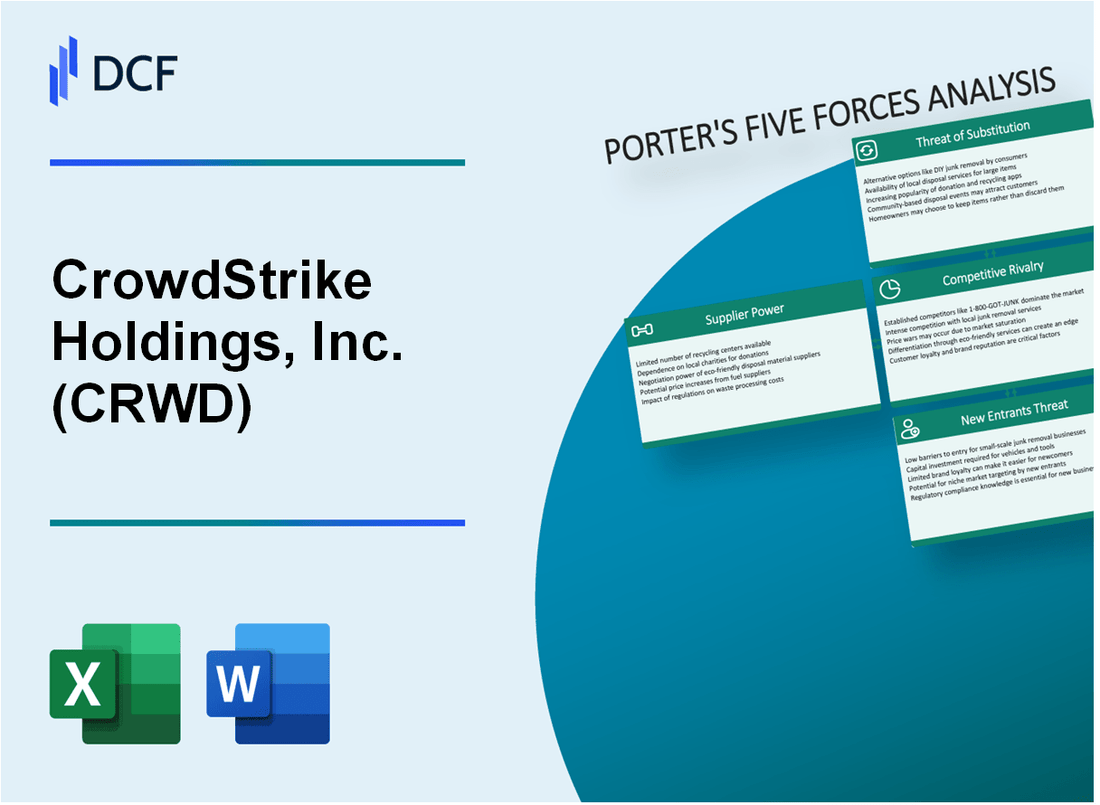
Crowdsstrike Holdings, Inc. (CRWD): 5 Forces Analysis [Jan-2025 Mis à jour] |
Entièrement Modifiable: Adapté À Vos Besoins Dans Excel Ou Sheets
Conception Professionnelle: Modèles Fiables Et Conformes Aux Normes Du Secteur
Pré-Construits Pour Une Utilisation Rapide Et Efficace
Compatible MAC/PC, entièrement débloqué
Aucune Expertise N'Est Requise; Facile À Suivre
CrowdStrike Holdings, Inc. (CRWD) Bundle
Dans le monde à enjeux élevés de la cybersécurité, Crowdstrike Holdings, Inc. (CRWD) navigue sur un champ de bataille complexe où l'innovation technologique, la dynamique du marché et le positionnement stratégique déterminent la survie et le succès. À mesure que les cybermenaces évoluent à la vitesse de la foudre, la compréhension des forces complexes façonnant le paysage concurrentiel de Crowdsstrike devient crucial pour les investisseurs, les amateurs de technologie et les professionnels de la cybersécurité. Cette plongée profonde dans le cadre des cinq forces de Michael Porter dévoile les facteurs critiques stimulant le potentiel stratégique de Crowdsstrike, révélant l'équilibre délicat de pouvoir, de concurrence et d'opportunité dans l'écosystème de défense numérique en constante évolution.
Crowdsstrike Holdings, Inc. (CRWD) - Five Forces de Porter: Poste de négociation des fournisseurs
Nombre limité de fournisseurs de technologies de cybersécurité spécialisées
Depuis le quatrième trimestre 2023, CrowdStrike s'appuie sur un bassin limité de fournisseurs de technologies de cybersécurité spécialisées:
| Catégorie des fournisseurs | Nombre de fournisseurs clés | Concentration du marché |
|---|---|---|
| Fournisseurs de technologies de cybersécurité | 7-10 fournisseurs spécialisés mondiaux | Les 3 meilleurs fournisseurs contrôlent 65% de la part de marché |
Influence des fournisseurs d'infrastructures cloud
Les fournisseurs d'infrastructures cloud démontrent un pouvoir de marché important:
- Part de marché AWS: 32% en 2023
- Part de marché Microsoft Azure: 23% en 2023
- Part de marché de Google Cloud: 10% en 2023
Dépendances des fabricants de semi-conducteurs
| Fabricant de semi-conducteurs | Part de marché mondial | Impact de la contrainte d'alimentation |
|---|---|---|
| Tsmc | 53% de la production mondiale de semi-conducteurs | Risque de perturbation de la chaîne d'approvisionnement à potentiel |
| Samsung | 18% de la production mondiale de semi-conducteurs | Potentiel de contrainte de chaîne d'approvisionnement modérée |
Chaîne d'approvisionnement de la technologie de cybersécurité avancée
Contraintes de la chaîne d'approvisionnement pour les technologies de cybersécurité avancées:
- Pénurie mondiale de puces à semi-conducteurs: 15 à 20% de limitation de production
- Délai de livraison moyen pour le matériel de cybersécurité spécialisé: 6-9 mois
- Investissement estimé de la chaîne d'approvisionnement de la technologie annuelle: 2,4 milliards de dollars
Crowdsstrike Holdings, Inc. (CRWD) - Five Forces de Porter: Pouvoir de négociation des clients
Grandes clients d'entreprise et pouvoir de négociation
Au quatrième trimestre 2023, CrowdStrike a déclaré 23 310 clients au total, 71% étant des clients d'entreprise. Les 10 meilleurs clients représentaient environ 12% du total des revenus récurrents annuels (ARR).
| Segment de clientèle | Nombre de clients | Pourcentage du total |
|---|---|---|
| Entreprenants | 16,551 | 71% |
| Clients du marché intermédiaire | 6,759 | 29% |
Demande de solution de cybersécurité
La croissance ARR de Crowdstrike au quatrième trimestre 2023 était de 33% en glissement annuel, atteignant 2,79 milliards de dollars.
- Le marché mondial de la cybersécurité devrait atteindre 366,10 milliards de dollars d'ici 2028
- Dépenses moyennes de la cybersécurité de l'entreprise: 2 700 $ par employé par an
Comparaison et commutation de la plate-forme
La plate-forme de Crowdsstrike propose 23 modules de cloud, permettant des solutions de cybersécurité complètes à travers les différents besoins des clients.
| Plate-forme de cybersécurité | Coût annuel moyen | Commutation de complexité |
|---|---|---|
| Crowdstrike Falcon | 8 $ - 15 $ par point final / mois | Moyen |
| Plateforme des concurrents a | 10 $ - 18 $ par point final / mois | Haut |
Modèle d'engagement basé sur l'abonnement
Le taux de rétention d'abonnement de Crowdstrike était de 98% au T4 2023, indiquant une forte satisfaction client et un engagement flexible.
- Durée du contrat moyen: 12-24 mois
- Options de mise à l'échelle flexibles disponibles
- Options de facturation mensuelles et annuelles
Crowdsstrike Holdings, Inc. (CRWD) - Five Forces de Porter: rivalité compétitive
Paysage concurrentiel du marché
Au quatrième trimestre 2023, le marché de la cybersécurité démontre une concurrence intense avec des mesures financières et de marché spécifiques:
| Concurrent | Part de marché | Revenus annuels | Revenus de sécurité des terminaux |
|---|---|---|---|
| Cowsterrike | 14.3% | 2,73 milliards de dollars (2023) | 1,58 milliard de dollars |
| Réseaux palo alto | 16.7% | 6,21 milliards de dollars (2023) | 2,35 milliards de dollars |
| Sentinelle | 7.2% | 591 millions de dollars (2023) | 414 millions de dollars |
Mesures compétitives clés
Dynamique concurrentielle du marché de la cybersécurité:
- Taille du marché mondial de la cybersécurité: 172,32 milliards de dollars en 2023
- Taux de croissance du marché projeté: 13,4% par an
- Nombre de fournisseurs de cybersécurité actifs: 3 541 dans le monde
- Investissement moyen de R&D: 18-22% des revenus annuels
Dépenses d'innovation technologique
| Entreprise | Dépenses de R&D | Dépôts de brevet |
|---|---|---|
| Cowsterrike | 608 millions de dollars (2023) | 127 brevets de cybersécurité |
| Réseaux palo alto | 1,2 milliard de dollars (2023) | 342 brevets de cybersécurité |
| Sentinelle | 214 millions de dollars (2023) | 86 brevets de cybersécurité |
Crowdsstrike Holdings, Inc. (CRWD) - Five Forces de Porter: Menace de substituts
Outils de sécurité open source comme solutions alternatives
En 2024, les outils de sécurité open source représentent une menace de substitution importante. Environ 65% des professionnels de la cybersécurité considèrent les solutions open source comme des alternatives viables aux plateformes commerciales.
| Outil de sécurité open source | Pénétration du marché | Croissance de l'utilisation annuelle |
|---|---|---|
| Renifler | 37.5% | 12.3% |
| Ossec | 22.8% | 9.6% |
| Ouverts | 18.4% | 7.9% |
Substitution logicielle antivirus traditionnelle
Les plates-formes antivirus traditionnelles continuent de présenter des risques de substitution. En 2024, environ 42% des petites et moyennes entreprises dépendent toujours des solutions antivirus traditionnelles.
- Part de marché McAfee: 18,7%
- Part de marché Symantec: 15,3%
- Part de marché de micro-tendance: 12,9%
Alternatives de services de sécurité basées sur le cloud
Les services de sécurité basés sur le cloud émergent comme des substituts compétitifs. Le marché mondial de la sécurité du cloud devrait atteindre 37,4 milliards de dollars d'ici 2024.
| Fournisseur de sécurité du cloud | Part de marché | Revenus annuels |
|---|---|---|
| Réseaux palo alto | 22.5% | 6,2 milliards de dollars |
| Zscaler | 15.7% | 1,8 milliard de dollars |
| Cloudflare | 11.3% | 1,3 milliard de dollars |
Apprentissage automatique et plates-formes de sécurité axées sur l'IA
L'apprentissage automatique et les plates-formes de sécurité axées sur l'IA augmentent les options de substitution. Le marché de la cybersécurité de l'IA devrait atteindre 46,3 milliards de dollars d'ici 2024.
- Sécurité IBM: 25,6% de part de marché de la sécurité de l'IA
- Darktrace: 18,4% de part de marché de la sécurité de l'IA
- VECTRA AI: 14,2% de part de marché de la sécurité de l'IA
Crowdsstrike Holdings, Inc. (CRWD) - Five Forces de Porter: Menace de nouveaux entrants
Investissement initial élevé requis pour le développement de la technologie de la cybersécurité
Les dépenses de recherche et développement de Crowdsstrike en 2023 étaient de 1,2 milliard de dollars, ce qui représente une obstacle important pour les participants au marché potentiels. Les coûts totaux de l'infrastructure technologique de l'entreprise ont atteint 456,7 millions de dollars au cours du même exercice.
| Catégorie d'investissement | Montant (2023) |
|---|---|
| Dépenses de R&D | 1,2 milliard de dollars |
| Infrastructure technologique | 456,7 millions de dollars |
Expertise technique importante nécessaire pour entrer sur le marché
Le marché de la cybersécurité nécessite des capacités techniques avancées. Crowdsstrike emploie 3 785 professionnels techniques au T4 2023, avec un niveau d'expertise technique moyen qui crée des barrières d'entrée substantielles.
- Expérience minimale d'ingénierie en cybersécurité: 5-7 ans
- Certifications avancées requises: CISSP, CISM, CEH
- Spécialisation de la sécurité du cloud: critique pour l'entrée du marché
La réputation de marque établie crée des barrières d'entrée
La position du marché de Crowdstrike est renforcée par sa forte reconnaissance de marque. La société dessert 21 613 clients d'abonnement au 31 janvier 2024, avec un taux de rétention de clientèle de 96%.
| Métrique de la marque | Valeur |
|---|---|
| Total des clients d'abonnement | 21,613 |
| Taux de rétention de la clientèle | 96% |
Défis de conformité et de certification réglementaires
L'entrée du marché de la cybersécurité nécessite de vastes certifications de conformité. Crowdsstrike maintient le respect de plusieurs normes internationales, notamment:
- Certification SOC 2 Type II
- Certification ISO 27001
- Compliance HIPAA
- Autorisation de Fedramp
Le coût estimé de la réalisation de ces certifications varie de 250 000 $ à 1,5 million de dollars pour les nouveaux entrants du marché.
CrowdStrike Holdings, Inc. (CRWD) - Porter's Five Forces: Competitive rivalry
The competitive rivalry facing CrowdStrike Holdings, Inc. is intense, characterized by well-capitalized, broad-based technology giants and specialized, fast-moving pure-plays. This dynamic forces CrowdStrike to maintain an aggressive pace of innovation and platform expansion.
The rivalry is extremely high with Microsoft, a competitor that possesses deep pockets and native integration across the enterprise technology stack. Microsoft Defender for Endpoint is a significant force, especially given the volume of deals it handles; for instance, Vendr data shows 652 Microsoft deals handled by the platform. Microsoft's ability to bundle security offerings within its existing ecosystem presents a structural cost advantage that is hard for CrowdStrike to counter purely on a standalone product basis.
Direct competition is fierce across multiple modules from SentinelOne, Palo Alto Networks, and Trellix. SentinelOne, for example, is actively targeting larger customers, reporting 1,459 larger customers (those with over $100,000 in annual recurring revenue) in its latest quarter. Palo Alto Networks continues its consolidation strategy, exemplified by its recent blockbuster $25 billion buy-out of an identity access management company.
The battleground is rapidly shifting toward AI-native platforms and the consolidation of Next-Gen SIEM (Security Information and Event Management). CrowdStrike's own thesis centers on its Falcon platform, Charlotte AI, and Next-Gen SIEM, aiming for repeatable, compliant response at speed. Rivals are countering with their own AI capabilities; for example, SentinelOne emphasizes its Purple AI and Hyperautomation features. CrowdStrike's Charlotte AI tool is cited as saving clients around 40 hours a week.
CrowdStrike's financial scale is a clear benchmark for rivals. The company achieved a full-year subscription revenue of $3.76 billion for fiscal year 2025, and its ending Annual Recurring Revenue (ARR) reached $4.24 billion as of January 31, 2025. Analysts project CrowdStrike's revenue to increase at a Compound Annual Growth Rate (CAGR) of 22% from fiscal 2025 to 2028.
The competitive pressure often manifests in how deals are won or lost on commercial terms. Rivals frequently compete aggressively on pricing flexibility and ease of policy management. SentinelOne is often favored for offering more flexible pricing and easier policy management compared to CrowdStrike. Furthermore, some alternatives are reported to be more cost-effective overall. CrowdStrike serves over 29,000 customers, including over half of the Fortune 1000 companies, but the cost of entry remains a point of leverage for competitors.
Here's a quick look at the scale and valuation context of the primary players as of mid-2025:
| Competitor | Key Metric/Data Point | Value |
| CrowdStrike (CRWD) | FY2025 Subscription Revenue | $3.76 billion |
| CrowdStrike (CRWD) | Ending ARR (Jan 31, 2025) | $4.24 billion |
| SentinelOne (S) | Larger Customers (>$100k ARR) | 1,459 |
| Palo Alto Networks (PANW) | Forward Sales Multiple (FY2026 proj.) | 12 times |
| Microsoft Defender | Deals Handled (Vendr Data) | 652 |
The strategic choices customers make reflect this rivalry, often balancing CrowdStrike's perceived deep visibility and threat intelligence against the operational simplicity or lower cost offered elsewhere. You see this trade-off clearly when looking at the agent architecture, where CrowdStrike leans on cloud analysis while SentinelOne builds more AI engines directly into its agent for local action.
Key competitive differentiators cited by users and analysts include:
- SentinelOne: Easier policy management and deployment.
- Microsoft: Native integration with Microsoft 365 services.
- CrowdStrike: Unmatched threat intelligence and Falcon Overwatch expertise.
- Alternatives: More budget-friendly pricing structures.
- CrowdStrike: Expected revenue CAGR of 22% through FY2028.
Finance: draft 13-week cash view by Friday.
CrowdStrike Holdings, Inc. (CRWD) - Porter's Five Forces: Threat of substitutes
You're looking at the competitive landscape for CrowdStrike Holdings, Inc. (CRWD), and the threat of substitution is definitely a major factor you need to model. The entire endpoint security paradigm is shifting, which is both an opportunity and a risk for CrowdStrike Holdings, Inc. (CRWD).
Cloud-native EDR/XDR is replacing legacy, on-premise antivirus and point solutions. The global antivirus (AV) software market itself is valued at about $4.23 billion in 2025. This market is seeing a clear migration, as enterprises increasingly expect AV solutions to have built-in EDR, XDR, or SIEM integration rather than being standalone tools. The move to cloud-based AV is preferred for its scalability and real-time updates, projecting an estimated 350 million units in cloud deployments by 2025.
Internal development of custom security tools is a costly, but possible, substitute. Insourcing your security operations means you have to factor in the collective costs of hiring staff with the right expertise for 24/7 operations, plus the capital investment required for modern security technologies. For many, the speed required to keep up with evolving threats means building in-house is simply too slow or too expensive compared to buying a mature platform.
Consolidation onto rival platforms, like Microsoft Defender or Palo Alto Networks Cortex, is the main substitution risk you need to watch. Microsoft Defender for Endpoint, for instance, offers native integration within the Windows ecosystem, which can translate to significant cost savings for organizations already heavily invested in Microsoft 365 E5 licenses. The competitive positioning in the Endpoint Protection Platform (EPP) space as of November 2025 shows this dynamic clearly:
| Vendor/Category | EPP Mindshare (November 2025) | Average Rating (out of 10) |
|---|---|---|
| Microsoft Defender for Endpoint | 9.5% | 8.4 |
| CrowdStrike Falcon | 7.8% | 8.6 |
| Other | 82.7% | N/A |
Furthermore, the broader Extended Detection and Response (XDR) market-where CrowdStrike Holdings, Inc. (CRWD) competes heavily-is projected to grow from USD 7.92 billion in 2025 to USD 30.86 billion by 2030. This rapid growth means that platform consolidation, whether toward Microsoft's integrated suite or Palo Alto Networks Cortex, presents a real threat to CrowdStrike Holdings, Inc. (CRWD)'s standalone EDR/XDR share.
The Falcon platform's breadth actively reduces the threat from these single-function security tools. CrowdStrike Holdings, Inc. (CRWD) has expanded its portfolio to offer 30 different product modules spanning identity protection, cloud security, data protection, and more. This modular approach, often driven by the Falcon Flex subscription model, incentivizes customers to consolidate more security spend onto the platform. Here's how deep that adoption runs:
- Customers adopting six or more cloud modules represented 48% of total subscription customers as of July 31, 2025.
- Those with seven or more cloud modules accounted for 33% of the base.
- Customers with eight or more modules represented 23% of the base.
- Total Annual Recurring Revenue (ARR) for CrowdStrike Holdings, Inc. (CRWD) reached $4.66 billion.
This multi-module adoption shows you that customers are actively using the platform effect to fight complexity and drive consolidation, which is a direct countermeasure to the substitution threat.
CrowdStrike Holdings, Inc. (CRWD) - Porter's Five Forces: Threat of new entrants
The threat of new entrants for CrowdStrike Holdings, Inc. remains structurally moderate to low, primarily due to the immense scale and complexity required to replicate its established, cloud-native, AI-driven security platform.
High capital investment is required to build a cloud-native, AI-driven platform. A new entrant faces substantial initial and ongoing expenditure. For instance, a basic GPU server on AWS can cost approximately $3,000-4,000 a month, while training-capable servers can run $30,000-40,000 a month. Furthermore, securing significant funding is a prerequisite for scale, as demonstrated by AI-first security startups like Cyera achieving a $3 billion valuation following a $300 million Series D round, and Clover Security launching with $36 million in funding.
A significant barrier stems from the need for massive data (telemetry) to train effective AI security models. The scale of telemetry data in hyperscale environments is staggering, generating petabytes of data per day, continuously streaming real-time signals from millions of components, which rivals financial transaction data in volume. AI/LLM systems generate unique telemetry across multiple layers, including API calls and token usage, which traditional tools may not capture by default. Training effective models requires ingesting and processing this 'vast amount of data'.
Regulatory compliance and enterprise trust take years to build. Providers must balance innovation with the highest standards of trust, especially in the AI era. While regulatory tailwinds, such as the EU's Digital Operational Resilience Act (DORA), drive spending on compliance tools, achieving the level of trust required for core security functions is a long-term process; adoption of new AI-Native platforms is expected to take time, mirroring the decade-long adoption curve of cloud computing.
The $4.24 billion Annual Recurring Revenue (ARR) base CrowdStrike Holdings, Inc. reported as of January 31, 2025, creates a strong network effect barrier. This scale, which grew to $4.66 billion by July 31, 2025, signifies a massive installed base that generates continuous feedback and validation for the platform, making it harder for smaller, unproven entrants to displace incumbent solutions.
The primary threat comes from large tech firms acquiring small, innovative startups to quickly enter the market. This trend accelerated in 2025 with 'mega-M&A' deals, signaling a battle between well-funded giants. Examples of this consolidation include:
- Google announcing a deal to acquire cloud and AI security vendor Wiz for $32 billion.
- Palo Alto Networks reaching a deal to acquire identity security vendor CyberArk for $25 billion.
- Wiz previously declining a $23 billion acquisition offer from Google in July 2025.
- CrowdStrike Holdings, Inc. itself being one of the vendors that unveiled multiple startup acquisition deals in 2025.
The high cost of these acquisitions shows that established players are willing to pay premium valuations to immediately acquire AI and cloud-native capabilities, rather than building them organically.
| Metric | Value | Date/Context |
| CrowdStrike Holdings, Inc. Ending ARR | $4.24 billion | January 31, 2025 |
| CrowdStrike Holdings, Inc. Latest Reported ARR | $4.66 billion | July 31, 2025 |
| Cloud Security Startup Valuation (Cyera) | $3 billion | Series D valuation |
| Cloud Security Startup Funding (Cyera) | $300 million | Series D round |
| Major Tech Acquisition Value (Google/Wiz) | $32 billion | Announced deal in 2025 |
| Major Tech Acquisition Value (PANW/CyberArk) | $25 billion | Announced deal in 2025 |
| Cost to Build AI Infrastructure (Training Server/Month) | $30,000-40,000 | AWS estimate |
| Telemetry Data Volume | Petabytes per day | Hyperscale environments |
Disclaimer
All information, articles, and product details provided on this website are for general informational and educational purposes only. We do not claim any ownership over, nor do we intend to infringe upon, any trademarks, copyrights, logos, brand names, or other intellectual property mentioned or depicted on this site. Such intellectual property remains the property of its respective owners, and any references here are made solely for identification or informational purposes, without implying any affiliation, endorsement, or partnership.
We make no representations or warranties, express or implied, regarding the accuracy, completeness, or suitability of any content or products presented. Nothing on this website should be construed as legal, tax, investment, financial, medical, or other professional advice. In addition, no part of this site—including articles or product references—constitutes a solicitation, recommendation, endorsement, advertisement, or offer to buy or sell any securities, franchises, or other financial instruments, particularly in jurisdictions where such activity would be unlawful.
All content is of a general nature and may not address the specific circumstances of any individual or entity. It is not a substitute for professional advice or services. Any actions you take based on the information provided here are strictly at your own risk. You accept full responsibility for any decisions or outcomes arising from your use of this website and agree to release us from any liability in connection with your use of, or reliance upon, the content or products found herein.