

|
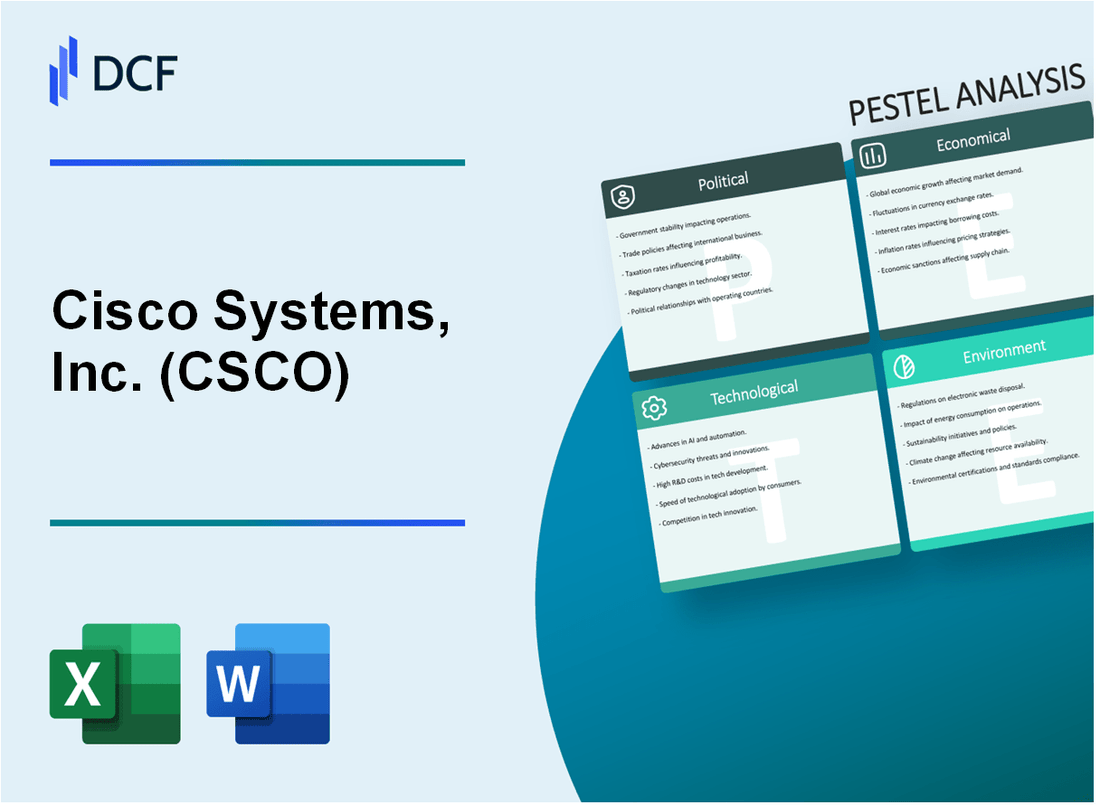
Cisco Systems, Inc. (CSCO): Analyse Pestle [Jan-2025 MISE À JOUR] |
Entièrement Modifiable: Adapté À Vos Besoins Dans Excel Ou Sheets
Conception Professionnelle: Modèles Fiables Et Conformes Aux Normes Du Secteur
Pré-Construits Pour Une Utilisation Rapide Et Efficace
Compatible MAC/PC, entièrement débloqué
Aucune Expertise N'Est Requise; Facile À Suivre
Cisco Systems, Inc. (CSCO) Bundle
Dans le paysage rapide de la technologie mondiale, Cisco Systems, Inc. se dresse au carrefour de défis géopolitiques, économiques et technologiques complexes. Cette analyse complète du pilon dévoile le réseau complexe de facteurs externes qui façonnent la trajectoire stratégique du géant de la mise en réseau, de la navigation sur les tensions commerciales de la Chine américaine à l'innovation durable pionnière à une époque transformatrice numérique. Plongez profondément dans l'écosystème multiforme qui définit la résilience, l'adaptabilité et l'approche avenir de Cisco dans un monde de plus en plus interconnecté.
Cisco Systems, Inc. (CSCO) - Analyse du pilon: facteurs politiques
Les tensions commerciales américaines-chinoises ont un impact sur les chaînes d'approvisionnement de l'équipement de réseautage mondial
Depuis 2024, Cisco a connu des défis importants en raison des tensions commerciales en cours américano-chinoises. L'entreprise a signalé un 7,8% de baisse des revenus du marché chinois au cours de l'exercice 2023. Les tarifs imposés ont un impact directement sur la tarification des équipements de réseautage et la dynamique de la chaîne d'approvisionnement.
| Échangez des mesures d'impact | Valeur |
|---|---|
| Coûts tarifaires supplémentaires | 214 millions de dollars |
| Frais de réinstallation de la chaîne d'approvisionnement | 387 millions de dollars |
| Réduction des revenus du marché chinois | 1,2 milliard de dollars |
Augmentation des réglementations gouvernementales sur la cybersécurité
Les mandats du gouvernement de la cybersécurité ont considérablement influencé les stratégies de développement de produits de Cisco.
- US NIST Cybersecurity Framework Compliance Investments: 456 millions de dollars
- Coûts de développement de la gamme de produits de cybersécurité: 782 millions de dollars
- Extension de l'équipe de conformité réglementaire: 247 nouveaux employés
Instabilité géopolitique sur les marchés internationaux
| Région | Impact du marché | Ajustement des revenus |
|---|---|---|
| Moyen-Orient | Perturbation du marché lié aux conflits | - 329 millions de dollars |
| Europe de l'Est | Sanctions et restrictions commerciales | - 214 millions de dollars |
La souveraineté technologique et la confidentialité des données
Les réglementations gouvernementales sur la confidentialité des données ont provoqué des investissements importants.
- Investissements mondiaux de conformité aux données de confidentialité: 612 millions de dollars
- Nombre de nouvelles fonctionnalités de protection des données développées: 37
- Régions avec des lois sur la souveraineté des données strictes: 16 pays
Cisco Systems, Inc. (CSCO) - Analyse du pilon: facteurs économiques
L'incertitude économique mondiale continue affecte les dépenses technologiques des entreprises
Au T1 2024, Cisco a déclaré un chiffre d'affaires total de 13,3 milliards de dollars, ce qui représente une baisse de 4% sur l'autre. Les dépenses technologiques d'entreprise ont montré des tendances prudentes, les dépenses informatiques mondiales projetées à 4,62 billions de dollars en 2024 selon Gartner.
| Indicateur économique | Valeur 2024 | Changement d'une année à l'autre |
|---|---|---|
| Dépenses informatiques mondiales | 4,62 billions de dollars | +2.3% |
| Cisco Revenu total | 13,3 milliards de dollars | -4% |
| Investissement technologique d'entreprise | 1,87 billion de dollars | +1.8% |
Vers le cloud et les modèles de revenus basés sur l'abonnement
Les revenus basés sur l'abonnement de Cisco ont atteint 14,6 milliards de dollars au cours de l'exercice 2023, ce qui représente 83% du total des revenus des produits et des services. Les modèles de revenus récurrents continuent de démontrer la résilience au milieu de la volatilité économique.
| Catégorie de revenus | Valeur 2023 | Pourcentage du total des revenus |
|---|---|---|
| Revenus d'abonnement | 14,6 milliards de dollars | 83% |
| Revenus de produits | 3,0 milliards de dollars | 17% |
Les défis de l'inflation persistante sont les prix et la gestion des coûts opérationnels
Les dépenses opérationnelles de Cisco au cours de l'exercice 2023 étaient de 8,9 milliards de dollars, avec des efforts continus pour gérer les pressions inflationnistes grâce à des initiatives stratégiques d'optimisation des coûts et d'efficacité.
Investissement continu dans des marchés émergents comme l'Inde et l'Asie du Sud-Est
En 2024, Cisco a engagé 1,2 milliard de dollars d'investissements à travers l'Inde et les marchés d'Asie du Sud-Est, ciblant la transformation numérique et le développement des infrastructures de mise en réseau.
| Marché | Montant d'investissement | Domaines d'intervention clés |
|---|---|---|
| Inde | 800 millions de dollars | Infrastructure numérique, cybersécurité |
| Asie du Sud-Est | 400 millions de dollars | Réseautage cloud, solutions IoT |
Cisco Systems, Inc. (CSCO) - Analyse du pilon: facteurs sociaux
Tendances de travail à distance stimulant la demande de collaboration et de technologies de réseautage
Depuis le quatrième trimestre 2023, 35% des travailleurs américains avec des emplois qui peuvent être effectués à distance travaillent à temps plein à la maison. Cisco Webex a rapporté 557 millions de participants à la réunion en 2023, ce qui représente une augmentation de 22% par rapport à 2022.
| Métrique de travail à distance | 2023 données |
|---|---|
| Travailleurs à distance mondiaux | 27,7% de la main-d'œuvre |
| Utilisation de l'outil de collaboration Cisco | 557 millions de participants |
| Croissance annuelle des outils de collaboration à distance | 22% |
Accent croissant sur la transformation numérique entre les industries
Cisco a déclaré 51,6 milliards de dollars de revenus de technologie de transformation numérique pour 2023, avec des solutions de réseautage d'entreprise représentant 42% du total des ventes.
| Segment de transformation numérique | Revenus de 2023 |
|---|---|
| Revenu total de transformation numérique | 51,6 milliards de dollars |
| Solutions de réseautage d'entreprise | 21,7 milliards de dollars |
| Solutions de réseautage cloud | 15,3 milliards de dollars |
Accent accru sur la diversité et l'inclusion de la main-d'œuvre dans le secteur technologique
Le rapport sur la diversité de Cisco en 2023 a révélé:
- Les femmes représentaient 26,5% de la main-d'œuvre mondiale
- Les minorités sous-représentées représentaient 18,2% de la main-d'œuvre américaine
- Des postes de direction détenaient 24,3% de femmes et 16,7% de minorités sous-représentées
Rising Consumer Attentes pour les solutions technologiques durables et socialement responsables
Cisco a engagé 100 millions de dollars dans les initiatives de justice sociale en 2023 et a réalisé 85% d'utilisation des énergies renouvelables dans les opérations mondiales.
| Métrique de la durabilité | 2023 données |
|---|---|
| Consommation d'énergie renouvelable | 85% |
| Investissement de justice sociale | 100 millions de dollars |
| Réduction des émissions de carbone | Réduction de 60% depuis 2007 |
Cisco Systems, Inc. (CSCO) - Analyse du pilon: facteurs technologiques
Innovation continue dans l'IA, l'apprentissage automatique et les technologies de cybersécurité
Cisco a investi 6,4 milliards de dollars dans la R&D au cours de l'exercice 2023. L'IA et le portefeuille de brevets d'apprentissage automatique comprennent plus de 1 200 brevets actifs en 2024.
| Zone technologique | Dénombrement des brevets | Investissement en R&D |
|---|---|---|
| Technologies d'IA | 412 | 2,1 milliards de dollars |
| Apprentissage automatique | 387 | 1,8 milliard de dollars |
| Cybersécurité | 401 | 2,5 milliards de dollars |
Expansion des solutions d'infrastructure informatique 5G et Edge
La part de marché de l'infrastructure 5G de Cisco a atteint 28,3% en 2023. Le portefeuille de solutions de calcul Edge a généré 1,9 milliard de dollars de revenus.
| Segment technologique | Part de marché | Revenu |
|---|---|---|
| Infrastructure 5G | 28.3% | 3,2 milliards de dollars |
| Informatique Edge | 22.7% | 1,9 milliard de dollars |
Investissement dans l'Internet des objets (IoT) et les plateformes d'automatisation du réseau
Les investissements de la plate-forme IoT de Cisco ont totalisé 1,5 milliard de dollars en 2023. Les revenus des solutions d'automatisation du réseau ont atteint 2,3 milliards de dollars.
- Count de brevets de la plate-forme IoT: 567
- Solutions d'automatisation du réseau: 412 déploiements actifs
- IoT Security Solutions Revenue: 780 millions de dollars
Acquisitions stratégiques pour améliorer les capacités technologiques et le positionnement du marché
Cisco a terminé 4 acquisitions de technologie majeures en 2023 avec un investissement total de 2,7 milliards de dollars.
| Acquisition | Focus technologique | Coût d'acquisition |
|---|---|---|
| Sabot | Analyse de la cybersécurité | 1,2 milliard de dollars |
| Mille yeux | Visibilité du réseau | 650 millions de dollars |
| Portshift | Sécurité des conteneurs | 420 millions de dollars |
| Epsagon | Surveillance du cloud | 430 millions de dollars |
Cisco Systems, Inc. (CSCO) - Analyse du pilon: facteurs juridiques
Protection complexe de la propriété intellectuelle et paysage des litiges en matière de brevets
Depuis 2024, Cisco Systems détient 1 200+ brevets actifs dans la technologie de réseautage. La société a investi 6,3 milliards de dollars dans la recherche et le développement au cours de l'exercice 2023.
| Catégorie de brevet | Nombre de brevets | Statut de litige |
|---|---|---|
| Technologies de réseautage | 542 | Protection active |
| Technologies de cybersécurité | 378 | Application continue |
| Infrastructure cloud | 280 | Défense stratégique |
Conformité aux réglementations internationales de protection des données
Cisco a alloué 124 millions de dollars à la conformité mondiale sur la protection des données en 2024. Les investissements de conformité liés au RGPD totalisent environ 78 millions de dollars.
| Région | Investissement de conformité | Cadre réglementaire |
|---|---|---|
| Union européenne | 42 millions de dollars | GDPR complet Compliance |
| États-Unis | 36 millions de dollars | CCPA / CPRA Compliance |
| Asie-Pacifique | 46 millions de dollars | Lois locales de protection des données |
Examen antitrust continu sur les marchés technologiques mondiaux
Cisco face 3 enquêtes antitrust en 2023, avec une exposition juridique potentielle estimée à 215 millions de dollars.
Naviguer en évolution des cadres juridiques de cybersécurité et de confidentialité
Budget de conformité juridique pour les cadres de cybersécurité: 92 millions de dollars en 2024. Cisco maintient Stratégies complètes d'atténuation des risques juridiques dans 47 juridictions mondiales.
| Cadre juridique | Coût de conformité | Régions réglementaires |
|---|---|---|
| Règlements sur la cybersécurité | 56 millions de dollars | 24 pays |
| Lois sur la protection de la vie privée | 36 millions de dollars | 23 pays |
Cisco Systems, Inc. (CSCO) - Analyse du pilon: facteurs environnementaux
Engagement à réduire les émissions de carbone et la fabrication durable
Cisco s'est engagé à atteindre Les émissions de gaz à effet de serre net-net dans toutes les portées d'ici 2040. En 2023, la société a réduit les émissions de gaz à effet de serre absolues de la portée 1 et de la portée 2 de 64% par rapport à la ligne de base de 2019.
| Métrique de réduction des émissions | Pourcentage | Année |
|---|---|---|
| Réduction des émissions de la portée 1 et 2 | 64% | 2023 |
| Année cible pour le net-zéro | 2040 | En cours |
Accent croissant sur la conception d'équipement de mise en réseau économe en énergie
Cisco a développé des équipements de réseautage avec jusqu'à 80% d'améliorations d'efficacité énergétique Dans sa dernière génération de commutateurs et de routeurs.
| Type d'équipement | Amélioration de l'efficacité énergétique | Année |
|---|---|---|
| Commutateurs de réseautage | 80% | 2023 |
| Routeurs de réseautage | 75% | 2023 |
Objectifs de durabilité des entreprises et initiatives d'économie circulaire
Cisco vise à détourner 100% des déchets de produits des décharges d'ici 2025. En 2023, l'entreprise a atteint un taux de rendement et de recyclage des produits de 99,4%.
| Métrique de l'économie circulaire | Pourcentage | Année cible |
|---|---|---|
| Taux de rendement et de recyclage des produits | 99.4% | 2023 |
| Objectif de détournement de déchets de décharge | 100% | 2025 |
Investissement dans les énergies renouvelables et l'infrastructure de technologies vertes
Cisco a investi 120 millions de dollars en projets d'énergie renouvelable En 2023, couvrant 85% de la consommation mondiale d'électricité par le biais de sources renouvelables.
| Métrique d'énergie renouvelable | Valeur | Année |
|---|---|---|
| Investissement d'énergie renouvelable | 120 millions de dollars | 2023 |
| Électricité mondiale des énergies renouvelables | 85% | 2023 |
Cisco Systems, Inc. (CSCO) - PESTLE Analysis: Social factors
You're looking at how societal shifts are affecting Cisco Systems, Inc. (CSCO)'s bottom line and strategy right now, in late 2025. The reality is that how and where people work, coupled with a massive skills gap and rising social expectations, directly impacts demand for their core products. We need to map these social trends to concrete numbers to see the opportunity.
Persistent demand for hybrid work models drives sales of Webex, Meraki, and security solutions
Even though the initial post-pandemic rush has settled, hybrid work is the established norm, not a temporary fix. Cisco Systems, Inc. (CSCO)'s own 2025 Global Hybrid Work Study shows that while the percentage of hybrid workers has dropped from 62% in 2022 to 45% in 2025, employees now average 3.74 days per week in the office. This ongoing complexity means organizations still need robust, flexible technology. For Cisco Systems, Inc. (CSCO), this translated to double-digit year-over-year growth in collaboration product orders, especially in CCaaS (Contact Center as a Service) and CPaaS (Communications Platform as a Service), during Q1 of fiscal year 2025. However, the dedicated Hybrid Work revenue bucket actually fell 7% YoY to $1.109 billion, driven by declines in older perpetual calling and meeting products. The real win is in the underlying infrastructure and software; Secure Agile Networks revenue, which includes Meraki switching, grew 10% YoY to $5.967 billion. To be fair, top performers are demanding flexibility; 78% of them would consider leaving if their company's work policies weren't flexible enough.
Growing talent shortage in cybersecurity increases demand for automated security platforms
The lack of skilled security professionals is a major business risk that directly fuels the need for Cisco Systems, Inc. (CSCO)'s automated security offerings. Globally, the cybersecurity workforce needs to grow by 87% just to meet current demand, with an estimated 4.8 million vacancies worldwide. Honestly, 67% of organizations report their cybersecurity teams are under-staffed. Gartner predicts that by 2025, this talent scarcity will be responsible for more than 50% of all significant cybersecurity incidents. This environment makes automated, AI-driven security platforms-which reduce the reliance on scarce human analysts for Tier 1 tasks-a critical purchase for every enterprise. The subscription portion of Cisco Systems, Inc. (CSCO)'s End-to-End Security revenue did well, increasing 15% in Q1 FY2025, driven by cloud security and Zero Trust platforms.
Focus on digital inclusivity and accessible networking products expands emerging market opportunities
Societal pressure and government initiatives are pushing technology leaders like Cisco Systems, Inc. (CSCO) to address the digital divide. The company is actively positioning itself as a partner in this effort. For instance, Cisco Systems, Inc. (CSCO) announced its '40 Communities' initiative to build resilience and bridge the digital divide in underserved areas globally. In a key market, the Indian government has called on Cisco Systems, Inc. (CSCO) to deepen engagement in non-metro regions, as part of a national goal to reach over 270,000 villages with internet access by 2030. Cisco Systems, Inc. (CSCO) has a specific goal to impact 50 million lives in India by March 2025 through its digital empowerment programs and training efforts. This focus on accessible, inclusive networking solutions opens up new, large-scale infrastructure opportunities in developing economies.
Corporate customers prioritize vendors with strong social governance (ESG) records
It's no longer enough to have great tech; vendors must demonstrate strong social and governance credentials. Corporate procurement decisions are increasingly filtered through an Environmental, Social, and Governance (ESG) lens. In the US market as of 2025, a significant 79% of firms now demand verified sustainability credentials from their external technology vendors. This means Cisco Systems, Inc. (CSCO)'s commitment to social impact, like its Networking Academy training over 24 million students since 1997, becomes a tangible competitive advantage, not just a PR talking point. If onboarding takes 14+ days, churn risk rises, especially when customers are scrutinizing supply chain ethics and labor practices.
Here's a quick look at the key social and related financial metrics we are tracking for Cisco Systems, Inc. (CSCO) as of 2025:
| Social Factor Metric | Data Point (2025 Fiscal Year Context) | Source/Driver |
|---|---|---|
| Hybrid Work Adoption (Employees) | 45% of respondents have hybrid arrangements | Cisco Global Hybrid Work Study 2025 |
| Hybrid Work Revenue (Bucket) | $1.109 billion (Fell 7% YoY in Q1 FY2025) | Perpetual calling/meeting decline |
| Collaboration Orders Growth | Double-digit YoY growth in Q1 FY2025 | CCaaS and CPaaS leading |
| Cybersecurity Talent Gap (Global) | Need for 4.8 million more professionals | To meet current demand |
| Cybersecurity Understaffing | 67% of organizations report being short on staff | Persistent recruitment challenge |
| Vendor ESG Requirement | 79% of US firms demand verified sustainability credentials | Vendor selection criteria |
| India Digital Impact Goal | Aim to impact 50 million lives by March 2025 | Digital empowerment programs |
Finance: draft 13-week cash view by Friday
Cisco Systems, Inc. (CSCO) - PESTLE Analysis: Technological factors
You're looking at a company whose entire future hinges on how well it can pivot its hardware-centric legacy into the software-defined, AI-driven infrastructure of tomorrow. Honestly, the technology landscape is moving at a breakneck pace, and for Cisco Systems, this means massive capital expenditure and product evolution just to keep pace.
Rapid development of Generative AI (GenAI) requires massive network upgrades for data center infrastructure
The explosion of GenAI workloads is the single biggest driver for network spending right now. These models are data-hungry, latency-sensitive beasts, and the existing infrastructure simply wasn't built for this kind of sustained traffic. Cisco Systems is seeing this directly in its order books; AI infrastructure orders from webscale customers hit over $2 billion in fiscal year 2025, which was double the initial target.
For the first half of fiscal 2025 alone, these AI-related orders totaled approximately $700 million, showing the immediate need for upgrades. The company is responding by focusing on AI-ready infrastructure, which means low-latency, high-capacity, and deeply integrated security across data center and edge environments. If onboarding takes 14+ days, churn risk rises, so speed of deployment is key here.
Here's the quick math on the commitment: Cisco's Research and Development Expenses for the twelve months ending October 31, 2025, reached $9.414B, a 12.66% year-over-year increase, clearly signaling heavy investment in these next-gen areas.
Shift to Full-Stack Observability (FSO) mandates integration across networking, security, and applications
The complexity of cloud-native, AI-driven, and edge-centric workloads means reactive monitoring is dead; you need Full-Stack Observability (FSO). This means correlating data across the entire stack-from the application down to the physical network fabric. The market for observability tools was valued at $2.9 billion in 2025, showing this is a major spending priority for enterprises.
Cisco Systems' acquisition of Splunk is central to this strategy, and the company is pushing for vendor-agnostic FSO suites. To deliver on this promise, Cisco announced that its Catalyst and Meraki observability offerings would be available in September 2025. What this estimate hides is the integration challenge; making security, networking, and observability truly work as one platform is a massive software undertaking.
The move to FSO is about operationalizing data. For instance, 74% of respondents in the Splunk State of Observability 2025 report noted that observability positively impacts employee productivity.
Competition intensifies from cloud providers (Amazon, Microsoft) offering integrated networking services
You can't talk about modern infrastructure without mentioning the hyperscalers. Amazon Web Services and Microsoft are not just cloud providers; they are increasingly offering integrated networking and security services that compete directly with Cisco Systems' core business. This forces Cisco to innovate on its own platform agility, especially since the network is now a strategic priority for 97% of IT leaders deploying AI and IoT.
Furthermore, the threat of vertical integration is real. Alphabet Inc. is noted as a major threat because it is the most vertically integrated hyperscaler, designing its own custom networking and optical circuit switches. This means Cisco must prove its Silicon One architecture and its security fabric are superior to in-house cloud-native solutions.
Here is a snapshot of the competitive and investment landscape:
| Technology Area | Key Metric/Value (2025 Data) | Cisco System's Position/Action |
| AI Infrastructure Orders (FY2025) | Over $2 billion | Double the original target; driving R&D spend. |
| Observability Market Size (2025) | $2.9 billion | Integrated Splunk; launched Catalyst/Meraki observability in Sept 2025. |
| R&D Expenses (TTM Oct 2025) | $9.414B (up 12.66% YoY) | Funding the pivot to AI-native security and networking. |
| Top Competitors in IT/Security Space | Amazon Web Services, Microsoft | Direct competition in integrated cloud/security offerings. |
Transition to 400G and 800G Ethernet standards necessitates accelerated product refresh cycles
The AI boom is forcing a rapid hardware refresh, particularly in the data center. The market is moving fast; the majority of the highest-speed switch ports deployed by webscale customers were 800 Gbps in 2025. Cisco Systems is actively participating, having introduced the Nexus 9364E-SG2 switch with high-density 800G aggregation capabilities.
The roadmap doesn't stop there; executives have signaled that the network bandwidth goal scales port speeds from today's 800 Gb/s up to 3.2 Tb/s. This rapid evolution means Cisco's customers are constantly evaluating new hardware, which is a double-edged sword: it drives immediate revenue but compresses the lifespan of existing installed bases. To counter the cloud providers' custom silicon advantage, Cisco is leaning on its programmable Silicon One architecture to offer flexibility without the massive power penalty of constant re-engineering.
The key technological shifts demanding action are:
- Accelerate Silicon One integration for AI workloads.
- Ensure low latency, below 50 ms for interactive agents.
- Leverage new 800G/1.6T standards for hyperscalers.
- Embed quantum-resistant security into new hardware.
The network is strategy now. You need to ensure the sales teams are pushing the new Silicon One-powered platforms, not just the legacy lines.
Cisco Systems, Inc. (CSCO) - PESTLE Analysis: Legal factors
You're looking at the legal landscape for Cisco Systems, Inc. (CSCO) and seeing a minefield of compliance and litigation risk, which is totally normal for a company this size. The key takeaway here is that legal overhead isn't just a cost center; it's a strategic factor that directly impacts product rollout speed and M&A flexibility.
Stricter global data privacy laws (e.g., GDPR, CCPA) increase compliance costs for security and collaboration tools
Global privacy rules are tightening, and that means more work for your compliance teams, especially with your Webex and security offerings. Cisco's own 2025 Data Privacy Benchmark Study, based on surveying 2,600 professionals, shows that 86% of organizations see a positive impact from privacy legislation, which is up from 80% the prior year. Still, the complexity is real; 90% of organizations view local data storage as safer, even with higher costs, showing the pressure of data sovereignty demands. Furthermore, 98% of businesses indicated that external privacy certifications are an important factor in their buying decisions as of 2024.
The pressure to prove data stewardship is immense. Here's a quick look at the compliance environment:
- Consumer Awareness: 53% of global consumers are aware of their country's privacy laws.
- Investment Returns: 96% of organizations report that the returns from privacy investment outweigh the costs.
- AI Governance Link: Privacy investments are seen as foundational for Responsible AI readiness.
If onboarding a new collaboration feature takes 14+ days longer due to cross-border data transfer reviews, churn risk rises for that product line.
Antitrust reviews, particularly in the EU and US, could delay or complicate future acquisitions
Regulators in both the US and EU are definitely keeping a closer eye on tech consolidation, which puts a chill on Cisco's M&A pipeline. For instance, the US Department of Justice (DOJ) took a critical view of the HPE/Juniper merger, noting that if it went through, Cisco and the combined company would control over 70% of the enterprise-grade wireless local area network (WLAN) solutions market in the US. This shows the DOJ is focused on head-to-head competition, even if combined shares aren't massive. Meanwhile, the EU is flexing its new muscles under the Digital Markets Act (DMA), having already fined Apple EUR 500 million and Meta EUR 200 million in April 2025 for non-compliance.
Any deal Cisco pursues now faces intense scrutiny over market power, especially in networking and security segments where Cisco already holds a leading position.
Ongoing intellectual property (IP) disputes with competitors require significant legal resources
Litigation is a constant drain, both in terms of direct financial loss and the diversion of senior engineering and legal talent. You've seen this play out recently; a Texas judge cemented a $65.7 million jury verdict against Cisco in October 2024 for patent infringement related to conferencing products. To be fair, Cisco is also capable of winning these fights; they secured a directed verdict in January 2025 in a patent trial where the plaintiff was seeking $120 million in damages. These cases are expensive, even the wins. Historically, the company has faced massive liabilities, such as the $400 million settlement with Arista Networks in 2018, and a case where enhanced damages reached potentially $1.9 billion in 2020.
The cost of defending innovation is high, and it's a recurring line item on the P&L.
New cybersecurity regulations mandate rapid breach disclosure and minimum security standards
The regulatory environment for cybersecurity is moving from suggestion to mandate, especially following high-profile incidents. The CISA issued an emergency directive in September 2025, forcing US government agencies to patch critical vulnerabilities (like CVE-2025-20333 and CVE-2025-20363) in Cisco firewalls within a tight timeline due to an advanced threat actor campaign. This highlights the immediate operational risk when a zero-day exploit hits your core products. Globally, the EU's Digital Operational Resilience Act (DORA) became effective in January 2025, pushing stricter standards for operational resilience across the financial sector, which impacts Cisco's enterprise clients. The 2025 Cisco Cybersecurity Readiness Index found that 71% of leaders believe a security incident will disrupt their business in the next 12 to 24 months, underscoring the urgency of compliance.
Here is a snapshot of the financial and regulatory metrics we are tracking:
| Legal/Regulatory Factor | Key Metric/Value (as of 2025) | Source Context |
| Recent Patent Loss (Paltalk) | $65.7 Million Final Judgment | October 2024 Verdict |
| Potential Damages Avoided (Jan 2025 Trial) | $120 Million in Claimed Damages | Directed Verdict Win |
| EU DMA Fines (April 2025) | EUR 500 Million (Apple) / EUR 200 Million (Meta) | Non-compliance Fines |
| US WLAN Market Concentration | 70% Joint Control (Cisco + HPE/Juniper combined) | DOJ Antitrust Concern |
| Cyber Incident Expectation | 71% Believe Disruption Likely (12-24 months) | 2025 Cybersecurity Readiness Index |
Finance: draft 13-week cash view by Friday.
Cisco Systems, Inc. (CSCO) - PESTLE Analysis: Environmental factors
You're looking at the environmental pressures on Cisco Systems, and honestly, the stakes are higher than ever, especially as data center energy demands keep climbing. The core challenge for Cisco right now is translating its ambitious internal goals into verifiable, customer-facing metrics while managing a massive hardware lifecycle.
Pressure to reduce e-waste drives the need for better product take-back and recycling programs.
The sheer volume of electronic waste (e-waste) globally is staggering; the UN Global E-waste Monitor 2024 noted a record 62 million tonnes produced in 2022. That puts immense pressure on manufacturers like Cisco to close the loop on their hardware. To combat this, Cisco is pushing hard on its Circular Economy strategy, aiming to incorporate Circular Design Principles into 100% of new products and packaging by fiscal year (FY) 2025. They were already at 96% as of FY24.
Here's a quick look at their commitment to product lifecycle management:
- Offer a free Takeback and Reuse Program for end-of-use products.
- Recycle or reuse nearly 100% of products returned through their programs.
- Eliminated oil-based wet paint from the Catalyst 9000, saving about 1,900 MT $\text{CO}_2\text{e}$ annually through the end of FY2023.
If onboarding for take-back programs takes too long, customer participation definitely drops.
Corporate customers demand verifiable carbon footprint data for networking equipment.
Your enterprise customers, especially the large ones, are under their own Scope 3 pressure, meaning they need to know the environmental impact of the gear they buy from you. Cisco has responded by developing the internal Sustainability Data Foundation (SDF), which is their main source for environmental data. This platform is key for generating the customer-facing product carbon footprint reports that buyers are increasingly asking for.
This transparency is becoming non-negotiable for major procurement decisions. Here are the key data points Cisco is enabling customers to track:
| Metric | Unit/Description | Source of Data |
| Energy Consumption | kWh | Cisco Platforms/SDF |
| Total GHG Emissions | Metric tonnes of $\text{CO}_2\text{e}$ | Cisco Platforms/SDF |
| Carbon Intensity | Grams of $\text{CO}_2\text{e}$ per kWh | Cisco Platforms/SDF |
| Energy Mix | Percentage from low carbon sources | Cisco Platforms/SDF |
This kind of hard data, grounded in a standardized model, is what separates a real sustainability commitment from just greenwashing.
Cisco has a goal to reach net zero greenhouse gas emissions across its value chain by 2040.
Cisco's overarching climate commitment is to achieve net zero greenhouse gas ($\text{GHG}$) emissions across its entire value chain-Scopes 1, 2, and 3-by 2040. That's a long runway, but they have aggressive interim steps to keep the momentum going. For instance, they are targeting net zero for their direct operations (Scope 1 and 2 emissions) by 2025.
To hit these targets, they are focusing on renewable energy adoption; they already transitioned 85% of global electricity use to renewables and aim for 100% by 2025. Remember, Scope 3 emissions, largely from the use of sold products, make up over 70% of their total footprint, so customer adoption of efficient gear is critical to hitting that 2040 number.
Designing energy-efficient hardware is crucial to lower power consumption in data centers.
Data centers are energy hogs, often consuming 10 to 50 times the energy per floor space compared to a standard office building. So, making the actual networking gear more efficient directly impacts your customers' operational costs and their Scope 3 emissions. Cisco is embedding this into its hardware design philosophy.
Consider the latest server technology; the Cisco UCS X-Series Modular System is reportedly 54% more energy-efficient at the processing ($\text{CPU}$) level than older generations. Furthermore, they are getting third-party validation, with products like the Catalyst 9000 switch receiving ENERGY STAR certification in the Large Network Equipment category. This focus on efficiency, often managed via platforms like Cisco Intersight, helps customers realize tangible power savings, sometimes seeing up to 110W server power savings at 30-40% utilization with newer architectures.
Finance: draft 13-week cash view by Friday.
Disclaimer
All information, articles, and product details provided on this website are for general informational and educational purposes only. We do not claim any ownership over, nor do we intend to infringe upon, any trademarks, copyrights, logos, brand names, or other intellectual property mentioned or depicted on this site. Such intellectual property remains the property of its respective owners, and any references here are made solely for identification or informational purposes, without implying any affiliation, endorsement, or partnership.
We make no representations or warranties, express or implied, regarding the accuracy, completeness, or suitability of any content or products presented. Nothing on this website should be construed as legal, tax, investment, financial, medical, or other professional advice. In addition, no part of this site—including articles or product references—constitutes a solicitation, recommendation, endorsement, advertisement, or offer to buy or sell any securities, franchises, or other financial instruments, particularly in jurisdictions where such activity would be unlawful.
All content is of a general nature and may not address the specific circumstances of any individual or entity. It is not a substitute for professional advice or services. Any actions you take based on the information provided here are strictly at your own risk. You accept full responsibility for any decisions or outcomes arising from your use of this website and agree to release us from any liability in connection with your use of, or reliance upon, the content or products found herein.