

|
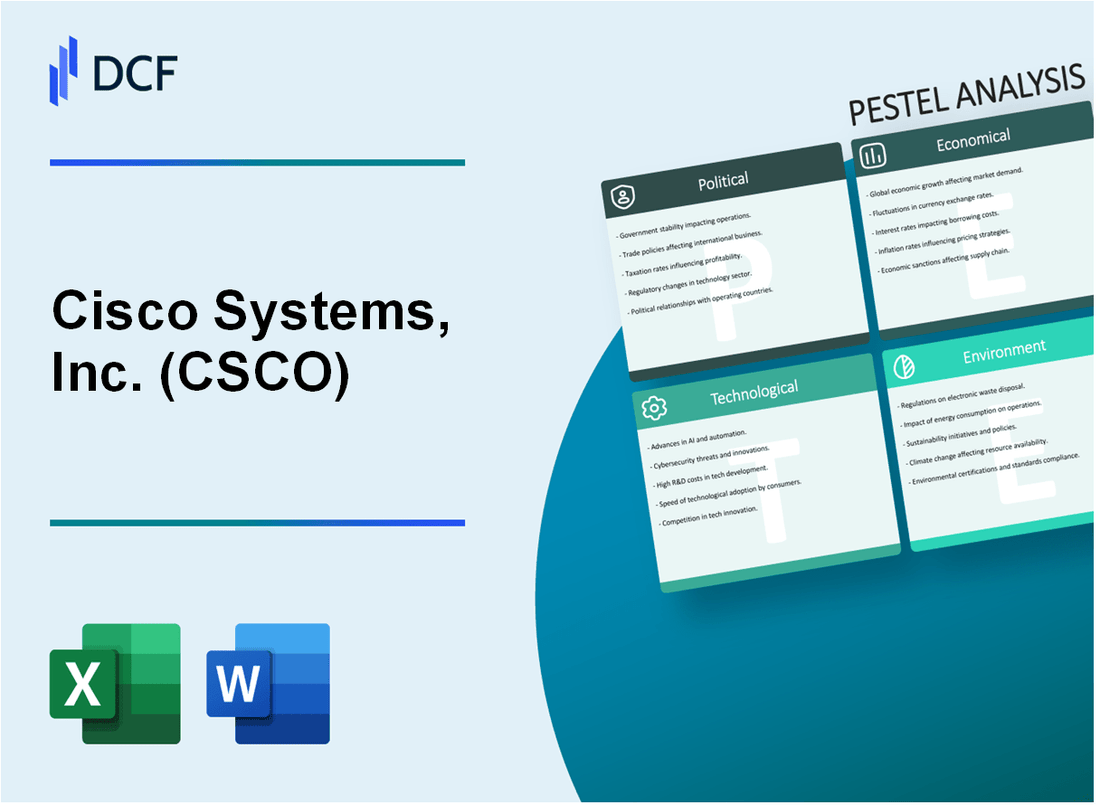
Cisco Systems, Inc. (CSCO): Análise de Pestle [Jan-2025 Atualizado] |
Totalmente Editável: Adapte-Se Às Suas Necessidades No Excel Ou Planilhas
Design Profissional: Modelos Confiáveis E Padrão Da Indústria
Pré-Construídos Para Uso Rápido E Eficiente
Compatível com MAC/PC, totalmente desbloqueado
Não É Necessária Experiência; Fácil De Seguir
Cisco Systems, Inc. (CSCO) Bundle
No cenário em rápida evolução da tecnologia global, a Cisco Systems, Inc. fica na encruzilhada de complexos desafios geopolíticos, econômicos e tecnológicos. Esta análise abrangente de pestles revela a intrincada rede de fatores externos que moldam a trajetória estratégica da gigante da rede, desde a navegação de tensões comerciais EUA-China até a pioneira inovação sustentável em uma era digitalmente transformadora. Mergulhe profundamente no ecossistema multifacetado que define a resiliência, a adaptabilidade e a abordagem avançada do futuro em um mundo cada vez mais interconectado.
Cisco Systems, Inc. (CSCO) - Análise de Pestle: Fatores Políticos
As tensões comerciais dos EUA-China impactam nas cadeias de suprimentos de equipamentos de rede globais
A partir de 2024, a Cisco enfrentou desafios significativos devido às tensões comerciais EUA-China-China. A empresa relatou um 7,8% declínio na receita do mercado da China no ano fiscal de 2023. As tarifas impostas impactaram diretamente os preços dos equipamentos de rede e a dinâmica da cadeia de suprimentos.
| Métricas de impacto comercial | Valor |
|---|---|
| Custos tarifários adicionais | US $ 214 milhões |
| Despesas de realocação da cadeia de suprimentos | US $ 387 milhões |
| Receita de mercado chinesa reduzida | US $ 1,2 bilhão |
Regulamentos crescentes de segurança cibernética do governo
Os mandatos do governo de segurança cibernética influenciaram substancialmente as estratégias de desenvolvimento de produtos da Cisco.
- NIST NIST Cibersegurança Estrutura de conformidade Investimentos: US $ 456 milhões
- Custos de Desenvolvimento da linha de produtos de segurança cibernética: US $ 782 milhões
- Expansão da equipe de conformidade regulatória: 247 novos funcionários
Instabilidade geopolítica em mercados internacionais
| Região | Impacto no mercado | Ajuste da receita |
|---|---|---|
| Médio Oriente | Interrupção do mercado relacionada a conflitos | -US $ 329 milhões |
| Europa Oriental | Sanções e restrições comerciais | -US $ 214 milhões |
Soberania de tecnologia e foco de privacidade de dados
Os regulamentos governamentais de privacidade de dados levaram a investimentos corporativos significativos.
- Investimentos globais de conformidade com privacidade de dados: US $ 612 milhões
- Número de novos recursos de proteção de dados desenvolvidos: 37
- Regiões com rigorosas leis de soberania de dados: 16 países
Cisco Systems, Inc. (CSCO) - Análise de Pestle: Fatores econômicos
A incerteza econômica global em andamento afeta os gastos com tecnologia corporativa
No primeiro trimestre de 2024, a Cisco registrou receita total de US $ 13,3 bilhões, representando um declínio de 4% ano a ano. Os gastos com tecnologia corporativa mostraram tendências cautelosas, com os gastos globais de TI projetados em US $ 4,62 trilhões em 2024, de acordo com o Gartner.
| Indicador econômico | 2024 Valor | Mudança de ano a ano |
|---|---|---|
| Gastos globais de TI | US $ 4,62 trilhões | +2.3% |
| Receita total da Cisco | US $ 13,3 bilhões | -4% |
| Investimento em tecnologia corporativa | US $ 1,87 trilhão | +1.8% |
Mudar para modelos de receita baseados em nuvem e assinatura
A receita baseada em assinatura da Cisco atingiu US $ 14,6 bilhões no ano fiscal de 2023, representando 83% do total de receitas de produtos e serviços. Os modelos de receita recorrentes continuam demonstrando resiliência em meio à volatilidade econômica.
| Categoria de receita | 2023 valor | Porcentagem da receita total |
|---|---|---|
| Receita de assinatura | US $ 14,6 bilhões | 83% |
| Receita do produto | US $ 3,0 bilhões | 17% |
A inflação persistente desafia preços e gerenciamento de custos operacionais
As despesas operacionais da Cisco no ano fiscal de 2023 foram de US $ 8,9 bilhões, com esforços contínuos para gerenciar pressões inflacionárias por meio de iniciativas estratégicas de otimização e eficiência de custos.
Investimento contínuo em mercados emergentes como a Índia e o Sudeste Asiático
Em 2024, a Cisco comprometeu US $ 1,2 bilhão em investimentos nos mercados da Índia e do Sudeste Asiático, direcionando o desenvolvimento da transformação digital e da infraestrutura de rede.
| Mercado | Valor do investimento | Principais áreas de foco |
|---|---|---|
| Índia | US $ 800 milhões | Infraestrutura digital, segurança cibernética |
| Sudeste Asiático | US $ 400 milhões | Networking em nuvem, soluções de IoT |
Cisco Systems, Inc. (CSCO) - Análise de Pestle: Fatores sociais
Tendências de trabalho remotas que impulsionam a demanda por tecnologias de colaboração e rede
A partir do quarto trimestre de 2023, 35% dos trabalhadores dos EUA com empregos que podem ser realizados remotamente estão trabalhando em casa em tempo integral. A Cisco WebEx registrou 557 milhões de participantes em 2023, representando um aumento de 22% em relação a 2022.
| Métrica de trabalho remoto | 2023 dados |
|---|---|
| Trabalhadores remotos globais | 27,7% da força de trabalho |
| Uso da ferramenta de colaboração da Cisco | 557 milhões de participantes |
| Crescimento anual em ferramentas de colaboração remota | 22% |
Ênfase crescente na transformação digital entre as indústrias
A Cisco reportou US $ 51,6 bilhões em receita de tecnologia de transformação digital para 2023, com soluções de rede corporativa representando 42% do total de vendas.
| Segmento de transformação digital | 2023 Receita |
|---|---|
| Receita total de transformação digital | US $ 51,6 bilhões |
| Soluções de rede corporativa | US $ 21,7 bilhões |
| Soluções de rede em nuvem | US $ 15,3 bilhões |
Maior foco na diversidade e inclusão da força de trabalho no setor de tecnologia
O relatório de diversidade 2023 da Cisco revelou:
- Mulheres representavam 26,5% da força de trabalho global
- As minorias sub -representadas compreendiam 18,2% da força de trabalho dos EUA
- Posições de liderança mantiveram 24,3% de mulheres e 16,7% sub -representados minorias
As expectativas crescentes do consumidor para soluções de tecnologia sustentável e socialmente responsável
A Cisco comprometeu US $ 100 milhões a iniciativas de justiça social em 2023 e alcançou 85% de uso de energia renovável nas operações globais.
| Métrica de sustentabilidade | 2023 dados |
|---|---|
| Uso de energia renovável | 85% |
| Investimento de justiça social | US $ 100 milhões |
| Redução de emissão de carbono | Redução de 60% desde 2007 |
Cisco Systems, Inc. (CSCO) - Análise de Pestle: Fatores tecnológicos
Inovação contínua em tecnologias de IA, aprendizado de máquina e segurança cibernética
A Cisco investiu US $ 6,4 bilhões em P&D no ano fiscal de 2023. AI e portfólio de patentes de aprendizado de máquina incluem 1.200 mais de patentes ativas a partir de 2024.
| Área de tecnologia | Contagem de patentes | Investimento em P&D |
|---|---|---|
| Tecnologias de IA | 412 | US $ 2,1 bilhões |
| Aprendizado de máquina | 387 | US $ 1,8 bilhão |
| Segurança cibernética | 401 | US $ 2,5 bilhões |
Expandindo soluções de infraestrutura de computação 5G e Edge
A participação de mercado de infraestrutura 5G da Cisco atingiu 28,3% em 2023. Portfólio de soluções de computação de borda gerou US $ 1,9 bilhão em receita.
| Segmento de tecnologia | Quota de mercado | Receita |
|---|---|---|
| Infraestrutura 5G | 28.3% | US $ 3,2 bilhões |
| Computação de borda | 22.7% | US $ 1,9 bilhão |
Investimento em Internet of Things (IoT) e plataformas de automação de rede
Os investimentos da plataforma IoT da Cisco totalizaram US $ 1,5 bilhão em 2023. A receita de soluções de automação de rede atingiu US $ 2,3 bilhões.
- IoT Platform Patent Count: 567
- Soluções de automação de rede: 412 implantações ativas
- Receita de soluções de segurança da IoT: US $ 780 milhões
Aquisições estratégicas para aprimorar as capacidades tecnológicas e o posicionamento de mercado
A Cisco concluiu 4 grandes aquisições de tecnologia em 2023, com investimento total de US $ 2,7 bilhões.
| Aquisição | Foco em tecnologia | Custo de aquisição |
|---|---|---|
| Splunk | Análise de segurança cibernética | US $ 1,2 bilhão |
| Mil olhos | Visibilidade da rede | US $ 650 milhões |
| PortShift | Segurança de contêineres | US $ 420 milhões |
| Epsagon | Monitoramento da nuvem | US $ 430 milhões |
Cisco Systems, Inc. (CSCO) - Análise de Pestle: Fatores Legais
Paisagem complexa de proteção à propriedade intelectual e litígios de patentes
A partir de 2024, a Cisco Systems detém 1.200+ patentes ativas em tecnologia de rede. A empresa investiu US $ 6,3 bilhões em pesquisa e desenvolvimento no ano fiscal de 2023.
| Categoria de patentes | Número de patentes | Status de litígio |
|---|---|---|
| Tecnologias de rede | 542 | Proteção ativa |
| Tecnologias de segurança cibernética | 378 | Execução em andamento |
| Infraestrutura em nuvem | 280 | Defesa Estratégica |
Conformidade com os regulamentos internacionais de proteção de dados
A Cisco alocou US $ 124 milhões para conformidade global de proteção de dados em 2024. Os investimentos em conformidade relacionados ao GDPR totalizam aproximadamente US $ 78 milhões.
| Região | Investimento de conformidade | Estrutura regulatória |
|---|---|---|
| União Europeia | US $ 42 milhões | Conformidade total do GDPR |
| Estados Unidos | US $ 36 milhões | Conformidade de CCPA/CPRA |
| Ásia-Pacífico | US $ 46 milhões | Leis locais de proteção de dados |
Scrutínio antitruste em andamento nos mercados de tecnologia global
Cisco enfrentou 3 investigações antitruste Em 2023, com potencial exposição legal estimada em US $ 215 milhões.
Navegando em evolução em segurança cibernética e na privacidade Legal Frameworks
Orçamento de conformidade legal para estruturas de segurança cibernética: US $ 92 milhões em 2024. A Cisco mantém Estratégias abrangentes de mitigação de risco legal em 47 jurisdições globais.
| Estrutura legal | Custo de conformidade | Regiões regulatórias |
|---|---|---|
| Regulamentos de segurança cibernética | US $ 56 milhões | 24 países |
| Leis de proteção de privacidade | US $ 36 milhões | 23 países |
Cisco Systems, Inc. (CSCO) - Análise de Pestle: Fatores Ambientais
Compromisso em reduzir as emissões de carbono e a fabricação sustentável
Cisco se comprometeu a alcançar Emissões de gases de efeito estufa de zero em todos os escopos até 2040. A partir de 2023, a empresa reduziu o escopo absoluto 1 e o escopo 2 emissões de gases de efeito estufa em 64% em comparação com a linha de base de 2019.
| Métrica de redução de emissão | Percentagem | Ano |
|---|---|---|
| Escopo 1 e 2 Redução de emissões | 64% | 2023 |
| Ano-alvo para rede-zero | 2040 | Em andamento |
Foco crescente no projeto de equipamentos de rede com eficiência energética
A Cisco desenvolveu equipamentos de rede com até 80% de melhorias na eficiência energética em sua última geração de comutadores e roteadores.
| Tipo de equipamento | Melhoria da eficiência energética | Ano |
|---|---|---|
| Interruptores de rede | 80% | 2023 |
| Roteadores de rede | 75% | 2023 |
Metas de sustentabilidade corporativa e iniciativas de economia circular
A Cisco pretende desviar 100% dos resíduos de produtos de aterros sanitários até 2025. Em 2023, a empresa alcançou 99,4% de retorno do produto e taxa de reciclagem.
| Métrica da Economia Circular | Percentagem | Ano -alvo |
|---|---|---|
| Taxa de retorno e reciclagem do produto | 99.4% | 2023 |
| Objetivo de desvio de aterros sanitários | 100% | 2025 |
Investimento em energia renovável e infraestrutura de tecnologia verde
A Cisco investiu US $ 120 milhões em projetos de energia renovável Em 2023, cobrindo 85% do consumo global de eletricidade por meio de fontes renováveis.
| Métrica de energia renovável | Valor | Ano |
|---|---|---|
| Investimento de energia renovável | US $ 120 milhões | 2023 |
| Eletricidade global de renováveis | 85% | 2023 |
Cisco Systems, Inc. (CSCO) - PESTLE Analysis: Social factors
You're looking at how societal shifts are affecting Cisco Systems, Inc. (CSCO)'s bottom line and strategy right now, in late 2025. The reality is that how and where people work, coupled with a massive skills gap and rising social expectations, directly impacts demand for their core products. We need to map these social trends to concrete numbers to see the opportunity.
Persistent demand for hybrid work models drives sales of Webex, Meraki, and security solutions
Even though the initial post-pandemic rush has settled, hybrid work is the established norm, not a temporary fix. Cisco Systems, Inc. (CSCO)'s own 2025 Global Hybrid Work Study shows that while the percentage of hybrid workers has dropped from 62% in 2022 to 45% in 2025, employees now average 3.74 days per week in the office. This ongoing complexity means organizations still need robust, flexible technology. For Cisco Systems, Inc. (CSCO), this translated to double-digit year-over-year growth in collaboration product orders, especially in CCaaS (Contact Center as a Service) and CPaaS (Communications Platform as a Service), during Q1 of fiscal year 2025. However, the dedicated Hybrid Work revenue bucket actually fell 7% YoY to $1.109 billion, driven by declines in older perpetual calling and meeting products. The real win is in the underlying infrastructure and software; Secure Agile Networks revenue, which includes Meraki switching, grew 10% YoY to $5.967 billion. To be fair, top performers are demanding flexibility; 78% of them would consider leaving if their company's work policies weren't flexible enough.
Growing talent shortage in cybersecurity increases demand for automated security platforms
The lack of skilled security professionals is a major business risk that directly fuels the need for Cisco Systems, Inc. (CSCO)'s automated security offerings. Globally, the cybersecurity workforce needs to grow by 87% just to meet current demand, with an estimated 4.8 million vacancies worldwide. Honestly, 67% of organizations report their cybersecurity teams are under-staffed. Gartner predicts that by 2025, this talent scarcity will be responsible for more than 50% of all significant cybersecurity incidents. This environment makes automated, AI-driven security platforms-which reduce the reliance on scarce human analysts for Tier 1 tasks-a critical purchase for every enterprise. The subscription portion of Cisco Systems, Inc. (CSCO)'s End-to-End Security revenue did well, increasing 15% in Q1 FY2025, driven by cloud security and Zero Trust platforms.
Focus on digital inclusivity and accessible networking products expands emerging market opportunities
Societal pressure and government initiatives are pushing technology leaders like Cisco Systems, Inc. (CSCO) to address the digital divide. The company is actively positioning itself as a partner in this effort. For instance, Cisco Systems, Inc. (CSCO) announced its '40 Communities' initiative to build resilience and bridge the digital divide in underserved areas globally. In a key market, the Indian government has called on Cisco Systems, Inc. (CSCO) to deepen engagement in non-metro regions, as part of a national goal to reach over 270,000 villages with internet access by 2030. Cisco Systems, Inc. (CSCO) has a specific goal to impact 50 million lives in India by March 2025 through its digital empowerment programs and training efforts. This focus on accessible, inclusive networking solutions opens up new, large-scale infrastructure opportunities in developing economies.
Corporate customers prioritize vendors with strong social governance (ESG) records
It's no longer enough to have great tech; vendors must demonstrate strong social and governance credentials. Corporate procurement decisions are increasingly filtered through an Environmental, Social, and Governance (ESG) lens. In the US market as of 2025, a significant 79% of firms now demand verified sustainability credentials from their external technology vendors. This means Cisco Systems, Inc. (CSCO)'s commitment to social impact, like its Networking Academy training over 24 million students since 1997, becomes a tangible competitive advantage, not just a PR talking point. If onboarding takes 14+ days, churn risk rises, especially when customers are scrutinizing supply chain ethics and labor practices.
Here's a quick look at the key social and related financial metrics we are tracking for Cisco Systems, Inc. (CSCO) as of 2025:
| Social Factor Metric | Data Point (2025 Fiscal Year Context) | Source/Driver |
|---|---|---|
| Hybrid Work Adoption (Employees) | 45% of respondents have hybrid arrangements | Cisco Global Hybrid Work Study 2025 |
| Hybrid Work Revenue (Bucket) | $1.109 billion (Fell 7% YoY in Q1 FY2025) | Perpetual calling/meeting decline |
| Collaboration Orders Growth | Double-digit YoY growth in Q1 FY2025 | CCaaS and CPaaS leading |
| Cybersecurity Talent Gap (Global) | Need for 4.8 million more professionals | To meet current demand |
| Cybersecurity Understaffing | 67% of organizations report being short on staff | Persistent recruitment challenge |
| Vendor ESG Requirement | 79% of US firms demand verified sustainability credentials | Vendor selection criteria |
| India Digital Impact Goal | Aim to impact 50 million lives by March 2025 | Digital empowerment programs |
Finance: draft 13-week cash view by Friday
Cisco Systems, Inc. (CSCO) - PESTLE Analysis: Technological factors
You're looking at a company whose entire future hinges on how well it can pivot its hardware-centric legacy into the software-defined, AI-driven infrastructure of tomorrow. Honestly, the technology landscape is moving at a breakneck pace, and for Cisco Systems, this means massive capital expenditure and product evolution just to keep pace.
Rapid development of Generative AI (GenAI) requires massive network upgrades for data center infrastructure
The explosion of GenAI workloads is the single biggest driver for network spending right now. These models are data-hungry, latency-sensitive beasts, and the existing infrastructure simply wasn't built for this kind of sustained traffic. Cisco Systems is seeing this directly in its order books; AI infrastructure orders from webscale customers hit over $2 billion in fiscal year 2025, which was double the initial target.
For the first half of fiscal 2025 alone, these AI-related orders totaled approximately $700 million, showing the immediate need for upgrades. The company is responding by focusing on AI-ready infrastructure, which means low-latency, high-capacity, and deeply integrated security across data center and edge environments. If onboarding takes 14+ days, churn risk rises, so speed of deployment is key here.
Here's the quick math on the commitment: Cisco's Research and Development Expenses for the twelve months ending October 31, 2025, reached $9.414B, a 12.66% year-over-year increase, clearly signaling heavy investment in these next-gen areas.
Shift to Full-Stack Observability (FSO) mandates integration across networking, security, and applications
The complexity of cloud-native, AI-driven, and edge-centric workloads means reactive monitoring is dead; you need Full-Stack Observability (FSO). This means correlating data across the entire stack-from the application down to the physical network fabric. The market for observability tools was valued at $2.9 billion in 2025, showing this is a major spending priority for enterprises.
Cisco Systems' acquisition of Splunk is central to this strategy, and the company is pushing for vendor-agnostic FSO suites. To deliver on this promise, Cisco announced that its Catalyst and Meraki observability offerings would be available in September 2025. What this estimate hides is the integration challenge; making security, networking, and observability truly work as one platform is a massive software undertaking.
The move to FSO is about operationalizing data. For instance, 74% of respondents in the Splunk State of Observability 2025 report noted that observability positively impacts employee productivity.
Competition intensifies from cloud providers (Amazon, Microsoft) offering integrated networking services
You can't talk about modern infrastructure without mentioning the hyperscalers. Amazon Web Services and Microsoft are not just cloud providers; they are increasingly offering integrated networking and security services that compete directly with Cisco Systems' core business. This forces Cisco to innovate on its own platform agility, especially since the network is now a strategic priority for 97% of IT leaders deploying AI and IoT.
Furthermore, the threat of vertical integration is real. Alphabet Inc. is noted as a major threat because it is the most vertically integrated hyperscaler, designing its own custom networking and optical circuit switches. This means Cisco must prove its Silicon One architecture and its security fabric are superior to in-house cloud-native solutions.
Here is a snapshot of the competitive and investment landscape:
| Technology Area | Key Metric/Value (2025 Data) | Cisco System's Position/Action |
| AI Infrastructure Orders (FY2025) | Over $2 billion | Double the original target; driving R&D spend. |
| Observability Market Size (2025) | $2.9 billion | Integrated Splunk; launched Catalyst/Meraki observability in Sept 2025. |
| R&D Expenses (TTM Oct 2025) | $9.414B (up 12.66% YoY) | Funding the pivot to AI-native security and networking. |
| Top Competitors in IT/Security Space | Amazon Web Services, Microsoft | Direct competition in integrated cloud/security offerings. |
Transition to 400G and 800G Ethernet standards necessitates accelerated product refresh cycles
The AI boom is forcing a rapid hardware refresh, particularly in the data center. The market is moving fast; the majority of the highest-speed switch ports deployed by webscale customers were 800 Gbps in 2025. Cisco Systems is actively participating, having introduced the Nexus 9364E-SG2 switch with high-density 800G aggregation capabilities.
The roadmap doesn't stop there; executives have signaled that the network bandwidth goal scales port speeds from today's 800 Gb/s up to 3.2 Tb/s. This rapid evolution means Cisco's customers are constantly evaluating new hardware, which is a double-edged sword: it drives immediate revenue but compresses the lifespan of existing installed bases. To counter the cloud providers' custom silicon advantage, Cisco is leaning on its programmable Silicon One architecture to offer flexibility without the massive power penalty of constant re-engineering.
The key technological shifts demanding action are:
- Accelerate Silicon One integration for AI workloads.
- Ensure low latency, below 50 ms for interactive agents.
- Leverage new 800G/1.6T standards for hyperscalers.
- Embed quantum-resistant security into new hardware.
The network is strategy now. You need to ensure the sales teams are pushing the new Silicon One-powered platforms, not just the legacy lines.
Cisco Systems, Inc. (CSCO) - PESTLE Analysis: Legal factors
You're looking at the legal landscape for Cisco Systems, Inc. (CSCO) and seeing a minefield of compliance and litigation risk, which is totally normal for a company this size. The key takeaway here is that legal overhead isn't just a cost center; it's a strategic factor that directly impacts product rollout speed and M&A flexibility.
Stricter global data privacy laws (e.g., GDPR, CCPA) increase compliance costs for security and collaboration tools
Global privacy rules are tightening, and that means more work for your compliance teams, especially with your Webex and security offerings. Cisco's own 2025 Data Privacy Benchmark Study, based on surveying 2,600 professionals, shows that 86% of organizations see a positive impact from privacy legislation, which is up from 80% the prior year. Still, the complexity is real; 90% of organizations view local data storage as safer, even with higher costs, showing the pressure of data sovereignty demands. Furthermore, 98% of businesses indicated that external privacy certifications are an important factor in their buying decisions as of 2024.
The pressure to prove data stewardship is immense. Here's a quick look at the compliance environment:
- Consumer Awareness: 53% of global consumers are aware of their country's privacy laws.
- Investment Returns: 96% of organizations report that the returns from privacy investment outweigh the costs.
- AI Governance Link: Privacy investments are seen as foundational for Responsible AI readiness.
If onboarding a new collaboration feature takes 14+ days longer due to cross-border data transfer reviews, churn risk rises for that product line.
Antitrust reviews, particularly in the EU and US, could delay or complicate future acquisitions
Regulators in both the US and EU are definitely keeping a closer eye on tech consolidation, which puts a chill on Cisco's M&A pipeline. For instance, the US Department of Justice (DOJ) took a critical view of the HPE/Juniper merger, noting that if it went through, Cisco and the combined company would control over 70% of the enterprise-grade wireless local area network (WLAN) solutions market in the US. This shows the DOJ is focused on head-to-head competition, even if combined shares aren't massive. Meanwhile, the EU is flexing its new muscles under the Digital Markets Act (DMA), having already fined Apple EUR 500 million and Meta EUR 200 million in April 2025 for non-compliance.
Any deal Cisco pursues now faces intense scrutiny over market power, especially in networking and security segments where Cisco already holds a leading position.
Ongoing intellectual property (IP) disputes with competitors require significant legal resources
Litigation is a constant drain, both in terms of direct financial loss and the diversion of senior engineering and legal talent. You've seen this play out recently; a Texas judge cemented a $65.7 million jury verdict against Cisco in October 2024 for patent infringement related to conferencing products. To be fair, Cisco is also capable of winning these fights; they secured a directed verdict in January 2025 in a patent trial where the plaintiff was seeking $120 million in damages. These cases are expensive, even the wins. Historically, the company has faced massive liabilities, such as the $400 million settlement with Arista Networks in 2018, and a case where enhanced damages reached potentially $1.9 billion in 2020.
The cost of defending innovation is high, and it's a recurring line item on the P&L.
New cybersecurity regulations mandate rapid breach disclosure and minimum security standards
The regulatory environment for cybersecurity is moving from suggestion to mandate, especially following high-profile incidents. The CISA issued an emergency directive in September 2025, forcing US government agencies to patch critical vulnerabilities (like CVE-2025-20333 and CVE-2025-20363) in Cisco firewalls within a tight timeline due to an advanced threat actor campaign. This highlights the immediate operational risk when a zero-day exploit hits your core products. Globally, the EU's Digital Operational Resilience Act (DORA) became effective in January 2025, pushing stricter standards for operational resilience across the financial sector, which impacts Cisco's enterprise clients. The 2025 Cisco Cybersecurity Readiness Index found that 71% of leaders believe a security incident will disrupt their business in the next 12 to 24 months, underscoring the urgency of compliance.
Here is a snapshot of the financial and regulatory metrics we are tracking:
| Legal/Regulatory Factor | Key Metric/Value (as of 2025) | Source Context |
| Recent Patent Loss (Paltalk) | $65.7 Million Final Judgment | October 2024 Verdict |
| Potential Damages Avoided (Jan 2025 Trial) | $120 Million in Claimed Damages | Directed Verdict Win |
| EU DMA Fines (April 2025) | EUR 500 Million (Apple) / EUR 200 Million (Meta) | Non-compliance Fines |
| US WLAN Market Concentration | 70% Joint Control (Cisco + HPE/Juniper combined) | DOJ Antitrust Concern |
| Cyber Incident Expectation | 71% Believe Disruption Likely (12-24 months) | 2025 Cybersecurity Readiness Index |
Finance: draft 13-week cash view by Friday.
Cisco Systems, Inc. (CSCO) - PESTLE Analysis: Environmental factors
You're looking at the environmental pressures on Cisco Systems, and honestly, the stakes are higher than ever, especially as data center energy demands keep climbing. The core challenge for Cisco right now is translating its ambitious internal goals into verifiable, customer-facing metrics while managing a massive hardware lifecycle.
Pressure to reduce e-waste drives the need for better product take-back and recycling programs.
The sheer volume of electronic waste (e-waste) globally is staggering; the UN Global E-waste Monitor 2024 noted a record 62 million tonnes produced in 2022. That puts immense pressure on manufacturers like Cisco to close the loop on their hardware. To combat this, Cisco is pushing hard on its Circular Economy strategy, aiming to incorporate Circular Design Principles into 100% of new products and packaging by fiscal year (FY) 2025. They were already at 96% as of FY24.
Here's a quick look at their commitment to product lifecycle management:
- Offer a free Takeback and Reuse Program for end-of-use products.
- Recycle or reuse nearly 100% of products returned through their programs.
- Eliminated oil-based wet paint from the Catalyst 9000, saving about 1,900 MT $\text{CO}_2\text{e}$ annually through the end of FY2023.
If onboarding for take-back programs takes too long, customer participation definitely drops.
Corporate customers demand verifiable carbon footprint data for networking equipment.
Your enterprise customers, especially the large ones, are under their own Scope 3 pressure, meaning they need to know the environmental impact of the gear they buy from you. Cisco has responded by developing the internal Sustainability Data Foundation (SDF), which is their main source for environmental data. This platform is key for generating the customer-facing product carbon footprint reports that buyers are increasingly asking for.
This transparency is becoming non-negotiable for major procurement decisions. Here are the key data points Cisco is enabling customers to track:
| Metric | Unit/Description | Source of Data |
| Energy Consumption | kWh | Cisco Platforms/SDF |
| Total GHG Emissions | Metric tonnes of $\text{CO}_2\text{e}$ | Cisco Platforms/SDF |
| Carbon Intensity | Grams of $\text{CO}_2\text{e}$ per kWh | Cisco Platforms/SDF |
| Energy Mix | Percentage from low carbon sources | Cisco Platforms/SDF |
This kind of hard data, grounded in a standardized model, is what separates a real sustainability commitment from just greenwashing.
Cisco has a goal to reach net zero greenhouse gas emissions across its value chain by 2040.
Cisco's overarching climate commitment is to achieve net zero greenhouse gas ($\text{GHG}$) emissions across its entire value chain-Scopes 1, 2, and 3-by 2040. That's a long runway, but they have aggressive interim steps to keep the momentum going. For instance, they are targeting net zero for their direct operations (Scope 1 and 2 emissions) by 2025.
To hit these targets, they are focusing on renewable energy adoption; they already transitioned 85% of global electricity use to renewables and aim for 100% by 2025. Remember, Scope 3 emissions, largely from the use of sold products, make up over 70% of their total footprint, so customer adoption of efficient gear is critical to hitting that 2040 number.
Designing energy-efficient hardware is crucial to lower power consumption in data centers.
Data centers are energy hogs, often consuming 10 to 50 times the energy per floor space compared to a standard office building. So, making the actual networking gear more efficient directly impacts your customers' operational costs and their Scope 3 emissions. Cisco is embedding this into its hardware design philosophy.
Consider the latest server technology; the Cisco UCS X-Series Modular System is reportedly 54% more energy-efficient at the processing ($\text{CPU}$) level than older generations. Furthermore, they are getting third-party validation, with products like the Catalyst 9000 switch receiving ENERGY STAR certification in the Large Network Equipment category. This focus on efficiency, often managed via platforms like Cisco Intersight, helps customers realize tangible power savings, sometimes seeing up to 110W server power savings at 30-40% utilization with newer architectures.
Finance: draft 13-week cash view by Friday.
Disclaimer
All information, articles, and product details provided on this website are for general informational and educational purposes only. We do not claim any ownership over, nor do we intend to infringe upon, any trademarks, copyrights, logos, brand names, or other intellectual property mentioned or depicted on this site. Such intellectual property remains the property of its respective owners, and any references here are made solely for identification or informational purposes, without implying any affiliation, endorsement, or partnership.
We make no representations or warranties, express or implied, regarding the accuracy, completeness, or suitability of any content or products presented. Nothing on this website should be construed as legal, tax, investment, financial, medical, or other professional advice. In addition, no part of this site—including articles or product references—constitutes a solicitation, recommendation, endorsement, advertisement, or offer to buy or sell any securities, franchises, or other financial instruments, particularly in jurisdictions where such activity would be unlawful.
All content is of a general nature and may not address the specific circumstances of any individual or entity. It is not a substitute for professional advice or services. Any actions you take based on the information provided here are strictly at your own risk. You accept full responsibility for any decisions or outcomes arising from your use of this website and agree to release us from any liability in connection with your use of, or reliance upon, the content or products found herein.