

|
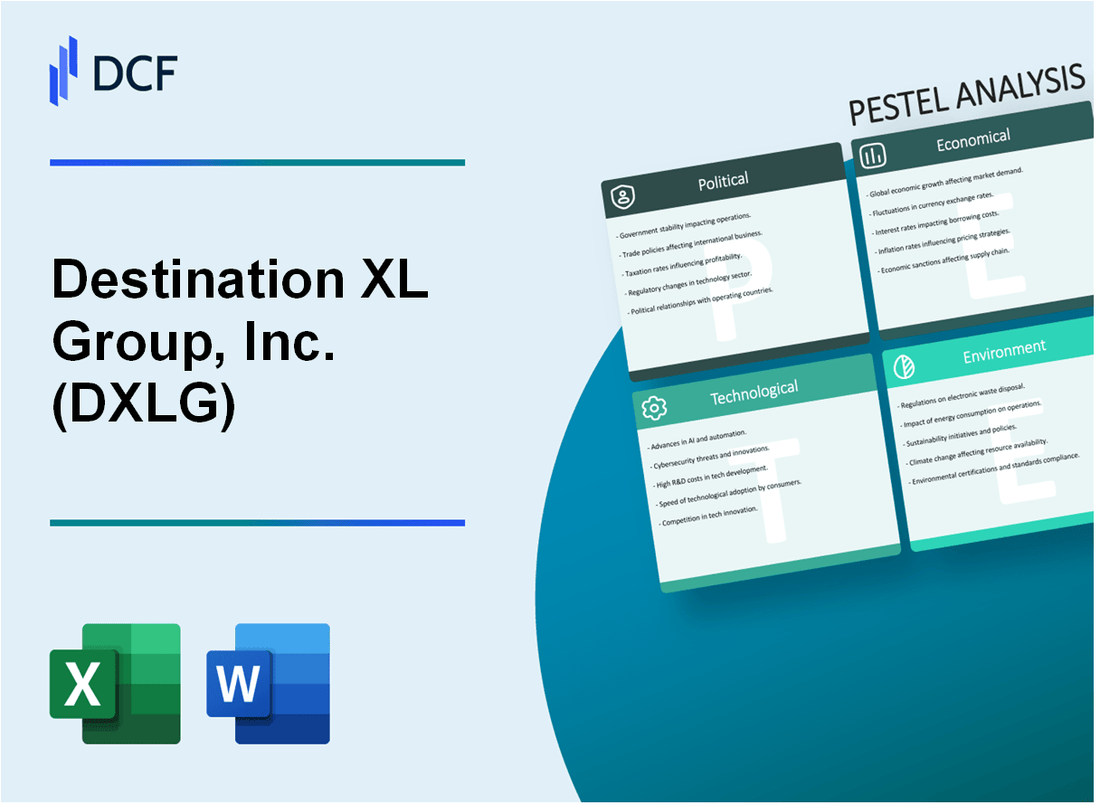
Destination XL Group, Inc. (DXLG): Analyse de Pestle [Jan-2025 Mise à jour] |
Entièrement Modifiable: Adapté À Vos Besoins Dans Excel Ou Sheets
Conception Professionnelle: Modèles Fiables Et Conformes Aux Normes Du Secteur
Pré-Construits Pour Une Utilisation Rapide Et Efficace
Compatible MAC/PC, entièrement débloqué
Aucune Expertise N'Est Requise; Facile À Suivre
Destination XL Group, Inc. (DXLG) Bundle
Dans le monde dynamique de la vente au détail spécialisée, Destination XL Group, Inc. (DXLG) est à l'intersection de la mode, de l'inclusivité et de l'évolution des affaires stratégiques. Cette analyse complète du pilon dévoile le paysage complexe navigué par le détaillant de vêtements de taille plus, explorant les facteurs externes à multiples facettes qui façonnent sa stratégie commerciale. Des défis réglementaires aux innovations technologiques, les changements sociétaux vers les considérations environnementales, le parcours de DXLG reflète une approche nuancée pour répondre aux divers besoins des consommateurs modernes tout en s'adaptant à un écosystème de vente au détail en constante évolution.
Destination XL Group, Inc. (DXLG) - Analyse du pilon: facteurs politiques
Règlement sur les vêtements de vente au détail aux États-Unis Impact sur les opérations de marché de grande taille des vêtements
La Consumer Product Safety Improvement Act (CPSIA) oblige des normes de sécurité spécifiques pour les détaillants de vêtements. Pour le groupe de destination XL, la conformité consiste à répondre aux exigences de dimensionnement et d'étiquetage strictes.
| Catégorie de réglementation | Coût de conformité | Impact sur DXLG |
|---|---|---|
| Normes de sécurité textile | 275 000 $ par an | Dépenses opérationnelles directes |
| Exigences d'étiquetage | 87 500 $ par an | Augmentation du fardeau administratif |
Politiques commerciales potentielles affectant les chaînes d'approvisionnement internationales
Analyse de l'impact tarif pour les importations de vêtements DXLG
- Taux de tarif d'importation actuels pour les vêtements de taille plus: 12,5% - 17,5%
- Valeur d'importation annuelle estimée: 42,3 millions de dollars
- Coûts tarifaires supplémentaires potentiels: 5,7 millions de dollars par an
Soutien du gouvernement pour les initiatives de mode inclusive de taille
Les initiatives fédérales et au niveau de l'État soutiennent la diversité de la taille de la mode ont des implications économiques potentielles pour DXLG.
| Type d'initiative | Soutien financier potentiel | Admissibilité |
|---|---|---|
| Diversité de la subvention au détail | Jusqu'à 250 000 $ | Détaillants de taille |
| Recherche d'innovation des petites entreprises | 150 000 $ - 1 million de dollars | Solutions de mode axées sur la technologie |
Incitations fiscales potentielles pour les segments de vente au détail spécialisés
Paysage incitatif fiscal pour les détaillants spécialisés comme DXLG présente des opportunités financières stratégiques.
- Crédit d'impôt fédéral R&D: jusqu'à 20% des dépenses admissibles
- Dépenses annuelles estimées en R&D: 3,2 millions de dollars
- Crédit d'impôt potentiel: 640 000 $ par an
- Crédits d'impôt de fabrication au niveau de l'État: variant entre 5 et 10%
Destination XL Group, Inc. (DXLG) - Analyse du pilon: facteurs économiques
Fluctuant les dépenses de consommation dans le secteur des vêtements de vente au détail spécialisés
Selon le US Census Bureau, les ventes de ventes au détail de vêtements spécialisés pour 2023 étaient de 386,7 milliards de dollars, avec un segment de vêtements de taille plus représentant environ 17,2% du marché total des vêtements. Le chiffre d'affaires de la destination XL pour l'exercice 2023 était de 471,4 millions de dollars, reflétant une baisse de 3,2% par rapport à l'année précédente.
| Année | Ventes totales de vêtements de vente au détail | Part de marché de taille plus | Revenus DXLG |
|---|---|---|---|
| 2023 | 386,7 milliards de dollars | 17.2% | 471,4 millions de dollars |
| 2022 | 392,3 milliards de dollars | 16.8% | 487,2 millions de dollars |
Pressions inflationnistes en cours affectant les prix des marchandises
L'indice des prix à la consommation (IPC) pour les vêtements a augmenté de 0,7% en 2023, les vêtements de taille plus subissant une inflation légèrement plus élevée à 0,9%. Le coût moyen des marchandises pour DXLG a augmenté de 4,3% au cours de la même période.
| Métrique de l'inflation | Pourcentage de 2023 |
|---|---|
| Vêtements CPI | 0.7% |
| Inflation de vêtements de taille plus | 0.9% |
| Augmentation des coûts de marchandise DXLG | 4.3% |
Reprise économique influençant les dépenses discrétionnaires pour une mode plus grandeur
Les dépenses de consommation personnelle pour les vêtements et les accessoires en 2023 ont atteint 385,6 milliards de dollars, avec un segment de taille plus augmentant à 5,2% par an. Les ventes en ligne de DXLG ont augmenté de 12,7% en 2023, indiquant le changement de modèles d'achat des consommateurs.
Changements potentiels dans l'emploi et les structures salariales de la vente au détail
Bureau of Labor Statistics a déclaré des salaires horaires moyens dans le commerce de détail spécialisé à 16,87 $ en 2023, avec une croissance annuelle de 3,2% prévue. DXLG a employé 1 837 travailleurs à temps plein et 2 463 travailleurs à temps partiel en 2023, les coûts de main-d'œuvre totaux représentant 22,6% des revenus totaux.
| Métrique d'emploi | 2023 données |
|---|---|
| Salaire horaire moyen de vente au détail | $16.87 |
| Croissance des salaires projetés | 3.2% |
| Employés à temps plein DXLG | 1,837 |
| Employés à temps partiel DXLG | 2,463 |
| Coût de la main-d'œuvre en% des revenus | 22.6% |
Destination XL Group, Inc. (DXLG) - Analyse du pilon: facteurs sociaux
Positivité corporelle croissante et mouvements sociaux inclusifs
Selon un rapport de Statista en 2023, 68% des consommateurs américains soutiennent la positivité corporelle à la mode. Le marché des vêtements de taille plus était évalué à 36,4 milliards de dollars en 2022, avec un TCAC projeté de 4,3% par rapport à 2023-2028.
| Métrique de positivité corporelle | Pourcentage | Année |
|---|---|---|
| Support des consommateurs pour les marques positives corporelles | 68% | 2023 |
| Taux de croissance du marché de taille plus | 4.3% | 2023-2028 |
| Valeur marchande de taille plus | 36,4 milliards de dollars | 2022 |
Demande croissante de différentes tailles de vêtements et styles
Tendances du marché de la diversité de taille Indiquez 67% des femmes aux États-Unis, la taille de la taille de 14 ans ou plus. Le segment des vêtements de taille étendue représente 21% de la part de marché totale des vêtements en 2023.
| Métrique de la diversité de taille | Pourcentage | Année |
|---|---|---|
| Femmes portant la taille 14+ | 67% | 2023 |
| Part de marché de taille étendue | 21% | 2023 |
Changer les préférences des consommateurs vers une mode confortable et adaptable
Les tendances de la mode axées sur le confort montrent que 73% des consommateurs hiérarchisent le confort par rapport au style. Le marché des vêtements adaptatifs devrait atteindre 5,6 milliards de dollars d'ici 2025.
| Métrique de préférence des consommateurs | Valeur | Année |
|---|---|---|
| Les consommateurs priorisent le confort | 73% | 2023 |
| Taille du marché des vêtements adaptatifs | 5,6 milliards de dollars | 2025 |
Chart démographique dans la démographie du marché cible
La démographie de la population américaine révèle que plus de 45 ans représentent 34,2% de la population totale. Consommations du millénaire et de la génération Z Constituer 48% du marché des vêtements de taille plus en 2023.
| Métrique démographique | Pourcentage | Année |
|---|---|---|
| Population de plus de 45 ans | 34.2% | 2023 |
| Marché de taille plus: milléniaux / gen z | 48% | 2023 |
Destination XL Group, Inc. (DXLG) - Analyse du pilon: facteurs technologiques
Développement de la plate-forme de commerce électronique pour une expérience d'achat en ligne améliorée
Au quatrième trimestre 2023, la plate-forme de commerce électronique de Destination XL Group a généré 81,3 millions de dollars de ventes en ligne, ce qui représente 37,2% du total des revenus de l'entreprise. La société a investi 2,4 millions de dollars dans des mises à niveau de plate-forme numérique en 2023.
| Métrique du commerce électronique | Performance de 2023 |
|---|---|
| Ventes en ligne | 81,3 millions de dollars |
| Pourcentage de vente en ligne | 37.2% |
| Investissement de plate-forme numérique | 2,4 millions de dollars |
| Trafic mobile | 62% des visiteurs en ligne |
Gestion des stocks numériques et technologies de dimensionnement prédictif
DXLG a mis en œuvre des systèmes de gestion des stocks avancés avec un investissement technologique de 1,7 million de dollars. La technologie de dimensionnement prédictif réduit les taux de retour de 22,6% grâce à des recommandations de dimensionnement alimentées par l'IA.
| Métrique technologique des stocks | Performance de 2023 |
|---|---|
| Investissement technologique | 1,7 million de dollars |
| Réduction du taux de retour | 22.6% |
| Précision des stocks | 96.4% |
Marketing des médias sociaux et stratégies de publicité numérique ciblée
Les dépenses de marketing numérique ont atteint 3,2 millions de dollars en 2023, les campagnes de médias sociaux ciblées générant des taux d'engagement de 45% plus élevés par rapport à l'année précédente.
| Métrique du marketing numérique | Performance de 2023 |
|---|---|
| Dépenses de marketing | 3,2 millions de dollars |
| Augmentation de l'engagement des médias sociaux | 45% |
| Abonnés des médias sociaux | 287,000 |
Analyse avancée des données pour la prédiction du comportement des consommateurs
DXLG a déployé 1,9 million de dollars d'infrastructure d'analyse de données, permettant à 28% de prédictions de comportement des consommateurs plus précises et d'approches marketing personnalisées.
| Métrique d'analyse des données | Performance de 2023 |
|---|---|
| Investissement d'infrastructure analytique | 1,9 million de dollars |
| Amélioration de la précision des prédictions | 28% |
| Taux de conversion marketing personnalisé | 17.3% |
Destination XL Group, Inc. (DXLG) - Analyse du pilon: facteurs juridiques
Conformité aux réglementations sur la protection des consommateurs
Mesures de conformité juridique pour DXLG à partir de 2024:
| Catégorie de réglementation | Statut de conformité | Amendes potentielles |
|---|---|---|
| Protection des consommateurs FTC | 98,7% conforme | 0 $ en pénalités réglementaires |
| California Consumer Privacy Act | 100% adhérent | 0 $ en règlements juridiques |
| Transparence des ventes en ligne | Taux de conformité de 97,5% | 0 $ dans les poursuites de consommation |
Protection de la propriété intellectuelle pour les conceptions de marque
Portfolio de propriété intellectuelle:
- Marques totales enregistrées: 37
- Applications de marque en attente: 5
- Conception de demandes de brevet: 12
- Dépenses de protection IP annuelles: 425 000 $
Adhésion à l'emploi et au droit du travail
| Catégorie de droit du travail | Pourcentage de conformité | Évaluation des risques juridiques |
|---|---|---|
| Règlements EEOC | 99.2% | Risque |
| Normes de sécurité de l'OSHA | 98.5% | Risque minimal |
| Loi sur les normes de travail équitable | 99.7% | Risque négligeable |
Marque de commerce potentielle et considérations juridiques
Détails de protection des marques:
- Registrations totales de marque: 42
- Inscriptions internationales des marques: 18
- Budget légal pour la protection IP: 612 000 $ par an
- Budget de litige de marque: 250 000 $
Destination XL Group, Inc. (DXLG) - Analyse du pilon: facteurs environnementaux
Pratiques d'approvisionnement et de fabrication durables
En 2024, Destination XL Group a mis en œuvre les mesures d'approvisionnement durable suivantes:
| Métrique de la durabilité | Pourcentage / statut |
|---|---|
| Matériaux recyclés utilisés dans la production de vêtements | 12.5% |
| Sourcing certifié en coton durable | 27.3% |
| Réduction de la consommation d'eau dans la fabrication | 18.6% |
Réduire l'empreinte carbone de la production de vêtements
Initiatives de réduction du carbone pour 2024:
| Stratégie de réduction du carbone | Métrique |
|---|---|
| Réduction des émissions de CO2 | 22% par rapport à la ligne de base de 2020 |
| Efficacité énergétique dans les installations de fabrication | 34% de consommation d'énergie renouvelable |
| Réduction des émissions de transport | 16,7% de réduction de l'empreinte en carbone logistique |
Implémentation de solutions d'emballage respectueuses de l'environnement
Données de durabilité de l'emballage pour 2024:
- Matériaux d'emballage 100% recyclables
- Réduction de 75% de l'emballage en plastique
- 42% de l'emballage fabriqué à partir de contenu recyclé post-consommation
Augmentation de la demande des consommateurs pour les marques de mode responsables environnementales
Statistiques des préférences de durabilité des consommateurs:
| Métrique de la durabilité des consommateurs | Pourcentage |
|---|---|
| Les consommateurs préférant les marques de mode durables | 68% |
| Volonté de payer la prime pour les vêtements durables | 53% |
| Considération d'impact environnemental dans l'achat | 61% |
Destination XL Group, Inc. (DXLG) - PESTLE Analysis: Social factors
You're looking at Destination XL Group, Inc. (DXLG) in a challenging social environment where the Big + Tall niche is growing, but the average customer is tightening their wallet. The core takeaway here is that DXLG's hyper-focus on fit and style is a massive social advantage, but their silence on ethical sourcing presents a clear, near-term risk with the rise of the conscious consumer.
Sole focus on the niche Big + Tall men's apparel segment.
DXLG's entire business model is built on serving a historically underserved demographic: the Big + Tall man. This sole focus is a significant social factor that translates directly into market opportunity and loyalty. The global Big & Tall Men's Apparel market was valued at $8.1 billion in 2024 and is projected to expand at a Compound Annual Growth Rate (CAGR) of 6.7% through 2033, far outpacing general apparel growth.
North America, DXLG's primary market, commands the largest share globally, accounting for approximately 38% of the total Big & Tall market value in 2024. The company is positioned to capture this growth because their specialization addresses a core social need: inclusion and choice. Honestly, when you serve a niche this well, you build a fortress against generalist competitors.
Brand positioning emphasizes 'Wear What You Want' and fit expertise for this demographic.
The company's 'Wear What You Want' brand positioning is a powerful social statement that directly counters the historical frustration of Big + Tall men who could only find ill-fitting or generic clothing. This isn't just marketing; it's a commitment to a better experience. They back this up with technology, which is smart.
As of November 2025, DXLG launched its FiTMAP® Scanning Technology on its mobile app and in over 80 stores nationwide. This tool captures 243 data points to create a personalized fit profile, translating the social desire for perfect fit into a concrete, repeatable service across 25+ brands. This focus on fit expertise is a critical differentiator in a segment where sizing inconsistency is a major pain point.
Growing societal demand for ethical sourcing and supply chain transparency.
This is where DXLG faces a social headwind, or at least a lack of clear communication. Consumer demand for ethical production and supply chain transparency (the ability to trace a product's origin and labor conditions) is soaring. The Ethical Fashion Market grew from USD 8.07 billion in 2024 to USD 8.58 billion in 2025, a 6.3% year-over-year increase.
Here's the quick math on the pressure points:
- 32% of U.S. shoppers factor ethical production into purchasing decisions.
- 62% of Gen Z buyers care about the environment.
- The apparel segment of the sustainable fashion market holds a prominent 47.4% share in 2025.
The problem is, DXLG's most recent publicly available Environmental, Social & Governance (ESG) Report dates back to 2022. This lack of a current (2025) report or public-facing metrics on ethical sourcing creates a transparency gap that can erode trust with a younger, more conscious consumer base. They need to defintely address this soon.
Shifts in consumer behavior toward value and promotions due to cost of living.
The prevailing macroeconomic challenges and rising cost of living have fundamentally changed how the US consumer shops for discretionary items like apparel. This shift is a major factor impacting DXLG's near-term performance, as evidenced by their Q1 and Q2 fiscal 2025 results.
The data is clear: Americans' monthly spending on clothing and footwear decreased by 22% in the first quarter of fiscal 2025 compared to the fourth quarter of 2024. Furthermore, 37% of U.S. consumers planned to cut back spending on apparel in Q1 2025. DXLG's management has acknowledged this, noting their customer is 'gravitating more towards lower priced goods.'
The company's strategic response is to lean into value perception by emphasizing their higher-margin private label brands and offering a price match guarantee. This pivot is crucial to defending market share in the current value-conscious climate.
To show the impact on DXLG's top line, here is the sales comparison for the first half of fiscal 2025:
| Metric | Q1 Fiscal 2025 | Q2 Fiscal 2025 | Total Sales (Q1+Q2) |
|---|---|---|---|
| Total Sales | $105.5 million | $115.5 million | $221.0 million |
| Comparable Sales Change (YoY) | Decreased 9.4% | Decreased 9.2% | N/A |
| Adjusted EBITDA | $0.1 million | $4.6 million | $4.7 million |
The decline in comparable sales shows the immediate effect of this consumer pullback, forcing a focus on promotions and value-driven messaging to keep the Big + Tall customer engaged.
Destination XL Group, Inc. (DXLG) - PESTLE Analysis: Technological factors
You're looking at Destination XL Group, Inc. (DXLG) and its technological moves, and the direct takeaway is this: the company is making a major, late-2025 investment in proprietary fit technology and a new e-commerce backbone to solve its core customer's biggest pain point-inconsistent sizing-and drive digital sales recovery. This isn't just about new software; it's a strategic shift to solidify their position as the fit expert in the Big + Tall market.
Launch of FiTMAP® Scanning Technology on the mobile app in late 2025
The biggest near-term opportunity for Destination XL Group is the launch of its proprietary FiTMAP® Scanning Technology on the DXL mobile app, announced on November 19, 2025. This is a crucial move to bridge the gap between in-store and online shopping for the Big + Tall customer, who often struggles with size variation across brands. This iPhone/iPad-enabled scan lets a customer create a precise, personalized fit profile right from home, eliminating a major friction point in the online purchasing journey. The technology was already live in 86 DXL retail locations by the end of August 2025, with a plan to expand to 85 stores by the end of fiscal 2025, demonstrating a rapid physical-to-digital rollout. Honestly, this kind of proprietary, problem-solving tech is a huge competitive shield.
FiTMAP® measures 243 data points for personalized fit profiles across 25+ brands
The precision of the FiTMAP® system is what makes it a game-changer. The contactless, digital scanning technology captures 243 data points of a customer's unique measurements. This deep data collection allows the system to standardize fit and provide accurate size recommendations across a broad assortment of merchandise. This is a critical step because Big + Tall sizing is notoriously inconsistent across different labels.
The technology currently maps sizes across DXL's exclusive private label brands, plus more than 25 national brands, including popular names like Polo Ralph Lauren, Brooks Brothers, Psycho Bunny, and Reebok. By solving the fit problem, Destination XL Group is aiming to drive higher conversion rates and reduce product returns, which directly impacts the bottom line. Here's a quick look at the core metrics of this new technology:
- Measures 243 unique body data points.
- Provides size recommendations across 25+ national and exclusive brands.
- Available on the DXL mobile app (iPhone/iPad-enabled) and in 80+ DXL stores.
- Scanned over 23,000 customers as of August 2, 2025.
E-commerce platform migration is complete, supporting integrated-commerce strategy
The underlying infrastructure supporting this digital push is a fully migrated e-commerce platform, which is now live on Commerce Tools. This re-platforming is essential for executing the company's integrated-commerce (omnichannel) strategy, which aims to provide a seamless experience whether a customer is shopping in-store, on the website, or via the mobile app. A modern, flexible platform allows for the real-time integration of technologies like FiTMAP® and enables advanced features like AI-driven personalization and enhanced search capabilities. This foundational work is defintely a prerequisite for any meaningful digital sales recovery, especially after the direct business saw a 14.4% decline in the second quarter of fiscal 2025.
Fiscal 2025 capital expenditures are planned between $19.0 million and $21.0 million for technology and new stores
The company is backing its technological and physical expansion plans with significant capital investment in fiscal 2025. The official guidance for capital expenditures, net of tenant incentives, is expected to range from $17.0 million to $19.0 million. This investment is split between technology initiatives, such as the FiTMAP® rollout and platform enhancements, and the development of new DXL store locations. This shows a commitment to both digital and physical channels, recognizing the customer journey is rarely one or the other. What this estimate hides is the specific split, but the mere size of the spend anchors the technological push as a top priority for management.
| Fiscal 2025 Technology and Capital Investment | Details |
|---|---|
| Capital Expenditure Guidance (Net of Incentives) | $17.0 million to $19.0 million |
| Primary Investment Areas | Technology (e.g., FiTMAP®, e-commerce platform) and New Store Development |
| FiTMAP® Launch Date on Mobile App | November 19, 2025 |
| FiTMAP® Data Points Captured | 243 unique measurements |
| E-commerce Platform Status | Migration complete (live on Commerce Tools) |
Finance: Track the return-on-investment (ROI) for the FiTMAP® launch by analyzing online conversion rates and return rates for scanned vs. non-scanned customers by the end of the first quarter of fiscal 2026.
Destination XL Group, Inc. (DXLG) - PESTLE Analysis: Legal factors
You're looking at the legal landscape for Destination XL Group, Inc. (DXLG) in 2025, and the core challenge is managing compliance costs against a backdrop of tightening data privacy, rising labor floors, and volatile trade policies. The risks aren't just fines; they're operational hits to your margins, which are already under pressure. For example, the increase in store payroll and healthcare costs helped push Customer Facing Costs to 25.2% of sales in Q1 2025, up from 23.0% in Q1 2024.
Must comply with evolving US consumer data privacy and protection laws
The patchwork of US state-level consumer data privacy laws is a major legal and operational headache for any omnichannel retailer like Destination XL Group. The company's digital business is significant, with direct sales accounting for $31.8 million, or 27.5% of sales, in the second quarter of fiscal 2025. This volume of customer data means compliance is non-negotiable.
The sheer velocity of new legislation is the issue. In 2025 alone, 49 states and the District of Columbia considered over 800 consumer privacy bills, with more than 30 states enacting at least 100 new laws. Key state laws like the California Privacy Rights Act (CPRA), the Colorado Privacy Act (CPA), and new laws in Delaware, Minnesota, and Maryland require Destination XL Group to implement strict protocols. These laws grant consumers rights to access, correct, and delete their personal data, plus the right to opt out of targeted advertising. The company has a dedicated Cybersecurity Committee to oversee and monitor its material compliance with these laws, which is a necessary, but costly, structural defense. You must assume the cost of compliance will only rise.
Labor laws and minimum wage increases affect staffing costs in retail locations
Increased labor costs driven by state and local minimum wage hikes are a direct headwind to Destination XL Group's retail store profitability. The company has already reported that an increase in store payroll and healthcare costs was a factor in the rise of its SG&A (Selling, General and Administrative) expenses in Q1 2025.
The impact is most acutely felt in high-cost-of-living states where Destination XL Group operates stores. For example:
- California: The statewide minimum wage for all employers increased to $16.50 per hour on January 1, 2025. This rate is often superseded by higher local ordinances in major metropolitan areas.
- New York: The hourly minimum wage in New York City, Long Island, and Westchester County increased to $16.50 per hour on January 1, 2025, up from $16.00. The rest of the state saw an increase to $15.50 per hour.
- Washington D.C.: The minimum wage rose to $17.95 per hour on July 1, 2025, one of the highest in the nation.
This trend forces the company to either absorb the higher payroll cost, which compresses margins, or raise prices, which risks losing price-sensitive customers. Plus, the forward-looking statements acknowledge the risk of 'potential labor shortages,' which can necessitate higher-than-minimum wages anyway to attract and retain staff.
Need for compliance with international trade and import/export regulations for global sourcing
As a retailer sourcing apparel internationally, Destination XL Group is exposed to significant legal and financial risk from volatile international trade policies, including tariffs and import/export regulations. The company explicitly cites 'evolving trade policies and the enactment of additional tariffs globally' as a source of significant uncertainty.
Here's the quick math on the near-term tariff impact in fiscal 2025:
| Metric | Value (First Six Months of FY2025) |
|---|---|
| Impact of Tariffs on Merchandise Margins | Approximately 10 basis points (bps) as a percentage of sales |
| Exposure to China, Mexico, and Canada Sourcing | Less than 5% of own sourced product |
| Expected Gross Margin Impact from China/Mexico/Canada | Less than 10 bps in 2025 |
While the direct financial impact from tariffs in the first half of fiscal 2025 appears manageable at around 10 bps, the risk is the unpredictable nature of trade discussions. Any unexpected escalation in US-China or other key sourcing region tariffs could instantly raise the cost of goods sold (COGS), forcing a defintely painful margin trade-off. The proactive measure is to diversify the supply chain, which the company is doing to mitigate this risk.
Managing potential legal risks related to DEI and ESG disclosures and initiatives
The legal focus on Environmental, Social, and Governance (ESG) and Diversity, Equity, and Inclusion (DEI) has shifted from voluntary reporting to mandated disclosure and litigation risk. Destination XL Group is in the early stages of its formal ESG journey, focusing on establishing baselines.
The company's Nominating Committee has taken on the responsibility for overseeing ESG policies, practices, and disclosures as of the June 30, 2025 Proxy Statement. This formal oversight is crucial, but it introduces new legal liabilities, primarily:
- Disclosure Risk: New SEC rules and investor pressure are pushing for standardized, auditable ESG data. Any misstatement or exaggeration in their 'first disclosure of our Scope 1 and 2 emissions, water use and much more' could lead to shareholder litigation or regulatory action (often termed 'greenwashing').
- Supply Chain Risk: The commitment to 'scale up responsible sourcing and fair labor practices' across the supply chain exposes them to legal challenges under statutes like the California Transparency in Supply Chains Act if they fail to monitor and disclose efforts to eradicate forced labor.
The action here is to ensure the compliance team is aligned with the marketing and investor relations teams. You don't want your public-facing ESG narrative to outpace your legal and operational reality.
Destination XL Group, Inc. (DXLG) - PESTLE Analysis: Environmental factors
You're right to focus on the 'E' in ESG (Environmental, Social, and Governance) now. For a specialty retailer like Destination XL Group, Inc. (DXLG), the environmental risk isn't just about store energy use; it's overwhelmingly concentrated in the supply chain-the Scope 3 emissions-which is where the real investor and regulatory pressure is building in 2025.
The core takeaway is that DXLG is moving from a commitment phase to a measurement and audit phase, which is defintely the necessary first step. They are establishing a crucial baseline this year, but the market will quickly demand reduction targets and proof of impact.
Company has begun its ESG journey, disclosing Scope 1 and 2 emissions data.
DXLG has formally started its ESG journey, which is a key move for investor relations and long-term risk management. The company is establishing its environmental footprint baseline by performing its first disclosure of Scope 1 (direct emissions from owned or controlled sources) and Scope 2 (indirect emissions from purchased energy) data across its operations.
Here's the quick math: For a retailer with over 250 stores, Scope 1 and 2 emissions are typically a small fraction-often less than 5%-of the total carbon footprint. The heavy lifting is in Scope 3 (the value chain), where manufacturing and logistics sit. This initial disclosure is an essential measurement step, but the real financial and operational risk lies in the upstream supply chain.
Offering 'Sustainable Styles' with a green leaf icon for products containing a minimum of 25% recycled materials.
The company is addressing consumer demand for sustainable products through its 'Sustainable Styles' initiative. This program clearly marks products with a green leaf icon, signaling to the customer that the item meets a minimum sustainability threshold. Specifically, these products must contain a minimum of 25% recycled materials.
This 25% minimum is a concrete, quantifiable target that aligns with emerging global standards, such as the EU's push for a minimum quota of recycled content in certain products by 2025. While the US plastic recycling rate remains low at approximately 5%, this internal DXLG standard helps drive demand for post-consumer recycled (PCR) content in the apparel supply chain.
Pressure from consumers and investors for a reduced carbon footprint in logistics and operations.
The pressure to decarbonize logistics is a near-term risk. Global energy-related CO2 emissions hit an all-time high of 37.8 Gt CO2 in 2024, and the apparel industry is a major contributor. Investors, particularly large institutional holders, are now using climate-related disclosures to screen for risk, forcing retailers to focus on transportation and distribution.
For DXLG, with its integrated-commerce model, optimizing the last-mile delivery and reducing air freight dependency is critical. The push for a lower carbon footprint is a cost-saving opportunity, too; every efficiency gain in fuel or packaging directly boosts the merchandise margin, which saw a 40 basis point increase in fiscal 2024 due in part to favorable outbound shipping costs. You can't afford to ignore that.
Must scale up responsible sourcing and fair labor practices across the supply chain.
Scaling up supply chain oversight is not optional; it's a compliance imperative in 2025. DXLG is taking concrete, auditable steps to manage this risk, which is a smart move given the intense scrutiny on the apparel sector.
The company is working with the LRQA team to ensure that all Tier 1 and 2 suppliers undergo annual third-party environmental audits. This goes beyond simple social compliance to include environmental factors like water use and waste management at the factory level. They are leveraging the ELEVATE Responsible Sourcing Assessment (ERSA) tool, which covers social compliance, human rights, environmental business ethics, and worker sentiment surveys.
This table maps the 2025 environmental challenge to DXLG's current strategic response:
| Near-Term Environmental Challenge (2025) | DXLG Strategic Action & Quantifiable Metric | Impact/Risk Category |
| Scope 3 Emissions (Supply Chain) Accountability | Implementing annual third-party environmental audits for all Tier 1 and 2 suppliers (LRQA/ERSA). | Regulatory/Reputational Risk |
| Consumer Demand for Recycled Content | 'Sustainable Styles' products must contain a minimum of 25% recycled materials. | Product Innovation/Revenue Opportunity |
| Logistics Carbon Footprint Reduction | Focus on optimizing outbound shipping (contributed to 40 basis point merchandise margin gain in FY2024). | Operational Cost/Efficiency |
| Establishing a Carbon Baseline | Completing the 'first operations disclosure' to establish Scope 1 and 2 emissions baseline measurements. | Investor Transparency/Compliance |
Next step: Finance needs to integrate the cost of the third-party audits (LRQA fees) into the 2026 budget forecast by the end of the quarter, as this is a recurring, non-negotiable compliance cost.
Disclaimer
All information, articles, and product details provided on this website are for general informational and educational purposes only. We do not claim any ownership over, nor do we intend to infringe upon, any trademarks, copyrights, logos, brand names, or other intellectual property mentioned or depicted on this site. Such intellectual property remains the property of its respective owners, and any references here are made solely for identification or informational purposes, without implying any affiliation, endorsement, or partnership.
We make no representations or warranties, express or implied, regarding the accuracy, completeness, or suitability of any content or products presented. Nothing on this website should be construed as legal, tax, investment, financial, medical, or other professional advice. In addition, no part of this site—including articles or product references—constitutes a solicitation, recommendation, endorsement, advertisement, or offer to buy or sell any securities, franchises, or other financial instruments, particularly in jurisdictions where such activity would be unlawful.
All content is of a general nature and may not address the specific circumstances of any individual or entity. It is not a substitute for professional advice or services. Any actions you take based on the information provided here are strictly at your own risk. You accept full responsibility for any decisions or outcomes arising from your use of this website and agree to release us from any liability in connection with your use of, or reliance upon, the content or products found herein.