

|
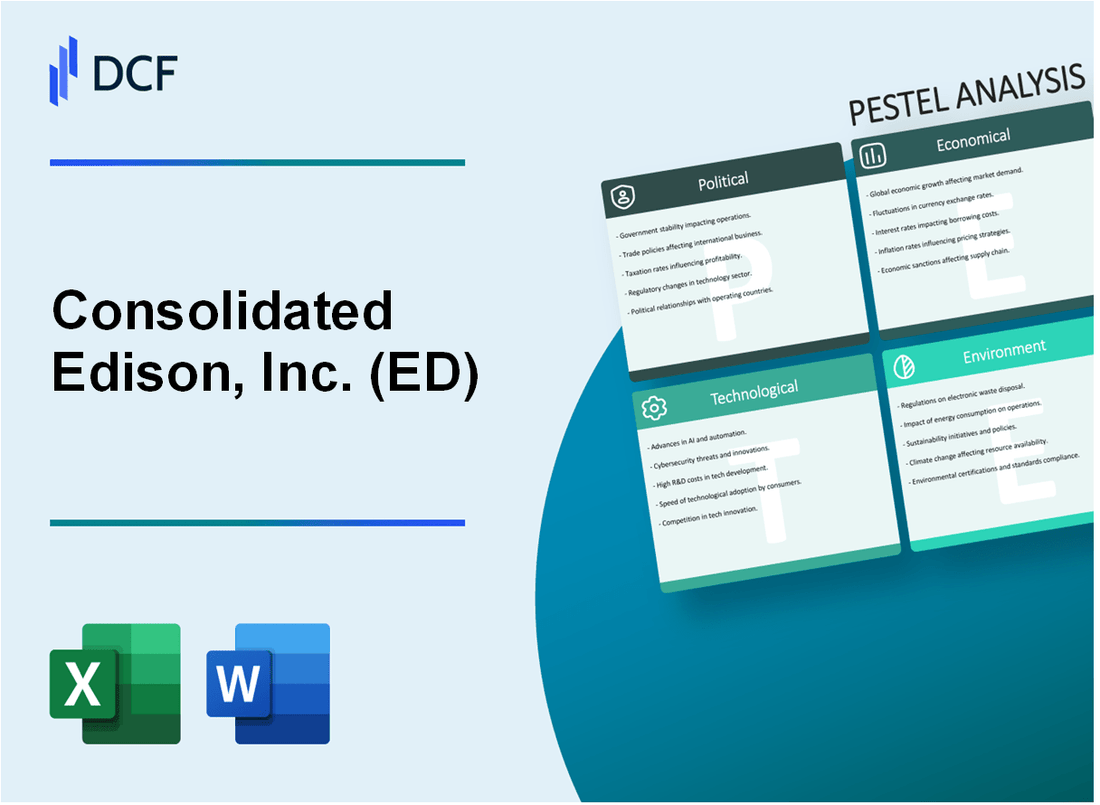
Consolidated Edison, Inc. (ED): Analyse de Pestle [Jan-2025 MISE À JOUR] |
Entièrement Modifiable: Adapté À Vos Besoins Dans Excel Ou Sheets
Conception Professionnelle: Modèles Fiables Et Conformes Aux Normes Du Secteur
Pré-Construits Pour Une Utilisation Rapide Et Efficace
Compatible MAC/PC, entièrement débloqué
Aucune Expertise N'Est Requise; Facile À Suivre
Consolidated Edison, Inc. (ED) Bundle
Dans le paysage dynamique de l'infrastructure énergétique urbaine, Consolidated Edison, Inc. (ED) est un joueur pivot à naviguer des défis et des opportunités complexes dans les domaines politiques, économiques, sociologiques, technologiques, juridiques et environnementaux. Cette analyse complète du pilon dévoile le réseau complexe de facteurs influençant l'un des fournisseurs d'utilité les plus critiques de New York, offrant une exploration nuancée de la façon dont les forces externes façonnent la trajectoire stratégique de l'entreprise dans un écosystème énergétique de plus en plus volatile et transformateur. Plongez profondément dans l'analyse multiforme qui révèle les intersections critiques de la réglementation, de l'innovation, de la durabilité et de la résilience urbaine stimulant la stratégie commerciale d'Edison.
Consolidated Edison, Inc. (ED) - Analyse du pilon: facteurs politiques
Secteur des services publics réglementés avec surveillance du gouvernement
Consolidated Edison opère sous la juridiction Commission de la fonction publique de New York (PSC). En 2023, le cadre réglementaire de l'utilitaire impliquait:
| Corps réglementaire | Métriques de surveillance clés |
|---|---|
| New York PSC | Approbation des taux, investissements d'infrastructure de 1,8 milliard de dollars en 2023 |
| Commission fédérale de la réglementation de l'énergie (FERC) | Règlements de transmission interétatique, surveillance de la conformité |
Conformité aux politiques énergétiques
La conformité aux mandats d'énergie de l'État de New York comprend:
- Norme d'énergie propre nécessitant 70% d'électricité renouvelable d'ici 2030
- Volume d'approvisionnement des crédits d'énergie renouvelable (RECS): 3,2 millions de MWh en 2023
- Cibles de réduction des gaz à effet de serre: réduction de 85% d'ici 2050
Impact de la législation sur l'investissement des infrastructures
Initiatives politiques affectant les investissements dans les infrastructures:
| Législation | Investissement estimé | Chronologie de la mise en œuvre |
|---|---|---|
| New York Clean Energy Jobs and Climate Act | 1,2 milliard de dollars alloués à la modernisation de la grille | 2023-2026 |
| Loi sur les investissements et les emplois des infrastructures | 42,45 millions de dollars pour la résilience de la grille de New York | 2022-2026 |
Administration politique Priorités d'énergie
Les déplacements politiques potentiels impactant Conède comprennent:
- Le programme d'énergie propre de la gouverneur de New York Kathy Hochul
- L'administration Biden se concentre sur les investissements en énergies renouvelables
- Changements de politique potentiels affectant les réglementations sur les émissions de carbone
Métriques d'évaluation des risques politiques pour condedison show vulnérabilité réglementaire modérée avec des stratégies d'adaptation en cours pour l'évolution des paysages politiques.
Consolidated Edison, Inc. (ED) - Analyse du pilon: facteurs économiques
Revenus stables des services de services publics réglementés dans la région métropolitaine de New York
Consolidated Edison a déclaré un chiffre d'affaires total de 14,1 milliards de dollars pour l'exercice 2022. La société dessert environ 3,5 millions de clients électriques et 1,1 million de clients gaziers à New York et dans le comté de Westchester.
| Segment | Revenus (2022) | Clientèle |
|---|---|---|
| Utilitaire électrique | 8,7 milliards de dollars | 3,5 millions de clients |
| Utilité du gaz | 3,2 milliards de dollars | 1,1 million de clients |
| Utilité à vapeur | 400 millions de dollars | 1 700 clients |
Sensibilité aux fluctuations des taux d'intérêt
Au 31 décembre 2022, Consolidated Edison avait 20,3 milliards de dollars de dette totale. Le taux d'intérêt moyen pondéré de l'entreprise était de 4,2% pour l'année.
| Métrique de la dette | Valeur |
|---|---|
| Dette totale | 20,3 milliards de dollars |
| Taux d'intérêt moyen pondéré | 4.2% |
| Maturité de la dette à long terme | 2033-2052 |
Impacts économiques des infrastructures urbaines et des tendances de la population
Population de New York en 2022: 8,8 millions. Le territoire de service d'Edison consolidé couvre 662 milles carrés avec une densité de population de 27 012 personnes par mile carré.
Investissement dans la modernisation du réseau et l'efficacité énergétique
Dépenses en capital pour 2022: 2,1 milliards de dollars. Les investissements se sont concentrés sur:
- Infrastructure de transmission et de distribution électrique
- Fiabilité du système de gaz
- Technologies de l'énergie propre
| Catégorie d'investissement | 2022 dépenses |
|---|---|
| Infrastructure électrique | 1,2 milliard de dollars |
| Mises à niveau du système de gaz | 600 millions de dollars |
| Technologies de l'énergie propre | 300 millions de dollars |
Consolidated Edison, Inc. (ED) - Analyse du pilon: facteurs sociaux
Servir une population urbaine diversifiée avec différents besoins de consommation d'énergie
Consolidated Edison dessert 3,5 millions de clients électriques et 1,1 million de clients de gaz à New York et dans le comté de Westchester. Démographie de la population à partir de 2023:
| Catégorie démographique | Pourcentage |
|---|---|
| Hispanique / Latino | 29.1% |
| Blanc | 48.7% |
| Noir / afro-américain | 15.6% |
| asiatique | 9.8% |
Augmentation de la demande des consommateurs de solutions énergétiques durables et vertes
Green Energy Investments par Consolidated Edison:
- 1,8 milliard de dollars alloués aux projets d'énergie renouvelable en 2023
- 345 MW de capacité solaire installée
- 127 MW de capacité d'énergie éolienne
Défis d'infrastructure vieillissants dans la région métropolitaine de New York densément peuplée
Statistiques d'investissement dans les infrastructures:
| Catégorie d'infrastructure | Montant d'investissement |
|---|---|
| Modernisation de la grille électrique | 687 millions de dollars |
| Remplacement du câble souterrain | 213 millions de dollars |
| Mises à niveau de la sous-station | 156 millions de dollars |
Des attentes croissantes des clients pour les outils de gestion des services numériques et de l'énergie
Métriques d'adoption des services numériques:
- 1,2 million de clients utilisant l'application mobile
- 68% des paiements de factures achevés en ligne
- Taux de satisfaction du client à 92%
Investissement des plates-formes d'engagement numérique du client: 45 millions de dollars en 2023
Consolidated Edison, Inc. (ED) - Analyse du pilon: facteurs technologiques
Investissements importants dans les technologies de transformation intelligente et numérique
Consolidated Edison a investi 1,2 milliard de dollars dans les technologies de modernisation du réseau en 2023. La stratégie de transformation numérique de l'entreprise comprend le déploiement de systèmes de surveillance des réseaux avancés avec un investissement prévu de 350 millions de dollars à 2025.
| Catégorie d'investissement technologique | Montant ($) | Chronologie de la mise en œuvre |
|---|---|---|
| Infrastructure de grille intelligente | 1,200,000,000 | 2023-2024 |
| Surveillance du réseau numérique | 350,000,000 | 2024-2025 |
Mise en œuvre de l'infrastructure de mesure avancée (AMI) pour un service amélioré
Con Edison a déployé 1,3 million de mètres avancés sur son territoire de service, représentant 68% de la clientèle totale. La société prévoit de terminer le déploiement complet de l'AMI d'ici 2026 avec un investissement supplémentaire de 275 millions de dollars.
| Métriques de déploiement AMI | État actuel | Achèvement cible |
|---|---|---|
| Compteurs avancés installés | 1,300,000 | 2026 |
| Pourcentage de clientèle | 68% | 100% |
| Investissement restant | $275,000,000 | 2024-2026 |
Développer des capacités d'intégration d'énergie renouvelable et de stockage d'énergie
Con Edison s'est engagé à 100 MW de projets de stockage d'énergie d'ici 2025. La société possède actuellement 35 MW de systèmes de stockage de batteries opérationnels et prévoit d'investir 180 millions de dollars dans les technologies d'intégration des énergies renouvelables.
| Métriques de stockage d'énergie renouvelable | Capacité actuelle | Capacité cible |
|---|---|---|
| Systèmes de stockage de batteries | 35 MW | 100 MW |
| Investissement dans les technologies d'intégration | $180,000,000 | 2024-2025 |
Explorer l'infrastructure de charge des véhicules électriques et les technologies connexes
Con Edison a alloué 50 millions de dollars pour le développement des infrastructures de charge EV. La société a installé 500 bornes de recharge publiques et prévoit de s'étendre à 1 500 stations d'ici 2026.
| Infrastructure de charge EV | État actuel | Extension cible |
|---|---|---|
| Bornes de charge publique | 500 | 1,500 |
| Investissement en infrastructure | $50,000,000 | 2024-2026 |
Consolidated Edison, Inc. (ED) - Analyse du pilon: facteurs juridiques
Conformité réglementaire stricte avec les directives de la Commission de la fonction publique de New York
Consolidated Edison opère sous une surveillance réglementaire rigoureuse, avec des frais de conformité totalisant 412,3 millions de dollars en dépenses réglementaires pour 2022. La Commission de la fonction publique de New York exige un respect strict des normes opérationnelles et des règlements sur la protection des consommateurs.
| Métrique de la conformité réglementaire | Valeur 2022 |
|---|---|
| Total des dépenses réglementaires | 412,3 millions de dollars |
| Pénalités de violation de la conformité | 1,7 million de dollars |
| Fréquence d'audit réglementaire | Trimestriel |
Exigences en cours réglementaires environnementaux et de sécurité
Les coûts de conformité environnementale pour Consolidated Edison ont atteint 287,6 millions de dollars en 2022, avec des investissements importants dans la réduction des émissions et la sécurité.
| Métrique de la conformité environnementale | Valeur 2022 |
|---|---|
| Dépenses totales de conformité environnementale | 287,6 millions de dollars |
| Investissements de réduction des émissions de gaz à effet de serre | 93,4 millions de dollars |
| Mises à niveau des infrastructures de sécurité | 62,1 millions de dollars |
Conteste juridique potentiel liée au développement des infrastructures
Consolidated Edison a dû faire face à 17 procédures judiciaires liées aux infrastructures en 2022, avec des frais de litige potentiels estimés à 45,2 millions de dollars.
| Métrique du défi juridique | Valeur 2022 |
|---|---|
| Infrastructure active procédure judiciaire | 17 |
| Coûts de litige estimés | 45,2 millions de dollars |
| Cas de litige norme environnementale | 8 |
Négociations de cas de taux d'utilité complexes et approbations réglementaires
Consolidated Edison a effectué 3 négociations de cas de taux majeures en 2022, les augmentations de taux approuvées totalisant 4,8% dans ses territoires de service.
| Tarif métrique de négociation du cas | Valeur 2022 |
|---|---|
| Procédure de tarif total | 3 |
| Augmentation des taux approuvés | 4.8% |
| Temps de traitement de l'approbation réglementaire | 8,3 mois |
Consolidated Edison, Inc. (ED) - Analyse du pilon: facteurs environnementaux
Engagement à réduire les émissions de carbone et à soutenir la transition d'énergie propre
Consolidated Edison s'est engagé à réduire les émissions de carbone par 100% D'ici 2050. Les émissions actuelles de dioxyde de carbone de la société s'élèvent à 7,8 millions de tonnes métriques par an. En 2023, la société a réduit les émissions de gaz à effet de serre de 32% par rapport aux niveaux de référence 2013.
| Cible de réduction des émissions | Année | Pourcentage |
|---|---|---|
| Réduction des émissions de carbone | 2050 | 100% |
| Réduction des émissions actuelles | 2023 | 32% |
Investir dans des initiatives de production d'énergies renouvelables et de durabilité
Consolidated Edison a investi 1,2 milliard de dollars dans des projets d'énergie renouvelable en 2023. La société exploite actuellement:
- 245 MW de capacité de génération solaire
- 87 MW de production d'énergie éolienne
- 36 MW de systèmes de stockage d'énergie
| Type d'énergie renouvelable | Capacité (MW) | Investissement ($ m) |
|---|---|---|
| Génération solaire | 245 | 510 |
| Énergie éolienne | 87 | 340 |
| Stockage d'énergie | 36 | 350 |
Gestion de l'impact environnemental des infrastructures énergétiques traditionnelles
Consolidated Edison a alloué 780 millions de dollars à la modernisation des infrastructures pour réduire l'impact environnemental. La société a mis en œuvre des systèmes de détection des fuites qui ont réduit les émissions de méthane de 22% en 2023.
| Investissement en infrastructure | Montant ($ m) | Réduction des émissions |
|---|---|---|
| Modernisation des infrastructures | 780 | 22% de réduction du méthane |
S'adapter aux stratégies de résilience et d'adaptation du changement climatique
Consolidated Edison a investi 450 millions de dollars dans l'infrastructure de résilience climatique. La société a réalisé 127 projets d'adaptation climatique en 2023, en se concentrant sur la protection contre les inondations et le durcissement de la grille.
| Métrique de résilience climatique | Montant | Investissement ($ m) |
|---|---|---|
| Projets d'adaptation climatique | 127 | 450 |
Consolidated Edison, Inc. (ED) - PESTLE Analysis: Social factors
The social landscape for Consolidated Edison is dominated by a severe energy affordability crisis and the complex, dual-edged sword of electrification. You are navigating a volatile public mood where necessary grid investments are directly colliding with customers' ability to pay, all while being mandated to drive the clean energy transition.
Public anger over rising bills fuels the ongoing affordability crisis.
The affordability crisis is the top social risk, driven by the cumulative effect of past rate hikes and the proposed future increases needed for infrastructure modernization. The sheer scale of customer debt shows the stress: as of January 2025, approximately 440,000 residential customers were at least two months behind on their bills, with total arrears exceeding $1 billion.
The public outcry is intense because the proposed rate hikes are substantial. The company's January 2025 filing requested new rates that would result in an average electric bill increase of 11.4 percent and an average gas bill increase of 13.3 percent starting in 2026. For many New Yorkers, this is simply an impossible burden. State officials, including the Governor, have publicly opposed the double-digit increases, which signals a tough regulatory fight ahead.
Here is a snapshot of the proposed rate changes:
| Customer Class | Proposed Average Bill Increase (2026) | Source of Public Anger |
|---|---|---|
| Average Electric Bill | 11.4% | Funding grid modernization and clean energy compliance. |
| Average Gas Bill | 13.3% | Funding infrastructure and gas system safety. |
| Residential Customers in Arrears (Jan 2025) | N/A | 440,000 customers behind on bills, owing over $1 billion. |
Disconnection policies cut service to 88,000 households in Q1/Q2 2025.
The company's move to ramp up collections post-pandemic has had a dramatic social impact. In the first six months of 2025 (Q1/Q2), Consolidated Edison disconnected service to more than 88,000 households due to unpaid bills. This aggressive collection strategy, which is a response to the massive growth in aged accounts receivables, cut off service to almost 2.5% of all customers in the New York area.
This is a major social and political flashpoint, especially since the shutoffs occurred during periods of extreme heat, which drives up air conditioning use and puts vulnerable populations at risk. While a company spokesperson noted that termination is a last resort, the data shows the severity: residential customer debt fell from $948 million at the end of 2024 to $840 million by the end of June 2025, largely due to this crackdown. One in five disconnected homes remained without power for at least a week.
Growing customer adoption of electric vehicles and heat pumps drives demand.
The clean energy transition is creating a surge in electricity demand, primarily from the adoption of electric vehicles (EVs) and heat pumps. This trend is a clear opportunity for the company but requires massive capital investment in the electric grid. Consolidated Edison is authorized to invest up to $720 million in customer incentives to support the connection of roughly 26,000 EV charging plugs to the grid through at least 2025.
The heat pump adoption rate is significant, with over 43,000 installations completed through the Clean Heat program as of July 2025. However, a lack of effective customer education and confusing rate structures mean fewer than 1% of these adopters are enrolled in the designated heat pump rate. This underutilization is leaving up to $131 million in potential customer bill savings unrealized, which only adds to the public perception of high costs and complexity. The company forecasts a summer peak demand of 12,610 megawatts for 2025, a significant increase from the 11,822 megawatts reached in 2024.
Focus on environmental justice communities for infrastructure investment.
There is a strong social and regulatory push to ensure that the clean energy transition benefits all communities, especially those historically disadvantaged (Environmental Justice or EJ communities). Consolidated Edison has a formal Environmental Justice policy that guides its investments. A key part of the company's $11.8 billion investment plan (covering rates through 2025) is dedicated to improving reliability and resiliency in these specific areas.
The company's commitment focuses on several key areas:
- Ensuring disadvantaged communities are not disproportionally burdened by operations.
- Engaging with EJ advocates on project design and implementation.
- Providing opportunities for employment and skills development in these communities.
- Facilitating the transition of commercial, bus, and truck fleets to zero-emission vehicles to improve air quality in EJ neighborhoods.
This focus is a strategic imperative; it helps secure regulatory approval for major capital projects, like the proposed $21 billion investment plan for 2026-2028, which explicitly includes serving customers in disadvantaged communities. You must defintely execute on this commitment to maintain your social license to operate.
Consolidated Edison, Inc. (ED) - PESTLE Analysis: Technological factors
The technological landscape for Consolidated Edison, Inc. (ED) is defined by massive capital investment aimed at grid modernization and resiliency, plus the sophisticated integration of new, decentralized energy sources. This isn't just about replacing old wires; it's a fundamental shift to a digital, two-way grid. The company is defintely a trend-aware realist, mapping near-term risks like extreme weather to clear, multi-billion-dollar actions.
Investing over $21 billion in three years for new infrastructure and grid hardening
Consolidated Edison is making a substantial, near-term commitment to fortify its energy delivery systems against climate change and manage the surge in demand from electrification. The company proposed an infrastructure investment plan to the New York State Public Service Commission (PSC) in early 2025, committing to spend more than $21 billion over the three-year period from 2026 to 2028 to build new transmission, substation, and distribution facilities. This is part of a larger, decade-long commitment, with a total capital expenditure plan of approximately $72 billion over the next decade, of which $66 billion is earmarked for core infrastructure upgrades.
For the 2025 fiscal year, the capital allocation is already aggressive, with the company having invested $1.1 billion in the first quarter (Q1) of 2025 alone. This capital is crucial for grid hardening-making the system resilient-which is projected to reduce weather-related outages by 30% by 2030.
| Capital Investment Focus | Key Financial/Timeline Data (2025-2028) | Primary Technological Goal |
|---|---|---|
| Proposed 3-Year Infrastructure Plan | More than $21 billion (2026-2028) | Build new transmission, substation, and distribution facilities. |
| Total Decade-Long Capital Plan | Approximately $72 billion (Next decade) | Modernize aging systems and accelerate the clean energy transition. |
| Q1 2025 Investment | $1.1 billion invested in Q1 2025 | Address immediate grid vulnerabilities and fund ongoing projects. |
Deploying algorithms and sensors on underground equipment for early fault detection
The company operates the world's largest underground, low-voltage, network system, which includes approximately 96,800 miles of underground cable. Managing this requires advanced diagnostics. They are actively deploying a network of sensors and leveraging artificial intelligence (AI) for predictive maintenance.
Here's the quick math: preventing one major fault saves millions in repair and avoids massive service disruption.
- Manhole Arc Recognition System (MARS): A prototype, developed in collaboration with the Electric Power Research Institute (EPRI), uses advanced algorithms to detect arcing events in underground low-voltage systems with high accuracy.
- Sensor Network: Consolidated Edison is evaluating incorporating MARS-like algorithms within a broader network of sensors deployed across the Manhattan underground system to provide crucial data for future machine learning and AI analysis.
- Advanced Interrupters: The company is installing 100 new interrupters-sophisticated circuit breakers-on underground equipment in Brooklyn and Queens over five years, with 20 already installed as of June 2024, to swiftly isolate faults and limit outages.
- Cable Monitoring: They are currently installing a Generation Two and developing a Generation Three cable monitoring system, with a goal of using complete fiberoptic sensors to eliminate electronics from underground vaults and provide real-time asset management data.
Building a Distributed System Technology Platform (DSTP) to integrate renewables
To manage the influx of customer-owned solar, battery storage, and other distributed energy resources (DER), Consolidated Edison is building a Distributed System Technology Platform (DSTP). This platform is the cornerstone of New York State's Reforming the Energy Vision (REV) initiative.
The company filed its Distributed System Implementation Plan (DSIP) with the PSC in June 2025, which serves as the comprehensive roadmap for the DSTP. The platform's core function is to forecast, plan, interconnect, monitor, control, and effectively manage this increasingly complex, bi-directional energy flow.
Key technological accomplishments under the DSTP framework include:
- Interconnection Online Application Portal (IOAP): Streamlining the process for customers to connect DER using the PowerClerk tool.
- Hosting Capacity Maps: Publishing maps that show where new DER can be added to the grid without requiring major upgrades.
- Non-Wires Solutions (NWS): Delivering over 160 MW of NWS opportunities to DER providers, which are alternatives to traditional infrastructure like new substations or transmission lines.
Developing clean energy hubs to facilitate major offshore wind integration
Consolidated Edison is making significant investments in new, large-scale transmission infrastructure to bring thousands of megawatts of clean, remote power into New York City. The goal is to meet the state's mandate for 100% carbon-free electricity by 2040.
The central project is the Brooklyn Clean Energy Hub, an $810 million multi-value transmission substation located in Vinegar Hill.
- Capacity: The Hub will serve as a made-ready interconnection point for offshore wind, with the potential to connect up to 4,500 MW of renewable wind energy within the next decade.
- Timeline: Construction is expected to start in mid-2024 and the facility is slated to be energized before the summer of 2028.
Another major technological investment is the Idlewild Project in southeast Queens, a $1.2 billion investment to create two new substations and a new electric network. This project will meet growing demand while enabling clean energy provision to major transportation hubs, including JFK Airport and Port Authority electric vehicle (EV) bus fleet charging.
Consolidated Edison, Inc. (ED) - PESTLE Analysis: Legal factors
New York's Climate Leadership and Community Protection Act (CLCPA) mandates 70% renewable energy by 2030.
The New York State Climate Leadership and Community Protection Act (CLCPA) is the single most significant legal driver for Consolidated Edison, Inc.'s (ED) capital expenditure and operational strategy. This law mandates a 70% renewable energy supply by 2030 and a 100% zero-emission electric grid by 2040, which translates directly into massive infrastructure investment requirements for the utility.
To comply with the CLCPA, the company's subsidiaries are undertaking substantial, multi-year climate resilience and clean energy investments. For the period from 2025 through 2029, Consolidated Edison Company of New York, Inc. (CECONY) and Orange and Rockland Utilities, Inc. (O&R) have proposed climate resilience investments totaling $645 million and $184 million, respectively, to fortify the grid against extreme weather events driven by climate change.
Here's the quick math: CECONY's total projected climate resilience investments are expected to reach approximately $5.3 billion through 2044, with O&R's projected at $900 million over the same timeframe. That's a huge, defintely necessary capital outlay, but it's all legally mandated.
PSC slashed a proposed rate increase by $1.3 billion for electricity and $395 million for gas.
The New York Public Service Commission (PSC) functions as the primary regulatory check on the company's ability to recover its legally mandated and necessary capital costs. In 2025, the legal and regulatory process severely constrained the company's proposed rate hikes for 2026, demonstrating the high-stakes balancing act between clean energy investment and customer affordability.
Consolidated Edison Company of New York, Inc. initially filed for an electric delivery revenue increase of approximately $1.6 billion and a gas delivery revenue increase of approximately $440 million for the 12-month period ending December 31, 2026 (Rate Year 1). However, a November 2025 Joint Proposal (settlement) significantly reduced this request.
The settlement, which is subject to final PSC approval, would increase electric delivery service revenues by approximately $234 million and gas delivery revenues by approximately $27.5 million in Rate Year 1. The difference between the initial request and the proposed settlement represents a cut of approximately $1.366 billion for electric and $412.5 million for gas revenue increases, which is a major win for ratepayers, but a constraint on the company's funding plans.
| Rate Increase Component | Initial 2025 Filing Request (RY1) | 2025 Joint Proposal/Settlement (RY1) | Approximate Reduction (Slashed Amount) |
|---|---|---|---|
| Electric Delivery Revenue Increase | Approximately $1.6 billion | Approximately $234 million | Approximately $1.366 billion |
| Gas Delivery Revenue Increase | Approximately $440 million | Approximately $27.5 million | Approximately $412.5 million |
Revenue decoupling mechanism continues for electric and gas services, stabilizing sales.
A key legal and regulatory stability factor is the continuation of the revenue decoupling mechanism (RDM) for the utilities' New York electric and gas rate plans.
This mechanism is critical because it breaks the link between the volume of energy sold and the utility's authorized revenue. In simple terms, Consolidated Edison's revenues are generally not affected by changes in delivery volumes, regardless of whether customers conserve energy or increase usage.
This provides essential financial predictability, especially as the company must legally incentivize energy efficiency and building electrification under the CLCPA. Without RDM, the company would be penalized financially for successfully encouraging customers to use less energy.
- Stabilizes revenue despite energy efficiency programs.
- Removes disincentive for promoting state-mandated conservation.
- Protects financial performance from weather-related volume fluctuations.
Compliance costs for eliminating remaining polychlorinated biphenyls (PCBs) in the system.
Environmental law compliance continues to be a notable, non-discretionary cost center for the company, particularly concerning the elimination of polychlorinated biphenyls (PCBs).
The Stockholm Convention, an international treaty, requires the elimination of PCBs in existing equipment by 2025, a deadline that creates a legal imperative for remediation. While the company is actively managing its legacy sites, the costs are substantial and ongoing.
For the 2025 fiscal year, Consolidated Edison (Con Edison) and Consolidated Edison Company of New York, Inc. (CECONY) estimate they will incur costs for environmental remediation of approximately $39 million and $38 million, respectively. These expenses are typically recovered through regulatory mechanisms, but they represent a continuous, legally required drain on capital and operational focus. The remediation is a long-term liability, but the 2025 costs are clearly defined.
Consolidated Edison, Inc. (ED) - PESTLE Analysis: Environmental factors
The environmental factors for Consolidated Edison, Inc. (ED) are dominated by an aggressive, state-mandated transition to a decarbonized grid, which simultaneously presents a massive capital expenditure opportunity and a significant regulatory risk.
The company's strategy is a dual focus: drastically cutting its own emissions while building a resilient, high-capacity electric grid to enable its customers to electrify their homes and vehicles. It's a huge undertaking, but it's where the growth is for a regulated utility in the Northeast.
Corporate goal of net-zero Scope 1 greenhouse gas emissions by 2050
Consolidated Edison, Inc. has committed to achieving overall net-zero Scope 1 emissions from its operations by 2050, directly supporting New York State's climate goals. To be fair, this is a complex challenge, especially since approximately 89% of the company's Scope 1 emissions come from the operation of its steam, electric, and co-generation plants, which includes the nation's largest district steam system. The company has an intermediate goal to achieve zero direct greenhouse gas (GHG) emissions (Scope 1) for the company-owned electric-generating units on its steam system by 2040.
Here's the quick math on their progress: the company has already reduced its Scope 1 emissions by 55% since the 2005 baseline. That's a strong track record, but the last mile-decarbonizing the steam system-is the defintely hardest part.
Reduced Scope 1 emissions by more than 54% since the 2005 baseline
The company has made substantial progress in reducing its direct carbon footprint, primarily by switching from heavier fossil fuels to natural gas in its power and steam generation. As of the most recent data (August 2025), Consolidated Edison, Inc. has achieved a 55% reduction in direct GHG emissions (Scope 1) from its 2005 baseline of 6.0 million metric tons of CO2 equivalent. This reduction is a key metric for regulators and investors alike, showing commitment to the transition.
The majority of the remaining Scope 1 emissions are concentrated in the steam system, which is why the company is focusing on pilots to reduce carbon emissions from steam generation and is also planning an 85% reduction in fugitive methane emissions from its natural gas delivery system by 2040.
| Environmental Target | Goal/Metric | Target Date | Latest Status (2025) |
|---|---|---|---|
| Net-Zero Scope 1 Emissions | Overall net-zero Scope 1 emissions from operations | 2050 | On track; 55% reduction achieved since 2005 baseline. |
| Scope 1 Emissions Reduction | Reduction from 2005 baseline | N/A | Reduced by 55% (as of August 2025). |
| Building Electrification Support | Electrification of heating systems in more than 150,000 buildings | 2030 | Investing $2.7 billion (2026-2030) in clean heat and efficiency. |
| Climate Resilience Investment | Total planned investment in resilience projects | Next 20 years | More than $5.6 billion planned. |
Investing in resiliency, informed by a climate study, to fortify systems against extreme weather
The escalating frequency of extreme weather-like the 2025 heatwave that strained the New York City grid-makes climate resiliency a core business driver, not just an environmental mandate. Consolidated Edison, Inc. released its new Climate Change Resilience Plan (CCRP) in February 2025, which is a long-term roadmap for adaptation.
This plan is based on the updated Climate Change Vulnerability Study (CCVS) from September 2023, which projects things like New York City experiencing up to 17 days per year with temperatures exceeding 95°F by 2030. The company plans to invest more than $5.6 billion in climate resilience projects over the next 20 years, focusing on hardening infrastructure against heat, wind, and coastal flooding. Since Superstorm Sandy, they have already spent over $1 billion on storm hardening, which has prevented more than 1.2 million customer interruptions.
Aiming to support electrification of 150,000 buildings by 2030
Buildings are the largest source of carbon emissions in New York City, so the shift from natural gas to electric heating (electrification) is crucial. Consolidated Edison, Inc. is aiming to support the electrification of heating systems in more than 150,000 buildings by 2030. This isn't just a goal; it's backed by serious capital allocation.
The company is planning to invest $2.7 billion between 2026 and 2030 to support customers in reducing their building carbon emissions through deep energy efficiency upgrades and building electrification programs. That's a direct flow of capital to drive the environmental shift at the customer level.
Building new infrastructure to meet demand from vehicle and building electrificaton
The transition to electric vehicles (EVs) and electric heating requires a fundamentally new, more robust grid. The company is responding with a massive capital plan to build the necessary infrastructure, including transmission, substation, and distribution facilities.
The sheer scale of the investment is the key takeaway here:
- The total capital expenditure plan is an ambitious $72 billion over the next decade.
- More than $21 billion is earmarked for investment over the three-year period from 2025 to 2027 to build new infrastructure.
- This includes a focus on EV charging, where the company has an authorized budget of approximately $700 million to support the installation of 21,371 Level 2 and 3,157 Direct Current Fast Charging plugs.
The grid must be ready to handle this new load, plus the integration of massive offshore wind and solar projects, or the entire clean energy transition stalls. That's a huge opportunity for regulated returns.
Your next step should defintely be to model the impact of a 100 basis point reduction in allowed ROE on the projected $38 billion capital plan's net present value.
Disclaimer
All information, articles, and product details provided on this website are for general informational and educational purposes only. We do not claim any ownership over, nor do we intend to infringe upon, any trademarks, copyrights, logos, brand names, or other intellectual property mentioned or depicted on this site. Such intellectual property remains the property of its respective owners, and any references here are made solely for identification or informational purposes, without implying any affiliation, endorsement, or partnership.
We make no representations or warranties, express or implied, regarding the accuracy, completeness, or suitability of any content or products presented. Nothing on this website should be construed as legal, tax, investment, financial, medical, or other professional advice. In addition, no part of this site—including articles or product references—constitutes a solicitation, recommendation, endorsement, advertisement, or offer to buy or sell any securities, franchises, or other financial instruments, particularly in jurisdictions where such activity would be unlawful.
All content is of a general nature and may not address the specific circumstances of any individual or entity. It is not a substitute for professional advice or services. Any actions you take based on the information provided here are strictly at your own risk. You accept full responsibility for any decisions or outcomes arising from your use of this website and agree to release us from any liability in connection with your use of, or reliance upon, the content or products found herein.