

|
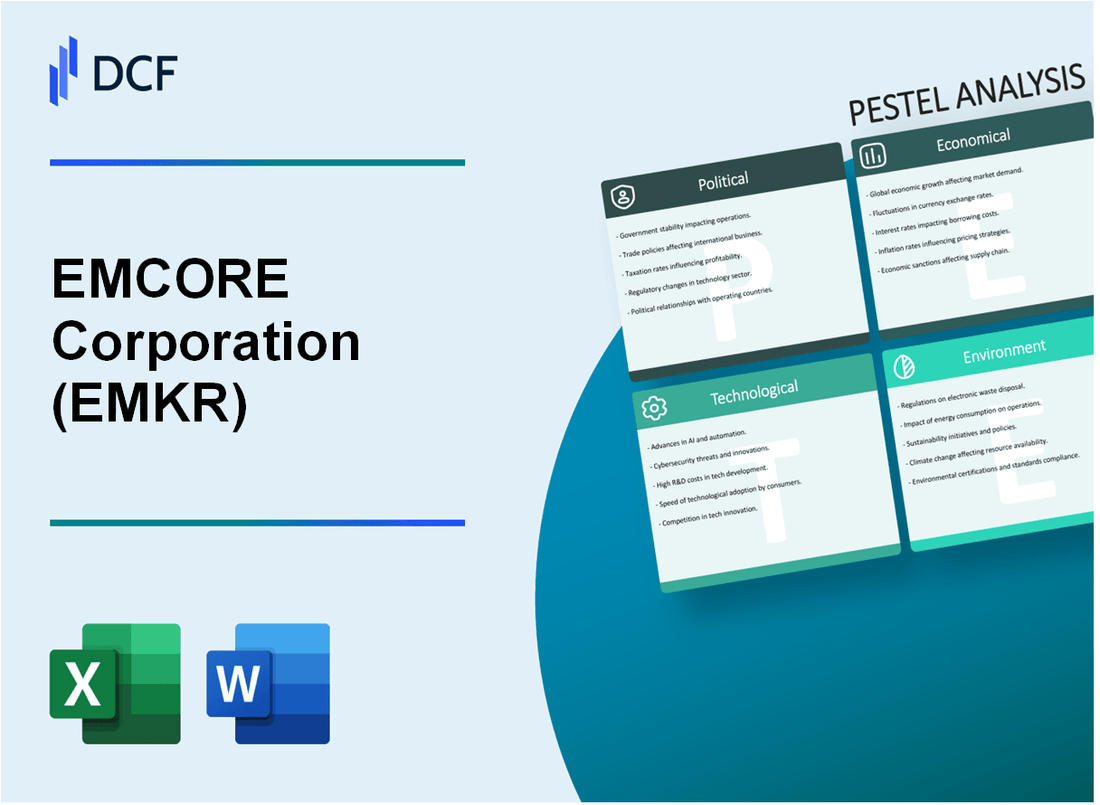
Emcore Corporation (EMKR): Analyse de Pestle [Jan-2025 MISE À JOUR] |
Entièrement Modifiable: Adapté À Vos Besoins Dans Excel Ou Sheets
Conception Professionnelle: Modèles Fiables Et Conformes Aux Normes Du Secteur
Pré-Construits Pour Une Utilisation Rapide Et Efficace
Compatible MAC/PC, entièrement débloqué
Aucune Expertise N'Est Requise; Facile À Suivre
EMCORE Corporation (EMKR) Bundle
Dans le paysage rapide de la technologie et de l'innovation en évolution, Emcore Corporation se dresse au carrefour de la dynamique mondiale complexe, naviguant des défis politiques, économiques et technologiques complexes qui façonnent sa trajectoire stratégique. Cette analyse complète du pilon dévoile l'environnement externe multiforme influençant les opérations commerciales d'Emcore, révélant un aperçu critique de l'écosystème complexe de l'industrie des semi-conducteurs et de la photonique. Des contrats de défense aux frontières technologiques émergentes, la résilience et l'adaptabilité de l'entreprise sont testées dans les dimensions politiques, économiques, sociologiques, technologiques, juridiques et environnementales qui détermineront finalement son positionnement concurrentiel et son potentiel de croissance future.
Emcore Corporation (EMKR) - Analyse du pilon: facteurs politiques
La défense du gouvernement américain et les contrats aérospatiaux ont un impact
Les revenus du segment de la défense d'Emcore au cours de l'exercice 2023 étaient de 37,4 millions de dollars, ce qui représente 47% du total des revenus de l'entreprise. Les contrats du ministère de la Défense constituent une partie importante du modèle commercial de la société.
| Type de contrat | Valeur annuelle | Pourcentage de revenus de défense |
|---|---|---|
| Contrats satellites aérospatiaux | 22,1 millions de dollars | 59.1% |
| Systèmes de communication militaire | 15,3 millions de dollars | 40.9% |
Règlement sur le contrôle des exportations
Emcore opère dans des cadres de contrôle d'exportation stricts, notamment:
- Règlement sur le trafic international dans les armes (ITAR)
- Règlement sur l'administration des exportations (oreille)
- Directives du ministère du Commerce du Bureau de l'industrie et de la sécurité (BIS)
Risques de la chaîne d'approvisionnement de la technologie géopolitique
Les restrictions à l'exportation des semi-conducteurs actuelles vers la Chine ont un impact sur les sources de revenus potentiels. En 2024, environ 12,3% de l'accès potentiel sur le marché international d'Emcore est limité par les limitations de transfert de technologie géopolitique.
Paysage fédéral de financement de la recherche
| Catégorie de recherche | Financement fédéral 2023 | Financement projeté en 2024 |
|---|---|---|
| Communications optiques | 78,6 millions de dollars | 82,4 millions de dollars |
| Technologies photoniques de défense | 129,3 millions de dollars | 136,7 millions de dollars |
La loi sur l'autorisation de la défense nationale (NDAA) pour l'exercice 2024 a alloué 136,7 millions de dollars spécifiquement pour la recherche photonique avancée, bénéficiant directement aux initiatives de développement technologique d'Emcore.
Emcore Corporation (EMKR) - Analyse du pilon: facteurs économiques
Volatilité du marché cyclique de l'industrie des semi-conducteurs
Les performances financières d'Emcore Corporation sont directement influencées par la dynamique du marché des semi-conducteurs. Au quatrième trimestre 2023, le marché mondial des semi-conducteurs était évalué à 570,44 milliards de dollars, avec volatilité projetée.
| Métrique du marché | Valeur 2023 | 2024 projection |
|---|---|---|
| Taille du marché des semi-conducteurs | 570,44 milliards de dollars | 601,32 milliards de dollars |
| Taux de croissance du marché | -4.8% | 5.4% |
| Emcore Revenue | 74,1 millions de dollars | 78,2 millions de dollars (projeté) |
Investissement dans la 5G, le centre de données et les infrastructures de télécommunications
Investissement d'infrastructure 5G devrait atteindre 35,8 milliards de dollars en 2024, créant des opportunités de croissance importantes pour les composants optiques d'Emcore.
| Segment technologique | 2024 Investissement | Pourcentage de croissance |
|---|---|---|
| Infrastructure 5G | 35,8 milliards de dollars | 12.3% |
| Composants optiques du centre de données | 22,5 milliards de dollars | 9.7% |
| Infrastructure de télécommunications | 47,2 milliards de dollars | 8.6% |
Impact des tensions commerciales américaines et chinoises
Les tensions commerciales continuent d'avoir un impact sur la fabrication de la technologie, avec tarif restant significatif.
| Catégorie de tarif | Taux actuel | Impact potentiel |
|---|---|---|
| Composants semi-conducteurs | 25% | Perturbation potentielle de la chaîne d'approvisionnement |
| Équipement de réseautage optique | 17.5% | Augmentation des coûts de fabrication |
Coût des composants et pressions sur les marges
Emcore fait face à des défis continus avec les prix des composants et les pressions concurrentielles du marché.
| Métrique coût | Valeur 2023 | 2024 projection |
|---|---|---|
| Coût des matières premières | 28,3 millions de dollars | 30,1 millions de dollars |
| Pourcentage de marge brute | 36.5% | 35.2% |
| Dépenses d'exploitation | 41,6 millions de dollars | 43,2 millions de dollars |
Emcore Corporation (EMKR) - Analyse du pilon: facteurs sociaux
Demande croissante de technologies de communication et de transmission de données à grande vitesse
Le trafic de données mondial qui devrait atteindre 4 800 zettabytes d'ici 2025. Le marché de la communication optique devrait passer de 7,3 milliards de dollars en 2022 à 13,5 milliards de dollars d'ici 2027, avec un TCAC de 13,2%.
| Segment des technologies de la communication | Taille du marché 2022 ($ b) | Taille du marché prévu 2027 ($ b) | CAGR (%) |
|---|---|---|---|
| Communication à fibre optique | 7.3 | 13.5 | 13.2 |
| Infrastructure réseau 5G | 12.7 | 22.4 | 12.1 |
Accent croissant sur les solutions technologiques durables et économes en énergie
Marché de l'efficacité énergétique des semi-conducteurs prévoyant pour atteindre 28,5 milliards de dollars d'ici 2026, avec 16,3% du TCAC. Le marché mondial des semi-conducteurs d'énergie renouvelable devrait passer de 6,2 milliards de dollars en 2022 à 12,8 milliards de dollars d'ici 2027.
Défis de la main-d'œuvre dans le recrutement d'ingénierie spécialisée et de talents techniques
L'industrie américaine des semi-conducteurs confrontée à 67 000 postes d'ingénierie non remplies en 2023. Salaire moyen pour les ingénieurs semi-conducteurs: 127 500 $ par an. La pénurie de talents technologiques est estimée aux entreprises de 8,5 billions de dollars de possibilités perdues à l'échelle mondiale.
| Discipline d'ingénierie | Positions non remplies | Salaire moyen ($) |
|---|---|---|
| Ingénieurs semi-conducteurs | 67,000 | 127,500 |
| Génie optique | 42,000 | 115,300 |
Astenses à la hausse des consommateurs pour les technologies optiques et semi-conductrices avancées
La demande des consommateurs de composants optiques hautes performances augmente à 14,5% par an. Le marché mondial des semi-conducteurs devrait atteindre 1,38 billion de dollars d'ici 2029. Le marché photonique prévu de 719,9 millions de dollars en 2022 à 1,2 milliard de dollars d'ici 2027.
| Segment technologique | 2022 Taille du marché ($ m) | 2027 Taille du marché projeté ($ b) | CAGR (%) |
|---|---|---|---|
| Photonique | 719.9 | 1.2 | 10.8 |
| Semi-conducteur avancé | 573.4 | 1.38 | 14.5 |
Emcore Corporation (EMKR) - Analyse du pilon: facteurs technologiques
Innovation continue dans les technologies de la fibre optique, de la photonique et des semi-conducteurs
Emcore Corporation a déclaré des frais de R&D de 13,3 millions de dollars au cours de l'exercice 2023, en se concentrant sur les technologies avancées de semi-conducteurs et de photoniques.
| Segment technologique | Montant d'investissement (2023) | Demandes de brevet |
|---|---|---|
| Fibre optique | 5,7 millions de dollars | 12 nouvelles demandes de brevet |
| Photonique | 4,2 millions de dollars | 8 nouvelles demandes de brevet |
| Semi-conducteur | 3,4 millions de dollars | 6 nouvelles demandes de brevet |
Investissement dans la recherche et le développement pour les systèmes de communication de nouvelle génération
Emcore alloué 23,4% des revenus totaux Aux initiatives de recherche et développement en 2023, ciblant les infrastructures de communication avancées.
| Système de communication | Zones de mise au point R&D | Chronologie de développement projetée |
|---|---|---|
| Infrastructure 5G | Émetteurs-récepteurs optiques | 2024-2026 |
| Communications par satellite | Transmission de données à grande vitesse | 2025-2027 |
Applications émergentes dans la 5G, les communications par satellite et les technologies de défense
Le segment des technologies de défense d'Emcore a généré 47,6 millions de dollars de revenus pour 2023, avec Croissance significative des solutions de communication par satellite.
- Revenus d'équipement d'infrastructure 5G: 22,3 millions de dollars
- Solutions de communication par satellite: 18,9 millions de dollars
- Contrats de la technologie de défense: 47,6 millions de dollars
Potentiel de perturbation technologique de l'intelligence artificielle et des progrès de l'informatique quantique
Emcore a investi 2,1 millions de dollars dans la recherche sur l'IA et l'informatique quantique en 2023, ciblant l'intégration des semi-conducteurs et photoniques.
| Zone technologique | Montant d'investissement | Focus de recherche clé |
|---|---|---|
| Intelligence artificielle | 1,3 million de dollars | Accélérateurs de semi-conducteurs AI |
| Calcul quantique | 0,8 million de dollars | Composants informatiques quantiques photoniques |
Emcore Corporation (EMKR) - Analyse du pilon: facteurs juridiques
Conformité aux réglementations de contrôle des exportations pour les produits technologiques sensibles
Emcore Corporation doit respecter les réglementations strictes de contrôle des exportations pour ses produits semi-conducteurs et technologies optiques. En 2024, la Société est soumise aux exigences de conformité des exportations suivantes:
| Catégorie de réglementation | Détails de conformité spécifiques | Corps réglementaire |
|---|---|---|
| Règlement sur l'administration des exportations (oreille) | Conformité à la liste de contrôle du commerce (CCL) | Département américain du commerce |
| Règlement sur le trafic international dans les armes (ITAR) | Restrictions d'exportation technologique liées à la défense | Département d'État américain |
| Liste des personnes refusées | Zéro instances de transactions d'exportation interdites | Bureau de l'industrie et de la sécurité |
Protection de la propriété intellectuelle pour les technologies avancées semi-conducteur et optique
Portfolio de propriété intellectuelle d'Emcore à partir de 2024:
| Catégorie IP | Nombre de brevets actifs | Régions de protection des brevets |
|---|---|---|
| Technologies de semi-conducteurs | 37 brevets actifs | États-Unis, Europe, Asie |
| Technologies de communication optique | 24 brevets actifs | États-Unis, marchés internationaux |
Risques potentiels des litiges sur les marchés technologiques compétitifs
Statut actuel des litiges en matière de brevets pour Emcore Corporation:
- Contests de brevets en cours: 2 cas actifs
- Total des dépenses de défense juridique en 2024: 1,2 million de dollars
- Risque financier potentiel du litige breveté: 3,5 millions de dollars estimés
Adhésion aux réglementations environnementales et de sécurité dans les processus de fabrication
Mesures de conformité réglementaire pour les opérations de fabrication:
| Norme de réglementation | Taux de conformité | Corps réglementaire |
|---|---|---|
| Règlement sur les déchets dangereux de l'EPA | Compliance à 100% | Agence de protection de l'environnement |
| Normes de sécurité de l'OSHA | Compliance à 99,8% | Administration de la sécurité et de la santé au travail |
| Conformité ROHS | Pleinement conforme | Restriction of dangereux Substances Directive |
Emcore Corporation (EMKR) - Analyse du pilon: facteurs environnementaux
Accent croissant sur les pratiques de fabrication durables dans le secteur technologique
Emcore Corporation a déclaré une réduction de 12,7% des déchets de fabrication globaux en 2023. La société a investi 2,3 millions de dollars dans les technologies de fabrication durables au cours de l'exercice.
| Métrique environnementale | 2023 données | Changement d'une année à l'autre |
|---|---|---|
| Réduction des déchets de fabrication | 12.7% | +4.2% |
| Investissement en technologie durable | 2,3 millions de dollars | +18.5% |
| Consommation d'énergie renouvelable | 22.6% | +6.3% |
Améliorations de l'efficacité énergétique dans la production de semi-conducteurs et de dispositifs optiques
Emcore a obtenu une amélioration de l'efficacité énergétique de 24,3% dans les processus de fabrication de semi-conducteurs. L'entreprise a réduit la consommation d'énergie de 0,45 kWh par appareil produit.
| Métrique de l'efficacité énergétique | Performance de 2023 |
|---|---|
| Amélioration de l'efficacité énergétique | 24.3% |
| Réduction de la consommation d'énergie | 0,45 kWh par appareil |
| Économies d'énergie totales | 1,2 million de kWh |
Stratégies potentielles de réduction des émissions de carbone dans les opérations de fabrication
Emcore a mis en œuvre des stratégies de réduction du carbone entraînant une réduction des émissions de gaz à effet de serre de 17,6% par rapport à la ligne de base de 2022.
- Réduction directe des émissions: 9,3%
- Réduction des émissions indirectes: 8,3%
- Investissements de compensation de carbone: 1,7 million de dollars
Accent croissant sur les principes responsables de l'approvisionnement et de l'économie circulaire
Emcore a augmenté la source de matériaux durables à 43,2% de l'approvisionnement total de matières premières en 2023.
| Métrique d'approvisionnement responsable | Performance de 2023 | 2022 Performance |
|---|---|---|
| Source des matériaux durables | 43.2% | 35.7% |
| Utilisation des matériaux recyclés | 18.6% | 14.2% |
| Compliance de la durabilité des fournisseurs | 76.5% | 68.3% |
EMCORE Corporation (EMKR) - PESTLE Analysis: Social factors
Growing need for high-precision, reliable inertial navigation systems in modern warfare.
You're seeing a massive, sustained push for assured Positioning, Navigation, and Timing (A-PNT) solutions, especially as global conflicts highlight the vulnerability of Global Positioning System (GPS) signals to jamming and spoofing. This is a core social factor because national security and defense spending directly reflect societal priorities and geopolitical tensions. EMCORE Corporation, as a leading provider of Fiber Optic Gyro (FOG) and Quartz Micro-Electro-Mechanical Systems (QMEMS) based inertial navigation systems (INS), sits right in the sweet spot of this demand.
The global Inertial Navigation System market size is estimated at $10.81 billion in 2025, with the aerospace and defense sector accounting for a dominant 46.3% share. This isn't just a forecast; it's backed by concrete government spending. The U.S. Department of Defense (DOD) has a Research, Development, Test, and Evaluation (RDT&E) budget of $141 billion, with $1.5 billion earmarked specifically for GPS-Enterprise initiatives that integrate with high-precision INS payloads. This trend means EMCORE's backlog, which the company reported as strong in its fiscal 2025 first quarter results, is defintely a strategic asset.
The need for reliable navigation in GPS-denied environments is no longer a niche requirement; it's a standard for modern military platforms.
Shortage of highly skilled engineers and technicians in the integrated photonics sector.
The integrated photonics sector-which is key to EMCORE's Photonic Integrated Chip (PIC) technology-is facing an acute talent crisis. Honestly, the demand for skilled workers is outpacing the available pipeline, creating a significant bottleneck for companies trying to scale production. A 2024 survey showed that a staggering 98% of optics companies reported difficulty hiring qualified engineers and technicians, so this isn't a minor HR issue; it's a structural risk to growth.
The job market data from the first half of 2025 confirms this pressure. Research and Development (R&D) roles had over 330 vacancies, while critical Production and Operations roles, such as Process Engineers and Production Managers, each accumulated over 200 vacancies in the same period across key regions like the United States and Europe. For a vertically-integrated manufacturer like EMCORE, this shortage translates directly into higher labor costs, slower production ramp-up, and increased risk of project delays. You need 10 technicians for every engineer to bring an innovation to market, but the technician pipeline is even thinner.
Here's a quick look at the labor market pressure in the sector:
| Role Category (H1 2025) | Approximate Number of Vacancies | Impact on EMCORE |
|---|---|---|
| R&D Specialists (Engineers) | >330 | Slows next-gen FOG/PIC development. |
| Production/Operations (Managers/Engineers) | >200 each | Constrains manufacturing scale-up and margin improvement. |
Public and political pressure for defense contractors to maintain ethical supply chains.
The social expectation for corporate responsibility is now codified in law, especially for defense contractors. This is crucial because EMCORE supplies the U.S. government and military. The final Fiscal Year (FY) 2025 National Defense Authorization Act (NDAA) includes provisions that directly impact the defense industrial base, compelling greater supply chain diligence and transparency.
The DOD is now directed to develop policies to incentivize contractors to assess and monitor their entire supply chain for vulnerabilities and noncompliance risks. Plus, the FY 2025 NDAA specifically prohibits the DOD from procuring certain semiconductor products and services from any entity that also provides them to companies like Huawei or its affiliates, with this prohibition becoming effective on September 19, 2025. This means you must have a clear line of sight into your Tier 2 and Tier 3 suppliers, verifying the ethical sourcing and security of every component, especially those used in your inertial navigation systems.
The pressure isn't just regulatory; it's coming from investors and the public through Environmental, Social, and Governance (ESG) mandates. While defense is being re-evaluated as an ethical investment due to security needs, the need for ethical sourcing remains a non-negotiable part of the 'Social' pillar.
Shift toward smaller, more efficient, and secure communication devices.
The societal move toward hyper-connected, secure, and mobile communication drives demand for the underlying technology EMCORE develops. Think about the massive 5G rollout and the proliferation of Internet of Things (IoT) devices. These all require high-speed, low-latency data transmission, which is where integrated photonics and fiber optics-EMCORE's core expertise-come in. The U.S. communication equipment market is expected to grow at a Compound Annual Growth Rate (CAGR) of 3.42% from 2025 to 2033, fueled by this demand.
This trend is a significant opportunity, even though EMCORE has strategically divested its Broadband business to focus on defense. The technology developed for smaller, more efficient, and secure military navigation-like the miniaturization achieved in their Fiber Optic Gyroscopes (FOGs) and Photonic Integrated Chips (PICs)-has a dual-use advantage. The same core competency in making components smaller and more reliable for a missile can be applied to commercial-grade sensors and communication systems down the road, giving the company a long-term option on the commercial market's growth. The push is always for smaller, faster, and more secure components.
The key social drivers impacting EMCORE's technology are:
- 5G/IoT Expansion: Requires faster, more secure optical components.
- Autonomous Systems: Demands highly reliable, small-form-factor navigation sensors.
- GPS Vulnerability: Drives military/government reliance on FOG/MEMS INS technology.
Finance: draft 13-week cash view by Friday, specifically modeling the impact of a 5% increase in technician wages due to the photonics talent shortage.
EMCORE Corporation (EMKR) - PESTLE Analysis: Technological factors
The technological landscape for EMCORE Corporation is defined by a race to miniaturize, a continuous need to inject capital into next-generation photonics, and the non-negotiable cost of defense-grade cybersecurity compliance. Your core challenge is translating R&D investment into scalable, high-margin products before disruptive technologies like quantum sensing mature.
Rapid advancements in integrated photonics (Photonic Integrated Circuits, or PICs) demand constant R&D investment.
EMCORE's primary technological opportunity and risk lies in its Photonic Integrated Chip (PIC) technology. This is a crucial move to replace bulky, hand-assembled fiber optic components with a single, reliable silicon waveguide system. The market is moving fast: the Fiber Optic Gyroscope (FOG) market is valued at approximately $1.19 billion in 2025 and is projected to grow at a 4.32% CAGR to 2030, but the photonic-based segment is expected to outpace that with an 11.09% CAGR through 2030.
Your investment here is clear. For Fiscal 2025 Q1 (ended December 31, 2024), EMCORE reported Non-GAAP operating expenses of $6.4 million, which covers the continuous R&D needed to maintain this edge. [cite: 8, 16, 17 in previous step] You must keep pushing PIC integration across your entire product family. It's the only way to simplify production and drive down unit-to-unit variation, which is critical for defense customers.
Miniaturization of navigation and sensing components for smaller platforms.
The demand for smaller, lighter, and lower-power (SWaP) inertial systems is the biggest near-term driver in the defense and aerospace segments. The global Inertial Measurement Unit (IMU) market is valued at $2.93 billion in 2025, with the high-precision Navigation Grade IMU segment reaching approximately $1.5 billion this year. The push for autonomous systems-UAVs, missiles, and autonomous ground vehicles-is fueling this trend. Your new PIC-based TAC-DSP-1750 Fiber Optic Gyroscope, launched in October 2025, is a direct response to this, being the smallest high-performance single or dual-axis FOG available. [cite: 18 in previous step]
Here's the quick math: smaller platforms mean smaller payloads, so every gram and watt counts. Your success depends on how quickly you can apply the PIC advantage to shrink the form factor of your high-performance FOGs and IMUs to capture market share in these rapidly expanding segments. The market for attitude and heading reference systems (AHRS), a key application for smaller IMUs, is expected to advance at a 5.7% CAGR through 2030.
Competition from emerging sensor technologies, like quantum sensing.
While your FOG technology is mature and proven, you cannot ignore the existential threat from quantum sensing. This technology, which uses quantum phenomena to achieve dramatically increased sensitivity, is viewed as a significant 'threat of technological substitution' to traditional FOG and MEMS systems.
The quantum sensing market was estimated at US$375 million in 2024, and while still small, it is accelerating. The risk is no longer theoretical: in March 2025, Boeing completed a flight test using a quantum IMU, achieving a massive reduction in GPS-denied navigation error from tens of kilometers down to just tens of meters. This performance leap could quickly make legacy FOG systems obsolete for certain high-end, GPS-denied missions. Your action should be to explore hybrid quantum-photonic solutions now.
Need for robust cybersecurity in all defense-related hardware and software.
The Department of Defense (DoD) is making its Cybersecurity Maturity Model Certification (CMMC) mandatory for all contractors handling sensitive data, with requirements beginning to appear in solicitations in October 2025. This isn't just an IT problem; it affects the entire hardware and software development lifecycle for your defense products.
For a business of your size, achieving CMMC Level 2 certification-necessary for handling Controlled Unclassified Information (CUI)-is a significant, non-recurring expense. The first-year cost for a small-to-medium-sized business pursuing Level 2 is estimated to range from $138,000 to $233,000. This includes preparation, technology upgrades, and the formal third-party assessment. The Pentagon's own estimate for the recurring assessment and affirmation costs for Level 2 is over $37,000 for small entities. You must embed this compliance cost into your 2026 budget and product pricing.
This is a cost of doing business in the defense sector, not an optional expense.
| Technological Factor | EMCORE's Position / Action | Key 2025 Market Data |
|---|---|---|
| Integrated Photonics (PICs) | Strategic focus on integrating PICs into all FOG-based products. | FOG Market Value: $1.19 billion (2025). Photonic IMU CAGR: 11.09% to 2030. |
| Miniaturization (SWaP) | Launched PIC-based TAC-DSP-1750 FOG, the smallest high-performance unit. | IMU Market Value: $2.93 billion (2025). Navigation-Grade IMU Market: ~$1.5 billion (2025). |
| Quantum Sensing Competition | Near-term threat requiring R&D pivot to hybrid solutions. | Quantum Sensing Market Value: $375 million (2024). March 2025 flight test showed quantum IMU reduced navigation error to tens of meters. |
| Cybersecurity (CMMC 2.0) | Mandatory compliance for all DoD contracts starting October 2025. | Estimated first-year cost for Level 2 compliance: $138,000 to $233,000 for a small-to-medium business. |
EMCORE Corporation (EMKR) - PESTLE Analysis: Legal factors
Complex and stringent Federal Acquisition Regulation (FAR) and Defense Federal Acquisition Regulation Supplement (DFARS) compliance.
As a core supplier of inertial navigation systems to the U.S. aerospace and defense market, EMCORE Corporation operates under an incredibly complex legal and regulatory umbrella. The vast majority of its contracts are subject to the Federal Acquisition Regulation (FAR) and the Defense Federal Acquisition Regulation Supplement (DFARS), which dictate everything from accounting practices and cost allowability to cybersecurity and supply chain integrity.
This isn't just paperwork; it's a constant, high-stakes compliance burden. The most immediate legal change impacting EMCORE in 2025 is the DFARS redefinition of a 'material weakness' in a contractor's business systems, effective January 17, 2025. This change replaces the broader 'significant deficiency' with a term that directly aligns with Generally Accepted Government Auditing Standards (GAGAS), raising the bar for internal control robustness. If a deficiency has a 'reasonable possibility' of preventing the detection or correction of a material misstatement, it's now a material weakness, which can lead to contract payment withholding.
You have to view this as a cost of doing business, but one that can explode if mismanaged. In fiscal year 2024, the Defense Contract Audit Agency (DCAA) examined $599.8 billion in contract costs across the industry and identified over $15.9 billion in audit exceptions, showing the sheer scale of potential financial exposure for contractors. EMCORE must invest heavily in its internal Enterprise Resource Planning (ERP) and compliance systems to mitigate this risk, especially post-merger with Velocity One Holdings, LP, to ensure system integration doesn't create new, costly compliance gaps.
Need for robust intellectual property (IP) protection against foreign infringement.
EMCORE's competitive advantage rests entirely on its proprietary technology, specifically its Fiber Optic Gyro (FOG), Ring Laser Gyro (RLG), and Quartz Micro-Electro-Mechanical Systems (MEMS) for inertial navigation. Losing this intellectual property (IP) to foreign infringement, particularly from state-subsidized competitors, is an existential threat. The value at risk is substantial, anchored by the 2022 acquisition of KVH Industries' FOG and Inertial Navigation Systems business, which included all associated intellectual property and assets for approximately $55 million in cash.
Protecting this IP requires a multi-layered legal strategy that extends far beyond U.S. borders. The 2025 U.S. Trade Representative (USTR) Special 301 Report continues to highlight that foreign countries, especially China, are the number one source of pirated and counterfeit products, necessitating a proactive legal defense.
Here's the quick math: protecting a $55 million IP asset is cheaper than losing it.
- File for patents in key foreign markets to establish legal standing.
- Implement trade secret protection protocols for the most sensitive manufacturing processes.
- Monitor global supply chains for unauthorized use of proprietary components.
- Allocate a dedicated legal budget for potential international enforcement actions.
Strict adherence to export control laws for sensitive defense technology.
The products EMCORE makes-inertial sensors for missile guidance, military ground vehicles, and aircraft-are classified as defense articles and are subject to the strictest export control regimes: the International Traffic in Arms Regulations (ITAR) and the Export Administration Regulations (EAR). Any unauthorized export, even an inadvertent technical data transfer to a foreign national employee, can result in massive civil and criminal penalties.
The regulatory environment is not static; it's constantly being updated in response to geopolitical tensions. For example, the Department of State published a final rule in August 2025 to amend the ITAR, including revisions to the U.S. Munitions List (USML) and a new license exemption, which aims to streamline defense trade with allies but requires immediate, costly compliance updates to internal systems. Failure to comply with these rules can result in civil monetary penalties that are adjusted annually for inflation, often reaching hundreds of thousands of dollars per violation, plus exclusion from future government contracts.
The focus on supply chain compliance is also intense in 2025, with multi-agency coordination (BIS, OFAC, DOJ) cracking down on sanctions evasion networks that leverage global supply chains. EMCORE must ensure its distributors and third-party partners are fully compliant with the latest OFAC sanctions lists.
Government auditing and oversight of contract performance and accounting practices.
The Defense Contract Audit Agency (DCAA) and the Defense Contract Management Agency (DCMA) provide constant and granular oversight of EMCORE's government contracts. This oversight is not limited to financial statements; it extends to six key business systems, including Accounting, Estimating, and Material Management and Accounting Systems (MMAS).
The DCAA's renewed focus, driven by the January 2025 DFARS change, means EMCORE's internal controls are under a microscope. A finding of a 'material weakness' in a business system can lead to the contracting officer withholding up to 5% of a contractor's monthly payments until the deficiency is corrected. This cash flow risk is significant for a company that reported cash, cash equivalents, and restricted cash of $9.0 million at the end of the first quarter of fiscal year 2025.
The legal and financial teams must work together to maintain an 'audit-ready' posture at all times. This proactive approach is the only way to avoid the crippling financial and operational delays caused by a system disapproval.
| Legal/Compliance Area | 2025 Regulatory/Financial Impact | Risk Quantification/Action |
|---|---|---|
| FAR/DFARS Compliance | DFARS redefinition of 'material weakness' effective Jan 17, 2025, increasing audit scrutiny. | Risk of payment withholding up to 5% of monthly contract value for system non-compliance. |
| Intellectual Property (IP) Protection | Protecting core FOG/INS technology, including the $55 million KVH-acquired IP. | Theft risk is high due to foreign infringement; requires active global patent defense. |
| Export Control (ITAR/EAR) | ITAR rule changes in August 2025 (USML revisions, new exemptions) require immediate compliance updates. | Potential fines for non-compliance can reach hundreds of thousands of dollars per violation, plus loss of export privileges. |
| Government Auditing (DCAA) | DCAA examined $599.8 billion in costs in FY2024, identifying $15.9 billion in audit exceptions across the industry. | Focus on six key business systems; a material weakness finding directly threatens cash flow and future contract awards. |
Finance: draft a 13-week cash view by Friday that models a 5% contract payment withholding scenario based on the new DFARS material weakness rule.
EMCORE Corporation (EMKR) - PESTLE Analysis: Environmental factors
You're looking at the environmental landscape for EMCORE Corporation, and the key takeaway is a tension between stringent global substance restrictions and the high-reliability demands of the aerospace and defense sector. This duality creates a compliance cost risk but also a long-term product differentiation opportunity.
Compliance with global and US regulations on hazardous substance use in manufacturing (e.g., RoHS)
EMCORE Corporation operates in a unique regulatory gray area where customer requirements often supersede standard commercial environmental mandates. Specifically, the company's products, which include Fiber Optic Gyroscopes (FOG) and Inertial Navigation Systems (INS) for military and aerospace applications, currently qualify for an exemption from many lead-free regulations, such as the European Union's Restriction of Hazardous Substances (RoHS) Directive.
The core reason is that EMCORE Corporation's military and aerospace customers explicitly require the use of tin-lead solders and finishes for high-reliability applications, which prohibit the use of pure tin and lead-free alloys. This requirement is a direct counterpoint to the global push for lead-free electronics. While this maintains product reliability for critical missions, it exposes the company to future legislative risk if these exemptions are narrowed or eliminated by 2025/2026 regulatory updates. All suppliers are still required to submit Material Safety Data Sheets (MSDS) for all hazardous materials delivered, ensuring compliance with US federal laws like the Resource Conservation and Recovery Act (RCRA).
Focus on energy efficiency in manufacturing to reduce operational costs and footprint
For a precision manufacturer like EMCORE Corporation, energy efficiency is a direct lever on operational expenditure, especially with volatile energy costs. While the company has not published specific 2025 energy reduction targets, the focus remains on optimizing the energy-intensive processes inherent in photonics and microelectromechanical systems (MEMS) manufacturing.
The financial incentive is clear: reducing energy consumption directly improves the Non-GAAP gross margin, which stood at a strong 36% in fiscal 1Q25 (ended December 31, 2024). Any capital expenditure (CapEx) on LED lighting retrofits, HVAC (Heating, Ventilation, and Air Conditioning) upgrades, or process optimization is a direct investment in margin stability. This is a low-hanging fruit opportunity that defintely needs to be addressed with concrete CapEx plans.
Scrutiny of supply chain for conflict minerals and ethical material sourcing
The scrutiny on ethical sourcing, particularly for conflict minerals, is a non-negotiable compliance factor for all defense contractors. EMCORE Corporation has a formal program to manage this risk, focusing on the four key conflict minerals-tin, tantalum, tungsten, and gold (3TG)-which are critical for their sensor components.
The company mitigates this risk through a multi-step due diligence process:
- Appointing a dedicated supply chain manager to oversee the Conflict Minerals compliance program.
- Requiring suppliers to provide Conflict Mineral declarations for all incorporated goods.
- Encouraging suppliers to use Conflict-Free Smelter program (CFS) certified smelters to increase confidence in a conflict-free supply chain.
This proactive supply chain management is crucial, as any lapse could jeopardize major government contracts, which are the lifeblood of EMCORE Corporation's $19.3 million in quarterly revenue (1Q25).
Increased customer demand for sustainable and environmentally conscious defense technology
The US Department of Defense (DoD) is the company's primary customer base, and it is increasingly integrating sustainability into its procurement strategy. The DoD's Sustainable Procurement Program (SPP) has a goal of achieving 100% compliance with mandatory Federal sustainable procurement programs across all acquisition transactions.
This creates a future-looking risk/opportunity spectrum for EMCORE Corporation's product line, which includes high-performance inertial navigation systems. While the current use of tin-lead solder is protected by a reliability exemption, the long-term trend favors low or non-toxic constituents. The company must invest in R&D to develop 'green' product alternatives that meet both the DoD's reliability standards and its sustainability mandates. This is a multi-year R&D effort, but the first-mover advantage in truly sustainable, high-reliability defense tech would be huge.
| Environmental Factor | Status / Metric (FY2025 Context) | Strategic Impact |
|---|---|---|
| RoHS/Lead-Free Compliance | Products use tin-lead solder under military/aerospace exemption. | Risk: Future exemption expiration could mandate costly redesigns. Opportunity: Current exemption secures high-reliability defense contracts. |
| Conflict Minerals Sourcing (3TG) | Formal due diligence program in place; suppliers required to provide declarations. | Mitigation: Protects $19.3M quarterly revenue base from supply chain ethics violations. |
| DoD Sustainable Procurement | DoD goal: 100% compliance with Federal SPP mandates. | Driver: Creates strong market pressure to develop non-toxic, energy-efficient product versions for future contracts. |
| Operational Energy Efficiency | No specific 2025 reduction metrics publicly disclosed. | Cost Focus: Direct link to improving the 36% Non-GAAP gross margin through CapEx in manufacturing. |
Finance: Track the quarterly US Department of Defense spending reports for Q4 2025 to gauge funding stability.
Disclaimer
All information, articles, and product details provided on this website are for general informational and educational purposes only. We do not claim any ownership over, nor do we intend to infringe upon, any trademarks, copyrights, logos, brand names, or other intellectual property mentioned or depicted on this site. Such intellectual property remains the property of its respective owners, and any references here are made solely for identification or informational purposes, without implying any affiliation, endorsement, or partnership.
We make no representations or warranties, express or implied, regarding the accuracy, completeness, or suitability of any content or products presented. Nothing on this website should be construed as legal, tax, investment, financial, medical, or other professional advice. In addition, no part of this site—including articles or product references—constitutes a solicitation, recommendation, endorsement, advertisement, or offer to buy or sell any securities, franchises, or other financial instruments, particularly in jurisdictions where such activity would be unlawful.
All content is of a general nature and may not address the specific circumstances of any individual or entity. It is not a substitute for professional advice or services. Any actions you take based on the information provided here are strictly at your own risk. You accept full responsibility for any decisions or outcomes arising from your use of this website and agree to release us from any liability in connection with your use of, or reliance upon, the content or products found herein.