

|
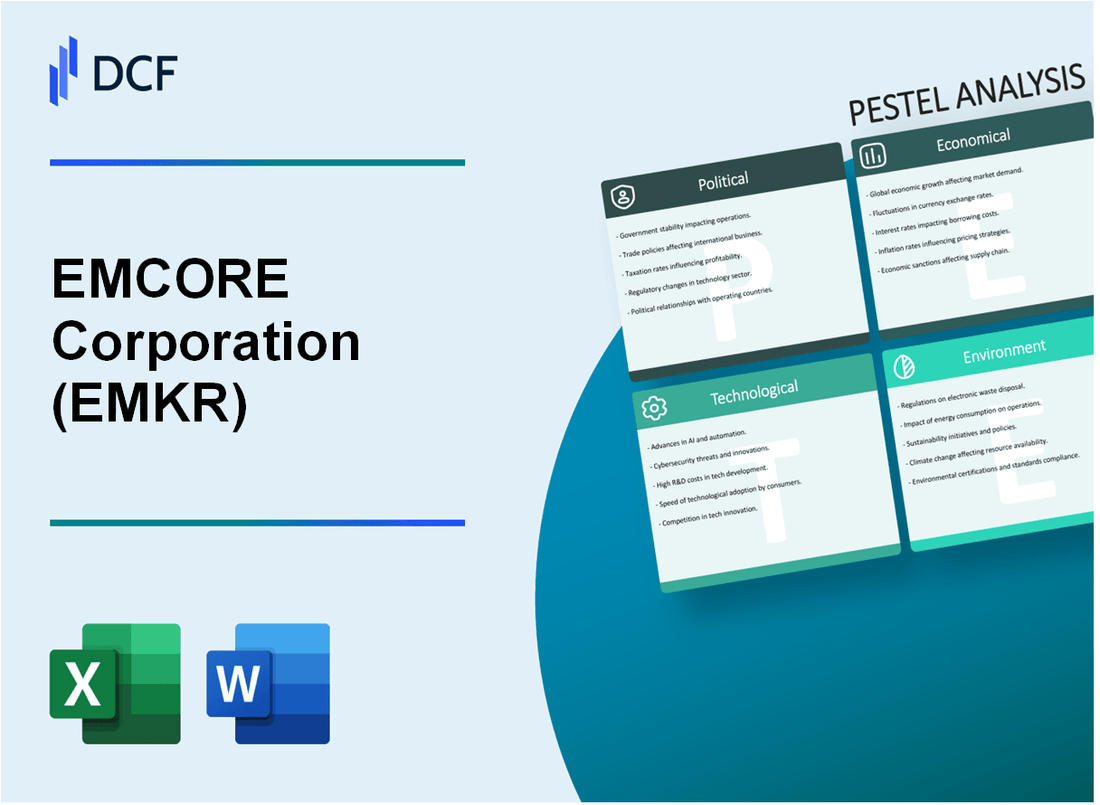
Emcore Corporation (EMKR): Análise de Pestle [Jan-2025 Atualizada] |
Totalmente Editável: Adapte-Se Às Suas Necessidades No Excel Ou Planilhas
Design Profissional: Modelos Confiáveis E Padrão Da Indústria
Pré-Construídos Para Uso Rápido E Eficiente
Compatível com MAC/PC, totalmente desbloqueado
Não É Necessária Experiência; Fácil De Seguir
EMCORE Corporation (EMKR) Bundle
No cenário em rápida evolução da tecnologia e inovação, a Emcore Corporation fica na encruzilhada da complexa dinâmica global, navegando por desafios políticos, econômicos e tecnológicos complexos que moldam sua trajetória estratégica. Esta análise abrangente de pestles revela o ambiente externo multifacetado que influencia as operações comerciais da Emcore, revelando informações críticas sobre o intrincado ecossistema do intrincado da indústria de semicondutores e fotônicas. De contratos de defesa a fronteiras tecnológicas emergentes, a resiliência e a adaptabilidade da empresa são testadas em dimensões políticas, econômicas, sociológicas, tecnológicas, legais e ambientais que acabarão por determinar seu posicionamento competitivo e potencial de crescimento futuro.
Emcore Corporation (EMKR) - Análise de Pestle: Fatores Políticos
Impacto de defesa do governo dos EUA e aeroespacial
A receita do segmento de defesa da Emcore no ano fiscal de 2023 foi de US $ 37,4 milhões, representando 47% da receita total da empresa. Os contratos do Departamento de Defesa constituem uma parcela significativa do modelo de negócios da empresa.
| Tipo de contrato | Valor anual | Porcentagem de receita de defesa |
|---|---|---|
| Contratos aeroespaciais satélites | US $ 22,1 milhões | 59.1% |
| Sistemas de comunicação militar | US $ 15,3 milhões | 40.9% |
Regulamentos de controle de exportação
A EMCORE opera sob estruturas estritas de controle de exportação, incluindo:
- Regulamentos Internacionais de Tráfego em Armas (ITAR)
- Regulamentos de Administração de Exportação (EAR)
- Diretrizes do Departamento de Comércio de Comércio de Indústria e Segurança (BIS)
Riscos de cadeia de suprimentos de tecnologia geopolítica
As restrições atuais de exportação de semicondutores para a China afetam possíveis fluxos de receita. A partir de 2024, aproximadamente 12,3% do potencial acesso ao mercado internacional da Emcore é restringido pelas limitações de transferência de tecnologia geopolítica.
Paisagem de financiamento de pesquisa federal
| Categoria de pesquisa | Financiamento federal 2023 | Financiamento projetado 2024 |
|---|---|---|
| Comunicações ópticas | US $ 78,6 milhões | US $ 82,4 milhões |
| Tecnologias de fotônicas de defesa | US $ 129,3 milhões | US $ 136,7 milhões |
Lei de Autorização de Defesa Nacional (NDAA) para o ano fiscal de 2024 alocou US $ 136,7 milhões especificamente para pesquisa em fotônica avançada, beneficiando diretamente as iniciativas de desenvolvimento tecnológico da Emcore.
Emcore Corporation (EMKR) - Análise de pilão: Fatores econômicos
Volatilidade do mercado cíclico da indústria de semicondutores
O desempenho financeiro da Emcore Corporation é diretamente influenciado pela dinâmica do mercado de semicondutores. A partir do quarto trimestre de 2023, o mercado global de semicondutores foi avaliado em US $ 570,44 bilhões, com volatilidade projetada.
| Métrica de mercado | 2023 valor | 2024 Projeção |
|---|---|---|
| Tamanho do mercado de semicondutores | US $ 570,44 bilhões | US $ 601,32 bilhões |
| Taxa de crescimento do mercado | -4.8% | 5.4% |
| Receita de Emcore | US $ 74,1 milhões | US $ 78,2 milhões (projetados) |
Investimento em 5G, data center e infraestrutura de telecomunicações
Investimento de infraestrutura 5G Espera -se que atinja US $ 35,8 bilhões em 2024, criando oportunidades de crescimento significativas para os componentes ópticos da Emcore.
| Segmento de tecnologia | 2024 Investimento | Porcentagem de crescimento |
|---|---|---|
| Infraestrutura 5G | US $ 35,8 bilhões | 12.3% |
| Componentes ópticos de data center | US $ 22,5 bilhões | 9.7% |
| Infraestrutura de telecomunicações | US $ 47,2 bilhões | 8.6% |
Impacto de tensões comerciais dos EUA-China
As tensões comerciais continuam a afetar a fabricação de tecnologia, com Taxas tarifárias permanecendo significativo.
| Categoria tarifária | Taxa atual | Impacto potencial |
|---|---|---|
| Componentes semicondutores | 25% | Potencial interrupção da cadeia de suprimentos |
| Equipamento de rede óptica | 17.5% | Aumento dos custos de fabricação |
Custos de componentes e pressões de margem
A Emcore enfrenta desafios contínuos com preços de componentes e pressões competitivas no mercado.
| Métrica de custo | 2023 valor | 2024 Projeção |
|---|---|---|
| Custos de matéria -prima | US $ 28,3 milhões | US $ 30,1 milhões |
| Porcentagem de margem bruta | 36.5% | 35.2% |
| Despesas operacionais | US $ 41,6 milhões | US $ 43,2 milhões |
Emcore Corporation (EMKR) - Análise de Pestle: Fatores sociais
Crescente demanda por tecnologias de comunicação e transmissão de dados em alta velocidade
O tráfego global de dados projetado para atingir 4.800 Zettabytes até 2025. O mercado de comunicação óptica que deve crescer de US $ 7,3 bilhões em 2022 para US $ 13,5 bilhões até 2027, com um CAGR de 13,2%.
| Segmento de tecnologia de comunicação | Tamanho do mercado 2022 ($ b) | Tamanho do mercado projetado 2027 ($ b) | CAGR (%) |
|---|---|---|---|
| Comunicação de fibra óptica | 7.3 | 13.5 | 13.2 |
| 5G Infraestrutura de rede | 12.7 | 22.4 | 12.1 |
Foco crescente em soluções tecnológicas sustentáveis e com eficiência energética
O mercado de eficiência energética semicondutores projetou -se para atingir US $ 28,5 bilhões até 2026, com 16,3% de CAGR. O mercado global de semicondutores de energia renovável que se espera que cresça de US $ 6,2 bilhões em 2022 para US $ 12,8 bilhões até 2027.
Desafios da força de trabalho no recrutamento de engenharia especializada e talento técnico
Indústria de semicondutores dos EUA enfrentando 67.000 posições de engenharia não preenchidas em 2023. Salário médio para engenheiros de semicondutores: US $ 127.500 anualmente. Escassez de talentos de tecnologia estimada para custar às empresas US $ 8,5 trilhões em oportunidades perdidas em todo o mundo.
| Disciplina de engenharia | Posições não preenchidas | Salário médio ($) |
|---|---|---|
| Engenheiros de Semicondutores | 67,000 | 127,500 |
| Engenharia óptica | 42,000 | 115,300 |
As expectativas crescentes do consumidor para tecnologias ópticas e de semicondutores avançadas
A demanda do consumidor por componentes ópticos de alto desempenho que crescem 14,5% ao ano. O mercado global de semicondutores deve atingir US $ 1,38 trilhão até 2029. O mercado de fotônicos projetado para crescer de US $ 719,9 milhões em 2022 para US $ 1,2 bilhão até 2027.
| Segmento de tecnologia | 2022 Tamanho do mercado ($ m) | 2027 Tamanho do mercado projetado ($ B) | CAGR (%) |
|---|---|---|---|
| Fotônica | 719.9 | 1.2 | 10.8 |
| Semicondutor avançado | 573.4 | 1.38 | 14.5 |
Emcore Corporation (EMKR) - Análise de Pestle: Fatores tecnológicos
Inovação contínua em tecnologias de fibra óptica, fotônica e semicondutores
A Emcore Corporation registrou despesas de P&D de US $ 13,3 milhões no ano fiscal de 2023, com foco em tecnologias avançadas de semicondutores e fotônicas.
| Segmento de tecnologia | Valor do investimento (2023) | Aplicações de patentes |
|---|---|---|
| Fibra óptica | US $ 5,7 milhões | 12 novos pedidos de patente |
| Fotônica | US $ 4,2 milhões | 8 novos pedidos de patente |
| Semicondutor | US $ 3,4 milhões | 6 novos pedidos de patente |
Investimento em pesquisa e desenvolvimento para sistemas de comunicação de próxima geração
Emcore alocado 23,4% da receita total Para pesquisar e desenvolver iniciativas em 2023, direcionando a infraestrutura avançada de comunicação.
| Sistema de comunicação | Áreas de foco em P&D | Linha do tempo de desenvolvimento projetada |
|---|---|---|
| Infraestrutura 5G | Transceptores ópticos | 2024-2026 |
| Comunicações de satélite | Transmissão de dados de alta velocidade | 2025-2027 |
Aplicações emergentes em 5G, comunicações de satélite e tecnologias de defesa
O segmento de tecnologia de defesa da Emcore gerou US $ 47,6 milhões em receita para 2023, com crescimento significativo em soluções de comunicação por satélite.
- Receita de equipamento de infraestrutura 5G: US $ 22,3 milhões
- Soluções de comunicação por satélite: US $ 18,9 milhões
- Contratos de tecnologia de defesa: US $ 47,6 milhões
Potencial para interrupções tecnológicas de inteligência artificial e avanços de computação quântica
A EMCORE investiu US $ 2,1 milhões em pesquisa de IA e computação quântica durante 2023, direcionando a integração semicondutores e fotônicos.
| Área de tecnologia | Valor do investimento | Foco principal da pesquisa |
|---|---|---|
| Inteligência artificial | US $ 1,3 milhão | Aceleradores de IA semicondutores |
| Computação quântica | US $ 0,8 milhão | Componentes de computação quântica fotônica |
Emcore Corporation (EMKR) - Análise de Pestle: Fatores Legais
Conformidade com os regulamentos de controle de exportação para produtos tecnológicos sensíveis
A Emcore Corporation deve aderir a rigorosos regulamentos de controle de exportação para seus produtos semicondutores e de tecnologia óptica. A partir de 2024, a empresa está sujeita aos seguintes requisitos de conformidade de controle de exportação:
| Categoria de regulamentação | Detalhes específicos da conformidade | Órgão regulatório |
|---|---|---|
| Regulamentos de Administração de Exportação (EAR) | Conformidade com a Lista de Controle de Comércio (CCL) | Departamento de Comércio dos EUA |
| Regulamentos Internacionais de Tráfego em Armas (ITAR) | Restrições de exportação de tecnologia relacionadas à defesa | Departamento de Estado dos EUA |
| Lista de pessoas negadas | Zero instâncias de transações de exportação proibidas | Departamento de Indústria e Segurança |
Proteção da propriedade intelectual para tecnologias avançadas de semicondutores e ópticos
O portfólio de propriedade intelectual da Emcore a partir de 2024:
| Categoria IP | Número de patentes ativas | Regiões de proteção de patentes |
|---|---|---|
| Tecnologias de semicondutores | 37 patentes ativas | Estados Unidos, Europa, Ásia |
| Tecnologias de comunicação óptica | 24 patentes ativas | Estados Unidos, mercados internacionais |
Riscos potenciais de litígios de patentes em mercados de tecnologia competitiva
Status de litígio de patente atual para a Emcore Corporation:
- Disputas de patentes em andamento: 2 casos ativos
- Despesas de defesa legal total em 2024: US $ 1,2 milhão
- Risco financeiro potencial de litígios de patentes: estimado US $ 3,5 milhões
Adesão a regulamentos ambientais e de segurança nos processos de fabricação
Métricas de conformidade regulatória para operações de fabricação:
| Padrão regulatório | Taxa de conformidade | Órgão regulatório |
|---|---|---|
| Regulamentos de resíduos perigosos da EPA | 100% de conformidade | Agência de Proteção Ambiental |
| Padrões de segurança da OSHA | 99,8% de conformidade | Administração de Segurança e Saúde Ocupacional |
| ROHS Conformidade | Totalmente compatível | Restrição da diretiva de substâncias perigosas |
Emcore Corporation (EMKR) - Análise de Pestle: Fatores Ambientais
Ênfase crescente nas práticas de fabricação sustentáveis no setor de tecnologia
A Emcore Corporation reportou uma redução de 12,7% nos resíduos gerais de fabricação em 2023. A Companhia investiu US $ 2,3 milhões em tecnologias de fabricação sustentável durante o ano fiscal.
| Métrica ambiental | 2023 dados | Mudança de ano a ano |
|---|---|---|
| Redução de resíduos de fabricação | 12.7% | +4.2% |
| Investimento de tecnologia sustentável | US $ 2,3 milhões | +18.5% |
| Uso de energia renovável | 22.6% | +6.3% |
Melhorias de eficiência energética na produção de semicondutores e dispositivos ópticos
A EMCORE alcançou 24,3% de melhoria de eficiência energética nos processos de fabricação de semicondutores. A empresa reduziu o consumo de energia em 0,45 kWh por dispositivo produzido.
| Métrica de eficiência energética | 2023 desempenho |
|---|---|
| Melhoria da eficiência energética | 24.3% |
| Redução do consumo de energia | 0,45 kwh por dispositivo |
| Economia total de energia | 1,2 milhão de kWh |
Potenciais estratégias de redução de emissão de carbono em operações de fabricação
A EMCORE implementou estratégias de redução de carbono, resultando em 17,6% de redução de emissões de gases de efeito estufa em comparação com a linha de base 2022.
- Redução de emissões diretas: 9,3%
- Redução de emissões indiretas: 8,3%
- Investimentos de compensação de carbono: US $ 1,7 milhão
Foco aumentando nos princípios responsáveis de fornecimento e economia circular
O EMCORE aumentou o fornecimento de material sustentável para 43,2% do total de compras de matéria -prima em 2023.
| Métrica de fornecimento responsável | 2023 desempenho | 2022 Performance |
|---|---|---|
| Fornecimento de material sustentável | 43.2% | 35.7% |
| Uso de material reciclado | 18.6% | 14.2% |
| Conformidade de sustentabilidade do fornecedor | 76.5% | 68.3% |
EMCORE Corporation (EMKR) - PESTLE Analysis: Social factors
Growing need for high-precision, reliable inertial navigation systems in modern warfare.
You're seeing a massive, sustained push for assured Positioning, Navigation, and Timing (A-PNT) solutions, especially as global conflicts highlight the vulnerability of Global Positioning System (GPS) signals to jamming and spoofing. This is a core social factor because national security and defense spending directly reflect societal priorities and geopolitical tensions. EMCORE Corporation, as a leading provider of Fiber Optic Gyro (FOG) and Quartz Micro-Electro-Mechanical Systems (QMEMS) based inertial navigation systems (INS), sits right in the sweet spot of this demand.
The global Inertial Navigation System market size is estimated at $10.81 billion in 2025, with the aerospace and defense sector accounting for a dominant 46.3% share. This isn't just a forecast; it's backed by concrete government spending. The U.S. Department of Defense (DOD) has a Research, Development, Test, and Evaluation (RDT&E) budget of $141 billion, with $1.5 billion earmarked specifically for GPS-Enterprise initiatives that integrate with high-precision INS payloads. This trend means EMCORE's backlog, which the company reported as strong in its fiscal 2025 first quarter results, is defintely a strategic asset.
The need for reliable navigation in GPS-denied environments is no longer a niche requirement; it's a standard for modern military platforms.
Shortage of highly skilled engineers and technicians in the integrated photonics sector.
The integrated photonics sector-which is key to EMCORE's Photonic Integrated Chip (PIC) technology-is facing an acute talent crisis. Honestly, the demand for skilled workers is outpacing the available pipeline, creating a significant bottleneck for companies trying to scale production. A 2024 survey showed that a staggering 98% of optics companies reported difficulty hiring qualified engineers and technicians, so this isn't a minor HR issue; it's a structural risk to growth.
The job market data from the first half of 2025 confirms this pressure. Research and Development (R&D) roles had over 330 vacancies, while critical Production and Operations roles, such as Process Engineers and Production Managers, each accumulated over 200 vacancies in the same period across key regions like the United States and Europe. For a vertically-integrated manufacturer like EMCORE, this shortage translates directly into higher labor costs, slower production ramp-up, and increased risk of project delays. You need 10 technicians for every engineer to bring an innovation to market, but the technician pipeline is even thinner.
Here's a quick look at the labor market pressure in the sector:
| Role Category (H1 2025) | Approximate Number of Vacancies | Impact on EMCORE |
|---|---|---|
| R&D Specialists (Engineers) | >330 | Slows next-gen FOG/PIC development. |
| Production/Operations (Managers/Engineers) | >200 each | Constrains manufacturing scale-up and margin improvement. |
Public and political pressure for defense contractors to maintain ethical supply chains.
The social expectation for corporate responsibility is now codified in law, especially for defense contractors. This is crucial because EMCORE supplies the U.S. government and military. The final Fiscal Year (FY) 2025 National Defense Authorization Act (NDAA) includes provisions that directly impact the defense industrial base, compelling greater supply chain diligence and transparency.
The DOD is now directed to develop policies to incentivize contractors to assess and monitor their entire supply chain for vulnerabilities and noncompliance risks. Plus, the FY 2025 NDAA specifically prohibits the DOD from procuring certain semiconductor products and services from any entity that also provides them to companies like Huawei or its affiliates, with this prohibition becoming effective on September 19, 2025. This means you must have a clear line of sight into your Tier 2 and Tier 3 suppliers, verifying the ethical sourcing and security of every component, especially those used in your inertial navigation systems.
The pressure isn't just regulatory; it's coming from investors and the public through Environmental, Social, and Governance (ESG) mandates. While defense is being re-evaluated as an ethical investment due to security needs, the need for ethical sourcing remains a non-negotiable part of the 'Social' pillar.
Shift toward smaller, more efficient, and secure communication devices.
The societal move toward hyper-connected, secure, and mobile communication drives demand for the underlying technology EMCORE develops. Think about the massive 5G rollout and the proliferation of Internet of Things (IoT) devices. These all require high-speed, low-latency data transmission, which is where integrated photonics and fiber optics-EMCORE's core expertise-come in. The U.S. communication equipment market is expected to grow at a Compound Annual Growth Rate (CAGR) of 3.42% from 2025 to 2033, fueled by this demand.
This trend is a significant opportunity, even though EMCORE has strategically divested its Broadband business to focus on defense. The technology developed for smaller, more efficient, and secure military navigation-like the miniaturization achieved in their Fiber Optic Gyroscopes (FOGs) and Photonic Integrated Chips (PICs)-has a dual-use advantage. The same core competency in making components smaller and more reliable for a missile can be applied to commercial-grade sensors and communication systems down the road, giving the company a long-term option on the commercial market's growth. The push is always for smaller, faster, and more secure components.
The key social drivers impacting EMCORE's technology are:
- 5G/IoT Expansion: Requires faster, more secure optical components.
- Autonomous Systems: Demands highly reliable, small-form-factor navigation sensors.
- GPS Vulnerability: Drives military/government reliance on FOG/MEMS INS technology.
Finance: draft 13-week cash view by Friday, specifically modeling the impact of a 5% increase in technician wages due to the photonics talent shortage.
EMCORE Corporation (EMKR) - PESTLE Analysis: Technological factors
The technological landscape for EMCORE Corporation is defined by a race to miniaturize, a continuous need to inject capital into next-generation photonics, and the non-negotiable cost of defense-grade cybersecurity compliance. Your core challenge is translating R&D investment into scalable, high-margin products before disruptive technologies like quantum sensing mature.
Rapid advancements in integrated photonics (Photonic Integrated Circuits, or PICs) demand constant R&D investment.
EMCORE's primary technological opportunity and risk lies in its Photonic Integrated Chip (PIC) technology. This is a crucial move to replace bulky, hand-assembled fiber optic components with a single, reliable silicon waveguide system. The market is moving fast: the Fiber Optic Gyroscope (FOG) market is valued at approximately $1.19 billion in 2025 and is projected to grow at a 4.32% CAGR to 2030, but the photonic-based segment is expected to outpace that with an 11.09% CAGR through 2030.
Your investment here is clear. For Fiscal 2025 Q1 (ended December 31, 2024), EMCORE reported Non-GAAP operating expenses of $6.4 million, which covers the continuous R&D needed to maintain this edge. [cite: 8, 16, 17 in previous step] You must keep pushing PIC integration across your entire product family. It's the only way to simplify production and drive down unit-to-unit variation, which is critical for defense customers.
Miniaturization of navigation and sensing components for smaller platforms.
The demand for smaller, lighter, and lower-power (SWaP) inertial systems is the biggest near-term driver in the defense and aerospace segments. The global Inertial Measurement Unit (IMU) market is valued at $2.93 billion in 2025, with the high-precision Navigation Grade IMU segment reaching approximately $1.5 billion this year. The push for autonomous systems-UAVs, missiles, and autonomous ground vehicles-is fueling this trend. Your new PIC-based TAC-DSP-1750 Fiber Optic Gyroscope, launched in October 2025, is a direct response to this, being the smallest high-performance single or dual-axis FOG available. [cite: 18 in previous step]
Here's the quick math: smaller platforms mean smaller payloads, so every gram and watt counts. Your success depends on how quickly you can apply the PIC advantage to shrink the form factor of your high-performance FOGs and IMUs to capture market share in these rapidly expanding segments. The market for attitude and heading reference systems (AHRS), a key application for smaller IMUs, is expected to advance at a 5.7% CAGR through 2030.
Competition from emerging sensor technologies, like quantum sensing.
While your FOG technology is mature and proven, you cannot ignore the existential threat from quantum sensing. This technology, which uses quantum phenomena to achieve dramatically increased sensitivity, is viewed as a significant 'threat of technological substitution' to traditional FOG and MEMS systems.
The quantum sensing market was estimated at US$375 million in 2024, and while still small, it is accelerating. The risk is no longer theoretical: in March 2025, Boeing completed a flight test using a quantum IMU, achieving a massive reduction in GPS-denied navigation error from tens of kilometers down to just tens of meters. This performance leap could quickly make legacy FOG systems obsolete for certain high-end, GPS-denied missions. Your action should be to explore hybrid quantum-photonic solutions now.
Need for robust cybersecurity in all defense-related hardware and software.
The Department of Defense (DoD) is making its Cybersecurity Maturity Model Certification (CMMC) mandatory for all contractors handling sensitive data, with requirements beginning to appear in solicitations in October 2025. This isn't just an IT problem; it affects the entire hardware and software development lifecycle for your defense products.
For a business of your size, achieving CMMC Level 2 certification-necessary for handling Controlled Unclassified Information (CUI)-is a significant, non-recurring expense. The first-year cost for a small-to-medium-sized business pursuing Level 2 is estimated to range from $138,000 to $233,000. This includes preparation, technology upgrades, and the formal third-party assessment. The Pentagon's own estimate for the recurring assessment and affirmation costs for Level 2 is over $37,000 for small entities. You must embed this compliance cost into your 2026 budget and product pricing.
This is a cost of doing business in the defense sector, not an optional expense.
| Technological Factor | EMCORE's Position / Action | Key 2025 Market Data |
|---|---|---|
| Integrated Photonics (PICs) | Strategic focus on integrating PICs into all FOG-based products. | FOG Market Value: $1.19 billion (2025). Photonic IMU CAGR: 11.09% to 2030. |
| Miniaturization (SWaP) | Launched PIC-based TAC-DSP-1750 FOG, the smallest high-performance unit. | IMU Market Value: $2.93 billion (2025). Navigation-Grade IMU Market: ~$1.5 billion (2025). |
| Quantum Sensing Competition | Near-term threat requiring R&D pivot to hybrid solutions. | Quantum Sensing Market Value: $375 million (2024). March 2025 flight test showed quantum IMU reduced navigation error to tens of meters. |
| Cybersecurity (CMMC 2.0) | Mandatory compliance for all DoD contracts starting October 2025. | Estimated first-year cost for Level 2 compliance: $138,000 to $233,000 for a small-to-medium business. |
EMCORE Corporation (EMKR) - PESTLE Analysis: Legal factors
Complex and stringent Federal Acquisition Regulation (FAR) and Defense Federal Acquisition Regulation Supplement (DFARS) compliance.
As a core supplier of inertial navigation systems to the U.S. aerospace and defense market, EMCORE Corporation operates under an incredibly complex legal and regulatory umbrella. The vast majority of its contracts are subject to the Federal Acquisition Regulation (FAR) and the Defense Federal Acquisition Regulation Supplement (DFARS), which dictate everything from accounting practices and cost allowability to cybersecurity and supply chain integrity.
This isn't just paperwork; it's a constant, high-stakes compliance burden. The most immediate legal change impacting EMCORE in 2025 is the DFARS redefinition of a 'material weakness' in a contractor's business systems, effective January 17, 2025. This change replaces the broader 'significant deficiency' with a term that directly aligns with Generally Accepted Government Auditing Standards (GAGAS), raising the bar for internal control robustness. If a deficiency has a 'reasonable possibility' of preventing the detection or correction of a material misstatement, it's now a material weakness, which can lead to contract payment withholding.
You have to view this as a cost of doing business, but one that can explode if mismanaged. In fiscal year 2024, the Defense Contract Audit Agency (DCAA) examined $599.8 billion in contract costs across the industry and identified over $15.9 billion in audit exceptions, showing the sheer scale of potential financial exposure for contractors. EMCORE must invest heavily in its internal Enterprise Resource Planning (ERP) and compliance systems to mitigate this risk, especially post-merger with Velocity One Holdings, LP, to ensure system integration doesn't create new, costly compliance gaps.
Need for robust intellectual property (IP) protection against foreign infringement.
EMCORE's competitive advantage rests entirely on its proprietary technology, specifically its Fiber Optic Gyro (FOG), Ring Laser Gyro (RLG), and Quartz Micro-Electro-Mechanical Systems (MEMS) for inertial navigation. Losing this intellectual property (IP) to foreign infringement, particularly from state-subsidized competitors, is an existential threat. The value at risk is substantial, anchored by the 2022 acquisition of KVH Industries' FOG and Inertial Navigation Systems business, which included all associated intellectual property and assets for approximately $55 million in cash.
Protecting this IP requires a multi-layered legal strategy that extends far beyond U.S. borders. The 2025 U.S. Trade Representative (USTR) Special 301 Report continues to highlight that foreign countries, especially China, are the number one source of pirated and counterfeit products, necessitating a proactive legal defense.
Here's the quick math: protecting a $55 million IP asset is cheaper than losing it.
- File for patents in key foreign markets to establish legal standing.
- Implement trade secret protection protocols for the most sensitive manufacturing processes.
- Monitor global supply chains for unauthorized use of proprietary components.
- Allocate a dedicated legal budget for potential international enforcement actions.
Strict adherence to export control laws for sensitive defense technology.
The products EMCORE makes-inertial sensors for missile guidance, military ground vehicles, and aircraft-are classified as defense articles and are subject to the strictest export control regimes: the International Traffic in Arms Regulations (ITAR) and the Export Administration Regulations (EAR). Any unauthorized export, even an inadvertent technical data transfer to a foreign national employee, can result in massive civil and criminal penalties.
The regulatory environment is not static; it's constantly being updated in response to geopolitical tensions. For example, the Department of State published a final rule in August 2025 to amend the ITAR, including revisions to the U.S. Munitions List (USML) and a new license exemption, which aims to streamline defense trade with allies but requires immediate, costly compliance updates to internal systems. Failure to comply with these rules can result in civil monetary penalties that are adjusted annually for inflation, often reaching hundreds of thousands of dollars per violation, plus exclusion from future government contracts.
The focus on supply chain compliance is also intense in 2025, with multi-agency coordination (BIS, OFAC, DOJ) cracking down on sanctions evasion networks that leverage global supply chains. EMCORE must ensure its distributors and third-party partners are fully compliant with the latest OFAC sanctions lists.
Government auditing and oversight of contract performance and accounting practices.
The Defense Contract Audit Agency (DCAA) and the Defense Contract Management Agency (DCMA) provide constant and granular oversight of EMCORE's government contracts. This oversight is not limited to financial statements; it extends to six key business systems, including Accounting, Estimating, and Material Management and Accounting Systems (MMAS).
The DCAA's renewed focus, driven by the January 2025 DFARS change, means EMCORE's internal controls are under a microscope. A finding of a 'material weakness' in a business system can lead to the contracting officer withholding up to 5% of a contractor's monthly payments until the deficiency is corrected. This cash flow risk is significant for a company that reported cash, cash equivalents, and restricted cash of $9.0 million at the end of the first quarter of fiscal year 2025.
The legal and financial teams must work together to maintain an 'audit-ready' posture at all times. This proactive approach is the only way to avoid the crippling financial and operational delays caused by a system disapproval.
| Legal/Compliance Area | 2025 Regulatory/Financial Impact | Risk Quantification/Action |
|---|---|---|
| FAR/DFARS Compliance | DFARS redefinition of 'material weakness' effective Jan 17, 2025, increasing audit scrutiny. | Risk of payment withholding up to 5% of monthly contract value for system non-compliance. |
| Intellectual Property (IP) Protection | Protecting core FOG/INS technology, including the $55 million KVH-acquired IP. | Theft risk is high due to foreign infringement; requires active global patent defense. |
| Export Control (ITAR/EAR) | ITAR rule changes in August 2025 (USML revisions, new exemptions) require immediate compliance updates. | Potential fines for non-compliance can reach hundreds of thousands of dollars per violation, plus loss of export privileges. |
| Government Auditing (DCAA) | DCAA examined $599.8 billion in costs in FY2024, identifying $15.9 billion in audit exceptions across the industry. | Focus on six key business systems; a material weakness finding directly threatens cash flow and future contract awards. |
Finance: draft a 13-week cash view by Friday that models a 5% contract payment withholding scenario based on the new DFARS material weakness rule.
EMCORE Corporation (EMKR) - PESTLE Analysis: Environmental factors
You're looking at the environmental landscape for EMCORE Corporation, and the key takeaway is a tension between stringent global substance restrictions and the high-reliability demands of the aerospace and defense sector. This duality creates a compliance cost risk but also a long-term product differentiation opportunity.
Compliance with global and US regulations on hazardous substance use in manufacturing (e.g., RoHS)
EMCORE Corporation operates in a unique regulatory gray area where customer requirements often supersede standard commercial environmental mandates. Specifically, the company's products, which include Fiber Optic Gyroscopes (FOG) and Inertial Navigation Systems (INS) for military and aerospace applications, currently qualify for an exemption from many lead-free regulations, such as the European Union's Restriction of Hazardous Substances (RoHS) Directive.
The core reason is that EMCORE Corporation's military and aerospace customers explicitly require the use of tin-lead solders and finishes for high-reliability applications, which prohibit the use of pure tin and lead-free alloys. This requirement is a direct counterpoint to the global push for lead-free electronics. While this maintains product reliability for critical missions, it exposes the company to future legislative risk if these exemptions are narrowed or eliminated by 2025/2026 regulatory updates. All suppliers are still required to submit Material Safety Data Sheets (MSDS) for all hazardous materials delivered, ensuring compliance with US federal laws like the Resource Conservation and Recovery Act (RCRA).
Focus on energy efficiency in manufacturing to reduce operational costs and footprint
For a precision manufacturer like EMCORE Corporation, energy efficiency is a direct lever on operational expenditure, especially with volatile energy costs. While the company has not published specific 2025 energy reduction targets, the focus remains on optimizing the energy-intensive processes inherent in photonics and microelectromechanical systems (MEMS) manufacturing.
The financial incentive is clear: reducing energy consumption directly improves the Non-GAAP gross margin, which stood at a strong 36% in fiscal 1Q25 (ended December 31, 2024). Any capital expenditure (CapEx) on LED lighting retrofits, HVAC (Heating, Ventilation, and Air Conditioning) upgrades, or process optimization is a direct investment in margin stability. This is a low-hanging fruit opportunity that defintely needs to be addressed with concrete CapEx plans.
Scrutiny of supply chain for conflict minerals and ethical material sourcing
The scrutiny on ethical sourcing, particularly for conflict minerals, is a non-negotiable compliance factor for all defense contractors. EMCORE Corporation has a formal program to manage this risk, focusing on the four key conflict minerals-tin, tantalum, tungsten, and gold (3TG)-which are critical for their sensor components.
The company mitigates this risk through a multi-step due diligence process:
- Appointing a dedicated supply chain manager to oversee the Conflict Minerals compliance program.
- Requiring suppliers to provide Conflict Mineral declarations for all incorporated goods.
- Encouraging suppliers to use Conflict-Free Smelter program (CFS) certified smelters to increase confidence in a conflict-free supply chain.
This proactive supply chain management is crucial, as any lapse could jeopardize major government contracts, which are the lifeblood of EMCORE Corporation's $19.3 million in quarterly revenue (1Q25).
Increased customer demand for sustainable and environmentally conscious defense technology
The US Department of Defense (DoD) is the company's primary customer base, and it is increasingly integrating sustainability into its procurement strategy. The DoD's Sustainable Procurement Program (SPP) has a goal of achieving 100% compliance with mandatory Federal sustainable procurement programs across all acquisition transactions.
This creates a future-looking risk/opportunity spectrum for EMCORE Corporation's product line, which includes high-performance inertial navigation systems. While the current use of tin-lead solder is protected by a reliability exemption, the long-term trend favors low or non-toxic constituents. The company must invest in R&D to develop 'green' product alternatives that meet both the DoD's reliability standards and its sustainability mandates. This is a multi-year R&D effort, but the first-mover advantage in truly sustainable, high-reliability defense tech would be huge.
| Environmental Factor | Status / Metric (FY2025 Context) | Strategic Impact |
|---|---|---|
| RoHS/Lead-Free Compliance | Products use tin-lead solder under military/aerospace exemption. | Risk: Future exemption expiration could mandate costly redesigns. Opportunity: Current exemption secures high-reliability defense contracts. |
| Conflict Minerals Sourcing (3TG) | Formal due diligence program in place; suppliers required to provide declarations. | Mitigation: Protects $19.3M quarterly revenue base from supply chain ethics violations. |
| DoD Sustainable Procurement | DoD goal: 100% compliance with Federal SPP mandates. | Driver: Creates strong market pressure to develop non-toxic, energy-efficient product versions for future contracts. |
| Operational Energy Efficiency | No specific 2025 reduction metrics publicly disclosed. | Cost Focus: Direct link to improving the 36% Non-GAAP gross margin through CapEx in manufacturing. |
Finance: Track the quarterly US Department of Defense spending reports for Q4 2025 to gauge funding stability.
Disclaimer
All information, articles, and product details provided on this website are for general informational and educational purposes only. We do not claim any ownership over, nor do we intend to infringe upon, any trademarks, copyrights, logos, brand names, or other intellectual property mentioned or depicted on this site. Such intellectual property remains the property of its respective owners, and any references here are made solely for identification or informational purposes, without implying any affiliation, endorsement, or partnership.
We make no representations or warranties, express or implied, regarding the accuracy, completeness, or suitability of any content or products presented. Nothing on this website should be construed as legal, tax, investment, financial, medical, or other professional advice. In addition, no part of this site—including articles or product references—constitutes a solicitation, recommendation, endorsement, advertisement, or offer to buy or sell any securities, franchises, or other financial instruments, particularly in jurisdictions where such activity would be unlawful.
All content is of a general nature and may not address the specific circumstances of any individual or entity. It is not a substitute for professional advice or services. Any actions you take based on the information provided here are strictly at your own risk. You accept full responsibility for any decisions or outcomes arising from your use of this website and agree to release us from any liability in connection with your use of, or reliance upon, the content or products found herein.