

|
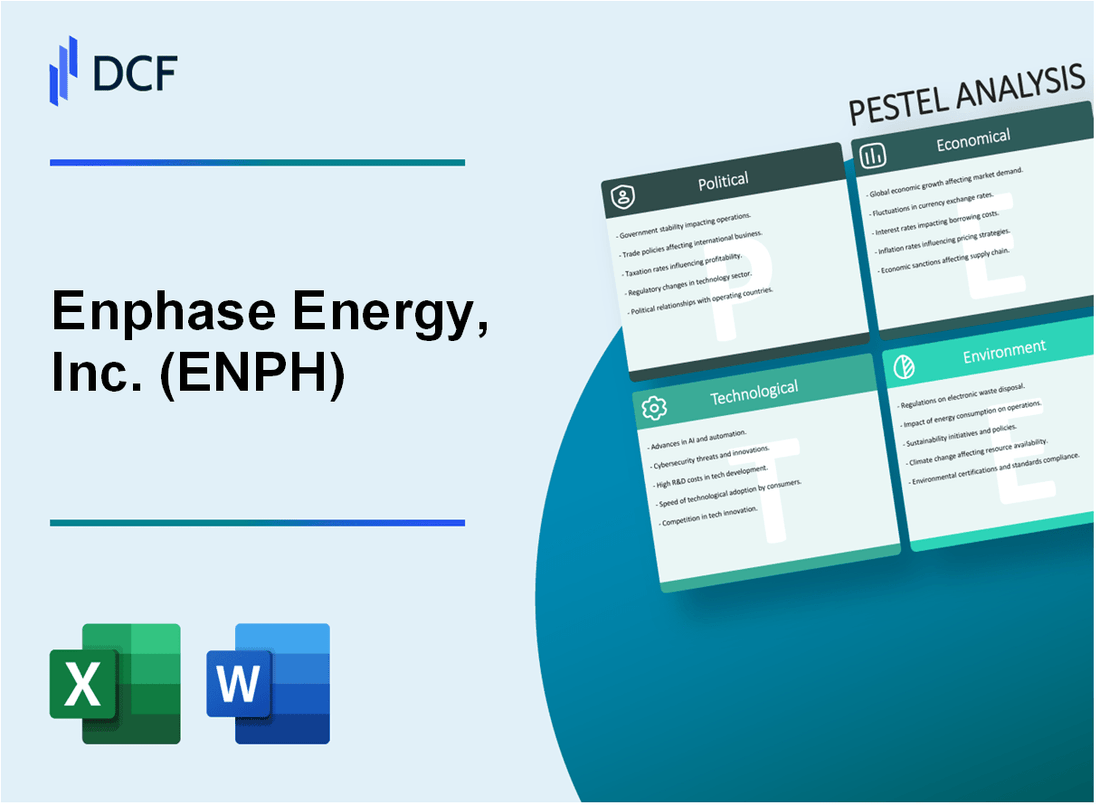
Enphase Energy, Inc. (ENPH): Analyse Pestle [Jan-2025 MISE À JOUR] |
Entièrement Modifiable: Adapté À Vos Besoins Dans Excel Ou Sheets
Conception Professionnelle: Modèles Fiables Et Conformes Aux Normes Du Secteur
Pré-Construits Pour Une Utilisation Rapide Et Efficace
Compatible MAC/PC, entièrement débloqué
Aucune Expertise N'Est Requise; Facile À Suivre
Enphase Energy, Inc. (ENPH) Bundle
Dans le paysage en évolution rapide des énergies renouvelables, Enphase Energy, Inc. (ENPH) est à l'avant-garde de l'innovation technologique, naviguant dans un réseau complexe de défis politiques, économiques, sociologiques, technologiques, juridiques et environnementaux. Cette analyse complète du pilon dévoile les facteurs complexes qui façonnent la trajectoire stratégique de l'entreprise, offrant une exploration nuancée de la façon dont l'Enphase ne s'adapte pas seulement, mais transformant activement l'écosystème d'énergie solaire. Des incitations fiscales fédérales à la technologie de microinvertisseur de pointe, le parcours de l'entreprise reflète une vision audacieuse des solutions énergétiques durables qui promet de redéfinir notre relation avec la production d'électricité et la consommation.
Enphase Energy, Inc. (ENPH) - Analyse du pilon: facteurs politiques
Extension fédérale de crédit à la taxe sur l'investissement solaire (ITC)
La loi sur la réduction de l'inflation de 2022 a prolongé le crédit d'impôt sur l'investissement solaire avec les détails suivants:
| Année | Pourcentage de crédit d'impôt |
|---|---|
| 2022-2032 | 30% de crédit d'impôt |
| 2033 | 26% de crédit d'impôt |
| 2034 | 22% de crédit d'impôt |
Politiques d'énergie propre en Californie
Les politiques solaires de la Californie comprennent:
- MANDAT des installations solaires sur les nouveaux bâtiments résidentiels depuis 2020
- Politique de mesure nette offrant un crédit à la génération solaire excédentaire
- L'objectif de la Californie de 100% d'électricité propre d'ici 2045
Politiques commerciales internationales
Détails d'importation / d'exportation des composants solaires:
| Politique | Impact | Taux tarifaire |
|---|---|---|
| Tarifs solaires américains | Restrictions d'importation sur les composants solaires chinois | 14.75% - 54.3% |
| Tarifs de la section 301 | Tâches supplémentaires sur l'équipement solaire chinois | 25% |
Incitations aux énergies renouvelables du gouvernement
Incitations fédérales et étatiques actuelles pour les ressources énergétiques distribuées:
- REIP (programme d'incitation aux énergies renouvelables) offrant 0,75 $ par Watt pour les installations solaires
- SGIP (programme d'incitation à l'auto-génération) offrant jusqu'à 1 000 $ par kWh pour le stockage d'énergie
- Programmes de subventions fédérales soutenant les infrastructures renouvelables totalisant 369 milliards de dollars d'investissements énergétiques propres
Enphase Energy, Inc. (ENPH) - Analyse du pilon: facteurs économiques
La hausse des coûts d'électricité stimulant l'adoption de l'énergie solaire résidentielle et commerciale
Selon la U.S. Energy Information Administration, les taux moyens d'électricité résidentielle ont augmenté à 14,96 cents par kilowatt-heure en 2023, soit une augmentation de 2,2% d'une année à l'autre. Les taux d'adoption solaire ont augmenté en conséquence, les installations solaires résidentielles augmentant de 30% en 2023.
| Année | Taux d'électricité (cents / kWh) | Croissance des installations solaires résidentielles |
|---|---|---|
| 2022 | 14.63 | 22% |
| 2023 | 14.96 | 30% |
Chaînes d'approvisionnement en semi-conducteurs volatiles affectant
Les coûts des semi-conducteurs pour la production de micro-invertiges ont considérablement fluctué, les prix des matières premières augmentant de 15 à 22% en 2023. Enphase Energy a été signalé 605,7 millions de dollars de revenus de micro-inservateurs Pour le troisième trimestre 2023, malgré les défis de la chaîne d'approvisionnement.
| Composant | Augmentation des prix 2022-2023 |
|---|---|
| Chips semi-conducteurs | 15-22% |
| Cuivre | 18% |
| Affinages en silicium | 20% |
Investissement croissant dans les infrastructures d'énergie renouvelable
Les investissements mondiaux sur les énergies renouvelables ont atteint 495 milliards de dollars en 2023, les infrastructures solaires représentant 43% du total des investissements. Le ministère américain de l'Énergie a déclaré 169 milliards de dollars en investissements fédéraux sur l'énergie propre pour 2023-2024.
| Catégorie d'investissement | Investissement total (2023) |
|---|---|
| Énergie renouvelable mondiale | 495 milliards de dollars |
| Infrastructure solaire | 212,85 milliards de dollars |
| Énergie propre fédérale américaine | 169 milliards de dollars |
Impact potentiel de ralentissement économique sur les investissements technologiques solaires
L'incertitude économique a modestement eu un impact sur les investissements solaires. Enphase Energy a déclaré un chiffre d'affaires du troisième trimestre 2023 de 726,8 millions de dollars, représentant une croissance de 22% en glissement annuel malgré les défis économiques.
| Métrique financière | Q3 2022 | Q3 2023 |
|---|---|---|
| Revenu | 515,6 millions de dollars | 726,8 millions de dollars |
| Croissance d'une année à l'autre | N / A | 22% |
Enphase Energy, Inc. (ENPH) - Analyse du pilon: facteurs sociaux
Augmentation de la sensibilisation aux consommateurs sur le changement climatique et les solutions énergétiques durables
Selon le programme Yale sur la communication sur le changement climatique, 72% des Américains pensent que le changement climatique se produit en 2023.
| Année | Adoption d'énergie solaire (%) | Conscience du climat des consommateurs (%) |
|---|---|---|
| 2020 | 3.0 | 65 |
| 2021 | 3.9 | 68 |
| 2022 | 4.4 | 72 |
Tendance croissante de l'indépendance de l'énergie résidentielle et de la résilience du réseau
Les installations solaires résidentielles américaines ont atteint 4,6 GW au troisième trimestre 2023, ce qui représente une croissance de 3% sur toute l'année. Les déploiements du système de stockage d'énergie ont augmenté de 360% de 2019 à 2022.
| Année | Installations solaires résidentielles (GW) | Croissance du stockage d'énergie (%) |
|---|---|---|
| 2020 | 3.8 | 180 |
| 2021 | 4.3 | 270 |
| 2022 | 4.5 | 360 |
La préférence du millénaire et de la génération Z pour la technologie soucieuse de l'environnement
75% des milléniaux et 82% des consommateurs de la génération Z considèrent la durabilité lors de l'achat de technologies. L'intention d'achat de la technologie solaire parmi ces générations a augmenté de 45% entre 2020 et 2023.
| Génération | Considération de la durabilité (%) | Intention d'achat de la technologie solaire (%) |
|---|---|---|
| Milléniaux | 75 | 38 |
| Gen Z | 82 | 45 |
Vers la production d'énergie décentralisée et l'intégration de la maison intelligente
Smart Home Energy Management Market prévoyait de atteindre 4,3 milliards de dollars d'ici 2025. Les ressources énergétiques distribuées devraient représenter 20% de la production totale d'électricité américaine d'ici 2030.
| Année | Marché de l'énergie de la maison intelligente ($ b) | Ressources énergétiques distribuées (%) |
|---|---|---|
| 2022 | 2.1 | 12 |
| 2024 | 3.2 | 16 |
| 2025 | 4.3 | 20 |
Enphase Energy, Inc. (ENPH) - Analyse du pilon: facteurs technologiques
Innovation continue en micro-invertificateur et technologie de stockage d'énergie
L'énergie enphase s'est développée Microinverteurs IQ8 Avec 96,5% d'efficacité de pointe et des capacités intégrées de stockage d'énergie. La société a investi 89,7 millions de dollars dans la R&D en 2022, ce qui représente 8,2% des revenus totaux.
| Modèle de micro-tinter | Efficacité maximale | Plage de sortie |
|---|---|---|
| IQ8-AC-NA | 96.5% | 330-480W |
| Iq8h-ac-n | 96.7% | 410-540W |
Plates-formes logicielles avancées pour la surveillance et la gestion du système solaire
La plate-forme logicielle Enphase illuminten gère plus de 2,1 millions d'installations solaires résidentielles et commerciales dans le monde, traitant 1,8 pétaoctets de données énergétiques mensuellement.
| Métrique de la plate-forme | 2023 données |
|---|---|
| Installations gérées totales | 2,1 millions |
| Traitement des données mensuelles | 1,8 pétaoctets |
Intégration de l'intelligence artificielle dans l'optimisation de l'énergie et la maintenance prédictive
Les algorithmes AI d'Enphase atteignent 99,2% de précision de maintenance prédictive, réduisant le temps d'arrêt du système de 37% par rapport aux méthodes de surveillance traditionnelles.
Tendances émergentes du stockage des batteries et des systèmes d'énergie renouvelable-interactive au réseau
Le système de stockage de l'enphase de charge fournit 3,36 kWh par unité, avec des configurations modulaires jusqu'à 42 kWh. L'entreprise a déclaré 1,2 milliard de dollars de revenus de stockage d'énergie pour 2022, ce qui représente 28% de croissance d'une année sur l'autre.
| Spécification du système de batterie | Détails techniques |
|---|---|
| Capacité de stockage par unité | 3,36 kWh |
| Capacité configurable maximale | 42 kWh |
| 2022 Revenus de stockage d'énergie | 1,2 milliard de dollars |
Enphase Energy, Inc. (ENPH) - Analyse du pilon: facteurs juridiques
Conformité à l'évolution des réglementations et des normes des énergies renouvelables
L'énergie enphase doit adhérer à plusieurs cadres réglementaires dans différentes juridictions:
| Corps réglementaire | Exigences de conformité | Règlements spécifiques |
|---|---|---|
| Commission fédérale de la réglementation de l'énergie (FERC) | Normes d'interconnexion de la grille | Ordre 2222 - Participation des ressources énergétiques distribuées |
| California Energy Commission | Normes de performance de l'équipement solaire | Titre 24 Normes d'efficacité énergétique de construction |
| Commission électrotechnique internationale (CEI) | Certifications mondiales de sécurité des produits | IEC 62109-1 et IEC 62109-2 Normes de sécurité |
Protection de la propriété intellectuelle pour les technologies de microinverter propriétaires
État du portefeuille de brevets:
| Catégorie de brevet | Nombre de brevets actifs | Couverture géographique |
|---|---|---|
| Technologie de micro-inservateur | 87 | États-Unis, Europe, Chine |
| Systèmes de gestion de l'énergie | 42 | Amérique du Nord, Asie-Pacifique |
Exigences de rapport de certification et de durabilité environnementale
Conformité aux normes de rapport environnemental:
- Normes Global Reporting Initiative (GRI): pleine conformité
- Conseil de normes de comptabilité de durabilité (SASB): reportage complet
- Projet de divulgation de carbone (CDP): soumission annuelle
Considérations de responsabilité et de garantie potentielles pour l'équipement d'énergie solaire
| Type de garantie | Durée | Portée de la couverture |
|---|---|---|
| Garantie du produit de micro-enceinte | 25 ans | Défauts de fabrication, dégradation des performances |
| Garantie de performance du système | 10 ans | Métriques de performance de la production d'énergie |
Dépenses de conformité juridique: 4,2 millions de dollars alloués à la conformité réglementaire et à la gestion des risques juridiques au cours de l'exercice 2024.
Enphase Energy, Inc. (ENPH) - Analyse du pilon: facteurs environnementaux
Réduire l'empreinte carbone grâce à la technologie des énergies renouvelables
Les micro-invertisseurs d'énergie enphase réduisent les émissions de carbone de 50 à 70% par rapport aux systèmes d'énergie solaire traditionnels. Le rapport sur le développement durable de la société 2023 indique un décalage cumulatif de carbone de 12,4 millions de tonnes métriques grâce à leurs déploiements de technologie solaire.
| Métrique de réduction du carbone | 2023 données |
|---|---|
| Décalage total de carbone | 12,4 millions de tonnes métriques |
| Pourcentage de réduction du carbone | 50-70% |
| Installations du système solaire | 2,5 millions dans le monde |
Soutenir la transition mondiale vers des solutions énergétiques propres et durables
Enphase Energy a déployé des technologies solaires dans 135 pays, 2023 contributions aux énergies renouvelables atteignant 8,2 gigawatts de capacité de production d'énergie propre.
| Métriques mondiales de durabilité | 2023 données |
|---|---|
| Pays avec déploiements | 135 |
| Production d'énergie propre | 8.2 Gigawatts |
| Installations solaires résidentielles | 1,8 million |
Minimiser les déchets électroniques grâce à la conception de produits durable et recyclable
Les microinvertisseurs enphase ont une durée de vie du produit de 25 ans, avec 92% des composants du produit conçus pour la recyclabilité. L'initiative de réduction des déchets de la société en 2023 a empêché 3 600 tonnes métriques de déchets électroniques d'entrer dans les décharges.
| Métriques de réduction des déchets | 2023 données |
|---|---|
| Durée de vie du produit | 25 ans |
| Composants de produits recyclables | 92% |
| Les déchets électroniques empêchés | 3 600 tonnes métriques |
Contribuant à la réduction des émissions de gaz à effet de serre grâce à la technologie solaire
Les solutions de technologie solaire d'Enphase Energy ont réduit les émissions de gaz à effet de serre de 6,7 millions de tonnes métriques en 2023, ce qui équivaut à la suppression de 1,4 million de véhicules de passagers des routes.
| Métriques de réduction des gaz à effet de serre | 2023 données |
|---|---|
| Les émissions totales de GES ont été réduites | 6,7 millions de tonnes métriques |
| Élimination des véhicules équivalents | 1,4 million |
| Offset de CO2 par système solaire | 4,8 tonnes métriques / an |
Enphase Energy, Inc. (ENPH) - PESTLE Analysis: Social factors
The social environment in 2025 is a powerful tailwind for Enphase Energy, Inc., driven by a fundamental shift in homeowner priorities from simple cost savings to outright energy independence. This trend is fueled by utility rate volatility and policy changes that fundamentally reset the economics of going solar, making battery storage-Enphase's core strength-an essential component, not an optional extra. This is a huge, defintely positive structural shift for the company.
Rising utility electricity costs drive consumer demand for energy independence and solar adoption.
Homeowners are increasingly adopting solar to hedge against unpredictable and rising utility costs. Data from the first half of 2025 shows that electricity rates continue to outpace general inflation across the US. For the summer period of 2025, home electricity bills are projected to rise by an average of more than 6% compared to 2024, reaching an average of $784 for the season.
In certain regions, the spike is far more severe. For example, the District of Columbia is projected to see a rise of 22.10% in annual household electric costs, and Indiana a rise of 16.30%, based on 2025 projections. This volatility pushes the value proposition of solar and storage from a luxury investment to a necessary financial tool for budget stability.
Market shift toward solar-plus-storage systems due to reduced net metering compensation (like California's NEM 3.0).
The most significant social and regulatory catalyst is the shift away from traditional Net Energy Metering (NEM) policies, most notably California's NEM 3.0, which took effect in April 2023. This policy slashed the compensation for excess solar energy exported to the grid by approximately 75%, from around 30 cents per kilowatt-hour (kWh) to an average of just 8 cents per kWh.
Here's the quick math: when exporting power back to the grid no longer pays the bills, storing that power for evening use becomes the only way to maximize the system's value. This change has made solar-plus-storage systems the new standard, directly benefiting Enphase Energy, Inc.'s core IQ Battery product line.
| California Solar Market Impact (NEM 3.0) | Pre-NEM 3.0 (Before April 2023) | Post-NEM 3.0 (By April 2024) |
|---|---|---|
| Export Compensation Value (Average) | ~30 cents per kWh | ~8 cents per kWh (75% reduction) |
| Residential Battery Attachment Rate | ~11% | Over 50% (Some installers report 90%) |
| Solar-Only Payback Period | ~4.6 years | 8-10 years |
| Solar-Plus-Storage Payback Period | N/A (Less common) | 7-8 years (Now the optimal choice) |
Strong customer satisfaction with a global Net Promoter Score (NPS) up to 79%.
In a sector where installation quality and post-sale support are critical to brand reputation, Enphase Energy, Inc. maintains a strong competitive edge through customer satisfaction. The company's global customer service Net Promoter Score (NPS)-a key metric for customer loyalty-was reported at 79% in the second quarter of 2025, an increase from 77% in the first quarter of 2025. This high score is a significant social asset, as word-of-mouth referrals and installer confidence are major drivers of residential solar sales.
This level of satisfaction is a crucial differentiator in a market with increasing installer bankruptcies and customer uncertainty, especially in the US and Europe.
- Q2 2025 Global Customer Service NPS: 79%
- Q1 2025 Global Customer Service NPS: 77%
- Average call wait time decreased to 1.8 minutes in Q2 2025, supporting the NPS improvement.
High demand for skilled labor; the solar installer profession is projected to grow 42% through 2034.
The overall growth of the solar industry creates a significant social challenge: a tight labor market for skilled installers. The US Bureau of Labor Statistics (BLS) projects employment of solar photovoltaic installers to grow by a massive 42% from 2024 to 2034, which is much faster than the average for all occupations. This rapid demand growth means competition for skilled labor is intense.
For Enphase Energy, Inc., which relies entirely on its network of certified installers, this labor shortage presents a near-term risk. The median annual wage for solar photovoltaic installers was $51,860 in May 2024, a figure that is expected to rise further due to the high demand and labor shortages across the sector. The company must invest in its installer network through training, certification, and incentives to ensure its products are installed correctly and efficiently, maintaining that high NPS.
Enphase Energy, Inc. (ENPH) - PESTLE Analysis: Technological factors
IQ Batteries Gen 4: Higher Density and Smaller Footprint
The launch of the fourth-generation IQ Battery system, specifically the IQ Battery 10C, is a defintely significant technological leap for Enphase Energy. You're always looking for ways to maximize energy storage in limited residential space, and this new design directly addresses that constraint. The IQ Battery 10C delivers 10 kWh of usable energy and 7.08 kW of continuous power.
This new generation uses safer, long-lasting Lithium Iron Phosphate (LFP) chemistry and achieves approximately 34% greater energy density compared to its predecessor. Here's the quick math: that density improvement means the new unit requires 62% less wall space for the same energy storage capacity. This is a huge selling point for homeowners, especially in dense US housing markets. The product is expected to begin shipping in the third quarter of 2025, which will immediately bolster the company's position in the home energy storage market.
| IQ Battery 10C (Gen 4) Metric | Value (2025) | Benefit over Predecessor |
|---|---|---|
| Usable Energy Capacity | 10 kWh | Higher whole-home backup capability |
| Continuous Power Output | 7.08 kW | Supports heavier loads like HVAC systems |
| Energy Density Increase | 34% greater | More power in a smaller package |
| Wall Space Reduction | 62% less | Easier, more flexible residential installation |
| Battery Chemistry | Lithium Iron Phosphate (LFP) | Enhanced safety and longevity |
Upcoming IQ9 Microinverter with Gallium Nitride (GaN)
The shift to Gallium Nitride (GaN) for the upcoming IQ9 microinverter series is a key long-term technology play. GaN is a wide-bandgap semiconductor that replaces traditional silicon, enabling faster switching and cooler operation. The new IQ9N-3P Commercial Microinverter, designed for the commercial and industrial (C&I) sector, is the first to use this.
This technology allows the IQ9 to reach a conversion efficiency of up to 97.5%, which is a top-tier figure in the industry. The unit is rated for a maximum output of 427 VA and can handle PV modules up to 600 W, aligning with the trend toward larger, higher-power solar panels. Commercial availability is slated for December 2025, strategically positioning Enphase Energy to capture a larger share of the lucrative C&I rooftop market.
AI-Driven Solargraf Platform Streamlines Installer Workflow
Beyond hardware, the Solargraf platform shows how Enphase Energy is using software to cut down on the soft costs of solar installation, which is a major industry pain point. The platform uses advanced AI-powered design and automated permitting capabilities tailored for Authority Having Jurisdiction (AHJ) requirements.
This automation is not just a nice-to-have; the DIY permitting feature can potentially reduce the time to produce full permit plans by up to 95%. That is a massive operational efficiency gain for installers. Plus, the platform's accuracy has been validated by the National Renewable Energy Laboratory (NREL), which provides a strong, independent stamp of reliability. The platform also integrates with major Third-Party Ownership (TPO) financing providers, including EnFin, GoodLeap, and LightReach, which streamlines the sales process for installers and helps them close deals faster.
IQ8 Microinverters: Grid-Forming and Sunlight Backup
The IQ8 Microinverter series remains a core technological differentiator, especially in the US residential market where grid resilience is a growing concern. This series is the industry's first microgrid-forming microinverter, meaning it can literally create a mini-grid.
The key benefit here is Sunlight Backup: the system can continue to produce and supply power to essential loads during a grid outage, even without a separate battery. This is a critical selling feature that competitors struggle to match. The IQ8+ model, for example, offers up to 290 VA continuous output and up to 97% efficiency. The market impact is clear: Enphase Energy holds approximately 60% market share in the US residential solar inverter market in 2025, largely driven by the IQ8's capabilities and the company's cumulative shipment of approximately 81.5 million microinverters globally.
- IQ8 is the first microgrid-forming microinverter.
- Enables Sunlight Backup during a grid outage.
- IQ8+ continuous output is up to 290 VA.
- Q1 2025 revenue was $356.1 million, showing continued product momentum.
Enphase Energy, Inc. (ENPH) - PESTLE Analysis: Legal factors
The legal landscape for Enphase Energy, Inc. in 2025 is defined by navigating both litigation risk and complex regulatory shifts that directly impact product marketability and financial incentives. As a leading solar technology company, Enphase must defintely manage the fallout from securities litigation while adapting its product strategy to evolving utility rules and federal compliance mandates.
Facing class-action lawsuits in early 2025 alleging misleading statements about European revenue streams.
Enphase is currently defending against a securities fraud class action lawsuit, filed in the United States District Court for the Northern District of California. The lawsuit, initiated in early 2025, alleges that the company misled investors regarding its competitive position and pricing strategy in the European solar inverter market between April 25, 2023, and October 22, 2024.
The core of the legal claim centers on the failure to adequately disclose the pressure from low-cost Chinese competitors, which ultimately led to a significant revenue decline. Investors learned the extent of the issue after the company announced its third quarter 2024 financial results, revealing an approximately 15% quarter-over-quarter decline in European revenue. The stock price dropped nearly 15% following this announcement. The legal process is moving forward; the Court appointed Lead Plaintiff and Lead Counsel on August 20, 2025. This ongoing litigation creates financial and reputational risk, plus it demands significant management attention.
Utility approval for the IQ Meter Collar by 46 U.S. utilities simplifies grid interconnection and installation.
A major legal and regulatory win for Enphase is the widespread utility approval of its IQ Meter Collar. This device simplifies whole-home backup installations by providing microgrid interconnection device (MID) functionality without needing a dedicated backup sub-panel, which cuts down on installation time and complexity.
As of November 17, 2025, Enphase announced expanded U.S. utility approvals for the IQ Meter Collar, including major players like Pacific Gas and Electric (PG&E) and San Diego Gas & Electric (SDG&E), plus 46 additional U.S. utilities. This is a clear example of regulatory compliance translating directly into a competitive advantage and a smoother sales cycle.
| Product Legal/Regulatory Milestone | Status as of November 2025 | Business Impact |
|---|---|---|
| IQ Meter Collar Approval Count | 46+ U.S. utilities approved | Simplifies whole-home backup installation; reduces labor costs and permitting time for installers. |
| FEOC Compliance Evaluation | Microinverters/Batteries determined 'FEOC Compliant' | Ensures eligibility for U.S. federal tax credits (e.g., Section 48E, 45Y) post-2025. |
Compliance risk related to potential changes in the definition of a Foreign Entity of Concern (FEOC).
The regulatory environment under the 'One Big Beautiful Bill Act' (OBBBA), signed on July 4, 2025, introduces significant compliance risk related to the Foreign Entity of Concern (FEOC) definition. This rule restricts the use of components manufactured by or subject to the jurisdiction of a Covered Nation (China, Russia, Iran, and North Korea) for projects seeking U.S. federal income tax credits under Section 48E or Section 45Y.
The restrictions take effect for facilities commencing construction after December 31, 2025. Enphase has proactively evaluated its supply chain and determined that certain microinverters and battery energy storage products are 'FEOC Compliant'. This compliance is critical, because losing eligibility for these tax credits would make their products significantly less competitive in the U.S. market.
Navigating complex state-level net metering rule changes (e.g., in California) that affect system economics.
State-level regulatory changes, particularly California's Net Energy Metering (NEM) 3.0, have profoundly affected the economics of residential solar. NEM 3.0, which took effect in April 2023, shifted the solar export credit value from retail electricity rates to a net billing tariff structure. The result? Export credits under NEM 3.0 may be 60% to 80% less valuable than under the previous NEM 2.0 policy.
This legal change makes solar-only systems less financially appealing and forces a shift toward solar-plus-storage solutions, which is a key opportunity for Enphase.
- NEM 3.0 necessitates battery energy storage systems (BESS) for value maximization.
- Enphase offers a power control solution allowing legacy NEM 1.0/2.0 customers to expand their systems without triggering a switch to the less lucrative NEM 3.0.
- This product strategy directly addresses the legal constraint, preserving higher financial returns for a large base of existing customers.
The regulatory environment is pushing the market toward Enphase's integrated solar and battery systems.
Enphase Energy, Inc. (ENPH) - PESTLE Analysis: Environmental factors
You are right to focus on the 'E' in PESTLE, as the environmental factor is not just a regulatory hurdle for Enphase Energy; it is the core of their business model. Their product line is a direct enabler of the low-carbon economy, and the company's recent strategic shift to domestic manufacturing in the U.S. creates a clear environmental and financial advantage.
Products directly contribute to a low-carbon economy, with 72 million metric tons of CO₂e cumulatively prevented (as of Dec 2024)
The company's primary environmental impact is the massive amount of greenhouse gas emissions avoided by replacing fossil fuel-generated electricity with solar power. As of December 31, 2024, Enphase Energy's deployed systems have cumulatively prevented an estimated 72 million metric tons of CO₂e (carbon dioxide equivalent) from entering the atmosphere. This number is a concrete measure of their positive contribution, equivalent to powering roughly 14.9 million homes with energy for one year. Their entire product ecosystem-microinverters, batteries, and software-is classified as a low-carbon solution under the EU Taxonomy for environmentally sustainable economic activities, underscoring their foundational role in the energy transition.
Cumulative clean energy production reached 107 TWh with 4.7 million systems deployed globally (as of Dec 2024)
The scale of Enphase Energy's deployment shows a significant global footprint in clean energy generation. By the end of 2024, the cumulative clean energy production from systems managed by Enphase reached 107 TWh (terawatt-hours). This production is the result of having approximately 4.7 million systems deployed across the globe. The high reliability of their microinverters, which are designed for a service life of over 25 years and have a mean time between failures (MTBF) of over 600 years for the IQ platform, ensures this environmental benefit is sustained for the long term. That's a defintely long-term environmental commitment.
Microinverters contribute to carbon emissions reduction compared to traditional solar power systems
The microinverter technology itself drives higher environmental performance compared to traditional string inverter systems. By maximizing the energy harvest at the individual panel level, the system can achieve 5% to 20% higher energy production over its lifetime, especially in common scenarios like partial shading or panel degradation. This higher output directly translates to a greater amount of carbon emissions avoided per installed watt over the system's life. Plus, the panel-level power electronics (MLPE) architecture eliminates the high-voltage direct current (DC) wiring on the roof, which enhances safety for first responders and reduces the risk of arc-fault fires, a crucial factor in the environmental and social context of a system's longevity and community acceptance.
Focus on supply chain relocation to the U.S. to reduce transportation emissions and qualify for IRA benefits
Enphase Energy's strategic pivot to U.S. manufacturing is a critical environmental and financial move in 2025. This relocation reduces the Scope 3 emissions associated with long-distance transportation of components, while also securing substantial financial benefits under the Inflation Reduction Act (IRA). This is a clear example of policy alignment driving positive environmental action.
Here's the quick math on the IRA impact and domestic production:
| Metric | Q2 2025 Performance | Q3 2025 Projection | Late 2025 Capacity Target |
|---|---|---|---|
| U.S. Microinverters Shipped (Units) | 1.41 million | N/A | 5 million per quarter |
| IRA Advanced Manufacturing Production Tax Credit (AMPTC) Benefit | $41.5 million boost to gross margins | $34-38 million tailwind | N/A |
The company's goal to have facilities in South Carolina and Texas producing 5 million IQ Microinverters per quarter by late 2025 is an aggressive target that will fundamentally re-wire their supply chain for lower carbon intensity and greater resilience. This shift also positions them to meet the domestic content requirements for the IRA's Domestic Content Bonus Credit, which offers an additional 10% tax credit for projects using U.S.-made solar components.
Next step: Operations: Confirm Q3 2025 IRA benefit realization and U.S. manufacturing ramp-up against the 5 million unit target.
Disclaimer
All information, articles, and product details provided on this website are for general informational and educational purposes only. We do not claim any ownership over, nor do we intend to infringe upon, any trademarks, copyrights, logos, brand names, or other intellectual property mentioned or depicted on this site. Such intellectual property remains the property of its respective owners, and any references here are made solely for identification or informational purposes, without implying any affiliation, endorsement, or partnership.
We make no representations or warranties, express or implied, regarding the accuracy, completeness, or suitability of any content or products presented. Nothing on this website should be construed as legal, tax, investment, financial, medical, or other professional advice. In addition, no part of this site—including articles or product references—constitutes a solicitation, recommendation, endorsement, advertisement, or offer to buy or sell any securities, franchises, or other financial instruments, particularly in jurisdictions where such activity would be unlawful.
All content is of a general nature and may not address the specific circumstances of any individual or entity. It is not a substitute for professional advice or services. Any actions you take based on the information provided here are strictly at your own risk. You accept full responsibility for any decisions or outcomes arising from your use of this website and agree to release us from any liability in connection with your use of, or reliance upon, the content or products found herein.