

|
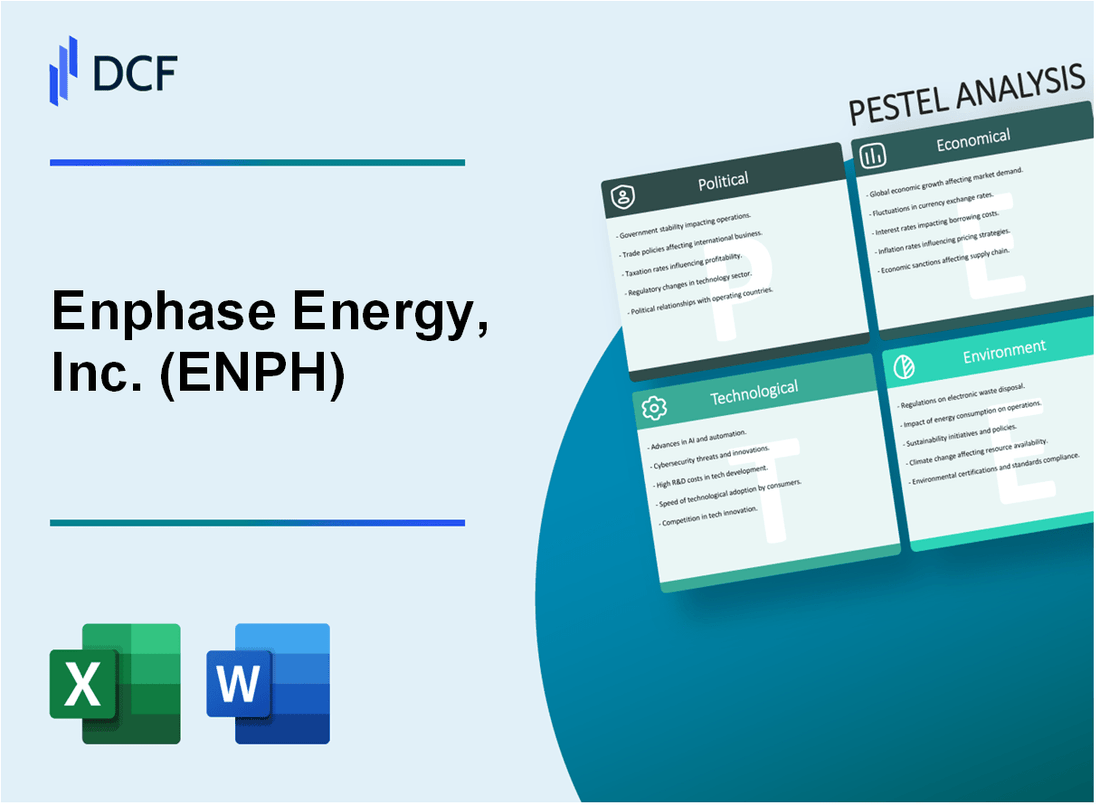
Enphase Energy, Inc. (ENPH): PESTLE Analysis [Nov-2025 Updated] |
Fully Editable: Tailor To Your Needs In Excel Or Sheets
Professional Design: Trusted, Industry-Standard Templates
Investor-Approved Valuation Models
MAC/PC Compatible, Fully Unlocked
No Expertise Is Needed; Easy To Follow
Enphase Energy, Inc. (ENPH) Bundle
You need to know where Enphase Energy, Inc. stands, and the picture is one of short-term pain for long-term gain. The residential solar market is struggling with high interest rates and policy shifts, but this company's move into high-density storage and domestic manufacturing is a defintely smart hedge. We're seeing a dip from a Q3 2025 revenue of $410.4 million, but the underlying tech and consumer shift to energy independence are the real story.
The political environment is a double-edged sword right now. Near-term, the risk of a Section 25D homeowner tax credit repeal is a major headwind, creating policy uncertainty that makes consumers pause on big purchases. But the Inflation Reduction Act (IRA) is a huge tailwind, offering tax credits for domestic manufacturing of microinverters-a clear incentive to shift production.
This geopolitical risk is driving a necessary, strategic move: shifting away from China supply chains to comply with Foreign Entity of Concern (FEOC) rules. To manage the uncertainty, Enphase Energy, Inc. is smart to use safe harbor agreements, essentially locking in tax credit eligibility for future projects. That's how you turn policy risk into a competitive advantage.
Action: Finance needs to model two scenarios: one with full 25D repeal and one with existing IRA benefits fully realized by Q2 2026.
The economy is where the near-term pain is most visible. High interest rates are making solar financing more expensive, which is softening U.S. residential demand. Plus, European demand fell hard, with Q3 2025 European revenue decreasing approximately 38% quarter-over-quarter.
The numbers tell the story: Q3 2025 revenue hit a high of $410.4 million, but the Q4 2025 revenue guidance is conservative, ranging from $310.0 million to $350.0 million. Also, new tariffs on battery imports are expected to negatively impact Q3 2025 gross margin by about 5 percentage points. Here's the quick math: that tariff hit directly reduces profitability, even as you manage inventory.
Action: Sales leadership must adjust Q1 2026 forecasts based on the $310.0 million to $350.0 million guidance range, focusing on markets less sensitive to rate hikes.
Honestly, the social trends are a powerful long-term driver. Rising utility electricity costs are pushing consumers toward energy independence, making solar adoption a necessity, not a luxury. This is why the market is shifting toward solar-plus-storage systems, especially with reduced net metering compensation (like California's NEM 3.0) making grid-tied systems less financially appealing.
Customer loyalty is strong, too, with a global Net Promoter Score (NPS) up to 79%. That's a massive competitive moat. Still, there's a major constraint: the need for skilled labor. The solar installer profession is projected to grow 27% through 2031, so finding and keeping talent is a real issue.
Action: HR should partner with trade schools to establish a certified installer pipeline, aiming to reduce the average time-to-hire for field roles by 20%.
Technology is Enphase Energy, Inc.'s ace in the hole. They are constantly innovating. The launch of the fourth-generation IQ Batteries (Gen 4) is a game-changer, offering 30% more energy density and requiring 62% less wall space. That makes installation easier and more appealing to homeowners.
The upcoming IQ9 microinverter, using Gallium Nitride (GaN) technology, promises higher power and efficiency. Plus, the AI-driven Solargraf platform streamlines system design and permitting for installers. That's a huge operational efficiency boost. The IQ8 Microinverters offer a key differentiator: seamless backup power without needing a separate battery. Simple, effective, and a clear sales pitch.
Action: Product Development needs to accelerate the IQ9 rollout to Q3 2026 to capture the high-efficiency segment before competitors catch up.
The legal landscape is complex, requiring careful navigation. Enphase Energy, Inc. is currently facing class-action lawsuits in early 2025 alleging misleading statements about European revenue streams. This is a distraction that requires resources.
On the positive side, utility approval for the IQ Meter Collar by 39 U.S. utilities simplifies grid interconnection and installation. That's a huge win for reducing soft costs. Still, the company must navigate compliance risk related to potential changes in the definition of a Foreign Entity of Concern (FEOC) and complex state-level net metering rule changes, which directly affect system economics for the end-user.
Action: Legal team must provide a clear risk assessment on the FEOC definition changes and their impact on the Q1 2026 supply chain strategy by the end of the year.
The environmental factor is core to the business model and provides a powerful narrative. The products directly contribute to a low-carbon economy, having cumulatively prevented 72 million metric tons of CO₂e (as of Dec 2024). That's a massive, concrete number.
Microinverters reduce carbon emissions by 50-70% compared to traditional solar power systems. The cumulative clean energy production reached 107 TWh with 4.7 million systems deployed globally (as of Dec 2024). The focus on supply chain relocation to the U.S. is not just about IRA benefits; it also reduces transportation emissions. It's a win-win for the balance sheet and the planet.
Action: Marketing should update all Q1 2026 collateral to prominently feature the 72 million metric tons of CO₂e number, linking environmental impact directly to product value.
Enphase Energy, Inc. (ENPH) - PESTLE Analysis: Political factors
Policy uncertainty from potential repeal of the Section 25D homeowner tax credit.
The political landscape for residential solar shifted dramatically with the passage of the One Big Beautiful Bill Act (OBBBA) in July 2025. This legislation introduced significant policy uncertainty by accelerating the sunset of the Section 25D Residential Clean Energy Credit, which is the 30% federal tax credit for homeowners who purchase their solar and battery systems outright (cash or loan). The credit is now set to expire for expenditures made after December 31, 2025, nearly a decade earlier than its previous phase-down schedule. Honestly, this is a massive headwind for the direct-purchase segment of the market.
This abrupt termination is expected to trigger a rush of installations in late 2025, but it creates a substantial demand cliff in 2026 for homeowner-owned systems. The silver lining for Enphase Energy, Inc. (ENPH) is that the Investment Tax Credit (ITC) for third-party-owned (TPO) systems-leases and Power Purchase Agreements (PPAs)-remains eligible under Section 48E until 2027. Since Enphase supplies both the direct-purchase and TPO markets, the TPO segment provides a crucial buffer against this political risk.
Inflation Reduction Act (IRA) provides tax credits for domestic manufacturing of microinverters.
The Inflation Reduction Act (IRA) remains a powerful political tailwind, specifically through the Section 45X Advanced Manufacturing Production Tax Credit (AMPTC). This credit directly rewards domestic production, giving Enphase a competitive edge by localizing its supply chain. The credit for microinverters is set at a precise 11 cents per watt (AC) of capacity.
Enphase has aggressively scaled its U.S. manufacturing footprint in states like South Carolina and Texas to capture this benefit. The financial impact is already materializing in their 2025 fiscal year results. For the second quarter of 2025 (Q2 2025) alone, Enphase anticipated a net IRA benefit of approximately $30-$33 million from domestic microinverter shipments. This is a clear, predictable revenue stream that helps offset other market pressures.
Here's the quick math on their domestic capacity:
- U.S. Manufacturing Capacity (Late 2025): 5 million IQ Microinverters per quarter.
- Annual Home Capacity: Enough to power over 1 million solar homes annually.
- Tax Credit Value (Per Microinverter): 11 cents per watt (AC).
Geopolitical risk drives a shift to non-China supply chains to comply with Foreign Entity of Concern (FEOC) rules.
Geopolitical tensions, particularly with China, are now codified into U.S. tax law via the Foreign Entity of Concern (FEOC) rules. The OBBBA, signed in July 2025, extends these restrictions to key clean energy tax credits (Sections 45Y, 48E, 45X) for projects commencing construction after December 31, 2025. Projects using components from a Prohibited Foreign Entity (PFE)-which includes entities owned by, controlled by, or subject to the jurisdiction of a government of a Covered Nation (China, Russia, Iran, North Korea)-will lose eligibility for these credits.
This forces a structural shift away from Chinese-sourced components, especially for battery cells, where Enphase previously faced tariff-related gross margin pressure. Enphase has proactively worked to ensure its U.S.-produced IQ8 and the new IQ9 Microinverters, along with its IQ Battery 5P, are FEOC Compliant by verifying that the microinverter, the Printed Circuit Board Assembly (PCBA), and the enclosure are not manufactured by a PFE. This compliance is defintely a strategic advantage for securing large-scale projects.
Use of 'safe harbor' agreements to lock in tax credit eligibility for future projects.
To mitigate the risk of future policy changes, particularly the potential expiration of the Section 48E commercial ITC in 2027, Enphase is actively using 'safe harbor' agreements. These agreements allow developers and financiers to lock in the current tax credit eligibility for future projects by demonstrating that construction has 'begun' through incurring at least 5% of the total project cost.
Since the July 2025 federal budget law change, Enphase has executed multiple safe harbor agreements. This is a smart move to safeguard project economics and accelerate clean energy deployment, especially in the TPO market.
Here is a summary of the near-term revenue secured by these political hedging tools:
| Agreement Type | Date Announced (2025) | Revenue Projected | Timeframe | Products Covered |
|---|---|---|---|---|
| Second Safe Harbor Agreement | August | ~$50 million | Not specified (near-term) | U.S.-manufactured IQ8HC Microinverters |
| Third Safe Harbor Agreement | November | ~$68 million | 12-24 months (starting 2026) | U.S.-manufactured IQ9 Microinverters |
These deals, totaling at least $118 million in projected revenue from specific agreements, provide a clear, policy-driven revenue pipeline that de-risks a portion of their forward-looking sales.
Enphase Energy, Inc. (ENPH) - PESTLE Analysis: Economic factors
Q3 2025 Revenue and Q4 2025 Guidance
The economic landscape for Enphase Energy is a study in divergence, with strong quarterly execution running headlong into cautious forward-looking guidance. The company reported Q3 2025 revenue of $410.4 million, which was the highest quarterly revenue level in two years. To be fair, a portion of this strength came from approximately $70.9 million in safe harbor revenue, where customers pre-purchased products to lock in expiring tax credits, essentially pulling future sales into Q3.
This pull-forward effect, plus persistent market headwinds, led to a conservative Q4 2025 revenue outlook. Management guided Q4 revenue to be in a range of $310.0 million to $350.0 million. This midpoint of $330.0 million represents a significant sequential decline from Q3, signaling that the company is actively managing channel inventory and bracing for continued market softness.
Impact of Tariffs on Gross Margin
Trade policy is defintely hitting the bottom line, turning into a direct cost of goods sold. New reciprocal tariffs on imported components, primarily for the battery storage business where the company sources battery cells from China, are a material drag on profitability. This is a critical factor because it forces a trade-off between supply chain diversification and immediate cost.
In Q3 2025, these tariffs had a negative impact of approximately 4.9 percentage points on the non-GAAP gross margin. For Q4 2025, the company projects this headwind will remain substantial, forecasting an impact of around five percentage points on both GAAP and non-GAAP gross margin. This structural cost pressure is a key differentiator from competitors with more localized supply chains.
| Metric (Q3 2025) | Value | Impact of Tariffs |
|---|---|---|
| Total Revenue | $410.4 million | N/A |
| Non-GAAP Gross Margin | 49.2% | Reduced by 4.9 percentage points |
| Non-GAAP Gross Margin (Excl. IRA) | 38.9% | Reduced by 4.9 percentage points |
| Q4 2025 Revenue Guidance | $310.0M to $350.0M | N/A |
High Interest Rates and U.S. Residential Solar Demand
The high interest rate environment continues to be a major economic headwind, particularly for the U.S. residential solar market. Most homeowners don't pay cash; they finance their systems, so every hike in the Federal Reserve's benchmark rate translates directly into higher loan payments. This increased financing cost softens demand because it erodes the immediate economic payback for the consumer.
While the U.S. revenue for Enphase Energy actually increased approximately 29% quarter-over-quarter in Q3 2025, this was largely due to the temporary boost from safe harbor revenue, not a fundamental recovery in underlying organic demand. Here's the quick math: remove that one-time $70.9 million safe harbor benefit, and the underlying growth story looks much more subdued, reflecting the ongoing pressure from elevated financing costs. The market is waiting for a sustained drop in interest rates to truly unlock the next wave of residential solar adoption.
Softening European Demand
Europe has become the company's biggest near-term challenge. After a period of high growth driven by energy security fears and soaring electricity prices, the market has hit an air pocket of oversupply and inventory correction. This softening European demand caused the region's revenue to decrease approximately 38% quarter-over-quarter in Q3 2025. That's a massive drop.
This decline is primarily due to distributors in countries like France and the Netherlands sitting on bloated inventories, meaning they are not placing new orders until they clear their existing stock. The economic factors driving this are:
- Slower-than-expected installation rates due to global inflation.
- Falling wholesale electricity prices, which reduce the urgency for solar adoption.
- A general economic slowdown in key European markets.
This regional slump is the main reason for the conservative Q4 guidance and highlights a key risk in the company's geographic diversification strategy.
Enphase Energy, Inc. (ENPH) - PESTLE Analysis: Social factors
The social environment in 2025 is a powerful tailwind for Enphase Energy, Inc., driven by a fundamental shift in homeowner priorities from simple cost savings to outright energy independence. This trend is fueled by utility rate volatility and policy changes that fundamentally reset the economics of going solar, making battery storage-Enphase's core strength-an essential component, not an optional extra. This is a huge, defintely positive structural shift for the company.
Rising utility electricity costs drive consumer demand for energy independence and solar adoption.
Homeowners are increasingly adopting solar to hedge against unpredictable and rising utility costs. Data from the first half of 2025 shows that electricity rates continue to outpace general inflation across the US. For the summer period of 2025, home electricity bills are projected to rise by an average of more than 6% compared to 2024, reaching an average of $784 for the season.
In certain regions, the spike is far more severe. For example, the District of Columbia is projected to see a rise of 22.10% in annual household electric costs, and Indiana a rise of 16.30%, based on 2025 projections. This volatility pushes the value proposition of solar and storage from a luxury investment to a necessary financial tool for budget stability.
Market shift toward solar-plus-storage systems due to reduced net metering compensation (like California's NEM 3.0).
The most significant social and regulatory catalyst is the shift away from traditional Net Energy Metering (NEM) policies, most notably California's NEM 3.0, which took effect in April 2023. This policy slashed the compensation for excess solar energy exported to the grid by approximately 75%, from around 30 cents per kilowatt-hour (kWh) to an average of just 8 cents per kWh.
Here's the quick math: when exporting power back to the grid no longer pays the bills, storing that power for evening use becomes the only way to maximize the system's value. This change has made solar-plus-storage systems the new standard, directly benefiting Enphase Energy, Inc.'s core IQ Battery product line.
| California Solar Market Impact (NEM 3.0) | Pre-NEM 3.0 (Before April 2023) | Post-NEM 3.0 (By April 2024) |
|---|---|---|
| Export Compensation Value (Average) | ~30 cents per kWh | ~8 cents per kWh (75% reduction) |
| Residential Battery Attachment Rate | ~11% | Over 50% (Some installers report 90%) |
| Solar-Only Payback Period | ~4.6 years | 8-10 years |
| Solar-Plus-Storage Payback Period | N/A (Less common) | 7-8 years (Now the optimal choice) |
Strong customer satisfaction with a global Net Promoter Score (NPS) up to 79%.
In a sector where installation quality and post-sale support are critical to brand reputation, Enphase Energy, Inc. maintains a strong competitive edge through customer satisfaction. The company's global customer service Net Promoter Score (NPS)-a key metric for customer loyalty-was reported at 79% in the second quarter of 2025, an increase from 77% in the first quarter of 2025. This high score is a significant social asset, as word-of-mouth referrals and installer confidence are major drivers of residential solar sales.
This level of satisfaction is a crucial differentiator in a market with increasing installer bankruptcies and customer uncertainty, especially in the US and Europe.
- Q2 2025 Global Customer Service NPS: 79%
- Q1 2025 Global Customer Service NPS: 77%
- Average call wait time decreased to 1.8 minutes in Q2 2025, supporting the NPS improvement.
High demand for skilled labor; the solar installer profession is projected to grow 42% through 2034.
The overall growth of the solar industry creates a significant social challenge: a tight labor market for skilled installers. The US Bureau of Labor Statistics (BLS) projects employment of solar photovoltaic installers to grow by a massive 42% from 2024 to 2034, which is much faster than the average for all occupations. This rapid demand growth means competition for skilled labor is intense.
For Enphase Energy, Inc., which relies entirely on its network of certified installers, this labor shortage presents a near-term risk. The median annual wage for solar photovoltaic installers was $51,860 in May 2024, a figure that is expected to rise further due to the high demand and labor shortages across the sector. The company must invest in its installer network through training, certification, and incentives to ensure its products are installed correctly and efficiently, maintaining that high NPS.
Enphase Energy, Inc. (ENPH) - PESTLE Analysis: Technological factors
IQ Batteries Gen 4: Higher Density and Smaller Footprint
The launch of the fourth-generation IQ Battery system, specifically the IQ Battery 10C, is a defintely significant technological leap for Enphase Energy. You're always looking for ways to maximize energy storage in limited residential space, and this new design directly addresses that constraint. The IQ Battery 10C delivers 10 kWh of usable energy and 7.08 kW of continuous power.
This new generation uses safer, long-lasting Lithium Iron Phosphate (LFP) chemistry and achieves approximately 34% greater energy density compared to its predecessor. Here's the quick math: that density improvement means the new unit requires 62% less wall space for the same energy storage capacity. This is a huge selling point for homeowners, especially in dense US housing markets. The product is expected to begin shipping in the third quarter of 2025, which will immediately bolster the company's position in the home energy storage market.
| IQ Battery 10C (Gen 4) Metric | Value (2025) | Benefit over Predecessor |
|---|---|---|
| Usable Energy Capacity | 10 kWh | Higher whole-home backup capability |
| Continuous Power Output | 7.08 kW | Supports heavier loads like HVAC systems |
| Energy Density Increase | 34% greater | More power in a smaller package |
| Wall Space Reduction | 62% less | Easier, more flexible residential installation |
| Battery Chemistry | Lithium Iron Phosphate (LFP) | Enhanced safety and longevity |
Upcoming IQ9 Microinverter with Gallium Nitride (GaN)
The shift to Gallium Nitride (GaN) for the upcoming IQ9 microinverter series is a key long-term technology play. GaN is a wide-bandgap semiconductor that replaces traditional silicon, enabling faster switching and cooler operation. The new IQ9N-3P Commercial Microinverter, designed for the commercial and industrial (C&I) sector, is the first to use this.
This technology allows the IQ9 to reach a conversion efficiency of up to 97.5%, which is a top-tier figure in the industry. The unit is rated for a maximum output of 427 VA and can handle PV modules up to 600 W, aligning with the trend toward larger, higher-power solar panels. Commercial availability is slated for December 2025, strategically positioning Enphase Energy to capture a larger share of the lucrative C&I rooftop market.
AI-Driven Solargraf Platform Streamlines Installer Workflow
Beyond hardware, the Solargraf platform shows how Enphase Energy is using software to cut down on the soft costs of solar installation, which is a major industry pain point. The platform uses advanced AI-powered design and automated permitting capabilities tailored for Authority Having Jurisdiction (AHJ) requirements.
This automation is not just a nice-to-have; the DIY permitting feature can potentially reduce the time to produce full permit plans by up to 95%. That is a massive operational efficiency gain for installers. Plus, the platform's accuracy has been validated by the National Renewable Energy Laboratory (NREL), which provides a strong, independent stamp of reliability. The platform also integrates with major Third-Party Ownership (TPO) financing providers, including EnFin, GoodLeap, and LightReach, which streamlines the sales process for installers and helps them close deals faster.
IQ8 Microinverters: Grid-Forming and Sunlight Backup
The IQ8 Microinverter series remains a core technological differentiator, especially in the US residential market where grid resilience is a growing concern. This series is the industry's first microgrid-forming microinverter, meaning it can literally create a mini-grid.
The key benefit here is Sunlight Backup: the system can continue to produce and supply power to essential loads during a grid outage, even without a separate battery. This is a critical selling feature that competitors struggle to match. The IQ8+ model, for example, offers up to 290 VA continuous output and up to 97% efficiency. The market impact is clear: Enphase Energy holds approximately 60% market share in the US residential solar inverter market in 2025, largely driven by the IQ8's capabilities and the company's cumulative shipment of approximately 81.5 million microinverters globally.
- IQ8 is the first microgrid-forming microinverter.
- Enables Sunlight Backup during a grid outage.
- IQ8+ continuous output is up to 290 VA.
- Q1 2025 revenue was $356.1 million, showing continued product momentum.
Enphase Energy, Inc. (ENPH) - PESTLE Analysis: Legal factors
The legal landscape for Enphase Energy, Inc. in 2025 is defined by navigating both litigation risk and complex regulatory shifts that directly impact product marketability and financial incentives. As a leading solar technology company, Enphase must defintely manage the fallout from securities litigation while adapting its product strategy to evolving utility rules and federal compliance mandates.
Facing class-action lawsuits in early 2025 alleging misleading statements about European revenue streams.
Enphase is currently defending against a securities fraud class action lawsuit, filed in the United States District Court for the Northern District of California. The lawsuit, initiated in early 2025, alleges that the company misled investors regarding its competitive position and pricing strategy in the European solar inverter market between April 25, 2023, and October 22, 2024.
The core of the legal claim centers on the failure to adequately disclose the pressure from low-cost Chinese competitors, which ultimately led to a significant revenue decline. Investors learned the extent of the issue after the company announced its third quarter 2024 financial results, revealing an approximately 15% quarter-over-quarter decline in European revenue. The stock price dropped nearly 15% following this announcement. The legal process is moving forward; the Court appointed Lead Plaintiff and Lead Counsel on August 20, 2025. This ongoing litigation creates financial and reputational risk, plus it demands significant management attention.
Utility approval for the IQ Meter Collar by 46 U.S. utilities simplifies grid interconnection and installation.
A major legal and regulatory win for Enphase is the widespread utility approval of its IQ Meter Collar. This device simplifies whole-home backup installations by providing microgrid interconnection device (MID) functionality without needing a dedicated backup sub-panel, which cuts down on installation time and complexity.
As of November 17, 2025, Enphase announced expanded U.S. utility approvals for the IQ Meter Collar, including major players like Pacific Gas and Electric (PG&E) and San Diego Gas & Electric (SDG&E), plus 46 additional U.S. utilities. This is a clear example of regulatory compliance translating directly into a competitive advantage and a smoother sales cycle.
| Product Legal/Regulatory Milestone | Status as of November 2025 | Business Impact |
|---|---|---|
| IQ Meter Collar Approval Count | 46+ U.S. utilities approved | Simplifies whole-home backup installation; reduces labor costs and permitting time for installers. |
| FEOC Compliance Evaluation | Microinverters/Batteries determined 'FEOC Compliant' | Ensures eligibility for U.S. federal tax credits (e.g., Section 48E, 45Y) post-2025. |
Compliance risk related to potential changes in the definition of a Foreign Entity of Concern (FEOC).
The regulatory environment under the 'One Big Beautiful Bill Act' (OBBBA), signed on July 4, 2025, introduces significant compliance risk related to the Foreign Entity of Concern (FEOC) definition. This rule restricts the use of components manufactured by or subject to the jurisdiction of a Covered Nation (China, Russia, Iran, and North Korea) for projects seeking U.S. federal income tax credits under Section 48E or Section 45Y.
The restrictions take effect for facilities commencing construction after December 31, 2025. Enphase has proactively evaluated its supply chain and determined that certain microinverters and battery energy storage products are 'FEOC Compliant'. This compliance is critical, because losing eligibility for these tax credits would make their products significantly less competitive in the U.S. market.
Navigating complex state-level net metering rule changes (e.g., in California) that affect system economics.
State-level regulatory changes, particularly California's Net Energy Metering (NEM) 3.0, have profoundly affected the economics of residential solar. NEM 3.0, which took effect in April 2023, shifted the solar export credit value from retail electricity rates to a net billing tariff structure. The result? Export credits under NEM 3.0 may be 60% to 80% less valuable than under the previous NEM 2.0 policy.
This legal change makes solar-only systems less financially appealing and forces a shift toward solar-plus-storage solutions, which is a key opportunity for Enphase.
- NEM 3.0 necessitates battery energy storage systems (BESS) for value maximization.
- Enphase offers a power control solution allowing legacy NEM 1.0/2.0 customers to expand their systems without triggering a switch to the less lucrative NEM 3.0.
- This product strategy directly addresses the legal constraint, preserving higher financial returns for a large base of existing customers.
The regulatory environment is pushing the market toward Enphase's integrated solar and battery systems.
Enphase Energy, Inc. (ENPH) - PESTLE Analysis: Environmental factors
You are right to focus on the 'E' in PESTLE, as the environmental factor is not just a regulatory hurdle for Enphase Energy; it is the core of their business model. Their product line is a direct enabler of the low-carbon economy, and the company's recent strategic shift to domestic manufacturing in the U.S. creates a clear environmental and financial advantage.
Products directly contribute to a low-carbon economy, with 72 million metric tons of CO₂e cumulatively prevented (as of Dec 2024)
The company's primary environmental impact is the massive amount of greenhouse gas emissions avoided by replacing fossil fuel-generated electricity with solar power. As of December 31, 2024, Enphase Energy's deployed systems have cumulatively prevented an estimated 72 million metric tons of CO₂e (carbon dioxide equivalent) from entering the atmosphere. This number is a concrete measure of their positive contribution, equivalent to powering roughly 14.9 million homes with energy for one year. Their entire product ecosystem-microinverters, batteries, and software-is classified as a low-carbon solution under the EU Taxonomy for environmentally sustainable economic activities, underscoring their foundational role in the energy transition.
Cumulative clean energy production reached 107 TWh with 4.7 million systems deployed globally (as of Dec 2024)
The scale of Enphase Energy's deployment shows a significant global footprint in clean energy generation. By the end of 2024, the cumulative clean energy production from systems managed by Enphase reached 107 TWh (terawatt-hours). This production is the result of having approximately 4.7 million systems deployed across the globe. The high reliability of their microinverters, which are designed for a service life of over 25 years and have a mean time between failures (MTBF) of over 600 years for the IQ platform, ensures this environmental benefit is sustained for the long term. That's a defintely long-term environmental commitment.
Microinverters contribute to carbon emissions reduction compared to traditional solar power systems
The microinverter technology itself drives higher environmental performance compared to traditional string inverter systems. By maximizing the energy harvest at the individual panel level, the system can achieve 5% to 20% higher energy production over its lifetime, especially in common scenarios like partial shading or panel degradation. This higher output directly translates to a greater amount of carbon emissions avoided per installed watt over the system's life. Plus, the panel-level power electronics (MLPE) architecture eliminates the high-voltage direct current (DC) wiring on the roof, which enhances safety for first responders and reduces the risk of arc-fault fires, a crucial factor in the environmental and social context of a system's longevity and community acceptance.
Focus on supply chain relocation to the U.S. to reduce transportation emissions and qualify for IRA benefits
Enphase Energy's strategic pivot to U.S. manufacturing is a critical environmental and financial move in 2025. This relocation reduces the Scope 3 emissions associated with long-distance transportation of components, while also securing substantial financial benefits under the Inflation Reduction Act (IRA). This is a clear example of policy alignment driving positive environmental action.
Here's the quick math on the IRA impact and domestic production:
| Metric | Q2 2025 Performance | Q3 2025 Projection | Late 2025 Capacity Target |
|---|---|---|---|
| U.S. Microinverters Shipped (Units) | 1.41 million | N/A | 5 million per quarter |
| IRA Advanced Manufacturing Production Tax Credit (AMPTC) Benefit | $41.5 million boost to gross margins | $34-38 million tailwind | N/A |
The company's goal to have facilities in South Carolina and Texas producing 5 million IQ Microinverters per quarter by late 2025 is an aggressive target that will fundamentally re-wire their supply chain for lower carbon intensity and greater resilience. This shift also positions them to meet the domestic content requirements for the IRA's Domestic Content Bonus Credit, which offers an additional 10% tax credit for projects using U.S.-made solar components.
Next step: Operations: Confirm Q3 2025 IRA benefit realization and U.S. manufacturing ramp-up against the 5 million unit target.
Disclaimer
All information, articles, and product details provided on this website are for general informational and educational purposes only. We do not claim any ownership over, nor do we intend to infringe upon, any trademarks, copyrights, logos, brand names, or other intellectual property mentioned or depicted on this site. Such intellectual property remains the property of its respective owners, and any references here are made solely for identification or informational purposes, without implying any affiliation, endorsement, or partnership.
We make no representations or warranties, express or implied, regarding the accuracy, completeness, or suitability of any content or products presented. Nothing on this website should be construed as legal, tax, investment, financial, medical, or other professional advice. In addition, no part of this site—including articles or product references—constitutes a solicitation, recommendation, endorsement, advertisement, or offer to buy or sell any securities, franchises, or other financial instruments, particularly in jurisdictions where such activity would be unlawful.
All content is of a general nature and may not address the specific circumstances of any individual or entity. It is not a substitute for professional advice or services. Any actions you take based on the information provided here are strictly at your own risk. You accept full responsibility for any decisions or outcomes arising from your use of this website and agree to release us from any liability in connection with your use of, or reliance upon, the content or products found herein.