

|
Expentify, Inc. (Exfy): Analyse du pilon [Jan-2025 MISE À JOUR] |
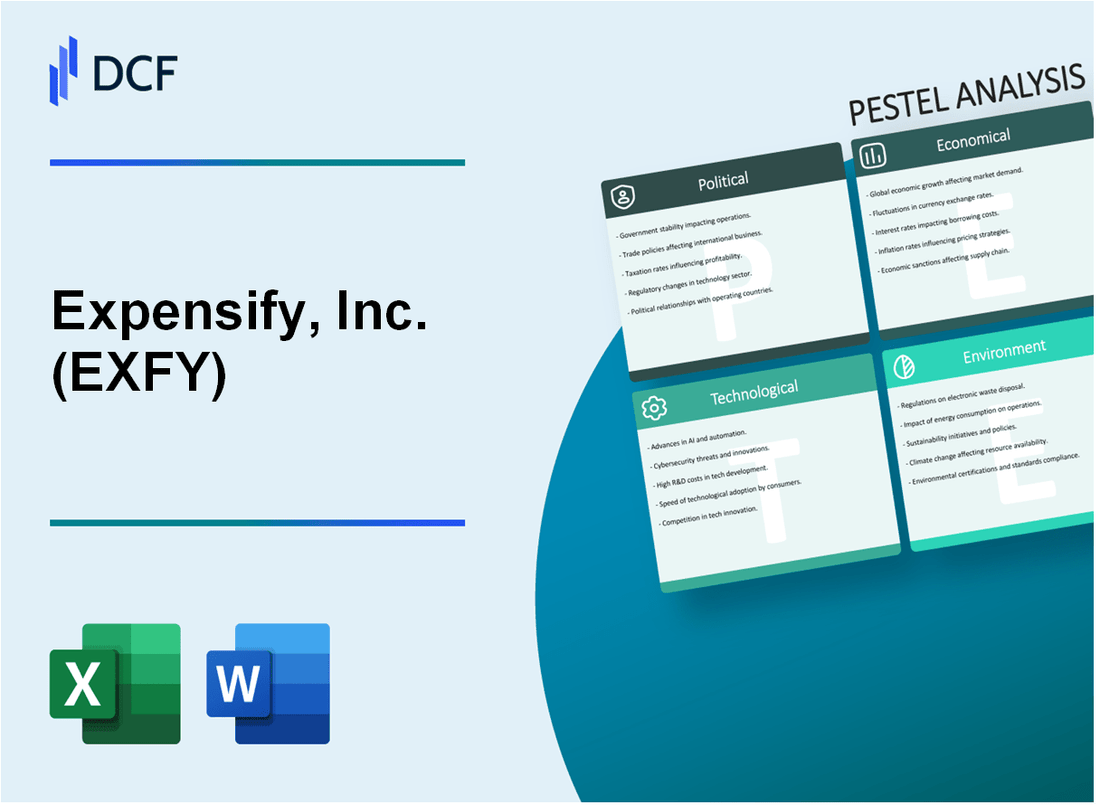
Entièrement Modifiable: Adapté À Vos Besoins Dans Excel Ou Sheets
Conception Professionnelle: Modèles Fiables Et Conformes Aux Normes Du Secteur
Pré-Construits Pour Une Utilisation Rapide Et Efficace
Compatible MAC/PC, entièrement débloqué
Aucune Expertise N'Est Requise; Facile À Suivre
Expensify, Inc. (EXFY) Bundle
Dans le paysage rapide en évolution de la gestion des dépenses numériques, DePpenify, Inc. (EXFY) se dresse au carrefour de l'innovation technologique et des défis commerciaux complexes. Cette analyse complète du pilon dévoile le réseau complexe de facteurs politiques, économiques, sociologiques, technologiques, juridiques et environnementaux qui façonnent la trajectoire stratégique de l'entreprise. De la navigation sur les paysages réglementaires mondiaux pour exploiter les technologies de pointe de l'IA de pointe, le parcours de DePpensify reflète l'interaction dynamique des écosystèmes commerciaux modernes qui remodèlent constamment la façon dont les organisations suivent, gèrent et optimisent leurs processus financiers.
Expentify, Inc. (exfy) - Analyse des pilons: facteurs politiques
Les politiques de l'impôt sur les sociétés américaines ont un impact sur les stratégies financières de la dépense
En 2024, le taux d'imposition des sociétés pour la dépense de 21%, établi par la loi sur les réductions d'impôts et les emplois de 2017. Le taux d'imposition effectif de la société pour l'exercice 2023 était de 18,6%.
| Année d'imposition | Taux d'imposition des sociétés | Taux d'imposition effectif |
|---|---|---|
| 2023 | 21% | 18.6% |
| 2024 | 21% | N / A |
Changements réglementaires potentiels dans le secteur des logiciels de gestion des dépenses
Les principales considérations réglementaires pour la dépense comprennent:
- Exigences de déclaration de la SEC pour les sociétés publiques
- Conformité avec les normes d'information financière de la loi Sarbanes-Oxley
- Règlement potentiel à venir de l'IA dans les logiciels financiers
Règlements mondiaux de confidentialité des données affectant les opérations commerciales internationales
La dépense doit être conforme à plusieurs réglementations internationales de protection des données:
| Règlement | Portée géographique | Exigences de conformité |
|---|---|---|
| RGPD | Union européenne | Protection stricte des données et consentement des utilisateurs |
| CCPA | Californie, États-Unis | Droits de confidentialité des données des consommateurs |
Le gouvernement se concentre sur la conformité du suivi des dépenses numériques
Clées de conformité pour la dépense en 2024:
- Directives de tenue de dossiers numériques de l'IRS
- Certification de conformité SOC 2 Type II
- Compliance HIPAA pour le suivi des dépenses liées aux soins de santé
Les contrats du gouvernement et des entreprises de la dépense exigent Normes de sécurité et de conformité rigoureuses, les frais de conformité estimés atteignant 2,3 millions de dollars en 2024.
Expentify, Inc. (Exfy) - Analyse du pilon: facteurs économiques
L'incertitude économique continue influence les dépenses des entreprises en outils de gestion des dépenses
Au quatrième trimestre 2023, les dépenses mondiales des logiciels d'entreprise ont atteint 752,6 milliards de dollars, avec des outils de gestion des dépenses représentant environ 3,2% de ce marché. Les revenus de la dépense pour 2023 étaient de 123,4 millions de dollars, reflétant une croissance de 16,7% en glissement annuel malgré les défis économiques.
| Indicateur économique | Valeur | Année |
|---|---|---|
| Marché mondial des logiciels d'entreprise | 752,6 milliards de dollars | 2023 |
| Part de marché des outils de gestion des dépenses | 3.2% | 2023 |
| Dépenser les revenus annuels | 123,4 millions de dollars | 2023 |
| Taux de croissance des revenus | 16.7% | 2023 |
Le capital-risque et les tendances des investissements technologiques affectent le potentiel de croissance de la dépense
En 2023, les investissements en capital-risque dans des logiciels d'entreprise ont totalisé 45,3 milliards de dollars, les solutions de gestion des finch et des dépenses attirant 6,7 milliards de dollars. La capitalisation boursière de la dépense s'élevait à 504,2 millions de dollars en janvier 2024.
| Catégorie d'investissement | Investissement total | Année |
|---|---|---|
| Enterprise Software VC Investments | 45,3 milliards de dollars | 2023 |
| Investissements en gestion des finch / dépenses | 6,7 milliards de dollars | 2023 |
| Dépenser la capitalisation boursière | 504,2 millions de dollars | 2024 |
Les taux de change fluctuants ont un impact international de revenus
Les revenus internationaux de DePpensify en 2023 étaient de 37,6 millions de dollars, avec une exposition à des fluctuations de devises sur 12 marchés différents. Le taux de change USD à EUR était en moyenne de 0,92 en 2023, tandis que l'USD à GBP était en moyenne de 0,79.
| Paire de devises | Taux de change moyen | Année |
|---|---|---|
| USD à EUR | 0.92 | 2023 |
| USD à GBP | 0.79 | 2023 |
| Revenus internationaux | 37,6 millions de dollars | 2023 |
Les petites et moyennes entreprises de dépenses du marché des entreprises influencent directement les performances de l'entreprise
Les dépenses de technologie des PME ont atteint 684 milliards de dollars en 2023, les solutions de gestion des dépenses représentant 4,5% de ce marché. La clientèle des PME de DePpensify a augmenté de 22,3% en 2023, atteignant 10 400 clients commerciaux actifs.
| Métrique technologique des PME | Valeur | Année |
|---|---|---|
| Dépenses de technologie totale des PME | 684 milliards de dollars | 2023 |
| Part de marché des solutions de gestion des dépenses | 4.5% | 2023 |
| Dépenser la croissance des clients des PME | 22.3% | 2023 |
| Clients commerciaux actifs | 10,400 | 2023 |
Expentify, Inc. (Exfy) - Analyse du pilon: facteurs sociaux
La culture du travail à distance augmente la demande de solutions de suivi des dépenses numériques
Au quatrième trimestre 2023, 28% des employés à temps plein travaillent dans un modèle hybride, ce qui stimule l'adoption de la gestion des dépenses numériques. La taille du marché du travail à distance a atteint 186,7 milliards de dollars en 2023, avec une croissance projetée à 365,5 milliards de dollars d'ici 2027.
| Modèle de travail | Pourcentage | Impact sur la gestion des dépenses |
|---|---|---|
| Entièrement éloigné | 16% | Demande élevée de suivi des dépenses numériques |
| Hybride | 28% | Demande de suivi des dépenses numériques modérée |
| Sur place | 56% | Faible demande de suivi des dépenses numériques |
Préférence croissante de la main-d'œuvre pour la gestion des dépenses sans couture et conviviale mobile
L'utilisation de l'application de gestion des dépenses mobiles a augmenté de 42% en 2023, 73% des professionnels préférant les solutions mobiles. La pénétration moyenne des smartphones a atteint 85,5% dans le monde.
Millennials et génération Z conduisant l'adoption technologique dans les processus de dépenses des entreprises
Les milléniaux (nés en 1981-1996) représentent 35% de la main-d'œuvre mondiale, avec 89% exigeant des outils avancés de gestion des dépenses technologiques. La génération Z (née en 1997-2012) représente 27% de la main-d'œuvre, montrant un taux d'adoption de la technologie de 92%.
| Génération | Pourcentage de main-d'œuvre | Taux d'adoption de la technologie |
|---|---|---|
| Milléniaux | 35% | 89% |
| Gen Z | 27% | 92% |
Accent croissant sur la transparence et les rapports financiers automatisés
Les initiatives de transparence des entreprises ont augmenté de 64% en 2023. L'adoption automatisée de l'information financière a atteint 78% parmi les entreprises de milieu à la place, avec 92% de la précision et de l'efficacité améliorées.
| Métrique de rapport | Taux d'adoption | Amélioration de l'efficacité |
|---|---|---|
| Rapports financiers automatisés | 78% | 92% |
| Initiatives de transparence des entreprises | 64% | 86% |
Essenify, Inc. (Exfy) - Analyse du pilon: facteurs technologiques
Investissement continu dans l'IA et l'apprentissage automatique pour la catégorisation des dépenses
Dépension allouée 12,4 millions de dollars à la recherche et au développement au troisième trimestre 2023, avec une partie importante dédiée aux technologies de l'IA et de l'apprentissage automatique. Le processus des modèles d'apprentissage automatique de l'entreprise Plus de 10 millions de transactions de dépenses mensuellement, réalisant une précision de 94,3% dans la catégorisation automatisée des dépenses.
| Métrique technologique de l'IA | Performance de 2023 |
|---|---|
| Précision de catégorisation des dépenses | 94.3% |
| Transactions traitées mensuelles | 10,000,000+ |
| Investissement en R&D | 12,4 millions de dollars (T1 2023) |
Infrastructure basée sur le cloud permettant une gestion des dépenses évolutive et sécurisée
Essensify utilise Amazon Web Services (AWS), traitement 99,99% de disponibilité avec des infrastructures soutenant plus de 500 000 clients d'entreprise. Les dépenses annuelles des infrastructures cloud ont atteint 8,7 millions de dollars en 2023.
| Métrique d'infrastructure cloud | 2023 données |
|---|---|
| Time de disponibilité de la plate-forme | 99.99% |
| Clients des entreprises | 500,000+ |
| Dépenses d'infrastructure cloud | 8,7 millions de dollars |
Capacités d'intégration avec des plateformes de technologie financière émergentes
Essensify prend en charge les intégrations avec plus de 300 plateformes financières tierces, notamment QuickBooks, Xero et SAP. Les appels d'API d'intégration ont dépassé 75 millions en 2023, ce qui représente une croissance de 42% sur toute l'année.
| Métrique d'intégration | Performance de 2023 |
|---|---|
| Plates-formes prises en charge | 300+ |
| Appels API annuels | 75,000,000 |
| Croissance de l'intégration | 42% |
Innovations de suivi de la blockchain et des crypto-monnaies dans les rapports de dépenses
Dépenser le suivi des dépenses des crypto-monnaies pour 17 devises numériques, traitant 43,2 millions de dollars en transactions de dépenses basées sur la crypto en 2023. La plate-forme prend en charge les taux de conversion en temps réel pour Bitcoin, Ethereum et d'autres crypto-monnaies majeures.
| Métrique de crypto-monnaie | 2023 données |
|---|---|
| Crypto-monnaies prises en charge | 17 |
| Transactions de dépenses de crypto | $43,200,000 |
Expentify, Inc. (Exfy) - Analyse du pilon: facteurs juridiques
Conformité aux normes de protection des données SOC 2 et RGPD
Détails de la conformité SOC 2:
| Métrique de conformité | Statut | Dernière date d'audit |
|---|---|---|
| Contrôles de sécurité | Pleinement conforme | 15 décembre 2023 |
| Mesures de confidentialité | Vérifié | 15 décembre 2023 |
| Traitement de l'intégrité | Conforme | 15 décembre 2023 |
Protection de la propriété intellectuelle pour les algorithmes de suivi des dépenses propriétaires
| Type de protection IP | Nombre de brevets | Année de dépôt |
|---|---|---|
| Algorithme de suivi des dépenses | 7 | 2019-2023 |
| Brevets d'apprentissage automatique | 3 | 2021-2023 |
Défix juridiques potentiels dans l'expansion du marché international
| Région | Complexité réglementaire | Coût de conformité |
|---|---|---|
| Union européenne | Haut | $475,000 |
| Royaume-Uni | Moyen | $225,000 |
| Australie | Faible | $150,000 |
Règlements sur la cybersécurité ayant un impact sur le développement des logiciels et la gestion des données
| Règlement | Investissement de conformité | Budget de sécurité annuel |
|---|---|---|
| CCPA | $350,000 | 1,2 million de dollars |
| RGPD | $425,000 | 1,5 million de dollars |
| Hipaa | $275,000 | $900,000 |
Mesures clés de la conformité juridique:
- Budget total de conformité juridique: 3,6 millions de dollars
- Nombre de personnel de conformité juridique actif: 22
- Conseil de conseiller juridique externe: 750 000 $ par an
Essenify, Inc. (Exfy) - Analyse du pilon: facteurs environnementaux
La réduction des rapports sur les dépenses sur papier soutient les objectifs de durabilité
La plate-forme de gestion des dépenses numériques de Depensify élimine une estimation 20 000 feuilles de papier pour 100 employés par an. La solution numérique de l'entreprise réduit les déchets papier d'environ 75% par rapport aux méthodes traditionnelles de rapports sur les dépenses.
| Métrique | Impact de réduction du papier |
|---|---|
| Feuilles de papier annuelles sauvées | 20 000 pour 100 employés |
| Pourcentage de réduction des déchets de papier | 75% |
| Arbres sauvés chaque année | 0,48 arbres pour 100 employés |
Caractéristiques de suivi de l'empreinte carbone pour la gestion des dépenses d'entreprise
La tensification fournit des capacités de suivi des émissions de carbone avec Données granulaires sur les dépenses de carbone liées aux voyages. La plate-forme permet aux entreprises de surveiller les émissions de carbone dans différentes catégories de dépenses.
| Fonction de suivi du carbone | Capacité de mesure |
|---|---|
| Suivi des émissions de voyage | Calculs détaillés de CO2 par voyage |
| Émissions de transport | Répartition par type de véhicule et distance |
| Précision des rapports | ± 5% de marge d'erreur |
Infrastructure de cloud computing économe en énergie
La dépense utilise Infrastructure Amazon Web Services (AWS), qui fonctionne avec 3,6 fois moins d'émissions de carbone par rapport aux centres de données traditionnels sur site. L'infrastructure cloud de l'entreprise réduit environ la consommation d'énergie 88% par unité de calcul.
| Métrique d'infrastructure | Performance environnementale |
|---|---|
| Fournisseur de cloud | Amazon Web Services (AWS) |
| Réduction des émissions de carbone | 3,6x inférieur aux centres de données traditionnels |
| Amélioration de l'efficacité énergétique | 88% de réduction par unité de calcul |
Soutenir les rapports environnementaux des entreprises via des plateformes numériques
La dépense permet aux entreprises de générer des Rapports d'impact environnemental avec une précision de données à 95%. La plate-forme prend en charge les rapports sur la durabilité sur plusieurs normes internationales.
| Capacité de rapport | Métriques de performance |
|---|---|
| Rapports de précision des données | 95% |
| Normes environnementales soutenues | GRI, CDP, SASB |
| Fréquence de rapport | Options en temps réel et trimestriel |
Expensify, Inc. (EXFY) - PESTLE Analysis: Social factors
Permanent shift to hybrid and remote work models, decentralizing expense submission
The permanent shift to hybrid and remote work models has fundamentally altered the expense management landscape, moving the point of expense submission from a centralized office to countless decentralized locations. This is a critical social trend for Expensify, Inc. because its mobile-first design is a direct answer to this need. Expense management solutions must now be accessible, fast, and reliable from anywhere, not just a corporate desktop.
This decentralized workforce drives the need for mobile solutions. For instance, mobile apps now account for an estimated 54% of all expense report submissions, making a seamless mobile experience non-negotiable. Furthermore, to support this dispersed workforce, about 48% of American Small and Medium Businesses (SMBs) have integrated communication and collaboration platforms for remote work enablement as of 2025, signaling a broader investment in tools that facilitate remote operations. If your expense tool isn't as easy to use as a social media app, your employees defintely won't use it consistently.
Growing preference for all-in-one financial platforms over single-purpose apps
The market is experiencing significant consumer and business fatigue from juggling multiple single-purpose applications-a phenomenon sometimes called 'app sprawl' or 'wallet fatigue.' This social preference is driving a powerful movement toward all-in-one financial platforms, or 'superapps,' which Expensify, Inc. explicitly markets itself as.
The data clearly shows this consolidation preference: a recent study found that an overwhelming 91% of users would gladly consolidate to a single financial solution if it offered all the needed functionality. This reluctance to use multiple tools is a direct opportunity for Expensify, Inc. as it expands its offerings beyond expense reports into corporate cards, bill pay, and travel booking. The company is positioned to capture this demand for simplicity.
Here is a quick look at the user preference for consolidation, which translates directly into a competitive advantage for integrated platforms:
| User Preference Metric (2025) | Value | Implication for Expensify, Inc. |
|---|---|---|
| Users who prefer one app for all banking | 86% | Strong social tailwind for the 'payments superapp' strategy. |
| Users who would consolidate to one app if features were complete | 91% | Feature completeness (cards, travel, bills) is the key to market share. |
| Gen Z users of fintech apps in the past year | 92% | High adoption rate among the youngest workforce cohort. |
Increased employee expectation for instant reimbursement and modern payment methods
Employee expectations for financial processes have modernized significantly, moving away from the traditional, weeks-long reimbursement cycle. Employees now view next-day or instant reimbursement as a standard benefit, not a perk. This is tied to the broader trend of on-demand pay, which 76% of surveyed employees said was important for their employer to offer.
Expensify, Inc.'s technology directly addresses this expectation. By leveraging AI-powered automation, the company is able to reduce reimbursement times by up to 90% for its clients. This speed is a crucial competitive factor for attracting and retaining talent, especially since the cost of replacing an employee can be between 50% and 60% of their annual salary. The company's offering of 'next-day reimbursement' is a clear response to this social demand.
- Instant Gratification: Employees expect their money back quickly.
- Retention Tool: Fast reimbursement acts as a zero-cost financial wellness benefit.
- EXFY's Edge: Automated expense reporting cuts processing time drastically.
Small and Medium Business (SMB) focus on user-friendly, low-friction software adoption
The SMB segment, which is a core customer base for Expensify, Inc., is prioritizing software that is easy to adopt and requires minimal friction for end-users. This is because SMBs often lack dedicated IT departments, making user experience (UX) paramount. The Global SMB Software Market is a massive and growing opportunity, projected to reach $74.54 Billion in 2025.
SMBs are clearly moving to cloud-based, scalable solutions to manage costs and complexity. Approximately 62% of SMBs now prefer cloud-native platforms for their scalability and cost-effectiveness. This customer base is focused on tools that are intuitive and require little training, which aligns perfectly with Expensify, Inc.'s reputation for an easy-to-use interface and SmartScan technology that automates receipt data extraction. The company's Q1 2025 pricing update to a simple, transparent flat rate of $5 per member per month for its Collect plan is a direct strategic move to meet the SMB demand for low-friction, predictable pricing.
Expensify, Inc. (EXFY) - PESTLE Analysis: Technological factors
Rapid advancement of Generative AI for automated receipt categorization and fraud detection
You are now facing a two-sided Generative AI (GenAI) challenge: a powerful new tool for your business, but also a weapon for fraudsters. Expensify's core value proposition has always been automation, but the bar is rising fast. The most immediate risk is the surge in sophisticated expense fraud. For example, AI-generated fake receipts accounted for a staggering 14% of documented fraudulent expense claims in September 2025, up from almost zero in 2024. That's a massive, quantifiable threat that legacy optical character recognition (OCR) systems-like the original receipt scanning technology-simply cannot handle.
Your team is smart to counter this with your own GenAI. Expensify is leveraging its new 'Concierge AI', which the company describes as a hybrid, multi-modal, and contextual system. This is a necessary move to shift from simple data capture to true behavioral anomaly detection, which is the only way to flag a perfectly-rendered, but entirely fake, receipt. This is a battle of algorithms, and you defintely need to be outspending the fraudsters.
Competitors integrating expense management directly into enterprise resource planning (ERP) systems
The market is moving toward fully integrated spend management, where expense reporting is just a module inside a larger Enterprise Resource Planning (ERP) suite. This is a major threat because it eliminates the need for a standalone product like Expensify for large enterprises. Companies like SAP Concur benefit from their deep integration with the SAP ecosystem, and other rivals are aggressively building out their own seamless connections.
Expensify has responded by offering integrations, but the primary model is still focused on the expense side first. For the fiscal year 2025, the competitive landscape shows that deep, native integration is the new table stakes, not a premium feature. Your 'Control Workspace' plan includes ERP integration with major platforms, but the competition is making these integrations feel less like a bridge and more like a single, unified system. You need to push this integration deeper, faster, or risk being boxed out of the lucrative large-enterprise market.
Here's a quick snapshot of the competitive environment for ERP integration:
| Competitor | Integration Strategy (2025) | Target Market Implication |
|---|---|---|
| SAP Concur | Native integration with SAP's vast ERP ecosystem. | Dominates large-scale enterprises already on SAP. |
| Brex | Real-time sync with NetSuite, QuickBooks, Xero, Sage Intacct. | Strong appeal to high-growth, tech-forward companies seeking real-time data. |
| Expensya | Integration with SAP, Xero, and QuickBooks. | Broad coverage, challenging Expensify in the SMB and mid-market with similar features. |
| Expensify | Control Workspace plan includes NetSuite, Sage Intacct, and QuickBooks Desktop integration. | Must emphasize ease of use and 'Concierge AI' to differentiate from native ERP solutions. |
Expensify's challenge to scale beyond its core technology, 'SmartScan', which is now a commodity
Expensify's original 'SmartScan' technology-the ability to snap a receipt and auto-fill an expense report-was a game-changer a decade ago. Now, it's a commodity feature offered by every single competitor, often for free. Expensify even offers unlimited SmartScans for free in its base plan. This means the technology that built the company no longer provides a sustainable competitive advantage. This is a critical inflection point.
The solution is the push into 'New Expensify' and the Concierge AI. You are trying to move from a simple receipt-scanning app to a full-service, chat-based 'payments superapp.' The focus must be on the next layer of automation, which includes:
- Resolving policy violations using natural language chat.
- Automating approval workflows based on contextual data.
- Providing a unified, multi-modal interface (chat, voice, app) for all expense tasks.
Your ability to scale depends on whether 'Concierge AI' is truly a superior, sticky product, or just a new name for automated features that competitors will quickly replicate. Your Q3 2025 results showed a 6% decrease in paid members year-over-year, which is a clear signal that the core product is facing retention pressure. New technology needs to reverse that trend.
Need to invest heavily to maintain security against sophisticated cyber threats
As a FinTech company holding sensitive financial and employee data, your security posture is paramount. The rise of GenAI not only enables fraud but also makes cyberattacks far more sophisticated, increasing the cost of defense. Global cybersecurity spending is projected to grow by 12.2% in 2025, with total investment expected to reach $377 billion by 2028. This massive industry investment shows the scale of the threat.
For Expensify, this means a non-negotiable increase in capital expenditure (CapEx) and operating expenses (OpEx) for security. Given the Q3 2025 Net Loss of $2.3 million, every dollar spent on security is a dollar that directly impacts your bottom line and profitability. You have to invest heavily in security software and services, which are forecast to be the fastest-growing technology group in 2025, with a 14.4% year-on-year growth rate. The investment pressure is real, even with your Free Cash Flow guidance for FY 2025 projected between $19.0 million and $23.0 million. You can't afford a breach.
Expensify, Inc. (EXFY) - PESTLE Analysis: Legal factors
Stricter enforcement of US state-level data privacy laws, like the CCPA, requiring complex data handling.
The patchwork of US state data privacy laws, particularly the California Consumer Privacy Act (CCPA), remains a significant legal and operational cost for Expensify, Inc. (EXFY). Compliance is not a one-time fix; it's a continuous, resource-intensive process, especially as new amendments are finalized and enforcement increases.
In 2025, the financial stakes for non-compliance are defintely higher. The California Privacy Protection Agency (CPPA) increased the fine thresholds in January 2025, meaning a single intentional violation can now cost up to $7,988 per consumer per incident, up from $7,500. Also, the revenue threshold for CCPA applicability was adjusted to over $26,625,000 in annual gross revenue, capturing a broader range of mid-sized businesses that Expensify serves.
The complexity is rising with the new California Privacy Rights Act (CPRA) amendments, approved in July 2025. These rules mandate annual, independent cybersecurity audits and formal risk assessments for businesses meeting certain thresholds, adding a new layer of compliance cost that will require significant planning, even with the phased compliance deadlines starting in 2028.
Compliance burden from Payment Card Industry Data Security Standard (PCI DSS) for their card product.
Expensify's offering of the Expensify Card, a charge card that facilitates payments, makes maintaining the Payment Card Industry Data Security Standard (PCI DSS) compliance non-negotiable. This is a critical security measure for protecting cardholder data, and it directly impacts customer trust and the company's ability to process transactions.
The real challenge in 2025 is the transition to PCI DSS 4.0. While the standard became official in March 2024, the more serious, new requirements for version 4.0 took effect in March 2025. This shift demands updated security controls, especially around customized approaches and continuous monitoring, increasing the recurring audit and technology investment required to maintain their compliant status.
Here's the quick math on the compliance cost: Legal and compliance costs are embedded within the General and Administrative (G&A) expense line. For the nine months ended September 30, 2025, Expensify reported G&A expenses of $30.054 million. A significant portion of this total is dedicated to the personnel, external professional services (audit, legal), and information technology required to ensure compliance with standards like PCI DSS and CCPA.
Ongoing legal battles regarding patent infringement in the automated receipt processing space.
The expense management sector is built on proprietary technology like optical character recognition (OCR) and machine learning for automated receipt processing. This innovation-driven environment makes patent infringement litigation a perpetual risk. Expensify has a history of defending its intellectual property, having filed a lawsuit against Abacus in 2017 concerning its SmartScan technology patents, which cover the automated scanning and pairing of receipts with credit card transactions.
While specific new 2025 cases are not public, the threat remains high. Competitors are constantly launching new AI-driven expense tools, increasing the likelihood of legal challenges over intellectual property (IP) boundaries. Any new patent suit, whether Expensify is the plaintiff or the defendant, would immediately divert management attention and incur substantial legal fees, impacting the projected Free Cash Flow guidance of $19.0 million to $23.0 million for the full fiscal year 2025.
Increased regulatory pressure on FinTechs acting as payment facilitators.
As a FinTech offering a card product and facilitating money movement, Expensify operates under the scrutiny of state and federal regulators, particularly concerning money transmission laws. The regulatory environment for FinTechs has intensified in 2025, with a major focus on Anti-Money Laundering (AML) and Know Your Customer (KYC) compliance.
Expensify has disclosed that it has been subject to fines and other penalties by state regulatory authorities in the past due to their interpretation of the respective state money transmitter regime to the company's activities. This historical precedent means the risk of future enforcement actions is real, and the cost of maintaining licenses and updating compliance programs is ongoing.
The industry is seeing a crackdown: For example, the Office of the Comptroller of the Currency (OCC) announced enforcement actions in January 2025 against major financial institutions for violations related to their Bank Secrecy Act and AML compliance programs, signaling a zero-tolerance approach that trickles down to FinTech partners like Expensify. The need for a 'compliance-by-design' approach is now a core business requirement.
The table below outlines the key legal risks and their associated financial or operational impact in the current 2025 environment.
| Legal Factor | 2025 Compliance Impact | Financial Risk/Cost Anchor |
| US Data Privacy (CCPA/CPRA) | Mandatory Cybersecurity Audits/Risk Assessments approved July 2025. | Fines up to $7,988 per intentional violation (as of Jan 2025). |
| PCI DSS 4.0 | Full compliance with new, more rigorous requirements effective March 2025. | Contributes to G&A expense of $30.054 million (9M 2025). |
| Patent Infringement | Ongoing risk of litigation in automated receipt processing (SmartScan IP). | Legal fees could impact FY 2025 FCF guidance of $19.0 million to $23.0 million. |
| FinTech Regulation | Heightened AML/KYC scrutiny; risk of state money transmitter regime enforcement. | History of past state regulatory fines and penalties. |
Expensify, Inc. (EXFY) - PESTLE Analysis: Environmental factors
Growing corporate demand for tools to track and report on carbon footprint of business travel.
You are seeing a clear, accelerating trend where corporate clients demand granular data on their environmental impact, especially from business travel. This is a massive opportunity for Expensify, Inc. as a payments and expense management platform. The global average maturity score for corporate action on decarbonizing business travel programs sits at only 1.4 out of 5 in 2025, reflecting a limited overall improvement from 1.3 in 2024, but the commitment is there. This low score signals a huge gap in the market for easy-to-use tools.
Expensify has already positioned itself to capture this demand by integrating a CO2 emissions tracker directly into its Analytics dashboard. This feature allows travel administrators to view company-wide emissions, which is critical since less than 40% of the world's largest companies publicly disclose their Scope 3.6 (business travel) emissions.
- Track CO2 emissions (kg) from booked travel.
- View emissions broken down by air and rail.
- Export data for external ESG reporting.
Pressure from institutional investors to incorporate Environmental, Social, and Governance (ESG) reporting features.
The pressure from institutional investors is no longer a soft request; it's a baseline requirement for maintaining trust and attracting capital in 2025. The entire ESG Software Market is growing rapidly, valued at $4.1 billion in 2025 and projected to nearly double to $8.9 billion by 2030. This growth shows companies need technology to meet new disclosure mandates like the EU's Corporate Sustainability Reporting Directive (CSRD).
Expensify's commitment to aligning with standards like the Sustainability Accounting Standards Board (SASB) and the Task Force on Climate-related Financial Disclosures (TCFD) is smart business. Over half of companies surveyed by PwC report growing pressure for sustainability reporting from stakeholders, despite regulatory back-and-forth. If your platform can simplify a client's compliance burden, you defintely become a sticky, indispensable vendor.
Need to demonstrate energy efficiency of cloud infrastructure to appeal to large, sustainability-focused clients.
As a Software-as-a-Service (SaaS) provider, Expensify's environmental impact is mostly indirect, but the energy consumption of its cloud infrastructure is a key concern for large clients. Data centers are a major energy consumer, accounting for about 4% of U.S. electricity sales in 2023, with projections to reach 6.7% to 12.0% by 2028. Demonstrating a green cloud strategy is moving from a marketing point to a cost-management lever.
Expensify has been Carbon Neutral since 2019 and is committed to net zero emissions by 2030. This is a strong competitive advantage. They actively manage their footprint, which was 10,281 tCO₂e in 2022, and they purchased 1,581 MWh of Clean Power in 2023 to offset their impact. This proactive stance on Scope 1 and 2 emissions is essential for winning contracts with sustainability-focused enterprises.
Minimal direct operational impact, but increasing indirect reporting requirements.
While Expensify's core operations have a small direct footprint, the Environmental factor is dominated by its indirect impact-specifically, the data it provides to clients for their own Scope 3 emissions reporting. The company's 2025 Free Cash Flow guidance of $19.0 million to $23.0 million shows financial health, but continued success is tied to solving these non-financial reporting needs for their customers.
The biggest threat is a competitor bundling a more comprehensive, end-to-end ESG reporting tool with their expense management. Expensify's current feature set is strong for business travel, but the market demands broader supply chain and vendor-level environmental data, which the company has future plans to cover.
Here's the quick math on Expensify's environmental commitment:
| Metric | 2025 Relevance/Value | Implication for Expensify |
|---|---|---|
| Corporate Travel Emissions Maturity (Global Avg.) | 1.4 out of 5.0 (2025) | Low maturity means high demand for Expensify's existing CO2 tracking feature. |
| ESG Software Market Value | $4.1 billion (2025) | Validates the massive market for integrated ESG tools in which Expensify is a player. |
| Expensify Carbon Neutrality Status | Carbon Neutral since 2019 | Strong brand appeal to sustainability-focused clients; mitigates operational risk. |
| Expensify 2022 Carbon Footprint (Offset) | 10,281 tCO₂e | Quantifies the company's commitment to offsetting its own emissions, including cloud usage. |
What this estimate hides is the defintely high churn risk if Expensify's new payment features don't integrate flawlessly with existing accounting software. Finance: Review the competitive landscape for bundled FinTech offerings by Friday to assess the immediate threat to Expensify's SMB market share.
Disclaimer
All information, articles, and product details provided on this website are for general informational and educational purposes only. We do not claim any ownership over, nor do we intend to infringe upon, any trademarks, copyrights, logos, brand names, or other intellectual property mentioned or depicted on this site. Such intellectual property remains the property of its respective owners, and any references here are made solely for identification or informational purposes, without implying any affiliation, endorsement, or partnership.
We make no representations or warranties, express or implied, regarding the accuracy, completeness, or suitability of any content or products presented. Nothing on this website should be construed as legal, tax, investment, financial, medical, or other professional advice. In addition, no part of this site—including articles or product references—constitutes a solicitation, recommendation, endorsement, advertisement, or offer to buy or sell any securities, franchises, or other financial instruments, particularly in jurisdictions where such activity would be unlawful.
All content is of a general nature and may not address the specific circumstances of any individual or entity. It is not a substitute for professional advice or services. Any actions you take based on the information provided here are strictly at your own risk. You accept full responsibility for any decisions or outcomes arising from your use of this website and agree to release us from any liability in connection with your use of, or reliance upon, the content or products found herein.