
|
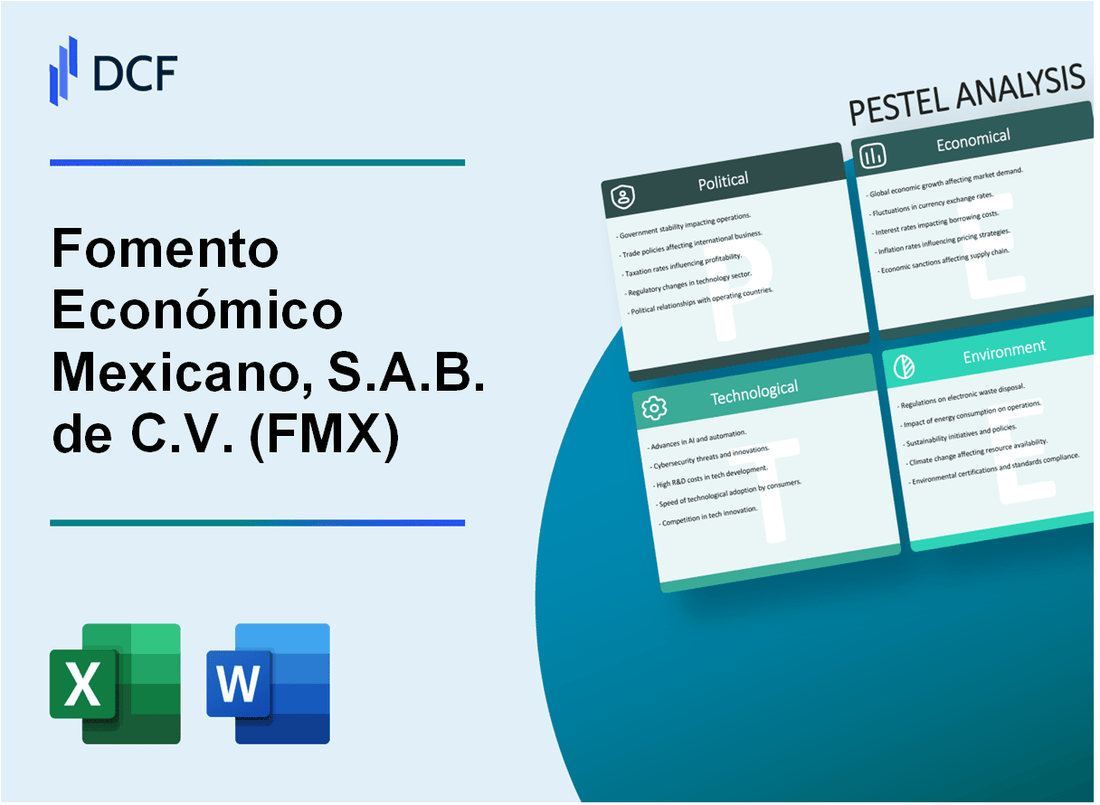
Fomento Económico Mexicano, S.A.B. de C.V. (FMX): Analyse du pilon [Jan-2025 mise à jour] |
Entièrement Modifiable: Adapté À Vos Besoins Dans Excel Ou Sheets
Conception Professionnelle: Modèles Fiables Et Conformes Aux Normes Du Secteur
Pré-Construits Pour Une Utilisation Rapide Et Efficace
Compatible MAC/PC, entièrement débloqué
Aucune Expertise N'Est Requise; Facile À Suivre
Fomento Económico Mexicano, S.A.B. de C.V. (FMX) Bundle
Dans le paysage dynamique des affaires mexicaines, Fomento Económico Mexicano, S.A.B. de C.V. (FMX) est un titan d'entreprise complexe naviguant sur des terrains politiques, économiques et technologiques complexes. Cette analyse complète du pilon dévoile les défis et les opportunités à multiples facettes qui façonnent l'écosystème stratégique de FMX, révélant comment les facteurs externes allant des réglementations gouvernementales aux changements sociétaux influencent profondément la trajectoire opérationnelle de l'entreprise. Plongez dans une exploration illuminante des forces macro-environnementales qui stimulent l'une des puissances d'entreprise les plus influentes du Mexique, où chaque décision stratégique est une danse délicate entre le risque et l'innovation.
Fomento Económico Mexicano, S.A.B. de C.V. (FMX) - Analyse du pilon: facteurs politiques
Impact de la stabilité politique du Mexique sur la FMX
Le paysage politique du Mexique à partir de 2024 montre des implications importantes pour les opérations stratégiques de FMX. L'indice de stabilité politique du pays a enregistré 5,6 sur 10, indiquant un risque politique modéré pour les investissements des entreprises.
| Métrique de stabilité politique | Valeur 2024 |
|---|---|
| Indice de stabilité politique | 5.6/10 |
| Indice de perception de la corruption du gouvernement | 31/100 |
| Score de qualité réglementaire | 0.48 |
Règlements gouvernementaux sur les industries des boissons et de la vente au détail
Coûts de conformité réglementaire pour FMX dans les secteurs des boissons et de la vente au détail estimés à 4,2% des revenus annuels.
- Taux d'imposition de l'industrie des boissons: 26,5%
- Frais de conformité réglementaire du secteur de la vente au détail: 87,3 millions de dollars
- Impact de l'impôt sur le sucre sur la production de boissons: augmentation de 8% des coûts de production
Politiques commerciales et accords internationaux
| Accord commercial | Impact sur FMX | 2024 Tarif |
|---|---|---|
| USMCA | Réduction des barrières commerciales transfrontalières | 0-2.5% |
| Accord commercial de Mexico-UE | Accès au marché élargi | 1.7% |
Changements de leadership politique potentiels
2024 L'élection présidentielle mexicaine a projeté des changements réglementaires potentiels avec une probabilité estimée de 35% de modifications de politique significatives affectant les opérations des entreprises.
- Pignon d'ajustement des taux d'imposition des sociétés potentielles: 25-30%
- Impact estimé de l'incertitude réglementaire: 112,6 millions de dollars
- Volatilité potentielle du sentiment des investissements étrangers: ± 7,3%
Fomento Económico Mexicano, S.A.B. de C.V. (FMX) - Analyse du pilon: facteurs économiques
La croissance économique du Mexique et les fluctuations du PIB
Le PIB du Mexique en 2023 était de 1,9 billion USD, avec un taux de croissance de 3,2%. La structure économique montre des variations importantes entre les secteurs:
| Secteur | Contribution du PIB (%) |
|---|---|
| Services | 62.8% |
| Industriel | 31.5% |
| Agriculture | 5.7% |
Volatilité des taux de change
Taux de change du peso mexicain (MXN) en 2023-2024:
| Paire de devises | Taux moyen |
|---|---|
| USD / MXN | 17.25 |
| EUR / MXN | 18.72 |
Inflation et dépenses de consommation
Indicateurs économiques du Mexique pour les dépenses de consommation et l'inflation:
| Indicateur économique | Valeur 2023 |
|---|---|
| Taux d'inflation | 4.3% |
| Dépenses de consommation | 6,2 billions de mxn |
| Croissance des ventes au détail | 3.8% |
Opportunités de diversification économique
Les principaux secteurs de la diversification économique du Mexique:
- Fabrication: 17,4% du PIB
- Services technologiques: 5,6% du PIB
- Énergie renouvelable: augmenter à 8,5% par an
- Fabrication d'exportation: 35,2 milliards USD en 2023
Fomento Económico Mexicano, S.A.B. de C.V. (FMX) - Analyse du pilon: facteurs sociaux
Changer la démographie et les préférences des consommateurs stimulent l'innovation des produits
Les démographies de la population mexicaine révèlent des informations critiques pour la stratégie de marché de la FMX:
| Segment démographique | Pourcentage | Tranche d'âge |
|---|---|---|
| Millénaire | 28.4% | 25-39 ans |
| Population de génération Z | 22.6% | 10-24 ans |
| Population urbaine | 80.2% | N / A |
L'augmentation de la conscience de la santé influence le développement de produits des boissons
Statistiques sur la tendance de la santé ayant un impact sur le portefeuille de boissons de FMX:
| Métrique de santé | Pourcentage | Segment des consommateurs |
|---|---|---|
| Préférence de boissons à faible teneur en sucre | 47% | Consommateurs urbains |
| Intérêt fonctionnel des boissons | 36% | 18-45 groupes d'âge |
| Demande de boisson biologique | 24% | Consommateurs de classe moyenne |
La migration urbaine et la croissance de la classe moyenne créent de nouvelles opportunités de marché
Informations sur la migration urbaine:
- Taux de croissance annuelle de la population urbaine: 1,8%
- Population de classe moyenne: 47,3 millions
- Revenu médian des ménages: 19 230 $ par an
Changements culturels vers la commodité et la consommation numérique
Tendances de consommation numérique affectant les stratégies de vente au détail de FMX:
| Métrique numérique | Pourcentage | Segment des consommateurs |
|---|---|---|
| Pénétration du commerce électronique | 63% | Consommateurs urbains |
| Fréquence d'achat mobile | 52% | 18-45 groupes d'âge |
| Adoption des paiements numériques | 68% | Consommateurs de classe moyenne |
Fomento Económico Mexicano, S.A.B. de C.V. (FMX) - Analyse du pilon: facteurs technologiques
La transformation numérique accélère dans les canaux de vente au détail et de distribution
FMX a investi 127,6 millions de dollars dans les initiatives de transformation numérique en 2023. La société a déployé 342 points de contact numériques sur les canaux de vente au détail, augmentant l'engagement de la plate-forme numérique de 37% par rapport à 2022.
| Métriques d'investissement numériques | Valeur 2023 | Changement d'une année à l'autre |
|---|---|---|
| Investissement de plate-forme numérique | 127,6 millions de dollars | +22.4% |
| Points de contact numériques | 342 | +46.3% |
| Engagement des canaux numériques | 37% | +12,6 points de pourcentage |
L'investissement dans l'automatisation et les technologies de l'IA améliore l'efficacité opérationnelle
FMX a alloué 93,4 millions de dollars aux technologies de l'IA et de l'automatisation en 2023, ciblant 18% de réduction des coûts opérationnels. La société a mis en œuvre 127 solutions d'optimisation des processus axées sur l'IA entre les réseaux de fabrication et de distribution.
| Métriques d'investissement d'automatisation | Valeur 2023 | Impact cible |
|---|---|---|
| Investissement IA / Automation | 93,4 millions de dollars | Objectif de réduction des coûts: 18% |
| Solutions d'optimisation des processus d'IA | 127 solutions | Mis en œuvre à travers les opérations |
La logistique avancée et les technologies de la chaîne d'approvisionnement améliorent l'avantage concurrentiel
FMX déployé Suivi de la chaîne d'approvisionnement compatible la blockchain sur 64% de son réseau de distribution. Les technologies de gestion des stocks en temps réel ont réduit les coûts logistiques de 15,3% en 2023.
| Métriques de la technologie logistique | Performance de 2023 | Couverture réseau |
|---|---|---|
| Suivi de la chaîne d'approvisionnement de la blockchain | 64% de couverture réseau | Expansion en 2024 |
| Réduction des coûts logistiques | 15.3% | Amélioration d'une année à l'autre |
Les plateformes de commerce électronique croissantes nécessitent une adaptation technologique continue
Le FMX a élargi les capacités de commerce électronique avec des investissements de 56,2 millions de dollars, ce qui a atteint une croissance de 42% des canaux de vente en ligne. La société a intégré 113 nouvelles technologies de paiement numérique et d'expérience client en 2023.
| Métriques technologiques du commerce électronique | Valeur 2023 | Pourcentage de croissance |
|---|---|---|
| Investissement de commerce électronique | 56,2 millions de dollars | +28.7% |
| Croissance du canal de vente en ligne | 42% | Augmentation d'une année à l'autre |
| Paiement numérique / CX Technologies | 113 technologies | Nouvellement intégré |
Fomento Económico Mexicano, S.A.B. de C.V. (FMX) - Analyse du pilon: facteurs juridiques
Règlements strictes sur les boissons et la sécurité alimentaire
Les réglementations mexicaines sur la sécurité alimentaire obligent des protocoles de conformité rigoureux. La Commission fédérale pour la protection contre les risques sanitaires (COFEPRIS) applique des directives strictes pour les boissons et la production alimentaire.
| Catégorie de réglementation | Exigence de conformité | Plage de pénalité |
|---|---|---|
| Standardisation du produit | NOM-251-SSA1-2009 Standard | 5 000 $ - 500 000 $ MXN par violation |
| Fabrication sanitaire | Certification HACCP obligatoire | Jusqu'à 1 000 000 $ MXN pour la non-conformité |
| Exigences d'étiquetage | Divulgation d'informations nutritionnelles | 10 000 $ - 250 000 $ MXN par incident |
Protection de la propriété intellectuelle
Droit de la propriété industrielle mexicaine offre une protection complète pour le développement de la marque et des produits. En 2024, les coûts d'enregistrement des marques varient de 1 200 $ à 3 500 USD.
| Type de protection IP | Durée d'enregistrement | Coût moyen |
|---|---|---|
| Enregistrement des marques | 10 ans | 2 500 USD |
| Enregistrement des brevets | 20 ans | 5 000 USD |
Règlements sur les lois du travail et l'emploi
Le droit fédéral mexicain du travail régit la gestion de la main-d'œuvre avec des mesures strictes de protection des employés.
| Réglementation du travail | Exigence clé | Pénalité pour non-conformité |
|---|---|---|
| Salaire minimum | 248,93 $ par jour (2024) | Amende jusqu'à 500 000 $ MXN |
| Avantages obligatoires | Bonus du 13e mois, salaire de vacances | Action en justice, pénalités financières |
| Heures de travail | Semaine de travail maximale de 48 heures | Compensation des heures supplémentaires requise |
Exigences de conformité environnementale
Les réglementations environnementales mexicaines imposent des exigences strictes aux opérations industrielles.
| Réglementation environnementale | Métrique de conformité | Plage de pénalité |
|---|---|---|
| Gestion des déchets | Conformité LGPGIR | 50 000 $ - 2 000 000 $ MXN |
| Contrôle des émissions | NOM-043-SEMARNAT | 100 000 $ - 5 000 000 $ MXN |
| Décharge d'eau | NOM-001-SEMARNAT-1996 | 75 000 $ - 3 000 000 $ MXN |
Fomento Económico Mexicano, S.A.B. de C.V. (FMX) - Analyse du pilon: facteurs environnementaux
Les initiatives de durabilité deviennent essentielles pour la réputation des entreprises
Les mesures de durabilité environnementale de la FEMSA en 2023:
| Métrique | État actuel | Année cible |
|---|---|---|
| Consommation d'énergie renouvelable | 42.5% | 2025 |
| Réduction des émissions de gaz à effet de serre | 35.2% | 2030 |
| Amélioration de l'efficacité de l'eau | 23.6% | 2025 |
Conservation et gestion de l'eau essentielles dans la production de boissons
Performance de gestion de l'eau de la FEMSA en 2023:
| Indicateur de gestion de l'eau | Mesures |
|---|---|
| Consommation totale d'eau | 14,2 millions de m³ |
| Taux de recyclage de l'eau | 18.7% |
| Ratio d'efficacité de l'eau | 1,74 litres / litre de boissons |
Augmentation de la pression pour réduire l'empreinte carbone et mettre en œuvre des technologies vertes
Investissements de réduction du carbone de la FEMSA en 2023:
- Investissement total de technologie verte: 42,5 millions de dollars
- Conversion de la flotte de véhicules électriques: 35% terminés
- Mises à niveau d'équipement économe en énergie: 18,3 millions de dollars
Programmes de gestion et de recyclage des déchets Fecutal to Environmental Strategy
Mesures de performance de gestion des déchets de la FEMSA:
| Catégorie de gestion des déchets | Performance de 2023 | Cible 2024 |
|---|---|---|
| Déchets totaux générés | 87 600 tonnes métriques | Réduire de 15% |
| Taux de recyclage | 62.4% | 68% |
| Réduction des déchets d'enfouissement | 41.3% | 50% |
Fomento Económico Mexicano, S.A.B. de C.V. (FMX) - PESTLE Analysis: Social factors
Growing middle class in key Latin American markets demands more convenience and premium product options.
The expanding middle class across Latin America is fundamentally reshaping consumer demand, moving past basic necessities toward convenience and better-for-you or premium products. This shift is a huge tailwind for Fomento Económico Mexicano's (FMX) Proximity Americas division, which is primarily OXXO. You can see this clearly in the recent numbers: Proximity Americas total revenues grew by a strong 9.2% in the third quarter of 2025 versus the same period last year.
Here's the quick math on consumer behavior: while store traffic decreased by 3.1% in the quarter, the average ticket (what each customer spends) increased by 4.9%. This tells us that customers are consolidating their trips but buying more, and likely higher-margin, items when they do come in. They are willing to pay for the convenience of a nearby OXXO, which now operates 25,180 stores across the Americas. Honestly, this focus on convenience is a reliable, long-term trend.
To capture this, FMX is prioritizing expansion, committing MX$18.1 billion in capital expenditure to the Proximity Americas division in 2025, an 11% increase from 2024, with plans for over 1,000 new store openings.
Increased health consciousness drives demand for low-sugar and non-sugary beverages, pressuring Coca-Cola FEMSA's core business.
Consumer awareness of sugar's health risks is a major headwind for Coca-Cola FEMSA (KOF), which is the world's largest Coca-Cola franchise bottler. The global low- and no-calorie soda market is now estimated at $25 billion in 2025 and is projected to grow at a Compound Annual Growth Rate (CAGR) of 5% through 2033. This trend is forcing a rapid portfolio shift.
While KOF's total revenues still grew 3.3% in Q3 2025, their overall volume declined by a significant 5.5% in Q2 2025, with Mexico, Brazil, and Colombia seeing the largest drops. The pressure is real, but the response is clear: the Coca-Cola system saw global volume for Coca-Cola Zero Sugar grow 14% in Q2 2025, and low- and zero-sugar brands now account for about 14% to 16% of the company's total soft drink volume. KOF must accelerate its shift away from full-sugar options to maintain market share.
High rates of unbanked populations create a massive opportunity for OXXO's financial services platform, OXXO Pay.
The sheer size of the unbanked population (those without access to traditional banking services) in Mexico presents FMX with a massive, defintely addressable market. Approximately 37% of Mexican adults remain unbanked, relying heavily on cash and alternative payment methods.
OXXO is perfectly positioned to serve this segment through its digital financial services platform, Spin by OXXO. The adoption rate is staggering: Spin by OXXO reached 9.9 million active users in Q3 2025, representing a 20.5% year-over-year growth. This isn't just a side project; it's a core driver of in-store activity, as the average tender (payment method) at OXXO Mexico using these digital/loyalty services climbed to 48.2% in Q3 2025, up sharply from 38.5% a year earlier.
This is a play on financial inclusion, using their vast retail footprint as the physical on-ramp for digital services.
| OXXO Digital Financial Services (Q3 2025) | Metric | Value | Y-o-Y Growth |
|---|---|---|---|
| Spin by OXXO | Active Users | 9.9 million | 20.5% |
| Spin Premia (Loyalty) | Active Users | 27.7 million | 16.4% |
| OXXO Mexico Average Tender (Digital/Loyalty) | % of Transactions | 48.2% | Up from 38.5% in Q3 2024 |
Urbanization and smaller household sizes increase reliance on proximity retail formats like OXXO.
As Latin America urbanizes and household sizes shrink, the demand for quick, local, and frequent shopping trips grows. This is the sweet spot for proximity retail (small-format stores) like OXXO, which is positioned as the neighborhood pantry and service hub. The convenience model thrives on density.
FMX is capitalizing on this by rapidly expanding its physical footprint. The Proximity Americas division added 198 new stores in Q3 2025 alone, contributing to 1,370 net store additions over the last twelve months. This pace is expected to continue; management guidance suggests FMX anticipates at least 10 years of expansion runway in Mexico, targeting a potential of 10,000 additional OXXO stores in the country over the long term. The strategy is simple: put a store where the people are moving.
The combination of physical presence and digital services is key:
- Proximity Americas total store count is 25,180.
- The company is investing MX$18.1 billion in Proximity Americas in 2025 CapEx.
- This expansion is critical for maintaining market leadership against discount formats like Bara.
Finance: Monitor the capital expenditure efficiency against the 10-year store expansion target.
Fomento Económico Mexicano, S.A.B. de C.V. (FMX) - PESTLE Analysis: Technological factors
The technological landscape for Fomento Económico Mexicano, S.A.B. de C.V. (FMX) is defined by a dual mandate: digitalizing its massive retail network, OXXO, while simultaneously automating the high-volume manufacturing and logistics of Coca-Cola FEMSA. This isn't just about staying current; it's about using technology to drive efficiency and counter rising operational costs, especially in labor and input materials.
Rapid adoption of digital payments and fintech services necessitates continuous investment in OXXO Pay infrastructure.
The shift to digital financial services (fintech) is a major technological driver. FMX is aggressively investing in its proprietary digital ecosystem, Spin, which includes the Spin by OXXO digital account and the Spin Premia loyalty program. This investment is crucial because it captures a significant portion of the unbanked or underbanked consumer base, integrating them directly into the OXXO retail loop.
In the second quarter of 2025, Spin by OXXO grew to 9.4 million active users, representing an 18.8% growth year-over-year. The Spin Premia loyalty program is even larger, reaching 26.6 million active loyalty users, a 16.9% increase from Q2 2024. This rapid adoption means FMX must defintely continue allocating a portion of its MX$18.1 billion 2025 capital expenditure for Proximity Americas toward technology upgrades to maintain system stability, security, and scalability. The average tender, or transaction value, at OXXO Mexico using these digital services hit 45.8% in Q2 2025, up from 36.1% in Q2 2024, showing how quickly the digital wallet is becoming the primary payment method.
E-commerce and last-mile delivery competition forces FMX to integrate online-to-offline (O2O) capabilities across its retail units.
Competition from pure-play e-commerce and fast-delivery services requires OXXO to transform its physical stores into online-to-offline (O2O) hubs. The company's Proximity Americas division, which operated 25,180 stores as of June 30, 2025, is using its dense footprint as a competitive advantage for last-mile delivery, order pickup, and financial services. The MX$18.1 billion CAPEX for Proximity Americas in 2025 is funding 'logistics enhancements' and 'new transportation equipment' to support this O2O strategy. Essentially, every new OXXO store, with over 1,000 new units planned for 2025, also functions as a mini-distribution center for the digital ecosystem.
Automation in bottling and logistics is crucial for Coca-Cola FEMSA to manage rising labor and input costs.
Coca-Cola FEMSA (KOF) is channeling the largest portion of FMX's total 2025 capital expenditure into manufacturing and supply chain technology. The beverage bottler is investing MX$31.6 billion in 2025, which is 53.7% of FMX's total CAPEX and a 6.9% increase from 2024. This spending is heavily focused on automation to boost efficiency and mitigate inflationary pressures on labor and raw materials. One of the clearest examples is the planned installation of nine new production lines across Latin America.
The most significant automation projects include:
- Brazil Investment: A US$110 million investment in the Mogi das Cruzes plant in São Paulo for two new production lines featuring high-level technology to improve efficiency and sustainability.
- Costa Rica Expansion: A US$45 million investment at the Calle Blancos plant to add a new production line, which will optimize operational efficiency and expand warehousing capacity.
Here's the quick math on the 2025 technology and infrastructure investments:
| FMX Business Unit (2025 CAPEX) | Amount (MXN Billion) | Amount (USD Equivalent) | Primary Technological Focus |
|---|---|---|---|
| Coca-Cola FEMSA (KOF) | 31.6 | ~$1.85 | Manufacturing Automation, Distribution Technology, New Production Lines (9 total) |
| Proximity Americas (OXXO, Spin) | 18.1 | ~$1.06 | Fintech Infrastructure (Spin), Logistics Enhancements, Store Technology Upgrades |
| Total FMX CAPEX | 58.8 | ~$3.44 | N/A |
Note: USD equivalent is approximate based on a conservative exchange rate for illustrative purposes; the MXN amounts are the official budget.
Data analytics and AI are being used to optimize store layouts, inventory, and pricing strategies for over 25,000 OXXO stores.
With Proximity Americas operating 25,180 stores as of mid-2025, FMX is using data analytics and Artificial Intelligence (AI) to manage the complexity of its massive retail network. This is an absolute necessity. The company is driving a 'fit-for-purpose corporate overhead efficiency program' and making 'internal adjustments' to its value proposition. This means using data to move beyond simple inventory management to predictive modeling.
For example, data analytics is being applied to optimize product assortment and pricing strategies, which management explicitly cited as a factor in improving their competitive position in key categories like beer, soft drinks, and snacks in 2025. AI-driven demand forecasting helps minimize waste (spoilage) and ensures the right product mix for each store's micro-market, a critical task for a chain with such a high volume of small, perishable transactions.
Fomento Económico Mexicano, S.A.B. de C.V. (FMX) - PESTLE Analysis: Legal factors
Stricter Labeling Laws for High-Sugar and High-Calorie Products
The regulatory environment for Coca-Cola FEMSA's product portfolio is tightening, particularly with the full implementation of Mexico's Official Mexican Standard, NOM-051 (front-of-package labeling). This is not a new law, but a phase-in process that hit its most restrictive stage in 2025. Specifically, Phase 3 of the standard is fully effective on or after October 1, 2025, requiring manufacturers to evaluate stricter nutritional thresholds for added sugars, saturated fats, and sodium.
This regulation has already forced significant strategic shifts, as Coca-Cola FEMSA has been reformulating products to avoid the prominent black octagonal warning seals. As of early 2025, the company has reduced the amount of sugar in its products by an additional 25% and now reports that 66% of its more than 80 brands are low-calorie or zero-calorie, representing a 20% increase in that segment since 2018. Still, any non-compliant product faces fines that can reach up to 781,920 Mexican pesos per violation, plus the costly changes to packaging design and inventory management across the entire distribution network.
The labeling law also strictly prohibits using marketing elements appealing to children, such as cartoon characters or celebrities, on products bearing the warning seals. This directly impacts promotional strategies in OXXO stores, where these products are a core revenue driver.
Anti-Trust Scrutiny in Retail and Beverage Sectors
Anti-trust scrutiny in Fomento Económico Mexicano's core markets, especially Mexico, is a heightened financial risk in 2025. The Mexican competition landscape is undergoing a significant overhaul with the proposed abolition of the independent Federal Economic Competition Commission (COFECE) and its replacement by the National Antitrust Commission (CNA) under the executive branch, a reform submitted on April 24, 2025. This shift creates regulatory uncertainty, but the clear trend is toward heavier financial penalties.
Here's the quick math: the new anti-trust regime raises the maximum fine ceilings dramatically. I defintely see this as a major near-term risk for a market leader like FMX.
| Anti-Competitive Conduct | Previous Maximum Fine (Approx. % of Revenues) | New Maximum Fine (Approx. % of Revenues) |
|---|---|---|
| Collusion (Cartels) | 10% | 15% |
| Abuse of Dominance/Exclusionary Conduct | 8% | 10% |
| Unlawful Mergers (Gun-Jumping) | Varies | Up to 10% (Gun-Jumping) / 15% (Illicit Concentration) |
While FMX has not reported a major fine in 2025, the regulator has recently imposed significant sanctions on other industries, such as a 2024 fine of MXN $437 million for gasoline price manipulation. This demonstrates the regulator's willingness to use maximum penalties, a direct threat to both Coca-Cola FEMSA's beverage dominance and OXXO's retail and fuel operations.
Emerging Data Privacy Regulations Impacting OXXO Pay
The expansion of OXXO Pay, FMX's digital financial service, exposes the company to a fragmented but rapidly evolving landscape of GDPR-style data privacy regulations (General Data Protection Regulation). The most immediate concern is Mexico's new Federal Law on the Protection of Personal Data in Possession of Private Parties, which was published on March 20, 2025.
This legislation introduces more robust provisions for data processing, requiring significant compliance upgrades for OXXO Pay, which services over 58 million Spin Premia rewards program spending accounts. Plus, other key markets are following suit; Peru's new Data Privacy Law regulation came into force on March 30, 2025. Non-compliance with data protection protocols, particularly those related to digital platform work (which can apply to OXXO Pay's platform model), carries substantial financial risk.
- Update privacy notices, contracts, and internal regulations to meet new transparency standards.
- Implement robust processes for handling Access, Rectification, Cancellation, and Opposition (ARCO) rights requests.
- The maximum fine for non-compliance with the new digital platform work laws can be equivalent in 2025 to approximately $135,000.00 USD.
Changes in Labor Laws Directly Impact Operating Expenses
Changes in labor laws across FMX's operating regions, particularly in Mexico, are directly pressuring operating expenses and eroding some of the cost advantages of operating in the region. The most quantifiable impact comes from minimum wage adjustments.
On January 1, 2025, Mexico's general minimum wage increased by 12%, rising to MXN $278.80 daily nationwide and MXN $419.88 in the Northern Border Free Zone. This is a structural increase in labor costs. The impact is visible in the Q3 2025 financial results, where FMX noted that continued pressure on wages in Mexico contributed to a 12% growth in combined selling and administrative expenses for the Proximity Americas division.
Also, new labor reforms for digital platform work, effective June 22, 2025, require platforms to classify workers earning above one minimum wage as employees and enroll them in social security programs. This adds new social security and severance liabilities to the cost structure for any FMX business unit, like OXXO Pay, that uses a gig-economy or platform model for certain services.
Fomento Económico Mexicano, S.A.B. de C.V. (FMX) - PESTLE Analysis: Environmental factors
Water scarcity and resource management are critical risks for Coca-Cola FEMSA's bottling operations in water-stressed regions.
You're operating a beverage business where water is the main ingredient, so water scarcity isn't just an environmental issue, it's a direct threat to your production capacity. Coca-Cola FEMSA (KOF) faces this risk across its Latin American footprint, especially in Mexico and Brazil, which requires continuous, substantial investment in efficiency and replenishment.
The company is addressing this with a dual focus: reducing consumption and replenishing local watersheds. In 2024, FEMSA achieved a 70.0% neutral water balance across all its operations, a strong step toward its 2030 goal. Also, KOF's franchisor, The Coca-Cola Company, updated its strategy in 2024 to seek 100% water replenishment in each of the over 200 high-risk locations identified across the global system. This is a huge commitment.
Here's the quick math on the investment: FEMSA's cumulative investment in the Latin American Alliance of Water Funds reached US$50.3 million in 2024, which is protecting over 565 thousand hectares of watersheds. That's a necessary, proactive CapEx to secure future water access. In 2024 alone, FEMSA returned 8,583 thousand cubic meters of treated water back to the environment, which is defintely a measurable impact.
The key metric for KOF's core bottling business is water use efficiency, which reached 1.36 liters of water per liter of beverage produced in 2024. This achievement was a benchmark for its sustainability-linked bonds, meaning failure would have increased the cost of debt.
Increased pressure from investors and regulators to meet ambitious carbon neutrality and waste reduction targets.
The pressure from stakeholders-investors, regulators, and consumers-to decarbonize and eliminate waste has intensified in 2025. This isn't about mere compliance anymore; it's about maintaining a social license to operate and attracting capital, as evidenced by FEMSA's high scores in the S&P Global's Corporate Sustainability Assessment 2025. Coca-Cola FEMSA specifically stood out in areas like packaging, circular economy, water, and climate change in the 2025 assessment.
FEMSA's action plan is built around two clear targets:
- Climate Action: Achieve 85.0% renewable electric energy use across all operations by 2030.
- Waste Reduction: Achieve zero waste to sanitary landfills.
The waste goal is already showing strong results: FEMSA achieved a 76% rate of waste diversion from sanitary landfills in 2024. This diversion helped avoid an estimated 699,922 tonnes of CO₂e emissions in 2024, showing a tangible link between waste management and climate mitigation. Furthermore, the Mexican government's updated climate plan (NDC 3.0), approved in November 2025, sets an unconditional national GHG emission cap ranging between 364 and 404 MtCO₂e by 2035, which increases the regulatory framework for all major industrial players like FMX.
Transitioning to sustainable packaging materials (e.g., rPET) requires substantial capital expenditure and supply chain changes.
The shift to a circular economy model for packaging is one of the most CapEx-intensive environmental challenges. Coca-Cola FEMSA's goal is to make 100% of its packaging recyclable or reusable, a target where it is nearly complete, with 97% of its packaging already designed to be recyclable as of early 2023. The real challenge is the recycled content (rPET).
The Coca-Cola Company, which sets the global standard for KOF, has tempered its ambition, now aiming to use 35% to 40% recycled material in primary packaging by 2035, including increasing recycled plastic use to 30% to 35% globally. To be fair, this is a long game, as the global system only reached 17% rPET use in 2023. This gap highlights the need for significant CapEx in collection and recycling infrastructure, not just in production lines.
Fomento Económico Mexicano plans to invest a record MX$58.8 billion in total capital expenditure in 2025, a 15% increase over 2024 spending, with a portion of this going to Coca-Cola FEMSA's capacity expansion. For example, a US$45 million investment was announced in March 2025 to expand a production plant in Costa Rica, which aligns with the Sustainability Framework. This continuous investment is critical for integrating rPET and increasing returnable packaging, which in 2021 already accounted for 34% of KOF's packaging.
Extreme weather events, intensified by climate change, disrupt logistics and supply chains, especially in coastal areas.
Climate change is no longer a future risk; it is a present operational cost. Extreme weather events directly impact FMX's logistics and distribution network, particularly in its extensive Latin American operations. The disruption hits the supply chain in two ways: physical damage and raw material scarcity.
Physical impacts are becoming more frequent. In 2024, severe flooding in Brazil disrupted operations at a plant in Porto Alegre, and Hurricane John struck the state of Guerrero in Mexico while the region was still recovering from Hurricane Otis. These events necessitate costly contingency planning and rapid response to ensure business continuity. One clean one-liner: Climate volatility is now a line item in the budget.
The broader impact is on raw materials and logistics costs:
- Water Stress: Rising temperatures and shifting rainfall patterns are causing water scarcity, which affects the availability and price of agricultural raw materials used in beverages.
- Logistics Costs: Climate-induced disruptions, like the 2023 Panama Canal drought, have caused shipping costs to more than double the pre-pandemic average, directly affecting the cost of importing raw materials and exporting finished goods.
The Mexican government's 2025 climate plan now includes a loss and damage component focused on response protocols for extreme weather events and risk transfer mechanisms, like parametric insurance, signaling a formal recognition of this operational risk at a national level.
Disclaimer
All information, articles, and product details provided on this website are for general informational and educational purposes only. We do not claim any ownership over, nor do we intend to infringe upon, any trademarks, copyrights, logos, brand names, or other intellectual property mentioned or depicted on this site. Such intellectual property remains the property of its respective owners, and any references here are made solely for identification or informational purposes, without implying any affiliation, endorsement, or partnership.
We make no representations or warranties, express or implied, regarding the accuracy, completeness, or suitability of any content or products presented. Nothing on this website should be construed as legal, tax, investment, financial, medical, or other professional advice. In addition, no part of this site—including articles or product references—constitutes a solicitation, recommendation, endorsement, advertisement, or offer to buy or sell any securities, franchises, or other financial instruments, particularly in jurisdictions where such activity would be unlawful.
All content is of a general nature and may not address the specific circumstances of any individual or entity. It is not a substitute for professional advice or services. Any actions you take based on the information provided here are strictly at your own risk. You accept full responsibility for any decisions or outcomes arising from your use of this website and agree to release us from any liability in connection with your use of, or reliance upon, the content or products found herein.