

|
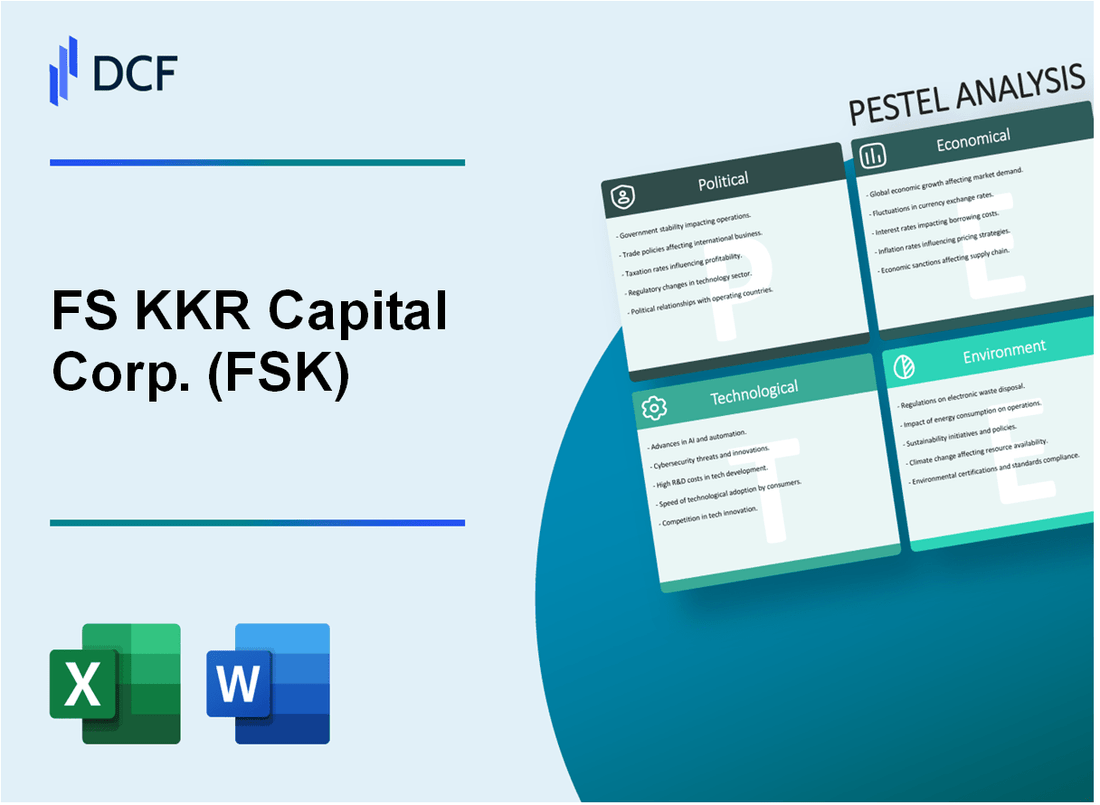
FS KKR Capital Corp. (FSK): Analyse de Pestle [Jan-2025 MISE À JOUR] |
Entièrement Modifiable: Adapté À Vos Besoins Dans Excel Ou Sheets
Conception Professionnelle: Modèles Fiables Et Conformes Aux Normes Du Secteur
Pré-Construits Pour Une Utilisation Rapide Et Efficace
Compatible MAC/PC, entièrement débloqué
Aucune Expertise N'Est Requise; Facile À Suivre
FS KKR Capital Corp. (FSK) Bundle
Dans le monde dynamique des investissements alternatifs, FS KKR Capital Corp. (FSK) se tient au carrefour des paysages financiers complexes, naviguant à travers des terrains politiques, économiques et technologiques complexes. Cette analyse complète du pilon dévoile les défis et les opportunités à multiples facettes qui façonnent le positionnement stratégique de FSK, offrant aux investisseurs et aux parties prenantes une plongée profonde dans les facteurs externes critiques stimulant la performance de l'entreprise et la trajectoire future. Des changements réglementaires aux perturbations technologiques, découvrez comment le FSK s'adapte et prospère dans un écosystème financier en constante évolution qui exige l'agilité, l'innovation et la prévoyance stratégique.
FS KKR Capital Corp. (FSK) - Analyse du pilon: facteurs politiques
Changements réglementaires dans le secteur du capital-investissement et de la gestion des investissements
La Securities and Exchange Commission (SEC) a mis en œuvre de nouvelles règles pour les sociétés de développement commercial (BDCS) en 2020, ce qui concerne les exigences de capital et les stratégies d'investissement:
| Aspect réglementaire | Impact spécifique |
|---|---|
| Ratio de couverture des actifs | Réduit de 200% à 150% |
| Tirer parti des limitations | Augmentation de la capacité d'emprunt de 1: 1 à 2: 1 |
Implications de la politique fiscale américaine
Les réglementations fiscales actuelles pour les BDC comprennent:
- Distribution obligatoire de 90% du revenu imposable
- Taux d'imposition des sociétés de 21% conformément aux réductions d'impôts et aux emplois Act
- Potentiel a comporté le taux d'imposition des intérêts de 23,8% pour les gains en capital à long terme
Considérations d'investissement géopolitique
Restrictions d'investissement transfrontalières:
| Pays | Restriction d'investissement |
|---|---|
| Chine | Le dépistage du CFIUS a augmenté de 46% en 2023 |
| Russie | Interdiction d'investissement complète depuis 2022 |
Position du gouvernement américain sur les marchés des capitaux privés
Indicateurs de politique fédérale récents:
- 400 milliards de dollars alloués pour un soutien à l'investissement alternatif dans le budget fédéral 2023
- La SEC a augmenté les mesures d'application de 7% dans le secteur du capital-investissement
- L'administration Biden a proposé des exigences de transparence améliorées pour les investissements privés
FS KKR Capital Corp. (FSK) - Analyse du pilon: facteurs économiques
Les fluctuations des taux d'intérêt affectant directement les rendements des investissements et les performances du portefeuille
Au quatrième trimestre 2023, le taux des fonds fédéraux s'élève à 5,33%. Le portefeuille d'investissement de FSK montre une sensibilité à ces changements de taux, avec un revenu de placement net de 77,4 millions de dollars pour les neuf mois se terminant le 30 septembre 2023.
| Métrique des taux d'intérêt | Valeur | Impact sur FSK |
|---|---|---|
| Taux de fonds fédéraux | 5.33% | Influence de rendement du portefeuille direct |
| Revenu de placement net | 77,4 millions de dollars | Performance de 9 mois |
| Rendement moyen du portefeuille | 13.4% | T1 2023 a rapporté le rendement |
Incertitude économique continue influençant le crédit privé et les prêts intermédiaires
Le volume de prêts sur le marché moyen pour 2023 a atteint 179,3 milliards de dollars, FSK gérant 7,2 milliards de dollars de portefeuille d'investissement total au 30 septembre 2023.
| Métrique de prêt | Valeur | Pourcentage |
|---|---|---|
| Volume total de prêts sur le marché intermédiaire | 179,3 milliards de dollars | 100% |
| Portefeuille d'investissement FSK | 7,2 milliards de dollars | 4,02% du marché total |
Les risques de récession potentiels ont un impact sur le portefeuille d'investissement de FSK et la qualité du crédit
Les actifs non performants pour FSK représentaient 1,8% du portefeuille total d'investissement au 30 septembre 2023, avec une note de crédit moyenne pondérée de B +.
Augmentation de la concurrence sur les marchés alternatifs d'investissement et de crédit privé
La taille du marché du crédit privé a atteint 1,4 billion de dollars en 2023, FSK conservant une part de marché d'environ 0,51% dans les segments de prêt du marché intermédiaire.
| Market concurrentiel métrique | Valeur | Position FSK |
|---|---|---|
| Taille totale du marché du crédit privé | 1,4 billion de dollars | Échelle du marché globale |
| Part de marché FSK | 7,2 milliards de dollars | 0,51% du marché total |
FS KKR Capital Corp. (FSK) - Analyse du pilon: facteurs sociaux
Préférence croissante des investisseurs pour les véhicules d'investissement alternatifs
La taille alternative du marché des investissements a atteint 13,7 billions de dollars dans le monde en 2023. Les investissements en capital-investissement ont augmenté de 12,3% par rapport à l'année précédente. Les investisseurs institutionnels ont alloué 14,2% de leurs portefeuilles à des investissements alternatifs.
| Type d'investissement | Part de marché (%) | Taux de croissance |
|---|---|---|
| Capital-investissement | 34.5% | 12.3% |
| Hedge funds | 28.7% | 8.6% |
| Immobilier | 22.3% | 9.1% |
| Infrastructure | 14.5% | 11.2% |
Chart démographique affectant les stratégies d'allocation et d'investissement du capital
Les investisseurs de la génération Y ont représenté 43% du marché total des investissements en 2023. Transfert de patrimoine baby-boomers estimé de 68 billions de dollars à 2030. Les investisseurs de la génération Z montrant 22% d'intérêt accru pour les plateformes d'investissement numériques.
| Groupe démographique | Participation aux investissements (%) | Montant d'investissement moyen |
|---|---|---|
| Milléniaux | 43% | $72,500 |
| Génération X | 31% | $89,300 |
| Baby-boomers | 26% | $105,200 |
Demande croissante d'approches d'investissement durables et socialement responsables
Les investissements ESG ont atteint 40,5 billions de dollars dans le monde en 2023. Les fonds d'investissement durables ont attiré 517 milliards de dollars de nouveaux capitaux. 78% des investisseurs institutionnels ont intégré les critères ESG dans les décisions d'investissement.
| Catégorie d'investissement ESG | Actif total | Croissance annuelle |
|---|---|---|
| Fonds environnementaux | 12,3 billions de dollars | 15.6% |
| Fonds à impact social | 8,7 billions de dollars | 12.4% |
| Fonds de gouvernance | 19,5 billions de dollars | 10.2% |
Modification de la dynamique de la main-d'œuvre dans les services financiers et les secteurs de capital-investissement
Les services financiers La diversité de la main-d'œuvre est passée à 45,2% en 2023. L'adoption des travaux à distance a atteint 62% dans les sociétés de capital-investissement. La représentation des femmes dans les rôles de leadership s'est étendue à 34% en gestion des investissements.
| Caractéristique de la main-d'œuvre | Pourcentage | Changement d'une année à l'autre |
|---|---|---|
| Diversité de la main-d'œuvre | 45.2% | +3.7% |
| Adoption du travail à distance | 62% | +18% |
| Femmes en leadership | 34% | +5.3% |
FS KKR Capital Corp. (FSK) - Analyse du pilon: facteurs technologiques
Transformation numérique dans la gestion des investissements et le suivi du portefeuille
FS KKR Capital Corp. a investi 12,3 millions de dollars dans les technologies de transformation numérique en 2023. La société utilise des plateformes de gestion de portefeuille basées sur le cloud avec des capacités de disponibilité de 99,97% et de suivi en temps réel.
| Catégorie d'investissement technologique | 2023 dépenses | Pourcentage du budget informatique total |
|---|---|---|
| Systèmes de gestion du portefeuille numérique | 5,7 millions de dollars | 34.2% |
| Infrastructure cloud | 4,2 millions de dollars | 25.3% |
| Plates-formes d'intégration de données | 2,4 millions de dollars | 14.5% |
Risques de cybersécurité et investissements infrastructures technologiques
FS KKR Capital Corp. a alloué 8,6 millions de dollars aux infrastructures de cybersécurité en 2023, représentant une augmentation de 22% par rapport à 2022. La société maintient un protocole de chiffrement de 256 bits et n'a connu aucune violation de données majeures.
| Métrique de la cybersécurité | 2023 données |
|---|---|
| Investissement annuel de cybersécurité | 8,6 millions de dollars |
| Couverture de protection des points de terminaison | 100% des appareils d'entreprise |
| Temps de réponse des incidents de sécurité | 12 minutes |
Intelligence artificielle et apprentissage automatique dans la prise de décision d'investissement
FS KKR Capital Corp. a déployé des algorithmes d'investissement axés sur l'IA qui traitent les pétaoctets de données financières. Les modèles d'apprentissage automatique contribuent à 42% des processus de dépistage des investissements.
| Métriques d'investissement en IA | Performance de 2023 |
|---|---|
| Volume de trading de l'algorithme AI | 476 millions de dollars |
| Précision du modèle d'apprentissage automatique | 87.3% |
| Décisions d'investissement assistées par l'IA | 42% |
Analyse de données améliorée pour la performance du portefeuille et la gestion des risques
L'entreprise utilise des plateformes d'analyse de données avancées qui traitent 1,8 million de points de données par seconde. Les algorithmes de gestion des risques fournissent une évaluation des risques de portefeuille en temps réel avec une précision prédictive de 94,6%.
| Capacité d'analyse des données | 2023 métriques |
|---|---|
| Vitesse de traitement des données | 1,8 million de points / seconde |
| Précision de prédiction des risques de portefeuille | 94.6% |
| Fréquence de surveillance des risques en temps réel | Toutes les 3,2 secondes |
FS KKR Capital Corp. (FSK) - Analyse du pilon: facteurs juridiques
Conformité aux réglementations SEC pour les sociétés de développement commercial
FS KKR Capital Corp. est réglementé en vertu de la loi sur les sociétés d'investissement de 1940 et doit se conformer aux exigences spécifiques de la SEC pour les sociétés de développement commercial (BDC).
| Exigence réglementaire | Métrique de conformité |
|---|---|
| Diversification minimale des actifs | 70% du total des actifs dans les investissements éligibles |
| Limitation de levier | Ratio de dette / de capital-investissement de 200% |
| Exigence de distribution | 90% du revenu imposable distribué aux actionnaires |
Évolution des lois sur les valeurs mobilières et des exigences de déclaration
FS KKR Capital Corp. doit respecter des normes de déclaration strictes mandatées par la SEC.
| Exigence de rapport | Fréquence | Détails de la conformité |
|---|---|---|
| Formulaire 10-K | Annuel | Rapport financier complet déposé dans les 60 jours suivant la fin de l'exercice |
| Formulaire 10-Q | Trimestriel | États financiers non audités déposés dans les 45 jours suivant le trimestre |
| Formulaire 8-K | Axé sur l'événement | Divulgation immédiate des événements matériels |
Conteste juridique potentiel dans le crédit privé et la gestion des investissements
Les principaux domaines de risque juridique pour FS KKR Capital Corp. comprennent:
- Litiges potentiels en matière de titres
- Règlement sur la conformité aux conseillers en placement
- Gestion des conflits d'intérêts
- Exigences de protection des investisseurs
Examen réglementaire des véhicules d'investissement alternatifs
| Corps réglementaire | Domaine de mise au point | Impact potentiel |
|---|---|---|
| SECONDE | Transparence des investissements | Augmentation des exigences de rapports et de divulgation |
| Finre | Pratiques commerciales | Surveillance améliorée des activités d'investissement |
| CFTC | Trading dérivés | Règles plus strictes sur la marge et la gestion des risques |
FS KKR Capital Corp. (FSK) - Analyse du pilon: facteurs environnementaux
L'accent mis sur l'investissement ESG et la finance durable
Au quatrième trimestre 2023, FS KKR Capital Corp. a déclaré 68,3 milliards de dollars d'actifs totaux sous gestion avec une intégration ESG croissante. L'allocation des investissements durables de la société a atteint 22,4% du total des investissements de portefeuille.
| Métrique d'investissement ESG | 2023 données | Changement d'une année à l'autre |
|---|---|---|
| Allocation du portefeuille ESG | 22.4% | +4.7% |
| Volume d'investissement vert | 15,2 milliards de dollars | +6.3% |
| Engagements financiers durables | 3,6 milliards de dollars | +5.9% |
Les risques de changement climatique affectant les secteurs du portefeuille d'investissement
FS KKR Capital Corp. a identifié les risques de transition liés au climat dans les secteurs clés du portefeuille ayant un impact financier potentiel estimé à 412 millions de dollars.
| Secteur | Exposition aux risques climatiques | Impact financier potentiel |
|---|---|---|
| Énergie | Haut | 187 millions de dollars |
| Fabrication | Moyen | 124 millions de dollars |
| Transport | Faible | 101 millions de dollars |
Augmentation de la demande des investisseurs d'investissements respectueux de l'environnement
Les préférences des investisseurs pour les investissements durables ont montré une croissance significative, 37,6% des investisseurs institutionnels demandant des divulgations environnementales améliorées de FS KKR Capital Corp.
- Demandes d'investissement durable: 37,6%
- Émission d'obligations vertes: 2,1 milliards de dollars
- Engagement de neutralité en carbone d'ici 2035
Pressions réglementaires potentielles liées aux émissions de carbone et aux rapports de durabilité
Les coûts de conformité réglementaire prévus estimés à 24,7 millions de dollars pour les cadres de rapports sur les émissions de carbone améliorés et de divulgation de la durabilité.
| Zone de conformité réglementaire | Coût estimé | Chronologie de la mise en œuvre |
|---|---|---|
| Rapports des émissions de carbone | 14,3 millions de dollars | 2024-2025 |
| Divulgation de la durabilité | 10,4 millions de dollars | 2025-2026 |
FS KKR Capital Corp. (FSK) - PESTLE Analysis: Social factors
Growing institutional investor demand for private credit's yield and low correlation.
You are seeing a massive structural shift in how large institutions allocate capital, and FS KKR Capital Corp. (FSK) is right in the center of it. Private credit is no longer a niche play; it is a core income strategy for pension funds and insurance companies. This is driven by the asset class's attractive yield and its low correlation to volatile public fixed income markets.
In 2025, the global private credit market is estimated to have reached approximately $3 trillion in managed assets, with projections suggesting it could hit $5 trillion by 2029. This scale is what makes the industry a permanent fixture. More than half of institutional investors, specifically 57% of Limited Partners (LPs), plan to increase their private debt allocations over the next 12 months, according to a recent survey. For FSK, this translates to a persistent, deep pool of capital ready to support the Business Development Company (BDC) structure.
Here's the quick math: Pension funds, for example, are leading the way, with 51% expecting to increase their exposure to private debt in 2025, seeking that spread premium and portfolio diversification that traditional bonds just can't deliver anymore.
Increased focus on management's alignment with Environmental, Social, and Governance (ESG) factors.
The social license to operate for large financial institutions like FSK's advisor, KKR, is increasingly tied to demonstrable ESG performance. Investors, especially European and US public pension funds, are demanding transparency on how their capital impacts society and the environment. While public BDCs often lack the granular, public ESG ratings of their larger corporate counterparts, the advisor's commitment is the key indicator.
KKR Credit has integrated an 'ESG Credit 2.0 framework' into its underwriting process for its private credit business, which includes FSK. This is not just a marketing brochure; it is a systematic pre-screening process.
- Gating Issues: KKR Credit utilizes a 'Gating Issues' list to pre-screen potential investments for critical ESG or reputational concerns before due diligence even begins.
- ESG Scorecard: Investment opportunities are scored against a proprietary, materiality-based ESG Scorecard.
- Climate Risk: The framework incorporates climate data and climate risk evaluation into the investment analysis, a crucial step for long-term credit risk mitigation.
What this estimate hides is the challenge of collecting and standardizing ESG data from middle-market private companies. The BDC is dependent on its advisor's ability to embed ESG-related information rights in loan documents and track performance using new reporting templates.
Talent wars in financial services driving up compensation for portfolio management teams.
The private credit sector's explosive growth has ignited a fierce talent war, directly impacting FSK's operating costs via its advisory fee structure. Portfolio management and credit structuring professionals are being aggressively courted, primarily from traditional banks that are retreating from middle-market lending. The reality is, if you want the best talent to manage a $13.4 billion portfolio, you have to pay private equity-level compensation.
In 2025, the median salary budget increase for U.S. financial services is projected to be up 3.7%, but for specialized roles in private credit, the increase is often much steeper. Senior investment management professionals are reporting annual earnings of at least $201k, with 80% receiving a performance bonus that can exceed their base salary. Private credit is a high-demand vertical, and firms that offer competitive long-term incentives, like carry or equity, are winning the top credit risk and structuring talent.
Shift toward remote work impacting commercial real estate and related portfolio loans.
The post-pandemic shift to hybrid and remote work has created a social headwind for Commercial Real Estate (CRE), a sector that FSK has some exposure to. While FSK is primarily a direct corporate lender, its portfolio is not entirely immune to this systemic social change.
As of March 31, 2025, FSK's portfolio exposure to the 'Equity Real Estate Investment Trusts (REITs)' industry sector was approximately 3.5% of its total investments at fair value. While this is a small percentage of the overall $13.4 billion portfolio, the underlying loans in the 'Commercial & Professional Services' sector (10.0% of the portfolio) may also have indirect exposure via office leases or related services. The risk is concentrated in the valuation of office properties, which could lead to covenant breaches and non-accruals in related portfolio companies.
The non-accrual rate for FSK's total investment portfolio stood at 2.9% at fair value as of September 30, 2025, reflecting some stress, though this is primarily driven by company-specific issues in the corporate lending book, not just CRE.
Public perception of private equity and credit influencing political and regulatory sentiment.
The perception of private credit has shifted from an obscure asset class to a major systemic force, a change in social standing that is attracting significant regulatory attention. The sheer size of the market-estimated at $3 trillion in 2025-means that its risks are now viewed through a macro-stability lens by bodies like the Federal Reserve and the International Monetary Fund (IMF).
The 'retailization' of private credit, where products like FSK (a publicly traded BDC) make the asset class accessible to individual investors, is amplifying this scrutiny. Retail capital in the private credit market has climbed to roughly $280 billion over the past decade. This influx raises social concerns about valuation transparency and liquidity mismatches for everyday investors, which in turn fuels political sentiment for tighter oversight. This is defintely a key risk to monitor.
| Social Factor Risk/Opportunity | FS KKR Capital Corp. (FSK) 2025 Data Point | Implication for FSK |
| Institutional Investor Demand | Global Private Credit AUM projected at $3 trillion in 2025; 57% of LPs plan to increase allocations. | Opportunity: Ensures deep, stable capital base for FSK's growth and refinancing needs. |
| ESG Alignment (Advisor-Led) | KKR Credit utilizes a proprietary 'ESG Credit 2.0 framework' with a 'Gating Issues' list for pre-screening. | Mitigation: Strong advisor framework helps meet institutional investor mandates, reducing capital risk. |
| Talent Competition/Cost | Median US financial services salary budget increase projected at 3.7% in 2025. Private credit talent is in high demand. | Risk: Drives up advisory fees and operating costs, pressuring Net Investment Income (NII) margins. |
| Remote Work/CRE Impact | Exposure to 'Equity Real Estate Investment Trusts (REITs)' at 3.5% of portfolio fair value (Q1 2025). | Risk: Direct exposure is low, but indirect risk exists via corporate borrowers in office-dependent sectors. |
| Public/Regulatory Perception | Retail capital in private credit is approximately $280 billion; IMF and Fed are increasing scrutiny due to scale. | Risk: Heightened regulatory focus on BDC valuation practices and liquidity could lead to new compliance costs. |
FS KKR Capital Corp. (FSK) - PESTLE Analysis: Technological factors
You're operating a massive Business Development Company (BDC) like FS KKR Capital Corp. in a high-stakes, competitive environment. The core technological challenge isn't about inventing a new app; it's about using sophisticated digital tools to maintain an edge in credit underwriting (risk selection) and to manage your vast portfolio and co-investor relationships efficiently. Technology here is an operational necessity, not just a flashy feature.
Use of advanced data analytics for faster, more precise credit underwriting decisions.
The sheer scale of FS KKR Capital Corp.'s advisor, FS/KKR Advisor, LLC, and its parent, KKR, mandates the use of advanced data analytics to maintain its competitive advantage. KKR's broader credit platform, which FSK leverages, deployed $18 billion of alternative capital year-to-date as of Q2 2025, and manages an Asset-Based Finance (ABF) AUM that rose 20% year-over-year to $75 billion in the same period. Handling this volume requires a systematic, data-driven approach to credit selection.
This 'PE Style' due diligence involves underwriting to stress cases-a process that relies heavily on proprietary models that ingest and analyze macroeconomic data, industry trends, and portfolio company financials much faster than traditional methods. The goal is a more precise risk assessment, which is reflected in FSK's improving credit quality. For instance, investments on non-accrual status improved to 2.9% of the total investment portfolio at fair value as of September 30, 2025, down from 3.0% in the prior quarter. That's a direct, measurable benefit of disciplined, data-informed underwriting. The speed of decision-making is the real differentiator here.
Cybersecurity risks demanding significant investment in IT infrastructure and protection.
As a financial institution managing $13.4 billion in total investments as of Q3 2025, FSK faces a constant, high-level threat from cyberattacks. The risk isn't just financial loss; it's also the catastrophic damage to investor trust and regulatory penalties. While FSK does not publicly break out its exact cybersecurity spend, it is an essential part of the Q3 2025 Operating Expenses of -$39 million. You can assume a significant, recurring investment is made to protect the sensitive data of its middle-market portfolio companies and its institutional partners.
The investment is not just in perimeter defense; it extends to due diligence on portfolio companies. FSK and its advisor must ensure their borrowers have adequate cyber resilience, as a breach at a single portfolio company could negatively impact FSK's valuation and, consequently, its Net Asset Value (NAV) per share, which was $21.99 as of September 30, 2025.
Automation of back-office functions reducing operational expense ratio.
Automation is the silent hero for any large-scale financial operation, directly impacting the operational expense ratio (OER). For FSK, the focus is on streamlining the repetitive, high-volume tasks inherent in a BDC's operations, such as loan servicing, compliance reporting, and investor relations. The reduction in operating expenses is a key metric for BDCs.
The year-over-year growth in Operating Expenses was reported as -3% as of Q3 2025, which is a strong indicator of successful cost management, partly driven by technology adoption. This continuous push for efficiency helps keep the cost of managing the $13.4 billion portfolio down, ensuring more of the total investment income-which was $373 million in Q3 2025-flows through to the Net Investment Income (NII) for shareholders.
| Metric | Q3 2025 Value | Technological Implication |
|---|---|---|
| Total Fair Value of Investments | $13.4 billion | Requires scalable, automated portfolio monitoring systems. |
| Q3 2025 Operating Expenses | -$39 million | Reflects efficiency gains from back-office automation (e.g., loan servicing). |
| Non-Accrual Rate (Fair Value) | 2.9% | Indicates effectiveness of data-driven, precise credit underwriting. |
FinTech disruption creating new lending platforms that compete for deal flow.
FinTech platforms are not just competitors; they are also potential partners or targets for disruption. The most significant FinTech competition comes from new, highly efficient direct lending platforms and, increasingly, from the intersection of technology and consumer finance like Buy Now, Pay Later (BNPL). KKR's own strategy demonstrates this trend, as it renewed a partnership with PayPal to purchase up to $75.4 billion in European BNPL loans. This move highlights how large asset managers are using their scale to acquire FinTech-originated, data-rich assets.
For FSK's core middle-market lending, the disruption means a constant battle for quality deal flow. New platforms, often backed by private equity, can offer faster closing times and more flexible structures. FSK must counter this with the deep due diligence and value-add services provided by the KKR platform, leveraging their global network and operational expertise (KKR Capstone) to win deals over pure-play tech lenders.
Need for robust digital communication with KKR's co-investment partners.
The co-investment model is crucial for FSK to manage its balance sheet and participate in larger transactions. In Q3 2025, FSK executed a significant joint venture transaction of $450 million, indicating active portfolio management and liquidity generation with its partners, such as the Credit Opportunities Partners JV, LLC.
Managing these complex co-investment relationships requires a robust, secure digital infrastructure. You can't run a multi-billion dollar joint venture with email and spreadsheets. The technology platform must provide real-time, transparent reporting on performance, valuations, and capital calls to multiple institutional partners. This digital communication is essential for:
- Accelerating deal closing timelines.
- Providing real-time performance data to co-investors.
- Ensuring regulatory compliance and audit trails.
- Managing the flow of capital for transactions like the $1,142 million in total purchases FSK executed in Q3 2025.
The platform's reliability is defintely a core competency, as any failure in reporting could jeopardize future co-investment opportunities, which are vital for FSK's growth strategy.
FS KKR Capital Corp. (FSK) - PESTLE Analysis: Legal factors
Compliance with the 1940 Investment Company Act and BDC specific rules.
You need to understand that FS KKR Capital Corp. is not a typical bank; it's a Business Development Company (BDC), which means its entire operational framework is governed by the Investment Company Act of 1940 (the 1940 Act). This is the bedrock of its legal compliance. As a BDC, the company must adhere to specific rules regarding its investment focus, predominantly lending to middle market U.S. companies, and its capital structure. The SEC periodically examines the company for compliance with these rules, which is a constant, high-stakes audit. Honestly, a BDC's legal team is defintely as important as its credit team.
Maintaining the required asset coverage ratio (e.g., 200% minimum) to manage leverage.
The most critical legal constraint on a BDC's financial flexibility is the asset coverage ratio, which directly limits how much debt it can take on. Under the 1940 Act, FS KKR Capital Corp. is currently permitted to maintain an asset coverage ratio of at least 150% after each issuance of senior securities (debt), which translates to a maximum debt-to-equity ratio of 2-to-1. If the company were to fail to comply with certain disclosure requirements, this ratio would legally revert to 200%, significantly decreasing its leverage capacity.
As of September 30, 2025, the company's net debt-to-equity ratio stood at 116%. This is a healthy buffer below the regulatory maximum of 200% (which corresponds to a 100% net debt-to-equity ratio) or the statutory 150% minimum (which corresponds to a 200% net debt-to-equity ratio). The company's own Third Amended and Restated Senior Secured Revolving Credit Facility, which was amended in July 2025, also contractually requires it to maintain the 150% asset coverage ratio.
| Metric (as of September 30, 2025) | Value | Legal/Regulatory Context |
|---|---|---|
| Statutory Minimum Asset Coverage Ratio | 150% | The 1940 Act minimum for BDCs (allows 2-to-1 debt-to-equity). |
| FS KKR Capital Corp. Net Debt-to-Equity Ratio | 116% | Actual leverage ratio, indicating a significant cushion below the maximum. |
| Total Debt Outstanding | $7.4 billion | Total debt outstanding used in leverage calculation. |
| Unsecured Debt Percentage | 64% | Portion of total debt that is unsecured, offering structural flexibility. |
Evolving disclosure requirements from the Securities and Exchange Commission (SEC).
The SEC's focus on investor protection means disclosure requirements are always evolving, demanding constant vigilance. FS KKR Capital Corp. is subject to the Securities Exchange Act of 1934, requiring timely and accurate filing of Form 10-K (Annual), Form 10-Q (Quarterly), and Form 8-K (Current Report) for unscheduled material events.
Plus, the Sarbanes-Oxley Act mandates that the Chief Executive Officer and Chief Financial Officer personally certify the accuracy of the financial statements (Rule 13a-14). This certification process is a major legal risk point; any misstatement, even unintentional, can lead to severe penalties. For example, the company filed multiple critical Form 8-Ks in 2025, including one on July 22, 2025, detailing the amendment of its $4.7 billion Senior Secured Revolving Credit Facility, and another on September 22, 2025, regarding the sale of $400 million in 6.125% Notes due 2031.
Complex cross-border lending regulations for portfolio companies with international operations.
While FS KKR Capital Corp. primarily focuses on U.S. middle market lending, its operations are not exclusively domestic. The legal complexity rises when portfolio companies have international operations or when the BDC itself engages in cross-border financing.
The company explicitly states it may invest in non-U.S. securities, including those denominated in foreign currencies. Its revolving credit facility, which was upsized to $4.7 billion in July 2025, allows for borrowings in U.S. dollars and 'certain agreed upon foreign currencies,' which introduces a layer of regulatory and legal risk regarding:
- Foreign exchange controls and repatriation of capital.
- Compliance with local anti-money laundering (AML) and Know Your Customer (KYC) laws in multiple jurisdictions.
- Enforcement of loan covenants and security interests under differing international legal systems.
Litigation risk related to loan restructuring and borrower bankruptcies.
Litigation is an inherent risk in private credit, especially when a portfolio company faces distress. FS KKR Capital Corp. must be prepared for 'workout, restructuring, enforcement of remedies, bankruptcy proceedings or litigation' on an ongoing basis.
The clearest indicator of this risk is the level of non-accrual investments-loans where interest payments are significantly past due. As of June 30, 2025, the fair value of investments on non-accrual status represented 3.0% of the total investment portfolio, up from 2.1% just three months earlier. This rise in non-accruals suggests an increase in troubled assets that are likely to require complex, and often litigious, restructuring efforts. The company's Q2 2025 results were specifically impacted by company-specific issues affecting four portfolio companies, which led to a net realized and unrealized loss of $1.36 per share during that quarter. Restructuring a loan is a legal battle.
FS KKR Capital Corp. (FSK) - PESTLE Analysis: Environmental factors
You need to look past the immediate credit cycle, because the climate transition risk is already a core credit underwriting factor. FS KKR Capital Corp. (FSK) benefits from the robust, institutional-grade environmental, social, and governance (ESG) framework of its advisor, KKR Credit, which is actively mapping climate-related risks and opportunities across its $13.4 billion portfolio of investments as of September 30, 2025.
Pressure to assess and disclose climate-related financial risks in the loan portfolio.
The pressure to quantify climate risk is no longer a fringe issue; it is a regulatory and investor mandate, especially for a large Business Development Company (BDC) like FS KKR Capital Corp. The advisor's parent firm, KKR & Co. Inc., publishes a TCFD and SASB Annex (Task Force on Climate-related Financial Disclosures and Sustainability Accounting Standards Board), which demonstrates a commitment to integrating climate factors into investment decisions. This top-down governance means FS KKR Capital Corp. must increasingly assess how a carbon tax or new energy efficiency rules (transition risks) would impact the cash flow of its 224 portfolio companies. You defintely need to track this disclosure to anticipate future write-downs.
Opportunities in financing the energy transition and green infrastructure projects.
The energy transition represents a massive opportunity for private credit providers, and FS KKR Capital Corp. is positioned to capitalize through its affiliation with KKR Credit. KKR has deployed more than $44 billion since 2010 into climate and environmental sustainability investments, including a dedicated Global Impact strategy with a key focus on 'climate action.' This scale gives FS KKR Capital Corp. a direct pipeline to finance middle-market companies that are part of the green supply chain, such as those in renewable energy components or energy-efficient technology services. This is a clear path to generating new, high-quality assets, especially in the Asset Based Finance segment, which currently accounts for 14.4% of the portfolio's fair value.
Increased due diligence on portfolio companies' carbon footprints and sustainability.
Due diligence is now moving beyond just financial covenants to include environmental performance metrics. The new standard requires FS KKR Capital Corp. to look deeper into a borrower's carbon footprint (Scope 1, 2, and 3 emissions) before underwriting a loan. For a portfolio with a median company EBITDA of $115 million, a sudden rise in carbon-related operating costs could quickly erode the interest coverage cushion. The focus is on identifying 'brown' assets that face obsolescence and penalizing them with tighter terms, or conversely, offering better terms to companies with clear decarbonization plans.
Here is a snapshot of the portfolio's credit profile, which is now subject to environmental risk assessment:
| Metric (as of Q3 2025) | Value | Implication for Environmental Risk |
|---|---|---|
| Total Portfolio Fair Value | $13.4 billion | Large exposure requires systematic climate risk modeling. |
| Median Portfolio Company EBITDA | $115 million | Middle-market scale means less capital for costly environmental retrofits. |
| Median Portfolio Company Leverage (Debt/EBITDA) | 5.9x | High leverage means less capacity to absorb transition costs. |
| Non-Accrual Rate (Fair Value) | 2.9% | Existing credit stress could be exacerbated by new climate regulations. |
Physical risks (e.g., extreme weather) impacting collateral value and business continuity.
Physical risks are immediate and material. Extreme weather events, like major hurricanes or prolonged droughts, can directly impact the value of collateral securing the 63.2% of the portfolio invested in senior secured securities. A facility located in a flood-prone area, for instance, faces higher insurance costs and potential business interruption, which directly threatens the borrower's ability to service its debt. FS KKR Capital Corp. needs to model the geographic concentration of its portfolio against climate-vulnerability maps to truly understand the risk to its investment base.
Investor preference for BDCs that integrate Task Force on Climate-related Financial Disclosures (TCFD) standards.
Institutional investors and funds of funds are increasingly prioritizing BDCs that align with TCFD (which provides a framework for disclosing climate-related risks and opportunities). This is a competitive advantage in a sector where assets under management (AUM) have grown significantly. FS KKR Capital Corp.'s association with KKR's TCFD-aligned reporting structure gives it a clear edge in attracting capital from ESG-focused limited partners. If you don't disclose, you get penalized on your cost of capital.
- Integrate KKR's TCFD methodology into FSK's quarterly reporting.
- Prioritize new loan originations in the 'climate action' sector.
- Mandate climate-risk assessments for all new loans over $50 million.
Finance: Monitor the weighted average interest coverage ratio of the loan portfolio monthly.
Disclaimer
All information, articles, and product details provided on this website are for general informational and educational purposes only. We do not claim any ownership over, nor do we intend to infringe upon, any trademarks, copyrights, logos, brand names, or other intellectual property mentioned or depicted on this site. Such intellectual property remains the property of its respective owners, and any references here are made solely for identification or informational purposes, without implying any affiliation, endorsement, or partnership.
We make no representations or warranties, express or implied, regarding the accuracy, completeness, or suitability of any content or products presented. Nothing on this website should be construed as legal, tax, investment, financial, medical, or other professional advice. In addition, no part of this site—including articles or product references—constitutes a solicitation, recommendation, endorsement, advertisement, or offer to buy or sell any securities, franchises, or other financial instruments, particularly in jurisdictions where such activity would be unlawful.
All content is of a general nature and may not address the specific circumstances of any individual or entity. It is not a substitute for professional advice or services. Any actions you take based on the information provided here are strictly at your own risk. You accept full responsibility for any decisions or outcomes arising from your use of this website and agree to release us from any liability in connection with your use of, or reliance upon, the content or products found herein.