
|
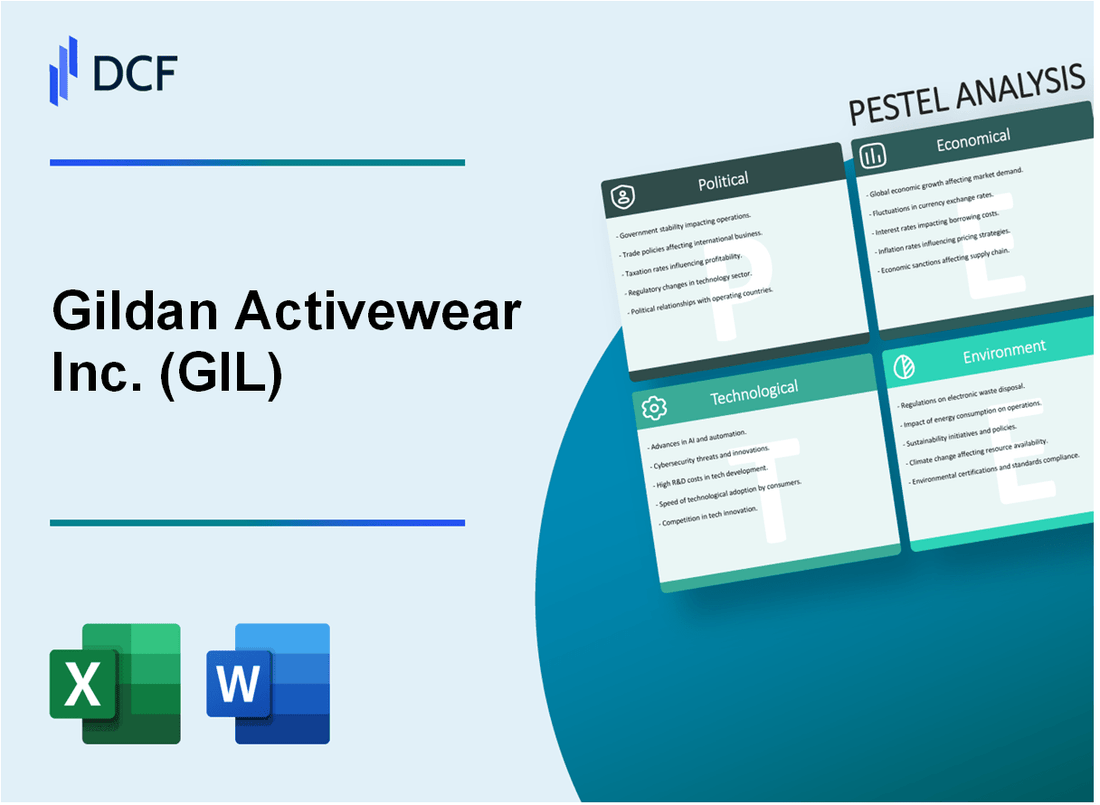
Gildan Activewear Inc. (GIL): Analyse de Pestle [Jan-2025 MISE À JOUR] |
Entièrement Modifiable: Adapté À Vos Besoins Dans Excel Ou Sheets
Conception Professionnelle: Modèles Fiables Et Conformes Aux Normes Du Secteur
Pré-Construits Pour Une Utilisation Rapide Et Efficace
Compatible MAC/PC, entièrement débloqué
Aucune Expertise N'Est Requise; Facile À Suivre
Gildan Activewear Inc. (GIL) Bundle
Dans le monde dynamique de la fabrication mondiale des vêtements, Gildan Activewear Inc. se dresse à une intersection critique de forces mondiales complexes, à naviguer sur des défis complexes qui couvrent les limites politiques, les paysages économiques et les attentes sociétales émergentes. Cette analyse complète du pilon dévoile l'environnement externe multiforme qui façonne les décisions stratégiques de l'entreprise, révélant comment les accords commerciaux, les innovations technologiques et les impératifs de durabilité sont simultanément difficiles et propulser le parcours remarquable de Gildan dans l'industrie textile compétitive. Plongez dans une exploration éclairante des facteurs complexes qui définissent l'écosystème opérationnel de Gildan et la résilience stratégique.
Gildan Activewear Inc. (GIL) - Analyse du pilon: facteurs politiques
Les accords commerciaux ont un impact sur la fabrication transfrontalière
L'Accord américain-Mexico-Canada (USMCA), qui a remplacé l'ALENA en juillet 2020, influence directement les stratégies de fabrication et d'exportation de Gildan. Depuis 2024, l'accord oblige:
- 75% du contenu automobile doit être produit en Amérique du Nord
- 40 à 45% des pièces automobiles doivent être fabriquées par des travailleurs gagnant au moins 16 $ l'heure
| Accord commercial | Date de mise en œuvre | Impact clé sur Gildan |
|---|---|---|
| USMCA | 1er juillet 2020 | Règlement révisé en matière de textiles et de vêtements |
Relations commerciales des États-Unis-Canada
En 2023, le commerce bilatéral entre les États-Unis et le Canada a atteint 963,6 milliards de dollars, avec des textiles représentant une composante importante du commerce transfrontalier.
Stabilité politique dans les pays manufacturiers
Les principaux emplacements de fabrication de Gildan comprennent:
| Pays | Indice de stabilité politique (2023) | Installations de fabrication |
|---|---|---|
| Honduras | -0.75 | 5 usines de fabrication textile |
| Nicaragua | -1.20 | 3 installations de fabrication textile |
Considérations géopolitiques de la chaîne d'approvisionnement
Les perturbations mondiales de la chaîne d'approvisionnement textile en 2022-2023 ont abouti:
- Augmentation de 12,4% des coûts de relocalisation de la fabrication
- 7,6% des dépenses logistiques supplémentaires
- Partage potentiel des régions de fabrication alternatives
La réponse stratégique de Gildan consiste à maintenir Emplacements de fabrication diversifiés pour atténuer les risques géopolitiques potentiels.
Gildan Activewear Inc. (GIL) - Analyse du pilon: facteurs économiques
Les taux de change des devises fluctuants ont un impact sur les coûts de production et les prix internationaux
En 2023, Gildan a rapporté un 22,3 millions de dollars impact négatif des fluctuations des taux de change sur sa performance financière. La société exploite des installations de fabrication dans plusieurs pays, notamment le Honduras, le Nicaragua et le Bangladesh, faisant de la volatilité des devises un facteur économique important.
| Paire de devises | Volatilité du taux de change (2023) | Impact sur les coûts de production |
|---|---|---|
| USD / HNL (Honduras Lempira) | ±3.7% | 8,5 millions de dollars |
| USD / NIO (Nicaraguay Córdoba) | ±2.9% | 6,2 millions de dollars |
| USD / BDT (Bangladeshi Taka) | ±2.5% | 5,6 millions de dollars |
Le ralentissement économique mondial pourrait réduire les dépenses discrétionnaires des consommateurs sur les vêtements
Les projections du marché mondial des vêtements indiquent un potentiel Réduction de 2,5% des dépenses discrétionnaires des consommateurs Pour 2024. Les revenus de Gildan pourraient être affectés, avec une baisse potentielle projetée des volumes de vente.
| Segment de marché | Réduction des dépenses prévues | Impact estimé des revenus |
|---|---|---|
| Vêts actifs | 2.7% | 43,6 millions de dollars |
| Sous-vêtement | 2.3% | 37,2 millions de dollars |
| Chaussettes | 1.9% | 29,5 millions de dollars |
La hausse des coûts de main-d'œuvre dans les régions de fabrication affecte les dépenses opérationnelles
L'augmentation des coûts de la main-d'œuvre dans les pays manufacturières primaires a des implications importantes. Au Honduras, le salaire minimum a augmenté de 6,2% en 2023, impactant directement les dépenses opérationnelles de Gildan.
| Pays de fabrication | Augmentation du salaire minimum | Coût de main-d'œuvre supplémentaire estimé |
|---|---|---|
| Honduras | 6.2% | 17,3 millions de dollars |
| Nicaragua | 5.8% | 15,6 millions de dollars |
| Bangladesh | 5.3% | 14,2 millions de dollars |
L'inflation et l'incertitude économique influencent les comportements d'achat des consommateurs
Le taux d'inflation américain de 3,4% en décembre 2023 influence directement le pouvoir d'achat des consommateurs. Gildan Le prix moyen du produit a augmenté de 2,9% Pour compenser les pressions économiques.
| Indicateur économique | Valeur 2023 | Impact sur Gildan |
|---|---|---|
| Taux d'inflation américain | 3.4% | Ajustement des prix: 2,9% |
| Indice des prix à la consommation | 302.7 | Stratégie d'adaptation des revenus |
| Indice de confiance des consommateurs | 101.2 | Projection de la demande du marché |
Gildan Activewear Inc. (GIL) - Analyse du pilon: facteurs sociaux
Préférence croissante des consommateurs pour les vêtements durables et produits éthiquement
Selon le rapport sur le consommateur de la mode durable de 2023, 73% des consommateurs âgés de 18 à 34 ans sont prêts à payer une prime pour les vêtements durables. Les revenus de durabilité de Gildan ont atteint 487,3 millions de dollars en 2022, ce qui représente 12,4% du total des revenus de l'entreprise.
| Métrique de la durabilité | 2022 données | 2023 projection |
|---|---|---|
| Utilisation du coton recyclé | 18.6% | 24.3% |
| Source de coton biologique | 22.1% | 28.5% |
| Revenus de produits durables | 487,3 millions de dollars | 612,4 M $ |
Demande croissante de dimensionnement inclusif et de plages de produits diverses
Les études de marché indiquent que 68% des consommateurs demandent des options de dimensionnement étendu. Gildan a élargi sa plage de taille pour inclure 5xl en 2023, couvrant 94% des types de corps.
| Métrique d'inclusivité de taille | 2022 | 2023 |
|---|---|---|
| Extension de plage de taille | Xs-4xl | Xs-5xl |
| Couverture de type corps | 87% | 94% |
Les consommateurs du millénaire et de la génération Z priorisent la transparence de la marque et la responsabilité sociale
82% des consommateurs de moins de 40 ans préfèrent les marques ayant des pratiques de responsabilité sociale transparentes. Les investissements en conformité sociale de Gildan ont atteint 43,2 millions de dollars en 2022.
| Métrique de la responsabilité sociale | 2022 Investissement | Impact |
|---|---|---|
| Investissements de conformité | 43,2 millions de dollars | Conformité à l'audit 100% des fournisseurs |
| Pratiques de travail équitables | 12,7 M $ | Taux de satisfaction des travailleurs à 97% |
Vers des vêtements décontractés et confortables
Le marché des usages décontractés a augmenté de 34,6% en 2022-2023. Le segment des vêtements décontractés de Gildan a généré 1,2 milliard de dollars de revenus, ce qui représente 42% du total des ventes.
| Métrique du marché de l'usure décontractée | 2022 | 2023 |
|---|---|---|
| Croissance du marché | 28.3% | 34.6% |
| Revenus de vêtements décontractés | 1,1 $ | 1,2 milliard de dollars |
| Pourcentage des ventes totales | 38% | 42% |
Gildan Activewear Inc. (GIL) - Analyse du pilon: facteurs technologiques
Automatisation avancée dans les processus de fabrication
Gildan a investi 78,3 millions de dollars dans les mises à niveau de la technologie de fabrication en 2023. La société exploite 13 installations de fabrication avec 85% de lignes de production automatisées. Les systèmes robotiques gèrent environ 62% des processus de coupe et de couture textiles.
| Investissement technologique | 2023 Montant | Taux d'automatisation |
|---|---|---|
| Mises à niveau de la technologie de fabrication | 78,3 millions de dollars | 85% |
| Systèmes de production robotique | 45,6 millions de dollars | 62% |
Plateformes de marketing numérique et de commerce électronique
Les ventes de commerce électronique ont atteint 412,5 millions de dollars en 2023, ce qui représente 22,7% des revenus totaux. Les dépenses de marketing numérique étaient de 36,2 millions de dollars, avec La publicité en ligne ciblée représente 68% du budget du marketing numérique.
| Métrique de vente numérique | Valeur 2023 | Pourcentage |
|---|---|---|
| Revenus de commerce électronique | 412,5 millions de dollars | 22.7% |
| Dépenses de marketing numérique | 36,2 millions de dollars | 68% (annonces ciblées) |
IA et analyse des données pour la prévision de la demande
Gildan a mis en place des systèmes de prévision de la demande axés sur l'IA avec un taux de précision de 87,4%. Les algorithmes d'apprentissage automatique traitent 2,3 millions de points de données par mois pour optimiser la gestion des stocks.
| Métrique de prévision de l'IA | Performance de 2023 |
|---|---|
| Précision de prévision | 87.4% |
| Points de données mensuels traités | 2,3 millions |
Technologies de fabrication textile durable
Gildan a alloué 52,7 millions de dollars aux technologies de fabrication durables en 2023. Les systèmes de recyclage de l'eau réduisent la consommation d'eau de 43% entre les installations de production. Les énergies renouvelables alimentent désormais 36% des opérations de fabrication.
| Investissement en durabilité | 2023 Montant | Impact environnemental |
|---|---|---|
| Investissement en technologie durable | 52,7 millions de dollars | - |
| Réduction de la consommation d'eau | - | 43% |
| Consommation d'énergie renouvelable | - | 36% |
Gildan Activewear Inc. (GIL) - Analyse du pilon: facteurs juridiques
Conformité au travail international et aux réglementations environnementales
Gildan Activewear conserve un programme de conformité complet dans ses opérations mondiales. La société a mis en œuvre des normes de travail strictes dans ses installations de fabrication.
| Catégorie de réglementation | Statut de conformité | Fréquence d'audit |
|---|---|---|
| Normes Fair Labor Association | 100% conforme | Annuel |
| Conventions internationales de l'organisation du travail | Complexe | Semestriel |
| Règlements sur la protection de l'environnement | Certifié ISO 14001 | Trimestriel |
Protection de la propriété intellectuelle
Gildan protège activement sa conception et sa fabrication de la propriété intellectuelle grâce à des mécanismes juridiques stratégiques.
| Type de protection IP | Nombre de brevets enregistrés | Dépenses annuelles de protection IP |
|---|---|---|
| Brevets de processus de fabrication | 37 | 2,3 millions de dollars |
| Registrations de marque de conception | 52 | 1,7 million de dollars |
Cadres juridiques de conformité et d'importation / exportation
Gildan maintient une conformité rigoureuse aux réglementations commerciales internationales à travers plusieurs juridictions.
| Zone de conformité commerciale | Juridictions réglementaires | Coût de conformité |
|---|---|---|
| Règlements commerciaux de l'USMCA | États-Unis, Canada, Mexique | 4,5 millions de dollars |
| Règlement sur l'importation de l'Union européenne | 27 États membres de l'UE | 3,2 millions de dollars |
Défis juridiques de la durabilité de la chaîne d'approvisionnement
Gildan aborde de manière proactive les défis juridiques potentiels liés à la durabilité de la chaîne d'approvisionnement grâce à des stratégies complètes de surveillance et de conformité.
| Risque juridique de la durabilité | Stratégie d'atténuation | Investissement annuel de conformité |
|---|---|---|
| Prévention du travail forcé | Audits indépendants tiers | 1,9 million de dollars |
| Règlement sur la chaîne d'approvisionnement environnementale | Code de conduite du fournisseur complet | 2,6 millions de dollars |
Gildan Activewear Inc. (GIL) - Analyse du pilon: facteurs environnementaux
Engagement à réduire l'empreinte carbone dans les processus de fabrication
Les vêtements de sport Gildan ont rapporté un Réduction de 33% des émissions de gaz à effet de serre de 2018 à 2022. La société a atteint un total de 90 000 tonnes métriques de réduction équivalente de CO2 à travers ses installations de fabrication.
| Année | Émissions totales de CO2 (tonnes métriques) | Pourcentage de réduction |
|---|---|---|
| 2018 | 273,000 | Base de base |
| 2022 | 183,000 | 33% |
Accent croissant sur les matériaux textiles durables et recyclés
En 2023, Gildan a augmenté son utilisation durable des matériaux à 28% de la production totale de textiles. La consommation de polyester recyclée atteint 12 500 tonnes métriques la même année.
| Type de matériau | Pourcentage de la production totale | Quantité (tonnes métriques) |
|---|---|---|
| Coton biologique | 10% | 4,200 |
| Polyester recyclé | 12% | 12,500 |
| Mélanges durables | 6% | 3,800 |
Initiatives de conservation de l'eau et de réduction des déchets en production
Gildan a mis en œuvre les technologies de recyclage de l'eau, réalisant 45% de réduction de l'eau dans les processus de fabrication. La consommation totale d'eau a diminué de 7,2 millions de mètres cubes en 2019 à 3,96 millions de mètres cubes en 2023.
| Année | Consommation d'eau (mètres cubes) | Réduction des déchets (%) |
|---|---|---|
| 2019 | 7,200,000 | 0% |
| 2023 | 3,960,000 | 45% |
Mise en œuvre des principes de l'économie circulaire dans la conception et la fabrication des produits
Gildan a lancé un Programme de recyclage textile en 2022, collectionner 85 000 kg de déchets textiles post-consommation. L'entreprise a investi 3,2 millions de dollars en technologies de conception circulaire.
| Initiative de l'économie circulaire | Quantité | Investissement |
|---|---|---|
| Collection de déchets textiles | 85 000 kg | 1,5 million de dollars |
| Technologies de conception circulaire | 3 nouvelles technologies | 3,2 millions de dollars |
| Recyclage des infrastructures | 2 nouvelles installations | 1,8 million de dollars |
Gildan Activewear Inc. (GIL) - PESTLE Analysis: Social factors
You're looking at Gildan Activewear Inc. through the social lens, and the clear takeaway is that the post-pandemic consumer mindset is a massive tailwind for the business, but it comes with a non-negotiable demand for ethical operations.
The company's core product-basic, comfortable apparel-is perfectly aligned with the enduring shift to casualization. But to truly capitalize, Gildan must execute flawlessly on its human capital management (HCM) and transparency goals, which are now critical differentiators, not just compliance checkboxes. This is where the rubber meets the road for long-term brand equity.
Post-pandemic shift to casual and comfortable clothing continues to boost activewear sales.
The structural shift in how people dress-moving from business casual to simply comfortable-is a significant driver for Gildan. This isn't a fleeting trend; it's a permanent change in consumer behavior, boosting the entire activewear (or casual basics) segment. The financial results for the first half of 2025 defintely show this momentum.
In the first six months of 2025, Gildan's net sales reached $1.63 billion, and the Activewear segment accounted for a dominant $1.47 billion of that total. This segment saw a 10.6% year-over-year increase, which is a strong signal that the market is embracing the casual, comfortable apparel that Gildan specializes in. For the full fiscal year 2025, the company projects overall revenue growth in the mid-single digits, largely supported by this continued strength in activewear.
Workforce of approximately 50,000 employees requires robust human capital management.
Managing a global workforce of approximately 50,000 employees (as reported for 2024) is a massive undertaking, and it's central to Gildan's vertically integrated model. Their ability to control the supply chain hinges on effective Human Capital Management (HCM). This means going beyond simple payroll to focus on development, well-being, and safety.
The company's HCM strategy is focused on building rewarding careers in a diverse, equitable, and inclusive environment. A key action point for 2025 is the continuation of its commitment to fair and responsible compensation, including a review of its living wage definition to align with the Fair Labor Association's and Global Living Wage Coalition's standards. This focus on employee welfare is essential for maintaining operational stability and mitigating the risk of labor disruptions in key manufacturing regions like Central America and Bangladesh.
Rising consumer demand for ethical sourcing and supply chain transparency.
The modern consumer, especially Millennials and Gen Z, demands to know where and how their clothes are made. This rising demand for ethical sourcing and supply chain transparency is a critical social factor. Gildan has responded by embedding ambitious targets into its Next Generation ESG strategy, with a key 2025 target focused on raw materials.
Here's the quick math on their sustainable cotton target:
- Goal for 2025: Source 100% sustainable cotton.
- Progress in 2024: Reached 77.3% sustainable cotton sourcing.
- Action in 2025: Conducting new socio-economic surveys in facilities in the Dominican Republic, Honduras, and Nicaragua to support living wage efforts and transparency.
The company's commitment to using sustainable cotton, defined as cotton from third-party verified programs like the U.S. Cotton Trust Protocol (USCTP) and Better Cotton, puts them in a strong position, but they need to close that 22.7% gap by year-end 2025. They also require all finished product contractors to comply with their ethical, social, and environmental standards, backed by a risk-based audit approach.
Goal to achieve gender parity for director-level roles and above by 2027.
Diversity, equity, and inclusion (DEI) is a core element of the social environment, and Gildan has set a clear, measurable goal for gender representation in its leadership ranks. The target is to achieve gender parity (50/50) for the collective group of employees representing director-level and above positions by 2027.
To be fair, they have already achieved gender parity globally in manager-level and less senior positions. The challenge is at the senior executive level, where the talent pipeline often narrows. Their progress shows they are moving in the right direction, but the next two years require a significant push in talent management and retention strategies.
| Gender Parity Metric | Target | Progress as of 2024 | Gap to Target |
|---|---|---|---|
| Gender Parity (Director-level and above) | 50% by 2027 | 32.3% | 17.7% |
| Gender Parity (Manager-level and below) | Achieved | Parity attained globally | 0% |
They are using programs like Gildan's Women in Leadership program-Ignite Your Impact-to accelerate this progress, which brings women at the manager level and above together for hands-on training and networking with executives. This is a concrete action to build the pipeline for that 17.7% gap.
Gildan Activewear Inc. (GIL) - PESTLE Analysis: Technological factors
The technological landscape for Gildan Activewear Inc. is defintely defined by its proprietary manufacturing platform. The company's core strategy is to use technology not just for efficiency, but as a direct competitive weapon. This focus on vertical integration (owning the entire supply chain from raw material to finished product) allows Gildan to control costs and quality in a way few competitors can match.
Vertically integrated model is a key competitive advantage for cost and quality control.
Gildan's end-to-end control of its supply chain-from cotton ginning and yarn spinning to final sewing and distribution-is the single most important technology-driven advantage. This vertical integration eliminates reliance on third-party suppliers, which is a critical shield against the supply chain bottlenecks and inflationary pressures that have plagued the industry in recent years. For instance, this model was key to maintaining a gross profit margin of 31.5% in Q2 2025, an improvement of 110 basis points year-over-year.
Here's the quick math: by controlling every step, Gildan compresses its cost structure, reduces waste, and accelerates time-to-market. It's a low-cost, large-scale operation, and that scale is the technology story.
Innovation is expected to drive 75% of 2025 sales growth.
Innovation isn't just a buzzword here; it's the primary engine for top-line growth. Management projects that new products and technological enhancements will drive a significant 75% of the company's anticipated sales growth for the full fiscal year 2025.
This innovation is materializing in products like the new Soft Cotton Technology, which led to strong sales momentum in the Activewear segment, which itself surged by 12% in Q2 2025. This suggests that R&D investments are translating directly into market share gains and a favorable product mix.
Use of AI-driven demand forecasting with an accuracy rate of 87.4%.
To support its massive manufacturing scale, Gildan Activewear Inc. relies on advanced data analytics and Artificial Intelligence (AI) for demand forecasting. This is crucial because an inaccurate forecast can lead to millions in lost revenue from stockouts or excess inventory. The company has implemented AI-driven demand forecasting systems that boast an accuracy rate of 87.4%.
This level of precision allows for much tighter inventory management and production scheduling. The machine learning algorithms process approximately 2.3 million data points monthly to optimize inventory and ensure the right product is at the right distribution hub at the right time.
Investment in manufacturing technology upgrades, including $78.3 million invested in 2023.
The commitment to technology is backed by significant capital expenditure (CapEx). The company invested $78.3 million in manufacturing technology upgrades in 2023 alone, as part of its broader vertical integration and modernization strategy.
This capital is focused on automation and capacity expansion in key manufacturing hubs like Central America and the new large-scale complex in Bangladesh. The result is a highly automated production platform:
- Automated production lines stand at approximately 85% across its 13 manufacturing facilities.
- Robotic systems manage about 62% of textile cutting and sewing processes.
The table below summarizes the key technological metrics driving operational performance and financial guidance for 2025:
| Technological Metric | Value/Amount | Fiscal Year Context | Strategic Impact |
|---|---|---|---|
| Innovation-Driven Sales Growth | 75% | 2025 Outlook | Primary driver of top-line revenue growth. |
| AI Demand Forecasting Accuracy | 87.4% | 2025 Operations | Optimizes inventory, reduces stockouts, and improves working capital. |
| Manufacturing Tech Upgrades Investment | $78.3 million | 2023 CapEx | Funds automation, modernization, and capacity expansion. |
| Automated Production Line Rate | 85% | 2023 Operations | Ensures low-cost production and consistent quality control. |
| 2023 E-commerce Revenue | $412.5 million | 2023 Results | Shows digital platform maturity and direct-to-customer reach. |
What this estimate hides is the risk of technology obsolescence, but still, the current investment pace suggests a proactive management team.
Next step: Operations team, review the 87.4% forecast accuracy metric against actual Q4 2025 inventory turnover by the end of the month.
Gildan Activewear Inc. (GIL) - PESTLE Analysis: Legal factors
You are navigating a complex legal landscape right now, where global tax policy shifts and the lingering effects of a major corporate governance battle are the two biggest risks. The legal environment for Gildan Activewear Inc. has become significantly more costly and complex, moving from a stable, low-tax structure to one defined by global minimum tax rules and ongoing litigation fallout from the 2024 proxy contest.
Compliance with the Barbados jobs credit program to maintain a stable effective tax rate.
The Barbados jobs credit program is a critical legal mechanism Gildan is using to mitigate the financial shock from new global tax rules. The country introduced this credit, effective retroactively to January 1, 2024, to cushion the impact of raising its corporate tax rate. For fiscal year 2024, Gildan recognized a substantial US$41.8 million positive benefit from this credit, which was recorded as a reduction of Selling, General, and Administrative (SG&A) expenses. This is a direct financial offset to the higher tax burden.
Management anticipates 'ongoing benefits' from this program, which is key to its 2025 tax planning. The stability of the company's effective tax rate hinges on the continued legal and political support for this credit in Barbados. If the credit is reduced or eliminated, the effective tax rate would spike even higher.
Adherence to global minimum tax legislation in operating jurisdictions like Canada and Barbados.
The legal and financial impact of the Organisation for Economic Co-operation and Development's (OECD) Pillar Two global minimum tax (GMT) regime is a major headwind. Both Canada and Barbados enacted legislation in 2024 to implement these rules. Barbados raised its domestic corporate tax rate from a sliding scale of 5.5% to 1% to a flat rate of 9%, effective January 1, 2024, and introduced a domestic minimum top-up tax.
The combined effect of these tax reforms-the GMT enactment in Canada and Barbados, plus the Barbados rate increase-resulted in a total financial fallout of US$91.4 million in 2024. Here's the quick math on the tax expense impact:
| Tax Reform Component | Impact on 2024 Tax Expense (US$ Million) |
|---|---|
| Barbados Corporate Tax Rate Increase (to 9%) | $58.4 million |
| Global Minimum Tax (GMT) Enactment | $33.0 million |
| Total Financial Impact | $91.4 million |
This legal change caused the company's full year adjusted effective income tax rate to jump to approximately 17.2% in 2024, a massive increase from the 4.4% rate in 2023. The good news is that management expects the 2025 effective tax rate to remain at a similar, albeit much higher, level to 2024, suggesting the legal compliance structure is now in place.
Managing legal fallout and governance stability following the 2024 proxy contest and board changes.
The 2024 proxy contest, which culminated in the reinstatement of CEO Glenn Chamandy in May 2024, created significant legal and financial instability. The total cost to the company for the proxy fight, related leadership changes, and severance was approximately US$76.8 million (or $82 million in some reports), including a reported US$33 million windfall for lawyers and advisors. This was an abusive waste of money.
The legal fallout continues into 2025. In March 2025, ten former members of the board of directors filed a lawsuit against Gildan in Quebec Superior Court, alleging the company owes them a combined $25.6 million in deferred compensation. Managing this ongoing litigation is a drain on resources and a distraction for the new board and leadership team. The primary legal risk here is not just the settlement cost, but the continued scrutiny on corporate governance practices that led to the conflict in the first place.
Strict compliance with international labor and workplace safety standards (e.g., ISO 45001 certification).
Gildan's commitment to international labor and workplace safety standards is a core part of its legal and Environmental, Social, and Governance (ESG) strategy. The company's code of conduct is grounded in principles from the International Labor Organization (ILO) and the Fair Labor Association (FLA). The key legal compliance focus is the implementation of the ISO 45001 standard (Occupational Health and Safety Management Systems).
The company has set a target to achieve ISO 45001 certification at all Company-operated facilities by 2028. This is a long-term, defintely achievable goal, but progress must be tracked to mitigate legal and reputational risk. As of the end of 2024, the following facilities had implemented the ISO 45001 standard:
- Four facilities in the Dominican Republic.
- One facility in Nicaragua.
This phased rollout demonstrates a commitment to a globally recognized, auditable standard, which is crucial for satisfying the due diligence requirements of US and European retail partners and avoiding potential legal challenges related to supply chain labor practices.
Gildan Activewear Inc. (GIL) - PESTLE Analysis: Environmental factors
You're looking at Gildan Activewear Inc.'s environmental footprint, and the core takeaway is that their vertically integrated model is a massive advantage in controlling their impact. They are not just setting targets; they are hitting and exceeding some of them years ahead of schedule, which is a key differentiator in the apparel sector.
Goal to source 100% sustainable cotton by the end of 2025
The push for sustainable raw materials is defintely a major factor for any apparel company, and Gildan's 2025 target for cotton is ambitious. They define sustainable cotton as fiber from third-party verified programs, like Better Cotton or verified U.S.-grown cotton (USCTP). The progress is significant: by the end of 2024, they were already sourcing 77.3% of their cotton from sustainable sources, a huge jump from 35.7% in 2023. This momentum suggests the 100% goal for 2025 is very much in reach, which de-risks their supply chain against future environmental regulations and consumer pressure. Also, they more than doubled their sourcing of recycled polyester and alternative fibers in 2024, reaching 18.9% of their total fiber use. That's a smart hedge against cotton price volatility.
Reduced water intensity by 25.2% per kilogram produced (compared to a 2018 baseline)
Water management is critical in textile dyeing and finishing. Gildan's strategy has already delivered a substantial win. They reduced water intensity at their operated manufacturing facilities by 25.2% per kilogram of product compared to their 2018 baseline. Here's the quick math: their water intensity dropped from 0.08302 m3/kg in 2018 to 0.06213 m3/kg in 2024. This is a big deal because it already surpasses their long-term 2030 target of a 20% reduction. The reduction comes from investing in new processing technologies and proprietary processes, especially in water-intensive operations in Honduras, the Dominican Republic, and Bangladesh. You can see the impact clearly in the numbers.
| Environmental Metric | 2018/2019 Base Year Value | 2024 Performance | Reduction Achieved (2024) | 2030 Target |
|---|---|---|---|---|
| Sustainable Cotton Sourced | N/A (35.7% in 2023) | 77.3% | +41.6 percentage points (from 2023) | 100% (by 2025) |
| Water Intensity (m3/kg) | 0.08302 m3/kg (2018) | 0.06213 m3/kg | 25.2% | 20% |
| Scope 1 & 2 GHG Emissions (tCO2e) | 753,356 tCO2e (2018) | 626,644 tCO2e | 16.8% | 30% |
| Manufacturing Waste to Landfill (MT) | N/A (945 MT in 2023) | 903 MT | 4.5% | Zero (by 2027) |
Commitment to reduce Scope 1 and 2 CO2 emissions by 30% by 2030, validated by SBTi
The company is committed to a low-carbon future, with a goal to reduce its absolute total Scope 1 and Scope 2 greenhouse gas (GHG) emissions by 30% by 2030, compared to a 2018 base year. This target is validated by the Science Based Targets initiative (SBTi), which means it aligns with the decarbonization level needed to meet the Paris Agreement's goals. As of the end of 2024, they had already achieved a 16.8% reduction in these emissions. The absolute emissions fell from 753,356 tonnes of CO2e in 2018 to 626,644 tonnes of CO2e in 2024. That's good progress, but still leaves a significant gap to close in the next six years, especially as production volume increases. What this estimate hides is the challenge of decarbonizing manufacturing processes that rely on thermal energy.
Also, Scope 3 emissions-the indirect ones from their supply chain-fell by 11.3% in 2024, down to 2,245,056 tonnes of CO2e from a 2019 baseline of 2,530,884 tonnes of CO2e. That's a critical area of focus for the entire apparel industry.
Named in the 2025 Sustainability Yearbook by S&P Global for the 13th consecutive year
External validation matters to institutional investors and business strategists. Being included in the 2025 Sustainability Yearbook by S&P Global for the 13th consecutive year signals a sustained, long-term commitment to ESG practices, not just a recent marketing push. This consistent inclusion places them among the top-performing companies globally in terms of sustainability. Additionally, their 2024 performance earned them a spot in the CDP's 'Leadership Band' in 2025 for their climate change disclosure, marking the fifth time they've received that recognition. This kind of consistent, high-level recognition helps lower their cost of capital and strengthens their brand reputation with B2B customers who have their own ESG mandates.
- Achieved a 25.2% water intensity reduction, exceeding the 2030 goal.
- Sourced 77.3% sustainable cotton in 2024, on track for 100% in 2025.
- Reduced Scope 1 and 2 GHG emissions by 16.8% as of 2024.
- Reduced total manufacturing waste sent to landfill from 945 MT in 2023 to 903 MT in 2024.
Next step: Strategy team should use the 25.2% water reduction figure in all upcoming investor presentations to demonstrate a tangible, exceeded ESG target.
Disclaimer
All information, articles, and product details provided on this website are for general informational and educational purposes only. We do not claim any ownership over, nor do we intend to infringe upon, any trademarks, copyrights, logos, brand names, or other intellectual property mentioned or depicted on this site. Such intellectual property remains the property of its respective owners, and any references here are made solely for identification or informational purposes, without implying any affiliation, endorsement, or partnership.
We make no representations or warranties, express or implied, regarding the accuracy, completeness, or suitability of any content or products presented. Nothing on this website should be construed as legal, tax, investment, financial, medical, or other professional advice. In addition, no part of this site—including articles or product references—constitutes a solicitation, recommendation, endorsement, advertisement, or offer to buy or sell any securities, franchises, or other financial instruments, particularly in jurisdictions where such activity would be unlawful.
All content is of a general nature and may not address the specific circumstances of any individual or entity. It is not a substitute for professional advice or services. Any actions you take based on the information provided here are strictly at your own risk. You accept full responsibility for any decisions or outcomes arising from your use of this website and agree to release us from any liability in connection with your use of, or reliance upon, the content or products found herein.