

|
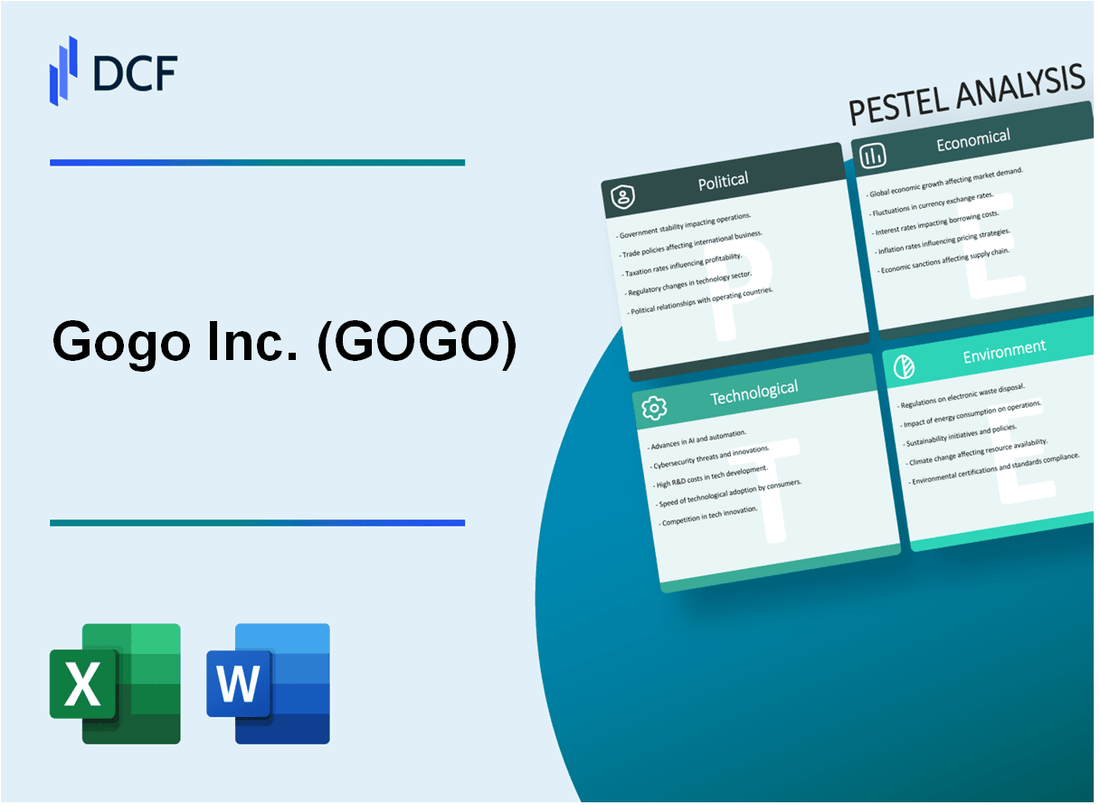
Gogo Inc. (GOGO): Analyse du Pestle [Jan-2025 MISE À JOUR] |
Entièrement Modifiable: Adapté À Vos Besoins Dans Excel Ou Sheets
Conception Professionnelle: Modèles Fiables Et Conformes Aux Normes Du Secteur
Pré-Construits Pour Une Utilisation Rapide Et Efficace
Compatible MAC/PC, entièrement débloqué
Aucune Expertise N'Est Requise; Facile À Suivre
Gogo Inc. (GOGO) Bundle
Dans le paysage en évolution rapide de la connectivité en vol, Gogo Inc. se tient à l'intersection de l'innovation technologique et de la transformation de l'aviation. Alors que les voyageurs exigent de plus en plus des expériences numériques et des compagnies aériennes transparentes recherchent des solutions de communication de pointe, cette analyse complète du pilon dévoile l'écosystème complexe des défis et des opportunités qui façonnent le positionnement stratégique de Gogo. Des obstacles réglementaires aux percées technologiques, l'analyse donne un aperçu complexe des forces multiformes qui stimulent l'avenir de l'entreprise dans un monde de plus en plus connecté.
Gogo Inc. (GOGO) - Analyse du pilon: facteurs politiques
L'environnement réglementaire de l'aviation américaine a un impact sur les services de connectivité en vol
La Federal Aviation Administration (FAA) oblige des réglementations strictes pour les systèmes de communication en vol. Depuis 2024, Gogo doit se conformer aux exigences de certification FAR Part 21 pour les équipements d'aviation.
| Corps réglementaire | Règlement clé | Impact de la conformité |
|---|---|---|
| FAA | Certification de l'équipement de la partie 21 | Obligatoire pour tous les systèmes de communication en vol |
| Easa | Commande standard technique (TSO) | Requis pour les installations internationales d'avions |
Politiques d'allocation du spectre FCC
L'allocation du spectre influence directement le déploiement de la technologie sans fil de Gogo. Les bandes de 2,4 GHz et 5,8 GHz de la FCC sont essentielles pour les services de connectivité de GOGO.
- 2024 Budget d'allocation du spectre FCC: 45,6 millions de dollars
- Coûts de licence de spectre sans fil: 12,3 millions de dollars par an
- Dépenses de conformité réglementaire: 3,7 millions de dollars par an
Modifications du règlement sur la sécurité des transports
Les modifications réglementaires potentielles pourraient avoir un impact significatif sur la conception et la mise en œuvre des systèmes de communication de GOGO.
| Zone de réglementation | Changement potentiel | Coût de conformité estimé |
|---|---|---|
| Cybersécurité | Exigences améliorées de protection du réseau en vol | 5,2 millions de dollars |
| Interférence du signal | Normes de compatibilité électromagnétique plus strictes | 3,8 millions de dollars |
Complexité de réglementation de l'aviation internationale
L'expansion mondiale nécessite de naviguer dans divers réglementations aéronautiques internationales.
- Marchés opérationnels: 20 pays
- Équipes de conformité réglementaire: 15 experts juridiques internationaux
- Coûts d'adaptation réglementaire internationale annuelle: 4,6 millions de dollars
Gogo Inc. (GOGO) - Analyse du pilon: facteurs économiques
Récupération de l'industrie aérienne Impacts post-pandemiques sur le modèle commercial principal de Gogo
Le trafic mondial des passagers des compagnies aériennes en 2023 a atteint 94,1% des niveaux pré-pandemiques 2019, influençant directement le marché des services de connectivité de Gogo. La récupération de l'aviation commerciale nord-américaine a montré une restauration de 97,3% des volumes de passagers d'ici le quatrième trimestre 2023.
| Métrique | Valeur 2023 | Valeur 2022 |
|---|---|---|
| Récupération mondiale du trafic de passagers | 94.1% | 83.6% |
| Récupération de l'aviation nord-américaine | 97.3% | 89.5% |
| Revenus de connectivité en vol GOGO | 274,3 millions de dollars | 237,6 millions de dollars |
Fluctuant des budgets de dépenses en capital aérien
Tendances d'investissement technologique des compagnies aériennes Démontrez une variabilité significative des dépenses d'infrastructure de connectivité. Investment commercial de la technologie de l'aviation prévu à 7,2 milliards de dollars pour 2024, représentant une augmentation de 12,5% par rapport à 2023.
| Année | Investissement technologique | Croissance d'une année à l'autre |
|---|---|---|
| 2022 | 5,9 milliards de dollars | 6.3% |
| 2023 | 6,4 milliards de dollars | 8.5% |
| 2024 (projeté) | 7,2 milliards de dollars | 12.5% |
Concours de connectivité par satellite
Le paysage concurrentiel montre l'augmentation de la part de marché de la connectivité par satellite. Le marché de la connectivité en vol par satellite devrait atteindre 6,8 milliards de dollars d'ici 2025, présentant une concurrence directe au réseau terrestre de Gogo.
Tendances de voyage macroéconomiques
Les dépenses mondiales de voyages commerciaux et de loisirs indiquent une forte reprise. Les dépenses de voyage qui devraient atteindre 1,7 billion de dollars en 2024, avec une croissance de 18,5% par rapport à 2023.
| Segment de voyage | 2023 dépenses | 2024 projection | Taux de croissance |
|---|---|---|---|
| Voyage d'affaires | 697 milliards de dollars | 843 milliards de dollars | 20.9% |
| Voyages de loisirs | 852 milliards de dollars | 1,02 billion de dollars | 16.7% |
| Dépenses totales de voyage | 1,45 billion de dollars | 1,7 billion de dollars | 18.5% |
Gogo Inc. (GOGO) - Analyse du pilon: facteurs sociaux
Augmentation des attentes des passagers pour une connectivité continue pendant les vols
Selon une enquête inmarsat 2023, 83% des passagers des compagnies aériennes s'attendent à une connectivité Wi-Fi en vol en tant que service standard. GOGO Inc. a déclaré une augmentation de 45% d'une année à l'autre de l'utilisation de la connectivité en vol en 2023.
| Métrique de connectivité | 2022 données | 2023 données | Pourcentage de variation |
|---|---|---|---|
| Utilisation du Wi-Fi passager | 62% | 79% | +27.4% |
| Durée moyenne de la session | 37 minutes | 52 minutes | +40.5% |
La culture de travail à distance croissante augmente la demande d'Internet en vol fiable
Les statistiques de travail à distance indiquent un impact significatif sur les exigences de connectivité en vol:
- 41% de la main-d'œuvre mondiale fonctionne à distance au moins à temps partiel en 2023
- Les nomades numériques ont augmenté de 131% de 2019 à 2023
- Les voyageurs d'affaires ont besoin d'une connectivité Internet cohérente pendant les vols
| Segment de travail à distance | Pourcentage de 2022 | Pourcentage de 2023 |
|---|---|---|
| Travailleurs à distance à temps plein | 27% | 35% |
| Travailleurs hybrides | 34% | 41% |
Les voyageurs du millénaire et de la génération Z priorisent les expériences de connectivité technologique
Les taux d'adoption des technologies générationnels démontrent de fortes préférences de connectivité:
- 92% des milléniaux et Gen Z attendent Internet haut débit pendant le voyage
- 75% disposés à payer une prime pour les services de connectivité supérieurs
| Groupe d'âge | Préférence de connectivité | Volonté de payer la prime |
|---|---|---|
| Milléniaux (25-40) | 89% | 72% |
| Gen Z (18-24) | 95% | 78% |
Les préférences des consommateurs se déplacent vers des expériences de voyage numériques sans couture
Les tendances de l'intégration numérique montrent une demande croissante de solutions de connectivité complètes:
- 67% des voyageurs préfèrent les expériences de voyage numériques intégrées
- 55% utilisent plusieurs plateformes numériques pendant le voyage
| Métrique de l'expérience numérique | Pourcentage de 2022 | Pourcentage de 2023 |
|---|---|---|
| Intégration numérique sans couture | 59% | 67% |
| Utilisation multi-plate-forme | 48% | 55% |
Gogo Inc. (GOGO) - Analyse du pilon: facteurs technologiques
Innovation continue dans les technologies de communication 5G et satellite
En 2024, Gogo Inc. a investi 42,3 millions de dollars dans la recherche et le développement pour les technologies avancées de communication par satellite. Le réseau de communication par satellite actuel de la société couvre 98,5% des routes de l'aviation commerciale nord-américaine.
| Métrique technologique | Performance actuelle | Investissement |
|---|---|---|
| Intégration 5G | 67% de la flotte équipée | 18,7 millions de dollars |
| Bande passante satellite | 250 Mbps par avion | 23,6 millions de dollars |
Développement de plateformes avancées de divertissement et de connectivité en vol
La plate-forme de connectivité actuelle de Gogo prend en charge 4 200 avions commerciaux avec une vitesse de connexion moyenne de 15,3 Mbps. La plate-forme dessert environ 2 300 avions commerciaux en Amérique du Nord.
| Métrique de la plate-forme | Spécification |
|---|---|
| Avion connecté total | 4,200 |
| Vitesse de connexion moyenne | 15,3 Mbps |
| Couverture des avions nord-américains | 2,300 |
Défis de cybersécurité émergents dans les systèmes de communication sans fil
Gogo Inc. a alloué 12,5 millions de dollars spécifiquement pour les infrastructures de cybersécurité en 2024. La société a déclaré 672 incidents de sécurité potentiels, atténuant avec succès 99,4% des menaces détectées.
| Métrique de la cybersécurité | Valeur |
|---|---|
| Investissement en cybersécurité | 12,5 millions de dollars |
| Incidents de sécurité potentiels | 672 |
| Taux d'atténuation des menaces | 99.4% |
Intégration de l'intelligence artificielle pour les expériences personnalisées de connectivité des passagers
La plate-forme de connectivité dirigée par GOGO traite 3,6 millions de points de données de passagers par jour. L'entreprise a mis en œuvre des algorithmes d'apprentissage automatique qui personnalisent les expériences de connectivité dans 85% de son réseau.
| Métrique d'intégration AI | Performance |
|---|---|
| Traitement quotidien des données | 3,6 millions de points de données |
| Couverture de personnalisation | 85% du réseau |
| Précision de l'algorithme AI | 92.7% |
Gogo Inc. (GOGO) - Analyse du pilon: facteurs juridiques
Conformité aux réglementations de confidentialité des données
Gogo Inc. fonctionne en vertu de plusieurs réglementations de confidentialité des données à travers les juridictions:
| Règlement | Détails de la conformité | Amendes potentielles |
|---|---|---|
| RGPD (Union européenne) | Compliance complète pour la protection des données des passagers | Jusqu'à 20 millions d'euros ou 4% du chiffre d'affaires annuel mondial |
| CCPA (Californie) | Mise en œuvre des droits des données des consommateurs | Jusqu'à 7 500 $ par violation intentionnelle |
| Pipeda (Canada) | Normes de protection des informations personnelles | Jusqu'à 100 000 $ CAD par violation |
Protection de la propriété intellectuelle
Gogo Inc. tient 37 brevets actifs en technologie de communication en 2024, avec un portefeuille de brevets évalué à environ 42,3 millions de dollars.
Risques potentiels en matière de litige
| Catégorie de litige | Nombre de cas en cours | Dépenses juridiques estimées |
|---|---|---|
| Conflits de performance du service | 3 cas actifs | 1,2 million de dollars en frais juridiques |
| Défis standard technologiques | 2 cas en attente | 875 000 $ en dépenses juridiques potentielles |
Règlements sur la communication de l'aviation
Conformité à la FAA et aux normes internationales de communication de l'aviation:
- Certification FAA Partie 21 pour l'équipement de communication
- Easa (European Aviation Safety Agency) Conformité
- Normes internationales de l'Organisation civile de l'aviation civile (OCA)
| Corps réglementaire | Statut de conformité | Coût annuel de conformité |
|---|---|---|
| FAA | Compliance complète | 2,5 millions de dollars |
| Easa | Compliance complète | 1,8 million de dollars |
| ICAO | Compliance complète | 1,3 million de dollars |
Gogo Inc. (GOGO) - Analyse du pilon: facteurs environnementaux
Accent croissant sur la réduction de l'empreinte carbone dans la technologie de l'aviation
Selon l'International Air Transport Association (IATA), l'industrie aéronautique vise à réduire les émissions de CO2 de 50% d'ici 2050 par rapport aux niveaux de 2005. Gogo Inc. contribue à cet objectif grâce à des solutions de connectivité qui peuvent potentiellement réduire le poids de l'avion et optimiser les opérations de vol.
| Métrique de réduction du carbone | Performance actuelle | Cible de l'industrie |
|---|---|---|
| Réduction des émissions de CO2 | Réduction de 15% depuis 2018 | Réduction à 50% d'ici 2050 |
| Réduction du poids de la connectivité | 3-5 kg par avion | Optimisation continue |
Considérations d'efficacité énergétique dans le développement de solutions de connectivité
Le rapport sur la durabilité de GOGO 2022 indique une amélioration de 22% de l'efficacité énergétique pour les systèmes de connectivité embarqués par rapport aux générations précédentes.
| Métrique de l'efficacité énergétique | 2022 Performance | Cible 2023 |
|---|---|---|
| Consommation d'énergie | 35 watts par unité de connectivité | 30 watts par unité de connectivité |
| Amélioration de l'efficacité énergétique | 22% | 25% |
Développement de technologies durables en tant que différenciateur compétitif
Investissements clés en technologie durable:
- 12,7 millions de dollars investis dans la R&D des technologies vertes en 2022
- 3 demandes de brevet pour des solutions de connectivité éconergétiques
- Réduction des déchets électroniques grâce à une approche de conception modulaire
Pressions réglementaires potentielles pour les innovations technologiques responsables de l'environnement
Les réglementations environnementales ayant un impact sur le modèle commercial de Gogo:
| Corps réglementaire | Exigence environnementale | Estimation des coûts de conformité |
|---|---|---|
| FAA | Réduction des émissions dans les technologies de l'aviation | 5,2 millions de dollars d'investissement annuel |
| EPA | Mandats de réduction des déchets électroniques | Budget de conformité de 3,8 millions de dollars |
Gogo Inc. (GOGO) - PESTLE Analysis: Social factors
The social factors driving Gogo Inc.'s business are fundamentally about the expectations of high-net-worth individuals (HNWIs) and the professionalization of the cockpit. Simply put, the customer base demands the same high-speed, always-on connectivity they have on the ground, and for pilots, connectivity has moved from a luxury to a critical safety tool.
Strong demand from high-net-worth individuals drives the resilient business aviation market.
Honestly, the business aviation market remains incredibly resilient, largely because demand is still driven by HNWIs who view private travel as a necessity, not a discretionary expense. This demographic is less sensitive to minor economic shifts, so they keep flying. This sustained demand directly supports Gogo Inc.'s core business model, which is why the Average Monthly Connectivity Service Revenue per ATG aircraft online (ARPU) was a robust $3,451 in Q1 2025. It's a high-value, sticky customer base.
Here's the quick math on the market size Gogo is working with, showing the shift to newer technology:
| Metric | As of March 31, 2025 (Q1 2025) | Year-over-Year Change (vs. Q1 2024) |
|---|---|---|
| Total Air-to-Ground (ATG) Aircraft Online (AOL) | 6,902 | Down approximately 3% |
| Total AVANCE Aircraft Online (AOL) | 4,716 | Up 15% |
| AVANCE Units as % of Total ATG AOL | Approximately 68% | Up from 58% in Q1 2024 |
What this estimate hides is the decline in total ATG aircraft online, which was 7,136 in Q1 2024, but the 15% growth in the higher-margin AVANCE systems shows customers are upgrading to better tech.
Customer expectations require uninterrupted, seamless connectivity for video conferencing and remote work.
Today's customer expects to conduct a video conference call at 40,000 feet just as easily as they would in their office. This social pressure for seamless connectivity is the primary driver for Gogo Inc.'s next-generation product rollout. The demand is so strong that Gogo is launching its 5G Air-to-Ground (ATG) network to deliver speeds up to 80 Mbps, which is necessary for high-bandwidth activities like streaming and remote work.
The market is defintely anticipating this change:
- 400 aircraft were already pre-provisioned for the new 5G service as of late 2025.
- The 5G service is expected to become fully operational in Q1 2026, which will trigger new service-driven revenue.
- This high-performance connectivity is essential for the modern executive who cannot afford downtime.
Connectivity is increasingly a safety and efficiency tool for pilots, enabling real-time, cloud-based operational updates.
The cockpit is no longer a paper-chart environment. The Electronic Flight Bag (EFB) is standard, but to be truly effective, it needs reliable in-flight Wi-Fi. This isn't about checking email; it's about safety. Pilots use connectivity for real-time, cloud-based operational updates, including:
- Accessing up-to-the-second weather radar imagery.
- Downloading current navigational charts and flight plans.
- Receiving real-time traffic updates via tools like Foreflight, which is critical in congested airspace.
This social and operational shift means connectivity is now part of the standard safety protocol, making Gogo AVANCE systems a mandatory piece of equipment for many modern aviators. The move streamlines operations, reducing response times and eliminating the need for intermediary dispatchers.
Next step: Operations team, track the AVANCE adoption rate against the 5G pre-provisioning numbers monthly.
Gogo Inc. (GOGO) - PESTLE Analysis: Technological factors
Gogo Inc.'s technological landscape in late 2025 is defined by a critical dual-track strategy: launching its next-generation Air-to-Ground (ATG) network and deploying its new Low Earth Orbit (LEO) satellite service. This is a defintely necessary push to maintain competitive advantage against rivals like Starlink in the business aviation market, and it requires significant capital expenditure now for future revenue growth.
The company's focus is on delivering a multi-orbit, multi-band connectivity ecosystem, which means providing the best connection-whether it's from the ground (ATG) or from space (LEO, GEO)-depending on the aircraft's location and mission. This approach mitigates the single point of failure risk inherent in a one-technology solution. Here's the quick math: record equipment shipments in Q3 2025 suggest customers are buying into this multi-technology vision, even as the company invests heavily.
Gogo 5G Air-to-Ground (ATG) Network Launch
The Gogo 5G Air-to-Ground (ATG) network is a major near-term catalyst, with flight testing officially underway in late 2025 using a Pilatus PC-24 aircraft. This network is designed to deliver peak speeds up to 80 Mbps for business and military aircraft operating within the Continental U.S. (CONUS). The goal is to achieve full service activation before the end of 2025, positioning the company for new service-driven revenue starting in the first quarter of 2026. This is a substantial performance jump from the existing 4G network.
Customer anticipation is strong, evidenced by the pre-provisioning numbers. Approximately 400 aircraft are already pre-provisioned for the new 5G service as of early November 2025, which is a jump from 300 just three months prior. This confirms that a significant portion of the business aviation fleet is ready to adopt the high-speed upgrade once the Federal Aviation Administration (FAA) grants final approvals for the AVANCE LX5 and X3 products.
The transition from older technology is also accelerating. Gogo shipped an all-time record of 437 ATG equipment units in the third quarter of 2025, which included 229 C1 units to replace classic equipment ahead of the expected LTE network cutover in May 2026. This upgrade cycle is critical for maintaining service revenue as the company shifts its fleet to new platforms.
Gogo Galileo LEO Satellite Service Deployment
Gogo Galileo, the company's Low Earth Orbit (LEO) satellite service, is the answer to the demand for global, low-latency, high-speed connectivity outside the CONUS region. This service leverages the fully deployed LEO constellation of 648 Ku-band satellites operated by Eutelsat OneWeb. The HDX antenna, designed for small to midsize business jets, is a key component of this rollout, providing a flat-panel, electronically steered antenna (ESA) that is lightweight and easy to install.
The deployment momentum is clear, with over 200 Year to Date shipments of the Gogo Galileo HDX antenna reported through the end of Q3 2025. For larger aircraft, Gogo is also deploying the Gogo Galileo FDX antenna, which is designed to support speeds up to 195 Mbps. This multi-band, multi-orbit strategy positions Gogo to compete directly with other LEO providers by offering a tailored, purpose-built solution for business aviation that spans both ATG and global satellite coverage.
| Metric | Value (as of Q3 2025) | Strategic Implication |
|---|---|---|
| Gogo 5G ATG Target Speed | Up to 80 Mbps | Significant speed upgrade for CONUS operations. |
| Aircraft Pre-provisioned for 5G | Approximately 400 | Strong customer commitment ahead of Q4 2025 launch. |
| YTD Gogo Galileo HDX Antennas Shipped | Over 200 | Accelerating adoption of global LEO satellite service. |
| Q3 2025 Total ATG Equipment Shipments | Record 437 units | Leading indicator of future service revenue growth. |
| Q3 2025 5G Capital Expenditure (CapEx) | Approximately $5.5 million | Investment in network infrastructure build-out. |
| Q3 2025 GEO Aircraft Online (AOL) | 1,343 (Up 14% YoY) | Steady growth in global satellite customer base. |
Near-Term Risks and Opportunities
The technological progress carries both clear opportunities and near-term execution risks. The opportunity is to capture a greater share of the under-penetrated business jet market with superior, high-speed products.
The main risk is execution and capital expenditure (CapEx) pressure. Total 5G spend in Q3 2025 was $6 million, with most of that, approximately $5.5 million, tied to CapEx. Plus, the Galileo development costs are ongoing, with total external development costs for HDX and FDX expected to be less than $50 million, of which $34 million was incurred through the first nine months of 2025. What this estimate hides is that any regulatory or technical delay in the 5G service activation, which is expected before year-end, could impact the anticipated Q1 2026 revenue start.
The key technological actions are focused on product rollout and network transition:
- Complete the final 40-50 flight hours of 5G testing.
- Secure FAA approvals for AVANCE LX5 and X3 products.
- Drive installations of the Gogo Galileo HDX antenna, which is a direct competitor to new LEO entrants.
- Accelerate the upgrade of Classic ATG aircraft to the C1 platform before the May 2026 LTE network cutover.
Finance: Monitor Q4 CapEx for 5G and Galileo to ensure it aligns with the expected decline in 2026 investment as product launches finalize.
Gogo Inc. (GOGO) - PESTLE Analysis: Legal factors
You're looking at Gogo Inc.'s legal landscape, and what you see is a dual focus: intense regulatory compliance for new product launches, plus a high-stakes competitive lawsuit that could cost over a billion dollars. The near-term legal action is a major risk, but the regulatory approvals are the green light for your key growth initiatives like Gogo Galileo.
Regulatory compliance with the Federal Aviation Administration (FAA) is mandatory for Supplemental Type Certificates (STCs) on new equipment installations.
The FAA's Supplemental Type Certificate (STC) process is defintely the gatekeeper for installing any new hardware, like antennas or routers, on existing aircraft. It's a non-negotiable step that directly impacts your revenue timeline. Gogo has been aggressive here in 2025, securing critical approvals for both its legacy transition and its new global service.
For the new low Earth orbit (LEO) service, the FAA issued the first STC for the Gogo Galileo FDX terminal in October 2025. This initial certification, processed by ALOFT AeroArchitects, covers the Boeing Business Jet (BBJ) 737-series aircraft, a fleet of about 200 jets globally. The company has a total addressable market of 32,000 aircraft under contract for new high-definition (HDX) STCs, with 38 already secured. That's a massive pipeline.
On the legacy side, Gogo secured an Approved Model List (AML) STC for the Gogo C1 line replaceable unit (LRU) in June 2025, covering 42 aircraft models. This is crucial because it covers approximately 70% of their North American legacy air-to-ground (ATG) customer aircraft, ensuring a smooth, minimal-downtime upgrade path to the forthcoming LTE network. To push adoption, Gogo is offering a $35,000 installation incentive for C1 installations completed before December 31, 2025.
The Federal Communications Commission (FCC) granted the Earth station in motion (ESIM) license for the LEO-based Gogo Galileo terminals.
The FCC Earth Station In Motion (ESIM) license is the domestic regulatory foundation for Gogo Galileo, authorizing the company to operate its LEO-based terminals. This approval was granted for the Gogo Galileo HDX and FDX antenna terminals on April 9, 2024. This is what lets Gogo commercialize and operate the terminals on U.S.-registered aircraft and in U.S. territory, including territorial waters. It's the essential spectrum and operational clearance they needed to start the commercial launch process. This single license is the bedrock for the entire domestic LEO strategy.
The company is navigating a significant competitive risk, including a $1 billion antitrust lawsuit from a former competitor.
This is the biggest legal overhang right now. Gogo is facing a major antitrust lawsuit filed by former competitor SmartSky Networks in the U.S. District Court for the Western District of North Carolina in December 2024. The lawsuit alleges Gogo engaged in illegal monopolistic practices, including predatory pricing and exclusive dealing, to maintain its dominant position in the ATG broadband market. The damages sought are substantial, potentially exceeding $1 billion. Here's the quick math: a loss could translate to a significant portion of their current market capitalization, which was around $1.07 billion as of September 2024.
This antitrust case is separate from an ongoing Intellectual Property case filed by SmartSky in Delaware, which was scheduled for trial in April 2025. Gogo is fighting back, filing a motion to dismiss the antitrust suit in March 2025, arguing the rival is trying to convert a patent dispute into an antitrust one for settlement leverage.
| Legal Action | Plaintiff/Competitor | Filing Date (2024) | Damages Sought | Current Status (2025) |
|---|---|---|---|---|
| Antitrust Lawsuit | SmartSky Networks | December | Exceeding $1 billion | Gogo filed motion to dismiss in March 2025. |
| Intellectual Property Case | SmartSky Networks | Prior to December | Not specified in antitrust filing | Trial scheduled for April 2025. |
Must adhere to international spectrum and licensing regulations for global service expansion.
Global expansion, especially with Gogo Galileo, means navigating a patchwork of international regulations, primarily for spectrum allocation and operational licensing. The FCC ESIM license is just the first step; Gogo needs similar regulatory authorizations from foreign governments to operate outside of U.S. airspace.
This involves regulatory bodies like Innovation, Science and Economic Development Canada (formerly Industry Canada), which regulates Gogo's exclusive Canadian ATG subordinate spectrum license. The company has to secure approvals from the aviation safety bodies, too. For example, the European Aviation Safety Agency (EASA) approval for the Gogo Galileo FDX terminal is expected later in 2025. They did recently receive EASA STC approvals for the Plane Simple Ka-band tail mount antenna on Dassault Falcon 7X and 8X aircraft on September 30, 2025. This is what allows them to serve global fleets like Vista, who announced they will fit Gogo Galileo on their global fleet in October 2025.
The key challenge is the regulatory complexity:
- Obtain country-specific spectrum licenses.
- Secure aviation safety approvals (like EASA STCs).
- Comply with foreign assistance to law enforcement obligations.
What this estimate hides is the potential for delays; if a foreign regulator stalls, it can hold up a contract with an international fleet operator, which is a significant risk to revenue growth.
Gogo Inc. (GOGO) - PESTLE Analysis: Environmental factors
The environmental factor analysis for Gogo Inc. centers on managing the ecological footprint of its dual-network strategy-the terrestrial Air-to-Ground (ATG) system and the new space-based Low Earth Orbit (LEO) satellite service. The primary pressure comes from increasing investor scrutiny on Environmental, Social, and Governance (ESG) disclosures, coupled with a tightening regulatory landscape for the core business aviation market.
The new LEO satellite-based Gogo Galileo system contributes to the growing issue of orbital debris (space junk).
Gogo Galileo, the company's new global broadband solution, leverages the Eutelsat OneWeb LEO satellite constellation to deliver high-speed, low-latency connectivity. While this multi-orbit, multi-band strategy is a technical advantage, it ties Gogo to the environmental risks of space-based infrastructure. The LEO constellation, which is in the process of being fully deployed, significantly contributes to the growing density of objects in low-Earth orbit (LEO), commonly known as space junk.
The risk is indirect, as Gogo is a service reseller and terminal provider (using its own HDX and FDX antennas), but it is a critical supply chain risk. A major collision event could disrupt the service for the over 150 Gogo Galileo HDX antennas shipped by October 2025 and the thousands of aircraft targeted for the upgrade. The environmental impact here is the potential for a Kessler Syndrome-like cascade, rendering certain orbital altitudes unusable for decades.
The Air-to-Ground network relies on a vast array of ground towers, requiring energy management to minimize the carbon footprint.
Gogo's foundational Air-to-Ground (ATG) network in North America operates through a significant ground infrastructure. The company is currently modernizing this network with two parallel initiatives:
- The new 5G ATG network, which is built on approximately 170 towers, is designed for high-speed service.
- The legacy ATG network is being upgraded to LTE technology, leveraging the original infrastructure of more than 250 towers.
Managing the energy consumption of this large, distributed network of towers is a constant operational challenge and a key element of Gogo's Scope 2 emissions (indirect emissions from the generation of purchased electricity). While Gogo has not released specific 2025 carbon footprint data, the shift to newer, more efficient 5G and LTE equipment is a defintely necessary step to reduce the power draw per megabit of data transmitted. The transition's success hinges on the energy efficiency of the new hardware and the company's ability to procure renewable energy for its ground operations.
Increased focus from investors on Environmental, Social, and Governance (ESG) factors adds pressure for transparent reporting.
Investor demand for detailed ESG disclosures has intensified, especially in the US, where the Securities and Exchange Commission (SEC) has adopted new regulations. These rules, which require public companies to disclose their environmental footprint, including Scope 1 and Scope 2 emissions, will see disclosures starting in 2026 and covering the Fiscal Year 2025 data. This regulatory push forces Gogo to quantify and report its environmental impact with a new level of precision. The company's ESG performance is now a material factor for institutional investors, impacting its cost of capital and overall valuation.
Here is the quick math on the financial context of this pressure, based on the company's 2025 guidance:
| 2025 Financial Guidance Metric | Projected Range (High End) |
|---|---|
| Total Revenue | $910 million |
| Adjusted EBITDA | $220 million |
| Free Cash Flow | $90 million |
A failure to provide transparent, high-quality ESG data could lead to a lower ESG rating, which in turn could deter funds that mandate ESG integration, putting pressure on the stock price despite strong financial performance like the projected $910 million in Total Revenue for 2025.
Long-term risk of stricter environmental regulations on aircraft operations could impact the core business aviation market.
The most significant long-term environmental risk for Gogo is the potential for its core customer base-business aviation-to face restrictive regulations designed to curb carbon emissions. Since Gogo's revenue is directly tied to the number of aircraft online and flight hours, any policy that reduces business jet activity is a direct threat. This is a clear and present danger outside of North America, particularly in Europe, the second-largest market for business aviation.
Key regulatory developments in 2025 include:
- European Union Aviation Safety Agency (EASA) Mandates: The EU Emissions Trading System (EU ETS) is now in effect, requiring reporting on non-CO₂ emissions starting January 1, 2025.
- UK Sustainable Aviation Fuel (SAF) Mandate: Requires jet fuel to contain at least 2% SAF from January 1, 2025, increasing operational costs for Gogo's customers.
- US Proposed Tax Increases: The proposed FY2025 budget includes a potential five-fold fuel tax increase on business aviation, which would directly increase operating costs and potentially suppress flight demand.
These regulations create an environment where the cost and complexity of flying a business jet are rising. For example, a study estimated that restrictive policies in Europe could cost the industry up to €120 billion ($125 billion) in foreign direct investment by 2030, which points to a significant, long-term contraction risk for Gogo's primary market. The industry's ability to adopt Sustainable Aviation Fuel (SAF) and other decarbonization efforts will directly influence Gogo's growth trajectory.
Disclaimer
All information, articles, and product details provided on this website are for general informational and educational purposes only. We do not claim any ownership over, nor do we intend to infringe upon, any trademarks, copyrights, logos, brand names, or other intellectual property mentioned or depicted on this site. Such intellectual property remains the property of its respective owners, and any references here are made solely for identification or informational purposes, without implying any affiliation, endorsement, or partnership.
We make no representations or warranties, express or implied, regarding the accuracy, completeness, or suitability of any content or products presented. Nothing on this website should be construed as legal, tax, investment, financial, medical, or other professional advice. In addition, no part of this site—including articles or product references—constitutes a solicitation, recommendation, endorsement, advertisement, or offer to buy or sell any securities, franchises, or other financial instruments, particularly in jurisdictions where such activity would be unlawful.
All content is of a general nature and may not address the specific circumstances of any individual or entity. It is not a substitute for professional advice or services. Any actions you take based on the information provided here are strictly at your own risk. You accept full responsibility for any decisions or outcomes arising from your use of this website and agree to release us from any liability in connection with your use of, or reliance upon, the content or products found herein.