
|
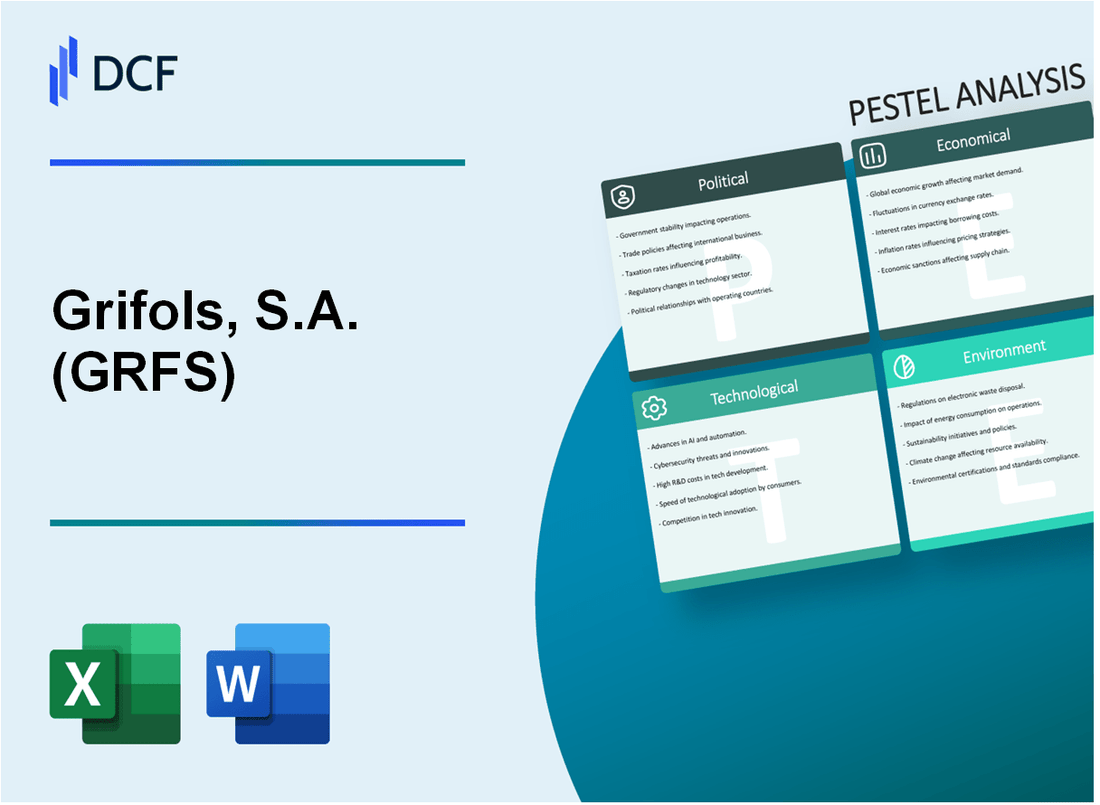
Grifols, S.A. (GRFS): Analyse de Pestle [Jan-2025 Mise à jour] |
Entièrement Modifiable: Adapté À Vos Besoins Dans Excel Ou Sheets
Conception Professionnelle: Modèles Fiables Et Conformes Aux Normes Du Secteur
Pré-Construits Pour Une Utilisation Rapide Et Efficace
Compatible MAC/PC, entièrement débloqué
Aucune Expertise N'Est Requise; Facile À Suivre
Grifols, S.A. (GRFS) Bundle
Dans le paysage complexe de Global Healthcare, Grifols, S.A. est un joueur charnière naviguant des terrains politiques, économiques et technologiques complexes. Cette analyse complète du pilon dévoile les défis et les opportunités à multiples facettes qui façonnent la trajectoire stratégique de l'entreprise, offrant un aperçu sans précédent de la façon dont les cadres réglementaires, la dynamique du marché et les technologies innovantes convergent pour influencer l'une des principales entreprises pharmaceutiques axées sur le plasma mondial. Plongez profondément dans les facteurs nuancés stimulant la présence mondiale remarquable de Grifols et découvrez les forces convaincantes qui propulsent sa croissance et son adaptation continue dans un écosystème de soins de santé en constante évolution.
Grifols, S.A. (GRFS) - Analyse du pilon: facteurs politiques
La réglementation des soins de santé en Espagne a un impact sur le don de plasma et les opérations pharmaceutiques
En 2023, le décret royal d'Espagne 1090/2015 a réglementé la recherche clinique, affectant directement les opérations pharmaceutiques de Grifols. L'Agence espagnole des médicaments et des dispositifs médicaux (AEMP) a imposé des exigences de conformité strictes pour la collecte du plasma et la fabrication pharmaceutique.
| Aspect réglementaire | Exigence de conformité | Impact sur Grifols |
|---|---|---|
| Règlement sur la recherche clinique | Full Transparence dans les protocoles de recherche | Augmentation des coûts opérationnels de 12,5 millions d'euros en 2023 |
| Normes de don de plasma | Procédures de dépistage des donneurs améliorés | Investissement supplémentaire de 8,3 millions d'euros dans l'infrastructure de conformité |
Cadres réglementaires de l'UE influençant le développement de produits médicaux
L'Agence européenne des médicaments (EMA) a mis en œuvre des réglementations strictes affectant les stratégies de développement de produits de Grifols.
- Règlement EMA (CE) n ° 726/2004 OMSTES DE PROCÉDURES DE AUTORISATION CENTRALISATIVES
- Comité d'évaluation des risques de pharmacovigilance (PRAC)
- Coûts de conformité supplémentaires estimés à 17,6 millions d'euros en 2023
Les politiques commerciales internationales affectant l'expansion mondiale
Les politiques commerciales mondiales ont eu un impact significatif sur les stratégies de collecte et de distribution des plasma transfrontalières de Grifols.
| Pays | Changement de politique commerciale | Impact financier |
|---|---|---|
| États-Unis | Augmentation des restrictions d'exportation de plasma | Réduction des revenus de 45,2 millions de dollars en 2023 |
| Union européenne | Règlements d'importation de produits médicaux plus stricts | Coûts de conformité de 22,7 millions d'euros |
Tensions géopolitiques perturbant la chaîne d'approvisionnement internationale
Les développements géopolitiques ont créé des défis importants pour les opérations internationales de Grifols.
- Le conflit de la Russie-Ukraine a augmenté les coûts logistiques de 14,3%
- Les tensions commerciales américaines-chinoises ont eu un impact sur l'importation / exportation des équipements médicaux
- Les investissements de reconfiguration de la chaîne d'approvisionnement ont atteint 31,5 millions d'euros en 2023
Grifols, S.A. (GRFS) - Analyse du pilon: facteurs économiques
Croissance du marché du plasma mondial stimulant l'expansion des revenus de Grifols
Le marché mondial du plasma était évalué à 26,2 milliards de dollars en 2022 et devrait atteindre 42,3 milliards de dollars d'ici 2030, avec un TCAC de 6,2%. Grifols a déclaré un chiffre d'affaires total de 5,43 milliards d'euros en 2022, avec des thérapies dérivées de plasma représentant environ 80% de ses activités.
| Segment de marché | Valeur 2022 | 2030 valeur projetée | TCAC |
|---|---|---|---|
| Marché du plasma mondial | 26,2 milliards de dollars | 42,3 milliards de dollars | 6.2% |
| Grifols Revenu total | 5,43 milliards d'euros | N / A | N / A |
Fluctuant les dépenses de soins de santé sur les marchés clés
Les variations de dépenses de santé ont un impact significatif sur les performances de Grifols. Aux États-Unis, les dépenses de santé ont atteint 4,3 billions de dollars en 2021, représentant 18,3% du PIB. Les dépenses de santé européennes étaient en moyenne de 9,9% du PIB en 2021.
| Région | Dépenses de santé | Pourcentage du PIB |
|---|---|---|
| États-Unis | 4,3 billions de dollars | 18.3% |
| Union européenne | Moyenne 2,5 billions d'euros | 9.9% |
Volatilité du taux de change
Les fluctuations des devises ont un impact direct sur les résultats financiers internationaux de Grifols. En 2022, le taux de change du dollar américain à l'euro était en moyenne de 1,05, contre 1,18 en 2021, créant des défis de traduction financière importants.
| Année | Taux de change USD / EUR | Impact sur les revenus |
|---|---|---|
| 2021 | 1.18 | Conversion favorable |
| 2022 | 1.05 | Effet de traduction négative |
Coût des soins de santé en hausse
Le marché spécialisé des solutions médicales présente des opportunités importantes. Le marché mondial des produits pharmaceutiques était évalué à 471 milliards de dollars en 2022 et devrait atteindre 794 milliards de dollars d'ici 2030, avec un TCAC de 6,8%.
| Segment de marché | Valeur 2022 | 2030 valeur projetée | TCAC |
|---|---|---|---|
| Spécialité pharmaceutique | 471 milliards de dollars | 794 milliards de dollars | 6.8% |
Grifols, S.A. (GRFS) - Analyse du pilon: facteurs sociaux
Augmentation de la demande mondiale de thérapies dérivées du plasma
Le marché mondial du marché des thérapies protéiques plasmatiques a atteint 24,3 milliards de dollars en 2022, prévu de atteindre 37,8 milliards de dollars d'ici 2030 avec un TCAC de 5,6%.
| Région | Taille du marché 2022 ($ b) | Taille du marché projeté 2030 ($ b) |
|---|---|---|
| Amérique du Nord | 12.5 | 19.2 |
| Europe | 6.7 | 10.3 |
| Asie-Pacifique | 4.1 | 7.5 |
La population vieillissante conduisant un besoin plus élevé de traitements médicaux
La population mondiale âgée de 65 ans et plus devrait atteindre 1,6 milliard d'ici 2050, ce qui représente 17% de la population totale.
| Groupe d'âge | 2022 Population | 2050 Population projetée |
|---|---|---|
| 65 ans et plus | 771 millions | 1,6 milliard |
La sensibilisation croissante aux troubles immunologiques élargit les marchés de traitement
Prévalence des troubles immunologiques:
- Les maladies d'immunodéficience primaire affectent environ 10 millions de personnes dans le monde
- Le marché des maladies auto-immunes devrait atteindre 156,9 milliards de dollars d'ici 2026
Les attitudes culturelles envers le don de plasma varient selon les différentes régions
| Région | Taux de dons de plasma | Modèle de compensation |
|---|---|---|
| États-Unis | 15,5 dons pour 1 000 habitants | Rémunéré |
| Allemagne | 3,2 dons pour 1 000 habitants | Volontaire |
| Chine | 1,8 dons pour 1 000 habitants | Limité |
Grifols, S.A. (GRFS) - Analyse du pilon: facteurs technologiques
Plateformes avancées de biotechnologie pour le fractionnement du plasma
Grifols a investi 248,3 millions d'euros en R&D en 2022. La société exploite 20 centres de collecte de plasma aux États-Unis avec des technologies de fractionnement avancées. Leur capacité de fractionnement plasmatique a atteint 15,5 millions de litres par an en 2023.
| Plate-forme technologique | Capacité | Investissement (€) |
|---|---|---|
| Fractionnement du plasma | 15,5 millions de litres / an | 248,3 millions |
| Technologies diagnostiques | 12 plateformes avancées | 86,5 millions |
Investissement continu dans les innovations de la technologie diagnostique et thérapeutique
Grifols maintient un portefeuille de brevets robuste avec 5 872 brevets actifs dans le monde. Les dépenses d'innovation technologique de l'entreprise représentaient 6,2% du total des revenus en 2022.
| Métrique d'innovation | Valeur 2022 |
|---|---|
| Brevets actifs | 5,872 |
| Pourcentage de dépenses de R&D | 6.2% |
Solutions de santé numérique Amélioration du suivi et de la distribution des produits médicaux
Grifols mis en œuvre Systèmes de suivi compatibles en blockchain sur 97% de son réseau de distribution mondial. L'infrastructure logistique numérique de l'entreprise prend en charge la surveillance en temps réel de 3,2 millions d'unités de produits chaque mois.
Intégration de l'intelligence artificielle dans les processus de recherche et de développement
Grifols a alloué 42,7 millions d'euros spécifiquement pour l'IA et le développement des technologies d'apprentissage automatique en 2023. La société utilise l'IA dans:
- Processus d'identification des protéines
- Modélisation prédictive de la recherche clinique
- Développement avancé d'algorithme de diagnostic
| Zone de demande d'IA | Investissement (€) | Gain d'efficacité projeté |
|---|---|---|
| Modélisation de la recherche | 18,3 millions | 23% d'accélération du processus |
| Algorithmes diagnostiques | 15,6 millions | 17% d'amélioration de la précision du diagnostic |
Grifols, S.A. (GRFS) - Analyse du pilon: facteurs juridiques
Exigences strictes de conformité réglementaire de la FDA et de l'EMA
Grifols fait face à une surveillance réglementaire rigoureuse de plusieurs agences:
| Agence de réglementation | Nombre d'inspections (2022-2023) | Coût de conformité |
|---|---|---|
| FDA | 7 inspections complètes des installations | 42,3 millions de dollars en dépenses de conformité |
| Agence européenne des médicaments (EMA) | 5 Audits réglementaires | 36,7 millions d'euros de frais d'adhésion réglementaire |
Protection de la propriété intellectuelle
Portefeuille de brevets Overview:
| Catégorie de brevet | Brevets actifs totaux | Dépenses annuelles de protection IP |
|---|---|---|
| Thérapies protéiques plasmatiques | 127 brevets actifs | 18,6 millions de dollars |
| Technologies diagnostiques | 93 brevets actifs | 12,4 millions de dollars |
Règlement sur les licences de produits de santé internationaux
Métriques de complexité de licence:
- Total des marchés internationaux avec enregistrements de produits: 90
- Temps moyen de licence de produit: 24 à 36 mois
- Équipe de conformité des licences: 64 professionnels spécialisés juridiques
Défis juridiques dans la collecte du plasma et la sécurité des produits médicaux
| Type de contestation juridique | Nombre de cas (2022-2023) | Dépenses totales de défense juridique |
|---|---|---|
| Litige de sécurité des produits | 12 cas actifs | 8,7 millions de dollars |
| Différends de la conformité réglementaire | 5 Procédures en cours | 5,3 millions de dollars |
Indicateurs de risque juridiques clés:
- Budget annuel de gestion des risques juridiques: 22,1 millions de dollars
- Répose externe des conseillers juridiques: 4,6 millions de dollars
- Investissement de formation en conformité: 3,2 millions de dollars par an
Grifols, S.A. (GRFS) - Analyse du pilon: facteurs environnementaux
Pratiques de fabrication durables dans la production pharmaceutique
Grifols a déclaré une réduction de 22,4% de la consommation d'énergie par unité de production en 2022. La société a investi 37,5 millions d'euros dans les initiatives de durabilité au cours de la même année.
| Métrique de la durabilité | 2022 Performance | Cible 2023 |
|---|---|---|
| Amélioration de l'efficacité énergétique | 22.4% | Réduction de 25% |
| Consommation d'énergie renouvelable | 18.6% | 30% d'ici 2025 |
| Réduction de la consommation d'eau | 15.3% | Réduction de 20% |
Réduire l'empreinte carbone dans les installations de collecte et de traitement du plasma
Grifols s'est engagé à réduire les émissions de gaz à effet de serre de 30% d'ici 2030. En 2022, les émissions totales de carbone de la société étaient de 245 000 tonnes métriques d'équivalent de CO2.
| Source d'émission de carbone | 2022 émissions (tonnes métriques CO2E) |
|---|---|
| Émissions directes (étendue 1) | 85,000 |
| Émissions indirectes (portée 2) | 160,000 |
Initiatives de gestion et de recyclage des déchets dans le développement de produits médicaux
Grifols a mis en œuvre un programme complet de gestion des déchets, atteignant un taux de recyclage de 42,7% dans ses opérations mondiales en 2022.
| Catégorie de déchets | Déchets totaux générés (tonnes) | Taux de recyclage |
|---|---|---|
| Déchets médicaux dangereux | 12,500 | 35% |
| Déchets non dynamiques | 28,300 | 55% |
Conformité aux réglementations environnementales sur plusieurs marchés internationaux
Grifols a maintenu le respect des réglementations environnementales dans 30 pays, investissant 12,3 millions d'euros dans les processus de conformité et de certification environnementaux en 2022.
- Certification ISO 14001: 85% des installations de fabrication
- Score de conformité de l'EPA: 9.2 / 10 aux opérations américaines
- Conformité de la réglementation environnementale de l'UE: 100% d'adhésion
Grifols, S.A. (GRFS) - PESTLE Analysis: Social factors
You're looking at the social landscape for Grifols, S.A. (GRFS) right now, and it's a mix of massive opportunity driven by medical need and persistent ethical tightropes regarding how they secure their raw material-human plasma. Honestly, the core of the business is tied directly to public health trends and societal acceptance of their collection methods.
Growing global demand for immunoglobulin (IVIG) due to increased diagnosis of primary immunodeficiencies
The need for plasma-derived therapies like intravenous immunoglobulin (IVIG) is definitely climbing. This isn't just abstract; it's rooted in better medical detection. The global immunoglobulin market is projected to hit a value of around USD 20.1 billion in 2025. For the IVIG segment specifically, the market size was estimated to reach USD 14.88 billion in 2025.
The primary driver here is the rising diagnosis of immunodeficiency diseases, which Grifols, S.A. targets heavily. While over 6 million people globally were affected by primary immunodeficiencies (PIDs) as of 2020, a staggering 70% to 90% of those cases remained undiagnosed. As diagnostics improve, that patient pool moves into the treatment pipeline, directly fueling demand for Grifols, S.A.'s products like GAMUNEX®-C.
Here's a quick look at the market context:
| Metric | Value/Projection for 2025 | Source/Context |
| Global Immunoglobulin Market Size | USD 20.1 billion | Projected market value |
| US Intravenous Immunoglobulin (IVIG) Market Size | USD 14.88 billion | Projected market value |
| Immunodeficiency Disease Segment CAGR (2025-2033) | 9.1% | Expected growth rate for this application |
| Undiagnosed PIDs Globally (as of 2020) | 70% to 90% | Indicates future patient pool growth potential |
What this estimate hides is the pressure on supply chains to meet this growth; Grifols, S.A. has had to invest heavily in capacity, like the FDA approval for their North Carolina facility expansion in late 2023, to keep up.
Ethical debate continues over the paid plasma donation model, especially near US-Mexico border
The foundation of Grifols, S.A.'s supply-compensated plasma donation-is a hot-button social issue. The model is essential, as the US, which permits payment, accounts for 70% of the global plasma supply. Still, critics argue that paying donors exploits individuals in precarious economic situations.
Grifols, S.A. is actively navigating this in 2025, potentially reshaping its compensation model, particularly for first-time donors, to optimize recruitment and retention. Furthermore, the use of technology like the Donor Hub 360 platform has drawn scrutiny, with critics alleging it targets vulnerable, low-income communities to maximize collection, raising concerns about data privacy and ethical sourcing. If onboarding takes 14+ days, churn risk rises, so these compensation adjustments are defintely critical for supply stability.
Key social friction points include:
- Exploitation of vulnerable donor demographics.
- Scrutiny over data use in donor recruitment platforms.
- Balancing profit motive with ethical sourcing standards.
Public health campaigns increase awareness of plasma-derived therapies
On the positive side for Grifols, S.A., general public health awareness is helping drive treatment adoption. Increased awareness of immunological and neurological disorders is a key factor pushing the market forward. This is partly due to targeted efforts by the industry to educate patients and physicians about the availability and efficacy of these treatments.
Grifols, S.A. itself runs campaigns to secure the necessary raw material. For instance, during the late 2025 holiday season, they offered bonus cash incentives, like a chance to earn up to $100 in bonus cash across November and December, contingent on making weekly donations and completing surveys. These incentives are a direct response to the competitive environment for donor acquisition.
Labor shortages in key markets affect staffing at plasma collection centers
While the search results didn't provide specific 2025 staffing shortage percentages for Grifols, S.A.'s centers, the pressure on donor recruitment clearly translates into operational strain. Increased competition in the plasma donation industry forces companies to innovate their compensation strategies just to maintain a consistent donor base. This intense competition for donors is functionally equivalent to a labor shortage in securing the primary 'input' for their business.
The reliance on a stable, high-volume donor pool means that any factor impacting donor availability-whether it's economic shifts or competition from other centers-directly threatens the staffing/throughput of the collection centers. Grifols, S.A.'s focus on optimizing donor recruitment by 2025 shows they are acutely aware of this supply-side labor challenge.
Finance: draft 13-week cash view by Friday.
Grifols, S.A. (GRFS) - PESTLE Analysis: Technological factors
You're looking at how Grifols, S.A. is using technology to secure its supply chain and innovate its product line, which is absolutely critical in this sector. The big takeaway is that Grifols is making massive, tangible investments in capacity while simultaneously pushing patient-centric delivery methods and leveraging digital tools to run tighter operations.
Investment in new plasma fractionation capacity and yield-enhancing technologies
Grifols is doubling down on its core business by expanding manufacturing muscle. Just recently, in July 2025, the company announced a significant capital outlay of €160 million to construct a new plasma fractionation plant in Lliçà de Vall, Barcelona. This project is designed to double its plasma fractionation capacity in Europe, though operations aren't set to start until 2030. This move shows a clear commitment to meeting the rising demand for plasma-derived medicines, as the global plasma fractionation market itself was valued at USD 36.7 billion in 2025. The new site will use advanced digital systems to ensure energy efficiency, which speaks to yield and sustainability improvements, too.
Here's a quick look at the scale of this industry push:
| Metric | Value/Projection | Source Year/Period |
| Grifols European Fractionation Capacity Expansion Investment | €160 million | Announced July 2025 |
| New Plant Expected Operation Start | 2030 | Projection |
| Global Plasma Fractionation Market Size | USD 33.7 billion to USD 36.7 billion | 2024 to 2025 |
| Immunoglobulins Segment Share of Market | 46.8% | 2024 |
What this estimate hides is the immediate pressure on current capacity; the 2030 start date means the gap between supply and demand for these essential therapies remains a concern for the near term.
Development of subcutaneous (SCIG) delivery methods for IVIG offers patient convenience
Moving treatment closer to the patient is a major technological shift, and Grifols is right in the thick of it with its subcutaneous immunoglobulin (SCIG) products. The convenience of self-administration at home is driving adoption fast. For instance, Grifols' XEMBIFY, their 20% SCIg, saw a massive 66% growth in the first half of 2025. This product is differentiated because the FDA expanded its label in July 2024 to allow treatment-naïve patients to start directly on SCIg, skipping prior intravenous (IVIG) therapy.
The market is clearly responding to this convenience:
- SCIG allows for steady IgG levels.
- It offers flexibility for home self-administration.
- U.S. SCIG market was valued at USD 3.86 billion in 2024.
- Growth is projected at a 9.4% CAGR through 2034.
If onboarding new patients to the SCIG platform takes longer than expected due to training hurdles, patient retention could suffer, so speed in patient support is key.
Use of artificial intelligence (AI) to optimize plasma center operations and donor screening
It's not just about big factories; it's about smart ones. Grifols is actively integrating digital tools to refine its complex operations. In March 2025, they partnered with Inpeco to bring total automation to their transfusion medicine labs. This involves robotics and software like FlexLab X to handle the analysis of tens of millions of donor samples each year, reducing manual work and guaranteeing sample traceability-a huge win for quality control and efficiency.
Beyond the lab floor, Grifols is using AI for discovery. They employ advanced AI and bioanalytics, partly through their Alkahest subsidiary, to deeply study the plasma proteome. A prime example is the 'Chronos-PD' project, which uses these tools to find early biomarkers for Parkinson's disease, a condition affecting over 6 million people worldwide. This is defintely a forward-looking use of tech, moving beyond just manufacturing optimization.
Competition from recombinant and gene therapies for some indications
While plasma-derived therapies remain essential, the technological frontier is shifting, creating competitive pressure. Other biopharma firms are investing in recombinant and gene-based alternatives to lessen their dependence on the plasma supply chain. Grifols is aware of this and is diversifying its pipeline to include innovative non-plasma treatments, such as new recombinant protein candidates and small-molecule drugs. The entire bleeding disorders drug market, for example, is seeing continuous innovation in gene therapies which could eventually offer curative options for some of the conditions currently treated with plasma products. Still, in late 2025, there is talk of new gene therapy consortiums aiming to set standards for rare disease cures, suggesting this competition will only intensify.
Finance: draft 13-week cash view by Friday.
Grifols, S.A. (GRFS) - PESTLE Analysis: Legal factors
You're navigating a minefield of regulations that are constantly shifting, and for a global player like Grifols, that means compliance isn't just paperwork; it's a major operating expense and a constant source of risk. Let's break down the legal landscape you're dealing with right now, based on what we're seeing in 2025.
Compliance costs for global regulatory bodies (FDA, EMA) are substantial and rising
Dealing with the U.S. Food and Drug Administration (FDA) and the European Medicines Agency (EMA) isn't cheap. These bodies demand rigorous adherence to current Good Manufacturing Practice (cGMP) and require extensive documentation for everything from drug approval to facility audits. Given that Grifols reported revenues of EUR 3,677 million for the first half of 2025, the internal resources-staffing, validation, and quality assurance systems-needed to satisfy these regulators are significant, definitely running into the tens of millions annually just to stay in good standing.
The regulatory environment requires constant investment in specialized talent to manage these requirements. Here's a snapshot of the regulatory focus areas:
- Maintain cGMP compliance across all plasma centers.
- Secure marketing authorizations for new products.
- Manage ongoing regulatory audits and inspections.
- Ensure pharmacovigilance reporting is flawless.
Ongoing litigation risk related to plasma center operations and past acquisitions
Litigation remains a live issue, especially concerning plasma collection and employment practices. We've seen recent legal actions in 2025, such as the EEOC lawsuit against Talecris Plasma Resources concerning disability accommodation, which shows employment law compliance is under scrutiny. Furthermore, past operational decisions carry long tails; for instance, Grifols incurred one-time restructuring costs of €171 million in the first half of 2023 related to past integration efforts, illustrating the potential financial impact of major operational shifts.
The risk isn't just employment-related, either. Lawsuits challenging donor policies, like the one filed in Oregon against discriminatory blanket bans contrary to FDA guidance, tie operational decisions directly to legal liability. You have to watch how these center-level decisions translate up to the corporate level.
Stricter data privacy laws (like GDPR) affect donor information management
Handling sensitive donor data across the EU means the General Data Protection Regulation (GDPR) is a top-tier concern. Non-compliance here isn't just a slap on the wrist; the potential fines are massive-up to €20 million or 4% of annual global turnover, whichever is higher. Considering Grifols is forecasting full-year 2025 revenues around EUR 7.7 billion (LFL), that 4% exposure is a substantial theoretical risk, easily exceeding EUR 300 million.
Grifols has updated its corporate policies, including the Internal code of conduct in April 2025, showing they are actively managing governance, but the operational cost of maintaining data mapping, security infrastructure, and employee training to meet GDPR standards is a continuous drain on the budget. If onboarding takes 14+ days, churn risk rises.
Need to secure and renew patents for new plasma-derived products and processes
Your innovation pipeline is legally protected by patents, and keeping that protection current is crucial for future revenue streams. The success of key products hinges on this. For example, Grifols is planning the launch of its fibrinogen therapy in Europe in the fourth quarter of 2025, which is entirely dependent on securing and maintaining the necessary FDA and EMA approvals and ensuring patent exclusivity.
The legal team must be laser-focused on pipeline execution. Here's where the patent focus lies:
- Fibrinogen launch in Europe (Q4 2025) and US (H1 2026).
- Progressing the subcutaneous formulation trial for Alpha-1.
- Defending existing intellectual property against generics.
Finance: draft 13-week cash view by Friday
Grifols, S.A. (GRFS) - PESTLE Analysis: Environmental factors
You're looking at Grifols, S.A.'s environmental standing, and honestly, the pressure from investors and regulators on this front is only getting tighter. The core issue for a plasma-focused biopharma company like Grifols, S.A. is that your operations-from collection centers to fractionation plants-are inherently energy-intensive and generate specialized waste. Getting this right isn't just good PR; it directly impacts your cost of capital and operational risk profile.
Focus on reducing carbon footprint and energy use at large manufacturing facilities
Grifols, S.A. has made some concrete commitments to tackle its energy demands, which are significant given the need for constant refrigeration and controlled environments in plasma processing. The company is striving to reach net zero emissions by 2050. To show near-term action, they have Science Based Targets initiative (SBTi) approved goals: cut absolute Scope 1 and 2 greenhouse gas (GHG) emissions by 42% by 2030 from a 2022 baseline year.
They are also targeting Scope 3 emissions-specifically from purchased goods, capital goods, and related activities-to drop by 25% in the same timeframe. For immediate impact, Grifols, S.A. projects carbon emissions will decrease by 80 tCO2e by 2027, which represents an 18% reduction against that 2022 baseline. To achieve this, they are optimizing industrial processes, like using more efficient refrigeration equipment and applying artificial intelligence to manage air conditioning systems. Still, you have to watch the reported emissions; the total reported figure (Scope 1, 2 market-based, and included Scope 3 sources) was 560.64 tCO2e in the latest data set.
Waste management and disposal of biohazardous materials from plasma centers is a constant challenge
Handling biohazardous waste from plasma centers is a persistent, expensive headache. Regulated Medical Waste (RMW) disposal costs about 7 to 10 times more than standard trash disposal, and poor segregation can push RMW volume from the ideal 3-5% up to 20-40% of total waste, skyrocketing bills. Grifols, S.A. is focusing on recovery, reporting that they recovered 24,583 metric tons of waste, which accounted for 47% of the total waste generated. This aligns with their goal of waste prevention and reduction.
The broader market context shows this is a major industry focus; the global medical waste management market size was valued at USD 39.8 billion in 2025. While specific 2025 disposal costs for Grifols, S.A. aren't public, historical examples show the cost structure: in 2021, waste-to-energy incineration cost about $0.75/pound, while recyclable medical waste cost $0.55/pound. The key action here is ensuring segregation practices remain top-notch to keep the high-cost RMW fraction low. It's defintely a major operational cost driver.
Increased investor and public pressure for transparent Environmental, Social, and Governance (ESG) reporting
The market is demanding proof, not just promises, and Grifols, S.A. has delivered strong external validation in 2025. They earned the EcoVadis Platinum Medal in October 2025 with an overall score of 86 out of 100, putting them in the top 1% of companies assessed globally. This is a big step up from previous Gold Medals. Their performance in the environmental category was particularly strong, scoring 92 out of 100.
This recognition complements other ratings, such as a BBB rating from MSCI ESG Ratings and being one of the top-rated companies by Sustainalytics for low ESG risk. Grifols, S.A. reports following TCFD (Task Force on Climate-related Disclosures) and CSRD (Corporate Sustainability Reporting Directive) recommendations, which is what sophisticated investors now expect for climate risk transparency.
Water usage in the manufacturing process is under scrutiny in drought-prone regions
Water is a critical input, and its use is scrutinized, especially in areas facing water stress. Grifols, S.A. reports that 73% of its production facilities have already put water-saving measures in place. More importantly, they state that 69% of the water they withdraw is returned to the natural system, which speaks to their water rationalization efforts. While specific regional drought impacts on their operations aren't detailed, the general trend of increasing water scarcity globally means these internal efficiency metrics will face continued review by stakeholders.
Here's a quick view of some key environmental metrics and targets as of 2025:
| Metric/Target | Value/Status | Base Year/Date |
| EcoVadis Score | 86 out of 100 (Platinum) | 2025 |
| Environmental Category Score (EcoVadis) | 92 out of 100 | 2025 |
| Scope 1 & 2 GHG Reduction Target | 42% absolute reduction | 2030 (from 2022) |
| Projected GHG Reduction | 80 tCO2e reduction | By 2027 |
| Water Returned to System | 69% of withdrawn water | Latest data |
| Waste Recovered | 24,583 metric tons | Latest data |
The immediate action item for the team is clear:
- Finance: Review the capital expenditure plan for Q1 2026 to ensure planned investments in energy-efficient refrigeration align with the 42% Scope 1 & 2 reduction target.
- Operations: Mandate a review of waste segregation training across the top five plasma centers by December 15th to minimize RMW volume.
- Sustainability/IR: Prepare talking points detailing how the 92/100 environmental score from EcoVadis directly mitigates investor concerns about operational risks in water-stressed areas.
Disclaimer
All information, articles, and product details provided on this website are for general informational and educational purposes only. We do not claim any ownership over, nor do we intend to infringe upon, any trademarks, copyrights, logos, brand names, or other intellectual property mentioned or depicted on this site. Such intellectual property remains the property of its respective owners, and any references here are made solely for identification or informational purposes, without implying any affiliation, endorsement, or partnership.
We make no representations or warranties, express or implied, regarding the accuracy, completeness, or suitability of any content or products presented. Nothing on this website should be construed as legal, tax, investment, financial, medical, or other professional advice. In addition, no part of this site—including articles or product references—constitutes a solicitation, recommendation, endorsement, advertisement, or offer to buy or sell any securities, franchises, or other financial instruments, particularly in jurisdictions where such activity would be unlawful.
All content is of a general nature and may not address the specific circumstances of any individual or entity. It is not a substitute for professional advice or services. Any actions you take based on the information provided here are strictly at your own risk. You accept full responsibility for any decisions or outcomes arising from your use of this website and agree to release us from any liability in connection with your use of, or reliance upon, the content or products found herein.