
|
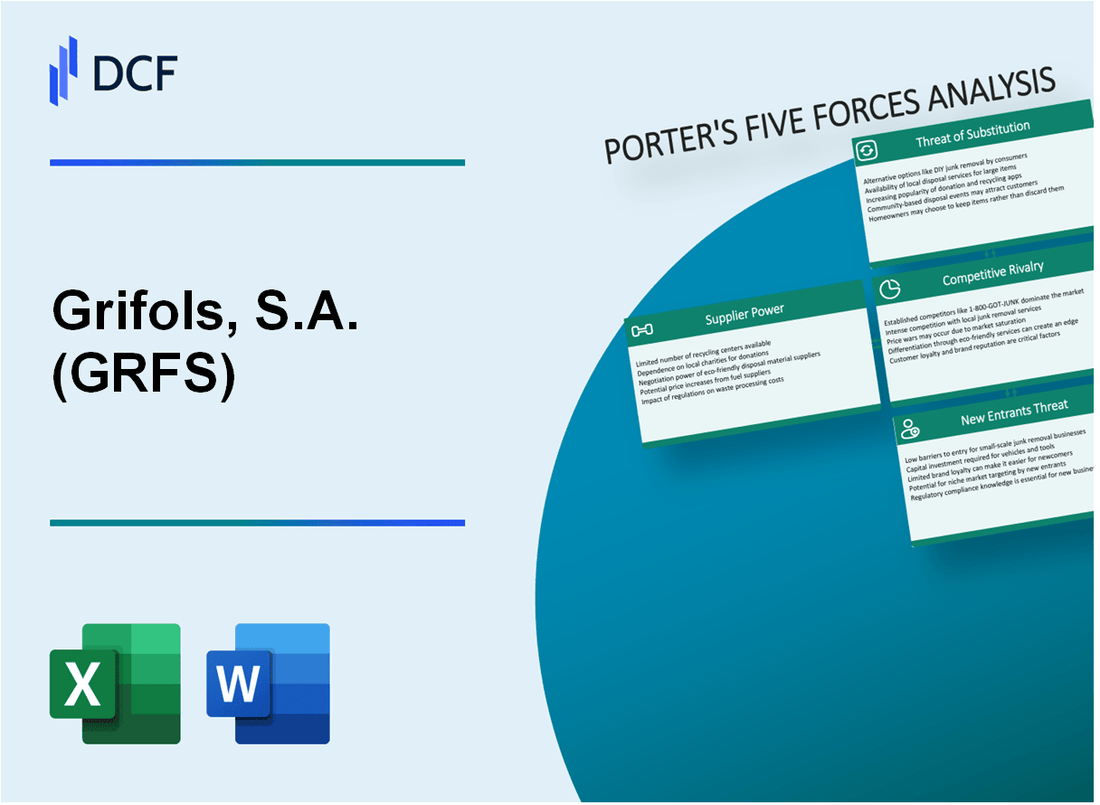
Grifols, S.A. (GRFS): 5 Forces Analysis [Jan-2025 Mis à jour] |
Entièrement Modifiable: Adapté À Vos Besoins Dans Excel Ou Sheets
Conception Professionnelle: Modèles Fiables Et Conformes Aux Normes Du Secteur
Pré-Construits Pour Une Utilisation Rapide Et Efficace
Compatible MAC/PC, entièrement débloqué
Aucune Expertise N'Est Requise; Facile À Suivre
Grifols, S.A. (GRFS) Bundle
Dans le paysage complexe des thérapies dérivées du plasma, Grifols, S.A., navigue sur un écosystème pharmaceutique difficile où les forces concurrentielles façonnent les décisions stratégiques et le positionnement du marché. Cette analyse de plongée profonde explore la dynamique complexe de l'environnement commercial de Grifols à travers le cadre renommé des cinq forces de Michael Porter, révélant les facteurs critiques qui influencent la stratégie concurrentielle, le potentiel de marché et la durabilité à long terme de l'entreprise dans un paysage de santé en évolution rapide.
Grifols, S.A. (GRFS) - Porter's Five Forces: Bargaining Power des fournisseurs
Nombre limité de centres de collecte de plasma dans le monde entier
En 2024, il y a environ 1 200 centres de collecte de plasma aux États-Unis, les Grifols opérant environ 300 centres. Le marché mondial de la collection de plasma est dominé par quelques acteurs clés:
| Entreprise | Nombre de centres de plasma | Part de marché |
|---|---|---|
| Grifols | 300 | 25% |
| CSL Behring | 250 | 20% |
| Mouton | 200 | 16% |
| Autres fournisseurs | 450 | 39% |
Capitaux élevés et exigences réglementaires pour la collecte du plasma
La collecte de plasma implique des investissements financiers importants:
- Coût moyen de démarrage pour un centre de collecte de plasma: 2,5 millions de dollars à 3,5 millions de dollars
- Compciliation annuelle et dépenses réglementaires: 500 000 $ à 750 000 $
- Les exigences de conformité de la FDA obligent des processus de documentation et de contrôle de la qualité
Dépendances spécialisées de l'équipement et de la technologie
Spécifications critiques de l'équipement et de la technologie:
- Machine de plasmaphérèse Coût: 150 000 $ à 250 000 $ par unité
- Coûts de maintenance annuels: 50 000 $ à 75 000 $ par machine
- Systèmes de logiciels et de suivi spécialisés: 100 000 $ à 200 000 $ Investissement initial
Normes strictes de contrôle de la qualité et de conformité
| Zone de conformité | Frais de conformité annuels | Organismes de réglementation |
|---|---|---|
| Conformité de la FDA | $750,000 | FDA |
| Conformité EMA | $650,000 | Agence européenne des médicaments |
| Contrôle de la qualité interne | $500,000 | Services internes |
Grifols, S.A. (GRFS) - Porter's Five Forces: Bargaining Power of Clients
Institutions et distributeurs de soins de santé en tant que clients principaux
Grifols dessert environ 4 500 hôpitaux et 55 000 centres de santé dans le monde. En 2022, les thérapies dérivées du plasma de l'entreprise ont atteint plus de 70 pays à travers le monde.
| Segment de clientèle | Part de marché | Volume d'achat annuel |
|---|---|---|
| Hôpitaux | 32% | 1,2 milliard d'euros |
| Cliniques spécialisées | 24% | 850 millions d'euros |
| Distributeurs | 44% | 1,5 milliard d'euros |
Marché des acheteurs concentrés
Les 5 principaux distributeurs de soins de santé contrôlent 85% du marché des achats thérapeutiques dérivés du plasma. Ceux-ci incluent:
- McKesson Corporation
- Amerisourcebergen
- Santé cardinale
- Henry Schein
- Owens & Mineure
Contrats à long terme avec les systèmes de soins de santé
Grifols maintient 67% de ses relations avec les clients grâce à des contrats pluriannuels, en moyenne des durées de 3 à 5 ans. Les valeurs du contrat varient de 50 millions d'euros à 250 millions d'euros par an.
Sensibilité aux prix dans les produits pharmaceutiques et médicaux
| Catégorie de produits | Élasticité des prix moyens | Variation des prix annuelle |
|---|---|---|
| Immunoglobulines | -0.4 | 2.1% |
| Thérapies albumine | -0.3 | 1.8% |
| Traitements du facteur VIII | -0.5 | 3.2% |
En 2022, Grifols a connu une pression moyenne de négociation des clients de 6,2% sur les prix des produits, les plus grands acheteurs institutionnels démontrant des capacités de négociation plus importantes.
Grifols, S.A. (GRFS) - Porter's Five Forces: Rivalité compétitive
Paysage de concurrence du marché
En 2024, le marché des thérapies dérivées de plasma démontre une dynamique concurrentielle intense avec les principaux acteurs du marché.
| Concurrent | Part de marché mondial | Revenus annuels (2023) |
|---|---|---|
| CSL Limited | 24.5% | 11,3 milliards de dollars |
| Takeda Pharmaceutique | 18.7% | 8,6 milliards de dollars |
| Grifols, S.A. | 16.2% | 5,9 milliards de dollars |
Investissement de la recherche et du développement
Paysage concurrentiel caractérisé par des dépenses substantielles de R&D:
- CSL Limited R&D dépenses: 1,2 milliard de dollars
- Takeda Pharmaceutical R&D dépense: 1,05 milliard de dollars
- Grifols, S.A. R&D dépenses: 780 millions de dollars
Fusions et stratégie d'acquisition
| Entreprise | Acquisitions majeures (2022-2024) | Valeur de transaction |
|---|---|---|
| Grifols, S.A. | Alkahest Biotech Company | 189 millions de dollars |
| CSL Limited | Vifor Pharma | 11,7 milliards de dollars |
Grifols, S.A. (GRFS) - Five Forces de Porter: menace de substituts
Biotechnologie et thérapies géniques émergentes
La taille du marché mondial de la thérapie génique a atteint 4,9 milliards de dollars en 2022, prévoyant à 13,9 milliards de dollars d'ici 2028 à un TCAC de 18,3%.
| Segment du marché de la thérapie génique | Valeur 2022 | 2028 Valeur projetée |
|---|---|---|
| Traitements d'hémophilie | 1,2 milliard de dollars | 3,5 milliards de dollars |
| Thérapies sur les troubles immunologiques | 1,5 milliard de dollars | 4,2 milliards de dollars |
Méthodes de traitement alternatives pour les troubles immunologiques
Les traitements alternatifs émergents montrent un potentiel de marché important:
- Le marché des thérapies interférentiels de l'ARN devrait atteindre 3,8 milliards de dollars d'ici 2026
- CRISPR Gene Édition des technologies projetées à une valeur marchande de 5,3 milliards de dollars d'ici 2025
- Les traitements d'anticorps monoclonaux augmentent à 14,2%
Avansions potentielles en médecine régénérative
Statistiques du marché de la médecine régénérative:
| Segment de marché | Valeur 2022 | 2030 valeur projetée |
|---|---|---|
| Thérapie cellulaire | 2,1 milliards de dollars | 8,7 milliards de dollars |
| Ingénierie tissulaire | 1,6 milliard de dollars | 6,5 milliards de dollars |
Développements de médicaments génériques contestant les traitements propriétaires
Mesures génériques de croissance du marché des médicaments:
- Taille du marché mondial des médicaments génériques: 407,3 milliards de dollars en 2022
- Prévu pour atteindre 633,6 milliards de dollars d'ici 2027
- Taux de croissance annuel composé (TCAC): 9,3%
Immunoglobuline spécifique Valeur marchande du médicament générique estimé à 2,1 milliards de dollars en 2023.
Grifols, S.A. (GRFS) - Five Forces de Porter: Menace de nouveaux entrants
Barrières réglementaires élevées dans l'industrie biopharmaceutique
La FDA a approuvé 55 nouveaux médicaments en 2023, avec un processus d'examen réglementaire moyen prenant 10,1 mois. Les approbations de la thérapie dérivée du plasma nécessitent des essais cliniques approfondis et une documentation de conformité.
| Coût de conformité réglementaire | Chronologie moyenne |
|---|---|
| 2,6 millions de dollars par soumission réglementaire | 10-14 mois pour une revue complète |
Investissement en capital substantiel requis pour les installations de plasma
Les installations de collecte et de fabrication de plasma exigent des ressources financières importantes.
| Type d'installation | Investissement estimé |
|---|---|
| Centre de collecte de plasma | 3 à 5 millions de dollars par centre |
| Usine de fabrication | 250 à 500 millions de dollars d'investissement total |
Paysage de propriété intellectuelle complexe
- Les brevets de thérapie dérivé du plasma durent généralement 20 ans
- Les frais de contentieux de brevet varient de 1 à 5 millions de dollars par cas
- Grifols détient plus de 1 200 brevets mondiaux
Expertise technologique avancée nécessaire pour l'entrée du marché
Le fractionnement du plasma nécessite des capacités technologiques spécialisées.
| Investissement technologique | Dépenses de recherche |
|---|---|
| Coûts d'équipement de R&D | 50 à 100 millions de dollars par an |
| Formation spécialisée du personnel | 5 à 10 millions de dollars par an |
Grifols, S.A. (GRFS) - Porter's Five Forces: Competitive rivalry
Rivalry is definitely high and concentrated among Grifols, S.A. (GRFS), CSL Behring, and Takeda Pharmaceutical Company Limited. These three main global players control an estimated 70% of global plasma fractionation capacity as of 2025. Furthermore, these leading companies together hold about 80% of the market share in the consolidated global plasma fractionation market. The overall plasma fractionation market size is estimated at USD 38.88 billion in 2025.
Competition centers on securing plasma supply, optimizing the cost per liter (CPL) of that raw material, and expanding fractionation capacity to meet demand. Grifols, for instance, executed an Operational Improvement Plan that resulted in its cost per liter of plasma declining by -22% in December 2023 compared to the July 2022 peak. Still, plasma supply security remains a strategic priority for all manufacturers.
Here's a quick look at the scale and cost focus among the top players in the plasma fractionation space:
| Metric | Grifols (Contextual Data) | CSL Behring (Contextual Data) | Takeda (Contextual Data) |
|---|---|---|---|
| Global Capacity Share (Est.) | Part of the 70% held by top 3 | Part of the 70% held by top 3 | Part of the 70% held by top 3 |
| 2025 Market Value (Est.) | USD 38.88 billion (Total Market) | Reported FY2025 Total Revenue: $11,158 million | PDT Revenue (2023 Context): Approx. $5.98 billion |
| CPL Optimization Metric | -22% CPL decline by Dec 2023 vs. July 2022 peak | Operates approx. 350 donation centers worldwide | Collects more than 15 million liters of plasma annually |
Grifols, S.A. is positioned as the second-largest player in this concentrated space, which naturally drives intense competition for market share gains. This is evident even in niche areas; for example, the Alpha-1 Antitrypsin Deficiency (AATD) augmentation therapy market was valued at USD 1.73 billion in 2025. While the outline suggests a 70% share for Grifols in AATD, established players like Grifols, Takeda, and CSL Behring command a significant share of the augmentation therapy segment based on their long-established products.
Competitors aren't just fighting on supply and cost; they're also investing heavily in R&D and digitalizing donor experiences to gain an edge. You see this in the focus on innovation:
- CSL Behring's Group R&D expenditure was $646 million in a recent period, with management guiding to ramp R&D costs to 10% of revenue for the full year.
- CSL Plasma deployed the RIKA Plasma Donation System in Houston, reducing donation time by 15 minutes.
- Grifols, S.A. announced completion of participant recruitment for a Phase 1/2 study for subcutaneous AAT therapy in February 2025.
Grifols, S.A. (GRFS) - Porter's Five Forces: Threat of substitutes
You're looking at the competitive landscape for Grifols, S.A. (GRFS), and when we talk about substitutes, the picture is nuanced. Honestly, for the core of their business-the high-value plasma proteins-the threat is low right now. Plasma-derived therapies (PDTs) are deeply entrenched because they treat rare and complex conditions where a direct, clinically superior replacement simply hasn't materialized yet. Still, you have to watch the horizon; technological advancements in biopharma mean this threat is definitely rising.
The most potent, specific threat comes from recombinant proteins, which are synthetic alternatives manufactured without human plasma. The Alpha-1 Antitrypsin (AAT) segment is the canary in the coal mine here. We're seeing a Phase II trial for Sanofi's SAR447537 (INBRX-101) as of January 2025, and if that succeeds, it could erode up to 20% of Grifols' biopharma revenue, specifically within the AAT business, by 2028. That's a concrete number to anchor your risk assessment to.
For many of the conditions Grifols treats, like primary immunodeficiencies, the plasma-derived product remains the gold standard. The World Health Organization (WHO) backs this up by listing key plasma proteins, like immunoglobulins and coagulation factors, on its List of Essential Medicines. That kind of institutional validation creates massive inertia against switching therapies. It's not just about efficacy; it's about established clinical pathways and patient trust.
Now, alternative treatments do exist for some conditions, but they don't cover the entire portfolio. Take hemophilia A: plasma-derived factor VIII is seeing market penetration decline in high-income countries due to new recombinant factor VIII products, non-factor antibodies, and gene therapy. However, for acquired fibrinogen deficiency (AFD), which is a critical, acute bleeding issue, the standard of care is still based on plasma components. The global market for AFD therapies is pegged around $800 million, and Grifols is launching a product to compete within that space.
Here's a quick look at how Grifols is directly addressing the substitution threat in the AFD space with its new launch, which competes against the existing standard of care:
| Feature | Standard of Care (Cryoprecipitate/FFP) | Grifols BT524/BT624 (New Launch) |
|---|---|---|
| Fibrinogen Dose | Variable amounts | Defined concentration in low volume |
| Preparation Time | Requires thawing | Faster to prepare; room temperature storable |
| Regulatory Status (EU) | Established | Expected commercial rollout in H2 2025 |
| Efficacy (vs. SOC) | Benchmark | Demonstrated non-inferiority in Phase III |
To counter the general threat and improve their offering, Grifols is actively diversifying its Biopharma portfolio. The most immediate action is the launch of its fibrinogen concentrate therapy, BT524/BT624, scheduled for the European Union in the second half of 2025, with a U.S. rollout planned for early 2026. Plus, they are advancing other pipeline products like trimodulin. This pipeline execution is key to maintaining leadership as they optimize every liter of plasma while simultaneously accelerating innovation platforms for non-plasma treatments.
Grifols, S.A. (GRFS) - Porter's Five Forces: Threat of new entrants
You're looking at the plasma fractionation space, and honestly, the threat of new entrants right now is low. The barriers to entry are just too high for anyone to jump in and meaningfully compete with Grifols, S.A. in the near term. This isn't like launching a new software app; this is about massive, entrenched infrastructure and regulatory hurdles that take a decade or more to clear.
New players need colossal capital investment just to get off the ground. You can't just buy a few liters of plasma; you need a vast, reliable collection network, which means building or acquiring hundreds of centers. Grifols, S.A. already operates approximately 400 plasma donation centers globally, with 289 of those located in the U.S. alone. To put that scale into perspective, consider that CSL Behring announced a $1.5 billion expansion of just one fractionation plant in 2023 to boost capacity by 70%. Building out that entire ecosystem-from donor recruitment to manufacturing-is a multi-billion dollar proposition before you even process your first liter.
Here's a quick look at the scale of established players in this capital-intensive industry:
| Metric | Value/Amount | Context |
|---|---|---|
| Global Plasma Fractionation Market Size (2025 Est.) | USD 37.87 billion | Total market valuation |
| Grifols, S.A. FY24 Revenue | EUR 7,212 million | Demonstrates existing revenue scale |
| Grifols U.S. Plasma Centers (Approx. Early 2021) | 289 centers | Part of the required collection network |
| CSL Behring Fractionation Plant Expansion Cost (2023) | $1.5 billion | Example of required manufacturing CapEx |
| Grifols 2025 Revenue Guidance (Excl. IRA) | EUR 7.7 billion | Indicates the revenue base to compete against |
Then you hit the regulatory wall. The pathway for plasma-derived therapies is long and incredibly stringent. It's not just about building the plant; it's about proving safety and efficacy over years of clinical trials to agencies like the FDA and EMA. As of late November 2025, the FDA's CBER had cleared only nine biological license applications, down from 19 in 2024. Similarly, the EMA's CHMP recommendations were at 44, a drop from 64 in 2024. This shows the gatekeepers are selective. Plus, for complex therapies, the FDA can mandate 15+ years of long-term follow-up (LTFU) studies, creating massive post-market commitment risks for any newcomer.
New entrants also struggle with the intangible barriers of reputation and trust. Grifols, S.A. is a pioneer in this space, treating conditions across neurology, immunology, and hematology. When you are dealing with patient-dependent, life-saving therapies, physicians and patients rely on established track records. Grifols, S.A. and its two largest competitors collectively hold approximately 70% market share in the U.S.. Breaking into that trust barrier requires more than just a product; it requires decades of demonstrated quality control.
The real moat for Grifols, S.A. is its integrated model. They manage everything from the donor compensation and collection (which takes about two months to freeze and transport plasma) to the complex fractionation and purification processes, and finally, distribution to the patient. Replicating this end-to-end system-which includes managing a global network of centers and specialized manufacturing facilities-is incredibly difficult to do quickly. It's definitely a vertically integrated fortress.
- Massive upfront capital expenditure required.
- Regulatory approval timelines are measured in years.
- Established players hold roughly 70% of the critical U.S. market share.
- Plasma processing involves a two-month pre-fractionation hold time.
- Post-market surveillance can require 15+ years of follow-up data.
Finance: draft the projected CapEx required for a greenfield competitor to reach 10% of Grifols' current U.S. center count by Q2 2026.
Disclaimer
All information, articles, and product details provided on this website are for general informational and educational purposes only. We do not claim any ownership over, nor do we intend to infringe upon, any trademarks, copyrights, logos, brand names, or other intellectual property mentioned or depicted on this site. Such intellectual property remains the property of its respective owners, and any references here are made solely for identification or informational purposes, without implying any affiliation, endorsement, or partnership.
We make no representations or warranties, express or implied, regarding the accuracy, completeness, or suitability of any content or products presented. Nothing on this website should be construed as legal, tax, investment, financial, medical, or other professional advice. In addition, no part of this site—including articles or product references—constitutes a solicitation, recommendation, endorsement, advertisement, or offer to buy or sell any securities, franchises, or other financial instruments, particularly in jurisdictions where such activity would be unlawful.
All content is of a general nature and may not address the specific circumstances of any individual or entity. It is not a substitute for professional advice or services. Any actions you take based on the information provided here are strictly at your own risk. You accept full responsibility for any decisions or outcomes arising from your use of this website and agree to release us from any liability in connection with your use of, or reliance upon, the content or products found herein.