
|
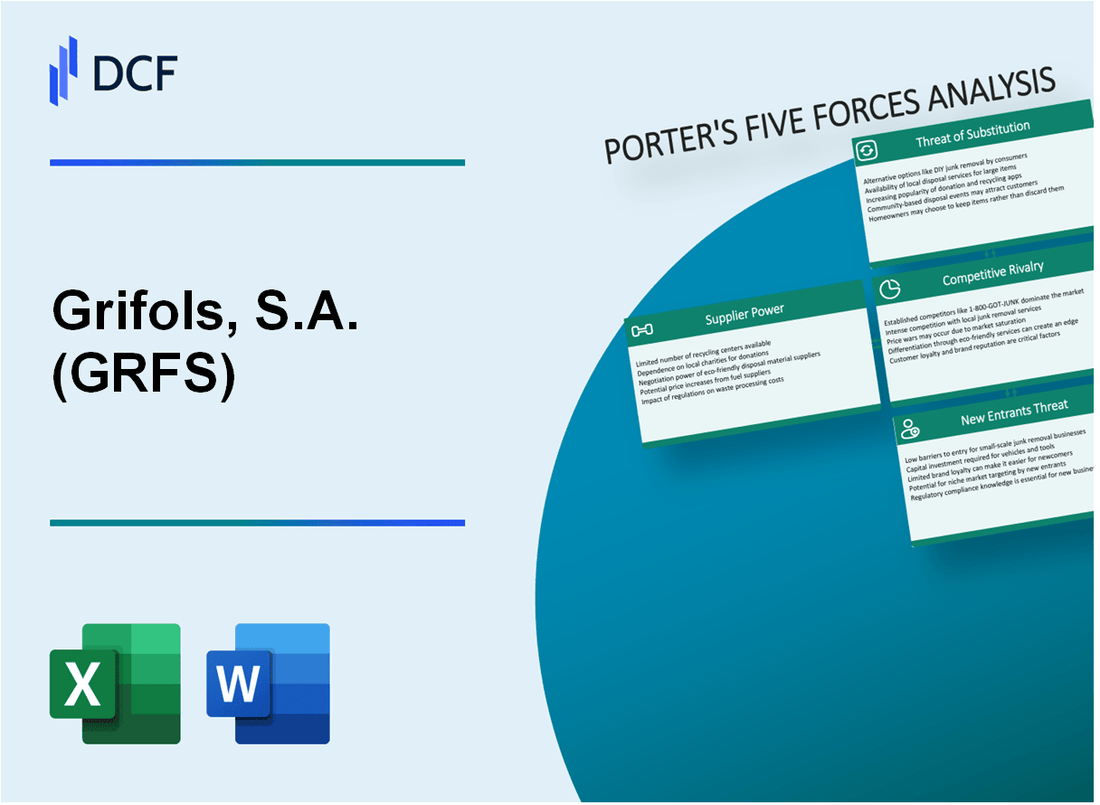
Grifols, S.A. (GRFS): 5 FORCES Analysis [Nov-2025 Updated] |
Fully Editable: Tailor To Your Needs In Excel Or Sheets
Professional Design: Trusted, Industry-Standard Templates
Investor-Approved Valuation Models
MAC/PC Compatible, Fully Unlocked
No Expertise Is Needed; Easy To Follow
Grifols, S.A. (GRFS) Bundle
You're looking for a clear, no-nonsense breakdown of the company's competitive standing, and honestly, the plasma industry is a fascinating oligopoly where supply chain control is everything. As we look at the landscape near the end of 2025, with projected revenues around €7.6 billion, understanding the five forces is crucial. We see substantial supplier power from plasma donors clashing with high rivalry against just two other global giants, even as inelastic demand for core products like Immunoglobulin-which saw 12.5% growth in H1 2025-keeps customers locked in. I've mapped out exactly where the pressure points are, from the low threat of new entrants due to massive capital needs to the creeping risk from synthetic substitutes, so dive in below to see the full, unvarnished analysis.
Grifols, S.A. (GRFS) - Porter's Five Forces: Bargaining power of suppliers
You're analyzing the core input for Grifols, S.A. (GRFS)-the plasma supply-and you see that the bargaining power of suppliers here is uniquely concentrated in the hands of the individual plasma donors. This raw material is human-derived and, for the critical plasma-derived therapies Grifols produces, it is effectively non-substitutable in the near to medium term. Plasma cannot be manufactured in a lab, so Grifols, S.A. must compete for this essential input.
The financial weight of this supplier group is significant. Donor compensation, which is the primary cost component, represents about 35% of raw material costs for Grifols, S.A.. This cost is not static; it is sensitive to local economic conditions and regulatory shifts in the various collection regions where Grifols, S.A. operates. For instance, in the US, compensation structures are dynamic, with reports in mid-2025 suggesting base rates around $30 for a first weekly donation, with the second donation potentially yielding between $50 to $65 depending on volume, and tiered loyalty programs like the 'Gold Level' offering up to $95 per week. Furthermore, compensation can be adjusted month-to-month based on center utilization.
Regulatory hurdles definitely play a role in constraining supply. Stringent rules, especially those from the U.S. Food and Drug Administration (FDA), limit the pool of qualified donors and increase the compliance costs associated with maintaining collection centers. This acts as a barrier to entry for new suppliers but also tightens the existing supply pool.
To counter the inherent power of this fragmented supplier base, Grifols, S.A. has invested heavily in vertical integration and scale. The company mitigates supplier power by owning and operating a vast network of plasma collection centers globally. As of recent reports, Grifols, S.A. maintains approximately 400 plasma donation centers across North America, Europe, Africa, and the Middle East. This scale helps Grifols, S.A. manage regional supply dynamics and optimize donor compensation strategies across its footprint.
The company is also actively consolidating supply through strategic acquisitions to secure long-term volume. A key move in 2025 was completing the consolidation of its joint venture with ImmunoTek. This involved acquiring the remaining 14 ImmunoTek centers for an aggregate amount of approximately $281.3 million in 2025. This followed the acquisition of the first 14 centers in 2024 for $265.0 million. This strategic action brings the total number of centers acquired from ImmunoTek to 28 for a total outlay near $479 million.
Here's a quick look at the recent ImmunoTek supply consolidation:
| Acquisition Phase | Year | Number of Centers Acquired | Aggregate Cost (USD) |
|---|---|---|---|
| Phase 1 (Groups 1 & 2) | 2024 | 14 | $265.0 million |
| Phase 2 (Groups 3 & 4) | 2025 | 14 | Approximately $281.3 million |
| Total ImmunoTek Consolidation | 2024-2025 | 28 | Near $479 million |
These efforts to secure supply are critical when you consider the company's revenue base; for example, Q1 2025 net revenues reached EUR 1,786 million. Controlling more centers directly translates to better control over the primary cost driver, which supports management's stated goal of reducing the Cost per Liter (CPL) of plasma.
The supplier power dynamic is further influenced by Grifols, S.A.'s own operational excellence initiatives, which aim to improve yield and efficiency, effectively lowering the required input volume per unit of final product. Key operational focus areas for margin expansion include:
- Plasma sourcing mix optimization.
- Plasma collection excellence.
- Yield & manufacturing efficiencies.
The company is definitely focused on making every liter count, which is a direct response to the high cost and power of its primary suppliers.
Grifols, S.A. (GRFS) - Porter's Five Forces: Bargaining power of customers
The bargaining power of customers for Grifols, S.A. sits in a moderate zone. You see, the plasma-derived medicines market isn't a free-for-all; it's structured more like an oligopoly, meaning there are only a few big players supplying these critical therapies. This structure inherently limits the immediate power customers have to dictate terms across the board.
However, the real stickiness comes from the treatment protocols. Once a hospital or a national healthcare system locks in a patient onto a specific plasma-derived therapy regimen, switching to a competitor's product is incredibly difficult, sometimes impossible, due to regulatory hurdles and clinical continuity concerns. This creates high switching costs for the end-user, which helps Grifols, S.A. maintain its footing.
Demand for Grifols, S.A.'s core products, especially Immunoglobulin (IG), is quite inelastic. Patients need these treatments for serious conditions, so they aren't going to stop buying just because the price nudges up a bit. This inelasticity is clear in the first half of 2025 performance: IG revenues rose by 12.5% cc (constant currency). To be fair, the subcutaneous form (SCIG) showed even more explosive growth at 66% cc in the same period.
Still, you can't ignore the big buyers. Large government purchasers and national healthcare systems, especially those buying in massive volumes, definitely have leverage. They can push back hard on pricing for high-volume products. Grifols, S.A.'s total projected 2025 revenue is estimated to be around €7.6 billion, and that entire figure is heavily dependent on satisfying this customer base, which means some negotiation is always on the table for those major contracts.
Here's a quick look at how the Biopharma segment-the main revenue driver from these customers-performed in the first six months of 2025:
| Metric | Value (H1 2025) | Context |
|---|---|---|
| Total H1 2025 Revenue | €3,677 million | Overall company revenue |
| Biopharma Revenue Growth (cc) | 8.2% | Segment growth driver |
| Immunoglobulin (IG) Revenue Growth (cc) | 12.5% | Core product momentum |
| Alpha-1 Revenue Growth (cc) | 4.8% | Specialty protein traction |
| Alpha-1 Global Market Share | 70% | Market leadership in this protein |
You can see the reliance on the Biopharma unit, which is where these critical therapies live. While the overall market structure helps Grifols, S.A., the sheer scale of national purchasing power means that for certain products, customers can definitely apply pricing pressure. It's a balancing act, really.
The customer base is concentrated, which naturally amplifies their individual power. Think about the major hospital groups or national formularies; they represent huge chunks of potential sales. If onboarding takes 14+ days, churn risk rises, but here, the clinical inertia is the real barrier to switching.
Here are the key customer-facing dynamics to keep in mind:
- High reliance on established patient regimens.
- Inelastic demand for life-sustaining IG therapies.
- Government systems exert significant volume leverage.
- Projected 2025 revenue of about €7.6 billion hinges on them.
- SCIG growth is exceptionally strong at 66% cc.
Finance: draft 13-week cash view by Friday.
Grifols, S.A. (GRFS) - Porter's Five Forces: Competitive rivalry
Rivalry is definitely high and concentrated among Grifols, S.A. (GRFS), CSL Behring, and Takeda Pharmaceutical Company Limited. These three main global players control an estimated 70% of global plasma fractionation capacity as of 2025. Furthermore, these leading companies together hold about 80% of the market share in the consolidated global plasma fractionation market. The overall plasma fractionation market size is estimated at USD 38.88 billion in 2025.
Competition centers on securing plasma supply, optimizing the cost per liter (CPL) of that raw material, and expanding fractionation capacity to meet demand. Grifols, for instance, executed an Operational Improvement Plan that resulted in its cost per liter of plasma declining by -22% in December 2023 compared to the July 2022 peak. Still, plasma supply security remains a strategic priority for all manufacturers.
Here's a quick look at the scale and cost focus among the top players in the plasma fractionation space:
| Metric | Grifols (Contextual Data) | CSL Behring (Contextual Data) | Takeda (Contextual Data) |
|---|---|---|---|
| Global Capacity Share (Est.) | Part of the 70% held by top 3 | Part of the 70% held by top 3 | Part of the 70% held by top 3 |
| 2025 Market Value (Est.) | USD 38.88 billion (Total Market) | Reported FY2025 Total Revenue: $11,158 million | PDT Revenue (2023 Context): Approx. $5.98 billion |
| CPL Optimization Metric | -22% CPL decline by Dec 2023 vs. July 2022 peak | Operates approx. 350 donation centers worldwide | Collects more than 15 million liters of plasma annually |
Grifols, S.A. is positioned as the second-largest player in this concentrated space, which naturally drives intense competition for market share gains. This is evident even in niche areas; for example, the Alpha-1 Antitrypsin Deficiency (AATD) augmentation therapy market was valued at USD 1.73 billion in 2025. While the outline suggests a 70% share for Grifols in AATD, established players like Grifols, Takeda, and CSL Behring command a significant share of the augmentation therapy segment based on their long-established products.
Competitors aren't just fighting on supply and cost; they're also investing heavily in R&D and digitalizing donor experiences to gain an edge. You see this in the focus on innovation:
- CSL Behring's Group R&D expenditure was $646 million in a recent period, with management guiding to ramp R&D costs to 10% of revenue for the full year.
- CSL Plasma deployed the RIKA Plasma Donation System in Houston, reducing donation time by 15 minutes.
- Grifols, S.A. announced completion of participant recruitment for a Phase 1/2 study for subcutaneous AAT therapy in February 2025.
Grifols, S.A. (GRFS) - Porter's Five Forces: Threat of substitutes
You're looking at the competitive landscape for Grifols, S.A. (GRFS), and when we talk about substitutes, the picture is nuanced. Honestly, for the core of their business-the high-value plasma proteins-the threat is low right now. Plasma-derived therapies (PDTs) are deeply entrenched because they treat rare and complex conditions where a direct, clinically superior replacement simply hasn't materialized yet. Still, you have to watch the horizon; technological advancements in biopharma mean this threat is definitely rising.
The most potent, specific threat comes from recombinant proteins, which are synthetic alternatives manufactured without human plasma. The Alpha-1 Antitrypsin (AAT) segment is the canary in the coal mine here. We're seeing a Phase II trial for Sanofi's SAR447537 (INBRX-101) as of January 2025, and if that succeeds, it could erode up to 20% of Grifols' biopharma revenue, specifically within the AAT business, by 2028. That's a concrete number to anchor your risk assessment to.
For many of the conditions Grifols treats, like primary immunodeficiencies, the plasma-derived product remains the gold standard. The World Health Organization (WHO) backs this up by listing key plasma proteins, like immunoglobulins and coagulation factors, on its List of Essential Medicines. That kind of institutional validation creates massive inertia against switching therapies. It's not just about efficacy; it's about established clinical pathways and patient trust.
Now, alternative treatments do exist for some conditions, but they don't cover the entire portfolio. Take hemophilia A: plasma-derived factor VIII is seeing market penetration decline in high-income countries due to new recombinant factor VIII products, non-factor antibodies, and gene therapy. However, for acquired fibrinogen deficiency (AFD), which is a critical, acute bleeding issue, the standard of care is still based on plasma components. The global market for AFD therapies is pegged around $800 million, and Grifols is launching a product to compete within that space.
Here's a quick look at how Grifols is directly addressing the substitution threat in the AFD space with its new launch, which competes against the existing standard of care:
| Feature | Standard of Care (Cryoprecipitate/FFP) | Grifols BT524/BT624 (New Launch) |
|---|---|---|
| Fibrinogen Dose | Variable amounts | Defined concentration in low volume |
| Preparation Time | Requires thawing | Faster to prepare; room temperature storable |
| Regulatory Status (EU) | Established | Expected commercial rollout in H2 2025 |
| Efficacy (vs. SOC) | Benchmark | Demonstrated non-inferiority in Phase III |
To counter the general threat and improve their offering, Grifols is actively diversifying its Biopharma portfolio. The most immediate action is the launch of its fibrinogen concentrate therapy, BT524/BT624, scheduled for the European Union in the second half of 2025, with a U.S. rollout planned for early 2026. Plus, they are advancing other pipeline products like trimodulin. This pipeline execution is key to maintaining leadership as they optimize every liter of plasma while simultaneously accelerating innovation platforms for non-plasma treatments.
Grifols, S.A. (GRFS) - Porter's Five Forces: Threat of new entrants
You're looking at the plasma fractionation space, and honestly, the threat of new entrants right now is low. The barriers to entry are just too high for anyone to jump in and meaningfully compete with Grifols, S.A. in the near term. This isn't like launching a new software app; this is about massive, entrenched infrastructure and regulatory hurdles that take a decade or more to clear.
New players need colossal capital investment just to get off the ground. You can't just buy a few liters of plasma; you need a vast, reliable collection network, which means building or acquiring hundreds of centers. Grifols, S.A. already operates approximately 400 plasma donation centers globally, with 289 of those located in the U.S. alone. To put that scale into perspective, consider that CSL Behring announced a $1.5 billion expansion of just one fractionation plant in 2023 to boost capacity by 70%. Building out that entire ecosystem-from donor recruitment to manufacturing-is a multi-billion dollar proposition before you even process your first liter.
Here's a quick look at the scale of established players in this capital-intensive industry:
| Metric | Value/Amount | Context |
|---|---|---|
| Global Plasma Fractionation Market Size (2025 Est.) | USD 37.87 billion | Total market valuation |
| Grifols, S.A. FY24 Revenue | EUR 7,212 million | Demonstrates existing revenue scale |
| Grifols U.S. Plasma Centers (Approx. Early 2021) | 289 centers | Part of the required collection network |
| CSL Behring Fractionation Plant Expansion Cost (2023) | $1.5 billion | Example of required manufacturing CapEx |
| Grifols 2025 Revenue Guidance (Excl. IRA) | EUR 7.7 billion | Indicates the revenue base to compete against |
Then you hit the regulatory wall. The pathway for plasma-derived therapies is long and incredibly stringent. It's not just about building the plant; it's about proving safety and efficacy over years of clinical trials to agencies like the FDA and EMA. As of late November 2025, the FDA's CBER had cleared only nine biological license applications, down from 19 in 2024. Similarly, the EMA's CHMP recommendations were at 44, a drop from 64 in 2024. This shows the gatekeepers are selective. Plus, for complex therapies, the FDA can mandate 15+ years of long-term follow-up (LTFU) studies, creating massive post-market commitment risks for any newcomer.
New entrants also struggle with the intangible barriers of reputation and trust. Grifols, S.A. is a pioneer in this space, treating conditions across neurology, immunology, and hematology. When you are dealing with patient-dependent, life-saving therapies, physicians and patients rely on established track records. Grifols, S.A. and its two largest competitors collectively hold approximately 70% market share in the U.S.. Breaking into that trust barrier requires more than just a product; it requires decades of demonstrated quality control.
The real moat for Grifols, S.A. is its integrated model. They manage everything from the donor compensation and collection (which takes about two months to freeze and transport plasma) to the complex fractionation and purification processes, and finally, distribution to the patient. Replicating this end-to-end system-which includes managing a global network of centers and specialized manufacturing facilities-is incredibly difficult to do quickly. It's definitely a vertically integrated fortress.
- Massive upfront capital expenditure required.
- Regulatory approval timelines are measured in years.
- Established players hold roughly 70% of the critical U.S. market share.
- Plasma processing involves a two-month pre-fractionation hold time.
- Post-market surveillance can require 15+ years of follow-up data.
Finance: draft the projected CapEx required for a greenfield competitor to reach 10% of Grifols' current U.S. center count by Q2 2026.
Disclaimer
All information, articles, and product details provided on this website are for general informational and educational purposes only. We do not claim any ownership over, nor do we intend to infringe upon, any trademarks, copyrights, logos, brand names, or other intellectual property mentioned or depicted on this site. Such intellectual property remains the property of its respective owners, and any references here are made solely for identification or informational purposes, without implying any affiliation, endorsement, or partnership.
We make no representations or warranties, express or implied, regarding the accuracy, completeness, or suitability of any content or products presented. Nothing on this website should be construed as legal, tax, investment, financial, medical, or other professional advice. In addition, no part of this site—including articles or product references—constitutes a solicitation, recommendation, endorsement, advertisement, or offer to buy or sell any securities, franchises, or other financial instruments, particularly in jurisdictions where such activity would be unlawful.
All content is of a general nature and may not address the specific circumstances of any individual or entity. It is not a substitute for professional advice or services. Any actions you take based on the information provided here are strictly at your own risk. You accept full responsibility for any decisions or outcomes arising from your use of this website and agree to release us from any liability in connection with your use of, or reliance upon, the content or products found herein.