
|
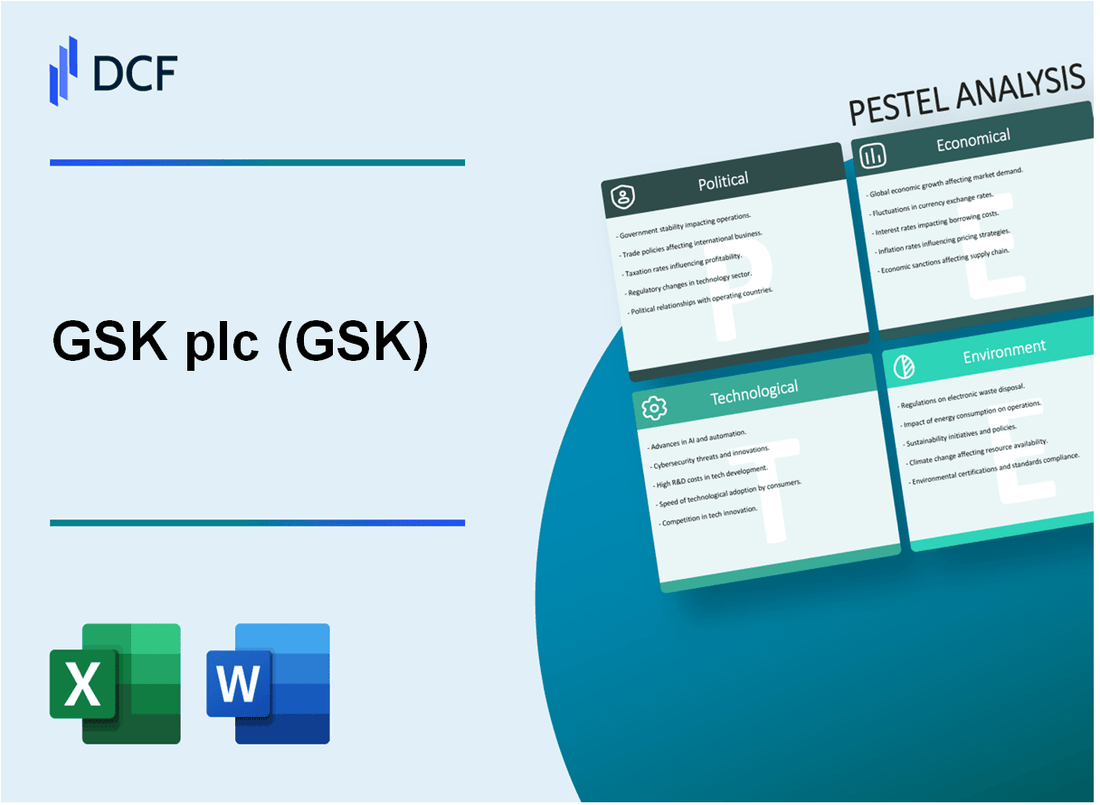
GSK PLC (GSK): Analyse du Pestle [Jan-2025 MISE À JOUR] |
Entièrement Modifiable: Adapté À Vos Besoins Dans Excel Ou Sheets
Conception Professionnelle: Modèles Fiables Et Conformes Aux Normes Du Secteur
Pré-Construits Pour Une Utilisation Rapide Et Efficace
Compatible MAC/PC, entièrement débloqué
Aucune Expertise N'Est Requise; Facile À Suivre
GSK plc (GSK) Bundle
Dans le monde dynamique des produits pharmaceutiques mondiaux, GSK PLC se tient au carrefour des forces d'intersection complexes qui façonnent son paysage stratégique. Cette analyse complète du pilon dévoile le réseau complexe des facteurs politiques, économiques, sociologiques, technologiques, juridiques et environnementaux qui influencent profondément les opérations commerciales de GSK, révélant les défis et les opportunités à multiples facettes auxquelles sont confrontés l'une des principales sociétés de soins de santé au monde. En disséquant ces dimensions externes critiques, nous explorerons comment GSK navigue sur un marché mondial de plus en plus complexe, en s'adaptant à des changements sans précédent qui définiront sa trajectoire future.
GSK PLC (GSK) - Analyse du pilon: facteurs politiques
L'environnement réglementaire britannique a un impact sur la recherche et le développement pharmaceutiques
L'Agence de réglementation des médicaments et des produits de santé (MHRA) supervise les réglementations pharmaceutiques au Royaume-Uni. En 2024, le budget de la MHRA est de 352,5 millions de livres sterling. Les sociétés pharmaceutiques comme GSK doivent se conformer aux cadres réglementaires rigoureux pour le développement et l'approbation des médicaments.
| Aspect réglementaire | Exigences de conformité | Impact sur GSK |
|---|---|---|
| Approbations des essais cliniques | Revue obligatoire de la MHRA | Temps d'approbation moyen: 60-90 jours |
| Surveillance de la sécurité des médicaments | Reportage continu | Examen annuel minimum de sécurité requis |
Implications du Brexit pour le commerce pharmaceutique transfrontalière et les essais cliniques
Le Brexit a eu un impact significatif sur les réglementations commerciales pharmaceutiques.
- Les exportations pharmaceutiques britanniques vers l'UE ont diminué de 18,3% depuis 2020
- Coûts de documentation douanière supplémentaires: 350 £ à 500 £ par expédition
- La complexité d'enregistrement des essais cliniques a augmenté de 42%
Changements de politique de santé du gouvernement
Les dépenses de santé du gouvernement britannique en 2024 sont de 180,2 milliards de livres sterling, avec un accès au marché pharmaceutique de plus en plus réglementé.
| Domaine politique | Changement de réglementation | Impact financier |
|---|---|---|
| Prix de médicament | Négociations de prix obligatoires | Réduction potentielle des revenus de 7 à 12% |
| Accès au marché | Critères de rentabilité plus stricts | Coût estimé de la conformité de 45 millions de livres sterling |
Règlements sur le commerce international et tensions géopolitiques
Les défis commerciaux mondiaux ont un impact direct sur les opérations pharmaceutiques internationales de GSK.
- Les tensions commerciales américaines-chinoises entraînant une augmentation de 15,6% des coûts de conformité à l'importation / exportation
- Tarifs sur les matières premières pharmaceutiques: 3 à 7% de dépenses supplémentaires
- Divergence réglementaire sur les principaux marchés augmentant la complexité opérationnelle
Le commerce pharmaceutique mondial de la GSK touché par un paysage réglementaire international complexe avec des coûts de conformité estimés atteignant 78,3 millions de livres sterling par an.
GSK PLC (GSK) - Analyse du pilon: facteurs économiques
Les fluctuations économiques mondiales ont un impact sur l'investissement et les prix pharmaceutiques
GSK a déclaré que les revenus du marché pharmaceutique mondial de 33,8 milliards de livres sterling en 2023, avec une baisse de 5% des taux de change constants. La stratégie de tarification de l'entreprise reflète des pressions économiques mondiales complexes.
| Indicateur économique | Valeur 2023 | Changement d'année |
|---|---|---|
| Revenus pharmaceutiques mondiaux | 33,8 milliards de livres sterling | -5% |
| Recherche & Dépenses de développement | 4,4 milliards de livres sterling | Augmentation de 3,2% |
| Marge bénéficiaire opérationnelle | 22.3% | -1,5 points de pourcentage |
Volatilité des taux de change
Impact de la monnaie sur les revenus internationaux de GSK:
| Devise | Volatilité du taux de change (2023) | Impact sur les revenus |
|---|---|---|
| USD / GBP | ±4.7% | £ 612 millions de écarts de revenus |
| EUR / GBP | ±3.2% | 387 millions de livres sterling de revenus |
Tendances des dépenses de santé
Analyse des dépenses de santé spécifiques au marché:
| Marché | Dépenses de santé 2023 | Part de marché GSK |
|---|---|---|
| États-Unis | 4,3 billions de dollars | 7.2% |
| Royaume-Uni | 240 milliards de livres sterling | 5.8% |
| Marchés émergents | 1,9 billion de dollars | 6.5% |
Investissement de la recherche et du développement
Répartition des investissements en R&D pour 2023:
- Dépenses totales de R&D: 4,4 milliards de livres sterling
- Recherche des vaccins: 1,2 milliard de livres sterling
- Recherche pharmaceutique: 2,6 milliards de livres sterling
- Recherche sur la santé des consommateurs: 0,6 milliard de livres sterling
| Zone de focus R&D | Investissement | Pourcentage de la R&D totale |
|---|---|---|
| Oncologie | 1,1 milliard de livres sterling | 25% |
| Immunologie | 0,9 milliard de livres sterling | 20.5% |
| Maladies infectieuses | 0,7 milliard de livres sterling | 15.9% |
GSK PLC (GSK) - Analyse du pilon: facteurs sociaux
Augmentation de la demande mondiale de solutions de soins de santé innovantes
La taille du marché mondial des soins de santé a atteint 8,3 billions de dollars en 2023, l'innovation pharmaceutique conduisant 62% de la croissance du marché. L'investissement en R&D de GSK en 2023 était de 4,4 milliards de livres sterling, ce qui représente 13% des revenus totaux.
| Segment de marché | Valeur globale (2023) | Taux de croissance |
|---|---|---|
| Solutions de soins de santé innovants | 3,2 billions de dollars | 7.5% |
| Recherche pharmaceutique | 1,9 billion de dollars | 6.8% |
Vieillissement de la population stimulant le développement de produits pharmaceutiques
La population mondiale âgée de 65 ans et plus pour atteindre 1,5 milliard d'ici 2050. Le portefeuille de médecine gériatrique de GSK a généré 2,7 milliards de livres sterling en 2023.
| Groupe d'âge | Population (2024) | Dépenses de santé |
|---|---|---|
| 65-74 ans | 727 millions | 3,6 billions de dollars |
| Plus de 75 ans | 522 millions | 4,2 billions de dollars |
Conscience croissante des consommateurs de la santé et du bien-être
Le marché mondial du bien-être d'une valeur de 5,6 billions de dollars en 2023. La division de santé grand public de GSK a déclaré 9,6 milliards de livres sterling de revenus annuels.
| Catégorie de bien-être | Taille du marché | Croissance annuelle |
|---|---|---|
| Soins de santé préventifs | 1,8 billion de dollars | 8.3% |
| Suppléments nutritionnels | 1,2 billion de dollars | 6.5% |
Changement des attentes des patients pour les traitements médicaux personnalisés
Marché de la médecine personnalisée estimé à 796 milliards de dollars en 2023. GSK a investi 620 millions de livres sterling dans la recherche en médecine de précision en 2023.
| Segment de médecine personnalisée | Valeur marchande | Croissance projetée |
|---|---|---|
| Tests génétiques | 289 milliards de dollars | 11.5% |
| Thérapies ciblées | 507 milliards de dollars | 9.7% |
GSK PLC (GSK) - Analyse du pilon: facteurs technologiques
Biotechnologie avancée et capacités de recherche génétique
GSK a investi 4,1 milliards de livres sterling en R&D en 2022, en mettant un accent significatif sur les plateformes de recherche génétique. L'entreprise entretient 39 programmes de recherche génétique actifs dans plusieurs domaines thérapeutiques.
| Domaine de recherche | Programmes actifs | Investissement (million de livres sterling) |
|---|---|---|
| Génétique en oncologie | 12 | 1,250 |
| Génétique d'immunologie | 9 | 950 |
| Génétique neurologique | 8 | 750 |
| Génétique des maladies rares | 10 | 1,150 |
Technologies de santé numérique et intégration de l'intelligence artificielle
GSK s'est associé à NVIDIA en 2023 pour développer des plateformes de découverte de médicaments axées sur l'IA, avec un investissement initial de 250 millions de livres sterling. L'entreprise a déployé 47 algorithmes d'apprentissage automatique dans les processus de développement de médicaments.
| Technologie d'IA | Nombre d'implémentations | Gain d'efficacité projeté |
|---|---|---|
| Dépistage moléculaire AI | 18 | 35% |
| Optimisation des essais cliniques | 15 | 28% |
| Algorithmes de recrutement des patients | 14 | 22% |
Augmentation de l'investissement dans les plateformes d'essais cliniques numériques
GSK a alloué 325 millions de livres sterling à l'infrastructure d'essais cliniques numériques en 2022-2023, mettant en œuvre 63 plateformes d'essais numériques dans les centres de recherche mondiaux.
| Type de plate-forme | Numéro déployé | Investissement (million de livres sterling) |
|---|---|---|
| Surveillance à distance des patients | 22 | 125 |
| Systèmes d'essai décentralisés | 20 | 110 |
| Collecte de données en temps réel | 21 | 90 |
Analyse sophistiquée des données pour le développement de médicaments et les idées des patients
GSK a utilisé 72 plates-formes d'analyse de données avancées en 2022, traitant plus de 3,2 pétaoctets de données de recherche clinique. La société a réduit les délais de développement de médicaments de 22% grâce à la mise en œuvre de l'analyse avancée.
| Focus d'analyse | Plates-formes déployées | Données traitées (pétaoctets) |
|---|---|---|
| Modélisation prédictive | 24 | 1.1 |
| Segmentation des patients | 18 | 0.8 |
| Prédiction des résultats cliniques | 30 | 1.3 |
GSK PLC (GSK) - Analyse du pilon: facteurs juridiques
Exigences strictes de conformité réglementaire pharmaceutique
GSK fait face à des exigences réglementaires complexes dans plusieurs juridictions. L'entreprise a dépensé 256 millions de livres sterling en 2023 en dépenses juridiques et liées à la conformité. La FDA a émis 14 lettres d'avertissement aux sociétés pharmaceutiques en 2023, GSK traitant 3 observations spécifiques de conformité.
| Corps réglementaire | Audits de conformité (2023) | Coût de conformité |
|---|---|---|
| FDA (États-Unis) | 7 Audits complets | 98,5 millions de livres sterling |
| EMA (Union européenne) | 5 Audits complets | 87,3 millions de livres sterling |
| MHRA (Royaume-Uni) | 3 Audits complets | 70,2 millions de livres sterling |
Protection de la propriété intellectuelle pour les brevets de médicament
GSK a maintenu 1 247 brevets pharmaceutiques actifs en 2023. La société a investi 1,4 milliard de livres sterling dans la recherche et le développement pour protéger les droits de propriété intellectuelle. Les frais de litige en brevet ont atteint 92 millions de livres sterling en 2023.
| Catégorie de brevet | Nombre de brevets | Durée de protection des brevets |
|---|---|---|
| Médicaments respiratoires | 347 brevets | 15-20 ans |
| Traitements du VIH | 216 brevets | 17-22 ans |
| Médicaments en oncologie | 184 brevets | 16-21 ans |
Paysage complexe de litiges pharmaceutiques mondiaux
GSK a fait face à 37 affaires juridiques actives en 2023, les frais de litige total atteignant 214 millions de livres sterling. Les frais de règlement des litiges liés à la pharmaceutique s'élevaient à 167 millions de livres sterling.
| Type de litige | Nombre de cas | Dépenses juridiques totales |
|---|---|---|
| Responsabilité du produit | 18 cas | 98,5 millions de livres sterling |
| Conflits de brevet | 12 cas | 67,3 millions de livres sterling |
| Conformité réglementaire | 7 cas | 48,2 millions de livres sterling |
Examen réglementaire en cours des pratiques d'essai cliniques
GSK a mené 64 essais cliniques en 2023, avec une surveillance réglementaire impliquant 12 agences internationales différentes. Les coûts de surveillance de la conformité des essais cliniques étaient de 43,6 millions de livres sterling.
| Phase d'essai clinique | Nombre de procès | Coût de surveillance réglementaire |
|---|---|---|
| Phase I | 17 essais | 12,4 millions de livres sterling |
| Phase II | 24 essais | 18,7 millions de livres sterling |
| Phase III | 23 essais | 12,5 millions de livres sterling |
GSK PLC (GSK) - Analyse du pilon: facteurs environnementaux
Pratiques de fabrication et de production durables
GSK s'est engagé à 100% d'électricité renouvelable dans les opérations mondiales d'ici 2025. La société a investi 42,4 millions de livres sterling dans des initiatives de durabilité en 2023. Les sites de fabrication de 34 pays ont mis en œuvre des protocoles de fabrication verts.
| Métrique de la durabilité | Performance de 2023 | Cible 2024 |
|---|---|---|
| Consommation d'énergie renouvelable | 85% | 95% |
| Réduction de la consommation d'eau | Réduction de 22% | Réduction de 30% |
| Taux de recyclage des déchets | 67% | 75% |
Engagements de réduction des émissions de carbone
GSK vise à réduire les émissions de carbone absolues de 42% d'ici 2030. L'empreinte carbone actuelle s'élève à 1,2 million de tonnes métriques CO2E. La société a promis 100 millions de livres sterling pour les initiatives de neutralité en carbone.
| Catégorie d'émissions | 2023 émissions (tonnes métriques CO2E) | Cible de réduction |
|---|---|---|
| Émissions de la portée 1 | 320,000 | Réduction de 25% d'ici 2030 |
| Émissions de la portée 2 | 480,000 | Réduction de 40% d'ici 2030 |
| Portée 3 Émissions | 400,000 | Réduction de 30% d'ici 2030 |
Stratégies responsables de gestion des déchets pharmaceutiques
GSK a mis en œuvre un programme complet de gestion des déchets pharmaceutiques avec des investissements de 35,6 millions de livres sterling. La société traite 98% des déchets pharmaceutiques grâce à des méthodes d'élimination certifiées pour l'environnement.
- Zéro déchet dangereux vers la décharge d'ici 2025
- Conformité à 100% des réglementations internationales d'élimination des déchets
- Techniques avancées de neutralisation chimique pour les déchets pharmaceutiques
Investissement de la technologie verte dans la recherche et le développement
GSK a alloué 275 millions de livres sterling à la recherche sur les technologies vertes en 2023. La R&D se concentre sur le développement durable des médicaments, les emballages écologiques et les processus de fabrication à faible émission de carbone.
| Zone de focus R&D | Investissement (million de livres sterling) | Résultat attendu |
|---|---|---|
| Formulation de médicaments durables | 95 | Réduire les déchets chimiques de 35% |
| Emballage respectueux de l'environnement | 85 | Emballage 100% recyclable d'ici 2026 |
| Fabrication à faible teneur en carbone | 95 | 50% d'amélioration de l'efficacité énergétique |
GSK plc (GSK) - PESTLE Analysis: Social factors
Global ageing populations drive demand for Specialty Medicines and vaccines like Shingrix
The demographic shift toward a globally aging population is a powerful social tailwind for GSK, directly increasing the market for its Specialty Medicines and vaccines. By 2050, the number of people aged 65 and older is projected to reach nearly 1.58 billion, a significant rise from the current estimate of 857 million.
This trend creates a clear, sustained demand for products that target age-related conditions. GSK's shingles vaccine, Shingrix, is a prime example of a product capitalizing on this, though the market can be volatile. In Q3 2025, Shingrix sales were £0.8 billion, a growth of 13% at Constant Exchange Rate (CER) compared to the prior year, demonstrating the product's value in this demographic. Honestly, this is a core engine for the Vaccines division.
Increased patient and public demand for preventive healthcare solutions
There is a definite social push for preventive care, moving beyond just treating sickness to actively maintaining health. This is reflected in the market: the Preventive Healthcare Technologies and Services market is projected to grow from $296.48 billion in 2024 to $341.51 billion in 2025, a Compound Annual Growth Rate (CAGR) of 15.2%. This is a massive, immediate opportunity.
GSK's Vaccines segment, which includes Shingrix and Arexvy (for RSV), is positioned right in the center of this trend. While the overall Vaccines sales in Q3 2025 saw a modest growth of 2% to £2.7 billion, the focus on new, high-value preventive shots like Arexvy and the continued strength of Shingrix show GSK is responding to the public's desire to stay healthy longer. The shift is about healthspan, not just lifespan.
High ranking on the Access to Medicine Index shows a strong global health commitment
Socially conscious investing and consumer scrutiny mean a pharmaceutical company's commitment to global health access is a critical non-financial factor. GSK's performance here is a major strength, providing a social license to operate in low- and middle-income countries (LMICs).
The company was ranked 2nd in the 2024 Access to Medicine Index, placing them in the top three across all technical areas and achieving 1st place in Product Delivery. This commitment translates into concrete actions, not just policy:
- Supplied 1.2 billion vaccines to the Gavi Alliance since 2010.
- Committed to providing at least two million doses of the long-acting injectable HIV-prevention drug, cabotegravir LA PrEP, for procurement in LMICs between 2025 and 2026.
- ViiV Healthcare's voluntary licensing agreements enable generic HIV treatment (DTG-based) to reach over 90% of patients on antiretrovirals (ARVs) in 128 LMICs, covering approximately 24 million people.
Focus on four core therapeutic areas: oncology, HIV, respiratory, and infectious diseases
GSK's strategic focus on these four core therapeutic areas is a direct response to global disease burden and unmet patient needs, which are major social and health factors. Their Specialty Medicines unit, which houses most of these areas, is the key growth driver, with Q3 2025 sales up 16% to £3.4 billion. The quick math shows where the social need and financial opportunity align.
The company is seeing strong double-digit growth in these specific areas, confirming the social and medical demand for these treatments. This focus allows for more efficient R&D investment and a clearer message to the public and investors about their mission.
| Core Therapeutic Area | Q3 2025 Sales (CER) | Q3 2025 Growth (CER) |
|---|---|---|
| HIV | £1.9 billion | +12% |
| Respiratory, Immunology & Inflammation | £1.0 billion | +15% |
| Oncology | £0.5 billion | +39% |
| Vaccines (Infectious Diseases) | £2.7 billion | +2% |
The 39% growth in Oncology sales to £0.5 billion in Q3 2025 is defintely a standout, driven by new product uptake. This strong growth in specialized treatments is why GSK raised its full-year 2025 turnover growth guidance to between 6% and 7%.
GSK plc (GSK) - PESTLE Analysis: Technological factors
Investing $30 billion in US R&D and supply chain over the next five years
GSK is making a massive, forward-looking commitment to solidify its technological base in a key market. The company announced plans in September 2025 to invest at least $30 billion across the United States over the next five years, specifically targeting research and development (R&D) and supply chain infrastructure.
This isn't just a capital expenditure (CapEx) play; it's a strategic move to ensure technological leadership and supply resilience within the US. The investment covers everything from drug discovery to clinical trial activity, with the US expected to become GSK's global leader for the number of clinical studies, sites, and participants during this five-year period.
$1.2 billion package allocated for AI, digital tools, and advanced manufacturing capabilities
A focused part of the larger commitment is a $1.2 billion package dedicated to advanced manufacturing and digital transformation. This investment is designed to build next-generation biopharma factories and laboratories, which is defintely a necessary step to produce complex, novel medicines efficiently.
Here's the quick math on where the $1.2 billion is going:
- Constructing a new biologics flex factory at Upper Merion, Pennsylvania, starting in 2026, focused on respiratory and cancer medicines.
- Deploying new Artificial Intelligence (AI) and advanced digital technology across five existing US manufacturing sites in Pennsylvania, North Carolina, Maryland, and Montana.
- Enhancing capabilities for new drug substance manufacturing and improved device and auto-injector assembly.
This focus on AI-powered manufacturing is crucial for improving yield, reducing batch variability, and accelerating time-to-market for complex biologics (medicines made from living organisms or their products).
Expecting five major new FDA product approvals in 2025 from the pipeline
The immediate technological success of GSK's R&D engine is visible in its product pipeline. For the 2025 fiscal year, the company expected five major new product approvals from the US Food and Drug Administration (FDA). By the end of the second quarter of 2025, three of these approvals were already secured, demonstrating strong R&D execution.
This rapid cadence of approvals is a direct measure of the effectiveness of their discovery technology and clinical development processes.
| Expected 2025 Major FDA Product Approvals | Therapeutic Area | Status as of Q2 2025 | Potential Indication |
|---|---|---|---|
| Penmenvy | Vaccines | Approved (Q1 2025) | Meningitis vaccine |
| Blujepa | Infectious Disease | Approved (Q1 2025) | First-in-class oral antibiotic for uncomplicated UTIs (uUTIs) |
| Nucala (Mepolizumab) | Respiratory | Approved (by Q2 2025) | Anti-IL5 biologic for Chronic Obstructive Pulmonary Disease (COPD) |
| Blenrep (Belantamab Mafodotin) | Oncology | Under FDA Review (PDUFA date Oct 23, 2025) | Multiple myeloma (combination therapy) |
| Depemokimab | Respiratory | Under FDA Review (Decision expected Dec 2025) | Ultra-long-acting biologic for severe asthma and nasal polyps |
Leveraging human genetics and genomics to accelerate drug discovery and development
GSK's core technological strategy is built on human genetics and genomics (the study of an organism's entire DNA). They prioritize drug targets that have genetic validation because historical data shows these targets are at least twice as likely to succeed in development. This is how you reduce the high failure rate inherent in drug development.
The company is applying AI and machine learning to large clinical and genetic datasets to map disease 'circuits'-the complex, multi-gene pathways that cause disease. This allows them to move from a trial-and-error approach to a predictive, precision-based one. A concrete example is their multi-year, multi-billion dollar framework collaboration with Flagship Pioneering, a scientific innovation engine.
This partnership, which has a potential value of over $7 billion in milestones and royalties, is already yielding results. In November 2025, they signed initial feasibility agreements with two Flagship companies: Quotient Therapeutics (using somatic genomics to find disease-causal drug targets) and ProFound Therapeutics (using a platform to identify novel proteins with strong genetic ties). This is all about finding the right target before you even start designing the drug. Finance: track the progress of the Quotient and ProFound programs; their success will be a leading indicator of R&D efficiency.
GSK plc (GSK) - PESTLE Analysis: Legal factors
Ongoing litigation with AnaptysBio over the oncology drug Jemperli licensing rights
The legal risk around GSK plc's oncology portfolio is real and immediate, centered on the licensing rights for the PD-1 inhibitor Jemperli (dostarlimab). This isn't just a contract dispute; it's a fight over a key growth driver, and it's happening right now in the Delaware Chancery Court.
In November 2025, GSK's subsidiary, Tesaro, Inc., filed a lawsuit alleging AnaptysBio, Inc. materially breached their 2014 license agreement. AnaptysBio immediately counter-sued. Honestly, a dual-lawsuit situation like this is a massive operational distraction. GSK's goal is to terminate the existing pact, secure a perpetual and irrevocable license to Jemperli, and reduce the royalties and milestone payments due to AnaptysBio by 50%. AnaptysBio, on the other hand, claims GSK has not used 'commercially reasonable efforts' to maximize the drug's return globally and has violated exclusivity by running competing clinical trials.
The financial stakes are high because Jemperli is a star performer. The drug generated sales of £600 million (approximately $785 million) in the first nine months of 2025 alone, representing an 89% year-on-year increase. A loss in this case could mean higher royalty payments or, worst-case, a challenge to the drug's commercialization rights, which would defintely impact future earnings projections.
Maintaining a £1.5 billion provision on the balance sheet for Zantac litigation claims
The Zantac (ranitidine) litigation has been a massive overhang, but recent actions have provided much-needed clarity on the financial exposure. GSK has moved to resolve the bulk of the claims, which is a smart move to remove long-term uncertainty. In October 2024, GSK announced a settlement of up to $2.2 billion to resolve approximately 80,000 U.S. state court product liability cases, covering about 93% of the outstanding claims against the company. This major resolution was expected to be fully implemented by mid-2025.
To account for this, GSK recognized an incremental charge of £1.8 billion (approximately $2.3 billion) in its Q3 2024 results, covering the state court settlements, a separate $70 million settlement for a federal qui tam (whistleblower) complaint, and the remaining 7% of pending state court cases. This charge is the concrete financial impact on the balance sheet for the 2025 fiscal year. While this is a huge number, settling without admitting liability allows GSK to focus capital on R&D, not on endless court battles. The legal risk is shifting from existential to manageable.
Here's the quick math on the major Zantac financial resolution:
| Metric | Amount | Notes |
|---|---|---|
| Total State Court Settlement Value (Up To) | $2.2 billion | Resolves ~80,000 U.S. state court cases. |
| Incremental Charge Recognized (Q3 2024) | £1.8 billion | Covers settlements and remaining 7% of state cases. |
| Percentage of State Cases Resolved | 93% | Expected to be fully implemented by mid-2025. |
Increased regulatory complexity in the pharmaceutical industry (e.g., clinical trial transparency)
The regulatory environment is getting stricter and more global, which means higher compliance costs and a longer time-to-market. The industry is seeing a push for greater clinical trial transparency, a key area of focus in 2025. Europe's Clinical Trials Regulation (CTR) is a prime example, mandating sponsors to publish trial data and results, including patient-friendly summaries (plain language summaries), in a centralized database.
Plus, the U.S. Food and Drug Administration (FDA) is expected to finalize guidance on enhancing diversity in clinical trials, requiring sponsors to set and meet specific demographic enrollment goals. This isn't just an ethical issue; it's a legal requirement that complicates trial design and recruitment. The World Health Organization (WHO) and the International Council for Harmonisation (ICH) are also driving change, with the comprehensive update to the Good Clinical Practice guidelines, ICH E6 (R3), expected in 2025. This update is fundamentally reshaping how global trials are conducted, requiring a more flexible, risk-based approach to monitoring. This means GSK has to overhaul its internal processes.
Need for robust intellectual property (IP) management to defend key drug patents
Intellectual Property (IP) is the lifeblood of a biopharma company, and actively defending patents is non-negotiable for GSK. The company's IP strategy, outlined in its January 2025 public policy position, is clear: seek full patent protection in high-income countries to incentivize the massive investment required to develop a new medicine (estimated at around $2.6 billion). The challenge is managing the patent cliff-the expiration of exclusivity for top-selling drugs-and defending against generic and biosimilar competitors.
GSK must execute a robust IP defense strategy for its key products to protect revenue streams. For example, the company faces patent expiry for several high-value HIV drugs in the near to medium term. Losing exclusivity means a rapid decline in revenue, so the legal team must be proactive in defending these assets.
- Apretude (Cabotegravir): US patent expiry is 2031, with EU expiry between 2026-2031.
- Dovato (Dolutegravir, Lamivudine): US patent expiry is 2028, with EU expiry between 2030-2031.
- Rukobia (Fostemsavir): EU patent expiry is as early as 2025-2027, making IP defense critical right now.
The immediate action for the legal and strategy teams is to map out the secondary patents and regulatory exclusivities for these products to extend effective protection as long as legally possible. This is where the real value is unlocked.
GSK plc (GSK) - PESTLE Analysis: Environmental factors
Goal to source 100% renewable electricity for operations by the end of 2025
You're seeing a global push for renewable energy, and GSK is defintely leaning into that trend, not just for optics, but for operational resilience. The company's near-term goal is to source 100% of its imported electricity from renewable sources by the end of 2025, which is a key part of its Scope 2 emissions reduction strategy.
The progress here is strong: by the end of 2024, GSK had already reached 90% of its imported electricity from renewable sources, a significant jump from 83% in 2023. That's a huge shift in just one year. This transition involves a mix of on-site generation, like solar panels, and large-scale Power Purchase Agreements (PPAs), such as the ten-year deal signed in 2024 to cover all three manufacturing sites in Singapore from January 2025. This Singapore deal alone is expected to increase the company's global purchased renewable electricity usage by 9%, demonstrating how targeted, regional action drives the overall corporate target.
Committed to achieving net-zero carbon emissions across the value chain by 2045
The long-term climate commitment is net-zero greenhouse gas (GHG) emissions across the entire value chain by 2045, which aligns with the Science Based Targets initiative (SBTi) Net Zero Standard. This means a massive 90% absolute reduction in emissions from the 2020 baseline, with the remaining 10% neutralized via high-quality carbon credits.
Here's the quick math on their current footprint: their own operations (Scope 1 and 2) account for only about 7% of the total carbon footprint. The real challenge lies in Scope 3, which is a whopping 93% of their total emissions, with a substantial 53% coming from the use of their sold products, primarily the propellant in metered-dose inhalers (MDIs). That's why the focus is on a low-carbon MDI program, which, if successful, has the potential to reduce emissions from that product category by around 90%.
As of 2024, GSK had achieved a 36% reduction in Scope 1 and 2 emissions from the 2020 baseline, which is a solid operational win. Still, the 2045 goal hinges on tackling that massive Scope 3 problem. They're aiming for an 80% absolute reduction across all scopes by 2030, with the residual 20% offset by nature-based solutions.
| 2025 Environmental Target Area | 2024 Progress (from 2020 Baseline) | 2025/2030/2045 Target |
|---|---|---|
| Imported Renewable Electricity (Scope 2) | 90% achieved (up from 83% in 2023) | 100% by end of 2025 |
| Operational Carbon Emissions (Scope 1 & 2) | 36% absolute reduction | 80% absolute reduction (all scopes) by 2030 |
| Overall Water Use Reduction | 28% reduction | 20% reduction by 2030 (Target met early) |
| Operational Waste Reduction | 25% reduction | Zero operational waste by 2030 |
Aiming for good water stewardship at 100% of GSK's sites by 2025
Water is a critical input in biopharma, so water stewardship is a non-negotiable risk factor. The good news is that GSK has already achieved its 2025 goal of ensuring 100% of its sites maintain good water stewardship status, aligning with the Alliance for Water Stewardship (AWS) definition.
In fact, they've also surpassed their longer-term consumption goal, achieving a 28% reduction in overall water use from the 2020 baseline, which is better than the target of 20% by 2030. This allows them to pivot to more impactful, basin-level work, like the five-year, multi-million-pound partnership with WWF, announced in March 2025. This partnership is focused on water-stressed regions in India and Pakistan where GSK has manufacturing sites and key suppliers, aiming to replenish over 300,000 m3 of water and positively impact over 100,000 local people by 2030.
Focus on reducing operational waste and limiting the environmental impact of products
The company is driving toward a goal of zero operational waste by 2030. This is a tough target for a manufacturing business, but they're making solid progress. As of 2024, they had already cut operational waste by 25% compared to the 2020 baseline. They're also focusing heavily on the circular economy, with 54% of materials recovered via circular routes in 2024.
This waste focus extends to their product portfolio, with a target of a 25% environmental impact reduction for products and packaging by 2030. To get there, they've implemented Sustainable Design Plans for all newly developed or acquired medicines starting in 2024. This means environmental factors are now baked into the product design process from day one, which is the only way to truly move the needle on a supply chain that accounts for 37% of their total carbon footprint.
- Reduce operational waste by 25% (achieved as of 2024).
- Recover 54% of materials through circular routes (2024 data).
- Apply Sustainable Design Plans to all new medicines (started 2024).
- Aim for 100% of paper packaging and palm oil to be certified by 2025.
Disclaimer
All information, articles, and product details provided on this website are for general informational and educational purposes only. We do not claim any ownership over, nor do we intend to infringe upon, any trademarks, copyrights, logos, brand names, or other intellectual property mentioned or depicted on this site. Such intellectual property remains the property of its respective owners, and any references here are made solely for identification or informational purposes, without implying any affiliation, endorsement, or partnership.
We make no representations or warranties, express or implied, regarding the accuracy, completeness, or suitability of any content or products presented. Nothing on this website should be construed as legal, tax, investment, financial, medical, or other professional advice. In addition, no part of this site—including articles or product references—constitutes a solicitation, recommendation, endorsement, advertisement, or offer to buy or sell any securities, franchises, or other financial instruments, particularly in jurisdictions where such activity would be unlawful.
All content is of a general nature and may not address the specific circumstances of any individual or entity. It is not a substitute for professional advice or services. Any actions you take based on the information provided here are strictly at your own risk. You accept full responsibility for any decisions or outcomes arising from your use of this website and agree to release us from any liability in connection with your use of, or reliance upon, the content or products found herein.