

|
Hawaiian Electric Industries, Inc. (HE): ANSOFF Matrix Analysis [Jan-2025 Mis à jour] |
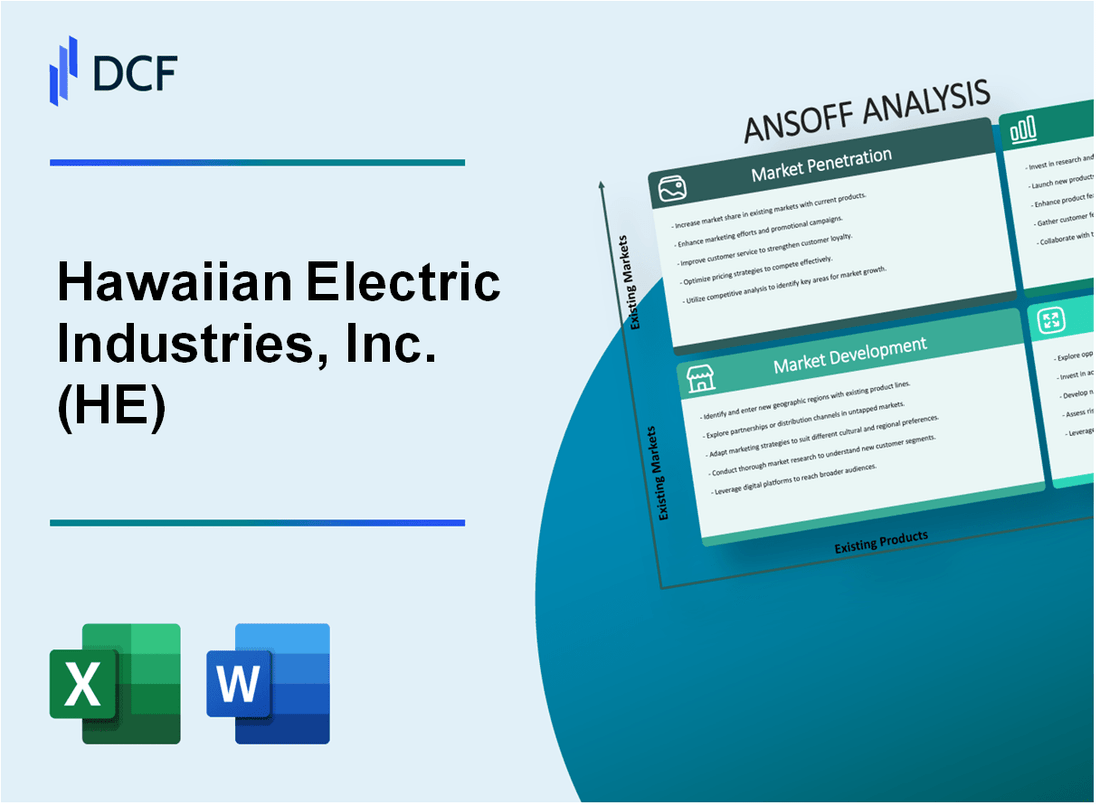
Entièrement Modifiable: Adapté À Vos Besoins Dans Excel Ou Sheets
Conception Professionnelle: Modèles Fiables Et Conformes Aux Normes Du Secteur
Pré-Construits Pour Une Utilisation Rapide Et Efficace
Compatible MAC/PC, entièrement débloqué
Aucune Expertise N'Est Requise; Facile À Suivre
Hawaiian Electric Industries, Inc. (HE) Bundle
Hawaiian Electric Industries, Inc. (il) est à l'avant-garde d'une révolution de l'énergie transformatrice, se positionnant stratégiquement pour redéfinir la production et la distribution d'énergie durables à travers le Pacifique. En explorant méticuleusement la matrice Ansoff, la société dévoile une feuille de route audacieuse qui transcende les frontières traditionnelles des services publics, adoptant des stratégies innovantes dans les énergies renouvelables, les progrès technologiques et l'expansion du marché. De l'adoption d'énergie solaire aux technologies de grille de pointe, il ne s'adapte pas seulement à l'avenir - il génère activement un écosystème d'énergie plus propre et plus efficace qui promet de remodeler la façon dont les communautés consomment et interagissent avec le pouvoir.
Hawaiian Electric Industries, Inc. (HE) - Matrice Ansoff: pénétration du marché
Développez l'adoption d'énergie solaire parmi les clients résidentiels et commerciaux existants à Hawaï
En 2022, Hawaiian Electric Industries a signalé 95 000 installations solaires résidentielles et commerciales à Hawaï. Le taux de pénétration solaire de l'entreprise a atteint 36% de la production totale d'électricité dans l'État.
| Segment de clientèle | Installations solaires | Taux de pénétration |
|---|---|---|
| Clients résidentiels | 68,500 | 28% |
| Clients commerciaux | 26,500 | 8% |
Mettre en œuvre des programmes d'efficacité énergétique agressifs
Hawaiian Electric a investi 42,3 millions de dollars dans des programmes d'efficacité énergétique en 2022, ciblant une réduction de 15% de la consommation d'énergie des clients.
- Services d'audit énergétique: 22 000 clients ont participé
- Programmes de remise: 6,2 millions de dollars distribués
- Installations de compteur intelligent: 87 000 terminés
Développer des campagnes de marketing ciblées
Attribution du budget marketing pour la promotion des énergies renouvelables: 3,7 millions de dollars en 2022.
| Canal de marketing | Investissement | Atteindre |
|---|---|---|
| Marketing numérique | 1,5 million de dollars | 250 000 clients |
| Événements communautaires | $850,000 | 45 événements locaux |
Offrez des plans de tarifs attractifs et des incitations
Budget du programme d'incitation aux énergies renouvelables: 14,6 millions de dollars en 2022.
- Crédits de mesure nette solaire: 0,15 $ par kWh
- Incitations au stockage de la batterie: jusqu'à 4 000 $ par installation
- Plans de taux de facturation des véhicules électriques: 25% tarifs réduits
Améliorer la qualité du service client
Investissement du service client: 8,2 millions de dollars en 2022.
| Métrique de service | Performance |
|---|---|
| Temps de réponse moyen | 12 minutes |
| Taux de satisfaction client | 87% |
| Adoption du service numérique | 65% des clients |
Hawaiian Electric Industries, Inc. (HE) - Matrice Ansoff: développement du marché
Explorez l'expansion dans d'autres marchés de l'île du Pacifique au-delà de Hawaï
Hawaiian Electric Industries, Inc. a déclaré un chiffre d'affaires total de 1,08 milliard de dollars en 2022. Le potentiel du marché de l'île du Pacifique comprend Guam, avec une taille du marché de l'électricité d'environ 250 millions de dollars par an.
| Marché | Revenus annuels potentiels | Potentiel d'énergie renouvelable |
|---|---|---|
| Guam | 250 millions de dollars | Potentiel solaire de 37% |
| Samoa américaine | 45 millions de dollars | 28% de capacité renouvelable |
Associez-vous à des gouvernements locaux pour développer des infrastructures d'énergie renouvelable
Hawaiian Electric a investi 185 millions de dollars dans des projets d'infrastructures renouvelables en 2022. Le portefeuille actuel des énergies renouvelables représente 34% de la capacité de production totale.
- 75 millions de dollars alloués à la modernisation de la grille
- 37 MW de nouveaux projets solaires terminés
- 15 MW d'infrastructures d'énergie éolienne développées
Enquêter sur les opportunités dans les projets d'énergie solaire et éolienne à l'échelle des services publics
Les projets renouvelables à l'échelle des services publics d'Hawaiian Electric au total 278 MW. Investissement prévu pour de nouveaux projets renouvelables estimés à 420 millions de dollars à 2025.
| Type de projet | Capacité actuelle | Investissement prévu |
|---|---|---|
| Solaire | 187 MW | 265 millions de dollars |
| Vent | 91 MW | 155 millions de dollars |
Développer des infrastructures de charge de véhicules électriques sur différentes îles hawaïennes
Les plans électriques hawaïens pour installer 250 nouvelles stations de charge EV d'ici 2024. Les infrastructures de charge EV actuelles comprennent 175 emplacements de chargement publics.
- Budget de 35 millions de dollars pour l'expansion des infrastructures EV
- Ciblant 500 stations de charge totales d'ici 2026
- Investissement moyen de 140 000 $ par station de charge
Cherchez des approbations réglementaires pour les projets d'interconnexion de la grille inter-îles
Coût estimé du projet pour l'interconnexion du réseau inter-îles: 325 millions de dollars. Time d'achèvement prévu: 2025-2027.
| Île | Coût d'interconnexion de la grille | Achèvement estimé |
|---|---|---|
| Oahu | 175 millions de dollars | 2025 |
| Maudi | 95 millions de dollars | 2026 |
| Île d'Hawaï | 55 millions de dollars | 2027 |
Hawaiian Electric Industries, Inc. (HE) - Matrice Ansoff: développement de produits
Développer des solutions avancées de stockage d'énergie pour compléter la production renouvelable
Hawaiian Electric Industries a investi 28,7 millions de dollars dans des projets de stockage de batteries en 2022. La société a déployé 134 MW de capacité de stockage d'énergie sur le réseau d'Hawaï. Les installations de stockage de batteries ont augmenté de 42% par rapport à l'année précédente.
| Projet de stockage d'énergie | Capacité (MW) | Investissement ($ m) |
|---|---|---|
| Stockage de grille oahu | 78 | 16.5 |
| Maui Energy Storage | 36 | 7.9 |
| Projets de l'île d'Hawaï | 20 | 4.3 |
Créer des technologies de réseau intelligent pour améliorer l'efficacité de la distribution de l'électricité
Smart Grid Investments a atteint 42,3 millions de dollars en 2022. La société a mis en œuvre une infrastructure de comptage avancée couvrant 95% de sa clientèle. La modernisation de la grille a réduit les pertes de transmission de 3,6%.
- Déploiement avancé des infrastructures de mesure: 245 000 compteurs intelligents
- Systèmes de surveillance du réseau en temps réel: 12 nouveaux centres de contrôle
- Amélioration de l'efficacité du réseau: réduction de 3,6% des pertes de transmission
Lancez des systèmes de gestion d'énergie à domicile innovants pour les clients résidentiels
Hawaiian Electric a lancé des systèmes de gestion de l'énergie domestique avec 6,2 millions de dollars en coûts de développement. 37 500 clients résidentiels ont adopté des technologies de gestion de l'énergie de la maison intelligente en 2022.
| Technologie | Taux d'adoption | Segments de clientèle |
|---|---|---|
| Intégration intelligente du thermostat | 22 500 clients | Résidentiel |
| Gestion de l'énergie solaire | 15 000 clients | Solaire résidentiel |
Introduire des microréseaux et des solutions énergétiques décentralisées
Les investissements de microréseaux ont totalisé 35,6 millions de dollars en 2022. La société a développé 7 nouveaux projets de microréseaux sur les îles hawaïennes, soutenant 45 000 clients avec des solutions énergétiques décentralisées.
- Capacité totale des microrésexes: 24 MW
- Nombre de projets microréens: 7
- Clients desservis par des microréseaux: 45 000
Développer des technologies de maintenance prédictive pour les infrastructures électriques
Les investissements en technologie de maintenance prédictive ont atteint 18,4 millions de dollars. La société a mis en place des systèmes de surveillance axés sur l'IA sur 3 200 miles de lignes de transmission, ce qui réduit les pannes inattendues de 27%.
| Technologie de maintenance | Investissement ($ m) | Réduction de la panne |
|---|---|---|
| Systèmes de surveillance de l'IA | 12.6 | 27% de réduction |
| Technologies d'inspection des drones | 5.8 | Amélioration de l'efficacité de 18% |
Hawaiian Electric Industries, Inc. (HE) - Matrice Ansoff: diversification
Investissez dans des technologies d'énergie propre émergentes comme la production d'hydrogène vert
Hawaiian Electric Industries a investi 12,5 millions de dollars dans la recherche et le développement de l'hydrogène vert en 2022. La capacité actuelle de production d'hydrogène verte s'élève à 50 tonnes métriques par an. La valeur marchande projetée pour l'hydrogène vert à Hawaï est estimée à 78 millions de dollars d'ici 2025.
| Catégorie d'investissement | Montant | Croissance projetée |
|---|---|---|
| R&D à l'hydrogène vert | 12,5 millions de dollars | 15,3% par an |
| Capacité de production | 50 tonnes métriques / an | 250% d'ici 2026 |
Explorez la gestion des flotte de véhicules électriques et les offres de services connexes
Hawaiian Electric a engagé 25 millions de dollars dans l'infrastructure de véhicules électriques. Stations de charge EV actuelles numéro 127 à Hawaï. Les revenus des services de gestion de la flotte ont atteint 4,2 millions de dollars en 2022.
- Investissement total d'infrastructure de charge EV: 25 millions de dollars
- Nombre de bornes de recharge: 127
- Revenus des services de gestion de la flotte: 4,2 millions de dollars
Développer des services de conseil en énergie pour les clients commerciaux et industriels
Les services de conseil en énergie ont généré 6,7 millions de dollars de revenus pour Hawaiian Electric en 2022. La clientèle s'est étendue à 214 clients commerciaux et industriels.
| Consulting Service Metrics | 2022 données |
|---|---|
| Revenus totaux | 6,7 millions de dollars |
| Nombre de clients | 214 |
Créer des plateformes numériques pour le trading et la gestion de l'énergie
Coût de développement de la plate-forme numérique: 8,3 millions de dollars. La base d'utilisateurs de la plate-forme est passée à 45 000 en 2022. Le volume des transactions a atteint 17,6 millions de dollars.
- Investissement de développement de plate-forme numérique: 8,3 millions de dollars
- Base d'utilisateurs: 45 000
- Volume de transaction annuel: 17,6 millions de dollars
Investissez dans des projets de développement d'infrastructures durables
L'investissement en infrastructure durable a totalisé 42,6 millions de dollars en 2022. Les projets incluent l'intégration du réseau d'énergie renouvelable et le développement des microréseaux.
| Investissement en infrastructure | Montant |
|---|---|
| Investissement total d'infrastructure durable | 42,6 millions de dollars |
| Projets d'intégration de la grille renouvelable | 18,3 millions de dollars |
| Développement des microréseaux | 24,3 millions de dollars |
Hawaiian Electric Industries, Inc. (HE) - Ansoff Matrix: Market Penetration
Market penetration for Hawaiian Electric Industries, Inc. (HE) centers on deepening service within its existing island markets by accelerating infrastructure investment and driving customer adoption of new programs.
Accelerate Grid Modernization Using Securitization Funding
You're looking at significant capital deployment to harden the grid against future events, which directly impacts reliability and customer trust. Hawaiian Electric Industries, Inc. (HE) has a three-year wildfire safety strategy that is projected to cost $350 million, with $137 million budgeted specifically for work in 2025. This is part of a broader, multiyear effort that includes replacing 2,202 wood utility poles with fire-resistant alternatives and undergrounding two miles of high-risk overhead lines in Lahaina. The company is seeking regulatory approval for securitization, which authorizes financing up to $500 million for these resilience investments. If this securitization is approved, the estimated 3-year total bill impact for Oahu is $68M, for Hawaii Island $101M, and for Maui County $181M. Without securitization, the estimated monthly bill impact for an average residential customer would be $1 on Oahu, $3 on Hawaii Island, and $5 in Maui County. In 2024, the company spent about $120 million on wildfire safety improvements alone.
Drive Adoption of BYOD Plus Program
The Bring Your Own Device Plus (BYOD Plus) program, which started on May 15, 2025, is a key lever for increasing distributed energy resource participation. This program is designed to harness customer battery storage to support the grid, especially during the evening peak. The total capacity allocated for enrollment is 50 MW statewide. This capacity is split evenly, reserving 25 MW specifically for Low and Moderate-Income (LMI) households and 25 MW for non-LMI participants. The commitment period for participants is five years, running from May 15, 2025 - May 14, 2030. Customers must commit a minimum of 1 kW capacity. The financial incentives are structured to encourage adoption, defintely.
| Customer Segment | Upfront Incentive (per kW) | Export Credit Rate | Minimum Committed Capacity |
|---|---|---|---|
| Non-LMI | $400/kW | Retail Rate (during dispatch window) | 1 kW |
| LMI | $800/kW | Retail Rate (during dispatch window) | 1 kW |
For example, an LMI household with two batteries, each committing 1 kW, could receive up to $8,000 in upfront rebates.
Increase Renewable Energy Generation
Hawaiian Electric Industries, Inc. (HE) is pushing past its 2024 Renewable Portfolio Standard (RPS) achievement of 36% consolidated renewable energy generation. This is a step up from the 33% achieved in 2023. The company is moving toward the state's 2030 goal of 40% RPS, with the long-term target being 100% renewable energy by 2045. The 2024 figures show significant progress across the islands, though the consolidated number masks island-specific performance.
- Oahu RPS in 2024: 30.8%
- Hawaii Island RPS in 2024: 58.7%
- Maui County RPS in 2024: 41.1%
Grid-scale solar additions in 2024 included projects like Kupono Solar (42 MW) and AES Kuihelani Solar (60 MW). New private rooftop solar installations totaled 61 MW in 2024. The company is on track to exceed the forecasted cumulative distributed solar capacity of 1,186 MW by 2030.
Offer Dynamic Pricing Tariffs
To optimize existing grid capacity, Hawaiian Electric Industries, Inc. (HE) is advancing its Advanced Rate Design Strategy (ARDS) through Time-of-Use (TOU) rates. The TOU Study began on February 1, 2024, for a subset of customers. This tariff structure divides the day into three pricing periods to incentivize usage shifts away from peak demand times:
- Daytime Period (9 a.m. to 5 p.m.)
- Evening Peak Period (5 p.m. - 9 p.m.)
- Overnight Period (9 p.m. - 9 a.m.)
The rates are set in a 1:2:3 ratio, meaning the evening peak is the most expensive period, and daytime rates are the cheapest. The overall Pilot implementation schedule has been extended to December 31, 2026.
Improve Customer Satisfaction and Reliability
Solidifying the existing market position relies on maintaining high service levels, which is supported by the grid modernization efforts mentioned above. Hawaiian Electric Industries, Inc. (HE) is a prominent utility supplying power to approximately 95% of the state's population. The company's Q3 2025 report showed a subsidiary net income of $37 million, reflecting a significant recovery driven by higher revenues and reduced wildfire liabilities. The utility continues to focus on decarbonization and grid modernization to enhance reliability.
Hawaiian Electric Industries, Inc. (HE) - Ansoff Matrix: Market Development
You're looking at expanding Hawaiian Electric Industries, Inc. (HEI) beyond its regulated Hawaii footprint. The core competency here is managing an island grid with high renewable penetration, which is a complex, high-cost environment. For context, Hawaiian Electric achieved a consolidated Renewable Portfolio Standard (RPS) of 36% in 2024, accelerating toward the 2030 milestone of 40%.
Establish a non-regulated consulting arm to export expertise in complex island grid decarbonization
The current strategic direction shows a move toward simplification, with the sale of 90.1% of American Savings Bank closing on December 31, 2024, and the divestiture of Pacific Current's solar and battery assets. This shift contrasts with the prior non-regulated activities; for instance, Pacific Current recorded a $35.2 million asset impairment in Q3 2024. The expertise developed, however, remains valuable. The utility itself saw a typical residential bill decrease of 7% in 2024, and returned $18 million in bill credits to customers.
Target other isolated, high-cost energy markets like U.S. territories or Caribbean island nations with existing products
The experience gained in Hawaii's unique environment-which includes managing a system where about 43% of single-family homes have rooftop solar-is the product for export. The scale of the challenge is reflected in the company's financial position; for the full year 2024, Hawaiian Electric Industries, Inc. reported a net loss of $1,426 million, or $11.23 per share, compared to a net income of $199 million in 2023. The utility's Q3 2025 net income was $37 million, a significant improvement from the Q3 2024 net loss of $83 million.
Bid on federal contracts to manage and modernize microgrids on U.S. military bases outside of Hawaii
The need for grid modernization and resilience mirrors the work HEI is undertaking in Hawaii, which requires significant capital. The projected Capital Expenditure (CapEx) over the next three years, from 2026 to 2028, is roughly $1.8 billion to $2.4 billion, which includes funding for wildfire and resilience work. Specifically, wildfire and resilience CapEx is expected to be approximately $50 million to $100 million, planned to be financed via securitization. The company has recently improved its financial flexibility, expanding its credit facility capacity to $600 million from $375 million and successfully issuing approximately $500 million in debt.
Partner with mainland utilities to share best practices on integrating high levels of distributed solar, a core competency
Hawaiian Electric is on track to exceed the forecasted cumulative distributed solar capacity of 1,186 MW by 2030. This integration experience is a marketable asset. For comparison, the consolidated revenue for Hawaiian Electric Industries, Inc. in 2024 was $2.90 Billion USD, a decrease from $3.68 Billion USD in 2023. The core income from continuing operations in Q2 2025 was $35 million, or $0.20 per share.
Here are some key financial and operational metrics relevant to assessing this market development strategy:
| Metric Category | Description | Value (Latest Available) | Year/Period |
| Financial Performance | Full Year Net Loss | $1,426 million | 2024 |
| Financial Performance | Q3 Net Income | $31 million | Q3 2025 |
| Financial Performance | Revenue (TTM) | $2.76 Billion USD | 2025 TTM |
| Operational Achievement | Consolidated RPS | 36% | 2024 |
| Operational Achievement | Forecasted Cumulative Distributed Solar Capacity | 1,186 MW | By 2030 |
| Strategic Finance | Debt Issued | Approx. $500 million | 2025 |
| Strategic Finance | Projected Resilience CapEx (2026-2028) | $50 million to $100 million | Annualized Portion |
| Litigation/Risk Management | Maui Settlement First Payment Expected | No sooner than Q1 2026 | N/A |
The core competency is built on handling high renewable penetration and grid stability challenges:
- RPS Milestone Target: 40% by 2030.
- Hawaii Island RPS Achieved: 59%.
- Single-Family Homes with Rooftop Solar: 43%.
- Q3 2024 Wildfire Liability Accrual (Pre-tax): $203.0 million.
- Q3 2024 Core Income from Continuing Operations: $33 million (or $0.29 per share).
The utility dividend to HEI continues to be suspended.
Hawaiian Electric Industries, Inc. (HE) - Ansoff Matrix: Product Development
You're looking at how Hawaiian Electric Industries, Inc. (HE) can grow by introducing new services to its existing customer base, which is the core of Product Development in the Ansoff Matrix. This means taking what you know about the Hawaii market and building something new for it.
Expand and upgrade the public Electric Vehicle (EV) fast-charging network across Oahu and Maui.
The utilization of your company-owned public Fast Chargers is definitely climbing. In 2024, energy dispensed by EV-U Fast Chargers across the service territory hit 2,184,143 kWh, marking an 81 percent increase from the year before. To manage this growth, the EV Charging Station Asset Manager team was expanded from one full-time employee to two FTEs in late 2023. Commercial EV TOU (Time-of-Use) rates, like EV-J or EV-P, are part of a pilot running from 2022 - 2027 on Oahu and Maui, incentivizing charging during mid-day solar peaks.
Introduce advanced Energy-as-a-Service (EaaS) packages for large commercial and industrial customers in Honolulu.
For your largest customers in Honolulu, EaaS packages would build on existing support structures. The Commercial Account Management Team already serves as a single point of contact for large power service projects, load management, and new product information. While specific EaaS package revenue targets aren't public, this push aligns with the overall $400 million expected CapEx for 2025. You're essentially productizing grid support services for C&I (Commercial & Industrial) clients.
Develop and market utility-owned battery storage services for residential customers beyond the BYOD Plus incentive model.
Beyond customer-sited storage like the new BYOD Plus program, utility-owned assets are key for grid stability. The BYOD Plus program, which replaced Battery Bonus, has a total capacity target of 50 MW statewide, with 25 MW specifically reserved for LMI (Low-Moderate Income) households starting May 15, 2025. Meanwhile, two major utility-owned battery projects are slated for completion around September 2025, if approved: the Waena BESS on Maui and the North Kohala Microgrid project. Here's a quick look at the storage landscape:
| Program Type | Program Name Example | Capacity/Scale | Customer Incentive/Benefit |
| Utility-Owned BESS | Waena BESS (Maui) | Utility-owned asset | Ensure grid stability; accommodate more renewables |
| Utility-Owned Microgrid | North Kohala Microgrid | Utility-owned asset | Integrated with BESS; expected completion September 2025 |
| Customer-Owned Storage | BYOD Plus | 50 MW total capacity | Upfront incentive of $400/kW committed (non-LMI) |
| Closed Customer Storage | Battery Bonus | N/A | Closed to new participants |
Launch a new demand-response program utilizing smart thermostat and water heater controls to manage load.
You already have a proven model for load control. The Residential Direct Load Control Water Heater program is fully subscribed with 34,000 participating customers, offering a consistent $3 bill credit every month, or $48 per year, whether an event is triggered or not. This is a low-cost way for the utility to manage load, as water heaters are simple resistive loads. The Q2 2025 results showed $1 million in demand response revenues, showing the financial upside. A new program could expand this to smart thermostats, where the incremental cost to upgrade a standard unit is between $100 and $200.
The existing DR portfolio includes several mechanisms for load shaping:
- Fast Demand Response (Fast DR) for Oahu/Maui businesses.
- Residential Direct Load Control for water heaters.
- Commercial & Industrial Direct Load Control (CIDLC) using generators.
- Power Partnership Programs with independent companies.
Finance: draft 13-week cash view by Friday.
Hawaiian Electric Industries, Inc. (HE) - Ansoff Matrix: Diversification
You're looking at how Hawaiian Electric Industries, Inc. (HEI) can move beyond its regulated utility base in Hawaii, which supplies power to approximately 95% of the state's population. This diversification strategy uses capital freed up from non-core assets and focuses on adjacent, non-regulated growth areas.
The recent divestiture of its majority stake in American Savings Bank (ASB) provides the initial capital base for this push. The transaction valued the bank at $450 million, with the sale of 90.1% generating an aggregate cash consideration of $405 million for Hawaiian Electric Industries, Inc. (HEI). As of Q1 2025, HEI used $384 million of these proceeds to retire holding company debt. HEI retains a 9.9% non-controlling interest in ASB, which previously held $9.3 billion in total assets.
The immediate financial capacity for a major non-utility move is highlighted by the reported liquidity figures as of the end of Q3 2025. While the holding company had $40 million in unrestricted cash, the total reported liquidity figure is cited at $544 million.
Here's a look at the proposed diversification vectors and the financial context:
| Diversification Action | Relevant Financial/Statistical Data Point | Value/Amount |
| Strategic Non-Utility Acquisition | Unrestricted Cash/Liquidity Target for Acquisition | $544 million |
| ASB Divestiture Proceeds Used for Debt Reduction | Holding Company Debt Retired (Q1 2025) | $384 million |
| ASB Divestiture Valuation | Total Bank Valuation | $450 million |
| Utility Operational Context | Q3 2025 Core Net Income (HEI Consolidated) | $33 million |
| Utility Operational Context | Debt-to-Equity Ratio (HEI) | 1.64 |
The first two points focus on technology and scale outside the regulated territory. You could start a subsidiary to offer large-scale, non-utility-owned Battery Energy Storage Systems (BESS) development in mainland US markets. Battery Energy Storage Systems (BESS) are important for filling gaps when solar and wind energy drop, and several stand-alone BESS projects are already in operation or being developed in Hawaii. This move leverages the utility's operational knowledge in grid stability, which is also a focus of Hawaiian Electric's $450 million, three-year wildfire safety plan, which budgeted $137 million for 2025 work.
The third point directly targets the available capital. You would leverage the $544 million in unrestricted cash for a strategic, non-utility acquisition in a complementary, non-regulated mainland sector. This is a pure market/product development move, distinct from the regulated utility business that reported Q3 2025 net income of $30.7 million.
The final vector is re-entering financial services in a targeted way. You could establish a new financial services product line, distinct from the divested American Savings Bank, focused on green financing for energy efficiency projects. This is a product development strategy using the experience gained from the bank holding, while the utility focuses on its core mission. The utility's Q1 2025 revenue was $744.1 million, showing the scale of the core business that this diversification seeks to balance.
Consider the following potential focus areas for non-regulated technology investment:
- Invest in non-regulated, utility-adjacent technology startups focused on grid resilience outside of Hawaii.
- Form a subsidiary to offer large-scale, non-utility-owned BESS development in mainland US markets.
- Establish a new financial services product line focused on green financing.
- Acquire a mainland entity using up to $544 million in liquidity.
Finance: draft 13-week cash view by Friday.
Disclaimer
All information, articles, and product details provided on this website are for general informational and educational purposes only. We do not claim any ownership over, nor do we intend to infringe upon, any trademarks, copyrights, logos, brand names, or other intellectual property mentioned or depicted on this site. Such intellectual property remains the property of its respective owners, and any references here are made solely for identification or informational purposes, without implying any affiliation, endorsement, or partnership.
We make no representations or warranties, express or implied, regarding the accuracy, completeness, or suitability of any content or products presented. Nothing on this website should be construed as legal, tax, investment, financial, medical, or other professional advice. In addition, no part of this site—including articles or product references—constitutes a solicitation, recommendation, endorsement, advertisement, or offer to buy or sell any securities, franchises, or other financial instruments, particularly in jurisdictions where such activity would be unlawful.
All content is of a general nature and may not address the specific circumstances of any individual or entity. It is not a substitute for professional advice or services. Any actions you take based on the information provided here are strictly at your own risk. You accept full responsibility for any decisions or outcomes arising from your use of this website and agree to release us from any liability in connection with your use of, or reliance upon, the content or products found herein.