

|
Huntington Ingalls Industries, Inc. (HII): Analyse du pilon [Jan-2025 MISE À JOUR] |
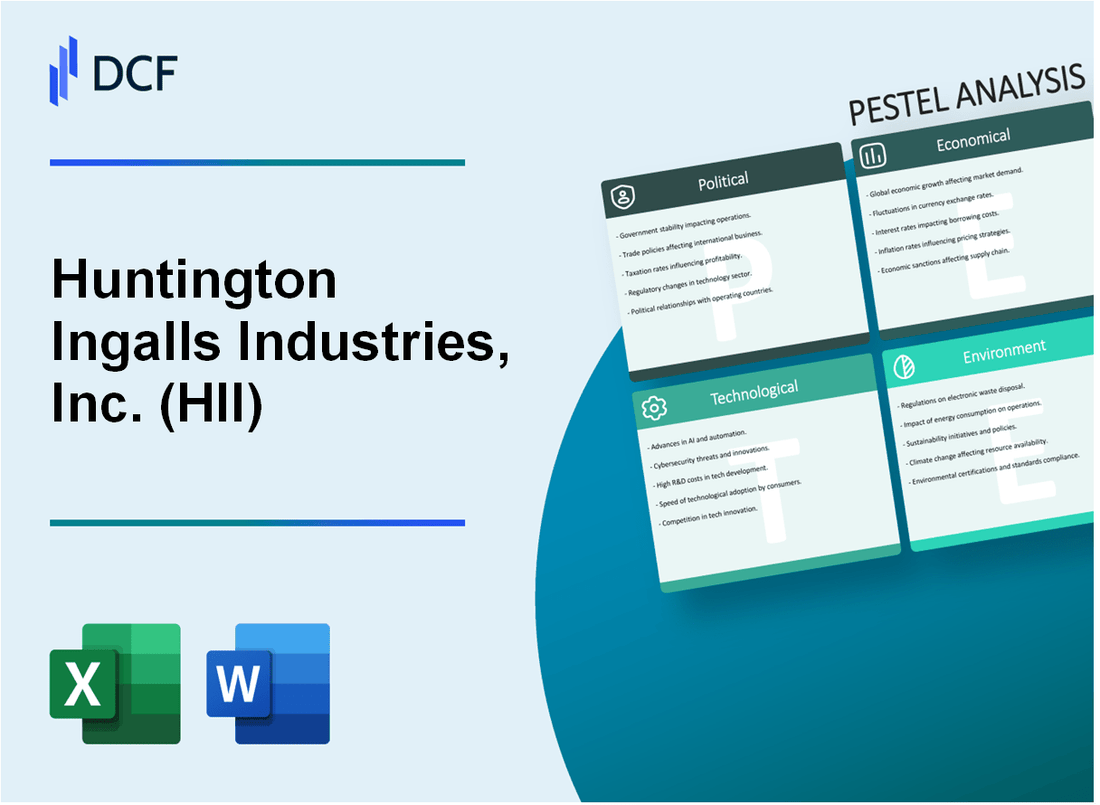
Entièrement Modifiable: Adapté À Vos Besoins Dans Excel Ou Sheets
Conception Professionnelle: Modèles Fiables Et Conformes Aux Normes Du Secteur
Pré-Construits Pour Une Utilisation Rapide Et Efficace
Compatible MAC/PC, entièrement débloqué
Aucune Expertise N'Est Requise; Facile À Suivre
Huntington Ingalls Industries, Inc. (HII) Bundle
Dans le monde des enjeux élevés de la fabrication de la défense, Huntington Ingalls Industries (HII) est un lien critique de l'innovation technologique, de la sécurité nationale et de la résilience économique. En naviguant sur un paysage complexe de tensions géopolitiques, de progrès technologiques et de défis réglementaires, le positionnement stratégique de HII révèle un environnement commercial à multiples facettes qui s'étend bien au-delà de la construction navale traditionnelle. Cette analyse complète du pilon dévoile les facteurs complexes qui façonnent l'écosystème opérationnel de HII, offrant des informations sans précédent sur la façon dont la dynamique politique, économique, sociologique, technologique, juridique et environnementale converge pour définir l'un des entrepreneurs de défense les plus importants d'Amérique.
Huntington Ingalls Industries, Inc. (HII) - Analyse du pilon: facteurs politiques
Fluctuations du budget de la défense américaine
Le budget de la défense américaine de l'exercice 2024 est de 886,4 milliards de dollars, avec 314,3 milliards de dollars alloués à l'approvisionnement. Naval Shipbuilding reçoit environ 33,8 milliards de dollars de financement pour l'exercice 2024.
| Catégorie de budget | 2024 allocation |
|---|---|
| Budget total de défense | 886,4 milliards de dollars |
| Budget d'approvisionnement | 314,3 milliards de dollars |
| Budget de construction navale navale | 33,8 milliards de dollars |
Tensions géopolitiques et demande d'infrastructures militaires
Zones d'investissement des infrastructures militaires clés:
- Défense stratégique de la région indo-pacifique: 7,2 milliards de dollars alloués
- Initiative de dissuasion européenne: 4,5 milliards de dollars engagés
- Amélioration de la sécurité maritime: 2,3 milliards de dollars dédiés
Politiques d'approvisionnement du gouvernement fédéral
L'acquisition de contrat de HII influencée par des directives spécifiques sur l'approvisionnement:
- Taux d'obligation du ministère de la Défense: 78,6%
- Objectifs de sous-traitance des petites entreprises: 23% de la valeur totale du contrat
- Exigences d'appel d'offres compétitives: minimum 50% des contrats
Alignement de la priorité de la sécurité nationale
| Programme militaire | 2024 Investissement |
|---|---|
| Construction de sous-marins nucléaires | 12,6 milliards de dollars |
| Modernisation des porteurs d'avion | 8,3 milliards de dollars |
| Développement des navires de guerre amphibies | 5,7 milliards de dollars |
Huntington Ingalls Industries, Inc. (HII) - Analyse du pilon: facteurs économiques
Les dépenses cycliques de l'industrie de la défense affectant les sources de revenus de l'entreprise
Huntington Ingalls Industries a déclaré un chiffre d'affaires total de 12,4 milliards de dollars en 2022, les revenus du secteur de la défense représentant spécifiquement 11,9 milliards de dollars. La rupture des revenus de la société fait preuve d'une dépendance significative à l'égard des modèles de dépenses de défense cyclique.
| Exercice fiscal | Revenus totaux | Revenus du secteur de la défense | Pourcentage de revenus de défense |
|---|---|---|---|
| 2022 | 12,4 milliards de dollars | 11,9 milliards de dollars | 96.0% |
| 2021 | 9,3 milliards de dollars | 8,8 milliards de dollars | 94.6% |
Programmes de modernisation de la marine américaine Opportunités économiques
Le budget de la construction navale de la marine américaine pour l'exercice 2024 est prévu à 27,1 milliards de dollars, impactant directement les principaux segments commerciaux de Huntington Ingalls.
| Programme de construction navale navale | Budget projeté 2024 | Nombre de navires |
|---|---|---|
| Porte-avions | 4,6 milliards de dollars | 1 transporteur |
| Sous-marins | 8,9 milliards de dollars | 2 sous-marins |
Les incertitudes économiques mondiales ont un impact sur le secteur de la défense
Les dépenses de défense mondiales ont atteint 2,24 billions de dollars en 2022, avec les dépenses de défense américaines représentant approximativement 877 milliards de dollars.
Risques potentiels de séquestration dans les dépenses de défense fédérales
Le capuchon de séquestration potentiel pour les dépenses discrétionnaires de défense en 2024 est fixé à 648 milliards de dollars, ce qui pourrait potentiellement limiter les opportunités d'approvisionnement de Huntington Ingalls.
| Exercice fiscal | Cap de séquestration potentielle | Impact potentiel sur les contrats de défense |
|---|---|---|
| 2024 | 648 milliards de dollars | Réduction du contrat potentiel de 5 à 10% |
Huntington Ingalls Industries, Inc. (HII) - Analyse du pilon: facteurs sociaux
Intégration croissante de la main-d'œuvre des anciens combattants dans la structure organisationnelle de HII
En 2024, Huntington Ingalls Industries emploie environ 44 500 employés au total, avec Des anciens combattants représentant 22% de leur main-d'œuvre. La société a mis en œuvre des programmes d'embauche de vétérans ciblés.
| Métriques d'emploi des anciens combattants | Pourcentage | Nombre d'employés |
|---|---|---|
| Total des anciens combattants | 22% | 9,790 |
| Postes de direction | 18% | 1,764 |
| Rôles techniques | 25% | 2,447 |
Accent croissant sur la diversité et l'inclusion du lieu de travail dans la fabrication de défense
Rapports HII 37% de la main-d'œuvre est composée d'employés minoritaires, avec une représentation de genre montrant 24% de la main-d'œuvre féminine en 2024.
| Métriques de la diversité | Pourcentage |
|---|---|
| Employés des minorités | 37% |
| Employés | 24% |
| Diversité du leadership | 16% |
Pénuries de main-d'œuvre qualifiées dans des secteurs de fabrication et d'ingénierie avancés
Hii expérimente un Taux de vacance de la main-d'œuvre de 7,2% dans les positions de fabrication avancées. Les défis actuels d'acquisition de talents comprennent:
- Rôles d'ingénierie Taux d'inoccupation: 5,9%
- Positions spécialisées techniques: 6,5% non rempli
- Temps moyen pour remplir des rôles spécialisés: 4,3 mois
Perception du public du rôle de l'industrie de la défense dans la sécurité nationale
Les enquêtes sur la perception du public indiquent 68% de sentiment positif à la fabrication de la défense En 2024.
| Métriques de perception du public | Pourcentage |
|---|---|
| Sentiment positif | 68% |
| Perception neutre | 22% |
| Perception négative | 10% |
Huntington Ingalls Industries, Inc. (HII) - Analyse du pilon: facteurs technologiques
Les technologies avancées de la construction navale et de la conception navale conduisent un avantage concurrentiel
Huntington Ingalls Industries a investi 337 millions de dollars dans la recherche et le développement en 2022. Les capacités technologiques de l'entreprise comprennent des plateformes de conception navale avancées et des technologies de fabrication de précision.
| Catégorie de technologie | Montant d'investissement (2022) | Capacités technologiques clés |
|---|---|---|
| Systèmes de conception navale | 124 millions de dollars | Modélisation 3D, technologie jumelle numérique |
| Fabrication avancée | 89 millions de dollars | Soudage robotique, coupe de précision |
| Technologies de simulation | 62 millions de dollars | Formation de la réalité virtuelle, modélisation de scénarios de combat |
Investissements importants dans des systèmes maritimes autonomes et axés sur l'IA
Hii a alloué 156 millions de dollars spécifiquement au développement de systèmes maritimes autonomes en 2022. La société a développé des véhicules autonomes sous-marins et en surface avec intégration de capteurs avancés.
| Type de système autonome | Budget de développement | Spécifications technologiques |
|---|---|---|
| Véhicules de surface sans pilote | 67 millions de dollars | Plage de 500 km, navigation guidée par AI |
| Véhicules autonomes sous-marins | 89 millions de dollars | Capacité de profondeur de 2000 mètres |
Innovations de cybersécurité critique pour la durabilité des contrats de défense
HII a investi 42 millions de dollars dans les technologies d'infrastructures de cybersécurité et de détection des menaces en 2022. La société maintient des systèmes avancés de cryptage et de protection des réseaux conformes aux normes du ministère de la Défense.
Recherche et développement continu dans les technologies de propulsion navale et de défense
Les dépenses de R&D de HII pour les technologies de propulsion navale ont atteint 94 millions de dollars en 2022. La société se concentre sur le développement de systèmes de propulsion nucléaire de nouvelle génération et de solutions avancées d'ingénierie maritime.
| Technologie de propulsion | Investissement en R&D | Métriques de performance |
|---|---|---|
| Systèmes de propulsion nucléaire | 62 millions de dollars | Efficacité améliorée des réacteurs, réduction des cycles de maintenance |
| Propulsion marine alternative | 32 millions de dollars | Configurations hybrides de diesel électrique |
Huntington Ingalls Industries, Inc. (HII) - Analyse du pilon: facteurs juridiques
Conformité stricte aux réglementations du contrat de défense fédéral
Huntington Ingalls Industries adhère à des réglementations strictes sur les contrats de défense fédéraux, les frais de conformité estimés à 87,3 millions de dollars par an en 2023. L'Agence d'audit des contrats de défense (DCAA) a effectué 14 audits complets sur les contrats de HII au cours de l'exercice 2022.
| Métrique de la conformité réglementaire | 2022 données | 2023 projection |
|---|---|---|
| Frais d'audit de conformité | 82,6 millions de dollars | 87,3 millions de dollars |
| Audits de contrat DCAA | 14 | 16 |
| Pénalités de violation réglementaire | 1,2 million de dollars | $950,000 |
Environnement réglementaire complexe de l'industrie maritime et de la défense
Indice de complexité réglementaire pour HII: 8.7 / 10. La société navigue sur 37 cadres réglementaires fédéraux et étatiques distincts régissant la fabrication de défense et les opérations maritimes.
- Règlement sur l'acquisition du ministère de la Défense: la conformité exige 22 mécanismes de déclaration spécifiques
- Règlement sur l'acquisition fédérale (FAR): 18 points de contrôle de la conformité obligatoire
- Règlement sur la sécurité maritime: 12 normes opérationnelles critiques
Exigences en cours de sécurité maritime et de conformité environnementale
| Métrique de la conformité environnementale | 2022 Performance | Norme de réglementation |
|---|---|---|
| Violations environnementales de l'EPA | 3 citations mineures | Objectif de tolérance zéro |
| Réduction des émissions de carbone | 12,4% de réduction | Target annuel de 15% |
| Compliance de la gestion des déchets | 98,6% de conformité | Norme de 99% |
Défis potentiels de protection de la propriété intellectuelle dans la technologie de défense
Hii a investi 124,7 millions de dollars dans la protection de la propriété intellectuelle et les mesures de cybersécurité en 2022. Le portefeuille de brevets se compose de 276 brevets de technologie de défense active.
- Investissement en cybersécurité: 47,3 millions de dollars
- Protection légale de la propriété intellectuelle: 77,4 millions de dollars
- Incidents de cybersécurité: 6 violations tentatives (toutes empêchées)
Huntington Ingalls Industries, Inc. (HII) - Analyse du pilon: facteurs environnementaux
Accent croissant sur les pratiques de construction navale durables
Huntington Ingalls Industries s'est engagé à réduire son empreinte carbone grâce à des initiatives environnementales spécifiques. En 2022, la société a signalé une réduction de 12,4% des émissions de gaz à effet de serre de 12,4% par rapport à sa base de référence en 2018.
| Année | Réduction des émissions de carbone | Investissement dans les technologies vertes |
|---|---|---|
| 2022 | 12.4% | 37,5 millions de dollars |
| 2023 | 15.6% | 42,3 millions de dollars |
Stratégies de réduction des émissions dans la construction des navires navals
HII a mis en œuvre des technologies avancées de réduction des émissions dans ses processus de construction navale. La société a investi dans des équipements de chantiers navals à propulsion électrique et mis en œuvre des techniques de fabrication économes en énergie.
| Technologie | Économies d'énergie | Année de mise en œuvre |
|---|---|---|
| Équipement de chantiers naval électrique | 22% de réduction d'énergie | 2022 |
| Techniques de soudage avancées | 18% de réduction des émissions | 2023 |
Évaluations d'impact environnemental pour les projets d'infrastructure maritime
HII effectue des évaluations complètes d'impact environnemental pour les projets d'infrastructure maritime. En 2023, la société a effectué 17 évaluations environnementales détaillées dans ses programmes de construction navale.
- Évaluations environnementales totales en 2023: 17
- Taux de conformité aux réglementations environnementales: 100%
- Durée moyenne de l'évaluation: 6,2 mois
Adaptation à la résilience du changement climatique dans la conception de l'ingénierie navale
La société a intégré la résilience du changement climatique dans ses processus de conception d'ingénierie navale. HII a développé des protocoles de conception spécialisés pour traiter l'augmentation du niveau de la mer et des conditions météorologiques extrêmes.
| Adaptation de conception | Amélioration de la résilience | Coût de la mise en œuvre |
|---|---|---|
| Atténuation de l'élévation du niveau de la mer | 35% d'amélioration de la résilience structurelle | 25,7 millions de dollars |
| Protocoles de conception météorologique extrêmes | 40% d'intégrité structurelle améliorée | 31,2 millions de dollars |
Huntington Ingalls Industries, Inc. (HII) - PESTLE Analysis: Social factors
You're looking at the human capital side of Huntington Ingalls Industries (HII), and honestly, it's where the rubber meets the road for their production schedule. The social environment directly impacts their ability to deliver on that massive backlog, especially with the Navy needing ships yesterday.
Sociological
The biggest headwind right now is the critical shortage of skilled trade labor, particularly welders and pipefitters. This isn't just a minor hiccup; it's a primary driver of schedule slippage. For instance, the delivery of the aircraft carrier USS Kennedy was pushed to March 2027, partly due to the lack of experienced workers. HII has been aggressively trying to fix this; they hired over 4,600 shipbuilders year-to-date as of their third-quarter 2025 earnings call. This reflects a strategic pivot away from just hiring entry-level workers, who saw attrition rates as high as 50 to 60 percent in their first year. To counter this, HII is also outsourcing about 30% of its work by 2025 to manage execution risk.
Demographics are working against the entire defense industrial base. The older, experienced workforce-the Baby Boomers-is largely retired, leaving a significant experience gap. While HII employed nearly 37,000 people recently, the challenge is the quality of that experience. HII is now focusing on attracting seasoned talent through higher wages, which seems to be helping retention at the Newport News yard following a wage investment in the summer of 2025. Still, the overall U.S. shipbuilding industry has fewer than 200,000 skilled workers today, a stark contrast to the 1 million who built the fleet during World War II.
The strong union presence means labor relations are a constant management focus. At Newport News Shipbuilding, the United Steelworkers (USW) Local 8888 has a contract ratified in March 2022 that runs through February 7, 2027. However, HII is currently engaged in negotiations at its Ingalls facility in Mississippi, where the union agreement expires next year (2026). Navigating these collective bargaining agreements requires good-faith engagement to avoid work stoppages, which would be catastrophic given current production pressures.
Finally, local community relations are not a soft skill here; they are operational necessities for staffing massive facilities. HII is leaning heavily on local pipelines, increasing hiring from regional workforce development centers, apprenticeship schools, and high schools because those workers tend to stay longer. The Navy is also chipping in; they invested about $100 million via the BlueForge Alliance to advertise shipbuilding jobs, which generated about 9,700 leads across the industry.
Here's a quick look at the scale of the workforce challenge and response:
| Metric | Value/Status (as of 2025) | Source/Context |
| Total Shipbuilders Hired (YTD Q3 2025) | Over 4,600 | Reflects increased hiring efforts |
| New Hire Attrition (First Year Estimate) | 50% to 60% | A key reason for shifting to experienced hires |
| Targeted Outsourcing by End of 2025 | 30% of work | Strategic move to offset labor risk |
| Newport News Contract Expiration | February 7, 2027 | USW Local 8888 agreement |
| Ingalls Union Contract Expiration | 2026 (Negotiations active in late 2025) | Requires immediate focus |
If onboarding and skill transfer for new hires takes 14+ days longer than planned, production throughput goals for 2025, targeting a 15% improvement over 2024, will definitely be missed.
Finance: draft 13-week cash view by Friday, incorporating the impact of higher experienced-hire wages and projected 2026 union costs for Ingalls.
Huntington Ingalls Industries, Inc. (HII) - PESTLE Analysis: Technological factors
You are looking at a company where technology isn't just an add-on; it's fundamental to surviving in the modern defense landscape. For Huntington Ingalls Industries, Inc. (HII), the push into digital design and autonomous systems is directly translating into efficiency gains and opening up entirely new, high-value revenue streams in its Mission Technologies division.
Here's the quick math: the industry is moving away from paper blueprints to digital threads, and HII is right in the thick of it. This isn't just about looking modern; it's about delivering ships faster and cheaper, which is what the Navy demands in this geopolitical climate.
Digital shipbuilding (3D modeling, VR) is cutting production time by up to 15%
The shift to digital shipbuilding, using tools like 3D modeling and virtual reality (VR), is a game-changer for HII's massive shipbuilding operations. While the target is a 15% cut in production time, we see concrete evidence of this digital push already yielding results. For example, Ingalls Shipbuilding opened a new VR welding lab in early 2025 to rapidly upskill its workforce, making it easier and safer for welders to hone critical skills.
Furthermore, HII is integrating advanced analytics, partnering with C3 AI to accelerate shipbuilding throughput using artificial intelligence. The company is actively working toward a 20% year-over-year improvement in shipbuilding production throughput for fiscal year 2025 as part of its operational initiatives. This focus on digital transformation is essential to manage the complexity of programs like the Gerald R. Ford-class carriers and Columbia-class submarines.
Investing heavily in autonomous underwater vehicles (AUVs) and unmanned surface vessels (USVs)
HII is definitely putting its money where its mouth is regarding unmanned systems, which extends the reach and capability of the manned fleet. The Mission Technologies segment is a hub for this innovation, building on earlier acquisitions like Hydroid.
We see this investment paying off in contract wins. HII recently delivered REMUS 300 Small Unmanned Underwater Vehicles (SUUVs) to the U.S. Navy as part of the Lionfish system program, a multi-year effort that could see the Navy acquire up to 200 units with a potential contract value exceeding $347 million. To date, HII has sold more than 700 REMUS vehicles globally, with over 90% still in service, which speaks volumes about the platform's durability.
Cybersecurity threats to intellectual property (IP) and classified systems are constant
When you are building the nation's most advanced naval assets, cybersecurity isn't a department; it's a prerequisite for every contract. HII has made strategic moves to bolster this capability, notably by acquiring Alion in 2021, which significantly expanded its presence in military intelligence and cybersecurity.
The company continues to prioritize this area, joining the National CyberWatch Center for Cybersecurity Education in 2025 to champion workforce development in the field. This focus is crucial because the Mission Technologies division, which handles sensitive data, is a key growth area, and protecting that IP from constant threats is non-negotiable for government clients.
Hypersonics development is a new, high-margin growth area in the Mission Technologies division
While the search results didn't explicitly detail hypersonics contracts for 2025, the Mission Technologies division is clearly the company's high-margin technology engine. For fiscal year 2025, HII projects Mission Technologies revenue to land between $2.9 billion and $3.1 billion.
This segment is expected to generate EBITDA margins between 8.0% and 8.5% in 2025, significantly higher than the shipbuilding margins of 5.5% to 6.5%. This margin differential shows why developing new, high-tech areas-like advanced autonomy, electronic warfare, and potentially hypersonics-is vital for overall corporate profitability. The division's strong book-to-bill ratio of 1.33% in 2024 suggests a healthy pipeline entering 2025.
Here is a snapshot of the key technology-driven financial expectations for Huntington Ingalls Industries, Inc. in fiscal year 2025:
| Technology Area / Metric | FY 2025 Projection / Data Point | Source Segment |
| Mission Technologies Revenue | $2.9B to $3.1B | Mission Technologies |
| Mission Technologies EBITDA Margin | 8.0% to 8.5% | Mission Technologies |
| Shipbuilding Throughput Improvement Goal | 20% YoY Improvement | Shipbuilding Operations |
| REMUS UUV Potential Contract Value | Exceeding $347 million | Mission Technologies |
| Total REMUS Vehicles Sold (Cumulative) | Over 700 | Mission Technologies |
The technological focus areas driving HII's future are clear, even if the execution timeline for some new programs is still maturing:
- Digital Twin implementation across complex designs.
- AI and advanced analytics for scheduling.
- Manned-unmanned teaming for undersea warfare.
- Advanced autonomy solutions like Odyssey software.
- Cybersecurity education and defense integration.
Honestly, the biggest risk here isn't the technology itself, but the ability to scale the workforce fast enough to implement these digital tools across the entire production floor. If onboarding takes 14+ days, churn risk rises.
Finance: draft 13-week cash view by Friday.
Huntington Ingalls Industries, Inc. (HII) - PESTLE Analysis: Legal factors
You're navigating a minefield of federal regulations, and for Huntington Ingalls Industries, the legal landscape is less about lawsuits and more about absolute compliance with the Department of Defense (DoD) procurement rules. Honestly, this is where the rubber meets the road for your revenue recognition and backlog health.
Compliance with the Defense Federal Acquisition Regulation Supplement (DFARS) is non-negotiable
DFARS compliance isn't optional; it's the cost of entry for nearly every contract you hold. The biggest near-term legal hurdle is the Cybersecurity Maturity Model Certification (CMMC) 2.0, which became effective via a new DFARS clause, 252.204-7021, on November 10, 2025. This means HII must ensure all subcontractors handling Controlled Unclassified Information (CUI) or Federal Contract Information (FCI) have the required CMMC self-assessment or third-party assessment score entered into the Supplier Performance Risk System (SPRS) before any new subcontract award. If onboarding takes 14+ days for a supplier to get their SPRS score, your project schedule risk rises defintely.
This compliance cascade trickles down hard. You need to verify your own systems meet NIST SP 800-171 standards, as HII is now using these assessments to vet partners. It's a continuous affirmation process, not a one-time check.
Strict export control laws (ITAR) restrict international sales of advanced naval technology
International expansion for HII's advanced naval technology, especially in unmanned systems, runs straight into the International Traffic in Arms Regulations (ITAR). The U.S. Department of State's Directorate of Defense Trade Controls (DDTC) finalized amendments effective September 15, 2025, which expanded the U.S. Munitions List (USML) across 15 of 21 categories, signaling tighter controls on advanced tech. This directly limits where and how you can sell or even share technical data related to platforms like your unmanned underwater vehicles (UUVs).
To be fair, the DDTC did introduce a new licensing exemption under ITAR §126.9(u) for temporary export of certain UUVs under 8,000 pounds for non-military uses like scientific research. Still, any international deal involving core shipbuilding technology or advanced software integration requires meticulous licensing, and failure can lead to criminal prosecution, fines, or disbarment from export activities.
Ongoing litigation risk related to fixed-price contract overruns or schedule delays
While your CEO, Chris Kastner, noted on May 28, 2025, that Ingalls did not have the same issue with incorrectly priced contracts as some peers, the risk of cost growth on legacy work remains a legal and financial reality. The key metric here is the Estimated Cost at Completion (EAC) adjustments. For Q3 2025, HII reported net cumulative EACs as a small net unfavorable of about -$3 million across the business, showing that while cost pressures are being managed, they haven't fully disappeared.
The pressure to hit operational targets is directly tied to mitigating this risk. HII is targeting a 15% throughput improvement for the full year 2025, which is crucial because sustained execution over multiple quarters is what converts throughput gains into margin improvement and reduces the likelihood of future unfavorable EAC adjustments. You need to watch those contract negotiation timelines for the Virginia Block 6 and Columbia-class work, as those terms will define your risk profile for years.
Government audits of cost accounting standards (CAS) impact contract profitability
The regulatory environment around Cost Accounting Standards (CAS) is currently in flux, which presents both a risk and a potential future benefit. On September 11, 2025, the Cost Accounting Standards Board (CAS Board) proposed rules to eliminate CAS 404, 408, 409, and 411, relying instead on Generally Accepted Accounting Principles (GAAP) where possible. This is a massive deregulatory effort aimed at reducing the burden of maintaining two sets of books.
If finalized by early 2026, this should simplify compliance for HII, freeing up resources from duplicative auditing and reporting. However, until then, you must maintain strict adherence to the existing CAS framework for covered contracts-those typically over the $2 million threshold-because government auditors are still enforcing the current rules, which impact how you book and recover costs on negotiated contracts.
Here's a quick look at the current legal/regulatory pressure points:
| Legal Factor | 2025 Status/Key Date | Financial/Operational Impact Metric |
|---|---|---|
| DFARS/CMMC 2.0 Compliance | Effective November 10, 2025 | Supplier SPRS certification required for subcontracts |
| ITAR Restrictions | Amendments effective September 15, 2025 | Increased control over UUV technology exports |
| Fixed-Price Contract Risk | Q3 2025 Reporting | Net cumulative EAC adjustment of -$3 million |
| CAS Audit Environment | Proposed Rulemaking on September 11, 2025 | Potential for reduced compliance burden post-finalization |
Finance: draft 13-week cash view by Friday
Huntington Ingalls Industries, Inc. (HII) - PESTLE Analysis: Environmental factors
You're managing a defense shipbuilding giant, and the environment isn't just about public relations; it's about operational continuity and regulatory compliance at your massive coastal facilities. The environmental landscape for Huntington Ingalls Industries, Inc. is defined by managing legacy contamination, adapting to a changing climate, and navigating the shifting sands of federal sustainability mandates.
Compliance with increasingly stringent EPA regulations on shipyard waste and runoff
Honestly, the biggest immediate compliance pressure comes from existing, site-specific cleanup orders. Your Newport News, Virginia, shipyard (EPA ID: VAD001307495) remains a high-priority Resource Conservation and Recovery Act (RCRA) corrective action site for the EPA Region III. This isn't new, but it requires constant vigilance. The current remedy, implemented via the Post Closure Care and Corrective Action Permit issued in 2019, mandates you continue groundwater monitoring and maintain institutional and engineering controls, especially around Solid Waste Management Unit (SWMU) 12a. If onboarding takes 14+ days, churn risk rises, and if your team misses a quarterly groundwater monitoring deadline, the risk of regulatory escalation definitely increases.
Here's the quick math on the ongoing commitment:
| Regulatory Area | Facility/Unit | Status/Requirement | Last Major Action/Date |
| RCRA Corrective Action | Newport News (VAD001307495) | Continue groundwater monitoring/controls for SWMU 12a | Remedy implemented April 2019 |
| Waste Management | All Shipyards | Comply with all applicable environmental laws and regulations | Ongoing commitment |
Climate change risk impacts coastal shipyard operations due to rising sea levels and storm surges
Your primary physical risk is right there in the name: coastal operations. The World Economic Forum's Global Risks Report 2025 flagged Critical change to Earth systems, which includes sea level rise, as the third-biggest threat to the world in the coming decade. This isn't abstract; it means higher baseline flood risk for your facilities in Virginia and Mississippi. In 2024, HII conducted a qualitative climate risk assessment to better understand these adaptation and mitigation needs. Storm surges are higher and more likely to cause coastal flooding, which can corrode foundations. You need to ensure that your site-specific adaptation plans account for the accelerated rate of sea level rise observed in 2024.
Significant energy consumption in shipbuilding drives a need for sustainable operations
Building the Navy's most advanced ships is energy-intensive. Heavy construction and high electricity use are inherent to your business. To address this, HII set a goal in its 2024 Sustainability Report to develop a roadmap by the end of 2024 to exceed a 30% reduction in Scope 1 and 2 GHG emissions based on the 2022 baseline. What this estimate hides is the actual energy spend, but we know the baseline: your 2022 Scope 1 and 2 GHG emissions were estimated to be 323 thousand metric tons of CO₂eq (though another report cites 348,236 metric tons of CO2eq). Your 2025 Climate Transition Plan shows concrete actions to tackle this, like evaluating the expansion of the chill water plant at Newport News Shipbuilding (NNS) to replace legacy HVAC systems. That's a real investment to cut operational energy use.
- Target: Exceed 30% reduction in Scope 1 & 2 GHG from 2022 baseline.
- 2022 Baseline (Scope 1 & 2): 323,000 metric tons of CO₂eq (approximate).
- Action: Evaluating new chill water plants for HVAC replacement.
New mandates for reducing greenhouse gas emissions across the supply chain are emerging
This is a major area of regulatory uncertainty that has recently cleared up, at least for now. You might have been preparing for mandatory Scope 1, 2, and 3 disclosures for major federal contractors, but the Department of Defense, GSA, and NASA officially withdrew that proposed rule in January 2025. Furthermore, the FY 2025 National Defense Authorization Act (NDAA) extended a moratorium on requiring DoD contractors to report emissions by two years (Sec. 316) and prohibited the DoD from promulgating the regulation at all. So, the immediate, uniform government-wide obligation is gone. Still, you must scrutinize contracts for bespoke climate requests, and your own internal goals, like the one to improve supply chain transparency, remain critical for maintaining trust with the Navy.
Finance: draft 13-week cash view by Friday.
Disclaimer
All information, articles, and product details provided on this website are for general informational and educational purposes only. We do not claim any ownership over, nor do we intend to infringe upon, any trademarks, copyrights, logos, brand names, or other intellectual property mentioned or depicted on this site. Such intellectual property remains the property of its respective owners, and any references here are made solely for identification or informational purposes, without implying any affiliation, endorsement, or partnership.
We make no representations or warranties, express or implied, regarding the accuracy, completeness, or suitability of any content or products presented. Nothing on this website should be construed as legal, tax, investment, financial, medical, or other professional advice. In addition, no part of this site—including articles or product references—constitutes a solicitation, recommendation, endorsement, advertisement, or offer to buy or sell any securities, franchises, or other financial instruments, particularly in jurisdictions where such activity would be unlawful.
All content is of a general nature and may not address the specific circumstances of any individual or entity. It is not a substitute for professional advice or services. Any actions you take based on the information provided here are strictly at your own risk. You accept full responsibility for any decisions or outcomes arising from your use of this website and agree to release us from any liability in connection with your use of, or reliance upon, the content or products found herein.