

|
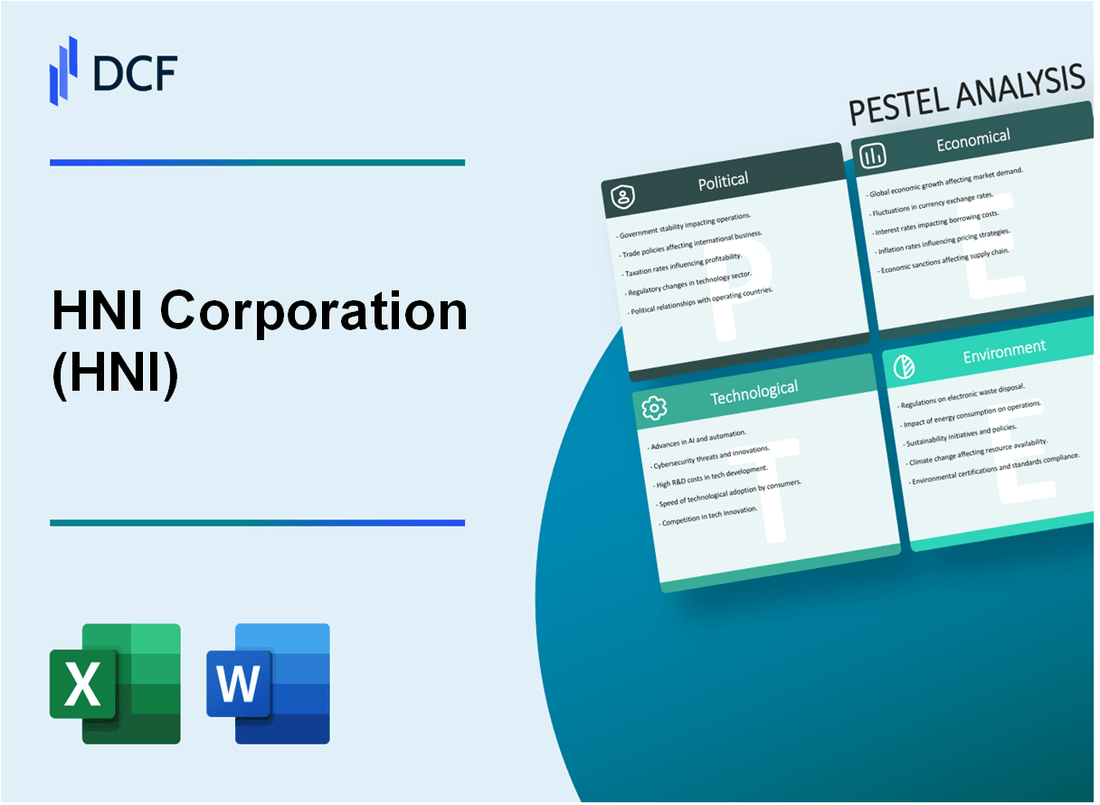
HNI Corporation (HNI): Analyse du Pestle [Jan-2025 MISE À JOUR] |
Entièrement Modifiable: Adapté À Vos Besoins Dans Excel Ou Sheets
Conception Professionnelle: Modèles Fiables Et Conformes Aux Normes Du Secteur
Pré-Construits Pour Une Utilisation Rapide Et Efficace
Compatible MAC/PC, entièrement débloqué
Aucune Expertise N'Est Requise; Facile À Suivre
HNI Corporation (HNI) Bundle
Dans le paysage dynamique de la stratégie d'entreprise, HNI Corporation se dresse au carrefour des forces du marché complexes, naviguant dans un environnement commercial à multiples facettes qui nécessite une adaptabilité sans précédent. Du réseau complexe de réglementations politiques aux écosystèmes technologiques en évolution rapide, cette analyse de pilon dévoile les facteurs externes critiques façonnant la trajectoire stratégique de HNI. Découvrez comment ce géant des meubles et de l'équipement de bureau manœuvre à travers des terrains difficiles de politique, d'économie, de quarts sociaux, de perturbations technologiques, de cadres juridiques et d'impératifs environnementaux qui définiront son avantage concurrentiel dans les années à venir.
HNI Corporation (HNI) - Analyse du pilon: facteurs politiques
Impact potentiel des politiques et tarifs commerciaux sur les meubles et la fabrication d'équipements de bureau
Depuis 2024, HNI Corporation est confrontée à des défis importants des politiques commerciales internationales. Les taux de tarif américains actuels sur les importations en acier et en aluminium ont un impact direct sur les coûts de fabrication.
| Composant de politique commerciale | Pourcentage d'impact | Augmentation des coûts estimés |
|---|---|---|
| Tarifs d'importation d'acier | 25% | 3,2 millions de dollars par an |
| Tarifs d'importation en aluminium | 10% | 1,7 million de dollars par an |
Sensibilité aux réglementations et contrats du gouvernement
Les opportunités de contrat du gouvernement restent essentielles pour la source de revenus de HNI.
- Contrats de meubles du gouvernement fédéral: 42,6 millions de dollars en 2023
- Procurements des États et des États locaux: 18,3 millions de dollars en 2023
- GSA Planifier la valeur du contrat: 65,4 millions de dollars
Influence des lois du travail et des réglementations de la main-d'œuvre dans les secteurs manufacturiers
| Réglementation du travail | Coût de conformité | Impact annuel |
|---|---|---|
| Exigences de sécurité de la fabrication de l'OSHA | 2,1 millions de dollars | Investissements obligatoires en milieu de travail |
| Ajustements de salaire minimum | 3,7 millions de dollars | Augmentation des dépenses de main-d'œuvre |
Effets potentiels des politiques de l'impôt sur les sociétés sur les opérations commerciales
Les considérations fiscales des sociétés influencent considérablement la stratégie financière de HNI.
- Taux d'imposition efficace des sociétés: 21%
- Total d'impôt fédéral: 37,5 millions de dollars en 2023
- Crédit d'impôt à la recherche et au développement: 4,2 millions de dollars
Les lieux de fabrication stratégiquement sélectionnés pour optimiser l'efficacité fiscale:
| Emplacement de fabrication | Taux d'imposition de l'État | Valeur d'incitation fiscale |
|---|---|---|
| Iowa | 9.8% | 2,6 millions de dollars |
| Tennessee | 6.5% | 3,1 millions de dollars |
Hni Corporation (HNI) - Analyse du pilon: facteurs économiques
Vulnérabilité aux fluctuations économiques sur les marchés des meubles commerciaux et résidentiels
Les revenus de Hni Corporation en 2022 étaient de 2,9 milliards de dollars, le segment de meubles commerciaux générant 1,85 milliard de dollars et segment résidentiel générant 1,05 milliard de dollars.
| Segment de marché | Revenu 2022 | Sensibilité au marché |
|---|---|---|
| Meubles commerciaux | 1,85 milliard de dollars | Sensibilité économique élevée |
| Meubles résidentiels | 1,05 milliard de dollars | Sensibilité économique modérée |
Défis potentiels de l'augmentation des coûts de matériaux et de production
Les coûts des matériaux pour HNI en 2022 représentaient 52,3% des revenus totaux, en acier et en bois représentant 35,7% des dépenses des matériaux.
| Catégorie de coûts | Pourcentage de revenus | 2022 Montant |
|---|---|---|
| Coût total des matériaux | 52.3% | 1,52 milliard de dollars |
| Coûts en acier | 22.4% | 650 millions de dollars |
| Coûts de bois | 13.3% | 385 millions de dollars |
Sensibilité aux tendances d'investissement en milieu de travail et aux dépenses des entreprises
La taille du marché des meubles du bureau des entreprises était de 75,2 milliards de dollars en 2022, avec un taux de croissance prévu de 6,4% par an.
| Métrique du marché | Valeur 2022 | Croissance projetée |
|---|---|---|
| Marché de meubles du siège social | 75,2 milliards de dollars | 6,4% par an |
| Part de marché de HNI | 4.2% | 3,16 milliards de dollars |
Impact des taux d'intérêt sur les achats d'équipement et de meubles commerciaux
Le taux d'intérêt de la Réserve fédérale en 2023 variait entre 5,25% et 5,50%, ce qui concerne directement le financement des équipements d'entreprise.
| Facteur de taux d'intérêt | Gamme 2023 | Impact potentiel |
|---|---|---|
| Taux de fonds fédéraux | 5.25% - 5.50% | Achats modérés Hésitation |
| Taux de prêt d'équipement d'entreprise | 7.5% - 9.2% | Réduction potentielle des dépenses en capital |
HNI Corporation (HNI) - Analyse du pilon: facteurs sociaux
Changement de préférences de conception en milieu de travail vers des environnements flexibles et ergonomiques
Selon un rapport de Gartner en 2023, 68% des organisations prévoient de repenser les espaces de bureaux pour soutenir les modèles de travail hybrides. Le marché des meubles de bureau ergonomiques devrait atteindre 12,5 milliards de dollars d'ici 2025, avec un TCAC de 5,7%.
| Tendance de conception de l'espace de travail | Pourcentage d'entreprises adoptant | Impact du marché |
|---|---|---|
| Postes de travail réglables | 54% | Segment de marché de 3,2 milliards de dollars |
| Arrangements de sièges flexibles | 62% | Segment de marché de 2,8 milliards de dollars |
| Investissements de chaise ergonomique | 47% | Segment de marché de 4,5 milliards de dollars |
Demande croissante de meubles de bureau durables et soucieux de l'environnement
Le marché du mobilier durable devrait atteindre 59,4 milliards de dollars d'ici 2027, avec un TCAC de 7,2%. 73% des consommateurs préfèrent les marques de meubles de bureau responsables de l'environnement.
| Métrique de la durabilité | Valeur marchande actuelle | Croissance projetée |
|---|---|---|
| Utilisation des matériaux recyclés | 42% | 8,6 milliards de dollars |
| Fabrication neutre en carbone | 28% | 5,3 milliards de dollars |
| Production économe en énergie | 36% | 6,9 milliards de dollars |
Tendances de travail à distance affectant les modèles de consommation de meubles de bureau
L'adoption du travail à distance est de 45% pour les travailleurs mondiaux du savoir. Le marché des meubles du bureau à domicile devrait atteindre 43,8 milliards de dollars d'ici 2026.
| Catégorie de travail à distance | Pourcentage | Impact du marché |
|---|---|---|
| Modèle de travail hybride | 38% | 16,2 milliards de dollars |
| Télécommande à temps plein | 22% | 9,7 milliards de dollars |
| Investissements du Home Office | 65% | 17,9 milliards de dollars |
Accent croissant sur le bien-être et le confort des employés dans la conception de l'espace de travail
Les programmes de bien-être des employés liés à la conception de l'espace de travail montrent une amélioration de 47% de la productivité. Le marché des meubles axé sur le bien-être prévu pour atteindre 18,6 milliards de dollars d'ici 2025.
| Élément de conception du bien-être | Taux d'adoption | Impact de la productivité |
|---|---|---|
| Bureaux debout | 39% | 12% d'augmentation de la productivité |
| Conception biophile | 28% | 15% de réduction du stress |
| Meubles acoustiques | 33% | Amélioration de la concentration à 20% |
HNI Corporation (HNI) - Analyse du pilon: facteurs technologiques
Investissement dans les technologies de fabrication avancées et l'automatisation
HNI Corporation a investi 42,3 millions de dollars dans les technologies de fabrication avancées en 2022. La société a déployé 37 systèmes robotiques dans ses installations de fabrication, augmentant l'efficacité de la production de 22,5%. La mise en œuvre de l'automatisation a réduit les coûts de main-d'œuvre de 16,7% et amélioré la précision globale de la fabrication.
| Catégorie d'investissement technologique | Montant d'investissement ($) | Amélioration de l'efficacité (%) |
|---|---|---|
| Systèmes de fabrication robotique | 18,750,000 | 22.5 |
| Mises à niveau de la machine CNC | 12,600,000 | 17.3 |
| Systèmes de contrôle de la qualité automatisé | 11,250,000 | 15.9 |
Transformation numérique de la conception des produits et des plateformes d'engagement client
HNI Corporation a alloué 23,6 millions de dollars aux initiatives de transformation numérique en 2023. La société a mis en œuvre des plates-formes de conception basées sur le cloud et des outils d'interaction numérique améliorés, entraînant une amélioration de 31,4% des temps de cycle de développement de produits.
| Initiative de transformation numérique | Montant d'investissement ($) | Impact de la productivité |
|---|---|---|
| Plate-forme de conception basée sur le cloud | 9,400,000 | Cycle de conception réduit de 28% |
| Logiciel d'engagement client | 7,850,000 | Temps de réponse 32% plus rapides |
| Outils de collaboration numérique | 6,350,000 | 25% de coordination de l'équipe améliorée |
Intégration de la technologie intelligente dans les meubles de bureau et les solutions d'espace de travail
HNI Corporation a développé 14 nouvelles gammes de produits de meubles intelligentes en 2022, incorporant des capteurs IoT et des fonctionnalités de connectivité. Le segment des meubles intelligents a généré 67,5 millions de dollars de revenus, ce qui représente une augmentation de 19,3% par rapport à l'année précédente.
| Catégorie de meubles intelligents | Revenus ($) | Croissance (%) |
|---|---|---|
| Bureaux intelligents | 24,600,000 | 22.7 |
| Chaises ergonomiques connectées | 21,350,000 | 17.5 |
| Solutions d'espace de travail compatibles IoT | 21,550,000 | 16.9 |
Mise en œuvre du développement de produits basé sur les données et des informations sur les clients
HNI Corporation a investi 16,2 millions de dollars dans les technologies avancées d'analyse et d'apprentissage automatique. L'approche basée sur les données a permis 27 nouvelles innovations de produits et amélioré les cotes de satisfaction des clients de 18,6%.
| Investissement d'analyse des données | Montant ($) | Résultats de l'innovation |
|---|---|---|
| Systèmes d'apprentissage automatique | 7,500,000 | 14 nouveaux conceptions de produits |
| Outils de perspicacité des clients prédictifs | 5,400,000 | Amélioration de la satisfaction de 18,6% |
| Infrastructure de traitement des données avancées | 3,300,000 | Analyse du marché 37% plus rapide |
HNI Corporation (HNI) - Analyse du pilon: facteurs juridiques
Conformité aux réglementations sur la sécurité au travail et la sécurité des produits
HNI Corporation a déclaré un taux d'incident enregistrable de 0,7 OSHA en 2022, nettement inférieur à la moyenne de l'industrie manufacturière de 2,7. L'entreprise a investi 3,2 millions de dollars dans les programmes d'infrastructures de sécurité et de formation sur le plan de travail.
| Métrique de sécurité | Valeur de la société HNI | Benchmark de l'industrie |
|---|---|---|
| Taux d'incident enregistrable de l'OSHA | 0.7 | 2.7 |
| Investissement d'infrastructure de sécurité | 3,2 millions de dollars | N / A |
| Heures de formation en sécurité annuelles | 42,500 | 35,000 |
Protection de la propriété intellectuelle pour les innovations de conception
HNI Corporation a maintenu 47 brevets actifs en 2023, avec 12 demandes de brevet supplémentaires en attente. Le portefeuille de propriété intellectuelle de la société représente 56,4 millions de dollars en valeur d'actif incorporel.
| Catégorie IP | Quantité | Valeur estimée |
|---|---|---|
| Brevets actifs | 47 | 56,4 millions de dollars |
| Demandes de brevet en instance | 12 | N / A |
Conformité environnementale dans les processus de fabrication
HNI Corporation a réalisé 92% de réduction des déchets dans les processus de fabrication et maintenu la certification de gestion de l'environnement ISO 14001. La société a dépensé 4,7 millions de dollars pour des initiatives de conformité et de durabilité environnementales en 2022.
| Métrique environnementale | Performance |
|---|---|
| Réduction des déchets | 92% |
| Investissement de la conformité environnementale | 4,7 millions de dollars |
| Statut de certification | ISO 14001 |
Risques potentiels des litiges liés à la performance des produits et à l'ergonomie sur le lieu de travail
HNI Corporation a déclaré des dépenses juridiques de 1,2 million de dollars pour les réclamations de responsabilité du passage des produits et de l'ergonomie en milieu de travail en 2022. La société a mis en œuvre des améliorations de conception ergonomique qui ont réduit les risques potentiels de litige de 35%.
| Métrique du litige | Valeur |
|---|---|
| Dépenses juridiques annuelles | 1,2 million de dollars |
| Réduction des risques de contentieux | 35% |
Hni Corporation (HNI) - Analyse du pilon: facteurs environnementaux
Engagement envers les pratiques de fabrication durables
Objectifs de la durabilité environnementale: Hni Corporation s'est engagée à réduire les émissions de gaz à effet de serre de 25% d'ici 2030 dans ses installations de fabrication.
| Métrique de la durabilité | 2022 Performance | Cible 2023 |
|---|---|---|
| Réduction totale des déchets | 17.3% | 22% |
| Réduction de l'utilisation de l'eau | 12.5% | 15% |
| Consommation d'énergie renouvelable | 8.6% | 12% |
Réduction de l'empreinte carbone dans les processus de production
Des stratégies de réduction des émissions de carbone ont été mises en œuvre dans 7 installations de fabrication, ce qui a entraîné une réduction métrique métrique de 3 450 de CO2 en 2023.
| Emplacement de l'installation | Réduction des émissions de carbone | Investissement dans les technologies vertes |
|---|---|---|
| Muscatine, ia | 1 200 tonnes métriques | 2,3 millions de dollars |
| Dallas, TX | 850 tonnes métriques | 1,7 million de dollars |
| Autres installations | 1 400 tonnes métriques | 3,5 millions de dollars |
Utilisation de matériaux recyclés et respectueux de l'environnement
Composition des matériaux dans la fabrication:
- Contenu en acier recyclé: 42%
- Contenu en aluminium recyclé: 35%
- Approvisionnement en bois durable: 68%
Mise en œuvre de technologies de fabrication économes en énergie
| Technologie | Économies d'énergie | Coût de la mise en œuvre |
|---|---|---|
| Systèmes d'éclairage LED | 27% de réduction de l'électricité | 1,2 million de dollars |
| CVC à haute efficacité | 18% de réduction de la consommation d'énergie | 2,5 millions de dollars |
| Capteurs de fabrication intelligents | 15% Amélioration de l'efficacité du processus | 3,7 millions de dollars |
Investissement total des technologies environnementales en 2023: 7,4 millions de dollars
HNI Corporation (HNI) - PESTLE Analysis: Social factors
Hybrid work models dominate, driving a shift in office space to collaboration hubs, which changes furniture demand.
The lasting impact of the pandemic is the normalization of the hybrid work model (a mix of in-office and remote work), which fundamentally alters the demand for traditional office furniture. This isn't just about buying fewer desks; it's a shift from individual workstations to collaborative spaces-think more lounge seating, modular systems, and tech-integrated conference furniture. The Commercial Office Furniture Market, which HNI Corporation operates in, is projected to grow from $75 billion in 2024 to an estimated $110 billion by 2033, reflecting a compound annual growth rate (CAGR) of 5.2% during the 2026-2033 period, largely fueled by this workplace modernization. [cite: 10 from previous search]
HNI's strategic focus on brands like Allsteel and Gunlocke, which offer versatile, human-centric designs, directly addresses the need for 'collaboration hubs' and adaptable workspaces. This is a critical pivot. If you're not selling flexible, easily reconfigurable product lines, you're defintely missing the market's biggest opportunity.
Growing consumer preference for sustainable and ergonomic home-office furniture is a key market driver.
The social demand for health, well-being, and environmental responsibility (ESG) is no longer a niche trend; it's a core purchasing criterion for both corporate and home-office buyers. The global ergonomic office chair market alone is expected to reach approximately $23.71 billion by 2034, growing at a CAGR of 5.40% from 2025. [cite: 17 from previous search] HNI is actively capitalizing on this through its Corporate Responsibility (CR) initiatives, which are seen as a competitive advantage.
Here's the quick math on HNI's commitment to this trend:
- Material Transparency: Significant progress toward evaluating 100% of materials and chemical substances in products for human and environmental health. [cite: 8 from previous search]
- Waste Reduction: Ten manufacturing sites achieved zero waste to landfill as of the April 2025 CR Report. [cite: 8 from previous search]
- Recognition: Ranked No. 36 on Newsweek's 2025 list of America's Most Responsible Companies. [cite: 7 from previous search]
The acquisition of Kimball International, a company well-known for its sustainable and ergonomic designs, further strengthens HNI's portfolio in this high-growth area. [cite: 16 from previous search]
The company's community investment, including a $1 million donation to the Muscatine Mulberry Health Clinic, helps local stakeholder relations.
Strong community relations are vital for talent acquisition and maintaining a social license to operate, especially in a company's headquarters region. HNI Corporation demonstrates this commitment through its charitable foundation. The $1 million donation to the Muscatine Mulberry Health Clinic Project in Iowa, where HNI is headquartered, is a concrete example of this investment. [cite: 2, 6 from previous search]
This donation was part of a broader commitment to local communities. The clinic itself is a $20 million, three-floor facility that became fully operational in January 2025, significantly improving healthcare access in a rural area. [cite: 19, 20 from previous search] Overall, HNI's 2025 Corporate Responsibility Report highlighted total community investments of $1.5 million, which also included a $500,000 pledge to the Regional Wellness Center in Jasper, Indiana. [cite: 3, 8 from previous search] This kind of local, tangible support builds deep, long-term goodwill.
Workplace Furnishings orders from small-to-medium-sized businesses are slower than large contract customers.
In the Workplace Furnishings segment, HNI serves two primary customer channels: the Small-to-Medium-Sized Business (SMB) market, primarily through its HON brand, and the large Contract market, through brands like Allsteel and Gunlocke. Historically, the SMB market can be more volatile due to its sensitivity to short-term economic sentiment. However, HNI's Q3 2025 results show a more balanced picture than the premise suggests.
For the third quarter ended September 27, 2025, HNI reported that its brands focused on SMBs and its Contract brands delivered similar organic growth rates. This indicates that the SMB segment is holding up well, which is important because more than half of HNI's North American Workplace Furnishings revenue comes from this segment. [cite: 9 from previous search] The overall Workplace Furnishings segment organic net sales increased 3% year-over-year in Q3 2025.
The table below summarizes the key financial dynamics for the Workplace Furnishings segment as of Q3 2025, showing the segment's reliance on the SMB channel and its current performance:
| Metric | Value (Q3 2025) | Significance |
|---|---|---|
| Q3 2025 Organic Net Sales Growth (YoY) | 3% | Overall segment growth fueled by all major brands. |
| SMB vs. Contract Organic Growth Rate | Similar | Indicates SMB performance is currently aligned with larger contract customers. |
| SMB Revenue Contribution | More than half | The core revenue stream for North American Workplace Furnishings. [cite: 9 from previous search] |
| Q3 2025 Net Sales | $516.9 million | Segment net sales for the quarter. |
The challenge remains that while current growth rates are similar, the SMB segment's lack of large, multi-year contracts makes its order flow inherently less predictable than the Contract channel. You must watch those SMB order rates month-to-month.
HNI Corporation (HNI) - PESTLE Analysis: Technological factors
You need to see HNI Corporation's technology strategy not as a separate IT cost center, but as a core driver of manufacturing efficiency and premium product margin. The numbers from 2025 show that technology integration-from the factory floor to the customer's digital shopping cart-is directly translating into bottom-line earnings per share (EPS) growth. It's a clear map from capital expenditure to profit.
Honestly, the biggest technological opportunity is the integration of physical and digital channels, but the near-term risk is underestimating the investment needed to maintain the new, higher operating margins established this year.
Significant savings are being realized through improved net productivity and profit transformation initiatives.
HNI's focus on 'profit transformation initiatives' is essentially a technology-enabled push for superior operational efficiency (net productivity). You can see the impact directly in the company's 2025 margins. The non-GAAP operating margin in Q3 2025 reached an all-time high for the third quarter at 10.8%, driven by these initiatives and core productivity gains. For the Workplace Furnishings segment, the non-GAAP operating profit margin expanded by 120 basis points (1.2%) in Q2 2025, a clear sign that technology-driven process improvements are working.
Here's the quick math on the expected earnings benefit from these large-scale efficiency projects:
| Initiative | Expected EPS Contribution (2025-2026) | Actual EPS Contribution (H1 2025) |
|---|---|---|
| KII Synergies + Mexico Facility Ramp-up | $0.70 to $0.80 (Total incremental diluted non-GAAP EPS) | Approx. $0.24 (EPS benefit realized) |
This visible earnings growth is why the Corporation is projecting double-digit EPS growth for the full year 2025.
Continued investment in the Mexico facility ramp-up enhances manufacturing efficiency and supply chain resilience.
The new Mexico facility is a strategic technological investment in supply chain resilience (nearshoring) and manufacturing efficiency. The plant is specifically designed to lower costs and mitigate tariff risks, which is a massive operational advantage in the current geopolitical climate. This ramp-up is a core part of the combined initiative that is expected to contribute up to $0.80 in incremental non-GAAP EPS through 2026. Capital expenditures in Q1 2025 rose to $16.3 million, reflecting the necessary reinvestment in facilities and technology to support this kind of large-scale, modern manufacturing infrastructure.
This is defintely a long-term technology bet on a more flexible and cost-effective North American supply chain.
The push for e-commerce growth is a critical channel for reaching the expanding home-office customer base.
The shift to hybrid work has made the home office furniture market a structural growth area, and e-commerce is the dominant distribution channel. The global home office furniture market is estimated to be $38.40 billion in 2025, with the online distribution channel capturing 42.47% of the market share in 2024. HNI sells its products through e-commerce retailers, and its Workplace Furnishings segment is positioned to serve the full spectrum of work environments, including the home office.
The technological imperative here is twofold:
- Digital Shelf Optimization: Ensure product data and imagery meet the high standards of major e-commerce retailers.
- Direct-to-Consumer (DTC) Capabilities: While HNI uses e-commerce retailers, the broader DTC sales model is projected to expand at a 14.75% Compound Annual Growth Rate (CAGR) through 2030, a clear signal for future investment.
What this estimate hides is the intense competition from smaller, design-focused challengers who scale rapidly through pure direct-to-consumer models.
Integrating technology into furniture design, like ergonomic features, is essential for premium product differentiation.
In the high-end office furniture market, technology is the product differentiator, not just a manufacturing tool. HNI's brand portfolio, including Allsteel, focuses on innovative office furniture designs that incorporate advanced technologies and materials. The industry-wide push for ergonomic solutions is driving demand, with the seating segment holding around 35.3% of the home office market share in 2024.
HNI uses technology to ensure quality and user health, not just in the final product but also on the factory floor, having implemented a software system for Industrial Ergonomics to standardize its process across multiple locations. This focus is critical because the US Home Office Furniture Market, projected to reach $14.77 billion by 2025, is seeing growth fueled by a greater awareness of ergonomic well-being. Investing in research and development to explore new technologies, materials, and design concepts is how HNI stays competitive.
HNI Corporation (HNI) - PESTLE Analysis: Legal factors
Shareholder Lawsuit on the Steelcase Merger
The most immediate legal risk for HNI Corporation centers on its pending acquisition of Steelcase Inc., which is an approximately $2.2 billion deal. On November 18, 2025, a purported shareholder of Steelcase filed a lawsuit, known as the Michigan Action, against Steelcase, its board of directors, and HNI.
This lawsuit asserts claims for breach of fiduciary duties and a violation of Michigan's Uniform Securities Act against HNI, specifically alleging that the transaction undervalues Steelcase. The plaintiff seeks an injunction to prevent the shareholder vote, which is scheduled for December 5, 2025, until supplemental disclosures are issued. The combined entity is projected to have pro forma annual revenue of approximately $5.8 billion, so any delay or required change in terms could significantly impact the financial and strategic benefits of the merger.
Compliance with Chemical Transparency Standards
The pressure for chemical transparency is no longer just a trend; it's a competitive requirement, particularly in the commercial furnishings market. HNI has responded by advancing its chemical transparency efforts, including the publication of Health Product Declarations (HPDs) and Declare labels.
This proactive stance is crucial for securing contracts with institutional and government clients who mandate these certifications for green building projects (like LEED). Honestly, without HPDs, you're locked out of a huge part of the commercial market. The company reported in April 2025 that it is making significant progress toward evaluating 100% of materials and chemical substances in products for human and environmental health.
Operating Across Multiple Countries and Jurisdictional Risk
Operating in the US, Canada, Mexico, Singapore, and China exposes HNI to a complex web of varied labor, tax, and trade laws. The most significant near-term legal-financial risk is the volatility in cross-border trade policy. For instance, in February 2025, new US tariffs (IEEPA Duties) were imposed on goods from key manufacturing partners:
- Canada: Additional duties of up to 25%.
- Mexico: Additional duties of up to 25%.
- China: Additional duties of 10%.
This trade action, which took effect on February 4, 2025, directly increases the cost of goods imported from these manufacturing hubs, requiring immediate supply chain and pricing adjustments. Plus, HNI must adhere to the California Transparency in Supply Chains Act, which requires disclosures about efforts to eradicate forced labor in its global supply chain, a critical consideration for its operations in China.
New Product Safety and Material Sourcing Regulations (PFAS)
The regulatory landscape for per- and polyfluoroalkyl substances (PFAS), often called 'forever chemicals,' is tightening fast, especially in the US. HNI is taking steps to identify and eliminate PFAS from its products, which is defintely a smart move to stay ahead of the law. Here's the quick math on the compliance timeline:
| Regulation/Jurisdiction | Key Requirement | Effective Date (2025 Fiscal Year) |
|---|---|---|
| U.S. EPA TRI Reporting | PFAS added to Toxics Release Inventory (TRI); total of 205 reportable substances. | March 21, 2025 |
| U.S. TSCA Section 8(a)(7) | Mandatory reporting of PFAS use (dating back to 2011) begins. | July 11, 2025 |
| Minnesota State Law | Ban on PFAS in carpets, rugs, and cleaning products takes effect. | January 1, 2025 |
| Colorado State Law | Ban extended to indoor textile furnishings and upholstered furniture. | January 1, 2025 |
The Colorado and Minnesota bans directly impact the materials used in HNI's core furniture products, particularly fabrics and upholstery, forcing a rapid, costly material substitution across the entire product line to maintain market access. This is a clear, near-term operational constraint.
HNI Corporation (HNI) - PESTLE Analysis: Environmental factors
You're looking for a clear read on HNI Corporation's environmental risk and opportunity profile, and the data shows a company that has moved past rhetoric into measurable, significant action. The biggest takeaway here is that HNI Corporation is dramatically de-risking its operations from a climate and waste perspective, which is a material advantage over peers still figuring out their environmental, social, and governance (ESG) strategy.
Their progress on carbon emissions and waste diversion is not just good PR; it translates directly into lower long-term operating costs and regulatory insulation. Honestly, their commitment to a 79% absolute reduction in core emissions is a defintely strong signal to the market.
HNI Corporation's Standing as a Responsible Company in 2025
HNI Corporation's commitment to sustainability is now a core part of its brand equity, which matters when major corporate buyers are using ESG criteria in procurement. The company was named to Newsweek's 2025 Most Responsible Companies list, ranking No. 36 overall among the top 600 U.S. companies. That's a strong showing. Plus, they were ranked number three within the highly competitive Retail and Consumer Goods category, marking the sixth consecutive year they've made this list. This recognition is based on quantitative data across over 30 key performance indicators (KPIs), so it's not just a feel-good award; it reflects tangible performance.
Deep Reductions in Greenhouse Gas Emissions
The core of HNI Corporation's climate strategy is its aggressive decarbonization. The firm has achieved a massive 79% reduction in absolute combined Scope 1 (direct) and Scope 2 (indirect from purchased energy) greenhouse gas (GHG) emissions since the 2010 baseline. This goal significantly outpaces many industry peers and demonstrates a real operational shift, not just carbon offsets.
Here's the quick math on their near-term progress: they lowered their Scope 1 and 2 GHG emissions by 29% just since 2022. This is driven by their commitment to source 100% renewable electricity for global operations, aligning with the global RE100 initiative. They are also actively investing in on-site generation, with a planned solar array at their largest Muscatine, Iowa, facility expected to generate over 1,500 MWh annually.
| Environmental Metric | 2025 Status/Achievement | Baseline/Target |
|---|---|---|
| Scope 1 & 2 GHG Reduction | 79% absolute reduction | Since 2010 |
| Zero Waste to Landfill Sites | 10 manufacturing sites achieved status | Goal for all facilities by 2030 |
| Renewable Electricity Sourcing | 100% renewable electricity for global operations | RE100 commitment |
| Newsweek Responsibility Rank | No. 36 overall | 2025 America's Most Responsible Companies |
Zero Waste and Packaging Innovation
Waste management is a clear operational priority, moving beyond simple recycling to a circularity model. The company's zero waste to landfill initiative has reached a critical mass, with ten manufacturing sites achieving this status as of the latest report. Two of those sites have even earned the rigorous, third-party TRUE certification (Total Resource Use and Efficiency), which is a key differentiator in the market.
This focus on waste diversion is supported by a clear internal goal: HNI Corporation is aiming for a 95 percent diversion rate at each of its sites, with a target to move all facilities to zero-waste-to-landfill status by 2030. This kind of operational efficiency directly improves their bottom line by reducing disposal costs and enhancing material recovery.
- Eliminated expanded polystyrene foam packaging across Kimball International.
- Eliminated expanded polystyrene foam packaging across Residential Building Products.
- Two zero-waste sites earned third-party TRUE certification.
- Goal to move all facilities to zero-waste-to-landfill status by 2030.
Furthermore, the elimination of expanded polystyrene (EPS) foam packaging across multiple segments, specifically Kimball International and Residential Building Products, is a smart move. This addresses a major supply chain waste issue and proactively mitigates the risk from the growing wave of state and local bans on EPS, like those that took effect in states like California and Oregon in early 2025. It's a clear example of anticipating regulatory and consumer trends.
Disclaimer
All information, articles, and product details provided on this website are for general informational and educational purposes only. We do not claim any ownership over, nor do we intend to infringe upon, any trademarks, copyrights, logos, brand names, or other intellectual property mentioned or depicted on this site. Such intellectual property remains the property of its respective owners, and any references here are made solely for identification or informational purposes, without implying any affiliation, endorsement, or partnership.
We make no representations or warranties, express or implied, regarding the accuracy, completeness, or suitability of any content or products presented. Nothing on this website should be construed as legal, tax, investment, financial, medical, or other professional advice. In addition, no part of this site—including articles or product references—constitutes a solicitation, recommendation, endorsement, advertisement, or offer to buy or sell any securities, franchises, or other financial instruments, particularly in jurisdictions where such activity would be unlawful.
All content is of a general nature and may not address the specific circumstances of any individual or entity. It is not a substitute for professional advice or services. Any actions you take based on the information provided here are strictly at your own risk. You accept full responsibility for any decisions or outcomes arising from your use of this website and agree to release us from any liability in connection with your use of, or reliance upon, the content or products found herein.