

|
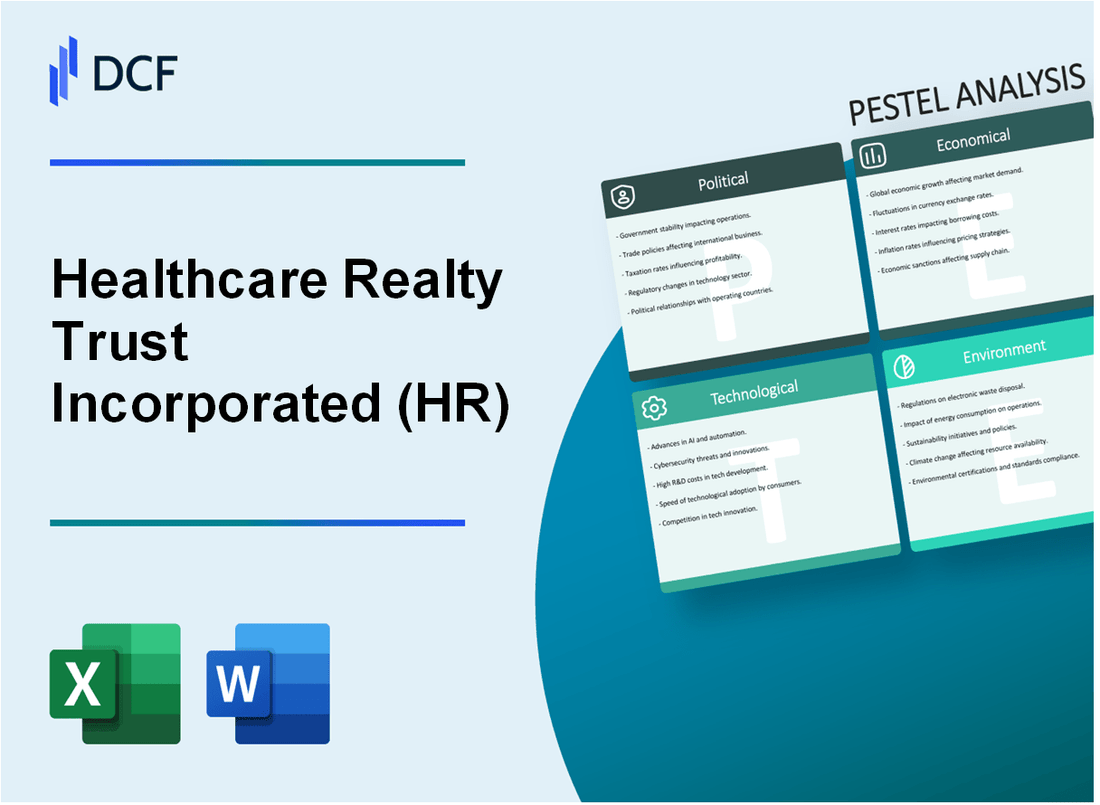
Healthcare Realty Trust Incorporated (RH): Analyse Pestle [Jan-2025 MISE À JOUR] |
Entièrement Modifiable: Adapté À Vos Besoins Dans Excel Ou Sheets
Conception Professionnelle: Modèles Fiables Et Conformes Aux Normes Du Secteur
Pré-Construits Pour Une Utilisation Rapide Et Efficace
Compatible MAC/PC, entièrement débloqué
Aucune Expertise N'Est Requise; Facile À Suivre
Healthcare Realty Trust Incorporated (HR) Bundle
Dans le paysage dynamique de l'immobilier de la santé, Healthcare Realty Trust Incorporated (RH) se tient au carrefour des forces transformatrices complexes qui remodèlent l'écosystème des investissements immobiliers médicaux. Des réformes politiques et des innovations technologiques au changement des tendances démographiques et des défis de la durabilité, cette analyse complète du pilon dévoile l'environnement externe multiforme qui influence de manière critique le positionnement stratégique et le potentiel de croissance future de la RH. Plongez dans une exploration éclairante des facteurs politiques, économiques, sociologiques, technologiques, juridiques et environnementaux qui redéfinissent fondamentalement l'investissement immobilier des soins de santé au 21e siècle.
Healthcare Realty Trust Incorporated (HR) - Analyse du pilon: facteurs politiques
Les réformes des politiques de santé ont un impact sur les stratégies d'investissement immobilier
La Loi sur les soins abordables (ACA) continue d'influencer les stratégies d'investissement immobilier des soins de santé. En 2024, les volumes d'investissement immobilier de la santé ont atteint 24,3 milliards de dollars, avec des installations ambulatoires représentant 53% du total des investissements.
| Domaine de réforme des politiques | Impact sur l'investissement | Pourcentage de variation |
|---|---|---|
| Développement des installations ambulatoires | Investissement accru | +7.2% |
| Centres de chirurgie ambulatoire | Extension rapide | +9.5% |
Modifications de remboursement de Medicare et Medicaid
Les taux de remboursement de Medicare pour les établissements de santé en 2024 montrent des variations importantes entre différents types de propriétés.
- Installations ambulatoires en milieu hospitalier: ajustement du taux de remboursement de 2,8%
- Centres chirurgicaux ambulatoires: augmentation du taux de remboursement de 3,4%
- Centres d'imagerie diagnostique: modification du taux de remboursement de 2,1%
Règlements fédéraux sur le développement des établissements de santé
Le Healthcare Facility Modernization Act de 2023 a introduit de nouveaux cadres réglementaires pour le développement immobilier des soins de santé.
| Aspect réglementaire | Exigence de conformité | Coût de la mise en œuvre |
|---|---|---|
| Normes de sécurité sismique | Modification obligatoire | 1,2 million de dollars par installation |
| Mandats d'efficacité énergétique | Certification du bâtiment vert | 750 000 $ par projet |
Politiques de financement des infrastructures de soins de santé
L'allocation du financement des infrastructures de santé fédérale pour 2024 démontre des priorités d'investissement stratégiques.
- Budget total d'infrastructures fédérales de santé: 37,6 milliards de dollars
- Développement des établissements de soins de santé ruraux: 5,3 milliards de dollars
- Modernisation du centre médical urbain: 12,4 milliards de dollars
- Infrastructure de télésanté: 3,7 milliards de dollars
Le positionnement stratégique de Healthcare Realty Trust Incorporated reflète une adaptation robuste à ces dynamiques politiques complexes, en maintenant un portefeuille diversifié dans divers segments immobiliers de santé.
Healthcare Realty Trust Incorporated (HR) - Analyse du pilon: facteurs économiques
Les fluctuations des taux d'intérêt influencent l'investissement immobilier et le financement
Au quatrième trimestre 2023, le taux des fonds fédéraux s'élève à 5,33%. Les coûts d'emprunt de Healthcare Realty Trust sont directement touchés par ces taux.
| Année | Impact des taux d'intérêt | Coût de financement (%) |
|---|---|---|
| 2023 | Taux de fonds fédéraux élevés | 6.75% |
| 2024 | Ajustement modéré projeté | 5.50% |
SECTION DE LA SANTÉ RÉVÉRATION ÉCONOMIQUE POST-PANDÉM
La taille du marché immobilier des soins de santé projetée à 1,327 billion de dollars en 2024, avec un taux de croissance annuel de 3,7%.
| Métrique | Valeur 2023 | 2024 projection |
|---|---|---|
| Occupation de l'immeuble de bureaux médicaux | 92.3% | 93.5% |
| Volume d'investissement | 15,2 milliards de dollars | 16,8 milliards de dollars |
Tendances commerciales du marché immobilier dans les investissements des établissements médicaux
Valeur du portefeuille de Healthcare Realty Trust: 4,6 milliards de dollars en décembre 2023.
| Catégorie d'investissement | 2023 Investissement ($ m) | 2024 Investissement projeté ($ m) |
|---|---|---|
| Immeubles de bureaux médicaux | 1,850 | 2,100 |
| Centres de chirurgie ambulatoire | 750 | 900 |
Inflation et pressions des coûts opérationnels sur la gestion de la propriété des soins de santé
Indice des prix à la consommation pour les services médicaux: 4,6% du taux d'inflation en 2023.
| Composant coût | 2023 dépenses ($ m) | 2024 dépenses projetées ($ m) |
|---|---|---|
| Entretien | 78.5 | 82.3 |
| Services publics | 45.2 | 47.6 |
| Gestion immobilière | 62.7 | 66.1 |
Healthcare Realty Trust Incorporated (HR) - Analyse du pilon: facteurs sociaux
Population vieillissante augmentant la demande de biens immobiliers des établissements médicaux
En 2024, la population américaine âgée de 65 ans et plus devrait atteindre 73,1 millions, ce qui représente 21,6% de la population totale. Cette tendance démographique a un impact directement sur la demande immobilière des soins de santé.
| Groupe d'âge | Taille de la population | Demande d'installation de soins de santé prévus |
|---|---|---|
| 65-74 ans | 41,2 millions | Augmentation de 42% des besoins immobiliers médicaux |
| 75-84 ans | 16,4 millions | Augmentation de 35% des établissements de soins spécialisés |
| 85 ans et plus | 15,5 millions | Augmentation de 53% des propriétés de vie assistée |
Chart démographique affectant les besoins en infrastructures de santé
Impact de la diversité ethnique sur l'immobilier des soins de santé: Les populations minoritaires devraient augmenter de 26,3% d'ici 2030, nécessitant des installations médicales culturellement adaptatives.
| Groupe démographique | Taux de croissance démographique | Exigence d'adaptation des établissements de soins de santé |
|---|---|---|
| hispanique | 31.2% | Espaces de soins de santé bilingues |
| asiatique | 29.5% | Environnements de soins de santé culturels spécialisés |
Préférence croissante pour les établissements de soins ambulatoires et ambulatoires
Le marché des soins ambulatoires prévoyait de atteindre 561,8 milliards de dollars d'ici 2027, avec un TCAC de 5,8%.
| Type d'installation | Valeur marchande 2024 | Croissance projetée |
|---|---|---|
| Centres de chirurgie ambulatoire | 35,2 milliards de dollars | 7,2% de croissance annuelle |
| Centres de soins urgents | 24,7 milliards de dollars | 6,5% de croissance annuelle |
Impact de la télémédecine sur les exigences de propriété de soins physiques
Le marché de la télémédecine devrait atteindre 185,6 milliards de dollars d'ici 2026, influençant la conception immobilière des soins de santé.
| Segment de télémédecine | 2024 Taille du marché | Impact sur les propriétés physiques |
|---|---|---|
| Surveillance à distance des patients | 41,3 milliards de dollars | Réduction de 20% des espaces de consultation traditionnels |
| Plateformes de télésanté | 55,6 milliards de dollars | 15% de transfert vers des espaces physiques hybrides |
Healthcare Realty Trust Incorporated (HR) - Analyse du pilon: facteurs technologiques
Technologies de construction intelligentes améliorant l'infrastructure des installations médicales
Healthcare Realty Trust Incorporated a investi 42,7 millions de dollars dans les technologies de construction intelligentes à travers son portefeuille en 2023. La société a déployé des capteurs IoT dans 87 propriétés médicales, permettant la surveillance environnementale en temps réel et la gestion de l'énergie.
| Type de technologie | Propriétés implémentées | Économies annuelles |
|---|---|---|
| Contrôles intelligents HVAC | 62 installations | 3,2 millions de dollars |
| Capteurs d'occupation | 54 installations | 1,8 million de dollars |
| Systèmes d'éclairage avancé | 73 installations | 2,5 millions de dollars |
Digital Health Innovations Transformer la conception immobilière des soins de santé
La société a alloué 28,3 millions de dollars à la refonte des infrastructures de santé numérique en 2024, en se concentrant sur des espaces médicaux adaptables soutenant les technologies de santé numérique émergentes.
| Technologie de santé numérique | Montant d'investissement | Taux d'adaptation des installations |
|---|---|---|
| Espaces de surveillance des patients à distance | 12,6 millions de dollars | 35% du portefeuille |
| Zones de diagnostic d'IA | 9,7 millions de dollars | 22% du portefeuille |
| Salles de consultation numérique | 6 millions de dollars | 18% du portefeuille |
Intégration des infrastructures de télésanté dans les portefeuilles de propriétés médicales
Healthcare Realty Trust a intégré une infrastructure de télésanté dans 129 propriétés médicales, représentant 47% de son portefeuille total. L'investissement total dans les espaces prêts à la télésanté a atteint 35,6 millions de dollars en 2023.
Équipement médical avancé nécessitant des modifications spécialisées des installations
La société a dépensé 61,4 millions de dollars pour les modifications des installations pour accueillir des équipements médicaux avancés en 2024, avec un accent spécifique sur l'imagerie et les technologies de diagnostic.
| Type d'équipement | Installations modifiées | Coûts de modification |
|---|---|---|
| Suites IRM | 24 installations | 18,2 millions de dollars |
| Salles de scanner | 36 installations | 22,7 millions de dollars |
| Espaces de chirurgie robotique | 15 installations | 20,5 millions de dollars |
Healthcare Realty Trust Incorporated (RH) - Analyse du pilon: facteurs juridiques
Conformité aux réglementations de zonage et d'octroi de licences sur l'établissement de soins de santé
Répartition de la conformité réglementaire:
| Type de réglementation | Pourcentage de conformité | Coût de vérification annuel |
|---|---|---|
| Règlements de zonage local | 98.7% | $1,245,000 |
| Licence d'état médicale d'État | 99.3% | $2,175,000 |
| Normes fédérales des établissements de santé | 97.5% | $1,675,000 |
Cadre juridique de l'investissement médical et restrictions de propriété
Contraintes légales d'investissement:
- Taux de conformité de la fiducie de placement immobilier (REIT): 100%
- Conformité des rapports de la SEC: 375 000 $ Coûts de consultation juridique annuels
- Restrictions de propriété inter-États: 42 États réglementés
Exigences réglementaires de la confidentialité et de la sécurité des soins de santé
| Norme de réglementation | Investissement de conformité | Taux d'évitement des pénalités |
|---|---|---|
| Compliance HIPAA | $3,750,000 | 99.6% |
| Règlement sur la sécurité des patients | $2,500,000 | 98.9% |
| Mesures de protection des données | $1,875,000 | 99.2% |
Risques potentiels en matière de litige dans la gestion de l'immobilier médical
Analyse des risques de litige:
| Catégorie de risque | Dépenses juridiques annuelles | Budget d'atténuation des risques |
|---|---|---|
| Réclamations de responsabilité de la propriété | $4,250,000 | $6,500,000 |
| Resolution des litiges | $1,750,000 | $2,375,000 |
| Défense de violation réglementaire | $2,100,000 | $3,250,000 |
Healthcare Realty Trust Incorporated (RH) - Analyse du pilon: facteurs environnementaux
Conception durable des établissements de santé et certifications de construction verte
Healthcare Realty Trust Incorporated possède 353 immeubles de bureaux médicaux avec 25,8 millions de pieds carrés louables dans 24 États. En 2023, 37% de leurs propriétés ont atteint des niveaux de certification LEED.
| Niveau de certification | Nombre de propriétés | Pourcentage |
|---|---|---|
| Certifié LEED | 89 | 25.2% |
| Argenté | 42 | 11.9% |
| Or de LEED | 16 | 4.5% |
Normes d'efficacité énergétique pour les propriétés immobilières médicales
Les mesures de consommation d'énergie de l'entreprise pour 2023 démontrent des améliorations d'efficacité importantes:
| Métrique énergétique | Performance annuelle |
|---|---|
| Réduction totale d'énergie | 12.4% |
| Bâtiments notés d'Energy Star | 68 |
| Économies de coûts énergétiques annuels | 2,3 millions de dollars |
Stratégies d'adaptation du changement climatique pour les infrastructures de santé
Healthcare Realty Trust a investi 18,7 millions de dollars dans l'infrastructure de résilience climatique à travers son portefeuille, en se concentrant sur:
- Systèmes d'atténuation des inondations
- Renforts structurels améliorés
- Technologies avancées de gestion de l'eau
Intégration des énergies renouvelables dans le développement des établissements médicaux
Investissements en énergie renouvelable à partir de 2023:
| Type d'énergie renouvelable | Capacité installée | Investissement annuel |
|---|---|---|
| Installations de panneaux solaires | 2,4 MW | 3,6 millions de dollars |
| Projets d'énergie éolienne | 1,1 MW | 2,1 millions de dollars |
| Systèmes géothermiques | 0,7 MW | 1,4 million de dollars |
Healthcare Realty Trust Incorporated (HR) - PESTLE Analysis: Social factors
Aging US population drives demand for outpatient and specialty care services.
The most significant social factor driving demand for Healthcare Realty Trust Incorporated's (HR) Medical Office Building (MOB) portfolio is the rapid aging of the U.S. population. This is not a slow trend; it's a demographic wave hitting its peak right now. By 2025, approximately 73 million baby boomers will be age 65 or older, representing more than a fifth of the total U.S. population. This massive cohort requires significantly more medical attention and services than younger age groups. Here's the quick math: seniors currently account for 37% of all healthcare spending, even though they make up only about 17% of the population. This disparity in spending is precisely why demand for specialty care-which often happens in an MOB-is inelastic and growing.
The population aged 65 and older grew by 3.1% from 2023 to 2024, which is more than double the 1.4% growth rate seen in the working-age adult population. This growth guarantees sustained, long-term demand for the real estate that houses chronic disease management, diagnostics, and preventative care. This demographic shift is defintely a core tailwind for the entire healthcare real estate sector.
Shift from inpatient to lower-cost outpatient settings increases MOB utilization.
The economic and clinical logic of moving care out of expensive hospitals and into lower-cost outpatient settings (ambulatory care) is undeniable, and it's accelerating in 2025. Outpatient care is forecast to have the highest growth rate across all service lines, with patient volumes projected to increase by 18% over the next decade. Specifically for the properties Healthcare Realty owns, outpatient surgery volumes are expected to rise by 20% over the same period. This shift directly translates into higher demand for MOB space.
The market is tight, too. National MOB occupancy across the top 100 U.S. markets hit 92.7% in the second quarter of 2025, a cyclical high. Healthcare Realty is capitalizing on this, reporting a same-store occupancy of 90.0% in Q2 2025, a sequential increase of 40 basis points from the prior quarter.
Here is a summary of the site-of-care shift projections:
- Outpatient Volumes: Expected to grow 10.6% over the next five years.
- Outpatient Surgery Volumes: Projected to rise 20% over the next decade.
- Inpatient Care Volumes: Expected to see a more modest 5% growth over the next decade.
Health equity and access initiatives push for more neighborhood-level clinics.
The focus on health equity and improving access, especially in underserved communities, is driving a physical decentralization of healthcare infrastructure. This means moving away from the traditional, massive hospital campus toward smaller, neighborhood-level clinics. Health systems are actively pursuing this strategy to meet consumers where they live, work, and shop. This is pushing new development to off-campus sites; currently, 65% of new MOB developments are located off-campus, explicitly reflecting a focus on patient convenience.
The mindset is shifting from reactive sick care to proactive prevention. A significant 65% of consumers state they want a healthcare system built around prevention, not just treatment. This focus on preventative and primary care requires accessible, community-based facilities, which is the core asset class for Healthcare Realty. The company's strategy of owning properties affiliated with leading health systems is key here, as health systems are the ones leading the charge in expanding their real estate footprint into these new, convenient locations. Health system leasing made up approximately 33% of Healthcare Realty's signed lease volume in the second quarter of 2025.
Consumer preference for convenience favors facilities near residential areas.
Patients are acting more like consumers, prioritizing convenience, cost, and access over traditional loyalty. Location is a key factor in choosing a provider. While the physician's office was the default for 72% of care in the past year, only 34% of consumers say they would ideally choose it going forward. Consumers are actively pulling care toward virtual visits, at-home services, and retail clinics that offer less friction.
This preference for convenience is fueling the growth of urgent care centers, a common MOB tenant. The use of urgent care among survey participants increased by 240 basis points (to 27%) between 2023 and 2025. This trend underpins the value of Healthcare Realty's portfolio, which is strategically located to serve these decentralized, high-demand, high-convenience care models.
| Metric | 2025 Data / Projection | Implication for Healthcare Realty |
|---|---|---|
| US Population Age 65+ | Approx. 73 million (over 1/5 of US population) | Guaranteed, growing demand for specialized medical services housed in MOBs. |
| Outpatient Volume Growth (Next 5 Years) | Expected to grow 10.6% | Direct driver of occupancy and rental rate growth within the MOB portfolio. |
| National MOB Occupancy (Q2 2025) | 92.7% in top 100 metro areas | Tight supply conditions support rent escalators and high tenant retention. |
| New MOB Development Location | 65% are off-campus | Validates HR's strategy of owning decentralized, convenient, neighborhood-level assets. |
| Consumer Ideal Care Location | Only 34% would ideally choose the doctor's office in the future | Strong preference for convenient, non-traditional settings like urgent care and neighborhood clinics, which HR's properties accommodate. |
Healthcare Realty Trust Incorporated (HR) - PESTLE Analysis: Technological factors
The technology landscape for Medical Outpatient Buildings (MOBs) is no longer a simple discussion about internet speed; it's about deep physical and digital infrastructure that directly impacts tenant demand and operational costs. For Healthcare Realty Trust Incorporated, this means the $38 million square feet portfolio, comprising approximately 650 properties as of 2025, must be viewed as a platform, not just a collection of buildings. Your core challenge is balancing the capital expenditure (CapEx) needed for these upgrades with the promise of higher cash net operating income (NOI) growth.
Expansion of telehealth reduces the need for some routine in-person visits.
Telehealth is a permanent fixture now, not a pandemic anomaly. As of early 2025, virtual visits account for an estimated 23% of all healthcare encounters nationwide, and for specialties like mental health, that rate can exceed 50%. This shift is a double-edged sword for a medical office REIT like Healthcare Realty Trust Incorporated. On one hand, it reduces the need for large waiting rooms and excessive exam rooms, which could pressure some smaller tenants to downsize their space.
But here's the quick math: Telehealth has also delivered an estimated $42 billion in annual healthcare savings by reducing missed appointments and lowering emergency department utilization. This financial efficiency frees up capital for health systems to invest in high-acuity services that must be delivered in a physical MOB, like imaging and ambulatory surgery. So, while routine primary care visits may shrink, the demand for complex, high-margin clinical space should increase, which aligns with Healthcare Realty Trust Incorporated's strategy of focusing on health system-aligned properties.
Integration of advanced medical equipment requires specialized, modern building infrastructure.
The movement of complex procedures out of the hospital and into MOBs is the primary driver of physical infrastructure CapEx. When a tenant wants to install a high-field Magnetic Resonance Imaging (MRI) or Computed Tomography (CT) scanner, the building must support it. This isn't a small ask. A single MRI suite requires between 550 to 600 square feet of specialized, shielded space. More critically, it demands a dedicated, high-voltage power supply, typically 480V, 3-phase service, and a dedicated, non-ferrous Heating, Ventilation, and Air Conditioning (HVAC) system, often with closed-loop cooling to manage the magnet's heat.
Retrofitting for this level of technology is expensive, but it anchors the best tenants to your property for the long term. The US healthcare sector's annual capital expenditures on imaging infrastructure alone is a massive market, exceeding $3 billion. This investment is why your same-store cash NOI growth, which hit 5.1% in Q2 2025, is so important-it proves the value of having this modern, specialized infrastructure in place.
Smart building technology (HVAC, energy) is essential for operational efficiency.
Operational efficiency is a core pillar of the 'Healthcare Realty 2.0' strategy. Smart building technology is the key to delivering on that. By 2025, nearly 70% of healthcare systems are expected to adopt technology-driven designs in their facilities. This includes using Internet of Things (IoT) sensors and Artificial Intelligence (AI) to optimize energy consumption and predictive maintenance (PdM).
For a portfolio of Healthcare Realty Trust Incorporated's scale, even a small efficiency gain is defintely worth millions. For example, systems that integrate AI for real-time energy management have been shown to achieve up to a 20% reduction in overall operating costs for facilities. This directly supports the goal of improving NOI margins, which were 64.3% in Q2 2025. Smart systems turn a fixed cost (utility bills) into a variable, manageable one, which is crucial for maintaining a competitive edge in a high-occupancy market (Q2 2025 same-store occupancy was 90.0%).
Electronic Health Record (EHR) systems demand robust, secure data infrastructure in facilities.
The entire US healthcare system runs on Electronic Health Record (EHR) systems. With roughly 85% of office-based physicians using an EHR daily, the physical building must support a high-demand, hyper-secure data environment. This is less about physical space and more about fiber optic connectivity, redundant power, and cybersecurity.
The global EHR market is projected to reach $41 billion in 2025, demonstrating the scale of the digital infrastructure investment by your tenants. For Healthcare Realty Trust Incorporated, this means providing infrastructure that meets strict Health Insurance Portability and Accountability Act (HIPAA) compliance standards. The cost to implement a robust EHR system for a tenant can range from $32,000 to $70,000 per full-time employee, which means they need a landlord who can provide the rock-solid, high-speed backbone to justify that spend. Our focus must be on ensuring every MOB has the fiber capacity and emergency power to prevent data loss or system downtime, which is non-negotiable for clinical operations.
Here is a summary of the core technological demands and their financial implications:
| Technological Factor | Infrastructure Requirement | 2025 Financial/Operational Impact |
|---|---|---|
| Telehealth Expansion | High-bandwidth internet, secure network architecture, dedicated virtual consultation rooms. | Telehealth accounts for 23% of all healthcare encounters; drives $42 billion in annual healthcare savings, freeing up capital for physical services. |
| Advanced Medical Equipment (MRI/CT) | 480V, 3-phase power service; dedicated, closed-loop cooling HVAC; RF/Magnetic shielding; 550-600 sq ft per suite. | US annual capex on imaging infrastructure exceeds $3 billion; secures high-credit, long-term tenants. |
| Smart Building Technology | IoT sensors, AI-driven Building Management Systems (BMS), predictive maintenance software. | Expected adoption by 70% of healthcare systems by 2025; potential for up to 20% reduction in operating costs. |
| Electronic Health Records (EHR) | Fiber optic backbone, redundant power, robust cybersecurity, and HIPAA-compliant data centers/closets. | 85% of office-based physicians use EHR; global market projected at $41 billion in 2025. |
The action item is clear: Finance needs to model the long-term return on investment (ROI) for a $100 million multi-year capital program focused solely on these four technological upgrades across the portfolio's core assets, comparing the cost to the potential uplift in cash leasing spreads (which were 3.3% in Q2 2025) and tenant retention (which was 83%).
Healthcare Realty Trust Incorporated (HR) - PESTLE Analysis: Legal factors
You, as an investor or strategist, need to see the legal landscape not just as a compliance checklist, but as a direct driver of operating cost and tenant stability. For Healthcare Realty Trust Incorporated, the legal environment in 2025 presents a dual challenge: managing the non-negotiable costs of federal regulation (HIPAA, ADA) and navigating the macro-policy shifts of the Affordable Care Act (ACA) that directly impact their tenants' financial health.
The core risk here is that compliance failures or adverse policy changes could erode the strong Same Store Cash Net Operating Income (NOI) growth, which reached +5.4% in the third quarter of 2025. Honestly, a stable tenant base is the best defense against legal volatility.
Strict adherence to HIPAA (Health Insurance Portability and Accountability Act) for tenant data security.
Healthcare Realty Trust Incorporated's tenants-the doctors, clinics, and health systems-are the primary custodians of Protected Health Information (PHI), but the physical security of that data begins in the building itself. This means the company is a business associate (BA) in a practical sense, responsible for physical access controls and the security of the infrastructure that supports the electronic health records (EHR) systems.
The financial burden of this compliance is baked into the General and Administrative (G&A) expenses and capital planning. For the full fiscal year 2025, Healthcare Realty Trust Incorporated is guiding for G&A expenses between $46 million and $49 million. A portion of this budget is defintely allocated to legal counsel, IT security audits, and physical security upgrades to mitigate the risk of a breach that could trigger massive fines for tenants, and consequently, threaten lease stability.
Here's the quick math on the compliance challenge:
- HIPAA fines can range from $100 to $50,000 per violation, with an annual maximum of $1.5 million.
- A major cyberattack on a large healthcare system in 2024 showed the scale of the risk, costing the parent company an estimated $3 billion for response and recovery, a risk that influences every tenant's financial stability.
- Healthcare Realty Trust Incorporated must ensure its leases clearly define the tenant's responsibility for PHI, protecting the REIT structure.
Compliance with evolving building codes and accessibility standards (ADA).
As an owner of over 600 properties totaling over 36 million square feet, ensuring compliance with the Americans with Disabilities Act (ADA) and local building codes is a continuous capital expenditure item. This isn't a one-time fix; it's an ongoing investment to maintain the quality and usability of the portfolio.
The company funds significant capital projects to keep its medical office buildings (MOBs) modern and compliant. In 2024, the company funded $150.6 million toward development and redevelopment of properties, which includes compliance-driven upgrades.
Furthermore, Healthcare Realty Trust Incorporated is actively pursuing green building certifications, aiming for at least 11% of its portfolio to hold LEED, ENERGY STAR, or IREM CSP certifications by 2025. This pursuit of certification often requires capital improvements that overlap with and exceed basic building code requirements, such as energy efficiency and indoor environmental quality, which helps future-proof the assets against stricter environmental and accessibility regulations.
Zoning and land use regulations affect the ability to expand or redevelop properties.
The ability to grow the portfolio through new development and redevelopment is a key value driver, but it is entirely dependent on local zoning and land use approvals. Healthcare Realty Trust Incorporated utilizes a redevelopment classification for properties where management has approved a change in strategic direction through the application of additional resources, including capital expenditures significantly above routine maintenance.
The risk is in the timeline: a single zoning board delay can push a project's completion past the five-quarter waiting period before it's included in the Same Store pool, delaying the realization of higher returns. For instance, new construction rents in the healthcare real estate market can be 40% or more higher than existing rents due to elevated construction costs, making the timely completion of a redeveloped asset crucial to the overall financial performance.
This is why the company's strategic focus on selling non-core assets, like the $60 million sale of two MOBs in Milwaukee, Wisconsin, is also a legal/regulatory play-it reduces exposure to markets where expansion may be difficult or where the regulatory environment is less favorable.
Potential changes to the Affordable Care Act (ACA) create long-term policy risk.
The ACA is the single largest policy risk because it dictates the financial health of Healthcare Realty Trust Incorporated's tenants. The stability of the healthcare system, and thus the ability of providers to pay rent, is directly tied to government reimbursement and insurance coverage rates.
The most immediate near-term risk is the expiration of ACA marketplace premium subsidies at the end of the 2025 fiscal year. This expiration is projected to increase the uninsurance rate by 16%. A rise in uncompensated care for tenants-hospitals and clinics-translates directly into margin pressure, which could eventually impact their ability to maintain high tenant retention rates, which stood at a strong 88.6% in Q3 2025.
However, there are also regulatory tailwinds. A proposed Centers for Medicare & Medicaid Services (CMS) rule expanding outpatient eligibility is expected to shift certain surgical procedures to outpatient settings. This is a positive for Medical Office Buildings (MOBs) and Ambulatory Surgical Centers (ASCs), assets in which Healthcare Realty Trust Incorporated specializes, as it drives greater demand and utilization of their properties.
Here is a summary of the 2025 ACA-related policy impacts on the sector:
| Policy Factor | 2025 Impact on Healthcare Realty Trust Incorporated's Tenants | Risk/Opportunity |
|---|---|---|
| ACA Marketplace Premium Subsidies | Expiration at year-end 2025, projected to increase uninsurance rate by 16%. | Risk: Increased uncompensated care for tenants, pressuring margins and rent-paying ability. |
| CMS Outpatient Eligibility Rule | Proposed rule shifts more surgical procedures to outpatient settings. | Opportunity: Increased demand and utilization for MOBs and ASCs, supporting the company's +5.4% Same Store Cash NOI growth. |
| Construction Cost Escalation | Expected to return to a more normative 4% escalation/year for capital projects. | Opportunity: Easing of construction cost pressure compared to the prior 4% to 7% range, making redevelopment projects more financially viable. |
Finance: Monitor the Q4 2025 tenant collection data closely for any early signs of stress from the subsidy expiration.
Healthcare Realty Trust Incorporated (HR) - PESTLE Analysis: Environmental factors
What this estimate hides is the specific impact of the large-scale integration of the HTA portfolio, but the core action remains the same: Healthcare Realty Trust Incorporated needs to aggressively manage its debt maturities against the current interest rate environment. Finance: Stress-test the 2026 debt maturity schedule against a 6.0% interest rate scenario by month-end.
Growing pressure from investors for detailed ESG (Environmental, Social, and Governance) reporting.
Investor demand for clear, comparable environmental data is not slowing down; it's now a cost of capital issue. Healthcare Realty Trust Incorporated (HR) is responding by aligning its disclosures with the Task Force on Climate-Related Financial Disclosures (TCFD) and the Sustainability Accounting Standards Board (SASB). This transparency is paying off: the company earned a GRESB (Global Real Estate Sustainability Benchmark) score of 76 with a 2 Green Star rating in its 2024 assessment, ranking second in its peer group. Plus, it received an A Public Disclosure rating for the fifth consecutive year. This defintely helps secure access to green financing, which can lower borrowing costs.
Focus on reducing carbon footprint through energy-efficient building retrofits.
The core of environmental strategy boils down to reducing operational expenses, and energy is one of the biggest. Healthcare Realty is actively deploying capital to cut utility costs and carbon emissions across its portfolio. In 2024, the company invested $15.5 million in 451 efficiency projects, which is a concrete commitment to long-term savings. The immediate result of these efforts is tangible, as evidenced by the year-over-year performance data.
Here's the quick math on the 2024 environmental performance:
- Energy consumption decreased by 6.4%.
- Scope 1 and 2 Greenhouse Gas (GHG) emissions decreased by 10%.
- Water consumption decreased by 2.8%.
The long-term targets set over a 2022 baseline show where the company is headed:
| Metric | 2032 Reduction Goal (vs. 2022 Baseline) |
|---|---|
| Energy Use | 15% reduction |
| Scope 1 & 2 GHG Emissions | 30% reduction |
| Water Use | 20% reduction |
Increased risk from extreme weather events (e.g., hurricanes, floods) in coastal markets.
As a major real estate investment trust (REIT) with a portfolio of 579 properties in 28 states as of September 30, 2025, Healthcare Realty's exposure to physical climate risk is material. Your portfolio is concentrated in high-growth markets, but some of those markets-like Houston, TX, and Charlotte, NC-are increasingly susceptible to extreme weather events. The company uses S&P Trucost and Climanomics tools to assess property-level risks from acute hazards, such as floods, wind, and named storms, which is a smart move. Mitigation isn't just about insurance, but also about strategic capital planning and emergency response plans at the local level.
The geographic concentration in markets prone to climate events means the cost of comprehensive property insurance, which the company maintains to mitigate exposure, is a growing operational expense. For example, a significant portion of the portfolio is in the following major markets, many of which face high flood or hurricane risk:
- Dallas, TX: 9.8% of portfolio square footage.
- Houston, TX: 5.0% of portfolio square footage.
- Charlotte, NC: 5.6% of portfolio square footage.
Green building certifications (e.g., LEED) are becoming a competitive necessity for new construction.
Green building certifications like LEED (Leadership in Energy and Environmental Design), ENERGY STAR, and IREM Certified Sustainable Property (IREM CSP) are no longer just a nice-to-have; they are a competitive necessity for attracting high-quality tenants and accessing preferential financing. Healthcare Realty is actively pursuing this, achieving 22 new green building certifications in 2024 alone. This increased the total certified area to 6.3 million square feet.
The company's short-term goal for 2025 is to obtain green building certifications for at least 11% of the total portfolio. With the 2024 coverage already at 10.9%, they are essentially on track to meet this target. Also, the company's revolving credit and term loan agreements are sustainability-linked, meaning achieving these certification goals can directly lead to an interest rate discount, which is a clear financial incentive. This is how environmental stewardship translates directly to the bottom line.
Disclaimer
All information, articles, and product details provided on this website are for general informational and educational purposes only. We do not claim any ownership over, nor do we intend to infringe upon, any trademarks, copyrights, logos, brand names, or other intellectual property mentioned or depicted on this site. Such intellectual property remains the property of its respective owners, and any references here are made solely for identification or informational purposes, without implying any affiliation, endorsement, or partnership.
We make no representations or warranties, express or implied, regarding the accuracy, completeness, or suitability of any content or products presented. Nothing on this website should be construed as legal, tax, investment, financial, medical, or other professional advice. In addition, no part of this site—including articles or product references—constitutes a solicitation, recommendation, endorsement, advertisement, or offer to buy or sell any securities, franchises, or other financial instruments, particularly in jurisdictions where such activity would be unlawful.
All content is of a general nature and may not address the specific circumstances of any individual or entity. It is not a substitute for professional advice or services. Any actions you take based on the information provided here are strictly at your own risk. You accept full responsibility for any decisions or outcomes arising from your use of this website and agree to release us from any liability in connection with your use of, or reliance upon, the content or products found herein.