

|
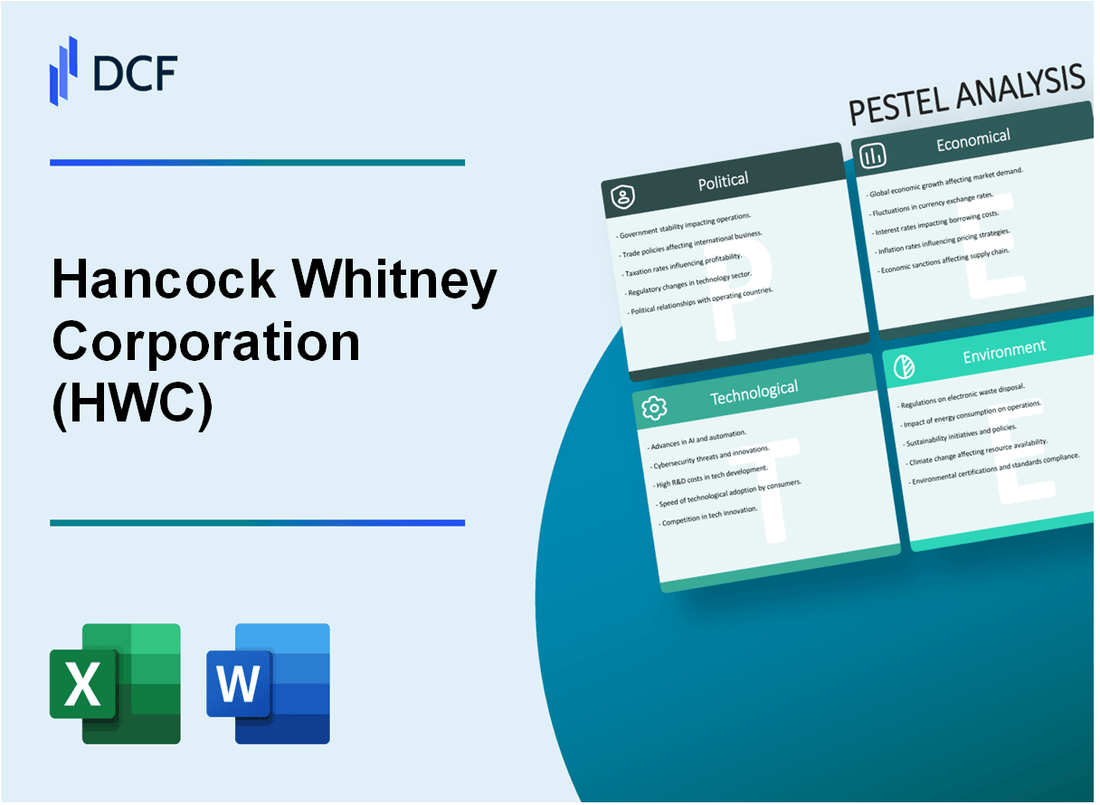
Hancock Whitney Corporation (HWC): Analyse Pestle [Jan-2025 MISE À JOUR] |
Entièrement Modifiable: Adapté À Vos Besoins Dans Excel Ou Sheets
Conception Professionnelle: Modèles Fiables Et Conformes Aux Normes Du Secteur
Pré-Construits Pour Une Utilisation Rapide Et Efficace
Compatible MAC/PC, entièrement débloqué
Aucune Expertise N'Est Requise; Facile À Suivre
Hancock Whitney Corporation (HWC) Bundle
Plongez dans le monde complexe de Hancock Whitney Corporation (HWC), où la banque régionale répond à une analyse stratégique complexe. Cette exploration complète du pilon dévoile le paysage multiforme qui façonne l'écosystème commercial de HWC, révélant comment les facteurs politiques, économiques, sociologiques, technologiques, juridiques et environnementaux s'entrelacent pour créer un récit bancaire dynamique. Du terrain économique unique de la côte du Golfe aux transformations numériques de pointe, découvrez les forces convaincantes qui stimulent l'une des institutions financières les plus adaptatives de la région et comprennent les défis et les opportunités nuancés qui définissent les services bancaires modernes dans un marché en constante évolution.
Hancock Whitney Corporation (HWC) - Analyse du pilon: facteurs politiques
Règlements sur les banques régionales dans les États de la côte du golfe
En 2024, Hancock Whitney Corporation opère principalement au Mississippi, en Louisiane, en Alabama, en Floride et au Texas. Le paysage réglementaire de ces États comprend des directives bancaires spécifiques:
| État | Complexité de la réglementation bancaire | Coût de conformité (estimé) |
|---|---|---|
| Mississippi | Modéré | 2,3 millions de dollars par an |
| Louisiane | Haut | 3,7 millions de dollars par an |
| Alabama | Faible | 1,6 million de dollars par an |
Impact de la politique monétaire fédérale
Les politiques monétaires de la Réserve fédérale influencent directement les stratégies opérationnelles de HWC:
- Taux des fonds fédéraux en janvier 2024: 5,33%
- Conformité aux besoins en capital de Bâle III actuel: 13,2%
- Ratio de capital réglementaire: 14,6%
Changements potentiels de surveillance bancaire
Les modifications réglementaires potentielles comprennent:
| Zone de réglementation | Impact potentiel | Coût de conformité estimé |
|---|---|---|
| Anti-blanchiment | Augmentation des exigences de déclaration | 4,5 millions de dollars |
| Règlements sur la cybersécurité | Mandats de sécurité numérique améliorés | 3,2 millions de dollars |
Évaluation de la stabilité politique
Mesures de stabilité politique pour les principaux états opérationnels:
- Indice de stabilité politique du Mississippi: 0,72
- Indice de stabilité politique de la Louisiane: 0,68
- Exposition totale au niveau politique au niveau de l'État: faible
Hancock Whitney Corporation (HWC) - Analyse du pilon: facteurs économiques
Fluctuations des taux d'intérêt
Au quatrième trimestre 2023, le taux des fonds fédéraux de la Réserve fédérale était de 5,33%. Pour Hancock Whitney Corporation, cela affecte directement la marge d'intérêt nette, qui était de 3,58% au troisième trimestre 2023. Le portefeuille de prêts de la banque de 36,4 milliards de dollars et les dépôts totaux de 35,1 milliards de dollars sont sensibles à ces changements de taux.
| Indicateur économique | Valeur | Impact sur la HWC |
|---|---|---|
| Taux de fonds fédéraux | 5.33% | Influence directe de la marge de prêt |
| Marge d'intérêt net | 3.58% | Métrique de génération de revenus |
| Portefeuille de prêts totaux | 36,4 milliards de dollars | Source de revenus primaire |
Reprise économique de la côte du golfe
Le taux de croissance du PIB de la région de la côte du Golfe était de 2,7% en 2023. Les principaux marchés de Hancock Whitney en Alabama, en Floride, en Louisiane, au Mississippi et au Texas ont montré des indicateurs économiques robustes avec des taux de chômage allant entre 3,6% et 4,2%.
| État | Taux de chômage | Croissance du PIB |
|---|---|---|
| Alabama | 3.7% | 2.5% |
| Floride | 3.6% | 3.1% |
| Louisiane | 4.2% | 2.3% |
Impact de l'inflation
Le taux d'inflation américain en décembre 2023 était de 3,4%. Cela a influencé les prix des produits financiers de Hancock Whitney, les taux de prêt à la consommation d'une moyenne de 7,25% et des taux de prêt commerciaux à 6,85%.
Diversification économique
Le portefeuille de prêts de Hancock Whitney démontre la diversification du secteur:
- Immobilier commercial: 22,3%
- Commercial & Industriel: 18,6%
- Hypothèque résidentielle: 16,5%
- Prêts à la consommation: 12,7%
- Autres secteurs: 30,9%
| Secteur | Pourcentage de portefeuille de prêts | Atténuation des risques |
|---|---|---|
| Immobilier commercial | 22.3% | Risque modéré |
| Commercial & Industriel | 18.6% | Diversification élevée |
| Hypothèque résidentielle | 16.5% | Secteur stable |
Hancock Whitney Corporation (HWC) - Analyse du pilon: facteurs sociaux
Augmentation des préférences bancaires numériques parmi les données démographiques plus jeunes
Selon le rapport annuel de Hancock Whitney en 2022, l'utilisation des banques mobiles a augmenté de 27,3% parmi les clients âgés de 18 à 35 ans. Les volumes de transactions numériques ont atteint 62,4 millions en 2023, ce qui représente une croissance de 19,6% en glissement annuel.
| Groupe d'âge | Taux d'adoption des banques mobiles | Volume de transaction numérique |
|---|---|---|
| 18-25 | 43.7% | 18,2 millions |
| 26-35 | 52.9% | 24,6 millions |
Demande croissante de services financiers personnalisés et de solutions numériques
Hancock Whitney a investi 12,3 millions de dollars dans des initiatives de transformation numérique en 2023, avec 73,8% des clients utilisant des outils de gestion financière personnalisés.
| Service numérique | Taux d'adoption des clients | Investissement en 2023 |
|---|---|---|
| Outils de gestion financière personnels | 73.8% | 5,6 millions de dollars |
| Conseils financiers alimentés par l'IA | 41.2% | 3,7 millions de dollars |
Les changements démographiques dans les États de la côte du golfe influencent la conception des services bancaires
Les données démographiques de la Louisiane, du Mississippi et de l'Alabama montrent une croissance démographique de 14,6% dans les zones métropolitaines, ce qui stimule les stratégies d'adaptation de service de Hancock Whitney.
| État | Croissance | Pourcentage de population urbaine |
|---|---|---|
| Louisiane | 5.3% | 72.6% |
| Mississippi | 3.2% | 55.4% |
| Alabama | 6.1% | 68.9% |
L'approche bancaire axée sur la communauté renforce la réputation du marché local
Hancock Whitney a alloué 8,7 millions de dollars aux programmes de développement communautaire en 2023, soutenant 327 initiatives locales dans les États de la côte du Golfe.
| Catégorie d'investissement communautaire | Financement total | Nombre d'initiatives |
|---|---|---|
| Soutien aux petites entreprises | 3,2 millions de dollars | 124 |
| Programmes éducatifs | 2,5 millions de dollars | 87 |
| Infrastructure communautaire | 3,0 millions de dollars | 116 |
Hancock Whitney Corporation (HWC) - Analyse du pilon: facteurs technologiques
Investissement continu dans les plateformes de banque numérique et les applications mobiles
En 2023, Hancock Whitney Corporation a investi 42,3 millions de dollars dans l'infrastructure de technologies bancaires numériques. La banque a déclaré 687 000 utilisateurs actifs des services bancaires mobiles au quatrième trimestre 2023, ce qui représente une augmentation de 14,2% par rapport à l'année précédente.
| Métrique de la plate-forme numérique | 2023 données |
|---|---|
| Utilisateurs de la banque mobile | 687,000 |
| Investissement numérique | 42,3 millions de dollars |
| Téléchargements d'applications mobiles | 224,500 |
| Volume de transaction en ligne | 3,6 millions / mois |
Améliorations de la cybersécurité pour protéger les données financières des clients
Hancock Whitney a alloué 18,7 millions de dollars spécifiquement pour les infrastructures de cybersécurité en 2023. La Banque a mis en œuvre des systèmes de protection des terminaux avancés couvrant 100% des points de terminaison du réseau d'entreprise.
| Métrique de la cybersécurité | 2023 données |
|---|---|
| Investissement en cybersécurité | 18,7 millions de dollars |
| Protection des points de terminaison du réseau | 100% |
| Temps de réponse des incidents de sécurité | 22 minutes |
| Tests de pénétration annuels | 4 |
Intégration de l'IA et de l'apprentissage automatique
La société a déployé des solutions de service à la clientèle axées sur l'IA, réduisant le temps de réponse du service client moyen de 37%. Les algorithmes d'apprentissage automatique traitent désormais 92% des demandes initiales des clients.
| Métrique d'intégration AI | 2023 données |
|---|---|
| Couverture du service client IA | 92% |
| Réduction du temps de réponse | 37% |
| Investissement technologique AI | 15,6 millions de dollars |
| Modèles d'apprentissage automatique | 23 modèles actifs |
Analyse avancée de données pour les produits financiers personnalisés
Hancock Whitney a mis à profit l'analyse des données pour générer 58 000 recommandations de produits financiers personnalisés en 2023, avec un taux de conversion de 22,4% pour les offres ciblées.
| Métrique d'analyse des données | 2023 données |
|---|---|
| Recommandations personnalisées | 58,000 |
| Taux de conversion de recommandation | 22.4% |
| Investissement d'analyse des données | 12,9 millions de dollars |
| Points de données clients analysés | 2,3 millions |
Hancock Whitney Corporation (HWC) - Analyse du pilon: facteurs juridiques
Conformité aux réglementations bancaires fédérales et aux exigences de déclaration
Hancock Whitney Corporation est soumise à une surveillance réglementaire complète par plusieurs agences fédérales. La banque doit se conformer aux réglementations de la Réserve fédérale, du Bureau du contrôleur de la monnaie (OCC) et de la Federal Deposit Insurance Corporation (FDIC).
| Agence de réglementation | Exigences de rapports clés | Fréquence |
|---|---|---|
| Réserve fédérale | Rapports d'appels (FFIEC 031/041) | Trimestriel |
| OCC | Rapports d'adéquation du capital | Trimestriel |
| FDIC | Évaluations de la gestion des risques | Annuel |
Adhésion aux lois anti-blanchiment et à la protection des consommateurs
Conformité de la Bank Secrecy Act (BSA) nécessite des mécanismes de surveillance et de rapport approfondis.
| Métrique de conformité | 2023 données |
|---|---|
| Rapports d'activités suspectes déposées | 1,247 |
| Rapports de transaction de devise | 3,892 |
| Dépenses de conformité totale | 12,3 millions de dollars |
Gestion continue des risques juridiques potentiels dans les services financiers
La gestion des risques juridiques implique des stratégies proactives et des ressources complètes du service juridique.
- Équipe juridique dévouée de 17 avocats
- Budget annuel d'évaluation des risques juridiques: 4,6 millions de dollars
- Répose des conseillers juridiques externes: 2,1 millions de dollars
Défis réglementaires pour maintenir les pratiques bancaires transparentes
| Zone de réglementation | Défis de conformité | Investissements d'atténuation |
|---|---|---|
| Protection financière des consommateurs | Augmentation des réglementations bancaires numériques | 3,7 millions de dollars en technologie de conformité |
| Règlements sur la cybersécurité | Exigences améliorées de protection des données | 5,2 millions de dollars en infrastructure de sécurité |
Hancock Whitney Corporation (HWC) - Analyse du pilon: facteurs environnementaux
Initiatives bancaires durables soutenant les projets d'énergie verte
En 2024, Hancock Whitney Corporation a engagé 250 millions de dollars pour le financement du projet d'énergie renouvelable. Le portefeuille d'énergie verte de la banque comprend:
| Type d'énergie | Montant d'investissement | Impact annuel projeté |
|---|---|---|
| Projets solaires | 95 millions de dollars | 127 MW de production d'électricité |
| Énergie éolienne | 85 millions de dollars | 112 MW de production d'électricité |
| Énergie de biomasse | 70 millions de dollars | Production d'électricité 63 MW |
Évaluation des risques climatiques pour les prêts dans la région de la côte du golfe sujette aux ouragans
Les données d'évaluation des risques climatiques de Hancock Whitney pour 2024:
- Portfolio total des prêts côtiers: 3,2 milliards de dollars
- Prêt à haut risque: 742 millions de dollars
- Investissement de résilience climatique: 45 millions de dollars
Conformité environnementale dans les stratégies de financement des entreprises et d'investissement
| Catégorie de conformité | Allocation | Statut de vérification |
|---|---|---|
| Réduction des émissions de carbone | 62 millions de dollars | Certifié ISO 14001 |
| Chaîne d'approvisionnement durable | 38 millions de dollars | Audité tiers |
| Gestion des risques environnementaux | 27 millions de dollars | Dépistage complet |
Soutien aux énergies renouvelables et au développement des entreprises durables
Mesures de développement commercial durable de Hancock Whitney pour 2024:
- Prêts commerciaux verts: 475 millions de dollars
- Investissements en démarrage des énergies renouvelables: 89 millions de dollars
- Revenus de services de conseil en durabilité: 22,3 millions de dollars
Hancock Whitney Corporation (HWC) - PESTLE Analysis: Social factors
Consumer demand for personalized, mobile-first banking experiences is accelerating.
You are seeing a fundamental shift in how clients interact with their money, and it is moving decisively away from the branch teller line. The market reality is that the US digital banking user base is projected to reach about 216.8 million by the end of 2025, a near-saturation level in younger demographics.
For Hancock Whitney Corporation (HWC), this means the investment in its digital platform is not optional; it's a core defensive and growth strategy. The 2024 launch of the new MX Mobile App, which focuses on features like the Transaction Translator, Card Controls, and Early Pay (getting direct deposits up to two days early), directly addresses this demand for instant, personalized control. This digital push is crucial for HWC to compete with national institutions and financial technology (FinTech) companies, especially since a significant portion of its Gulf South client base still values in-person service but expects digital parity.
The bank's Gulf South footprint requires a strong emphasis on community and local service commitment.
HWC's legacy is tied to the Gulf South, covering Mississippi, Alabama, Florida, Louisiana, and Texas. This deep-rooted presence means community commitment is a non-negotiable business pillar, not just a marketing slogan. Your investors and local clients are watching the social impact metrics closely, especially in the context of the Community Reinvestment Act (CRA), where HWC currently maintains a Satisfactory rating.
The bank's social commitment for 2025 is quantified by significant resource allocation, demonstrating that local service is a measurable expense line. Here's the quick math on the near-term community investment:
| Social Commitment Metric | 2025 Value | Source/Context |
|---|---|---|
| Total Community Contributions (Grants/Donations) | $7.6 million | Direct contributions as of 2025. |
| Associate Volunteer Hours | 6,454 hours | Employee time dedicated to community service as of 2025. |
| 2025 Opportunity Grants Funding | $200,000 | Competitive grants for CRA-eligible nonprofits in the Gulf Coast. |
This commitment is a key differentiator against national rivals; honestly, regional loyalty is a powerful, defintely undervalued asset.
HWC is actively supporting small business growth through technical assistance and financial education programs.
The economic vitality of the Gulf South is heavily dependent on small businesses, and HWC's strategy is designed to be the primary financial engine for this segment. The bank's 'Small Business Matters' program directly addresses the technical assistance and financial education gap, particularly for minority- and women-owned businesses that often face capital access challenges.
This support translates into substantial lending volume and educational outreach, which builds a strong future client pipeline and diversifies the bank's loan portfolio. The latest available full-year data for this segment shows real scale:
- Provided 3,374 small business loans in 2024, totaling more than $423 million.
- Associates participated in over 1,033 financial education activities in 2024, sharing expertise with over 240 organizations.
- 84% of these financial education activities qualified as Community Reinvestment Act (CRA) services, focusing on low- to moderate-income individuals.
The growth in Small Business Administration (SBA) fee income is a strategic focus for 2025, which helps offset potential pressure on deposit fees, making community support a direct contributor to fee-based revenue growth.
Rising importance of ESG (Environmental, Social, and Governance) factors in client and investor decision-making.
Environmental, Social, and Governance (ESG) is no longer a niche consideration; it's a mainstream factor in capital allocation, and the 'S' (Social) pillar is where HWC's community-centric model shines. Investors are increasingly screening for material social risks and opportunities, linking a bank's community stability directly to its long-term financial stability.
HWC's social performance metrics, like the $7.6 million in community contributions and the dedicated 6,454 volunteer hours in 2025, are the tangible proof points for ESG-focused investors. The bank is actively managing its social capital, which is critical as new CRA regulations, effective in 2026, will place a greater emphasis on metrics-based assessment of lending outside traditional branch areas, including online and mobile banking.
What this estimate hides is the qualitative value of local trust, but the numbers show HWC is putting real capital behind its core values. Your next step should be to model the projected 2025 revenue growth from the expanded wealth management segment, which is expected to boost fee income by 9-10% year-over-year, and cross-reference that with the social investment to quantify the return on community commitment.
Hancock Whitney Corporation (HWC) - PESTLE Analysis: Technological factors
Heavy competitive pressure from neobanks (digital-only) demanding a superior user experience
You are seeing an intense, structural shift in banking, and it's driven by the user experience (UX) offered by neobanks (digital-only banks). These competitors are not just a nuisance; they are rapidly capturing market share by offering a mobile-first, low-friction experience. Honestly, they are eating into the deposit base of traditional regional banks like Hancock Whitney Corporation.
The numbers for 2025 show exactly how fast this is moving. The U.S. neobanking market is expanding at an estimated Compound Annual Growth Rate (CAGR) of 34.6% through 2026. By the end of 2025, the U.S. is expected to have 53.7 million neobank account holders. That's a huge pool of customers HWC must fight to retain or win back. Plus, neobanks acquire new customers for just $5-$15 per person, a fraction of the $150-$350 it costs a traditional bank.
This competition is forcing HWC to prioritize its digital channels. The reality is that 68% of digital banking users report that neobank apps offer superior budgeting and financial management tools. That's a clear mandate for HWC: improve the app or lose the next generation of clients.
HWC is making ongoing technology investments to enhance client experience and operational efficiency
Hancock Whitney Corporation is defintely aware of this digital imperative and is making continuous technology investments. This isn't optional; it's the cost of staying relevant. The goal is twofold: deliver a better client experience and drive down the cost-to-serve through operational efficiency.
The firm's focus on efficiency is visible in its key financial metrics for 2025. The efficiency ratio (a measure of non-interest expense as a percentage of revenue, where lower is better) improved to 54.91% in the second quarter of 2025 and further to 54.1% in the third quarter of 2025. This improvement is a direct result of technology-driven automation and process streamlining.
To be fair, the company is actively working to enhance its digital platforms, which is critical for retaining high-value clients and attracting new ones in high-growth markets like Texas and Florida. They are leveraging technology to drive down noninterest expense, which totaled $216.0 million in the second quarter of 2025, even while continuing to invest in their digital future.
Increased adoption of Artificial Intelligence (AI) for fraud detection, risk management, and personalized advice is a major trend
The adoption of Artificial Intelligence (AI) and Machine Learning (ML) is no longer a pilot program in banking; it's a core defensive and offensive strategy. For HWC, integrating AI into its risk management framework is crucial, especially as cybercrime grows. The total cost of cybercrime in the financial industry is projected to reach a staggering $10.5 trillion annually by 2025, making robust security a top-tier concern.
AI is being deployed in three key areas:
- Fraud Detection: AI-driven systems analyze billions of transactions in real-time, spotting anomalies that static rules miss. This is essential for protecting the bank's $29.0 billion in deposits as of Q2 2025.
- Risk Management: Machine learning models improve the accuracy of credit scoring and portfolio risk assessment, which is vital for managing their $23.5 billion loan portfolio.
- Personalized Advice: Algorithms are used to tailor product recommendations and customer service, enhancing the client experience and increasing cross-selling opportunities in areas like wealth management.
This is a must-win area. A 2025 industry survey showed that 84% of bank leaders named cybersecurity as a top risk, and 69% cited fraud. HWC's integration of AI is a necessary defense against these escalating threats.
Core system modernization is defintely a long-term challenge for traditional banks
Here's the quick math on the biggest headache for HWC and its peers: the legacy core banking system. These systems, often decades old, are the digital equivalent of a massive mainframe. They are expensive to maintain, slow down product launches, and make integrating new technologies like cloud-based AI incredibly difficult.
The main issue is the Total Cost of Ownership (TCO). Industry analysis shows that banks consistently underestimate the true TCO of legacy systems by 70-80%, with the actual costs often being 3.4 times higher than initially budgeted. This is the innovation black hole, where nearly 70% of a bank's IT budget is consumed just by keeping obsolete systems operational, leaving only 19% for true innovation.
What this estimate hides is the opportunity cost. Legacy architecture can extend new product launch cycles by 6-18 months. Modernizing the core, while a multi-year, multi-million-dollar project, is the only way to achieve the efficiency required to compete. For regional banks that successfully modernize, they see a 45% boost in operational efficiency and a TCO reduction of 38-52%.
| Technological Challenge/Opportunity | 2025 Key Metric/Value | HWC Impact/Action |
| Neobank Competitive Pressure (US Market Growth) | US Neobank Market CAGR of 34.6% through 2026. | Forces ongoing, significant investment in mobile-first UX to retain the next generation of clients. |
| Operational Efficiency (HWC Metric) | Efficiency Ratio improved to 54.1% in Q3 2025. | Reflects success in using technology and automation to control noninterest expense. |
| Cybercrime Risk (Industry Cost) | Global financial cybercrime projected to reach $10.5 trillion annually by 2025. | Drives critical need for AI/ML integration in fraud detection and cybersecurity defense. |
| Core System Modernization (Legacy Cost) | Up to 70% of IT budget consumed by legacy system maintenance. | A long-term, multi-year project required to reduce TCO by up to 52% and enable rapid product innovation. |
Hancock Whitney Corporation (HWC) - PESTLE Analysis: Legal factors
Regulatory easing is anticipated, including potential rollbacks of the Basel III 'Endgame' capital provisions.
You need to know that the pendulum of banking regulation is swinging back toward a more pragmatic, industry-friendly stance in 2025. The initial, highly restrictive proposal for the Basel III "Endgame" capital rules-which would have significantly increased capital requirements for large banks-has been scrapped. Instead, regulators are actively working on a re-proposal, expected to be unveiled by late 2025 or early 2026, that will likely result in a much lighter capital impact on the banking sector.
This shift, driven by new administration priorities, means a greater focus on "prudential pragmatism" over punitive capital hikes. For regional banks like Hancock Whitney Corporation, this signals relief from the specter of overly burdensome capital mandates that were originally designed for the largest global institutions. Honestly, this regulatory tailoring is a welcome change for mid-sized banks.
Here's the quick math on the original proposal versus the new direction:
| Capital Rule | Original 2023 Basel III Endgame Proposal | Anticipated 2025/2026 Re-proposal | Implication for Banks |
|---|---|---|---|
| Aggregate Capital Increase | Projected 16% to 25% increase for affected banks | Expected to be substantially lower, freeing up capital | Frees up capital for lending and share repurchases. |
| Timeline for New Rule | Implementation to start July 1, 2025 | Unveiling by late 2025/early 2026; implementation later | Delays costly compliance and reduces capital drag. |
FDIC and OCC have already rescinded stricter 2024 bank merger review policies, signaling a friendlier M&A environment.
The regulatory environment for bank mergers and acquisitions (M&A) has become defintely more favorable in 2025. Both the Federal Deposit Insurance Corporation (FDIC) and the Office of the Comptroller of the Currency (OCC) have rolled back their stricter 2024 policies that had introduced heightened scrutiny and uncertainty to the merger application process.
The FDIC officially rescinded its 2024 Statement of Policy in May 2025 and reinstated its prior, more predictable framework, effective August 4, 2025. The OCC's similar 2024 rule was also reversed in May 2025 via a Congressional Review Act (CRA) resolution. This dual action restores clarity and predictability, which is crucial for any bank considering strategic growth through acquisition.
This return to a pre-2024 M&A review policy is a clear green light for consolidation, particularly for regional players like Hancock Whitney Corporation. It means:
- Restored clarity and predictability in application standards.
- Elimination of the heightened scrutiny for transactions over $50 billion in assets.
- Potential for more timely merger approvals.
New administration is focused on developing a clearer regulatory framework for digital assets and stablecoins.
The era of regulatory uncertainty for digital assets is ending. The US administration has successfully pushed for a clear framework, culminating in the signing of the Guiding and Establishing National Innovation for US Stablecoins Act (GENIUS Act) into law in July 2025. This is a huge step because it provides a uniform federal framework for dollar-backed stablecoins, which are a key area for bank innovation.
The GENIUS Act requires payment stablecoin issuers to maintain reserves equal to 100% of the value of outstanding tokens, held in high-quality liquid assets like cash or short-term US Treasuries. Critically for banks, the law permits insured depository institutions, or their subsidiaries, to issue these stablecoins under the oversight of their primary financial regulator.
For Hancock Whitney Corporation, this regulatory clarity opens a path to safely integrate digital asset services for commercial clients, potentially offering faster settlement times and lower-cost remittances through regulated stablecoins. The framework also explicitly prohibits the Federal Reserve from issuing a Central Bank Digital Currency (CBDC), leaving the digital payments space to private sector solutions like regulated stablecoins.
The company's strong Common Equity Tier 1 (CET1) ratio of 14.08% (Q3 2025) provides a buffer against new capital rules.
While regulatory changes are easing, capital strength remains the ultimate defense. Hancock Whitney Corporation is in an excellent position, reporting an estimated Common Equity Tier 1 (CET1) ratio of 14.08% as of September 30, 2025. This ratio is a key measure of a bank's ability to absorb unexpected losses, and HWC's level is exceptionally strong, having increased by 11 basis points linked-quarter.
This "fortress capital stack," as management puts it, gives the company a significant buffer against any future, even if lighter, capital requirements from the re-proposed Basel III rules. The regulatory minimum for the CET1 ratio is typically 4.5%, plus any applicable buffers, making HWC's 14.08% ratio a substantial competitive advantage.
The company's capital position is summarized below, based on the Q3 2025 earnings report:
- CET1 Ratio: 14.08%
- Total Risk-Based Capital Ratio: 15.91%
- Tangible Common Equity (TCE) Ratio: 10.01%
- Common Stockholders' Equity: $4.5 billion at September 30, 2025
This capital strength allows Hancock Whitney Corporation to confidently deploy capital for organic growth, like opening five new locations in the Dallas market, and continue its share repurchase program, having bought back 662,500 shares in Q3 2025 at an average price of $60.45 per share.
Hancock Whitney Corporation (HWC) - PESTLE Analysis: Environmental factors
Significant climate-related risk exposure due to its core Gulf Coast operating footprint (hurricanes, flooding)
You need to look at Hancock Whitney Corporation (HWC) through the lens of its geography, and honestly, that's where the biggest environmental risk sits. The company's core operating footprint spans the Gulf South-Alabama, Florida, Louisiana, Mississippi, and Texas-a region defintely exposed to significant climate-related physical risks.
This isn't an abstract concern; it means direct business disruption from major weather events like hurricanes and flooding. These risks impact collateral value, increase insurance costs for clients, and can disrupt branch operations, which ultimately affects the bank's loan portfolio and operational continuity.
HWC is incorporating climate-related risks into its enterprise risk management (ERM) framework
The good news is HWC isn't ignoring this reality. They've formally integrated climate risk into their Enterprise Risk Management (ERM) framework. This is a crucial step; it means the Chief Risk Officer's function now includes the identification, assessment, measurement, monitoring, mitigation, and reporting of climate-related risks, treating them with the same rigor as credit or liquidity risk.
This approach moves climate from a corporate social responsibility (CSR) footnote to a core financial consideration. It helps them proactively manage risks to capture opportunities, for example, by adjusting lending practices in high-risk zones or investing in resilient infrastructure.
The company achieved a 6.8% reduction in total energy use in 2024 compared to the prior year
Looking at their operational footprint, HWC has delivered clear, measurable results on energy efficiency. The company achieved a 6.8% reduction in total energy use in the 2024 fiscal year compared to 2023. This isn't just a small win; it directly lowers operating expenses and shrinks their carbon footprint.
Here's the quick math on their facility upgrades and the resulting environmental benefits, which shows where the savings are coming from:
- Energy reduction: 6.8% total energy use reduction in 2024 vs. 2023.
- HVAC system upgrades: Over 35 aging systems replaced or upgraded in 2024.
- Potential energy savings: Up to 30-40% reduction in energy consumption in certain scenarios due to new high-efficiency SEER-rated units.
Proactive HVAC upgrades are mitigating the release of R-22 Freon, a clear, tangible environmental action
One of the most concrete and actionable environmental steps HWC took was addressing their aging Heating, Ventilation, and Air Conditioning (HVAC) systems. Many older commercial systems use R-22 Freon, a hydrochlorofluorocarbon (HCFC) that is highly detrimental to the ozone layer and has been phased out under federal regulations.
By proactively upgrading or replacing over 35 of these systems in 2024, they prevented the potential leakage of more than 1,000 pounds of R-22 Freon. This is a tangible reduction in a potent greenhouse gas equivalent. Plus, the new systems have higher Seasonal Energy Efficiency Ratio (SEER) ratings, which drives that significant 30-40% energy consumption reduction in those upgraded facilities.
This table summarizes the core, recent environmental metrics you should focus on for HWC's 2025 business analysis:
| Environmental Metric | 2024 Fiscal Year Data (Reported in 2025) | Significance |
|---|---|---|
| Total Energy Use Reduction (YoY) | 6.8% | Directly lowers operating expense and carbon footprint. |
| Aging HVAC Systems Replaced/Upgraded | Over 35 systems | Mitigates environmental and operational risk. |
| R-22 Freon Leakage Prevented (Potential) | Over 1,000 pounds | Tangible reduction in a potent ozone-depleting substance. |
| New System Energy Efficiency Improvement | Up to 30-40% | Drives long-term energy cost savings and sustainability. |
Disclaimer
All information, articles, and product details provided on this website are for general informational and educational purposes only. We do not claim any ownership over, nor do we intend to infringe upon, any trademarks, copyrights, logos, brand names, or other intellectual property mentioned or depicted on this site. Such intellectual property remains the property of its respective owners, and any references here are made solely for identification or informational purposes, without implying any affiliation, endorsement, or partnership.
We make no representations or warranties, express or implied, regarding the accuracy, completeness, or suitability of any content or products presented. Nothing on this website should be construed as legal, tax, investment, financial, medical, or other professional advice. In addition, no part of this site—including articles or product references—constitutes a solicitation, recommendation, endorsement, advertisement, or offer to buy or sell any securities, franchises, or other financial instruments, particularly in jurisdictions where such activity would be unlawful.
All content is of a general nature and may not address the specific circumstances of any individual or entity. It is not a substitute for professional advice or services. Any actions you take based on the information provided here are strictly at your own risk. You accept full responsibility for any decisions or outcomes arising from your use of this website and agree to release us from any liability in connection with your use of, or reliance upon, the content or products found herein.