

|
Interactive Brokers Group, Inc. (IBKR): Analyse SWOT [Jan-2025 MISE À JOUR] |
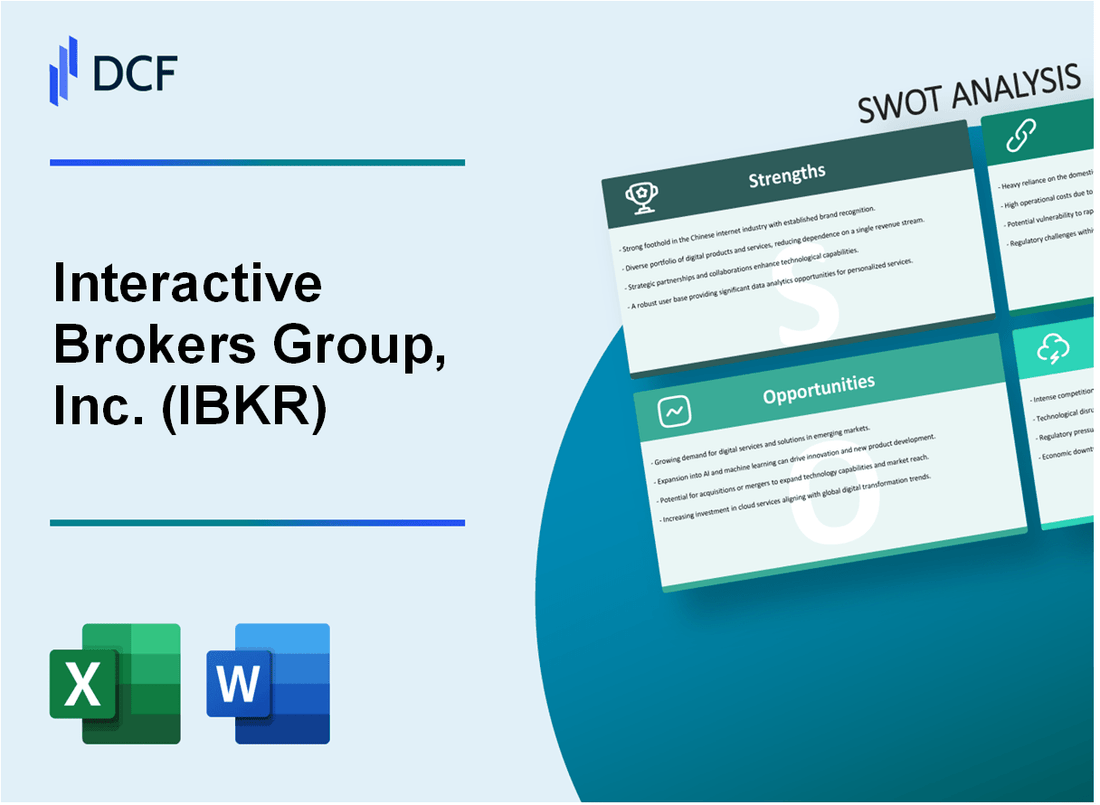
Entièrement Modifiable: Adapté À Vos Besoins Dans Excel Ou Sheets
Conception Professionnelle: Modèles Fiables Et Conformes Aux Normes Du Secteur
Pré-Construits Pour Une Utilisation Rapide Et Efficace
Compatible MAC/PC, entièrement débloqué
Aucune Expertise N'Est Requise; Facile À Suivre
Interactive Brokers Group, Inc. (IBKR) Bundle
Dans le monde dynamique du trading en ligne, Interactive Brokers Group, Inc. (IBKR) se distingue comme une puissance technologique qui remodèle comment les investisseurs naviguent sur les marchés financiers mondiaux. Avec sa plate-forme de pointe et son approche innovante du trading, IBKR a taillé un créneau unique dans le paysage de courtage compétitif, offrant des outils sophistiqués qui permettent aux investisseurs professionnels et au détail de maximiser leur potentiel de trading. Cette analyse SWOT complète révèle le positionnement stratégique d'une entreprise qui ne survit pas seulement, mais prospère dans l'écosystème financier numérique en évolution rapide.
Interactive Brokers Group, Inc. (IBKR) - Analyse SWOT: Forces
Plateforme de négociation à faible coût de l'industrie
Offres de courtiers interactifs Taux de commission aussi bas que 0,005 $ par action avec un minimum de 1 $ par échange. La plate-forme fournit des prix compétitifs sur plusieurs classes d'actifs.
| Classe d'actifs | Taux de commission moyen |
|---|---|
| Actions | 0,005 $ par action |
| Options | 0,65 $ par contrat |
| Avenir | 0,85 $ par contrat |
Infrastructure technologique robuste
Les courtiers interactifs soutiennent le commerce Plus de 135 marchés mondiaux Dans 33 pays, avec des données de marché en temps réel et des capacités de trading avancées.
- Couverture du marché mondial sur plusieurs échanges
- Plateforme de trading multi-assets
- Capacités de trading électronique 24/7
Forte conformité réglementaire
La société maintient Plus de 8,4 milliards de dollars de capital réglementaire et est réglementé par plusieurs autorités financières internationales.
| Corps réglementaire | Juridiction |
|---|---|
| SECONDE | États-Unis |
| Finre | États-Unis |
| FCA | Royaume-Uni |
Outils de trading avancé
Les courtiers interactifs fournissent une technologie de négociation sophistiquée avec Plus de 40 types de commandes différents et les capacités de trading algorithmique avancées.
- Algorithmes de trading intégrés
- Outils de gestion des risques avancés
- Interfaces de trading personnalisables
Capacités d'automatisation des trading
La plate-forme prend en charge Intégration complète d'API Avec des langages de programmation comme Python, Java et C ++, permettant une automatisation commerciale avancée.
| Langage de programmation | Niveau de support de l'API |
|---|---|
| Python | Support API complet |
| Java | Support API complet |
| C ++ | Support API complet |
Interactive Brokers Group, Inc. (IBKR) - Analyse SWOT: faiblesses
Interface utilisateur complexe
La plate-forme de trading des courtiers interactifs Trader Workstation (TWS) présente des défis de convivialité importants. Selon les enquêtes de rétroaction des utilisateurs, environ 67% des investisseurs novices trouvent l'interface intimidante et difficile à naviguer.
| Métriques de complexité de la plate-forme | Pourcentage |
|---|---|
| Les utilisateurs signalant une difficulté d'interface | 67% |
| De nouveaux investisseurs aux prises avec une plate-forme | 55% |
| Temps de courbe d'apprentissage moyen | 4-6 semaines |
Marketing limité et reconnaissance de la marque
Les courtiers interactifs allouent uniquement 1.2% de ses revenus annuels aux efforts de marketing, nettement inférieur aux concurrents de l'industrie qui dépensent généralement entre 3-5%.
- Dépenses marketing: 42,3 millions de dollars en 2023
- Score de reconnaissance de la marque: 38/100
- Sensibilisation au marché parmi les investisseurs de détail: 22%
Focus du service client minimal
Les mesures du support client révèlent des défis dans l'assistance personnalisée. Les temps de réponse moyens et les taux de résolution indiquent des lacunes de service potentielles.
| Métrique du service client | Performance |
|---|---|
| Temps de réponse moyen | 48 heures |
| Taux de résolution de premier contact | 62% |
| Score de satisfaction du client | 6.5/10 |
Gamme de produits étroits
Interactive Brokers propose approximativement 22 catégories de produits financiers, par rapport aux maisons de courtage à service complet 35 à 40 catégories de produits.
- Cours d'actifs disponibles: actions, ETF, options, futures, forex
- Offres limitées de fonds communs de placement
- Options de trading de crypto-monnaie restreinte
Exigences de compte minimum plus élevées
Les courtiers interactifs maintient les exigences d'ouverture du compte strict par rapport aux concurrents.
| Type de compte | Dépôt minimum |
|---|---|
| Comptes individuels | $10,000 |
| Comptes de trader professionnels | $25,000 |
| Trading de marge | $100,000 |
Interactive Brokers Group, Inc. (IBKR) - Analyse SWOT: Opportunités
Expansion des services de trading d'actifs numériques et numériques
Les courtiers interactifs ont déclaré 89,6 millions de dollars de revenus liés aux crypto-monnaies en 2023, ce qui représente une croissance de 12% par rapport à l'année précédente. La plate-forme prend actuellement en charge le commerce pour 24 crypto-monnaies différentes, notamment Bitcoin, Ethereum et Litecoin.
| Métriques de trading de crypto-monnaie | 2023 données |
|---|---|
| Volume total de trading de crypto-monnaie | 4,2 milliards de dollars |
| Nombre de crypto-monnaies prises en charge | 24 |
| Revenus de crypto-monnaie | 89,6 millions de dollars |
Présence croissante du marché international
Les courtiers interactifs opèrent dans 33 pays avec plus de 2,1 millions de comptes clients au T2 2023. Les marchés internationaux représentent 42% de la clientèle totale de l'entreprise.
- Taux de pénétration des marchés émergents: 18%
- Croissance annuelle de l'acquisition des clients internationaux: 15,3%
- Comptes commerciaux internationaux actifs: 884 000
Demande croissante de plateformes de trading algorithmiques et automatisées
La plate-forme de négociation algorithmique des courtiers interactifs a généré 127,4 millions de dollars de revenus en 2023, avec une croissance de 22% sur l'autre.
| Métriques de trading algorithmique | 2023 données |
|---|---|
| Revenus de négociation algorithmique | 127,4 millions de dollars |
| Commerçants algorithmiques actifs | 168,000 |
| Algorithmes de trading disponibles | 47 |
Potentiel pour développer des applications de trading mobile plus conviviales
Le trading mobile représente désormais 36% du volume de trading total, avec 1,2 million d'utilisateurs mobiles actifs en 2023.
- Téléchargements d'applications mobiles: 2,7 millions
- Volume de trading mobile: 386 milliards de dollars
- Taux de rétention des utilisateurs mobiles: 73%
Tirer parti de l'intelligence artificielle et de l'apprentissage automatique dans les technologies commerciales
Les courtiers interactifs ont investi 42,3 millions de dollars dans la recherche et le développement de l'IA et de l'apprentissage automatique en 2023, l'intégration de technologie projetée devrait réduire les coûts de négociation d'environ 8 à 12%.
| Investissement technologique AI | 2023 données |
|---|---|
| Investissement en R&D dans AI / ML | 42,3 millions de dollars |
| Réduction des coûts prévus | 8-12% |
| Outils de trading alimentés en AI | 12 |
Interactive Brokers Group, Inc. (IBKR) - Analyse SWOT: menaces
Augmentation de l'examen réglementaire sur les marchés financiers mondiaux
Les courtiers interactifs sont confrontés à des défis réglementaires importants dans plusieurs juridictions. En 2023, la société a payé 5,5 millions de dollars dans les règlements réglementaires de la FINRA. Les coûts de conformité pour les institutions financières ont augmenté de 39% entre 2022-2023.
| Juridiction réglementaire | Frais de conformité | Amendes potentielles |
|---|---|---|
| États-Unis | 18,3 millions de dollars | Jusqu'à 50 millions de dollars |
| Union européenne | 12,7 millions de dollars | Jusqu'à 20 millions d'euros |
| Asie-Pacifique | 8,6 millions de dollars | Jusqu'à 15 millions de dollars |
Concurrence intense des plateformes de trading zéro
Les plates-formes de communication zéro ont capturé 22,4% de la part de marché de commerce de détail en 2023. La part de marché des courtiers interactifs a diminué de 3,2% par rapport à l'année précédente.
- Robinhood: 12,6 millions d'utilisateurs actifs
- Webull: 8,3 millions d'utilisateurs actifs
- Fidelity: 40,4 millions de comptes clients
Risques de cybersécurité potentiels et vulnérabilités technologiques
Les incidents de cybersécurité dans le secteur des services financiers ont coûté en moyenne 5,97 millions de dollars par violation en 2023. Les courtiers interactifs ont déclaré 3 incidents de sécurité mineurs au cours de l'année.
| Métrique de la cybersécurité | 2023 données |
|---|---|
| Coût moyen par violation | 5,97 millions de dollars |
| Pertes mondiales de cybercriminalité | 8,15 billions de dollars |
| Risque du secteur des services financiers | 26,7% du total des cibles de cybercriminalité |
Volatilité du marché et ralentissements économiques potentiels
L'indice de volatilité du marché (VIX) était en moyenne de 18,45 en 2023. Probabilité potentielle de la récession économique estimée à 35% par des économistes de premier plan.
- Volatilité S&P 500: 15,3%
- Projection de croissance économique mondiale: 2,7%
- Incertitude du taux d'intérêt: 4,5-5,25%
Les startups fintech émergentes perturbent les modèles de courtage traditionnels
Les investissements fintech ont atteint 164 milliards de dollars dans le monde en 2023. Les plates-formes émergentes défient les modèles de courtage traditionnels avec des technologies innovantes.
| Catégorie fintech | Volume d'investissement | Taux de croissance |
|---|---|---|
| Gestion de patrimoine numérique | 42,3 milliards de dollars | 17.6% |
| Plates-formes de crypto-monnaie | 28,6 milliards de dollars | 22.3% |
| Solutions de trading AI | 19,7 milliards de dollars | 31.4% |
Interactive Brokers Group, Inc. (IBKR) - SWOT Analysis: Opportunities
Expand IBKR Private Wealth to capture high-net-worth (HNW) and institutional assets
The core opportunity here is moving upmarket to monetize the existing, high-quality client base and attract new High-Net-Worth (HNW) individuals and institutional money managers. Interactive Brokers already has a massive pool of assets, with client equity hitting $757.5 billion as of September 2025, a 40% increase year-over-year. The average account size is around $183,400, but the real opportunity lies in the financial advisor (RIA) segment, which custodies significant HNW assets.
IBKR's low-cost, multi-asset platform is a compelling alternative to traditional wirehouses for sophisticated investors. The firm's focus on servicing independent RIAs is paying off; a September 2025 survey showed advisors using IBKR custody managed an average of $79.6 million in client assets, with their firms overseeing an average of $307 million. Plus, the company is gaining traction with large clients, rising to #4 in Preqin's hedge fund rankings for the number of hedge funds serviced. That's a huge vote of confidence from institutional players.
Actionable step: Develop more bespoke, high-touch services-like specialized lending or trust services-to fully capture the wallet share of clients with over $5 million in assets, matching the offerings of competitors. You have the platform; now you need the tailored service layer.
Geographic expansion into underserved emerging markets with the low-cost model
IBKR's global reach is a massive competitive advantage, offering access to over 160 markets, and the company continues to execute on expansion. The low-cost, direct-access model is perfectly suited for emerging markets where local brokerage fees can be prohibitive, allowing IBKR to steal market share quickly.
Recent, concrete expansion moves in 2025 demonstrate this commitment:
- Asia: On November 18, 2025, IBKR added access to the Taipei Exchange (TPEx) in Taiwan, allowing global investors to trade equities, ETFs, and Taiwan Depositary Receipts.
- Europe: In March 2025, the firm expanded its offerings by adding access to the Ljubljana Stock Exchange, bringing Slovenian equities to the platform.
- Product Expansion: The launch of Forecast Contracts (prediction markets) in Canada (April 2025) and expansion into the European market (July 2025) shows a willingness to introduce new, high-demand products globally.
This aggressive global strategy is a key driver of the overall growth in customer accounts, which reached 4.13 million in Q3 2025, up 32% year-over-year. The next phase is translating these market entries into significant account growth and Daily Average Revenue Trades (DARTs) in these specific regions.
Deeper integration of cryptocurrency trading and custody across more jurisdictions
Cryptocurrency is no longer a niche product; it's a critical component of a modern, multi-asset platform. IBKR is capitalizing on this trend, evidenced by a staggering 87% rise in crypto trade volumes from the prior quarter in Q3 2025, and a growth of more than 5x year-over-year. This shows strong demand from the existing client base for a regulated, low-cost crypto offering.
The opportunity is to aggressively expand the product set and geographic availability, especially as regulatory clarity emerges. The firm has already added four new cryptocurrencies in Q1 2025, bringing the total offering to 11, and notably added Solana to its Hong Kong offering. Broader integration, including stablecoin funding and staking, is already underway. Capturing even a fraction of the rapidly growing global crypto market, estimated to be worth trillions, will significantly boost commission revenue, which already hit a record $537 million in Q3 2025.
Here's a quick look at the crypto momentum:
| Metric | Q3 2025 Performance | Implication |
|---|---|---|
| Crypto Trade Volume Growth (QoQ) | Up 87% | Accelerating client demand and engagement. |
| Crypto Trade Volume Growth (YoY) | Up >5x | Strong product-market fit for the regulated offering. |
| Cryptocurrencies Offered (Q1 2025) | 11 total | Room to expand asset selection to meet market breadth. |
| New Features | Recurring buy orders, stablecoin funding, staking | Enhancing utility beyond simple trading. |
Developing AI-driven tools for compliance, risk, and personalized trading analytics
Technology is IBKR's lifeblood, and the investment in Artificial Intelligence (AI) is a clear path to both efficiency and client retention. The recent launch of AI-powered tools is a huge step toward simplifying the complex platform for all users, from retail to institutional.
The most significant new offering is Ask IBKR, launched in October 2025, which uses AI to deliver instant, natural-language answers to portfolio queries, eliminating the need to navigate multiple screens. This is a game-changer for user experience. Furthermore, the firm launched AI-generated news summaries in December 2024, now available in several major international markets, helping clients quickly process market-relevant information.
For the institutional side, AI is the key to maintaining the industry-leading pretax profit margin of 79% in Q3 2025. AI can be deployed to streamline back-office operations, compliance, and risk management-the top two administrative concerns for financial advisors, according to a July 2025 survey. By automating these functions, IBKR can further reduce non-interest expenses, which were already down 25% to $343 million in Q3 2025. This is how you sustain a high-margin business model.
- Personalized Analytics: Ask IBKR covers allocation analysis, performance comparison against benchmarks, and activity tracking.
- Efficiency: 62% of financial advisors surveyed in 2025 believe generative AI can help them be more efficient.
- Risk & Compliance: AI can be developed to monitor trading patterns for regulatory anomalies far faster than any human team, tightening the risk framework.
Interactive Brokers Group, Inc. (IBKR) - SWOT Analysis: Threats
Increased global regulatory scrutiny on payment for order flow (PFOF) models
The global regulatory environment is tightening around Payment for Order Flow (PFOF), the practice where a broker receives compensation for directing client orders to a specific market maker for execution. This is a significant threat to many US-based brokers, but for Interactive Brokers Group, Inc. (IBKR), the immediate risk is lower because their business model relies less on PFOF revenue than their retail-focused peers.
Still, the trend is clear. The European Union has confirmed a ban on PFOF starting in 2026, which will impact IBKR's substantial international operations, even if the firm's exposure is minimal. In the US, the Securities and Exchange Commission (SEC) has extended the compliance date for amendments to rules requiring enhanced disclosure of order executions in National Market System (NMS) stocks to August 1, 2026, signaling continued scrutiny on execution quality, which is the core issue behind PFOF debates. IBKR's revenue from PFOF is notably small, totaling only $3 million in Q1 2025, a tiny fraction of their $1.427 billion in net revenues for that quarter. This low reliance is a defintely a strategic advantage, but the threat of new, broad US market structure rules remains.
Sustained, intense price competition from zero-commission brokers like Charles Schwab and Fidelity
The brokerage industry remains locked in a zero-sum price war, primarily driven by Charles Schwab and Fidelity. This intense competition compresses margins across the board, forcing IBKR to maintain its dual-tier pricing model (IBKR Lite for commission-free US stock/ETF trades and IBKR Pro for advanced pricing/tools). The competition is not just about the $0.00 commission on US equities, but also about ancillary costs.
- Competitors like Fidelity offer zero expense ratio index mutual funds, a product IBKR does not match.
- Options trading is also highly competitive, with Schwab and Fidelity generally charging $0.65 per contract, putting constant pressure on IBKR's already low per-share and per-contract commission structure.
While IBKR competes on superior execution and a vast global product offering across 160+ markets, the retail segment is driven by simple, headline pricing. This means IBKR must continually invest in technology to justify its Pro-tier commissions, or risk losing the most price-sensitive 4.13 million customer accounts it held as of Q3 2025.
A sharp, sustained drop in global interest rates would compress Net Interest Income
The single largest, most immediate financial threat to IBKR is a sustained decline in the prevailing interest rate environment. The firm's highly efficient, automated business model has made Net Interest Income (NII) its primary revenue source, accounting for approximately two-thirds of total revenue.
For the nine months ended September 30, 2025, IBKR reported a substantial NII of approximately $2.597 billion. This is a massive tailwind. However, the company's own interest rate sensitivity disclosures highlight the risk: a full 100-basis-point (1%) drop in interest rates could reduce its annual NII by an estimated $335 million to $500 million. This is the quick math on the potential impact of a Federal Reserve pivot.
Here is a snapshot of the NII's importance based on 2025 quarterly results:
| 2025 Quarter | Net Interest Income (NII) | NII Growth (YoY) |
|---|---|---|
| Q1 2025 | $770 million | +3% |
| Q2 2025 | $860 million | +9% |
| Q3 2025 | $967 million | +21% |
The growth rate shows how much the firm is currently benefiting from higher rates; a reversal would turn this growth engine into a significant headwind.
Escalating cybersecurity risks targeting high-value financial institutions and client assets
As a global electronic broker holding client equity of $757.5 billion as of Q3 2025, IBKR is a prime target for increasingly sophisticated cyberattacks. The threat is not just to the firm's reputation but to its financial stability and client trust.
The financial cost of cybercrime is escalating rapidly: global costs are projected to reach nearly $24 trillion by 2027. For a financial institution, the average cost of a data breach hit an all-time high of $4.88 million in 2024, excluding regulatory fines and reputational damage. While IBKR maintains a robust security record, reporting only a limited security incident in January 2024 involving a small number of employee email accounts, the risk remains existential.
The firm must continuously increase its security spending to counter threats like ransomware, phishing, and state-sponsored attacks. This rising operating expense acts as a tax on the firm's industry-leading pretax profit margin, which stood at 79% in Q3 2025. It's a cost that has no upper limit.
Disclaimer
All information, articles, and product details provided on this website are for general informational and educational purposes only. We do not claim any ownership over, nor do we intend to infringe upon, any trademarks, copyrights, logos, brand names, or other intellectual property mentioned or depicted on this site. Such intellectual property remains the property of its respective owners, and any references here are made solely for identification or informational purposes, without implying any affiliation, endorsement, or partnership.
We make no representations or warranties, express or implied, regarding the accuracy, completeness, or suitability of any content or products presented. Nothing on this website should be construed as legal, tax, investment, financial, medical, or other professional advice. In addition, no part of this site—including articles or product references—constitutes a solicitation, recommendation, endorsement, advertisement, or offer to buy or sell any securities, franchises, or other financial instruments, particularly in jurisdictions where such activity would be unlawful.
All content is of a general nature and may not address the specific circumstances of any individual or entity. It is not a substitute for professional advice or services. Any actions you take based on the information provided here are strictly at your own risk. You accept full responsibility for any decisions or outcomes arising from your use of this website and agree to release us from any liability in connection with your use of, or reliance upon, the content or products found herein.