

|
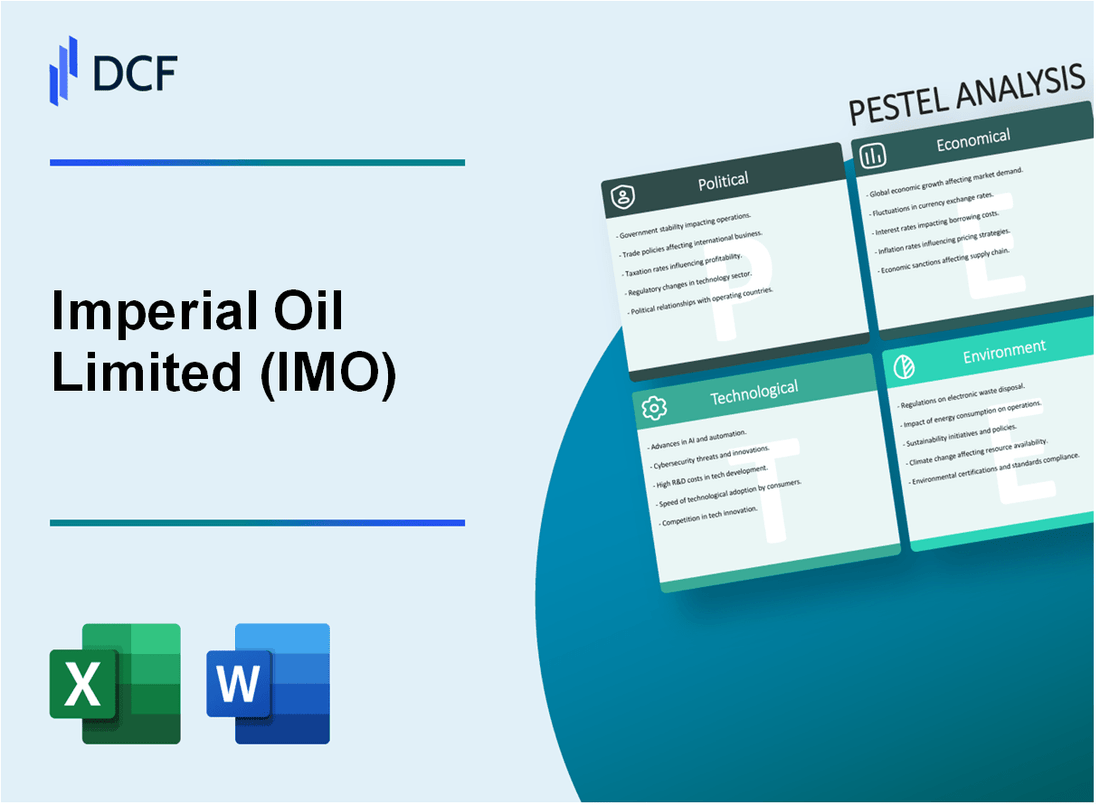
Imperial Oil Limited (IMO): Analyse du Pestle [Jan-2025 Mise à jour] |
Entièrement Modifiable: Adapté À Vos Besoins Dans Excel Ou Sheets
Conception Professionnelle: Modèles Fiables Et Conformes Aux Normes Du Secteur
Pré-Construits Pour Une Utilisation Rapide Et Efficace
Compatible MAC/PC, entièrement débloqué
Aucune Expertise N'Est Requise; Facile À Suivre
Imperial Oil Limited (IMO) Bundle
Imperial Oil Limited se dresse à un carrefour critique, naviguant dans le paysage complexe de la production d'énergie à une époque de transformation sans précédent. Alors que les marchés mondiaux, les préoccupations environnementales et les innovations technologiques convergent, ce géant canadien de l'énergie est confronté à des défis multiformes qui détermineront sa trajectoire stratégique. Des pressions réglementaires aux attentes sociétales, le pétrole impérial doit équilibrer habilement les opérations de pétrole traditionnelles avec des technologies durables émergentes, faisant de son analyse de pilon une exploration convaincante de l'adaptation, de la résilience et de la stratégie d'entreprise avant-gardiste dans le secteur de l'énergie dynamique.
Imperial Oil Limited (IMO) - Analyse du pilon: facteurs politiques
La pression du gouvernement canadien pour la réduction des émissions
L'objectif de réduction des émissions du Canada pour 2030 est fixé à 40 à 45% en dessous des niveaux de 2005. La réglementation des carburants propres du gouvernement fédéral, mise en œuvre en juillet 2023, nécessite une réduction de 15% de l'intensité du carbone du cycle de vie des carburants liquides d'ici 2030.
| Règlement | Impact sur l'industrie pétrolière | Coût de conformité |
|---|---|---|
| Règlement sur le carburant propre | Réduction obligatoire de l'intensité du carbone | Investissement estimé de 6,5 milliards de dollars à l'échelle de l'industrie |
| Mécanisme de tarification du carbone | Augmentation de la taxe sur le carbone | 170 $ par tonne d'ici 2030 |
Tensions de politique énergétique fédérale et provinciale
L'Alberta et le gouvernement fédéral continuent d'être en désaccord sur les politiques de développement pétrolier et gazières, avec des contestations judiciaires et des conflits politiques continus.
- Production de sables pétroliers de l'Alberta: 3,4 millions de barils par jour en 2023
- Proposition de plafond des émissions fédérales: réduction potentielle de la production de 35% d'ici 2030
- Impact économique estimé: 40 à 50 milliards de dollars de revenus perdus potentiels
Fiscalité au carbone et conformité environnementale
Les coûts de conformité prévus par Imperial Oil pour les réglementations environnementales sont importants.
| Zone de conformité | Coût annuel estimé | Investissement requis |
|---|---|---|
| Technologies de réduction des émissions | 500 à 750 millions de dollars | Infrastructure de capture et de stockage du carbone |
| Transition d'énergie renouvelable | 300 à 450 millions de dollars | Projets d'énergie à faible teneur en carbone |
Dynamique du marché géopolitique
La volatilité mondiale du marché du pétrole influencé par les tensions politiques internationales.
- Russie-Ukraine Impact du conflit: fluctuations des prix du pétrole
- Risques géopolitiques du Moyen-Orient: perturbations potentielles de l'approvisionnement
- Gamme mondiale des prix du pétrole en 2023: 70 $ - 90 $ le baril
Imperial Oil Limited (OMI) - Analyse du pilon: facteurs économiques
Volatilité des prix mondiaux du pétrole
Au quatrième trimestre 2023, les prix du pétrole brut de Brent ont fluctué entre 75 $ et 95 $ le baril. Le chiffre d'affaires annuel en 2022 d'Imperial Oil était de 12,7 milliards de dollars, avec un bénéfice net de 2,99 milliards de dollars. La production en amont de l'entreprise était en moyenne de 419 000 barils d'équivalent pétrolier par jour en 2022.
| Année | Revenu | Gains nets | Production (BOE / Day) |
|---|---|---|---|
| 2022 | 12,7 milliards de dollars | 2,99 milliards de dollars | 419,000 |
| 2021 | 8,9 milliards de dollars | 1,56 milliard de dollars | 395,000 |
Fluctuations du dollar canadien
En 2023, le dollar canadien s'est échangé entre 0,72 $ et 0,77 USD. L'exposition au commerce international d'Imperial Oil a entraîné un impact de change d'environ 127 millions de dollars en 2022.
Récupération économique et investissement du secteur de l'énergie
Les dépenses en capital du secteur de l'énergie canadien pour 2023 étaient prévues à 32,5 milliards de dollars. L'investissement en capital d'Imperial Oil pour 2022 était de 2,1 milliards de dollars, en se concentrant sur les opérations en amont et en aval.
| Catégorie d'investissement | 2022 dépenses |
|---|---|
| Investissement total en capital | 2,1 milliards de dollars |
| Opérations en amont | 1,3 milliard de dollars |
| Opérations en aval | 0,8 milliard de dollars |
L'investisseur se concentre sur l'énergie durable
Imperial Oil a engagé 720 millions de dollars à des initiatives à faible teneur en carbone d'ici 2030. L'objectif de réduction des émissions de gaz à effet de serre de la société est de 20 à 30% d'ici 2030 par rapport aux niveaux de 2016.
- Investissement à faible teneur en carbone: 720 millions de dollars d'ici 2030
- Objectif de réduction des émissions: 20-30% d'ici 2030
- Projets d'énergie renouvelable: développement continu
Imperial Oil Limited (IMO) - Analyse du pilon: facteurs sociaux
Demande publique croissante de production d'énergie respectueuse de l'environnement
Selon le régulateur du Canada Energy, 67% des Canadiens soutiennent les transitions d'énergie renouvelable en 2023. Les émissions de carbone d'Imperial Oil étaient de 10,8 millions de tonnes CO2E en 2022, avec un engagement à réduire l'intensité des émissions de 30% d'ici 2030.
| Année | Support public pour l'énergie propre | Émissions d'huile impériale |
|---|---|---|
| 2022 | 62% | 10,8 millions de tonnes CO2E |
| 2023 | 67% | 10,5 millions de tonnes CO2E |
Les exigences démographiques et compétences changeantes de la main-d'œuvre dans le secteur de l'énergie
La main-d'œuvre canadienne du secteur de l'énergie comprend 276 000 employés, avec un âge moyen de 44,7 ans. Imperial Oil emploie environ 5 600 travailleurs, avec 35% de moins de 35 ans.
| Métrique démographique | Secteur de l'énergie canadien | Huile impériale |
|---|---|---|
| Total des employés | 276,000 | 5,600 |
| Âge moyen | 44,7 ans | 42,3 ans |
| Employés de moins de 35 ans | 28% | 35% |
Augmentation de la pression sociale pour la durabilité des entreprises et la réduction du carbone
Imperial Oil a investi 350 millions de dollars dans les technologies à faible teneur en carbone en 2022. Les actionnaires représentant 68% du total des actions soutiennent une augmentation des rapports de durabilité.
| Investissement en durabilité | Montant |
|---|---|
| Investissement technologique à faible teneur en carbone | 350 millions de dollars |
| Soutien à la durabilité des actionnaires | 68% |
Engagement communautaire et relations indigènes dans les domaines de développement des ressources
Imperial Oil a signé 12 accords de collaboration autochtones, représentant l'engagement avec 7 communautés des Premières nations en Alberta et dans le nord-ouest des territoires. Le total des achats commerciaux autochtones a atteint 98,4 millions de dollars en 2022.
| Métrique d'engagement indigène | Nombre / montant |
|---|---|
| Accords de collaboration autochtones | 12 |
| Les communautés des Premières nations se sont engagées | 7 |
| Achat d'activité autochtone | 98,4 millions de dollars |
Imperial Oil Limited (IMO) - Analyse du pilon: facteurs technologiques
Investissements dans la transformation numérique et les technologies d'extraction avancées
Imperial Oil a investi 319 millions de dollars dans la technologie et l'innovation numérique en 2022, se concentrant sur les technologies d'extraction avancées pour ses opérations de sable pétrolier. La société a déployé 37 systèmes de forage autonomes dans ses installations Kearl et Cold Lake, réduisant les coûts opérationnels de 12,7%.
| Catégorie d'investissement technologique | 2022 dépenses ($ m) | Amélioration de l'efficacité (%) |
|---|---|---|
| Systèmes de forage autonome | 127.5 | 12.7 |
| Surveillance du réservoir numérique | 84.3 | 9.2 |
| Technologie des opérations à distance | 107.2 | 11.5 |
Mise en œuvre de l'IA et de l'apprentissage automatique pour l'efficacité opérationnelle
Imperial Oil a mis en œuvre des algorithmes d'apprentissage automatique à travers ses opérations en amont, entraînant une réduction de 6,4% des temps d'arrêt opérationnels. La société a déployé 22 systèmes de maintenance prédictive axés sur l'IA dans ses installations en 2022.
| Application d'IA | Nombre de systèmes | Réduction des temps d'arrêt (%) |
|---|---|---|
| Maintenance prédictive | 22 | 6.4 |
| Optimisation de la production | 15 | 5.1 |
| Allocation des ressources | 8 | 4.3 |
Développer des technologies de capture et de réduction des émissions du carbone
Imperial Oil a engagé 412 millions de dollars dans les technologies de capture du carbone et de réduction des émissions en 2022. La société a obtenu une réduction de 17,3% des émissions de gaz à effet de serre par rapport aux niveaux de base de 2019.
| Technologie de réduction des émissions | Investissement ($ m) | Réduction des émissions (%) |
|---|---|---|
| Infrastructure de capture de carbone | 237.5 | 11.2 |
| Technologies de réduction du méthane | 104.7 | 6.1 |
| Mises à niveau de l'efficacité énergétique | 69.8 | 4.9 |
Exploration des stratégies d'intégration d'énergie alternative et d'énergie renouvelable
Le pétrole impérial a alloué 156 millions de dollars à la recherche et au développement des énergies renouvelables en 2022. La société a lancé des projets pilotes pour l'intégration d'énergie solaire et éolienne dans son infrastructure existante.
| Initiative d'énergie renouvelable | Investissement ($ m) | Contribution d'énergie renouvelable projetée (%) |
|---|---|---|
| Intégration d'énergie solaire | 87.3 | 3.2 |
| Projets d'énergie éolienne | 68.7 | 2.8 |
Imperial Oil Limited (IMO) - Analyse du pilon: facteurs juridiques
Conformité à l'évolution des réglementations environnementales et des normes d'émissions
Imperial Oil Limited fait face à des exigences strictes de conformité environnementale en vertu de la loi canadienne sur la protection de l'environnement. Depuis 2024, la société doit respecter:
| Catégorie de réglementation | Exigence spécifique | Métrique de conformité |
|---|---|---|
| Émissions de gaz à effet de serre | Mécanisme de tarification du carbone | 170 $ par tonne d'ici 2030 |
| Norme de carburant propre | Réduction de l'intensité du carbone du cycle de vie | Cobile de réduction de 14,4% d'ici 2030 |
| Émissions de méthane | Réduction des opérations pétrolières et gazières | 40 à 45% de réduction d'ici 2025 |
Navigation des exigences complexes des droits des terres et de la consultation indigènes complexes
Les obligations légales pour la consultation indigène comprennent:
- Le framework de l'obligation de la Cour suprême du Canada
- Principes de consentement gratuit, antérieur et éclairé (FPIC)
- Accords d'impact et de prestations (IBAS)
| Métrique d'engagement indigène | Statut 2024 |
|---|---|
| Processus de consultation autochtones actifs | 17 accords en cours |
| Investissement financier dans les communautés autochtones | 42,3 millions de dollars |
Examen réglementaire accru sur les protocoles de protection de l'environnement et de sécurité
La surveillance réglementaire comprend:
| Corps réglementaire | Domaines d'intervention clés | Fréquence d'inspection |
|---|---|---|
| Régulateur de l'énergie du Canada | Sécurité et conformité environnementale | Audits complets trimestriels |
| Régulateur d'énergie de l'Alberta | Gestion des risques opérationnels | Inspections de site bisanal |
Des défis juridiques potentiels liés aux émissions de carbone et aux impacts du changement climatique
Exposition potentielle sur les risques juridiques:
| Catégorie de défi juridique | Risque financier estimé | Stratégie d'atténuation |
|---|---|---|
| Litige en changement climatique | 350 à 500 millions de dollars de responsabilité potentielle | Plan de réduction des émissions proactives |
| Pénalités réglementaires de non-conformité | Jusqu'à 75 millions de dollars par an | Cadre de conformité complet |
Imperial Oil Limited (IMO) - Analyse du pilon: facteurs environnementaux
Engagement à réduire les émissions de gaz à effet de serre et l'empreinte carbone
Imperial Oil a signalé des émissions totales de gaz à effet de serre (GES) de 24,4 millions de tonnes CO2 équivalent en 2022. La société vise à réduire l'intensité des émissions de 10% d'ici 2023 par rapport aux niveaux de base de 2016.
| Année | Émissions totales de GES (million de tonnes CO2E) | Cible de réduction des émissions |
|---|---|---|
| 2016 (ligne de base) | 26.1 | N / A |
| 2022 | 24.4 | 10% de réduction d'ici 2023 |
Investir dans la transition énergétique durable et les technologies renouvelables
Imperial Oil a investi 192 millions de CAD dans des technologies à faible teneur en carbone et des projets d'énergie renouvelable en 2022. La société s'est engagée à allouer 20% de ses dépenses en capital vers des initiatives à faible teneur en carbone d'ici 2025.
| Catégorie d'investissement | 2022 Investissement (CAD Million) | Pourcentage de la dépense en capital totale |
|---|---|---|
| Technologies à faible teneur en carbone | 192 | 15% |
| Projets d'énergie renouvelable | 78 | 6% |
Mise en œuvre de stratégies avancées de surveillance et d'atténuation environnementale
Imperial Oil a déployé 127 stations de surveillance environnementale sur ses sites opérationnels en 2022. La société a investi 86 millions de CAD dans les technologies avancées de surveillance environnementale et les infrastructures d'atténuation.
| Catégorie de surveillance | Nombre de stations de surveillance | Investissement (CAD Million) |
|---|---|---|
| Surveillance de la qualité de l'air | 47 | 32 |
| Surveillance de la qualité de l'eau | 42 | 28 |
| Surveillance de la contamination du sol | 38 | 26 |
Aborder la biodiversité et la protection des écosystèmes dans les zones de développement des ressources
Imperial Oil a mis en œuvre des programmes de conservation de la biodiversité dans 12 zones écologiques clés, avec un investissement total de 64 millions de CAC dans les initiatives de protection des écosystèmes en 2022.
| Zone écologique | Zone de conservation (hectares) | Investissement (CAD Million) |
|---|---|---|
| Forêt boréale | 3,200 | 22 |
| Restauration des zones humides | 1,850 | 18 |
| Préservation des prairies | 2,500 | 24 |
Imperial Oil Limited (IMO) - PESTLE Analysis: Social factors
Workforce Restructuring and Community Impact
You need to understand that the biggest near-term social factor for Imperial Oil Limited is its major, announced corporate restructuring, which will significantly alter its employee base and geographic footprint. The company is planning a workforce reduction of approximately 20% by the end of 2027. This move impacts an estimated 900 to 1,000 jobs, based on the 5,100 employees reported at the end of 2024.
This isn't just a simple layoff; it's a strategic consolidation. The company is centralizing corporate and technical functions, leveraging global business and technology centers, which is a common trend in large, integrated energy companies to drive efficiency. The majority of remaining Calgary head office positions are slated to relocate to the Strathcona refinery near Edmonton in the second half of 2028. This shift will definitely have a profound social and economic impact on Calgary, Alberta, where many of these jobs are currently located.
Here's the quick math on the financial side of the restructuring, which is a clear 2025 data point:
| Metric | Value (2025 Fiscal Year Data) | Timeline |
|---|---|---|
| One-Time Restructuring Charge (Pre-Tax) | Approx. $330 million | Q3 2025 |
| Expected Annual Expense Savings | $150 million | By 2028 |
| Workforce Reduction Target | 20% (approx. 900-1,000 roles) | By end of 2027 |
The company is taking a one-time charge in the third quarter of 2025, but the long-term goal is a clear reduction in annual expenses. That's the trade-off they're making.
Indigenous Reconciliation and Educational Investment
A crucial social factor in the Canadian energy sector is the relationship with Indigenous communities, and Imperial Oil Limited has a long-standing commitment here. Their focus is on reconciliation through economic and educational support, particularly in Science, Technology, Engineering, and Math (STEM) fields.
Their partnership with Indspire, an Indigenous-led national charity, is a concrete example. Since 2003, the company has provided more than $2 million to Indspire's Building Brighter Futures program. This money has directly supported over 600 First Nations, Inuit, and Métis students with scholarships and bursaries, helping them pursue post-secondary education. They also run the Cold Lake Indigenous Internship Program, offering paid, on-the-job training in a region where they operate.
This investment is a long-term strategic play, aiming to build a more diverse and skilled talent pipeline while strengthening community ties near key operations. Honestly, this is a must-have for operating successfully in Canada.
Labor Standards and Human Rights
From a global human rights perspective, the company's formal policies are aligned with international best practices. Imperial Oil Limited adheres to the spirit and intent of the International Labor Organization (ILO) 1998 Declaration on Fundamental Principles and Rights at Work.
This commitment translates into clear mandates across their operations and supply chain. They defintely respect the right to collective bargaining, which is a core tenet of the ILO Declaration.
- Respect freedom of association and right to collective bargaining.
- Prohibit all forms of forced or compulsory labor.
- Effectively abolish child labor in their workforce and supply chain.
- Eliminate discrimination in respect of employment and occupation.
What this estimate hides is the complexity of enforcing these standards across a vast, global supply chain, but the formal framework is in place and explicitly stated in their Standards of Business Conduct.
Imperial Oil Limited (IMO) - PESTLE Analysis: Technological factors
You're looking at Imperial Oil Limited's (IMO) technology strategy, and the direct takeaway is this: the company is making massive, near-term bets on both lower-carbon fuels and next-generation oil sands recovery to drive efficiency and reduce emissions intensity. These aren't just lab projects; they are multi-million dollar facilities starting up in 2025 that will materially change the product mix and cost structure.
The core of the technological push focuses on two things: integrating renewable fuels into the Downstream business (refining and marketing) and deploying advanced bitumen recovery methods in the Upstream (exploration and production). This dual approach is designed to keep the company competitive in a market demanding both energy security and lower carbon solutions. We defintely need to look at the numbers here, because they are significant.
Strathcona Renewable Diesel Project: A New Product Line
The Strathcona Renewable Diesel project, located at the refinery near Edmonton, Alberta, is Canada's largest of its kind and a major technological pivot. It's a $720 million investment that is expected to start up around mid-2025, immediately diversifying the product portfolio.
Once fully operational, the facility is projected to produce over one billion litres (or 20,000 barrels per day) of renewable diesel annually. This fuel is chemically identical to petroleum diesel, meaning it can be used without infrastructure changes, and it uses locally sourced vegetable oils like canola as feedstock. This is a smart move that leverages existing refining infrastructure to lower capital costs.
Enhanced Bitumen Recovery and Cold Lake Modernization
In the Upstream segment, technology is focused on making the extraction of heavy oil less steam-intensive and thus less carbon-intensive. The company is actively advancing its next-generation recovery methods, which are critical for long-term cost and environmental performance.
The Enhanced Bitumen Recovery Technology (EBRT) pilot is a prime example. This technology uses a light hydrocarbon solvent to replace up to 90 percent of the steam typically injected in conventional steam-assisted gravity drainage (SAGD) operations. Here's the quick math on the potential: based on Imperial Oil Limited's research, EBRT is expected to reduce the Greenhouse Gas (GHG) emissions intensity from in-situ oil sands extraction facilities by approximately 60 percent compared to conventional SAGD. That's a game-changer for the oil sands.
The Leming redevelopment project at Cold Lake is another key technological step, using an advanced form of SAGD recovery. This project is expected to start up late in 2025 and will add about 9,000 barrels per day of new, high-value production. This continued shift toward solvent-assisted and next-generation SAGD is a clear strategy to improve the asset's economic and environmental profile.
- EBRT Steam Reduction: Up to 90 percent less steam injected.
- EBRT GHG Intensity Reduction: Approximately 60 percent lower than conventional SAGD.
- Leming Production: Adds 9,000 barrels per day of SAGD production.
Automation, Efficiency, and Cost Structure
Technology is also the primary driver for a major corporate restructuring aimed at long-term financial efficiency. Imperial Oil Limited is centralizing corporate and technical activities into global business and technology centers to better leverage scale and automation.
This increased automation and technology adoption are the key drivers for the planned $150 million in annual expense reductions targeted by 2028. To be fair, this restructuring involves a workforce reduction of about 20 percent by the end of 2027 and resulted in a one-time pre-tax restructuring charge of approximately $330 million recorded in the third quarter of 2025. The short-term cost is high, but the long-term operational savings are substantial.
Here is a summary of the key technological and efficiency initiatives for the 2025 fiscal year and beyond:
| Technological Initiative | 2025 Status/Start-up | Key Metric/Value | Strategic Impact |
|---|---|---|---|
| Strathcona Renewable Diesel | Start-up mid-2025 | Over one billion litres annual production | Diversifies product mix; enters lower-carbon fuels market. |
| Enhanced Bitumen Recovery Technology (EBRT) Pilot | Construction underway | Expected 60 percent GHG intensity reduction | Future-proofs Upstream assets; lowers environmental footprint. |
| Leming Redevelopment Project (SAGD) | Start-up late 2025 | Adds 9,000 barrels per day of production | Increases low-cost, high-value production at Cold Lake. |
| Automation/Restructuring | $330 million Q3 2025 charge | Targeted $150 million annual expense reduction by 2028 | Structural cost reduction; leverages global technology centers. |
The next step for you is to model the impact of the $150 million annual cost reduction on the 2026 and 2027 unit cash costs for the Upstream segment, as this efficiency gain is a direct result of technology and automation. Finance: draft a sensitivity analysis on unit costs by next Tuesday.
Imperial Oil Limited (IMO) - PESTLE Analysis: Legal factors
The Alberta Energy Regulator issued an Environmental Protection Order (EPO) in March 2023 regarding industrial water seepage at Kearl.
You need to see this Kearl situation not just as an environmental issue, but as a major legal and regulatory risk that is still playing out in 2025. The Alberta Energy Regulator (AER) issued the EPO in February 2023 following two incidents: continuous industrial wastewater seepage and a separate overflow of approximately 5,300 cubic meters of water from a drainage pond in February 2023. These events triggered a significant regulatory response.
The immediate legal cost is minor, but the long-term compliance cost is substantial. The AER imposed a $50,000 administrative penalty in August 2024 for contraventions of approval conditions. More critically, in January 2025, the AER laid nine charges against Imperial Oil Limited-six under the Environmental Protection and Enhancement Act and three under the Public Lands Act-with the company's first court appearance scheduled for February 2025. The core action is remediation, not just fines.
Here is the quick math on the compliance effort as of mid-2025:
- Monitoring Wells: Imperial Oil has more than tripled the groundwater monitoring network to over 800 monitoring wells to manage the seepage.
- Water Volume: The drainage pond overflow was an estimated 5,300 cubic meters of water.
- AER Charges (Jan 2025): A total of nine charges were laid, indicating serious legal exposure beyond the initial EPO.
Compliance with Canada's new Clean Electricity Regulations, which came into force January 1, 2025, is a new legal hurdle.
The Clean Electricity Regulations (CER) are a key part of Canada's push for a net-zero grid by 2050, and they create a complex new legal structure for Imperial Oil's power generation. The regulations, which took effect on January 1, 2025, apply to fossil fuel-fired electricity generating units with a capacity of at least 25 megawatts (MW). This means the company must now plan for a future where its electricity generation meets a performance standard of 30 tonnes of CO2 per gigawatt hour (GWh) by 2035.
To be fair, the immediate 2025 impact is mitigated for existing assets. Units commissioned before the end of 2024 have a grace period of 25 years from their commissioning date before the Annual Emissions Limit (AEL) applies. Still, Imperial Oil is already spending heavily on related clean energy projects, which gives you a sense of the capital commitment required for regulatory compliance.
A concrete example of this capital deployment is the Strathcona renewable diesel facility, which completed construction and commissioning in the second quarter of 2025. This project, a $720 million investment, directly addresses the Clean Fuel Regulations (CFR) but is part of the broader legal mandate to lower carbon intensity across the Downstream business.
Operates under stringent Canadian labor laws, aligning with ILO principles on collective bargaining and non-discrimination.
Imperial Oil operates under a robust framework of Canadian federal and provincial labor laws, which mandate adherence to International Labour Organization (ILO) principles, including the right to collective bargaining. This legal environment means labor relations are a constant factor in operational costs and stability. You defintely need to factor in the cost of labor agreements and workforce restructuring.
For instance, the company finalized a new three-year contract in February 2024 for nearly 200 workers at the Strathcona refinery, represented by Unifor Local 3000Ca. This agreement included a wage increase of 3.5% effective February 1, 2025. Plus, the company has announced a plan to cut approximately 20% of its workforce by 2027, which requires meticulous legal compliance with all severance, notice, and common-law obligations to mitigate litigation risk.
Regulatory approval delays remain a challenging factor for large-scale energy projects across Canada.
The lengthy and complex regulatory approval process in Canada has been a significant legal headwind, deterring foreign direct investment (FDI). Major resource projects typically face a regulatory review period of 5 to 7 years, which is significantly longer than the 2 to 3 years seen in competing global jurisdictions. This regulatory uncertainty has contributed to an estimated 31% decline in FDI in the Canadian resource sector over the past decade.
However, the legal landscape is shifting in 2025 to address this. The federal government launched the Major Projects Office (MPO) in August 2025, a new body intended to fast-track approvals for projects deemed to be in the national interest. The MPO's goal is to reduce approval timelines for major projects to at most two years. This new legal and administrative push represents a significant opportunity for Imperial Oil to accelerate its large-scale Upstream and lower-emissions projects, like its carbon capture and storage (CCS) initiatives, which require timely regulatory sign-off.
| Legal/Regulatory Factor | Key 2025 Data Point | Strategic Impact on IMO |
|---|---|---|
| Kearl EPO/Charges | Nine charges laid by AER in January 2025. | Increased legal defense and remediation costs; heightened reputational risk. |
| Clean Electricity Regulations (CER) | Came into force January 1, 2025; 25-year grace period for existing assets. | Mandates long-term capital planning for decarbonization; immediate focus on compliance planning. |
| Strathcona Diesel Project | $720 million facility completed commissioning in Q2 2025. | Concrete capital expenditure to meet clean fuel regulations and diversify product mix. |
| Labor Costs/Contracts | 3.5% wage increase for unionized Strathcona workers effective February 2025. | Predictable increase in operating expenses; legal compliance for planned 20% workforce reduction by 2027. |
| Regulatory Approval Delays | New Major Projects Office (MPO) aims for two-year approval timelines (launched August 2025). | Significant opportunity to accelerate new Upstream and CCS projects, reducing long-term project risk. |
Imperial Oil Limited (IMO) - PESTLE Analysis: Environmental factors
Climate Change and Emissions Reduction Goals
You need to see hard numbers on how Imperial Oil Limited is managing the massive transition risk that climate change presents. The company's primary response is centered on intensity reduction, not absolute cuts, which is a key distinction for investors. Their long-term commitment is a company-wide goal to achieve net-zero Scope 1 and 2 emissions from operated assets by 2050. This aligns with the broader Canadian federal ambition, but it's a long runway.
For the near-term, their focus is on the oil sands, which is where the bulk of the emissions challenge lies. They are targeting a reduction in greenhouse gas (GHG) intensity (Scope 1 and 2) of their operated oil sands facilities by 30 percent by the end of 2030, compared to 2016 levels. As of the latest updates, they had already achieved approximately a 10 percent reduction in year-end GHG emissions intensity since 2016. That's progress, but the next 20 percentage points will be the hard part.
Their strategy to hit the 2030 goal relies heavily on technology and collaboration through the Pathways Alliance. This includes carbon capture and storage (CCS) and next-generation solvent technologies at Cold Lake.
| Environmental Target | Scope | Baseline | Target Date | Value |
|---|---|---|---|---|
| Net-Zero Emissions | Scope 1 & 2 (Operated Assets) | N/A | 2050 | Achieve Net-Zero |
| GHG Intensity Reduction | Oil Sands (Scope 1 & 2) | 2016 Levels | 2030 | Reduce intensity by 30 percent |
Water Management and Operational Incidents
Water usage, especially in the oil sands, is a major environmental and social license-to-operate risk. Imperial Oil has made measurable strides in this area, particularly at its in-situ operations. For example, they've achieved a 30 percent reduction in fresh water use at Cold Lake since 2020. Plus, they've seen an almost 40 percent decrease in freshwater use at the Kearl mining operation since 2020. That's defintely a material operational improvement.
Still, the Kearl seepage incident remains a significant environmental liability and regulatory risk. Following the industrial wastewater migration event, the company expanded its seepage control system. There are now more than 800 monitoring wells in place at Kearl to manage and track industrial wastewater migration, with over 6,000 samples collected to date to monitor groundwater and surface water quality. This is a massive investment in mitigation and monitoring, but the fact remains that the Alberta Energy Regulator (AER) laid nine charges against the company in early 2025 related to the failure to contain and report the initial leaks, which included a release of 5.3 million litres of tailings-contaminated wastewater.
Low-Carbon Product Development and Capital Allocation
A tangible opportunity for Imperial Oil is the move into lower-carbon fuels. The company is actively building Canada's largest renewable diesel project at its Strathcona Refinery in Edmonton, with start-up expected around mid-year 2025. This facility is designed to produce more than one billion litres of renewable diesel annually from locally sourced agricultural feedstocks.
This kind of project shows a clear capital allocation toward the energy transition. For the 2025 fiscal year, Imperial Oil's total forecasted capital and exploration expenditures are between $1.9 billion and $2.1 billion. A portion of this budget is directly funding these environmental and efficiency projects, including:
- Starting up the Strathcona renewable diesel project in 2025.
- Ramping up the new Grand Rapids project at Cold Lake, which uses Solvent-Assisted Steam Assisted Gravity Drainage (SA-SAGD) technology.
- Investing in the Enhanced Bitumen Recovery Technology (EBRT) pilot, which could reduce GHG intensity by approximately 60 percent compared to conventional methods.
The company also reports that more than 800 hectares have been cumulatively reclaimed at Kearl and Cold Lake.
Disclaimer
All information, articles, and product details provided on this website are for general informational and educational purposes only. We do not claim any ownership over, nor do we intend to infringe upon, any trademarks, copyrights, logos, brand names, or other intellectual property mentioned or depicted on this site. Such intellectual property remains the property of its respective owners, and any references here are made solely for identification or informational purposes, without implying any affiliation, endorsement, or partnership.
We make no representations or warranties, express or implied, regarding the accuracy, completeness, or suitability of any content or products presented. Nothing on this website should be construed as legal, tax, investment, financial, medical, or other professional advice. In addition, no part of this site—including articles or product references—constitutes a solicitation, recommendation, endorsement, advertisement, or offer to buy or sell any securities, franchises, or other financial instruments, particularly in jurisdictions where such activity would be unlawful.
All content is of a general nature and may not address the specific circumstances of any individual or entity. It is not a substitute for professional advice or services. Any actions you take based on the information provided here are strictly at your own risk. You accept full responsibility for any decisions or outcomes arising from your use of this website and agree to release us from any liability in connection with your use of, or reliance upon, the content or products found herein.