

|
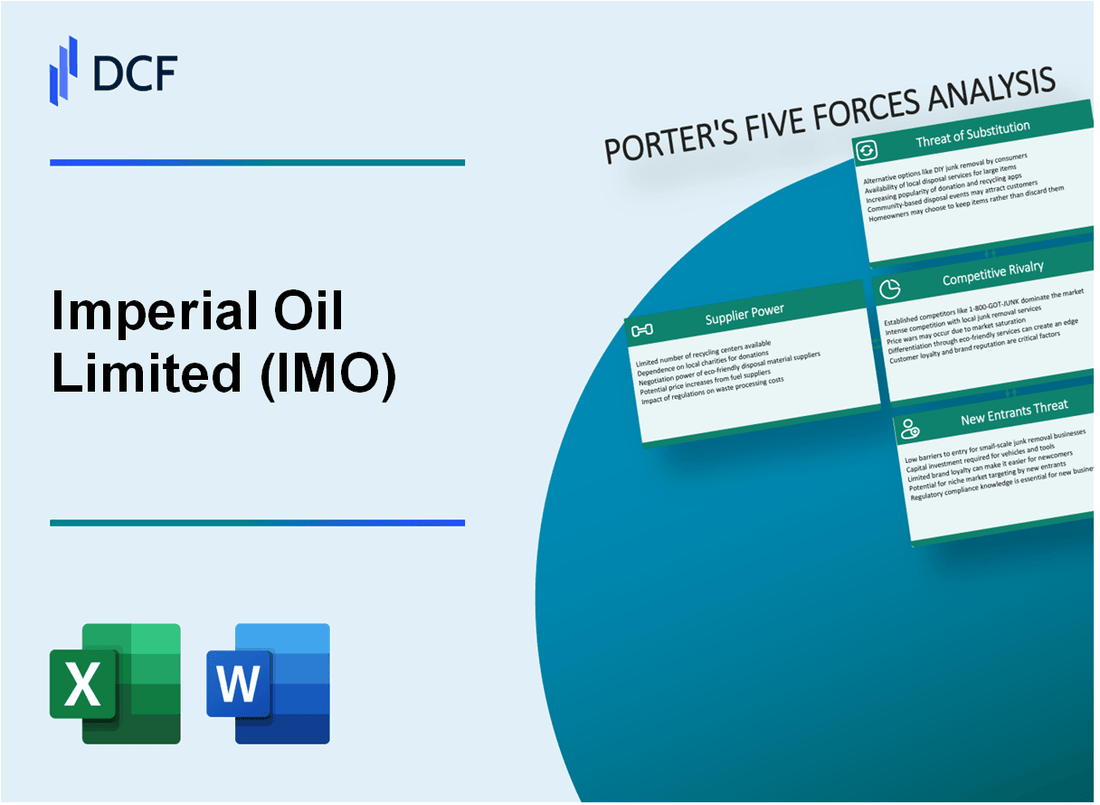
Imperial Oil Limited (IMO): 5 Forces Analysis [Jan-2025 Mis à jour] |
Entièrement Modifiable: Adapté À Vos Besoins Dans Excel Ou Sheets
Conception Professionnelle: Modèles Fiables Et Conformes Aux Normes Du Secteur
Pré-Construits Pour Une Utilisation Rapide Et Efficace
Compatible MAC/PC, entièrement débloqué
Aucune Expertise N'Est Requise; Facile À Suivre
Imperial Oil Limited (IMO) Bundle
Dans le paysage dynamique de l'énergie canadienne, Imperial Oil Limited (IMO) navigue dans un écosystème complexe de forces du marché qui façonnent son positionnement stratégique. En tant qu'acteur central dans le secteur du pétrole, l'entreprise est confrontée à des défis complexes des fournisseurs, des clients, des concurrents, des perturbations technologiques et des participants potentiels. Cette analyse de plongée profonde explore la dynamique stratégique en utilisant le célèbre cadre de cinq forces de Michael Porter, révélant les pressions concurrentielles nuancées qui définissent la résilience opérationnelle d'Imperial Oil et le potentiel futur dans un marché de l'énergie de plus en plus transformateur.
Imperial Oil Limited (OMI) - Five Forces de Porter: Pouvoir de négociation des fournisseurs
Paysage des fournisseurs d'équipement et de technologie majeurs
Dans l'industrie pétrolière et gazière, Imperial Oil Limited fait face à un marché des fournisseurs concentrés avec des fournisseurs clés:
| Catégorie des fournisseurs | Nombre de principaux fournisseurs | Concentration du marché |
|---|---|---|
| Équipement de forage | 4-6 fabricants mondiaux | 87% de part de marché |
| Technologie d'extraction | 3-5 fournisseurs spécialisés | Contrôle du marché à 92% |
| Systèmes avancés d'ingénierie du pétrole | 2-3 entreprises internationales | Dominance du marché de 79% |
Facteurs de dépendance aux fournisseurs
Dépendances critiques des infrastructures:
- Coût spécialisé de l'équipement de forage: 2,3 millions de dollars à 5,7 millions de dollars par unité
- Investissements de technologie d'extraction avancée: 4,1 millions de dollars à 8,6 millions de dollars par système
- Dépenses de remplacement des composants technologiques: 750 000 $ à 1,9 million de dollars
Analyse des coûts de commutation
| Composant d'infrastructure | Coût de remplacement | Estimation des temps d'arrêt |
|---|---|---|
| Technologie de plate-forme de forage | 6,2 millions de dollars | 4-6 mois |
| Système d'extraction | 5,9 millions de dollars | 3-5 mois |
| Logiciel de génie pétrolier | 3,4 millions de dollars | 2-3 mois |
Exigences d'investissement en capital
Répartition des investissements de transition des fournisseurs:
- Total des dépenses en capital pour la transition des fournisseurs: 15,7 millions de dollars
- Coûts de mise à niveau des infrastructures technologiques annuelles: 3,2 millions de dollars
- Attribution de la recherche et du développement pour la diversification des fournisseurs: 2,6 millions de dollars
Imperial Oil Limited (OMI) - Five Forces de Porter: Pouvoir de négociation des clients
De grands clients industriels et commerciaux avec un pouvoir d'achat important
Imperial Oil Limited dessert les principaux clients ayant des exigences en volume substantielles:
| Segment de clientèle | Consommation annuelle de produits pétroliers | Part de marché |
|---|---|---|
| Secteur des transports | 45,2 millions de mètres cubes | 27.6% |
| Industries manufacturières | 22,7 millions de mètres cubes | 16.3% |
| Services énergétiques | 18,5 millions de mètres cubes | 12.9% |
Produits de pétrole raffiné sur le marché de l'énergie concurrentielle
Dynamique de la concurrence du marché:
- 5 principaux fournisseurs de pétrole sur le marché canadien
- Part de marché d'Imperial Oil: 19,4%
- Différenciation moyenne des prix: ± 3,2%
Sensibilité aux prix due aux fluctuations mondiales des prix du pétrole
Impact de la volatilité des prix:
| Année | Écart de prix du pétrole brut | Taux de commutation client |
|---|---|---|
| 2022 | 89,50 $ / baril | 7.3% |
| 2023 | 76,25 $ / baril | 5.9% |
Base de clients diversifiés dans les secteurs
Répartition de la segmentation du client:
- Transport: 42.5% de la clientèle totale
- Fabrication: 33.7% de la clientèle totale
- Secteur de l'énergie: 23.8% de la clientèle totale
Imperial Oil Limited (OMI) - Five Forces de Porter: Rivalité compétitive
Paysage concurrentiel du marché
Imperial Oil Limited fait face à une concurrence intense dans le secteur du pétrole canadien avec des rivaux clés:
| Concurrent | Capitalisation boursière | Revenus annuels |
|---|---|---|
| Énergie solaire | 59,4 milliards de dollars | 47,8 milliards de dollars |
| Ressources naturelles canadiennes | 63,2 milliards de dollars | 42,6 milliards de dollars |
| Imperial Oil Limited | 36,7 milliards de dollars | 31,2 milliards de dollars |
Dynamique compétitive
Intensité compétitive dans le secteur de l'énergie canadien caractérisé par:
- Exigences élevées en matière de dépenses en capital
- Investissements technologiques sur l'innovation
- Environnement réglementaire complexe
- Fluctuant les prix mondiaux du pétrole
Analyse des parts de marché
| Entreprise | Part de marché du pétrole canadien |
|---|---|
| Énergie solaire | 22.5% |
| Ressources naturelles canadiennes | 19.3% |
| Imperial Oil Limited | 16.7% |
Métriques de performance opérationnelle
Indicateurs de performance concurrentiels clés:
- Production en amont d'Imperial Oil: 397 000 barils par jour
- Dépenses de recherche et de développement: 284 millions de dollars par an
- Ratio d'efficacité opérationnelle: 82,3%
Imperial Oil Limited (OMI) - Five Forces de Porter: menace de substituts
Augmentation des alternatives d'énergie renouvelable
La capacité mondiale des énergies renouvelables a atteint 2 799 GW en 2022, avec l'énergie solaire et éolienne représentant 1 495 GW de capacité totale. L'investissement en énergies renouvelables a totalisé 495 milliards de dollars en 2022, indiquant une dynamique de marché importante.
| Source d'énergie | Capacité mondiale (GW) | Année |
|---|---|---|
| Énergie solaire | 1,185 | 2022 |
| Énergie éolienne | 310 | 2022 |
Adoption des véhicules électriques
Les ventes mondiales de véhicules électriques ont atteint 10,5 millions d'unités en 2022, ce qui représente 13% du total des ventes de véhicules. La part de marché de l'EV projetée devrait atteindre 18% d'ici 2025.
- Croissance mondiale des ventes de véhicules électriques: 55% en glissement annuel en 2022
- Valeur marchande projetée EV: 957 milliards de dollars d'ici 2028
Paysage politique du gouvernement
Les gouvernements du monde entier ont engagé 1,3 billion de dollars à des politiques de transition énergétique propres en 2022. Les mécanismes de tarification du carbone couvrent 23% des émissions mondiales de gaz à effet de serre.
Technologies alternatives émergentes
| Technologie | Investissement mondial | Taille du marché prévu d'ici 2030 |
|---|---|---|
| Hydrogène | 11,5 milliards de dollars (2022) | 72 milliards de dollars |
| Biocarburants | 8,3 milliards de dollars (2022) | 46,5 milliards de dollars |
Imperial Oil Limited (OMI) - Five Forces de Porter: menace de nouveaux entrants
Exigences de capital élevé pour l'exploration et la production du pétrole et du gaz
Imperial Oil Limited fait face à des obstacles importants aux nouveaux entrants grâce à des exigences d'investissement en capital substantielles. En 2023, le projet moyen en amont en amont en amont et en amont nécessite environ 500 millions de CAD à 1,5 milliard de dépenses en capital initiales.
| Catégorie d'investissement en capital | Gamme de coûts estimés (CAO) |
|---|---|
| Forage d'exploration | 50 à 150 millions de dollars par puits |
| Infrastructure de production | 300 à 800 millions de dollars |
| Configuration de la conformité environnementale | 50 à 100 millions de dollars |
Environnement réglementaire complexe dans le secteur de l'énergie canadien
Le paysage de la réglementation énergétique canadienne présente des obstacles à l'entrée substantielles pour les nouveaux concurrents.
- Le processus d'approbation du Conseil national de l'énergie prend 18 à 36 mois
- Les exigences d'évaluation environnementale peuvent coûter 5 à 15 millions de dollars
- Les processus de consultation autochtones obligent des investissements supplémentaires
Barrières technologiques et infrastructures
La complexité technologique nécessite des investissements importants dans des équipements et une expertise spécialisés.
| Catégorie de technologie | Investissement estimé |
|---|---|
| Technologie d'imagerie sismique | 10-25 millions de dollars |
| Technologie d'extraction | 75 à 200 millions de dollars |
| Systèmes de surveillance numérique | 15-50 millions de dollars |
Économies d'échelle établies
Les sociétés pétrolières intégrées existantes comme Imperial Oil présentent des avantages de coûts importants.
- Efficacité de production de 85 à 90% par rapport aux nouveaux participants
- Avantage de coût de production par baril de 5 à 12 $
- Infrastructures de pipeline et de transport existantes évaluées à des milliards
Imperial Oil Limited (IMO) - Porter's Five Forces: Competitive rivalry
The rivalry within the Canadian integrated energy space is sharp, especially among the major players. You see this intensity when you look at the sheer scale of production these companies are pushing out, even with volatile commodity prices. For instance, in the third quarter of 2025, Imperial Oil Limited achieved its highest quarterly output in over three decades at 462,000 gross oil-equivalent barrels per day (boepd).
This drive for volume is a direct response to the high fixed costs inherent in oil sands operations; you have to run hard to cover those costs, which naturally escalates the fight for market share. To give you a sense of the competition you are up against, consider the Q3 2025 upstream production figures for the key integrated rivals:
| Company | Q3 2025 Upstream Production (boe/d) | Key Asset Production Highlight |
| Imperial Oil Limited (IMO) | 462,000 gross boepd | Kearl: 316,000 gross bpd |
| Suncor Energy (SU) | 870,000 bbls/d | Net SCO Production: 544,100 bbls/d |
| Cenovus Energy (CVE) | 832,900 boe/d | Oil Sands Segment: 642,800 boe/d |
The pressure to maintain and grow production is clear when you see competitors like Suncor Energy reporting 870,000 bbls/d and Cenovus Energy reporting 832,900 boe/d in the same period. Imperial Oil Limited's own Kearl project was a standout, hitting a record 316,000 barrels per day gross output in Q3 2025.
The completion of major export infrastructure, like the Trans Mountain Expansion (TMX), is a double-edged sword. It helps with price realization-meaning better netbacks for every barrel sold-but it also opens the door to more direct competition for global market access, intensifying the rivalry beyond just Canadian buyers. The WTI benchmark averaged $64.97 per barrel in Q3 2025, showing that even with better egress, the underlying commodity price environment still dictates profitability.
To counter these competitive pressures and the market volatility, Imperial Oil Limited is actively sharpening its cost structure. You've seen the announcement regarding a significant restructuring effort aimed at efficiency gains.
- Targeted annual expense reduction: $150 million.
- Timeline for achieving savings: By 2028.
- Workforce impact: Planning to cut about 20% of its workforce by the end of 2027.
- Restructuring charge taken in Q3 2025: Approximately $330 million before tax.
Honestly, that $150 million savings target is about 3% of their operating profits at the time of the announcement, so while the workforce reduction sounds large, the direct bottom-line impact is measured, but it signals a clear intent to compete on cost, which is defintely necessary in this crowded field. Finance: draft 13-week cash view by Friday.
Imperial Oil Limited (IMO) - Porter's Five Forces: Threat of substitutes
The threat of substitutes for Imperial Oil Limited's core products-refined fuels-is high and accelerating, driven by the global energy transition toward low-carbon alternatives. This shift fundamentally challenges the long-term viability of conventional hydrocarbon assets.
The scale of the substitution risk is stark when viewed against global climate targets. To maintain a 50 percent chance of limiting global warming to 1.5 degrees Celsius above preindustrial levels, an estimated 60% of global oil and gas reserves must remain unextracted by 2050. This implies that a significant portion of the industry's resource base, which underpins Imperial Oil Limited's valuation, faces obsolescence due to the rise of cleaner substitutes like electric vehicles and renewable fuels.
Financial estimates reflect this looming pressure. One analysis suggests the transition to a low-carbon economy has the potential to leave assets worth $2.3 trillion stranded by the end of the next decade. Furthermore, continued investment in carbon-intensive industries could put as much as $557 trillion of global capital at risk by 2050 under a scenario where the net-zero transition is delayed.
Imperial Oil Limited is actively mitigating this threat by integrating lower-carbon offerings into its portfolio. A key action is the commissioning of Canada's largest renewable diesel facility at its Strathcona refinery, with construction completed in the second quarter (Q2) of 2025. Once fully operational, this facility is projected to produce more than 1 billion liters (approximately 264.17 million gallons) of renewable diesel annually.
Government policies and carbon pricing mechanisms directly influence the cost-competitiveness of these substitutes versus Imperial Oil Limited's traditional offerings. While the federal consumer carbon tax, which added 17.6 cents per litre to gasoline as of March 31, 2025, has been ended by the new administration, the industrial carbon pricing system, specifically the Output-Based Pricing System (OBPS), remains a critical tool for driving decarbonization in the industrial sector. This industrial pricing, along with other regulations, increases the operating cost for high-emission processes, thereby improving the relative cost-competitiveness of lower-carbon substitutes like the renewable diesel Imperial Oil Limited is now producing.
Here's a quick look at how the threat level compares to Imperial Oil Limited's direct response:
| Threat Factor | Metric/Data Point | Imperial Oil Limited Mitigation/Response | Metric/Data Point |
|---|---|---|---|
| Reserve Viability Risk (1.5°C Scenario) | 60% of global oil and gas reserves must remain unextracted by 2050 | Strathcona Renewable Diesel Facility Annual Capacity | Over 1 billion liters |
| Potential Financial Stranding (Next Decade) | $2.3 trillion in assets at risk | Strathcona Renewable Diesel Facility Production Rate | 20,000 barrels per day complex |
| Policy Impact (Removed Consumer Cost) | Consumer carbon tax added 17.6 cents/litre to gasoline (as of March 31, 2025) | Projected Operational Status | Construction complete in Q2 2025, operations starting mid-year |
The ongoing evolution of the energy landscape means that Imperial Oil Limited must continue to pivot capital allocation toward these lower-carbon solutions to offset the structural decline in demand for its legacy products. The success of the Strathcona ramp-up is defintely key to managing this specific competitive force.
- Global oil and gas production needs to decrease by at least 65% between 2020 and 2050 under 1.5°C scenarios.
- The industrial carbon tax remains a key market-based instrument in Canada.
- Imperial Oil Limited's 2025 plan includes developing its lower-carbon product offering.
- The company is confident in robust margin uplift from the renewable diesel ramp-up.
Finance: draft 13-week cash view by Friday.
Imperial Oil Limited (IMO) - Porter's Five Forces: Threat of new entrants
The threat of new entrants into the Canadian oil sands and major refining sectors, where Imperial Oil Limited operates, remains decidedly low. This is primarily due to the sheer scale of investment required to even begin competing at a meaningful level.
You are looking at capital requirements that are staggering, effectively locking out smaller players. Building a major oil sands mine, for instance, demands a commitment measured in tens of billions of dollars over many years before a single barrel is sold. Consider the Kearl Oil Sands Project, which Imperial Oil operates; the initial development cost was reported at $12.9 billion, with the subsequent expansion phase costing an additional $8.9 billion, for a cumulative development cost nearing $21.8 billion. Even more recent proposed projects, like the Mildred Lake Oil Sands project, are estimated at $3.3 billion. To put this in industry context, the entire oil sands sector's base case capital expenditure forecast for 2025 is Cdn$14.6 billion.
The financial barriers are compounded by significant regulatory and logistical hurdles. New entrants face long, uncertain lead times for securing the necessary environmental and operational permits from various federal and provincial bodies. While the government established a Major Projects Office (MPO) to streamline approvals, the political sensitivity surrounding large-scale energy infrastructure means that the path to final investment decisions is fraught with potential delays and public opposition.
Securing access to specialized technology and, critically, transportation infrastructure presents another formidable barrier. The existing export capacity is already tight, meaning a new major producer must compete for space on already constrained systems. As of late 2025, Canada's total oil export capacity sits around 5.2 million barrels per day (bpd), while production is projected to hit 3.5 million bpd in 2025. Although the Trans Mountain Expansion increased system capacity by adding 590,000 bpd, analysts suggest all takeaway capacity could become constrained again by the third quarter of 2028. New entrants would need to secure capacity on these systems or fund entirely new, multi-billion dollar greenfield pipelines, which themselves face the same regulatory gauntlet.
Here is a comparison illustrating the scale of investment in the sector:
| Project Type/Metric | Estimated Capital Cost / Value | Status/Context |
|---|---|---|
| Kearl Oil Sands (Initial + Expansion) | $21.8 billion | Historical benchmark for a major oil sands mine |
| Mildred Lake Oil Sands (Proposed) | $3.3 billion | Example of a large proposed project |
| Oil Sands Sector Forecasted CapEx (2025) | Cdn$14.6 billion | Base case forecast for the entire sector |
| Trans Mountain Expansion Capacity Increase | 590,000 bpd | Capacity added to the system |
| Total Canadian Oil Export Capacity (Estimate) | 5.2 million bpd | Current system ceiling |
The industry trend itself favors acquisitions over greenfield development, precisely because of these high entry costs. Producers are finding it more financially sound to buy existing assets, which have lower breakeven costs, often below $50 per barrel WTI, rather than developing new sites where breakeven costs average $57 per barrel and can reach $75 per barrel.
The barriers to entry for a new competitor are substantial:
- Massive upfront capital for oil sands or refinery construction.
- Lengthy, politically charged regulatory and permitting processes.
- Difficulty securing firm, long-term capacity on existing pipelines.
- Need for proprietary, specialized extraction and processing technology.
Finance: finalize the sensitivity analysis on IMO's 2026 CapEx budget by Tuesday.
Disclaimer
All information, articles, and product details provided on this website are for general informational and educational purposes only. We do not claim any ownership over, nor do we intend to infringe upon, any trademarks, copyrights, logos, brand names, or other intellectual property mentioned or depicted on this site. Such intellectual property remains the property of its respective owners, and any references here are made solely for identification or informational purposes, without implying any affiliation, endorsement, or partnership.
We make no representations or warranties, express or implied, regarding the accuracy, completeness, or suitability of any content or products presented. Nothing on this website should be construed as legal, tax, investment, financial, medical, or other professional advice. In addition, no part of this site—including articles or product references—constitutes a solicitation, recommendation, endorsement, advertisement, or offer to buy or sell any securities, franchises, or other financial instruments, particularly in jurisdictions where such activity would be unlawful.
All content is of a general nature and may not address the specific circumstances of any individual or entity. It is not a substitute for professional advice or services. Any actions you take based on the information provided here are strictly at your own risk. You accept full responsibility for any decisions or outcomes arising from your use of this website and agree to release us from any liability in connection with your use of, or reliance upon, the content or products found herein.