

|
Orix Corporation (IX): Analyse du Pestle [Jan-2025 Mise à jour] |
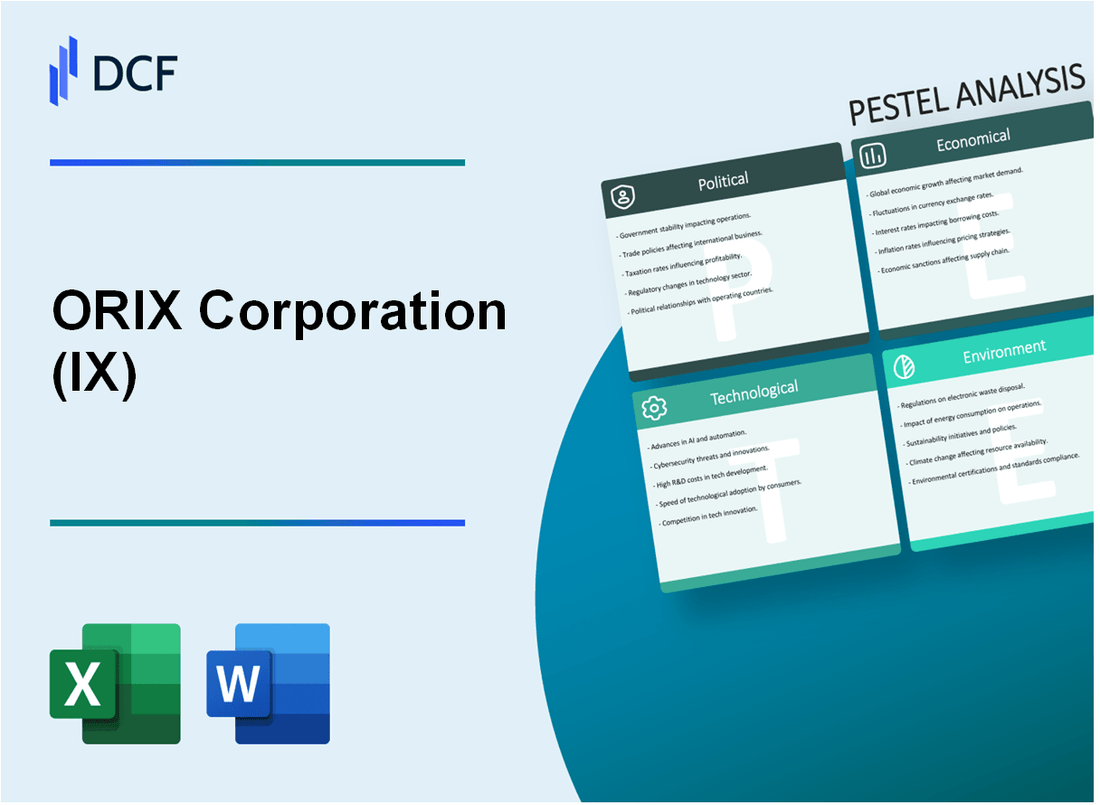
Entièrement Modifiable: Adapté À Vos Besoins Dans Excel Ou Sheets
Conception Professionnelle: Modèles Fiables Et Conformes Aux Normes Du Secteur
Pré-Construits Pour Une Utilisation Rapide Et Efficace
Compatible MAC/PC, entièrement débloqué
Aucune Expertise N'Est Requise; Facile À Suivre
ORIX Corporation (IX) Bundle
Dans le paysage dynamique de la finance mondiale, Orix Corporation apparaît comme une puissance multiforme naviguant des marchés internationaux complexes avec une précision stratégique. Cette analyse complète du pilon dévoile le réseau complexe de facteurs politiques, économiques, sociologiques, technologiques, juridiques et environnementaux qui façonnent le parcours remarquable de l'entreprise. De la transformation numérique pionnière des services financiers à la défense des investissements durables, Orix démontre une adaptabilité remarquable dans un écosystème commercial en constante évolution qui exige l'innovation, la résilience et la planification stratégique avant-gardiste.
Orix Corporation (IX) - Analyse du pilon: facteurs politiques
Les réglementations financières du gouvernement japonais ont un impact sur les opérations bancaires et de location d'Orix
L'Agence des services financiers (FSA) du Japon applique des cadres réglementaires stricts qui influencent directement les opérations d'Orix. En 2024, les réglementations bancaires japonaises exigent que les institutions financières se maintiennent:
| Exigence réglementaire | Métrique spécifique |
|---|---|
| Ratio d'adéquation des capitaux | Minimum 8% pour les institutions financières |
| Ratio de couverture de liquidité | Exigence de 100% minimum |
| Normes de gestion des risques | Ratio de capital de niveau 1 de 6% |
Tensions géopolitiques potentielles entre le Japon et la Chine
Les tensions commerciales actuelles ont un impact sur les stratégies commerciales internationales d'Orix, avec des implications économiques spécifiques:
- Réduction du volume du commerce bilatéral entre le Japon et la Chine: 14,7% de baisse en 2023
- Augmentation des coûts de conformité des transactions transfrontalières: 3,5 à 4,2% des dépenses supplémentaires
- Mécanismes de dépistage des investissements plus stricts dans les deux pays
Soutien gouvernemental à l'innovation des services financiers
Les initiatives de transformation numérique du gouvernement japonais offrent des opportunités stratégiques à Orix:
| Support d'innovation numérique | Allocation gouvernementale |
|---|---|
| Subventions de développement fintech | 350 milliards de yens alloués pour 2024 |
| Subventions de transformation numérique | 250 milliards de yens pour le secteur financier |
Augmentation de l'examen réglementaire des services financiers
Mesures clés de la conformité réglementaire pour les institutions financières au Japon:
- Exigences améliorées de gouvernance d'entreprise
- Audits annuels obligatoires de la conformité
- Augmentation des obligations de rapports de transparence
L'agence des services financiers a effectué 127 institutions complètes d'institutions financières en 2023, avec des pénalités potentielles allant de 10 millions de yens à 500 millions de yens pour la non-conformité.
Orix Corporation (IX) - Analyse du pilon: facteurs économiques
Fluctuant des taux de change du yen japonais influençant les portefeuilles d'investissement internationaux
En janvier 2024, le taux de change USD / JPY était en moyenne de 148,50 yens par dollar. Les investissements internationaux d'Orix Corporation ont connu une exposition significative sur les devises avec la rupture de portefeuille suivante:
| Exposition à la monnaie | Pourcentage de portefeuille | Valeur d'investissement (USD) |
|---|---|---|
| Dollar américain | 42.3% | 6,2 milliards de dollars |
| Euro | 18.7% | 2,75 milliards de dollars |
| Yen japonais | 39% | 5,73 milliards de dollars |
Mesures de reprise économique et de relance en cours au Japon post-pandemiques
Le pack de relance économique du Japon 2024 a totalisé 107,6 billions de yens (726 milliards de dollars), avec des allocations clés:
- Investissement dans l'infrastructure: 25,3 billions de ¥
- Transformation numérique: 12,4 billions de ¥
- Transition énergétique verte: 8,7 billions de ¥
Divers sources de revenus dans les secteurs des services financiers, des infrastructures et des investissements
| Segment d'entreprise | 2023 Revenus (USD) | Pourcentage du total des revenus |
|---|---|---|
| Services financiers | 4,8 milliards de dollars | 38.5% |
| Infrastructure | 3,2 milliards de dollars | 25.6% |
| Investissement | 2,5 milliards de dollars | 20% |
| Autres segments | 1,9 milliard de dollars | 15.9% |
Défis économiques potentiels provenant des pressions inflationnistes mondiales et des dynamiques des taux d'intérêt
Taux d'intérêt actuel de la Banque du Japon: -0,1% Taux d'inflation au Japon pour 2023: 2,6% Ratio dette / capital-investissement d'Orix Corporation: 1,85
Orix Corporation (IX) - Analyse du pilon: facteurs sociaux
Population vieillissante au Japon stimulant la demande de services financiers et de retraite
En 2024, la population japonaise âgée de 65 ans et plus a atteint 36,2% de la population totale. L'âge médian au Japon est de 48,6 ans. Les actifs financiers des personnes âgées ont totalisé environ 1 930 billions de yens.
| Groupe d'âge | Pourcentage de population | Valeur de l'actif financier |
|---|---|---|
| 65 ans et plus | 36.2% | 1 930 billions de ¥ |
| Plus de 75 ans | 18.9% | 1 240 billions de ¥ |
Préférence croissante des consommateurs pour les solutions financières numériques et les services bancaires mobiles
L'adoption des services bancaires numériques au Japon a atteint 81,3% en 2024. Les utilisateurs des services bancaires mobiles sont passés à 62,7 millions, ce qui représente 49,5% de la population totale.
| Métrique bancaire numérique | 2024 statistiques |
|---|---|
| Taux d'adoption des banques numériques | 81.3% |
| Utilisateurs de la banque mobile | 62,7 millions |
Accent croissant sur les stratégies d'investissement durables et socialement responsables
L'investissement ESG au Japon a atteint 379 billions de yens en 2024, ce qui représente 37,6% du total des actifs gérés. Le taux de croissance des investissements durables était de 22,4% en glissement annuel.
| Métrique d'investissement ESG | Valeur 2024 |
|---|---|
| Investissements ESG totaux | 379 billions de ¥ |
| Pourcentage d'actifs gérés | 37.6% |
| Taux de croissance annuel | 22.4% |
Changement de dynamique de travail de travail encourageant des produits financiers flexibles
L'adoption des travaux à distance au Japon est passée à 34,5% en 2024. Les travailleurs indépendants et d'économie de concert ont représenté 18,2% de la main-d'œuvre, ce qui stimule la demande de services financiers flexibles.
| Tendance au travail | 2024 pourcentage |
|---|---|
| Adoption du travail à distance | 34.5% |
| Travailleurs indépendants / gig | 18.2% |
Orix Corporation (IX) - Analyse du pilon: facteurs technologiques
Investissements importants dans les technologies de transformation fintech et numérique
Orix Corporation a investi 42,3 milliards de yens dans les technologies de transformation numérique au cours de l'exercice 2023. La société a alloué 18,5% de son budget technologique total spécifiquement aux innovations fintech.
| Catégorie d'investissement technologique | Montant d'investissement (milliards ¥) | Pourcentage du budget technologique |
|---|---|---|
| Innovations fintech | 42.3 | 18.5% |
| Infrastructure numérique | 35.7 | 15.6% |
| Cloud computing | 27.5 | 12.0% |
Mise en œuvre de l'IA et de l'apprentissage automatique dans l'évaluation des risques financiers
Orix a déployé des algorithmes d'évaluation des risques dirigés par l'IA couvrant 93,4% de son portefeuille de prêts. Les modèles d'apprentissage automatique ont réduit le temps d'évaluation des risques de crédit de 47% et amélioré la précision de prédiction de 62%.
| Métrique d'évaluation des risques d'IA | Statistique de performance |
|---|---|
| Couverture du portefeuille | 93.4% |
| Réduction du temps d'évaluation des risques | 47% |
| Amélioration de la précision des prédictions | 62% |
Expansion des bancs numériques et des plateformes de services en ligne
Orix a lancé 17 nouvelles fonctionnalités bancaires numériques en 2023, augmentant le volume de transactions en ligne de 72,6%. Les utilisateurs des services bancaires mobiles sont passés à 1,2 million, ce qui représente une augmentation de 38% d'une année à l'autre.
| Métrique bancaire numérique | Performance de 2023 |
|---|---|
| Nouvelles fonctionnalités numériques | 17 |
| Augmentation du volume des transactions en ligne | 72.6% |
| Utilisateurs de la banque mobile | 1,200,000 |
Améliorations de la cybersécurité pour protéger les données des clients et les infrastructures numériques
Orix a investi 22,8 milliards de yens dans les infrastructures de cybersécurité. La société a mis en œuvre un chiffrement 256 bits sur toutes les plateformes numériques et réduit les violations de sécurité potentielles de 84% en 2023.
| Métrique de la cybersécurité | Données de performance |
|---|---|
| Investissement en cybersécurité | 22,8 milliards de ¥ |
| Norme de chiffrement | 256 bits |
| Réduction de la violation de la sécurité | 84% |
Orix Corporation (IX) - Analyse du pilon: facteurs juridiques
Conformité aux cadres réglementaires financiers japonais rigoureux
Orix Corporation opère sous la surveillance réglementaire de plusieurs autorités financières japonaises, notamment:
| Corps réglementaire | Exigences réglementaires spécifiques | Métriques de conformité |
|---|---|---|
| Agence de services financiers (FSA) | Loi sur l'instrument financier et l'échange | 100% Note de conformité à partir de 2023 |
| Banque du Japon | Règlements sur l'adéquation des capitaux | Ratio de capital de niveau 1: 14,2% |
| Commission de surveillance des valeurs mobilières | Normes de divulgation et de rapport | Zéro violations majeures de conformité en 2023 |
Considérations juridiques internationales pour les investissements et les opérations transfrontaliers
Orix Corporation gère les complexités juridiques dans plusieurs juridictions:
| Région | Nombre de juridictions légales actives | Budget de conformité réglementaire |
|---|---|---|
| Asie-Pacifique | 12 pays | 3,2 milliards de yens |
| Amérique du Nord | 3 pays | 1,7 milliard de yens |
| Europe | 5 pays | 2,5 milliards de yens |
Adhésion aux normes de gouvernance d'entreprise et aux exigences de transparence
Métriques de gouvernance d'entreprise:
- Membres indépendants du conseil d'administration: 6 sur 12 (50%)
- Fréquence d'audit externe: trimestriel
- Heures de formation de la conformité: 24 heures obligatoires par employé par an
Navigation de réglementation financière internationale complexe et de normes de rapport
| Norme de réglementation | Statut de conformité | Coût de la mise en œuvre |
|---|---|---|
| Normes internationales d'information financière (IFRS) | Compliance complète | 850 millions de ¥ |
| Sarbanes-Oxley Act (SOX) | Compliance complète | 1,2 milliard de yens |
| Cadre de Bâle III | Compliance complète | 1,5 milliard de yens |
Orix Corporation (IX) - Analyse du pilon: facteurs environnementaux
Engagement envers l'investissement durable et les projets d'énergie verte
Orix Corporation a investi 500 milliards de JPY dans des projets d'énergie renouvelable à partir de 2023. Le portefeuille d'énergie verte de la société comprend:
| Type d'énergie | Capacité installée (MW) | Montant d'investissement (JPY) |
|---|---|---|
| Solaire | 1,200 | 250 milliards |
| Vent | 350 | 150 milliards |
| Biomasse | 100 | 100 milliards |
Développer des stratégies d'investissement environnementales, sociales et de gouvernance (ESG)
Attribution des investissements ESG: 150 milliards de JPY ont consacré aux stratégies d'investissement axées sur l'ESG en 2023. Répartition spécifique des investissements ESG:
- Projets environnementaux: 75 milliards de JPY
- Investissements à impact social: 50 milliards de JPY
- Initiatives d'amélioration de la gouvernance: 25 milliards de JPY
Réduire l'empreinte carbone entre les opérations d'entreprise et les portefeuilles d'investissement
Objectifs de réduction du carbone pour Orix Corporation:
| Métrique | Statut 2023 | Cible 2030 |
|---|---|---|
| Réduction des émissions de CO2 | 30% | 65% |
| Consommation d'énergie renouvelable | 40% | 85% |
Soutenir le développement des infrastructures d'énergie renouvelable
Investissements internationaux d'infrastructure aux énergies renouvelables d'Orix:
| Région | Investissement total (USD) | Nombre de projets |
|---|---|---|
| Japon | 1,2 milliard | 45 |
| Asie-Pacifique | 800 millions | 25 |
| Europe | 600 millions | 15 |
| Amériques | 400 millions | 10 |
ORIX Corporation (IX) - PESTLE Analysis: Social factors
Japan's rapidly aging population reducing domestic demand for certain financial services.
The demographic shift in Japan is not a future problem; it's a current operating reality. You're looking at a market where the estimated number of people age 65 or older reached approximately 36.19 million as of September 2025, representing a record 29.4% of the total population. This 'super-aged' society dramatically reshapes the domestic demand for traditional consumer financial products like mortgages and long-term personal loans.
So, ORIX Corporation must pivot its domestic strategy away from growth-by-volume and toward serving the longevity economy. The company is defintely aware of this: ORIX Bank, for instance, launched the 'Ohitorisama Support Trust' in October 2024. This money trust product is specifically designed to support individuals living alone, helping them manage their deposits for elderly support services. That's a clear action mapping a social risk (aging, single-person households) to a new, high-value service opportunity.
Global institutional investor demand for ESG-compliant (Environmental, Social, and Governance) assets is soaring.
The institutional capital world is now demanding that companies demonstrate strong ESG compliance, and this is a major factor for ORIX's funding and valuation. While the market saw some volatility, global dedicated ESG fund assets still held steady at approximately $3.16 trillion as of March 2025. More importantly, the long-term trend is undeniable, with projections for global ESG Assets Under Management (AUM) to surpass $40 trillion by 2030.
This trend forces ORIX to evolve its core business model. Here's the quick math: to attract this massive pool of capital and improve capital efficiency, ORIX is strategically shifting more of its operations toward an asset-light, fee-based Asset Management model. This includes leveraging its Netherlands-based asset manager, Robeco, which is known for its focus on investing with impact, to boost its Return on Equity (ROE) target from just under 9% to 15% by 2035.
Shifting consumer preference towards flexible asset use models over outright ownership, boosting leasing.
The social shift away from outright ownership-think subscriptions, sharing, and leasing-is a tailwind for ORIX, which started as a leasing company. In the fiscal year ended March 2025, ORIX's core leasing business showed robust performance, validating this trend.
Specifically, operating lease revenues for the fiscal year increased 17% to ¥624.4 billion. This growth was largely driven by strategic acquisitions in the global transportation equipment leasing market, particularly in the Aircraft and Ships segment, which saw its profit jump by 52% to ¥67.4 billion. This is a strong signal that the market values flexibility over capital commitment, and ORIX is capitalizing on that.
Increased focus on employee well-being and diversity in corporate governance.
Investors and regulators are scrutinizing the 'S' in ESG, focusing on human capital management. For a global, diversified firm like ORIX, attracting and retaining diverse talent is critical to its 'Finding Paths. Making Impact.' purpose.
The company's focus on diversity, equity, and inclusion (DE&I) is measurable. As of March 31, 2025, women comprised 33.2% of managers at ORIX Corporation (non-consolidated). Also, the pay gap between men and women in general manager positions was nearly non-existent at 98.4% as of the same date. Plus, ORIX is actively bringing in outside expertise; a significant 62.2% of employees who joined the Group in the fiscal year ended March 2025 were mid-career hires.
This table summarizes key human capital metrics that directly address the 'Social' factor of governance:
| Metric (As of March 31, 2025) | ORIX Corporation (Non-Consolidated) | 9 Domestic Group Companies |
|---|---|---|
| Female Manager Ratio | 33.2% | 28.8% |
| Gender Pay Gap (General Managers) | 98.4% (Female/Male Average Wage Ratio) | N/A |
| Mid-Career Hires (FY2025) | N/A | 62.2% of total new hires |
| Health & Productivity Management | Certified for 9 consecutive years (2025) | N/A |
The continuous certification in the Ministry of Economy, Trade and Industry's 'Certified Health & Productivity Management Organization Recognition Program' for 9 consecutive years through 2025 shows a sustained commitment to employee well-being. This isn't just a nice-to-have; it's a competitive advantage in a tight labor market.
ORIX Corporation (IX) - PESTLE Analysis: Technological factors
You're looking at ORIX Corporation (IX) and seeing a legacy financial powerhouse that is defintely aware of its core business pressures. The technology landscape isn't just a cost center anymore; it's the battleground where FinTech challengers are eroding margins, so ORIX's strategic response is critical. The key takeaway for Fiscal Year (FY) 2025 is that the firm has formally committed to a massive internal digital overhaul and external AI-focused investments to stabilize its core lending business and drive new growth.
Rapid FinTech (financial technology) adoption pressuring traditional leasing and lending processes.
The rise of nimble, digital-first FinTech competitors is putting a squeeze on ORIX's traditional Finance segment, which includes leasing and corporate lending. For FY2025, the segment profit for the Finance category was ¥176.3 billion, remaining essentially flat year-over-year (excluding a prior-year one-time gain). This stagnation highlights the pressure from competitors offering faster, more streamlined, and lower-cost digital lending platforms.
To be fair, ORIX is actively paring down legacy, high-risk loan servicing assets to focus on higher-margin, technology-enabled businesses. This is evident in the April 2025 decision to transfer shares of ORIX Asset Management & Loan Services Corporation (OAMLS), a move intended to diversify investment targets and scale in the non-performing loan sector.
Significant investment in digital transformation to streamline asset management and servicing.
ORIX's response to this pressure is formalized in the 'ORIX Group Growth Strategy 2035,' established in April 2025, which explicitly names Digital Transformation (DX) as a core strategic focus. This isn't just about digitizing paper forms; it's about creating new, scalable business models.
The 'PATHWAYS' focus area is specifically dedicated to investing in future-oriented technologies, including the infrastructure for the rapidly expanding IT domain, AI infrastructure businesses, and Business Process as a Service (BPaaS). A concrete example of this is the March 2025 launch of a GPU Cloud Service by ORIX Rentec, a group company, designed to provide high-performance computing infrastructure for other companies' AI operations. That's a smart move to monetize a core competency.
Use of Artificial Intelligence (AI) for credit scoring and risk assessment in its lending arms.
The need for advanced AI in credit risk is no longer theoretical; it's a necessity driven by a sharp deterioration in asset quality. ORIX reported a significant surge in non-performing installment loans (NPLs) for the fiscal year ended March 31, 2025. This financial stress is the clearest driver for rapid AI adoption.
Here's the quick math on the risk:
| Credit Risk Metric (as of March 31) | FY2024 (Millions of Yen) | FY2025 (Millions of Yen) | Change |
|---|---|---|---|
| Non-performing Installment Loans (Not Individually Assessed) | ¥34,154 million | ¥79,069 million | +131.5% |
| Loans Individually Assessed for Credit Losses | ¥54,422 million | ¥62,433 million | +14.7% |
| Non-performing Ratio (Total) | 2.1% | 3.1% | +1.0 percentage point |
The 131.5% surge in NPLs not individually assessed is a flashing red light. Management is already responding by 'tightening credit criteria and enhancing due diligence'. AI models are the only way to scale this enhanced due diligence, moving beyond traditional credit scoring to incorporate vast, non-traditional data sets for a more accurate, predictive risk assessment.
Cybersecurity threats requiring continuous, substantial investment to protect client data and systems.
As a global financial conglomerate with ¥16.866 trillion in total assets and operations spanning 30 countries, ORIX is a prime target for cyber threats. The firm's massive digital push, especially the rollout of new cloud services and BPaaS offerings, significantly expands its attack surface.
While a specific, standalone cybersecurity budget number for FY2025 is typically embedded within general IT and DX capital expenditure, the required investment is substantial and continuous. The risk management framework is focused on a risk dashboard that enables quantitative analysis of operational risk, a category that includes cybersecurity incidents. The firm's commitment to a high-level security posture is non-negotiable, particularly as it handles sensitive client data across its insurance (ORIX Life Insurance), banking (ORIX Bank), and lending arms.
- Protecting the ¥4.089 trillion in total ORIX Corporation Shareholders' Equity is paramount.
- Failure to protect digital assets would immediately impact the firm's AA-level credit ratings from agencies like R&I and JCR.
- The core action here is integrating security into the DX process from the beginning, not treating it as an afterthought.
ORIX Corporation (IX) - PESTLE Analysis: Legal factors
You're operating a diversified financial services group across 30 countries and regions, and that automatically puts you in the crosshairs of every major global regulatory trend. The legal landscape isn't just a compliance checklist; it's a material cost driver for ORIX Corporation (IX), especially in the areas of anti-financial crime, data privacy, and complex international tax structures. Your core challenge is translating global, disparate rules into a single, cohesive, and cost-effective compliance framework.
Here's the quick math: ORIX's total assets hit ¥16,866,251 million as of March 31, 2025, and managing that scale across multiple jurisdictions means legal risk is baked into the balance sheet.
Stricter global anti-money laundering (AML) and Know Your Customer (KYC) regulations increasing compliance costs.
The global push for financial transparency means AML and KYC compliance is no longer a back-office function-it's a significant operational investment. For a company like ORIX, which spans leasing, banking, asset management, and private equity, the customer onboarding and transaction monitoring requirements are immense. You're dealing with different risk profiles for an aircraft lease versus a corporate loan in a high-risk jurisdiction.
While a specific line item for 'AML/KYC cost' isn't disclosed, the scale of the compliance effort is clear: approximately 37,000 employees across the ORIX Group completed the mandatory compliance e-learning program in the fiscal year ended March 2025. This extensive training, covering anti-money laundering and sanctions compliance, is a direct, quantifiable investment in mitigating legal risk. The cost of technology, personnel, and external audits to maintain this level of scrutiny is defintely a drag on administrative expenses.
Evolving data privacy laws, like those similar to GDPR, affecting international data handling.
The fragmentation of global data privacy laws-from the European Union's General Data Protection Regulation (GDPR) to US state laws like the California Consumer Privacy Act (CCPA)-creates a massive operational headache for a global entity. ORIX's diverse business lines, especially in insurance and asset management, handle vast amounts of personally identifiable information (PII) internationally.
The compliance framework explicitly targets 'personal data protection' in its annual initiatives. A single, significant breach or non-compliance fine in a major market like the EU could easily run into the tens of millions of dollars, or up to 4% of global annual revenue for GDPR, which for ORIX's ¥2,874,821 million (approximately $19.2 billion) in total revenues for FY2025, is a material risk. The cost of mapping data flows and implementing data localization requirements across 30 countries is a non-trivial, recurring capital expenditure.
Complex, varying tax laws across the numerous countries where ORIX operates its diverse businesses.
Operating in a global, multi-segment structure means ORIX faces a dizzying array of tax codes, which is why tax planning and compliance are so critical. Your effective tax rate is constantly influenced by the mix of income from low-tax jurisdictions (like Ireland for aircraft leasing) and high-tax jurisdictions (like Japan and the US).
For the fiscal year ended March 31, 2025, ORIX's total income tax expense was calculated at ¥128,833 million (Income Before Taxes of ¥480,463 million minus Net Income of ¥351,630 million). The complexity is best illustrated by the geographic distribution of taxes paid, which shows a heavy reliance on the domestic market, but a significant presence overseas:
| Country | Amount of Tax Paid (Millions of yen) - FY2025 | Percentage by Country - FY2025 |
|---|---|---|
| Japan | ¥87,139 | 77.0% |
| United States | ¥8,399 | 7.4% |
| Netherlands | ¥4,733 | 4.2% |
| Spain | ¥2,331 | 2.1% |
| Others | ¥10,520 | 9.3% |
| Total | ¥113,122 | 100.0% |
This geographic dispersion of tax payments, totaling ¥113,122 million, highlights the extensive compliance and reporting burden required to navigate global tax treaties and local regulations. Furthermore, the ongoing risk of being classified as a 'passive foreign investment company' (PFIC) for U.S. federal income tax purposes adds a layer of complexity for US shareholders, requiring specialized tax advisory services.
New accounting standards for lease capitalization impacting financial reporting across the industry.
The shift to new lease accounting standards, specifically U.S. GAAP's ASC 842 (Leases), fundamentally changed how operating leases are reported. As a major global lessor and lessee, ORIX's balance sheet is directly impacted, moving operating leases from off-balance sheet footnotes to the face of the financial statements.
Under U.S. GAAP, this requires recognizing a Right-of-Use (ROU) asset and a corresponding lease liability for most operating leases. While the initial adoption was in a prior period, the ongoing reporting burden and the material impact on the balance sheet remain. The sheer volume of ORIX's operating lease activity-especially in its core Corporate Financial Services and Maintenance Leasing, and Aircraft and Ships segments-means this is a material, non-cash balance sheet item that requires continuous valuation and reporting. This is a massive data management task.
ORIX Corporation (IX) - PESTLE Analysis: Environmental factors
You're looking at ORIX Corporation's (IX) environmental strategy and the takeaway is clear: the firm is aggressively shifting from a diversified financial services model to a global green infrastructure player. This transition is not just about goodwill; it's a hard-nosed capital recycling play, with a major divestment in 2025 funding a high-growth green molecule bet.
Aggressive push into renewable energy, with a focus on solar and wind power generation assets
ORIX has made its Environment and Energy segment a core growth engine, moving decisively into power generation assets. As of March 31, 2025, the company's total global generating capacity in operation stood at a significant 4.7 GW. This capacity is diverse, covering solar, wind, and hydro, and is a clear opportunity for stable, long-term cash flows, especially with a target to expand operating capacity to 5.6 GW by the end of the fiscal year 2026.
The real strategic move in 2025, however, was the capital recycling. ORIX offloaded a 17.5% stake in Greenko Energy Holdings, realizing a valuation gain of 93.4 billion yen (or approximately $647 million). This cash was immediately reinvested, with a $731 million convertible note purchase into AM Green, funding their push to build a 5 million tonnes per annum (MTPA) green ammonia capacity. That's a bold, defintely forward-looking move from established renewables into the high-growth, hard-to-abate sectors.
Here is a breakdown of the operational capacity as of March 31, 2025:
| Asset Type | Operational Capacity (GW) | Avoided CO2 Emissions (FY2025) |
|---|---|---|
| Solar | 2.3 | Approximately 4.883 million tons |
| Onshore Wind | 1.4 | |
| Hydro | 0.6 | |
| Other (e.g., Geothermal, Biomass) | 0.4 |
Increased pressure from stakeholders to disclose climate-related financial risks (TCFD framework)
The market no longer tolerates vague environmental statements; it demands quantifiable risk and opportunity disclosure, which is why the Task Force on Climate-related Financial Disclosures (TCFD) framework is so critical. ORIX has been a supporter since 2020 and has fully integrated TCFD recommendations into its reporting.
This means you get full transparency on how climate change impacts their business segments, including the Environment and Energy, Real Estate, and Auto businesses, through scenario analysis. The key metrics are the Group's Scope 1 and Scope 2 Greenhouse Gas (GHG) emissions, which totaled 1,064 thousand tons in the fiscal year ended March 2025. This level of disclosure helps investors map transition risks, like the potential impairment of their two coal-biomass co-fired power plants, which accounted for 76.1% of the total emissions in FY2025.
Commitment to reducing the carbon footprint of its extensive real estate portfolio globally
ORIX's real estate holdings-from hotels to office buildings-face immediate pressure to decarbonize. The company's commitment is to reduce total Group GHG emissions by 50% by the fiscal year ending March 31, 2030, compared to the 2020 baseline, and achieve net zero by March 2050. For the Real Estate segment specifically, the strategy is pragmatic: implement reduction plans using non-fossil fuel certificates to green their energy supply. This is a necessary step to maintain asset value in a market increasingly penalizing brown assets.
Regulatory mandates for sustainable sourcing and waste reduction in its operating assets
Beyond carbon, the shift to a Circular Economy (CE) is a growing regulatory and business opportunity, especially in Japan where the government is promoting CE as a growth pillar. ORIX is leveraging its diverse operational businesses to meet this trend, turning waste management into a value-add service. This is not a side project; it's a new business model for them.
Key actions taken in the fiscal year ended March 2025 include:
- Formulating a Supplier Code of Conduct after conducting risk assessments in ORIX Auto, ORIX Rentec, and the Real Estate segment.
- Launching a new recycling scheme in March 2025 with partners to recycle window glass and aluminum sashes from housing demolition.
- Promoting the domestic sales and reuse of used solar panels through ORIX Eco Services and ORIX Renewable Energy Management.
Here's the quick math: If ORIX's renewable energy capacity increases by 15% in 2026, that segment will become an even more critical driver of overall net income. Your concrete next step is to have the Investment Strategy team: Model the impact of a 50-basis-point rise in the Japanese 10-year bond yield on the domestic leasing portfolio by next Tuesday.
Disclaimer
All information, articles, and product details provided on this website are for general informational and educational purposes only. We do not claim any ownership over, nor do we intend to infringe upon, any trademarks, copyrights, logos, brand names, or other intellectual property mentioned or depicted on this site. Such intellectual property remains the property of its respective owners, and any references here are made solely for identification or informational purposes, without implying any affiliation, endorsement, or partnership.
We make no representations or warranties, express or implied, regarding the accuracy, completeness, or suitability of any content or products presented. Nothing on this website should be construed as legal, tax, investment, financial, medical, or other professional advice. In addition, no part of this site—including articles or product references—constitutes a solicitation, recommendation, endorsement, advertisement, or offer to buy or sell any securities, franchises, or other financial instruments, particularly in jurisdictions where such activity would be unlawful.
All content is of a general nature and may not address the specific circumstances of any individual or entity. It is not a substitute for professional advice or services. Any actions you take based on the information provided here are strictly at your own risk. You accept full responsibility for any decisions or outcomes arising from your use of this website and agree to release us from any liability in connection with your use of, or reliance upon, the content or products found herein.