

|
Orix Corporation (IX): Análise de Pestle [Jan-2025 Atualizado] |
Totalmente Editável: Adapte-Se Às Suas Necessidades No Excel Ou Planilhas
Design Profissional: Modelos Confiáveis E Padrão Da Indústria
Pré-Construídos Para Uso Rápido E Eficiente
Compatível com MAC/PC, totalmente desbloqueado
Não É Necessária Experiência; Fácil De Seguir
ORIX Corporation (IX) Bundle
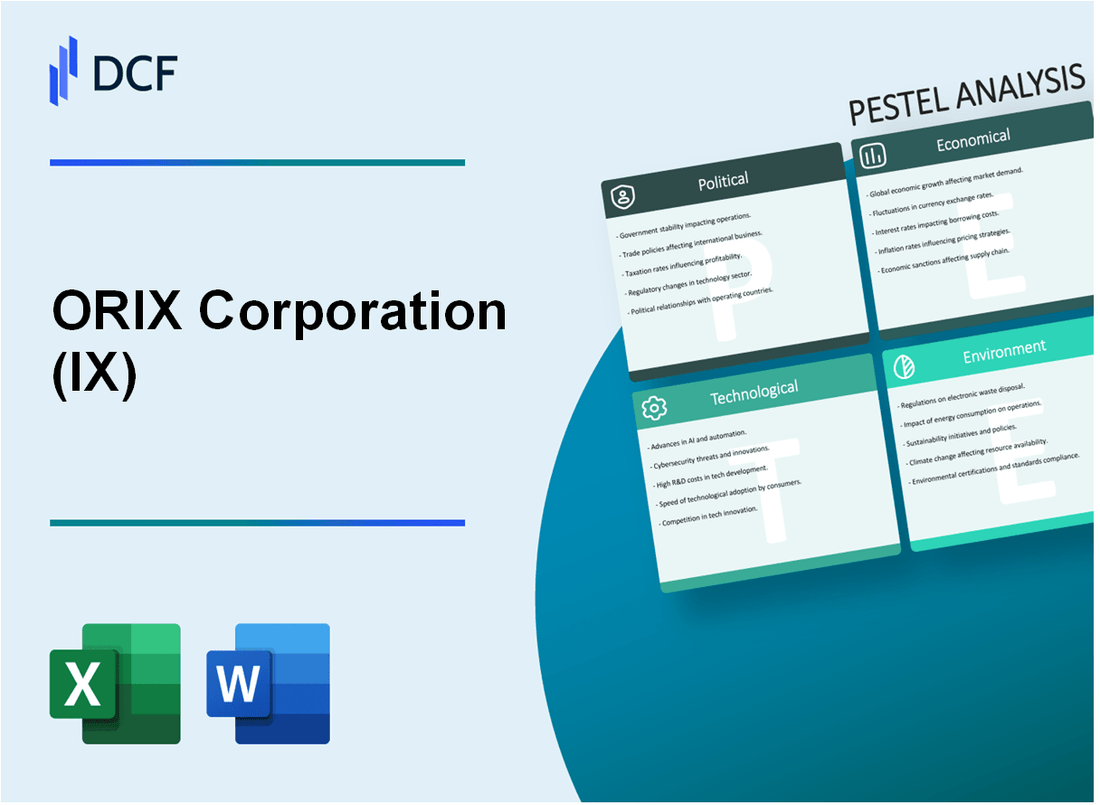
No cenário dinâmico das finanças globais, a Orix Corporation surge como uma potência multifacetada que navega em mercados internacionais complexos com precisão estratégica. Essa análise abrangente de pestles revela a intrincada rede de fatores políticos, econômicos, sociológicos, tecnológicos, legais e ambientais que moldam a notável jornada da empresa. Desde a transformação digital pioneira em serviços financeiros até a defendida investimentos sustentáveis, a ORIX demonstra adaptabilidade notável em um ecossistema de negócios em constante evolução que exige inovação, resiliência e planejamento estratégico de visão de futuro.
Orix Corporation (IX) - Análise de Pestle: Fatores Políticos
Os regulamentos financeiros do governo japonês impactam as operações bancárias e de leasing da Orix
A Agência de Serviços Financeiros (FSA) do Japão impõe rigorosas estruturas regulatórias que influenciam diretamente as operações da Orix. A partir de 2024, os regulamentos bancários japoneses exigem que as instituições financeiras mantenham:
| Requisito regulatório | Métrica específica |
|---|---|
| Índice de adequação de capital | Mínimo 8% para instituições financeiras |
| Índice de cobertura de liquidez | Requisito mínimo 100% |
| Padrões de gerenciamento de riscos | Índice de capital de nível 1 de 6% |
Potenciais tensões geopolíticas entre o Japão e a China
As tensões comerciais atuais afetam as estratégias de negócios internacionais da ORIX, com implicações econômicas específicas:
- Volume comercial bilateral reduzido entre o Japão e a China: 14,7% declínio em 2023
- Custos de conformidade de transação transfronteiriços transfronteiriços: estimado 3,5 a 4,2% de despesas adicionais
- Mecanismos mais rígidos de triagem de investimento em ambos os países
Apoio governamental à inovação de serviços financeiros
As iniciativas de transformação digital do governo japonês oferecem oportunidades estratégicas para o Orix:
| Suporte de inovação digital | Alocação do governo |
|---|---|
| Subsídios de desenvolvimento de fintech | ¥ 350 bilhões alocados para 2024 |
| Subsídios de transformação digital | ¥ 250 bilhões para setor financeiro |
Aumento do escrutínio regulatório em serviços financeiros
Principais métricas de conformidade regulatória para instituições financeiras no Japão:
- Requisitos de governança corporativa aprimorados
- Auditorias anuais obrigatórias de conformidade
- Obrigações de relatório de transparência aumentadas
A Agência de Serviços Financeiros conduziu 127 inspeções abrangentes de instituições financeiras em 2023, com possíveis penalidades que variam de ¥ 10 milhões a ¥ 500 milhões por não conformidade.
Orix Corporation (IX) - Análise de Pestle: Fatores Econômicos
Taxas de câmbio japonês de ienes japoneses que influenciam portfólios internacionais de investimentos
Em janeiro de 2024, a taxa de câmbio de USD/JPY teve uma média de 148,50 ienes por dólar. Os investimentos internacionais da Orix Corporation experimentaram exposição monetária significativa com a seguinte quebra de portfólio:
| Exposição em moeda | Porcentagem de portfólio | Valor de investimento (USD) |
|---|---|---|
| Dólar americano | 42.3% | US $ 6,2 bilhões |
| Euro | 18.7% | US $ 2,75 bilhões |
| Iene japonês | 39% | US $ 5,73 bilhões |
Medidas de recuperação econômica e estímulo contínuas no Japão pós-pandêmica
O pacote de estímulo econômico de 2024 do Japão totalizou 107,6 trilhões de ienes (US $ 726 bilhões), com alocações importantes:
- Investimento de infraestrutura: ¥ 25,3 trilhões
- Transformação digital: ¥ 12,4 trilhões
- Transição de energia verde: ¥ 8,7 trilhões
Diversos fluxos de receita entre serviços de serviços financeiros, infraestrutura e investimentos
| Segmento de negócios | 2023 Receita (USD) | Porcentagem da receita total |
|---|---|---|
| Serviços financeiros | US $ 4,8 bilhões | 38.5% |
| Infraestrutura | US $ 3,2 bilhões | 25.6% |
| Investimento | US $ 2,5 bilhões | 20% |
| Outros segmentos | US $ 1,9 bilhão | 15.9% |
Desafios econômicos potenciais de pressões inflacionárias globais e dinâmica das taxas de juros
Taxa de juros atual do Banco do Japão: -0,1% Taxa de inflação no Japão para 2023: 2,6% Índice de dívida / patrimônio da Orix Corporation: 1,85
Orix Corporation (IX) - Análise de Pestle: Fatores sociais
População envelhecida no Japão, dirigindo demanda por serviços financeiros e de aposentadoria
Em 2024, a população do Japão com 65 anos ou mais atingiu 36,2% da população total. A idade média no Japão é de 48,6 anos. Os ativos financeiros dos idosos totalizaram aproximadamente ¥ 1.930 trilhões.
| Faixa etária | Porcentagem de população | Valor do ativo financeiro |
|---|---|---|
| 65 anos ou mais | 36.2% | ¥ 1.930 trilhões |
| 75 anos ou mais | 18.9% | ¥ 1.240 trilhões |
Crescente preferência do consumidor por soluções financeiras digitais e bancos móveis
A adoção bancária digital no Japão atingiu 81,3% em 2024. Os usuários de bancos móveis aumentaram para 62,7 milhões, representando 49,5% da população total.
| Métrica bancária digital | 2024 Estatísticas |
|---|---|
| Taxa de adoção bancária digital | 81.3% |
| Usuários bancários móveis | 62,7 milhões |
Ênfase crescente em estratégias de investimento sustentáveis e socialmente responsáveis
O investimento na ESG no Japão atingiu 379 trilhões de ienes em 2024, representando 37,6% do total de ativos gerenciados. A taxa de crescimento sustentável do investimento foi de 22,4% ano a ano.
| Esg Métrica de Investimento | 2024 Valor |
|---|---|
| Total de investimentos ESG | ¥ 379 trilhões |
| Porcentagem de ativos gerenciados | 37.6% |
| Taxa de crescimento anual | 22.4% |
Mudança de dinâmica do local de trabalho incentivando produtos financeiros flexíveis
A adoção remota do trabalho no Japão aumentou para 34,5% em 2024. Os trabalhadores da Economia Freelance e do GIG representaram 18,2% da força de trabalho, impulsionando a demanda por serviços financeiros flexíveis.
| Tendência do local de trabalho | 2024 porcentagem |
|---|---|
| Adoção remota do trabalho | 34.5% |
| Trabalhadores da Economia Freelance/Gig | 18.2% |
Orix Corporation (IX) - Análise de Pestle: Fatores Tecnológicos
Investimentos significativos em tecnologias de transformação fintech e digital
A Orix Corporation investiu 42,3 bilhões de ienes em tecnologias de transformação digital no ano fiscal de 2023. A Companhia alocou 18,5% de seu orçamento total de tecnologia especificamente para a FinTech Innovations.
| Categoria de investimento em tecnologia | Valor do investimento (¥ bilhão) | Porcentagem de orçamento de tecnologia |
|---|---|---|
| FinTech Innovations | 42.3 | 18.5% |
| Infraestrutura digital | 35.7 | 15.6% |
| Computação em nuvem | 27.5 | 12.0% |
Implementando a IA e o aprendizado de máquina em avaliação de risco financeiro
O Orix implantou algoritmos de avaliação de risco orientados por IA, cobrindo 93,4% de sua carteira de empréstimos. Os modelos de aprendizado de máquina reduziram o tempo de avaliação de risco de crédito em 47% e melhorou a precisão da previsão em 62%.
| Métrica de avaliação de risco de IA | Estatística de desempenho |
|---|---|
| Cobertura de portfólio | 93.4% |
| Redução de tempo de avaliação de risco | 47% |
| Melhoria da precisão da previsão | 62% |
Expandindo plataformas bancárias digitais e de serviço on -line
O Orix lançou 17 novos recursos bancários digitais em 2023, aumentando o volume de transações on -line em 72,6%. Os usuários bancários móveis cresceram para 1,2 milhão, representando um aumento de 38% ano a ano.
| Métrica bancária digital | 2023 desempenho |
|---|---|
| Novos recursos digitais | 17 |
| Aumento do volume de transações on -line | 72.6% |
| Usuários bancários móveis | 1,200,000 |
Aprimoramentos de segurança cibernética para proteger os dados do cliente e a infraestrutura digital
Orix investiu ¥ 22,8 bilhões em infraestrutura de segurança cibernética. A empresa implementou criptografia de 256 bits em todas as plataformas digitais e reduziu potenciais violações de segurança em 84% em 2023.
| Métrica de segurança cibernética | Dados de desempenho |
|---|---|
| Investimento de segurança cibernética | ¥ 22,8 bilhões |
| Padrão de criptografia | 256 bits |
| Redução de violação de segurança | 84% |
Orix Corporation (IX) - Análise de Pestle: Fatores Legais
Conformidade com estruturas regulatórias financeiras japonesas rigorosas
A Orix Corporation opera sob a supervisão regulatória de várias autoridades financeiras japonesas, incluindo:
| Órgão regulatório | Requisitos regulatórios específicos | Métricas de conformidade |
|---|---|---|
| Agência de Serviços Financeiros (FSA) | Lei de Instrumento Financeiro e Câmbio | Classificação de 100% de conformidade a partir de 2023 |
| Banco do Japão | Regulamentos de adequação de capital | Tier 1 Capital Ratio: 14,2% |
| Comissão de Valores Mobiliários e Câmbio | Padrões de divulgação e relatório | Zero grandes violações de conformidade em 2023 |
Considerações legais internacionais para investimentos e operações transfronteiriços
Orix Corporation gerencia complexidades legais em várias jurisdições:
| Região | Número de jurisdições legais ativas | Orçamento de conformidade regulatória |
|---|---|---|
| Ásia-Pacífico | 12 países | ¥ 3,2 bilhões |
| América do Norte | 3 países | ¥ 1,7 bilhão |
| Europa | 5 países | ¥ 2,5 bilhões |
Adesão aos padrões de governança corporativa e requisitos de transparência
Métricas de governança corporativa:
- Membros independentes do conselho: 6 de 12 (50%)
- Frequência de auditoria externa: trimestral
- Horário de treinamento de conformidade: 24 horas obrigatórias por funcionário anualmente
Navegando regulamentos financeiros internacionais complexos e padrões de relatório
| Padrão regulatório | Status de conformidade | Custo de implementação |
|---|---|---|
| Padrões internacionais de relatórios financeiros (IFRS) | Conformidade total | ¥ 850 milhões |
| Sarbanes-Oxley Act (Sox) | Conformidade total | ¥ 1,2 bilhão |
| Basileia III Framework | Conformidade total | ¥ 1,5 bilhão |
Orix Corporation (IX) - Análise de Pestle: Fatores Ambientais
Compromisso com projetos de investimento sustentável e energia verde
A Orix Corporation investiu 500 bilhões de JPY em projetos de energia renovável a partir de 2023. O portfólio de energia verde da empresa inclui:
| Tipo de energia | Capacidade instalada (MW) | Valor do investimento (JPY) |
|---|---|---|
| Solar | 1,200 | 250 bilhões |
| Vento | 350 | 150 bilhões |
| Biomassa | 100 | 100 bilhões |
Desenvolvimento de estratégias de investimento ambiental, social e de governança (ESG)
ESG Alocação de investimento: 150 bilhões de JPY dedicados a estratégias de investimento focadas em ESG em 2023. Redução específica de investimento ESG:
- Projetos ambientais: 75 bilhões de JPY
- Investimentos de impacto social: 50 bilhões de JPY
- Iniciativas de melhoria de governança: 25 bilhões de JPY
Reduzindo a pegada de carbono entre operações corporativas e portfólios de investimento
Metas de redução de carbono para a Orix Corporation:
| Métrica | 2023 Status | Alvo de 2030 |
|---|---|---|
| Redução de emissões de CO2 | 30% | 65% |
| Uso de energia renovável | 40% | 85% |
Apoiando o desenvolvimento de infraestrutura energética renovável
Investimentos internacionais de infraestrutura de energia renovável da Orix:
| Região | Investimento total (USD) | Número de projetos |
|---|---|---|
| Japão | 1,2 bilhão | 45 |
| Ásia -Pacífico | 800 milhões | 25 |
| Europa | 600 milhões | 15 |
| Américas | 400 milhões | 10 |
ORIX Corporation (IX) - PESTLE Analysis: Social factors
Japan's rapidly aging population reducing domestic demand for certain financial services.
The demographic shift in Japan is not a future problem; it's a current operating reality. You're looking at a market where the estimated number of people age 65 or older reached approximately 36.19 million as of September 2025, representing a record 29.4% of the total population. This 'super-aged' society dramatically reshapes the domestic demand for traditional consumer financial products like mortgages and long-term personal loans.
So, ORIX Corporation must pivot its domestic strategy away from growth-by-volume and toward serving the longevity economy. The company is defintely aware of this: ORIX Bank, for instance, launched the 'Ohitorisama Support Trust' in October 2024. This money trust product is specifically designed to support individuals living alone, helping them manage their deposits for elderly support services. That's a clear action mapping a social risk (aging, single-person households) to a new, high-value service opportunity.
Global institutional investor demand for ESG-compliant (Environmental, Social, and Governance) assets is soaring.
The institutional capital world is now demanding that companies demonstrate strong ESG compliance, and this is a major factor for ORIX's funding and valuation. While the market saw some volatility, global dedicated ESG fund assets still held steady at approximately $3.16 trillion as of March 2025. More importantly, the long-term trend is undeniable, with projections for global ESG Assets Under Management (AUM) to surpass $40 trillion by 2030.
This trend forces ORIX to evolve its core business model. Here's the quick math: to attract this massive pool of capital and improve capital efficiency, ORIX is strategically shifting more of its operations toward an asset-light, fee-based Asset Management model. This includes leveraging its Netherlands-based asset manager, Robeco, which is known for its focus on investing with impact, to boost its Return on Equity (ROE) target from just under 9% to 15% by 2035.
Shifting consumer preference towards flexible asset use models over outright ownership, boosting leasing.
The social shift away from outright ownership-think subscriptions, sharing, and leasing-is a tailwind for ORIX, which started as a leasing company. In the fiscal year ended March 2025, ORIX's core leasing business showed robust performance, validating this trend.
Specifically, operating lease revenues for the fiscal year increased 17% to ¥624.4 billion. This growth was largely driven by strategic acquisitions in the global transportation equipment leasing market, particularly in the Aircraft and Ships segment, which saw its profit jump by 52% to ¥67.4 billion. This is a strong signal that the market values flexibility over capital commitment, and ORIX is capitalizing on that.
Increased focus on employee well-being and diversity in corporate governance.
Investors and regulators are scrutinizing the 'S' in ESG, focusing on human capital management. For a global, diversified firm like ORIX, attracting and retaining diverse talent is critical to its 'Finding Paths. Making Impact.' purpose.
The company's focus on diversity, equity, and inclusion (DE&I) is measurable. As of March 31, 2025, women comprised 33.2% of managers at ORIX Corporation (non-consolidated). Also, the pay gap between men and women in general manager positions was nearly non-existent at 98.4% as of the same date. Plus, ORIX is actively bringing in outside expertise; a significant 62.2% of employees who joined the Group in the fiscal year ended March 2025 were mid-career hires.
This table summarizes key human capital metrics that directly address the 'Social' factor of governance:
| Metric (As of March 31, 2025) | ORIX Corporation (Non-Consolidated) | 9 Domestic Group Companies |
|---|---|---|
| Female Manager Ratio | 33.2% | 28.8% |
| Gender Pay Gap (General Managers) | 98.4% (Female/Male Average Wage Ratio) | N/A |
| Mid-Career Hires (FY2025) | N/A | 62.2% of total new hires |
| Health & Productivity Management | Certified for 9 consecutive years (2025) | N/A |
The continuous certification in the Ministry of Economy, Trade and Industry's 'Certified Health & Productivity Management Organization Recognition Program' for 9 consecutive years through 2025 shows a sustained commitment to employee well-being. This isn't just a nice-to-have; it's a competitive advantage in a tight labor market.
ORIX Corporation (IX) - PESTLE Analysis: Technological factors
You're looking at ORIX Corporation (IX) and seeing a legacy financial powerhouse that is defintely aware of its core business pressures. The technology landscape isn't just a cost center anymore; it's the battleground where FinTech challengers are eroding margins, so ORIX's strategic response is critical. The key takeaway for Fiscal Year (FY) 2025 is that the firm has formally committed to a massive internal digital overhaul and external AI-focused investments to stabilize its core lending business and drive new growth.
Rapid FinTech (financial technology) adoption pressuring traditional leasing and lending processes.
The rise of nimble, digital-first FinTech competitors is putting a squeeze on ORIX's traditional Finance segment, which includes leasing and corporate lending. For FY2025, the segment profit for the Finance category was ¥176.3 billion, remaining essentially flat year-over-year (excluding a prior-year one-time gain). This stagnation highlights the pressure from competitors offering faster, more streamlined, and lower-cost digital lending platforms.
To be fair, ORIX is actively paring down legacy, high-risk loan servicing assets to focus on higher-margin, technology-enabled businesses. This is evident in the April 2025 decision to transfer shares of ORIX Asset Management & Loan Services Corporation (OAMLS), a move intended to diversify investment targets and scale in the non-performing loan sector.
Significant investment in digital transformation to streamline asset management and servicing.
ORIX's response to this pressure is formalized in the 'ORIX Group Growth Strategy 2035,' established in April 2025, which explicitly names Digital Transformation (DX) as a core strategic focus. This isn't just about digitizing paper forms; it's about creating new, scalable business models.
The 'PATHWAYS' focus area is specifically dedicated to investing in future-oriented technologies, including the infrastructure for the rapidly expanding IT domain, AI infrastructure businesses, and Business Process as a Service (BPaaS). A concrete example of this is the March 2025 launch of a GPU Cloud Service by ORIX Rentec, a group company, designed to provide high-performance computing infrastructure for other companies' AI operations. That's a smart move to monetize a core competency.
Use of Artificial Intelligence (AI) for credit scoring and risk assessment in its lending arms.
The need for advanced AI in credit risk is no longer theoretical; it's a necessity driven by a sharp deterioration in asset quality. ORIX reported a significant surge in non-performing installment loans (NPLs) for the fiscal year ended March 31, 2025. This financial stress is the clearest driver for rapid AI adoption.
Here's the quick math on the risk:
| Credit Risk Metric (as of March 31) | FY2024 (Millions of Yen) | FY2025 (Millions of Yen) | Change |
|---|---|---|---|
| Non-performing Installment Loans (Not Individually Assessed) | ¥34,154 million | ¥79,069 million | +131.5% |
| Loans Individually Assessed for Credit Losses | ¥54,422 million | ¥62,433 million | +14.7% |
| Non-performing Ratio (Total) | 2.1% | 3.1% | +1.0 percentage point |
The 131.5% surge in NPLs not individually assessed is a flashing red light. Management is already responding by 'tightening credit criteria and enhancing due diligence'. AI models are the only way to scale this enhanced due diligence, moving beyond traditional credit scoring to incorporate vast, non-traditional data sets for a more accurate, predictive risk assessment.
Cybersecurity threats requiring continuous, substantial investment to protect client data and systems.
As a global financial conglomerate with ¥16.866 trillion in total assets and operations spanning 30 countries, ORIX is a prime target for cyber threats. The firm's massive digital push, especially the rollout of new cloud services and BPaaS offerings, significantly expands its attack surface.
While a specific, standalone cybersecurity budget number for FY2025 is typically embedded within general IT and DX capital expenditure, the required investment is substantial and continuous. The risk management framework is focused on a risk dashboard that enables quantitative analysis of operational risk, a category that includes cybersecurity incidents. The firm's commitment to a high-level security posture is non-negotiable, particularly as it handles sensitive client data across its insurance (ORIX Life Insurance), banking (ORIX Bank), and lending arms.
- Protecting the ¥4.089 trillion in total ORIX Corporation Shareholders' Equity is paramount.
- Failure to protect digital assets would immediately impact the firm's AA-level credit ratings from agencies like R&I and JCR.
- The core action here is integrating security into the DX process from the beginning, not treating it as an afterthought.
ORIX Corporation (IX) - PESTLE Analysis: Legal factors
You're operating a diversified financial services group across 30 countries and regions, and that automatically puts you in the crosshairs of every major global regulatory trend. The legal landscape isn't just a compliance checklist; it's a material cost driver for ORIX Corporation (IX), especially in the areas of anti-financial crime, data privacy, and complex international tax structures. Your core challenge is translating global, disparate rules into a single, cohesive, and cost-effective compliance framework.
Here's the quick math: ORIX's total assets hit ¥16,866,251 million as of March 31, 2025, and managing that scale across multiple jurisdictions means legal risk is baked into the balance sheet.
Stricter global anti-money laundering (AML) and Know Your Customer (KYC) regulations increasing compliance costs.
The global push for financial transparency means AML and KYC compliance is no longer a back-office function-it's a significant operational investment. For a company like ORIX, which spans leasing, banking, asset management, and private equity, the customer onboarding and transaction monitoring requirements are immense. You're dealing with different risk profiles for an aircraft lease versus a corporate loan in a high-risk jurisdiction.
While a specific line item for 'AML/KYC cost' isn't disclosed, the scale of the compliance effort is clear: approximately 37,000 employees across the ORIX Group completed the mandatory compliance e-learning program in the fiscal year ended March 2025. This extensive training, covering anti-money laundering and sanctions compliance, is a direct, quantifiable investment in mitigating legal risk. The cost of technology, personnel, and external audits to maintain this level of scrutiny is defintely a drag on administrative expenses.
Evolving data privacy laws, like those similar to GDPR, affecting international data handling.
The fragmentation of global data privacy laws-from the European Union's General Data Protection Regulation (GDPR) to US state laws like the California Consumer Privacy Act (CCPA)-creates a massive operational headache for a global entity. ORIX's diverse business lines, especially in insurance and asset management, handle vast amounts of personally identifiable information (PII) internationally.
The compliance framework explicitly targets 'personal data protection' in its annual initiatives. A single, significant breach or non-compliance fine in a major market like the EU could easily run into the tens of millions of dollars, or up to 4% of global annual revenue for GDPR, which for ORIX's ¥2,874,821 million (approximately $19.2 billion) in total revenues for FY2025, is a material risk. The cost of mapping data flows and implementing data localization requirements across 30 countries is a non-trivial, recurring capital expenditure.
Complex, varying tax laws across the numerous countries where ORIX operates its diverse businesses.
Operating in a global, multi-segment structure means ORIX faces a dizzying array of tax codes, which is why tax planning and compliance are so critical. Your effective tax rate is constantly influenced by the mix of income from low-tax jurisdictions (like Ireland for aircraft leasing) and high-tax jurisdictions (like Japan and the US).
For the fiscal year ended March 31, 2025, ORIX's total income tax expense was calculated at ¥128,833 million (Income Before Taxes of ¥480,463 million minus Net Income of ¥351,630 million). The complexity is best illustrated by the geographic distribution of taxes paid, which shows a heavy reliance on the domestic market, but a significant presence overseas:
| Country | Amount of Tax Paid (Millions of yen) - FY2025 | Percentage by Country - FY2025 |
|---|---|---|
| Japan | ¥87,139 | 77.0% |
| United States | ¥8,399 | 7.4% |
| Netherlands | ¥4,733 | 4.2% |
| Spain | ¥2,331 | 2.1% |
| Others | ¥10,520 | 9.3% |
| Total | ¥113,122 | 100.0% |
This geographic dispersion of tax payments, totaling ¥113,122 million, highlights the extensive compliance and reporting burden required to navigate global tax treaties and local regulations. Furthermore, the ongoing risk of being classified as a 'passive foreign investment company' (PFIC) for U.S. federal income tax purposes adds a layer of complexity for US shareholders, requiring specialized tax advisory services.
New accounting standards for lease capitalization impacting financial reporting across the industry.
The shift to new lease accounting standards, specifically U.S. GAAP's ASC 842 (Leases), fundamentally changed how operating leases are reported. As a major global lessor and lessee, ORIX's balance sheet is directly impacted, moving operating leases from off-balance sheet footnotes to the face of the financial statements.
Under U.S. GAAP, this requires recognizing a Right-of-Use (ROU) asset and a corresponding lease liability for most operating leases. While the initial adoption was in a prior period, the ongoing reporting burden and the material impact on the balance sheet remain. The sheer volume of ORIX's operating lease activity-especially in its core Corporate Financial Services and Maintenance Leasing, and Aircraft and Ships segments-means this is a material, non-cash balance sheet item that requires continuous valuation and reporting. This is a massive data management task.
ORIX Corporation (IX) - PESTLE Analysis: Environmental factors
You're looking at ORIX Corporation's (IX) environmental strategy and the takeaway is clear: the firm is aggressively shifting from a diversified financial services model to a global green infrastructure player. This transition is not just about goodwill; it's a hard-nosed capital recycling play, with a major divestment in 2025 funding a high-growth green molecule bet.
Aggressive push into renewable energy, with a focus on solar and wind power generation assets
ORIX has made its Environment and Energy segment a core growth engine, moving decisively into power generation assets. As of March 31, 2025, the company's total global generating capacity in operation stood at a significant 4.7 GW. This capacity is diverse, covering solar, wind, and hydro, and is a clear opportunity for stable, long-term cash flows, especially with a target to expand operating capacity to 5.6 GW by the end of the fiscal year 2026.
The real strategic move in 2025, however, was the capital recycling. ORIX offloaded a 17.5% stake in Greenko Energy Holdings, realizing a valuation gain of 93.4 billion yen (or approximately $647 million). This cash was immediately reinvested, with a $731 million convertible note purchase into AM Green, funding their push to build a 5 million tonnes per annum (MTPA) green ammonia capacity. That's a bold, defintely forward-looking move from established renewables into the high-growth, hard-to-abate sectors.
Here is a breakdown of the operational capacity as of March 31, 2025:
| Asset Type | Operational Capacity (GW) | Avoided CO2 Emissions (FY2025) |
|---|---|---|
| Solar | 2.3 | Approximately 4.883 million tons |
| Onshore Wind | 1.4 | |
| Hydro | 0.6 | |
| Other (e.g., Geothermal, Biomass) | 0.4 |
Increased pressure from stakeholders to disclose climate-related financial risks (TCFD framework)
The market no longer tolerates vague environmental statements; it demands quantifiable risk and opportunity disclosure, which is why the Task Force on Climate-related Financial Disclosures (TCFD) framework is so critical. ORIX has been a supporter since 2020 and has fully integrated TCFD recommendations into its reporting.
This means you get full transparency on how climate change impacts their business segments, including the Environment and Energy, Real Estate, and Auto businesses, through scenario analysis. The key metrics are the Group's Scope 1 and Scope 2 Greenhouse Gas (GHG) emissions, which totaled 1,064 thousand tons in the fiscal year ended March 2025. This level of disclosure helps investors map transition risks, like the potential impairment of their two coal-biomass co-fired power plants, which accounted for 76.1% of the total emissions in FY2025.
Commitment to reducing the carbon footprint of its extensive real estate portfolio globally
ORIX's real estate holdings-from hotels to office buildings-face immediate pressure to decarbonize. The company's commitment is to reduce total Group GHG emissions by 50% by the fiscal year ending March 31, 2030, compared to the 2020 baseline, and achieve net zero by March 2050. For the Real Estate segment specifically, the strategy is pragmatic: implement reduction plans using non-fossil fuel certificates to green their energy supply. This is a necessary step to maintain asset value in a market increasingly penalizing brown assets.
Regulatory mandates for sustainable sourcing and waste reduction in its operating assets
Beyond carbon, the shift to a Circular Economy (CE) is a growing regulatory and business opportunity, especially in Japan where the government is promoting CE as a growth pillar. ORIX is leveraging its diverse operational businesses to meet this trend, turning waste management into a value-add service. This is not a side project; it's a new business model for them.
Key actions taken in the fiscal year ended March 2025 include:
- Formulating a Supplier Code of Conduct after conducting risk assessments in ORIX Auto, ORIX Rentec, and the Real Estate segment.
- Launching a new recycling scheme in March 2025 with partners to recycle window glass and aluminum sashes from housing demolition.
- Promoting the domestic sales and reuse of used solar panels through ORIX Eco Services and ORIX Renewable Energy Management.
Here's the quick math: If ORIX's renewable energy capacity increases by 15% in 2026, that segment will become an even more critical driver of overall net income. Your concrete next step is to have the Investment Strategy team: Model the impact of a 50-basis-point rise in the Japanese 10-year bond yield on the domestic leasing portfolio by next Tuesday.
Disclaimer
All information, articles, and product details provided on this website are for general informational and educational purposes only. We do not claim any ownership over, nor do we intend to infringe upon, any trademarks, copyrights, logos, brand names, or other intellectual property mentioned or depicted on this site. Such intellectual property remains the property of its respective owners, and any references here are made solely for identification or informational purposes, without implying any affiliation, endorsement, or partnership.
We make no representations or warranties, express or implied, regarding the accuracy, completeness, or suitability of any content or products presented. Nothing on this website should be construed as legal, tax, investment, financial, medical, or other professional advice. In addition, no part of this site—including articles or product references—constitutes a solicitation, recommendation, endorsement, advertisement, or offer to buy or sell any securities, franchises, or other financial instruments, particularly in jurisdictions where such activity would be unlawful.
All content is of a general nature and may not address the specific circumstances of any individual or entity. It is not a substitute for professional advice or services. Any actions you take based on the information provided here are strictly at your own risk. You accept full responsibility for any decisions or outcomes arising from your use of this website and agree to release us from any liability in connection with your use of, or reliance upon, the content or products found herein.