

|
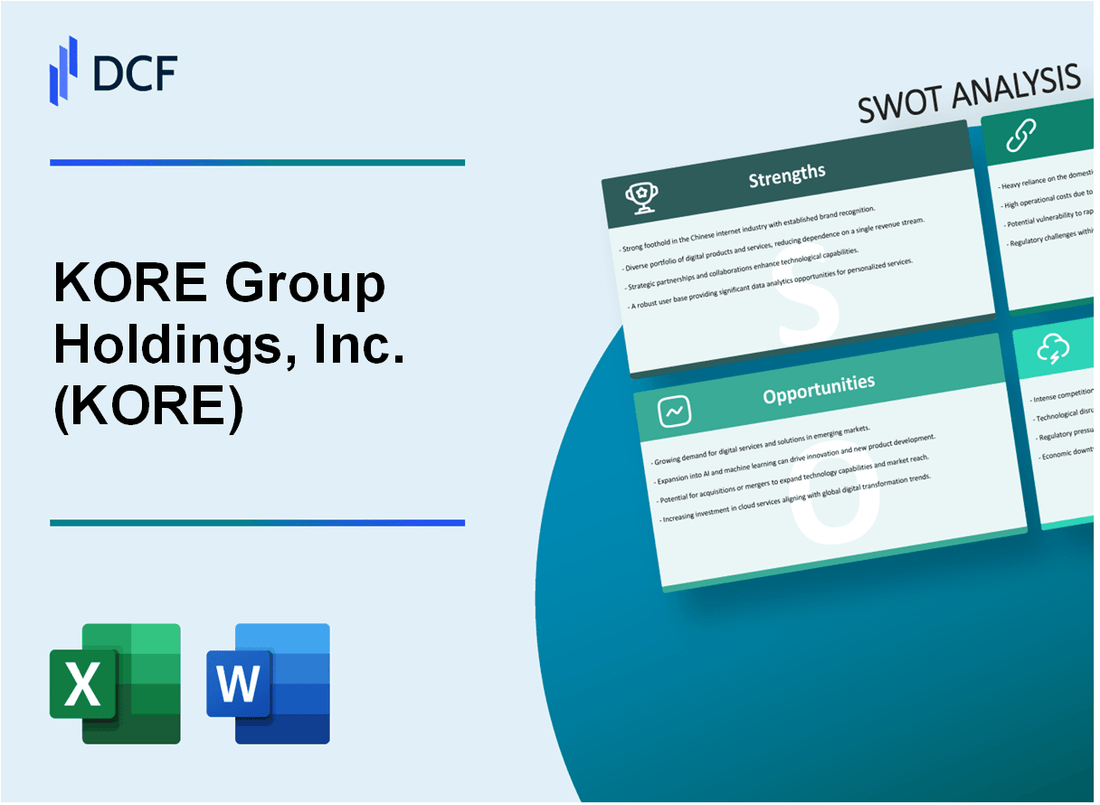
Kore Group Holdings, Inc. (KORE): Analyse SWOT [Jan-2025 MISE À JOUR] |
Entièrement Modifiable: Adapté À Vos Besoins Dans Excel Ou Sheets
Conception Professionnelle: Modèles Fiables Et Conformes Aux Normes Du Secteur
Pré-Construits Pour Une Utilisation Rapide Et Efficace
Compatible MAC/PC, entièrement débloqué
Aucune Expertise N'Est Requise; Facile À Suivre
KORE Group Holdings, Inc. (KORE) Bundle
Dans le monde en évolution rapide de l'Internet des objets (IoT), Kore Group Holdings, Inc. est à un moment critique, équilibrant des solutions de connectivité innovantes avec des défis de marché complexes. Alors que la transformation numérique accélère dans toutes les industries, cette analyse SWOT complète révèle le positionnement stratégique de l'entreprise, explorant comment Kore navigue dans ses forces, confronte les faiblesses, saisit les opportunités émergentes et atténue les menaces potentielles dans le 250 milliards de dollars Marché mondial de l'IoT. Plongez dans un examen perspicace du paysage concurrentiel de Kore et du potentiel stratégique en 2024.
Kore Group Holdings, Inc. (KORE) - Analyse SWOT: Forces
Plateforme de gestion mondiale de la connectivité IoT de premier plan
Kore exploite une plate-forme mondiale de gestion de la connectivité IoT desservant plus de 3 200 clients dans plus de 180 pays. Au troisième trimestre 2023, la société a géré plus de 21,5 millions de connexions IoT dans le monde.
| Métrique de la plate-forme | Données quantitatives |
|---|---|
| Connexions IoT totales | 21,5 millions |
| Couverture géographique | 180+ pays |
| Total des clients | 3,200+ |
Solutions IoT de bout en bout
Kore fournit des solutions IoT de bout en bout dans plusieurs domaines technologiques:
- Gestion de la connectivité
- Gestion des appareils
- Activation de l'application
- Services de sécurité
Partenariats établis
Kore maintient des partenariats stratégiques avec les principaux opérateurs sans fil, notamment:
- AT&T
- Verizon
- T-mobile
- Vodafone
Clientèle diversifiée
| Industrie verticale | Pourcentage de clientèle |
|---|---|
| Soins de santé | 22% |
| Transport / logistique | 18% |
| Fabrication industrielle | 15% |
| Services financiers | 12% |
| Autres secteurs | 33% |
Modèle de revenus récurrent
La performance financière de Kore depuis le troisième trimestre 2023 démontre de solides revenus récurrents:
- Revenus de services basés sur l'abonnement: 64,3 millions de dollars
- Pourcentage de revenus récurrents: 73%
- Croissance annuelle des revenus récurrents: 12,5%
Kore Group Holdings, Inc. (KORE) - Analyse SWOT: faiblesses
Défis financiers en cours avec des pertes trimestrielles cohérentes
Kore Group Holdings a déclaré une perte nette de 11,4 millions de dollars pour le troisième trimestre 2023, avec une perte nette cumulée de 37,2 millions de dollars pour les neuf premiers mois de 2023. Les états financiers de la société révèlent des pertes trimestrielles cohérentes:
| Quart | Perte nette |
|---|---|
| Q1 2023 | 12,1 millions de dollars |
| Q2 2023 | 13,7 millions de dollars |
| Q3 2023 | 11,4 millions de dollars |
Reconnaissance limitée de la marque
La présence du marché de Kore reste limitée par rapport aux plus grands concurrents technologiques. La part de marché de l'entreprise sur le marché de la connectivité IoT est d'environ 3,5%, ce qui est considérablement derrière les leaders de l'industrie.
- Marché IoT total adressable: 520 milliards de dollars
- Part de marché estimé de Kore: 3,5%
- Les 3 meilleurs concurrents détiennent plus de 45% de part de marché combinée
Capitalisation boursière relativement petite
En janvier 2024, la capitalisation boursière de Kore s'élève à 124,6 millions de dollars, ce qui est considéré comme petit dans le secteur compétitif de la technologie IoT.
| Catégorie de capitalisation boursière | Plage de valeur |
|---|---|
| Kore Group Holdings | 124,6 millions de dollars |
| Concurrents de l'IoT de niveau intermédiaire | 250 à 750 millions de dollars |
| Grandes entreprises technologiques IoT | 1 à 5 milliards de dollars |
Haute dépendance à l'égard du financement externe
Les états financiers de Kore indiquent une dépendance significative sur les sources de financement externes:
- Dette totale au troisième trimestre 2023: 98,3 millions de dollars
- Risque potentiel de dilution des actions: 12 à 15% par tour de financement
- Taux de brûlure en espèces: environ 4,2 millions de dollars par trimestre
Infrastructure technologique complexe
Kore a besoin d'investissements technologiques en cours substantiels pour maintenir un positionnement concurrentiel:
- Dépenses annuelles de R&D: 22,7 millions de dollars
- Coûts de maintenance des infrastructures technologiques: 6,5 millions de dollars par an
- Pourcentage de revenus réinvestis dans la technologie: 18,3%
Indicateurs clés de vulnérabilité financière:
| Métrique | Valeur |
|---|---|
| Ratio dette / fonds propres | 2.4:1 |
| Ratio actuel | 0.87 |
| Flux de trésorerie d'exploitation | - 15,6 millions de dollars |
Kore Group Holdings, Inc. (KORE) - Analyse SWOT: Opportunités
Élargir le marché IoT avec une croissance significative projetée dans plusieurs industries
Le marché mondial de l'IoT devrait atteindre 1 386,06 milliards de dollars d'ici 2026, avec un TCAC de 10,53% de 2021 à 2026. Les secteurs de croissance de l'industrie clé comprennent:
| Industrie | Valeur marchande de l'IoT projetée d'ici 2026 |
|---|---|
| Fabrication | 412,8 milliards de dollars |
| Soins de santé | 267,6 milliards de dollars |
| Automobile | 225,4 milliards de dollars |
Augmentation de la demande de solutions de gestion des appareils connectés
Les statistiques du marché de la gestion des appareils connectés indiquent:
- Devrait passer de 19,8 milliards de dollars en 2022 à 48,7 milliards de dollars d'ici 2027
- TCAC de 19,6% au cours de la période de prévision
- L'Amérique du Nord détient la plus grande part de marché à 38%
Potentiel d'acquisitions stratégiques pour améliorer les capacités technologiques
Le potentiel de stratégie d'acquisition de Kore est soutenu par:
- Marché d'acquisition de la plate-forme IoT d'une valeur de 3,2 milliards de dollars en 2022
- Activité de fusions et acquisitions attendues dans les solutions de connectivité IoT augmente à 22% par an
Intérêt croissant de l'entreprise pour les plates-formes de connectivité IoT complètes
Insistance du marché des plateformes de connectivité IoT de l'entreprise:
| Segment de marché | 2024 Valeur projetée |
|---|---|
| Plateformes IoT de l'entreprise | 37,5 milliards de dollars |
| Solutions de connectivité IoT d'entreprise | 22,3 milliards de dollars |
Marchés émergents avec des initiatives de transformation numérique croissantes
Croissance du marché de la transformation numérique dans les régions émergentes:
- Marché de transformation numérique Asie-Pacifique: 453,3 milliards de dollars d'ici 2025
- Dépenses de transformation numérique du Moyen-Orient: 57,3 milliards de dollars d'ici 2025
- Marché de transformation numérique en Amérique latine: 43,8 milliards de dollars d'ici 2025
Kore Group Holdings, Inc. (KORE) - Analyse SWOT: menaces
Concurrence intense de plus en plus de technologies et d'entreprises de télécommunications
Le marché mondial de la connectivité IoT était évalué à 22,3 milliards de dollars en 2023, avec des concurrents majeurs, notamment:
| Entreprise | Part de marché (%) | Revenus annuels ($ b) |
|---|---|---|
| Verizon | 15.7% | 133.7 |
| AT&T | 14.2% | 120.7 |
| Cisco | 11.5% | 51.6 |
Changements technologiques rapides dans la connectivité et la gestion de l'IoT
Indicateurs d'évolution de la technologie IoT:
- Le marché mondial de l'IoT devrait atteindre 1,39 billion de dollars d'ici 2026
- Connexions 5G devrait atteindre 1,9 milliard d'ici 2024
- Taux de croissance des investissements annuels moyens de la technologie IoT moyenne: 26,1%
Risques de cybersécurité potentiels et défis de confidentialité des données
Paysage des menaces de cybersécurité:
| Métrique | Valeur |
|---|---|
| Coût mondial de la cybercriminalité | 8,15 billions de dollars en 2023 |
| Coût moyen de violation de données | 4,45 millions de dollars |
| BRAUCHES DE SÉCURITÉ DE LES PRIPRIQUES IOT | Augmentation de 57% en 2023 |
Incertitudes économiques affectant les dépenses technologiques d'entreprise
Tendances des dépenses technologiques de l'entreprise:
- Prévisions de dépenses informatiques mondiales: 4,6 billions de dollars en 2024
- Croissance des dépenses technologiques attendues: 2,3%
- Marché des services cloud: 678,8 milliards de dollars en 2024
Perturbations potentielles de la chaîne d'approvisionnement dans les composants semi-conducteurs et technologiques
Défis du marché des semi-conducteurs:
| Métrique | Valeur |
|---|---|
| Revenus de semi-conducteurs mondiaux | 574 milliards de dollars en 2023 |
| Temps de plomb semi-conducteur | 22-26 semaines moyennes |
| Impact de la pénurie de composants | Perte de l'industrie de 500 milliards de dollars en 2023 |
KORE Group Holdings, Inc. (KORE) - SWOT Analysis: Opportunities
Accelerating the adoption of SGP.32 (eSIM) innovation to simplify global IoT deployment.
The new GSMA SGP.32 specification for embedded SIM (eSIM) in the Internet of Things (IoT) is a massive opportunity for KORE, as it solves the major pain points of global deployment. This standard, which promises a zero-touch, build-once, ship-anywhere model, is finally moving from specification to reality in 2025. You should view KORE's early positioning here as a clear competitive advantage.
The market is poised for explosive growth in this area. Industry forecasts project the installed base of SGP.32 eSIMs to grow at a staggering 240% Compound Annual Growth Rate (CAGR) through 2028. To put that in perspective, the base is expected to surge from a small number of deployments to 192.8 million by 2028, outpacing the growth of the older M2M (Machine-to-Machine) and consumer eSIM standards. KORE is already preparing a comprehensive managed services approach to handle this transition, which lets their enterprise customers focus on their core business, not on complex provisioning infrastructure.
High-growth potential in the Connected Health sector, a key vertical focus.
Connected Health is a high-margin, mission-critical vertical where KORE has already committed significant resources, including appointing a dedicated Executive Vice President of Connected Health in 2024. This focus is defintely smart because the complexity of regulatory compliance (like HIPAA and ISO 13485) creates a high barrier to entry for competitors, which KORE already navigates for customers.
A significant opportunity for KORE in 2025 is the conversion of a large Connected Health contract that was delayed from 2024. This single contract could drive a material increase in high-value, recurring connectivity revenue. For a concrete example of the scale they are targeting, KORE is helping one digital healthcare company, Smart Meter, with their goal to deliver remote healthcare solutions to five million patients in five years.
Expanding market share in the global IoT market, which is valued well over $250 billion.
The sheer size of the addressable market is the biggest opportunity. Forget the conservative estimates; the global IoT market is projected to be valued at up to $1.35 trillion in 2025, according to some of the most recent data. Even a slightly more conservative forecast puts the 2025 value at $864.32 billion, growing at a 24.30% CAGR through 2032. This massive landscape gives KORE ample room to grow its market share.
KORE's recent operational metrics show they are capturing a piece of this growth. Here's the quick math on their core business momentum:
| Metric | Q3 2025 Value | Year-over-Year Change |
|---|---|---|
| Total Connections | 20.5 million | Up 9% |
| Q3 2025 Revenue | $68.7 million | Roughly flat |
| Q3 2025 Adjusted EBITDA | $14.5 million | Up 12% |
| 9-Month 2024 Closed-Won Total Contract Value (TCV) | $128 million | N/A (Focus on current pipeline strength) |
The 9% growth in total connections, reaching over 20.5 million in Q3 2025, shows that the core connectivity engine is accelerating, which is the foundational piece for long-term revenue expansion.
Leverage operational efficiencies to turn negative Q3 Free Cash Flow (-$1.1 million) into sustained positive cash flow.
The path to sustained profitability is clear: convert the strong Adjusted EBITDA growth into consistent Free Cash Flow (FCF). While Q3 2025 FCF was negative $1.1 million, this figure actually represents a $1.1 million improvement from the prior year and is a minor, temporary setback against a larger positive trend. What this estimate hides is the operational discipline already in place.
The company's restructuring plan, completed in 2024, is now delivering over $20 million in annual run-rate savings, which directly supports FCF. Also, KORE already demonstrated positive FCF earlier in 2025, reporting $1.6 million in Q2 2025 and $1.6 million in Q4 2024. Management's full-year 2025 FCF outlook is a solid range of $10 million to $14 million. The opportunity is simply to execute on this guidance and fully realize the benefits of those cost efficiencies.
- Realize $10 million to $14 million FCF target for full-year 2025.
- Sustain the $20 million+ annual run-rate savings from the 2024 restructuring.
- Maintain the Q3 2025 Cash from Operations of $1.1 million.
KORE Group Holdings, Inc. (KORE) - SWOT Analysis: Threats
You are operating in a market where the competition isn't just bigger; it's gargantuan, and that scale difference is a constant, material threat. Plus, any time a company suspends its financial outlook, it throws a wrench into investor confidence, and that's exactly what KORE Group Holdings, Inc. is facing in late 2025. You need to map these risks to understand the true cost of capital and market uncertainty.
Intense competition from much larger telcos like Verizon and AT&T
KORE, as a pure-play Internet of Things (IoT) hyperscaler, competes directly with the massive financial and network power of Tier-1 carriers like Verizon and AT&T. This isn't a fair fight on capital expenditure (CapEx) or brand recognition. To put the scale in perspective, KORE reported total revenue of $68.7 million in Q3 2025. Contrast that with the giants.
Verizon's total operating revenue for Q3 2025 was $33.8 billion, and AT&T's was $30.7 billion in the same period.
Here's the quick math on CapEx alone: AT&T's capital investment guidance for the full year 2025 is between $22 billion and $22.5 billion, and Verizon's is between $17.5 billion and $18.5 billion. KORE simply cannot match that investment in 5G, fiber, or next-generation IoT infrastructure, which makes it a defintely challenging environment. These larger players are actively expanding their own IoT platforms, using their vast cash flows to subsidize services and offer converged solutions that KORE cannot easily replicate.
| Metric (Q3 2025) | KORE Group Holdings, Inc. | Verizon Communications Inc. | AT&T Inc. |
|---|---|---|---|
| Total Operating Revenue | $68.7 million | $33.8 billion | $30.7 billion |
| Annual Free Cash Flow Guidance (FY2025) | Negative $1.1 million (Q3 FCF) | $19.5 billion to $20.5 billion | More than $16 billion |
Suspension of FY2025 financial guidance due to strategic review creates investor uncertainty
In November 2025, KORE suspended its full-year financial guidance, a move that immediately signals high uncertainty to the market. The original 2025 outlook projected total revenue between $288 million and $298 million and Adjusted EBITDA between $62 million and $67 million. Suspending this guidance, which was reiterated as recently as Q2 2025, tells investors that the range of potential outcomes is now too wide to be meaningful.
The core reason is the ongoing strategic review, which includes evaluating a non-binding acquisition proposal. This uncertainty makes it difficult for analysts to model future performance, leading to cautious investor behavior and potential stock price volatility. The market hates a vacuum, and the lack of a clear outlook fills that vacuum with risk.
Potential for a disruptive acquisition or merger that could redefine the company's trajectory
The strategic review itself is a threat because it introduces the possibility of a complete change in ownership and strategy. On November 3, 2025, KORE announced receiving a non-binding proposal from its existing investors, Searchlight Capital Partners and Abry Partners, to acquire all outstanding common stock not already owned by them for $5.00 per share in cash.
While this proposal offers a potential exit for shareholders, the risk is twofold:
- Employee and Customer Disruption: An acquisition can halt internal projects, lead to key employee departures, and create anxiety among customers about the long-term continuity of service and product roadmaps.
- Deal Failure Risk: There is no assurance that the proposal will result in a transaction. If the deal falls apart after the company has already suspended guidance and focused resources on the review, the stock could see a sharp decline, and management's credibility could suffer.
Declining non-GAAP gross margin in IoT Connectivity, which fell to 59.6% in Q3 2025
The core business, IoT Connectivity, is showing a slight but concerning erosion in profitability. The non-GAAP gross margin for the IoT Connectivity segment dropped to 59.6% in Q3 2025, down from 60.9% in the same quarter of 2024. This 130 basis point decline suggests increasing cost pressures or pricing competition.
The overall non-GAAP gross margin for the company also fell to 55.2% in Q3 2025, a drop of 147 basis points year-over-year. This margin compression is a threat because it directly limits the cash available for reinvestment in the platform and technology needed to fend off the larger competitors. A lower margin per connection means you need to scale connections faster just to maintain the same level of gross profit.
Disclaimer
All information, articles, and product details provided on this website are for general informational and educational purposes only. We do not claim any ownership over, nor do we intend to infringe upon, any trademarks, copyrights, logos, brand names, or other intellectual property mentioned or depicted on this site. Such intellectual property remains the property of its respective owners, and any references here are made solely for identification or informational purposes, without implying any affiliation, endorsement, or partnership.
We make no representations or warranties, express or implied, regarding the accuracy, completeness, or suitability of any content or products presented. Nothing on this website should be construed as legal, tax, investment, financial, medical, or other professional advice. In addition, no part of this site—including articles or product references—constitutes a solicitation, recommendation, endorsement, advertisement, or offer to buy or sell any securities, franchises, or other financial instruments, particularly in jurisdictions where such activity would be unlawful.
All content is of a general nature and may not address the specific circumstances of any individual or entity. It is not a substitute for professional advice or services. Any actions you take based on the information provided here are strictly at your own risk. You accept full responsibility for any decisions or outcomes arising from your use of this website and agree to release us from any liability in connection with your use of, or reliance upon, the content or products found herein.