

|
KORE Group Holdings, Inc. (KORE): Análisis FODA [Actualizado en enero de 2025] |
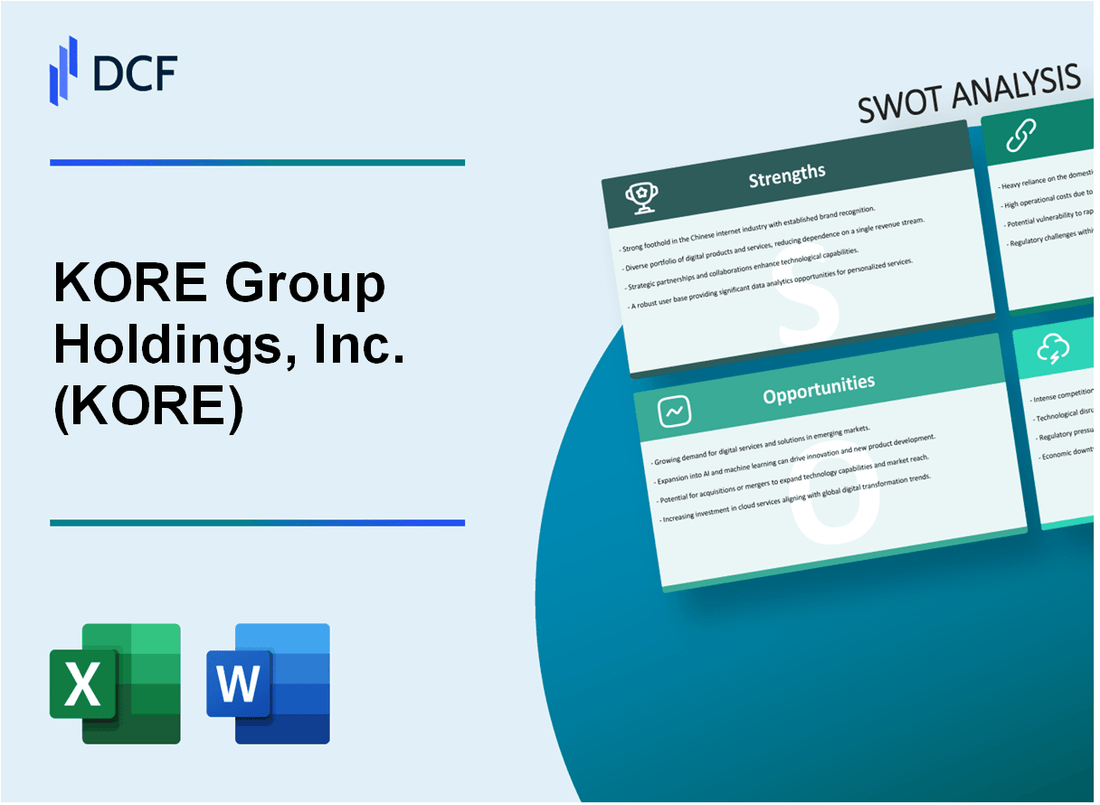
Completamente Editable: Adáptelo A Sus Necesidades En Excel O Sheets
Diseño Profesional: Plantillas Confiables Y Estándares De La Industria
Predeterminadas Para Un Uso Rápido Y Eficiente
Compatible con MAC / PC, completamente desbloqueado
No Se Necesita Experiencia; Fáciles De Seguir
KORE Group Holdings, Inc. (KORE) Bundle
En el mundo de Internet de las cosas en rápida evolución (IoT), Kore Group Holdings, Inc. se encuentra en una coyuntura crítica, equilibrando soluciones de conectividad innovadoras con desafíos complejos del mercado. A medida que la transformación digital se acelera en todas las industrias, este análisis FODA integral revela el posicionamiento estratégico de la compañía, explorando cómo Kore navega por sus fortalezas, enfrenta debilidades, aprovecha oportunidades emergentes y mitiga las posibles amenazas en el $ 250 mil millones Mercado global de IoT. Sumérgete en un examen perspicaz del panorama competitivo y el potencial estratégico de Kore en 2024.
Kore Group Holdings, Inc. (Kore) - Análisis FODA: Fortalezas
Plataforma de gestión de conectividad global de IoT líder
Kore opera una plataforma global de gestión de conectividad IoT que atiende a más de 3,200 clientes en más de 180 países. A partir del tercer trimestre de 2023, la compañía logró más de 21.5 millones de conexiones IoT en todo el mundo.
| Métrica de plataforma | Datos cuantitativos |
|---|---|
| Conexiones totales de IoT | 21.5 millones |
| Cobertura geográfica | Más de 180 países |
| Total de clientes | 3,200+ |
Soluciones integrales de IoT de extremo a extremo
Kore proporciona soluciones de IoT de extremo a extremo en múltiples dominios de tecnología:
- Gestión de conectividad
- Gestión de dispositivos
- Habilitación de aplicaciones
- Servicios de seguridad
Asociaciones establecidas
Kore mantiene asociaciones estratégicas con importantes operadores inalámbricos, que incluyen:
- AT&T
- Verizon
- T-Mobile
- Vodafone
Base de clientes diversificados
| De la industria vertical | Porcentaje de la base de clientes |
|---|---|
| Cuidado de la salud | 22% |
| Transporte/logística | 18% |
| Fabricación industrial | 15% |
| Servicios financieros | 12% |
| Otros sectores | 33% |
Modelo de ingresos recurrente
El desempeño financiero de Kore a partir del tercer trimestre de 2023 demuestra fuertes ingresos recurrentes:
- Ingresos de servicios basados en suscripción: $ 64.3 millones
- Porcentaje recurrente de ingresos: 73%
- Crecimiento anual de ingresos recurrentes: 12.5%
Kore Group Holdings, Inc. (Kore) - Análisis FODA: debilidades
Desafíos financieros continuos con pérdidas trimestrales consistentes
Kore Group Holdings informó una pérdida neta de $ 11.4 millones para el tercer trimestre de 2023, con una pérdida neta acumulada de $ 37.2 millones para los primeros nueve meses de 2023. Los estados financieros de la compañía revelan pérdidas trimestrales consistentes:
| Cuarto | Pérdida neta |
|---|---|
| Q1 2023 | $ 12.1 millones |
| Q2 2023 | $ 13.7 millones |
| P3 2023 | $ 11.4 millones |
Reconocimiento de marca limitado
La presencia del mercado de Kore sigue siendo limitada en comparación con los competidores de tecnología más grandes. La cuota de mercado de la compañía en el mercado de conectividad IoT es de aproximadamente el 3.5%, significativamente detrás de los líderes de la industria.
- Mercado de IoT totalmente direccionable: $ 520 mil millones
- La cuota de mercado estimada de Kore: 3.5%
- Los 3 principales competidores tienen más del 45% de participación de mercado combinada
Capitalización de mercado relativamente pequeña
A partir de enero de 2024, la capitalización de mercado de Kore es de $ 124.6 millones, lo que se considera pequeño en el competitivo sector de tecnología de IoT.
| Categoría de capitalización de mercado | Rango de valor |
|---|---|
| Kore Group Holdings | $ 124.6 millones |
| Competidores de IoT de nivel medio | $ 250- $ 750 millones |
| Grandes empresas de tecnología de IoT | $ 1- $ 5 mil millones |
Alta dependencia de la financiación externa
Los estados financieros de Kore indican una dependencia significativa de las fuentes de financiación externas:
- Deuda total a partir del tercer trimestre 2023: $ 98.3 millones
- Riesgo potencial de dilución de capital: 12-15% por ronda de financiación
- Tasa de quemadura de efectivo: aproximadamente $ 4.2 millones por trimestre
Infraestructura de tecnología compleja
Kore requiere sustanciales inversiones de tecnología continua para mantener un posicionamiento competitivo:
- Gastos anuales de I + D: $ 22.7 millones
- Costos de mantenimiento de la infraestructura tecnológica: $ 6.5 millones anuales
- Porcentaje de ingresos reinvertidos en tecnología: 18.3%
Indicadores clave de vulnerabilidad financiera:
| Métrico | Valor |
|---|---|
| Relación deuda / capital | 2.4:1 |
| Relación actual | 0.87 |
| Flujo de caja operativo | -$ 15.6 millones |
Kore Group Holdings, Inc. (Kore) - Análisis FODA: oportunidades
Expandir el mercado de IoT con un crecimiento significativo proyectado en múltiples industrias
Se proyecta que el mercado global de IoT alcanzará los $ 1,386.06 mil millones para 2026, con una tasa compuesta anual de 10.53% de 2021 a 2026. Los sectores clave de crecimiento de la industria incluyen:
| Industria | Valor de mercado de IoT proyectado para 2026 |
|---|---|
| Fabricación | $ 412.8 mil millones |
| Cuidado de la salud | $ 267.6 mil millones |
| Automotor | $ 225.4 mil millones |
Aumento de la demanda de soluciones de gestión de dispositivos conectados
Las estadísticas del mercado de gestión de dispositivos conectados indican:
- Se espera que crezca de $ 19.8 mil millones en 2022 a $ 48.7 mil millones para 2027
- CAGR del 19.6% durante el período de pronóstico
- América del Norte posee la mayor participación de mercado al 38%
Potencial para adquisiciones estratégicas para mejorar las capacidades tecnológicas
El potencial de estrategia de adquisición de Kore cuenta con el apoyo de:
- Mercado de adquisición de plataforma IoT valorado en $ 3.2 mil millones en 2022
- Actividad de M&A esperada en soluciones de conectividad IoT que crecen al 22% anual
Creciente interés empresarial en plataformas integrales de conectividad IoT
Enterprise IoT Connectivity Platform Market Insights:
| Segmento de mercado | 2024 Valor proyectado |
|---|---|
| Plataformas de IoT empresariales | $ 37.5 mil millones |
| Soluciones de conectividad de IoT empresarial | $ 22.3 mil millones |
Mercados emergentes con iniciativas de transformación digital creciente
Crecimiento del mercado de transformación digital en regiones emergentes:
- Mercado de transformación digital de Asia-Pacífico: $ 453.3 mil millones para 2025
- Gasto de transformación digital de Medio Oriente: $ 57.3 mil millones para 2025
- Mercado de transformación digital de América Latina: $ 43.8 mil millones para 2025
Kore Group Holdings, Inc. (Kore) - Análisis FODA: amenazas
Competencia intensa de compañías de tecnología y telecomunicaciones más grandes
El mercado global de conectividad IoT se valoró en $ 22.3 mil millones en 2023, con los principales competidores que incluyen:
| Compañía | Cuota de mercado (%) | Ingresos anuales ($ B) |
|---|---|---|
| Verizon | 15.7% | 133.7 |
| AT&T | 14.2% | 120.7 |
| Cisco | 11.5% | 51.6 |
Cambios tecnológicos rápidos en la conectividad y gestión de IoT
Indicadores de evolución de la tecnología IoT:
- Mercado global de IoT proyectado para alcanzar los $ 1.39 billones para 2026
- Se espera que las conexiones 5G alcancen 1.9 mil millones para 2024
- Tasa de crecimiento de la inversión anual de tecnología anual de IoT: 26.1%
Riesgos potenciales de ciberseguridad y desafíos de privacidad de datos
Panaje de amenaza de ciberseguridad:
| Métrico | Valor |
|---|---|
| Costos globales del delito cibernético | $ 8.15 billones en 2023 |
| Costo promedio de violación de datos | $ 4.45 millones |
| IoT del dispositivo de seguridad de la seguridad | 57% de aumento en 2023 |
Incertidumbres económicas que afectan el gasto en tecnología empresarial
Tendencias de gasto de tecnología empresarial:
- Pronóstico de gasto de TI global: $ 4.6 billones en 2024
- Crecimiento de gastos de tecnología esperada: 2.3%
- Mercado de servicios en la nube: $ 678.8 mil millones en 2024
Posibles interrupciones de la cadena de suministro en componentes de semiconductores y tecnología
Desafíos del mercado de semiconductores:
| Métrico | Valor |
|---|---|
| Ingresos globales de semiconductores | $ 574 mil millones en 2023 |
| Tiempos de entrega de semiconductores | Promedio de 22-26 semanas |
| Impacto de escasez de componentes | Pérdida de la industria de $ 500 mil millones en 2023 |
KORE Group Holdings, Inc. (KORE) - SWOT Analysis: Opportunities
Accelerating the adoption of SGP.32 (eSIM) innovation to simplify global IoT deployment.
The new GSMA SGP.32 specification for embedded SIM (eSIM) in the Internet of Things (IoT) is a massive opportunity for KORE, as it solves the major pain points of global deployment. This standard, which promises a zero-touch, build-once, ship-anywhere model, is finally moving from specification to reality in 2025. You should view KORE's early positioning here as a clear competitive advantage.
The market is poised for explosive growth in this area. Industry forecasts project the installed base of SGP.32 eSIMs to grow at a staggering 240% Compound Annual Growth Rate (CAGR) through 2028. To put that in perspective, the base is expected to surge from a small number of deployments to 192.8 million by 2028, outpacing the growth of the older M2M (Machine-to-Machine) and consumer eSIM standards. KORE is already preparing a comprehensive managed services approach to handle this transition, which lets their enterprise customers focus on their core business, not on complex provisioning infrastructure.
High-growth potential in the Connected Health sector, a key vertical focus.
Connected Health is a high-margin, mission-critical vertical where KORE has already committed significant resources, including appointing a dedicated Executive Vice President of Connected Health in 2024. This focus is defintely smart because the complexity of regulatory compliance (like HIPAA and ISO 13485) creates a high barrier to entry for competitors, which KORE already navigates for customers.
A significant opportunity for KORE in 2025 is the conversion of a large Connected Health contract that was delayed from 2024. This single contract could drive a material increase in high-value, recurring connectivity revenue. For a concrete example of the scale they are targeting, KORE is helping one digital healthcare company, Smart Meter, with their goal to deliver remote healthcare solutions to five million patients in five years.
Expanding market share in the global IoT market, which is valued well over $250 billion.
The sheer size of the addressable market is the biggest opportunity. Forget the conservative estimates; the global IoT market is projected to be valued at up to $1.35 trillion in 2025, according to some of the most recent data. Even a slightly more conservative forecast puts the 2025 value at $864.32 billion, growing at a 24.30% CAGR through 2032. This massive landscape gives KORE ample room to grow its market share.
KORE's recent operational metrics show they are capturing a piece of this growth. Here's the quick math on their core business momentum:
| Metric | Q3 2025 Value | Year-over-Year Change |
|---|---|---|
| Total Connections | 20.5 million | Up 9% |
| Q3 2025 Revenue | $68.7 million | Roughly flat |
| Q3 2025 Adjusted EBITDA | $14.5 million | Up 12% |
| 9-Month 2024 Closed-Won Total Contract Value (TCV) | $128 million | N/A (Focus on current pipeline strength) |
The 9% growth in total connections, reaching over 20.5 million in Q3 2025, shows that the core connectivity engine is accelerating, which is the foundational piece for long-term revenue expansion.
Leverage operational efficiencies to turn negative Q3 Free Cash Flow (-$1.1 million) into sustained positive cash flow.
The path to sustained profitability is clear: convert the strong Adjusted EBITDA growth into consistent Free Cash Flow (FCF). While Q3 2025 FCF was negative $1.1 million, this figure actually represents a $1.1 million improvement from the prior year and is a minor, temporary setback against a larger positive trend. What this estimate hides is the operational discipline already in place.
The company's restructuring plan, completed in 2024, is now delivering over $20 million in annual run-rate savings, which directly supports FCF. Also, KORE already demonstrated positive FCF earlier in 2025, reporting $1.6 million in Q2 2025 and $1.6 million in Q4 2024. Management's full-year 2025 FCF outlook is a solid range of $10 million to $14 million. The opportunity is simply to execute on this guidance and fully realize the benefits of those cost efficiencies.
- Realize $10 million to $14 million FCF target for full-year 2025.
- Sustain the $20 million+ annual run-rate savings from the 2024 restructuring.
- Maintain the Q3 2025 Cash from Operations of $1.1 million.
KORE Group Holdings, Inc. (KORE) - SWOT Analysis: Threats
You are operating in a market where the competition isn't just bigger; it's gargantuan, and that scale difference is a constant, material threat. Plus, any time a company suspends its financial outlook, it throws a wrench into investor confidence, and that's exactly what KORE Group Holdings, Inc. is facing in late 2025. You need to map these risks to understand the true cost of capital and market uncertainty.
Intense competition from much larger telcos like Verizon and AT&T
KORE, as a pure-play Internet of Things (IoT) hyperscaler, competes directly with the massive financial and network power of Tier-1 carriers like Verizon and AT&T. This isn't a fair fight on capital expenditure (CapEx) or brand recognition. To put the scale in perspective, KORE reported total revenue of $68.7 million in Q3 2025. Contrast that with the giants.
Verizon's total operating revenue for Q3 2025 was $33.8 billion, and AT&T's was $30.7 billion in the same period.
Here's the quick math on CapEx alone: AT&T's capital investment guidance for the full year 2025 is between $22 billion and $22.5 billion, and Verizon's is between $17.5 billion and $18.5 billion. KORE simply cannot match that investment in 5G, fiber, or next-generation IoT infrastructure, which makes it a defintely challenging environment. These larger players are actively expanding their own IoT platforms, using their vast cash flows to subsidize services and offer converged solutions that KORE cannot easily replicate.
| Metric (Q3 2025) | KORE Group Holdings, Inc. | Verizon Communications Inc. | AT&T Inc. |
|---|---|---|---|
| Total Operating Revenue | $68.7 million | $33.8 billion | $30.7 billion |
| Annual Free Cash Flow Guidance (FY2025) | Negative $1.1 million (Q3 FCF) | $19.5 billion to $20.5 billion | More than $16 billion |
Suspension of FY2025 financial guidance due to strategic review creates investor uncertainty
In November 2025, KORE suspended its full-year financial guidance, a move that immediately signals high uncertainty to the market. The original 2025 outlook projected total revenue between $288 million and $298 million and Adjusted EBITDA between $62 million and $67 million. Suspending this guidance, which was reiterated as recently as Q2 2025, tells investors that the range of potential outcomes is now too wide to be meaningful.
The core reason is the ongoing strategic review, which includes evaluating a non-binding acquisition proposal. This uncertainty makes it difficult for analysts to model future performance, leading to cautious investor behavior and potential stock price volatility. The market hates a vacuum, and the lack of a clear outlook fills that vacuum with risk.
Potential for a disruptive acquisition or merger that could redefine the company's trajectory
The strategic review itself is a threat because it introduces the possibility of a complete change in ownership and strategy. On November 3, 2025, KORE announced receiving a non-binding proposal from its existing investors, Searchlight Capital Partners and Abry Partners, to acquire all outstanding common stock not already owned by them for $5.00 per share in cash.
While this proposal offers a potential exit for shareholders, the risk is twofold:
- Employee and Customer Disruption: An acquisition can halt internal projects, lead to key employee departures, and create anxiety among customers about the long-term continuity of service and product roadmaps.
- Deal Failure Risk: There is no assurance that the proposal will result in a transaction. If the deal falls apart after the company has already suspended guidance and focused resources on the review, the stock could see a sharp decline, and management's credibility could suffer.
Declining non-GAAP gross margin in IoT Connectivity, which fell to 59.6% in Q3 2025
The core business, IoT Connectivity, is showing a slight but concerning erosion in profitability. The non-GAAP gross margin for the IoT Connectivity segment dropped to 59.6% in Q3 2025, down from 60.9% in the same quarter of 2024. This 130 basis point decline suggests increasing cost pressures or pricing competition.
The overall non-GAAP gross margin for the company also fell to 55.2% in Q3 2025, a drop of 147 basis points year-over-year. This margin compression is a threat because it directly limits the cash available for reinvestment in the platform and technology needed to fend off the larger competitors. A lower margin per connection means you need to scale connections faster just to maintain the same level of gross profit.
Disclaimer
All information, articles, and product details provided on this website are for general informational and educational purposes only. We do not claim any ownership over, nor do we intend to infringe upon, any trademarks, copyrights, logos, brand names, or other intellectual property mentioned or depicted on this site. Such intellectual property remains the property of its respective owners, and any references here are made solely for identification or informational purposes, without implying any affiliation, endorsement, or partnership.
We make no representations or warranties, express or implied, regarding the accuracy, completeness, or suitability of any content or products presented. Nothing on this website should be construed as legal, tax, investment, financial, medical, or other professional advice. In addition, no part of this site—including articles or product references—constitutes a solicitation, recommendation, endorsement, advertisement, or offer to buy or sell any securities, franchises, or other financial instruments, particularly in jurisdictions where such activity would be unlawful.
All content is of a general nature and may not address the specific circumstances of any individual or entity. It is not a substitute for professional advice or services. Any actions you take based on the information provided here are strictly at your own risk. You accept full responsibility for any decisions or outcomes arising from your use of this website and agree to release us from any liability in connection with your use of, or reliance upon, the content or products found herein.