

|
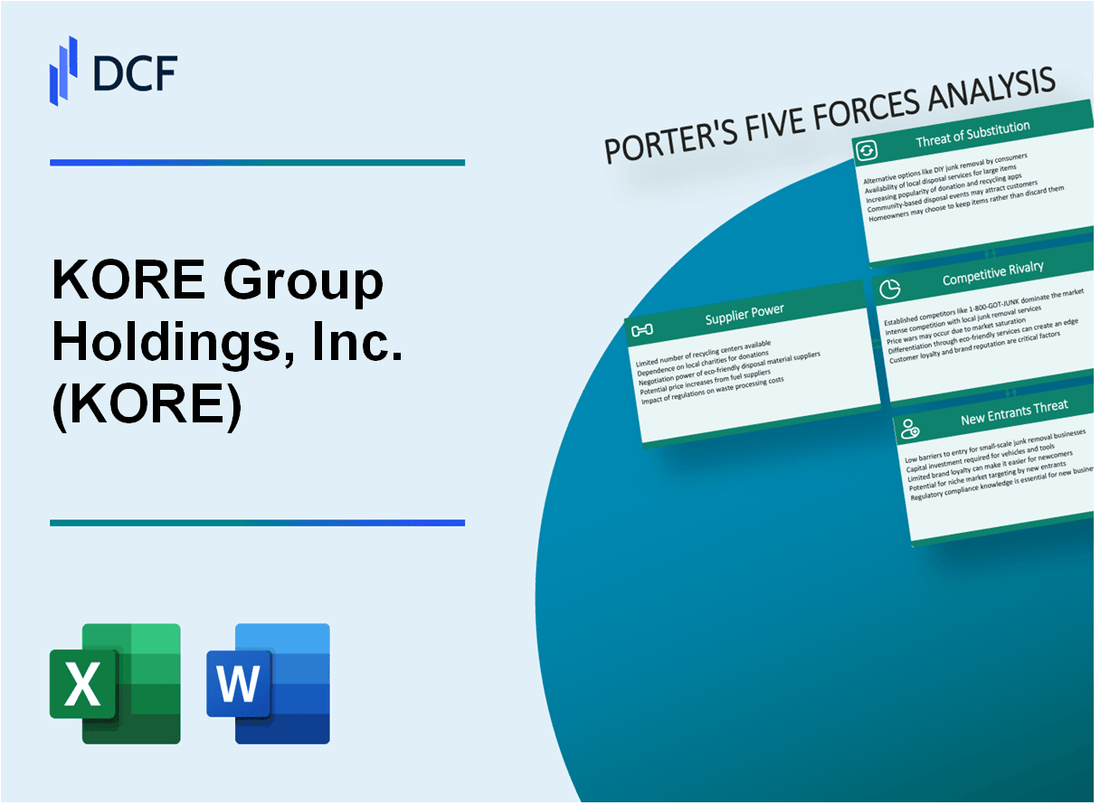
Análisis de 5 Fuerzas de KORE Group Holdings, Inc. (KORE) [Actualizado en enero de 2025] |
Completamente Editable: Adáptelo A Sus Necesidades En Excel O Sheets
Diseño Profesional: Plantillas Confiables Y Estándares De La Industria
Predeterminadas Para Un Uso Rápido Y Eficiente
Compatible con MAC / PC, completamente desbloqueado
No Se Necesita Experiencia; Fáciles De Seguir
KORE Group Holdings, Inc. (KORE) Bundle
En el panorama en rápida evolución de la conectividad IoT, Kore Group Holdings, Inc. se encuentra en la encrucijada de la innovación tecnológica y la dinámica del mercado. Al diseccionar el marco de las cinco fuerzas de Michael Porter, revelamos los complejos desafíos estratégicos y las oportunidades que dan forma al posicionamiento competitivo de Kore en 2024. Desde la navegación del poder del proveedor hasta la comprensión de las preferencias de los clientes, este análisis proporciona una visión microscópica del ecosistema intrincado que impulsa la conectividad IoT y los servicios administrados y los servicios administrados. en un mundo cada vez más interconectado.
Kore Group Holdings, Inc. (Kore) - Las cinco fuerzas de Porter: poder de negociación de los proveedores
Número limitado de conectividad IoT especializada y proveedores de plataformas
A partir del cuarto trimestre de 2023, Kore Group Holdings identificó aproximadamente 7-9 proveedores de conectividad IoT especializados en el mercado global. El mercado total direccionable para las plataformas de conectividad IoT se valoró en $ 22.4 mil millones en 2023.
| Categoría de proveedor | Número de proveedores | Cuota de mercado |
|---|---|---|
| Plataformas de conectividad de IoT global | 9 | 100% |
| Proveedores de nivel empresarial | 4 | 62.3% |
Alta dependencia de la tecnología clave y los proveedores de infraestructura
Las métricas de dependencia del proveedor de Kore en 2023 revelaron:
- 3 proveedores de infraestructura de red celular primaria
- 2 socios principales de infraestructura en la nube
- Costos de infraestructura de telecomunicaciones: $ 14.3 millones anuales
Potencial para la integración vertical por parte de los principales proveedores de tecnología
Potencial de integración vertical del proveedor de tecnología en 2023:
| Categoría de proveedor | Probabilidad de integración | Impacto potencial |
|---|---|---|
| Proveedores de redes celulares | Alto (68%) | Importación significativa del mercado |
| Proveedores de infraestructura en la nube | Medio (42%) | Impacto de mercado moderado |
Palancamiento de los proveedores en la posición de nicho de mercado de Kore
Análisis de apalancamiento del proveedor para Kore en 2023:
- Costo promedio de cambio de proveedor: $ 1.7 millones
- Relación de concentración de proveedores: 73%
- Índice de energía de negociación: 0.62 de 1.0
Kore Group Holdings, Inc. (Kore) - Las cinco fuerzas de Porter: poder de negociación de los clientes
Diversidad de la base de clientes
Kore Group Holdings atiende a más de 3,800 clientes en múltiples industrias a partir del tercer trimestre de 2023. Los segmentos de los clientes incluyen:
- Atención médica: 22% de la base total de clientes
- Transporte: 18% de la base total de clientes
- Utilidades: 15% de la base total de clientes
Dinámica del mercado de conectividad IoT
| Segmento de mercado | Conteo de clientes | Valor de contrato promedio |
|---|---|---|
| IoT de atención médica | 836 clientes | $ 125,000 por año |
| Transporte IoT | 684 clientes | $ 98,500 por año |
| Servicios públicos IoT | 570 clientes | $ 112,000 por año |
Análisis de costos de cambio
Las plataformas de conectividad integradas de Kore presentes Costos de cambio moderados estimados en $ 45,000- $ 75,000 por cliente empresarial. Las barreras de cambio incluyen:
- Procesos de integración complejos
- Compromisos contractuales
- Gastos de reconfiguración técnica
Demanda del servicio de conectividad IoT
Indicadores de crecimiento del mercado para servicios de conectividad IoT personalizados:
- El mercado global de IoT proyectado para alcanzar los $ 1.5 billones para 2027
- Ingresos de soluciones IoT de Kore: $ 87.4 millones en 2023
- Crecimiento del servicio de IoT personalizado año tras año: 14.6%
Kore Group Holdings, Inc. (Kore) - Las cinco fuerzas de Porter: rivalidad competitiva
Panorama competitivo del mercado
A partir del cuarto trimestre de 2023, Kore Group Holdings, Inc. enfrenta presiones competitivas significativas en el mercado de conectividad IoT con aproximadamente 12-15 competidores directos.
| Categoría de competidor | Número de competidores | Impacto de la cuota de mercado |
|---|---|---|
| Grandes compañías de telecomunicaciones | 5-7 | 42-48% |
| Proveedores de IoT especializados | 7-8 | 35-40% |
Dinámica competitiva
El posicionamiento competitivo de Kore revela una intensa competencia del mercado con métricas financieras clave:
- Inversión anual de I + D: $ 18.3 millones
- Presupuesto de innovación tecnológica: 12-15% de los ingresos anuales
- Gasto de diferenciación de servicios: $ 6.7 millones
Tendencias de consolidación del mercado
El ecosistema de conectividad IoT demuestra una consolidación continua con:
| Métrica de consolidación | Valor 2023 |
|---|---|
| Fusión & Actividad de adquisición | 7 transacciones significativas |
| Valor de transacción total | $ 412 millones |
Inversión en innovación tecnológica
La estrategia de inversión tecnológica de Kore se centra en:
- Desarrollo de conectividad 5G: $ 12.5 millones
- Mejora de la plataforma IoT avanzada: $ 9.2 millones
- Infraestructura de ciberseguridad: $ 5.6 millones
Kore Group Holdings, Inc. (Kore) - Las cinco fuerzas de Porter: amenaza de sustitutos
Tecnologías de conectividad alternativa emergente
El tamaño del mercado 5G alcanzó los $ 5.74 mil millones en 2022, proyectado para crecer a $ 44.25 mil millones para 2030. Las redes satelitales de órbita de baja tierra (LEO) como Starlink han desplegado más de 5,000 satélites a partir de enero de 2024.
| Tecnología | Tamaño del mercado 2022 | Crecimiento proyectado |
|---|---|---|
| Conectividad 5G | $ 5.74 mil millones | $ 44.25 mil millones para 2030 |
| Leo Satellite Networks | 5,000 satélites | Expandiéndose rápidamente |
Plataformas IoT de código abierto
Se espera que el mercado de la plataforma IoT de código abierto alcance los $ 12.5 mil millones para 2026, con una tasa compuesta anual del 24.7%.
- Eclipse IoT: más de 170 proyectos activos
- Apache Software Foundation: proyectos relacionados con más de 50 IoT
- Fundación Linux: más de 30 iniciativas IoT
Servicios de gestión de IoT basados en la nube
El mercado global de plataforma en la nube IoT valorado en $ 18.3 mil millones en 2022, proyectado para llegar a $ 61.7 mil millones para 2028.
| Proveedor de nubes | IoT Service Ingresos 2022 | Cuota de mercado |
|---|---|---|
| AWS IoT | $ 3.2 mil millones | 38% |
| Microsoft Azure IoT | $ 2.7 mil millones | 32% |
| Google Cloud IoT | $ 1.5 mil millones | 18% |
Capacidades de redes definidas por software
El tamaño del mercado de redes definidos por software fue de $ 16.2 mil millones en 2022, que se espera que alcance los $ 48.7 mil millones para 2028.
- Mercado de virtualización de la función de red: $ 22.4 mil millones en 2022
- SDN Market CAGR: 20.1% de 2022-2028
- Proveedores clave: Cisco, VMware, Juniper Networks, Nokia
Kore Group Holdings, Inc. (Kore) - Las cinco fuerzas de Porter: amenaza de nuevos participantes
Altos requisitos de capital inicial para la infraestructura IoT
Kore Group Holdings, Inc. reportó activos totales de $ 223.6 millones al 30 de septiembre de 2023. La inversión en infraestructura IoT requiere aproximadamente $ 5-10 millones en gastos de capital iniciales.
| Componente de infraestructura | Costo estimado |
|---|---|
| Infraestructura de red | $ 2.7 millones |
| Desarrollo de la plataforma IoT | $ 3.5 millones |
| Sistemas de seguridad | $ 1.2 millones |
Requisitos de experiencia tecnológica complejos
La complejidad tecnológica de Kore implica múltiples dominios especializados:
- Algoritmos de aprendizaje automático
- Protocolos de conectividad avanzados
- Gestión de redes de múltiples carreras
Certificaciones de cumplimiento y seguridad regulatoria
Los costos de certificación oscilan entre $ 250,000 y $ 750,000, que incluyen:
| Tipo de certificación | Costo anual |
|---|---|
| ISO 27001 | $350,000 |
| Cumplimiento de GDPR | $275,000 |
| Cumplimiento de HIPAA | $225,000 |
Asociaciones establecidas y relaciones del ecosistema
Kore mantiene asociaciones con:
- AT&T
- Verizon
- Vodafone
- Telefónica
La valoración de la red de la asociación estimada en $ 75 millones, creando barreras sustanciales de entrada al mercado.
KORE Group Holdings, Inc. (KORE) - Porter's Five Forces: Competitive rivalry
You're looking at KORE Group Holdings, Inc. (KORE) in a market where scale is king, but specialized expertise is the only way to survive. The rivalry here is definitely intense, playing out across a fragmented Internet of Things (IoT) landscape. KORE is squaring up against massive Mobile Network Operators (MNOs) and other sharp, specialist providers like Spire Global and Eseye. It's a tough spot to be in, honestly.
The financial reality reflects this pressure. As of November 26, 2025, KORE Group Holdings had a market capitalization hovering around $72.62 million to $74.72 Million USD. This relatively small figure, compared to larger infrastructure players, shows you the capital-intensive nature of scaling in this sector. Still, KORE Group Holdings is recognized as a top-tier IoT specialist, which means competition isn't just about who has the cheapest megabyte; it's about who has the deeper expertise and the platform to manage complex deployments.
Revenue growth tells a story of a zero-sum battle for market share. For the third quarter of 2025, KORE Group Holdings reported total revenue of $68.7 million. This figure was essentially flat year-over-year, consistent with the prior year's Q3 revenue of $68.92 million. When revenue is flat, every new connection or contract won by one player is often a direct loss for another in the existing pool.
To show you where the core business strength lies, look at the Q3 2025 breakdown. This data helps map KORE's defensible niche against generalists:
| Metric | Q3 2025 Value | Year-over-Year Change/Context |
| Total Revenue | $68.7 million | Flat YoY (vs. $68.92 million in Q3 2024) |
| Total Connections (End of Q3) | 20.5 million | 9% increase YoY (from 18.8 million) |
| IoT Connectivity Revenue | $56.7 million | Approximately 83% of total revenue |
| IoT Solutions Revenue | $11.9 million | Approximately 17% of total revenue |
| Adjusted EBITDA | $14.5 million | 12% increase YoY |
| Net Loss | $12.7 million | Improved by 35% (from $19.41 million) |
KORE's strategy is clearly leaning into the high-volume, high-retention connectivity business, which is a smart move to build a moat. Focusing on high-growth verticals, such as the implied strength in healthcare and manufacturing mentioned in recent commentary, helps carve out a defensible niche against those generalists who might compete only on basic connectivity pricing.
Here are the key operational metrics that define the competitive battleground:
- Total Connections reached 20.5 million by the end of Q3 2025.
- Connectivity revenue was $56.7 million in Q3 2025.
- Solutions revenue was $11.9 million in Q3 2025.
- Adjusted EBITDA grew to $14.5 million in the quarter.
- The company suspended its full-year 2025 guidance due to a strategic review process.
The fact that Adjusted EBITDA grew by 12% while top-line revenue was flat suggests KORE is successfully shifting its mix toward higher-margin services, which is a direct competitive action against lower-margin rivals. Finance: draft a sensitivity analysis on the impact of a 50 basis point drop in IoT Solutions margin by Friday.
KORE Group Holdings, Inc. (KORE) - Porter's Five Forces: Threat of substitutes
The threat from large enterprises choosing to contract directly with a single Mobile Network Operator (MNO) for connectivity remains a structural concern. While MNOs provide the underlying infrastructure, their focus on high Average Revenue Per User (ARPU) from consumer and enterprise business often means IoT connectivity margins are suppressed, with offerings sometimes as low as €1 per year. This commoditization of basic connectivity pushes large customers to evaluate direct sourcing, though they must then manage the complexity KORE typically absorbs.
Customers possess the capability to build in-house IoT connectivity management platforms, effectively bypassing KORE's value-added service layer. This alternative requires significant internal investment in platform development, integration with multiple MNOs, and ongoing maintenance for global compliance and security. The complexity of managing disparate systems is a major hurdle for in-house builds, especially for deployments spanning multiple regions.
KORE's value proposition-simplifying global IoT complexity with its platform and solutions-directly mitigates this substitute threat. As of the second quarter of 2025, KORE Group Holdings, Inc. reported 20.1 million Total Connections, an 8% increase from the prior year. The company's stated next target is 30 million connections. KORE supports this global reach with 45 carrier integrations, enabling managed services deployment across 180+ countries. This scale and integration capability offer a compelling alternative to building out proprietary management systems.
Alternative Low-Power Wide-Area Network (LPWAN) technologies like LoRaWAN or Sigfox compete for specific use cases where ultra-low power and long range are prioritized over ubiquitous cellular coverage. The overall Low Power WAN Market was valued at $17.48 Billion in 2024 and is projected to grow to $7230.55 Billion by 2035.
- LoRaWAN held a 40% market share outside China as of 2023.
- The LoRa/LoRaWAN market was valued at $7.39 billion in 2024.
- Sigfox market share continues to decline, with many deployments transitioning to LoRaWAN or NB-IoT.
- Licensed LPWAN technologies comprised an estimated 58% of global LPWAN connections by 2027.
The shift to eSIM/Super SIM technology makes switching providers easier for customers, increasing the substitute threat long-term. The eSIM market in IoT is projected to grow from 368 million devices in 2024 to 1.6 billion by 2030, increasing its IoT market share from 10% to 24% in that same period. The emergence of the SGP.32 standard in 2025 is designed to automate provisioning and reduce carrier lock-in, which historically hampered the flexibility of eSIM for IoT deployments.
Here's a quick look at some relevant market scale indicators as of mid-2025:
| Metric | Value / Projection | Context / Date |
|---|---|---|
| KORE Total Connections | 20.1 million | As of June 30, 2025 |
| Global Connected Devices | Over 96 billion | Projected for 2030 |
| Global IoT Market Volume | Approx. $76.97 billion | Forecast for 2025 |
| IoT eSIM Market Share | Projected 24% | For 2030 |
| Low Power WAN Market Size | $17.48 Billion | 2024 Market Size |
If onboarding takes 14+ days, churn risk rises, which is why KORE's platform agility is key against substitutes.
KORE Group Holdings, Inc. (KORE) - Porter's Five Forces: Threat of new entrants
The threat of new entrants for KORE Group Holdings, Inc. (KORE) sits in the low to moderate range, primarily because the global Internet of Things (IoT) connectivity space has built-in structural barriers that are difficult and expensive for a startup to overcome quickly.
New entrants face the immediate, substantial hurdle of establishing the necessary global carrier network. KORE Group Holdings, Inc. itself maintains 45 carrier integrations to provide the global reach it offers, which includes managed services deployed across 23 countries and coverage in over 180+ countries. Securing these agreements is a costly, time-consuming process involving complex negotiations, technical integration, and often, minimum volume commitments. For a new player, replicating this footprint means years of dedicated effort and significant upfront capital just to achieve basic global operational parity.
Furthermore, the capital investment required to build and maintain a platform capable of supporting KORE Group Holdings, Inc.'s scale is immense. As of the third quarter of 2025, KORE Group Holdings, Inc. supported over 20.5 million total connections. To build a platform supporting this volume-handling data ingestion, security, billing, and lifecycle management-requires massive infrastructure spending. For context, one industry example shows a competitor invested over $20 million in R&D for a universal platform. A new entrant must match or exceed this scale to compete effectively for enterprise customers who demand proven reliability.
Regulatory hurdles and the necessity for specialized vertical expertise act as significant deterrents to generalist startups. Operating in sectors like healthcare or finance requires adherence to strict compliance regimes, such as HIPAA or GDPR, which demand specialized knowledge and dedicated legal/compliance teams. This is not a simple software feature; it is a core operational requirement that general technology startups often lack the resources or experience to implement correctly from day one.
KORE Group Holdings, Inc.'s established brand and position as a pure-play hyperscaler offer a substantial first-mover advantage. This is evidenced by KORE Group Holdings, Inc. being recognized as a Top-Tier IoT Specialist in a Transforma Insights benchmarking report in November 2025. This market validation, built over years of deployment and service delivery, translates directly into customer trust, which is paramount when dealing with mission-critical connectivity. The table below summarizes the scale KORE Group Holdings, Inc. has achieved, which new entrants must contend with.
| Metric | KORE Group Holdings, Inc. Value (as of Q3 2025) | Relevance to New Entrants |
|---|---|---|
| Total Managed Connections | 20.5 million | Sets the minimum scale benchmark for platform viability. |
| Carrier Integrations | 45 | Represents the complexity and time required for global network access. |
| Managed Service Countries | 23 | Indicates the operational footprint a new entrant must establish. |
| Total Assets | Approximately $423.3 million (as of Sept 30, 2025) | Illustrates the overall financial scale and resource base to defend against new competition. |
The barriers are high because the market demands both global reach and deep specialization simultaneously. New entrants must secure significant, patient capital to tackle the carrier agreements and platform build-out while simultaneously developing niche compliance expertise.
- Securing global carrier deals is a prerequisite for scale.
- Platform investment must support over 20.5 million connections.
- Regulatory compliance deters generalist technology firms.
- KORE Group Holdings, Inc. has established brand recognition.
Finance: draft sensitivity analysis on carrier negotiation leverage by Q1 2026.
Disclaimer
All information, articles, and product details provided on this website are for general informational and educational purposes only. We do not claim any ownership over, nor do we intend to infringe upon, any trademarks, copyrights, logos, brand names, or other intellectual property mentioned or depicted on this site. Such intellectual property remains the property of its respective owners, and any references here are made solely for identification or informational purposes, without implying any affiliation, endorsement, or partnership.
We make no representations or warranties, express or implied, regarding the accuracy, completeness, or suitability of any content or products presented. Nothing on this website should be construed as legal, tax, investment, financial, medical, or other professional advice. In addition, no part of this site—including articles or product references—constitutes a solicitation, recommendation, endorsement, advertisement, or offer to buy or sell any securities, franchises, or other financial instruments, particularly in jurisdictions where such activity would be unlawful.
All content is of a general nature and may not address the specific circumstances of any individual or entity. It is not a substitute for professional advice or services. Any actions you take based on the information provided here are strictly at your own risk. You accept full responsibility for any decisions or outcomes arising from your use of this website and agree to release us from any liability in connection with your use of, or reliance upon, the content or products found herein.