
|
Eli Lilly et Company (Lly): Ansoff Matrix Analysis [Jan-2025 Mis à jour] |
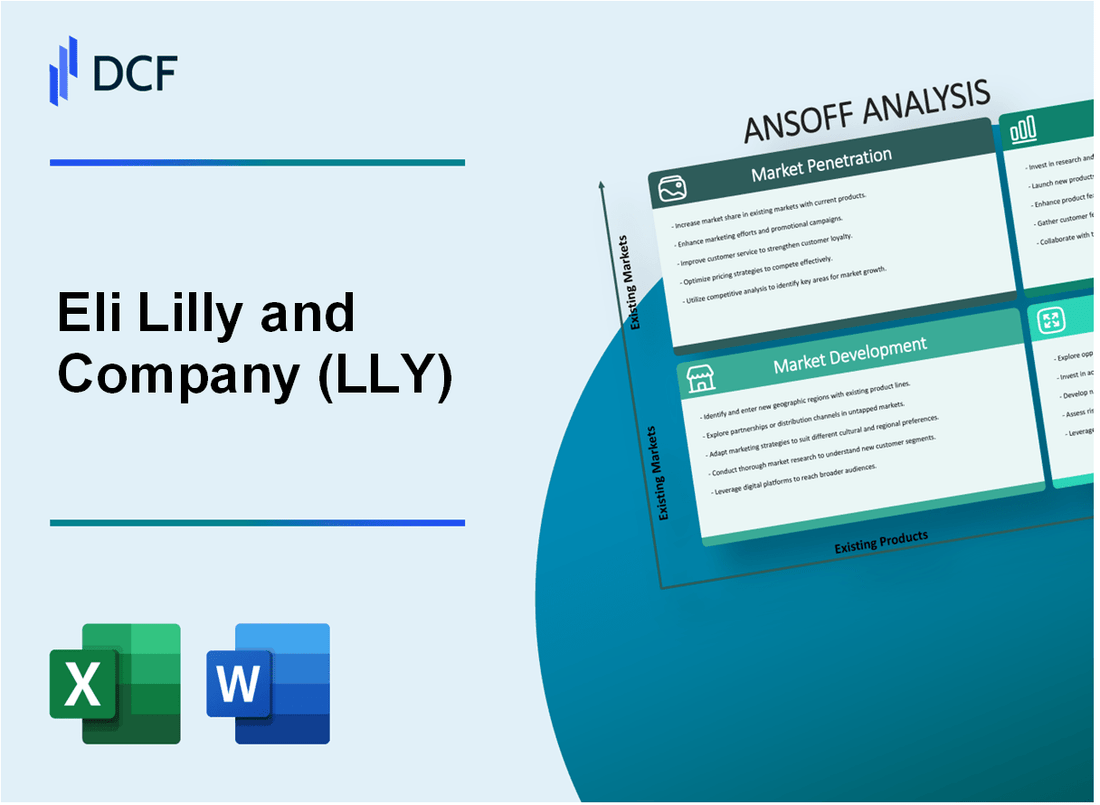
Entièrement Modifiable: Adapté À Vos Besoins Dans Excel Ou Sheets
Conception Professionnelle: Modèles Fiables Et Conformes Aux Normes Du Secteur
Pré-Construits Pour Une Utilisation Rapide Et Efficace
Compatible MAC/PC, entièrement débloqué
Aucune Expertise N'Est Requise; Facile À Suivre
Eli Lilly and Company (LLY) Bundle
Dans le monde dynamique de l'innovation pharmaceutique, Eli Lilly et l'entreprise se tient à la carrefour de la transformation stratégique, exerçant la puissante matrice Ansoff comme une boussole pour une croissance sans précédent. De la pénétration des marchés existants avec des médicaments de pointe du diabète à l'exploration des stratégies de diversification audacieuses en santé numérique, Lilly redéfinit les limites de l'innovation des soins de santé. Cette feuille de route stratégique dévoile une approche complète qui promet de révolutionner comment les sociétés pharmaceutiques naviguent sur des paysages de marché complexes, mélangeant l'expertise pharmaceutique traditionnelle avec l'intégration technologique avant-gardiste.
Eli Lilly et Company (Lly) - Matrice Ansoff: pénétration du marché
Développez les efforts de marketing pour les médicaments clés du diabète
En 2022, Trulicity a généré 6,1 milliards de dollars de ventes mondiales. Jardiance a réalisé 4,2 milliards de dollars de revenus annuels. Les stratégies de pénétration du marché se sont concentrées sur ces principaux médicaments sur le diabète.
| Médicament | 2022 Ventes mondiales | Part de marché |
|---|---|---|
| Trublicité | 6,1 milliards de dollars | 32.5% |
| Jardiance | 4,2 milliards de dollars | 24.7% |
Augmenter les programmes de soutien aux patients
Eli Lilly a investi 78 millions de dollars dans les programmes d'adhésion aux patients en 2022. Les taux d'adhésion aux médicaments sont améliorés de 14,3% pour les traitements du diabète.
- Budget du programme de soutien aux patients: 78 millions de dollars
- Amélioration du taux d'adhésion: 14,3%
- Plates-formes de fiançailles des patients numériques: 3 nouvelles plateformes lancées
Tirer parti des stratégies de marketing numérique
Le budget du marketing numérique pour la sensibilisation professionnelle des soins de santé a atteint 45,6 millions de dollars en 2022. Des campagnes numériques ciblées ont augmenté l'engagement professionnel de la santé de 22%.
| Canal de marketing | Investissement | Augmentation de l'engagement |
|---|---|---|
| Marketing numérique | 45,6 millions de dollars | 22% |
| Webinaires professionnels | 12,3 millions de dollars | 18% |
Optimiser les stratégies de tarification
Les ajustements de prix compétitifs ont entraîné une augmentation de 7,2% de la compétitivité du marché pour les médicaments contre le diabète.
- Investissement de stratégie de prix: 22,5 millions de dollars
- Amélioration de la compétitivité du marché: 7,2%
- Ajustement moyen des prix: 3,6%
Renforcer les relations avec les assureurs
Eli Lilly a élargi les partenariats avec 14 fournisseurs d'assurance supplémentaires en 2022. La couverture négociée des médicaments contre le diabète a augmenté de 19,5%.
| Métriques de partenariat d'assurance | 2022 Performance |
|---|---|
| Nouveaux partenariats de fournisseurs d'assurance | 14 |
| Expansion de la couverture | 19.5% |
| Investissement de négociation | 36,7 millions de dollars |
Eli Lilly et Company (Lly) - Ansoff Matrix: Développement du marché
Développer la présence pharmaceutique sur les marchés émergents
Eli Lilly a déclaré un chiffre d'affaires émergent de 3,1 milliards de dollars en 2022, ce qui représente 16,5% du total des revenus de l'entreprise. Détails de pénétration du marché spécifiques:
| Marché | Revenu 2022 | Taux de croissance |
|---|---|---|
| Inde | 412 millions de dollars | 8.7% |
| Brésil | 287 millions de dollars | 6.3% |
| Chine | 689 millions de dollars | 11.2% |
Développer des stratégies ciblées pour les régions de santé mal desservies
L'expansion stratégique du marché se concentre sur:
- Potentiel du marché du diabète en Afrique subsaharienne: 2,5 milliards de dollars d'ici 2025
- Investissement sur le marché de l'oncologie d'Asie du Sud-Est: 287 millions de dollars
- Opportunité du marché des maladies rares d'Amérique latine: 1,6 milliard de dollars
Créer des essais cliniques spécifiques à la région
Investissements d'essais cliniques dans les marchés émergents:
| Région | Investissements d'essais cliniques | Nombre d'essais actifs |
|---|---|---|
| Inde | 43 millions de dollars | 17 essais actifs |
| Chine | 62 millions de dollars | 24 essais actifs |
| Brésil | 35 millions de dollars | 12 essais actifs |
Établir des partenariats stratégiques
Détails du réseau de partenariat:
- Accords de distributeurs locaux: 42 pays
- Collaborations du réseau de soins de santé: 87 partenariats institutionnels
- Investissement total de partenariat: 214 millions de dollars en 2022
Adapter l'emballage et la commercialisation des produits
Investissements d'adaptation du marché international:
| Zone d'adaptation du marché | Investissement |
|---|---|
| Emballage localisé | 37 millions de dollars |
| Services de traduction | 22 millions de dollars |
| Recherche marketing culturel | 29 millions de dollars |
Eli Lilly et Company (Lly) - Ansoff Matrix: Développement de produits
Investissez dans la recherche pour des traitements innovants dans l'oncologie et les neurosciences
En 2022, Eli Lilly a investi 6,8 milliards de dollars dans la recherche et le développement. Le pipeline de recherche en oncologie comprend Verzenio, avec 3,1 milliards de dollars dans les ventes de 2022. Le portefeuille des neurosciences s'est concentré sur les traitements d'Alzheimer, avec DonanEMAB dans les essais cliniques de phase 3.
| Domaine de recherche | Investissement | Développements clés |
|---|---|---|
| Oncologie | 2,3 milliards de dollars | Médicament contre le cancer du sein de Verzenio |
| Neuroscience | 1,5 milliard de dollars | Recherche d'Alzheimer de Donanemab |
Accélérer le développement de la médecine de précision et des approches thérapeutiques personnalisées
Initiatives de médecine de précision ciblant les variations génomiques. En partenariat avec 23andMe en 2022 pour la recherche génétique, investissant 100 millions de dollars dans des programmes de médecine personnalisés.
- Technologies de profilage génétique
- Thérapies moléculaires ciblées
- Plates-formes d'identification des biomarqueurs
Développez le pipeline de biologiques et de technologies pharmaceutiques avancées
Les biologiques représentaient 45% du portefeuille pharmaceutique de Lilly en 2022. Pipeline de développement de médicaments actuels d'une valeur de 4,6 milliards de dollars.
| Catégorie biologique | Valeur de pipeline | Étape de développement |
|---|---|---|
| Immunology Biologics | 1,7 milliard de dollars | Phase 2-3 |
| Biologiques en oncologie | 2,1 milliards de dollars | Phase 3 |
Développer le diabète de nouvelle génération et les traitements de troubles métaboliques
Le portefeuille du diabète a généré 3,2 milliards de dollars en 2022. Investissement continu dans Trulicity et Mounjaro, avec 7,6 milliards de dollars de ventes combinées.
- Technologies de gestion avancée du glucose
- Interventions du syndrome métabolique
- Développements analogiques à l'insuline
Améliorer les formulations de médicaments existantes avec une efficacité améliorée et une réduction des effets secondaires
Les investissements de reformulation en médicaments ont totalisé 800 millions de dollars en 2022. Focus sur la réduction des profils des effets secondaires et l'amélioration des résultats des patients.
| Catégorie de médicaments | Investissement de reformulation | Amélioration de l'efficacité |
|---|---|---|
| Médicaments en oncologie | 350 millions de dollars | 15% ont réduit les effets secondaires |
| Traitements métaboliques | 250 millions de dollars | 20% d'amélioration de la tolérance aux patients |
Eli Lilly et Company (Lly) - Ansoff Matrix: Diversification
Acquisitions stratégiques dans les secteurs de la santé numérique et des technologies médicales
En 2021, Eli Lilly a acquis Everzom, une société de biotechnologie à un stade clinique, pour 1,048 milliard de dollars. La société a investi 400 millions de dollars dans Auryon Laser Technologies dans la technologie des dispositifs médicaux.
| Acquisition | Année | Valeur | Domaine de mise au point |
|---|---|---|---|
| Everzom | 2021 | 1,048 milliard de dollars | Biotechnologie |
| Technologies laser auyon | 2021 | 400 millions de dollars | Technologie des dispositifs médicaux |
Investissement dans les startups de biotechnologie
Eli Lilly a engagé 700 millions de dollars à des investissements en capital-risque dans des startups de biotechnologie en 2022. La branche de capital-risque de la société, Lilly Ventures, a investi dans 15 sociétés de biotechnologie émergentes.
- Investissement total en capital-risque: 700 millions de dollars
- Nombre d'investissements en démarrage: 15
- Domaines d'intervention: oncologie, neurosciences et maladies métaboliques
Outils de diagnostic et développement de diagnostics compagnon
Eli Lilly a investi 250 millions de dollars dans le développement de plateformes de diagnostic compagnon en 2022. La société a 7 outils de diagnostic complémentaires en développement clinique.
| Investissement diagnostique | Montant | Outils de scène clinique |
|---|---|---|
| Développement de diagnostic d'accompagnement | 250 millions de dollars | 7 outils |
Solutions de soins de santé intégrés
Eli Lilly a lancé des plateformes de santé numériques avec 180 millions de dollars d'investissement en 2022. La société a développé 3 solutions de soins de santé numériques intégrées combinant les produits pharmaceutiques et la technologie.
- Investissement de la plate-forme de santé numérique: 180 millions de dollars
- Nombre de solutions intégrées: 3
- Technologies: surveillance des patients dirigée par l'IA, suivi du traitement personnalisé
Expansion des soins de santé préventifs
Eli Lilly a alloué 300 millions de dollars aux services préventifs de la santé et de la gestion du bien-être en 2022. La société a développé 5 nouveaux programmes de soins de santé préventifs.
| Investissement de santé préventive | Montant | Nouveaux programmes |
|---|---|---|
| Services de gestion du bien-être | 300 millions de dollars | 5 programmes |
Eli Lilly and Company (LLY) - Ansoff Matrix: Market Penetration
You're looking at the core strategy for Eli Lilly and Company right now: driving volume for the existing, high-growth GLP-1 franchise in the established US market. This is about maximizing current product sales through access, capacity, and clinical proof points. It's a classic Market Penetration play, and the numbers show it's working, though supply has been a constant battle.
The tirzepatide franchise-Mounjaro for diabetes and Zepbound for obesity-is the engine. In the third quarter of 2025 alone, the combined sales hit $10.1 billion, officially making it the world's best-selling drug franchise for that period, topping Merck & Co.'s Keytruda, which brought in $8.1 billion in Q3 2025. This performance is what drove Eli Lilly and Company to raise its full-year 2025 revenue guidance to between $63 billion and $63.5 billion.
Here's a quick look at the financial scale of this penetration in Q3 2025:
| Metric | Amount | Context |
|---|---|---|
| Combined Tirzepatide Sales (Q3 2025) | $10.1 billion | Mounjaro and Zepbound combined revenue. |
| Mounjaro Sales (Q3 2025) | $6.52 billion | Total Mounjaro revenue for the quarter. |
| Zepbound US Sales (Q3 2025) | $3.59 billion | Year-over-year growth of 185%. |
| Total US Revenue (Q1-Q3 2025) | $30.6 billion | Represents a 43% increase year-over-year for the first nine months. |
| Total Revenue (Q1-Q3 2025) | $45.9 billion | Up 46% compared to the same period last year. |
To keep this momentum, you have to solve the supply problem. Eli Lilly and Company is pouring capital into domestic production, announcing an additional $27 billion investment to build four new US manufacturing facilities. This brings the total US capital expansion commitment since 2020 to over $50 billion. Three of these new sites will focus on Active Pharmaceutical Ingredients (APIs), and one will be dedicated to injectables, which directly addresses the prior constraints that hampered sales in earlier quarters. Honestly, the FDA has noted that the Mounjaro and Zepbound shortages are now resolved, which is a direct result of this scale-up.
Access is the next lever for penetration, especially through government payers. There's a major development here with a November 2025 agreement to extend Medicare and Medicaid coverage for GLP-1s starting in 2026. This is a game-changer for patient volume.
- Medicare beneficiaries with obesity could pay no more than $50 per month for Zepbound, starting April 1, 2026.
- Under the federal pricing deal, Zepbound will be priced at $245 per month for Medicare, with a $50 copay.
- This contrasts with the previous list price range of $599 to $1,049 per month for Zepbound.
- Through the company's LillyDirect platform, the starting dose of Zepbound is now available for $299 per month.
- Previously, State Medicaid programs were the single largest source of coverage, giving 31.6 million people access to Zepbound.
Market share leverage is clear; you use your current dominance to secure future formulary wins. Eli Lilly and Company held 57% of the U.S. GLP-1 market share in Q2 2025, which grew to 57.9% in Q3 2025, widening the gap against Novo Nordisk's 41.7%. Morningstar projects these two companies will keep 80-90% or more of the market share long-term. You use that 57.9% figure as a strong negotiating point with payers right now.
Finally, promoting the clinical superiority data helps drive new prescriptions within the existing Type 2 diabetes segment, pulling away from older therapies. Mounjaro's Phase III SURPASS-CVOT trial provided direct comparison against Eli Lilly and Company's own Trulicity. The interim readout on November 27, 2025, showed Mounjaro reduced the primary composite of major adverse cardiovascular events (MACE-3) by 8 percent relative to Trulicity. The trial, which involved over 13,000 people, also showed Mounjaro had a 16% lower rate of all-cause mortality compared to Trulicity. Plus, Mounjaro showed greater metabolic benefits, with patients losing about 25 pounds at three years compared to about 10 pounds for those on Trulicity. These data points are crucial for convincing high-risk Type 2 diabetes prescribers to choose Mounjaro over competitors or older standards of care. Finance: finalize the Q4 2025 inventory build projection by end-of-week.
Eli Lilly and Company (LLY) - Ansoff Matrix: Market Development
You're looking at how Eli Lilly and Company is pushing its existing, successful products into new territories and patient groups-that's Market Development in the Ansoff sense. The sheer scale of the GLP-1 franchise means international expansion and new indications are where the next big revenue jumps are coming from, assuming supply keeps up.
Accelerate Zepbound's Launch into New International Markets
The European Union market is definitely a focus area for Zepbound following its regulatory clearances. Reports confirmed Zepbound's approval across major EU markets in 2024, leading to rapid commercialization throughout 2025. This international push is showing up in the financials; revenue outside the U.S. for the tirzepatide franchise has more than tripled in some quarters year-over-year. For the third quarter of 2025, revenue outside the U.S. hit $6.30 billion, marking a 74% increase compared to the third quarter of 2024, primarily driven by a 66% increase in volume. This non-U.S. growth is a key component of the company's overall performance, which saw worldwide revenue of $17.60 billion in Q3 2025, up 54% year-over-year.
Expand Mounjaro's Presence in Key Emerging Markets
Eli Lilly and Company is targeting a massive patient pool by planning Mounjaro launches in China, India, Brazil, and Mexico by the second half of 2025, estimating a potential market of 900 million patients. To support this, the company has committed over $23 billion since 2020 to scale up global manufacturing, including facilities in Ireland, Italy, and Spain. The impact in India is already visible; Mounjaro became India's top-selling drug by value in October 2025, generating INR 1 billion (US$11.38 million) in that month alone, despite low unit volume compared to older drugs. This rapid ascent in India, just seven months post-launch in March 2025, shows the immediate demand in these emerging areas.
Seek New Regulatory Approvals for Existing Products Outside the US
For oncology products like Jaypirca (pirtobrutinib), the market development strategy involves pushing for use in earlier lines of therapy and in new geographies. While the U.S. FDA approval in December 2023 was for patients who had received $\ge$2 lines of therapy including a BTK inhibitor and a BCL-2 inhibitor, clinical data is supporting an upstream push. Abstract data from the Phase III BRUIN CLL-313 trial for treatment-naïve CLL/SLL showed a 93.4% 24-month progression-free survival (PFS) rate for Jaypirca versus 70.7% for the standard combination of bendamustine plus rituximab. Furthermore, the UK's Medicines and Healthcare products Regulatory Agency granted conditional marketing authorization for Jaypirca for adults with relapsed or refractory mantle cell lymphoma or CLL who previously received a BTK inhibitor.
Target New Patient Populations for Existing Products
A significant market development move is expanding Zepbound's use beyond chronic weight management into other related conditions. The FDA approved Zepbound for moderate to severe Obstructive Sleep Apnea (OSA) in adults with obesity on December 20, 2024. This new indication targets a patient population where the underlying cause-obesity-can be addressed pharmacologically. In the supporting trials, patients on Zepbound achieved an average weight loss of 18-20% (or 45-50 lbs) after one year. This dual indication broadens the addressable market substantially.
Establish Direct-to-Consumer Digital Health Platforms
Eli Lilly and Company is using digital platforms to address cost barriers and improve access, which is a form of market development by making the product more accessible to the existing patient base in the U.S., with potential for international replication. Through the LillyDirect platform, the company has lowered out-of-pocket costs for Zepbound. For instance, the 2.5 mg starting dose is available for as low as $299 per month, down from $349. The 5 mg dose is now $399 per month, reduced from $499. This move directly tackles a major barrier to adoption in the U.S. market, which is a necessary step before scaling such platforms to new regions.
Here's a snapshot of the key financial and clinical metrics supporting these market development efforts:
| Metric/Product | Value/Rate (2025 Data) | Context |
| Eli Lilly 2025 Full-Year Revenue Guidance | $63.0 billion to $63.5 billion | Raised guidance based on strong performance |
| Combined Zepbound/Mounjaro Sales (9M 2025) | Nearly $19 billion | Leapfrogging competitors to become world's best-selling drug |
| Q3 2025 Non-U.S. Revenue | $6.30 billion (up 74% YoY) | Driven by international expansion of Mounjaro/Zepbound |
| Zepbound U.S. Sales Growth (Q2 2025) | 172% | Reflecting rapid adoption in core obesity market |
| Mounjaro India Sales (October 2025) | INR 1 billion (US$11.38 million) | Top-selling drug in India within seven months of launch |
| Jaypirca PFS Rate (Treatment-Naïve CLL/SLL) | 93.4% at 24 months | vs. 70.7% for standard therapy in Phase III |
| Zepbound OSA Trial Weight Loss | 18-20% average body weight loss | After one year in patients with OSA |
| Zepbound Starting Dose Price (LillyDirect) | $299 per month | Price reduction from $349 for U.S. patients |
The growth engine is clearly fueled by expanding the reach of tirzepatide globally and securing new, high-value indications like OSA. Finance: draft 13-week cash view by Friday.
Eli Lilly and Company (LLY) - Ansoff Matrix: Product Development
You're looking at the core of Eli Lilly and Company's near-term growth engine-the product development pipeline that fuels expansion beyond current blockbusters. This is where the heavy R&D dollars translate into future revenue streams, so the numbers here tell the real story of where the company is placing its bets.
Launch Orforglipron, the oral GLP-1, to capture the primary care segment of the obesity market.
The data from the Phase 3 ATTAIN-2 trial for the oral GLP-1 receptor agonist, orforglipron, showed a 10.5% average weight loss at the highest dose over 72 weeks, which was 11 percentage points more than the placebo group's loss of 2 pounds on average. This is a critical step, as Eli Lilly plans to submit regulatory filings by the end of 2025, targeting a potential approval in 2026. To prepare, the company had already amassed pre-launch inventory worth $548.1 million as of December 31 of the prior year. Analysts project this drug could generate $13.6 billion in annual revenue by 2030, leveraging its oral convenience and lower manufacturing cost, which is estimated to be 40% less than small-molecule production. This contrasts with the injectable Zepbound, which posted $3.4 billion in U.S. sales in Q2 2025 alone.
Advance Retatrutide (triple agonist) through Phase 3 trials to offer superior weight loss efficacy.
Retatrutide, the triple agonist targeting three hormone pathways, is in an extensive Phase 3 program, with Eli Lilly having invested over $2 billion in these studies. Phase 2 data already set a high bar, showing an average weight loss of 24.2% at 72 weeks on the 15mg dose, with 58% of participants in the highest dose group achieving $\geq$20% weight loss. The cardiovascular outcomes trial, TRIUMPH-3, is a massive commitment, enrolling an estimated 10,000 participants and scheduled to run for about 5 years. Results from the TRIUMPH-1 obesity trial are expected in Q4 2025.
Develop new delivery systems, like higher-dose pens or auto-injectors, for existing Mounjaro and Zepbound.
While the focus is heavily on new molecules, the existing franchise remains a financial powerhouse. Mounjaro and Zepbound, both containing tirzepatide, generated a combined $8.57 billion in sales in Q2 2025. The list price for these once-a-week injectables is about $1,000 per month. The development of new delivery systems is a necessary step to maintain market share against emerging oral competitors, which are expected to be priced lower. The company's overall Q2 2025 revenue hit $15.56 billion, largely driven by these two products.
Introduce new indications for Verzenio, such as earlier-stage breast cancer, to extend its market life.
Verzenio continues to expand its footprint in oncology, particularly in the high-risk, early-stage breast cancer setting. The Phase 3 monarchE trial provided a significant boost, showing that two years of adjuvant Verzenio plus endocrine therapy (ET) reduced the relative risk of death by 15.8% versus ET alone. The seven-year absolute overall survival rate reached 86.8% in the Verzenio arm, compared to 85% in the control arm. This data is key as the drug competes in a space where Novartis' Kisqali is also present. Verzenio generated $5.3 billion in sales in 2024, and analysts forecast peak sales reaching $8.1 billion by 2030.
Invest in Donanemab's final clinical data to secure a first-in-class Alzheimer's disease treatment.
Donanemab, branded as Kisunla in the US, marks a major step as one of the first disease-modifying therapies for Alzheimer's disease, following its US approval in 2024. Eli Lilly invested almost $10 billion and over 30 years of research to reach this point. The annual cost in the United States is around $32,000, translating to approximately $48,696 for 18 months of treatment, based on the $695.65 per vial pricing. Global net sales for Kisunla reached $48.6 million in Q2 2025, and sales are projected to reach $3.8 billion by 2033. The drug is expected to launch in India within the next few months, following its regulatory approval there.
Here is a quick look at the financial scale of these key products and pipeline assets:
| Product/Asset | Key Metric | Value/Amount | Timeframe/Context |
|---|---|---|---|
| Orforglipron | Projected Annual Revenue Potential | $13.6 billion | By 2030 |
| Retatrutide (Phase 3) | Investment in Phase 3 Program | Over $2 billion | Current Development |
| Zepbound (Tirzepatide) | Net Sales | $3.4 billion | Q2 2025 |
| Mounjaro (Tirzepatide) | Net Sales | $5.2 billion | Q2 2025 |
| Verzenio | 2024 Sales | $5.3 billion | Prior Fiscal Year |
| Verzenio | Forecasted Peak Sales | $8.1 billion | 2030 |
| Kisunla (Donanemab) | US Annual Cost | $32,000 | Per Year |
| Kisunla (Donanemab) | Global Net Sales | $48.6 million | Q2 2025 |
The product development strategy hinges on maintaining dominance in metabolic disorders with both oral and triple-agonist options, while maximizing the lifespan of oncology assets like Verzenio through label expansion, and establishing a foothold in the nascent Alzheimer's market with Kisunla.
- Orforglipron weight loss (highest dose): 10.5% at 72 weeks.
- Retatrutide weight loss (Phase 2): 24.2% at 72 weeks.
- Verzenio OS risk reduction (monarchE): 15.8%.
- Kisunla treatment completion rate: 69% at 18 months.
- Total R&D investment for Donanemab: Almost $10 billion.
Finance: draft 13-week cash view by Friday.
Eli Lilly and Company (LLY) - Ansoff Matrix: Diversification
Commercialize Donanemab in the neuroscience market, creating a new revenue stream outside cardiometabolic health.
The drug, branded as Kisunla, received regulatory approval in July 2024 for treating early Alzheimer's disease. The total out-of-pocket cost for a 12-month treatment is set at $32,000. In the pivotal trial, participants treated with Donanemab saw their cognitive decline slow by 22% overall at 76 weeks compared to placebo, and one group experienced a 39% lower risk of their disease worsening. In the trial, 47% of patients were able to stop taking the drug within a year. As of November 2025, the drug is expected to launch in India within the next few months. This move establishes a significant presence in the neuroscience area, which is distinct from the core diabetes/obesity focus.
Acquire a mid-stage biotech company focused on gene therapy to enter a completely new modality.
Eli Lilly and Company is moving aggressively into gene therapy. In October 2025, the company agreed to acquire Adverum Biotechnologies for a total potential payout of up to $261.7 million, which includes $3.56 per share in cash at closing plus up to an additional $8.91 per share in contingent value rights (CVRs) based on milestones. Adverum's lead candidate, Ixo-vec, is a Phase 3 gene therapy for wet age-related macular degeneration (wAMD). This follows other 2025 moves, including a licensing deal with Sangamo Therapeutics for up to $1.4 billion and the purchase of Rznomics for $1.3 billion earlier in the year. This strategy diversifies the modality beyond traditional small molecules and antibodies.
Launch Jaypirca into the first-line Chronic Lymphocytic Leukemia (CLL) market, expanding oncology reach.
Jaypirca (pirtobrutinib) is expanding its use in oncology, specifically targeting first-line Chronic Lymphocytic Leukemia (CLL). In the first half of 2025, Jaypirca generated sales of $215 million. The Phase 3 BRUIN CLL-313 trial demonstrated a statistically significant improvement in progression-free survival (PFS) over chemoimmunotherapy, with a hazard ratio of 0.199. The overall CLL BTK inhibitor market is projected to reach nearly $5 billion by 2032 across seven major markets. This positions Eli Lilly and Company to capture a significant share of this growing oncology segment.
Invest in digital therapeutics and AI-driven patient monitoring to offer non-drug solutions for chronic diseases.
Eli Lilly and Company is embedding intelligence across its operations, which supports both drug development and potential non-drug offerings. The company launched Lilly TuneLab, an artificial intelligence and machine learning platform, which gives biotech companies access to drug discovery models trained on proprietary data estimated to cost over $1 billion to obtain. Furthermore, the company is building a large-scale NVIDIA DGX SuperPOD supercomputer to support a full "AI factory." This investment is underpinned by strong financial performance, with the Q1 2025 gross profit margin reaching 83%. The company also signed a deal with Superluminal Medicines for $1.3 billion to use AI for next-generation cardiometabolic drugs.
Establish a dedicated unit for rare disease drug development, a high-margin, specialized market.
The acquisition of Adverum Biotechnologies, focused on a serious, chronic retinal disease (wAMD), signals entry into a specialized area where a one-time treatment, like Ixo-vec aims to be, can command premium pricing. The total potential deal value for Adverum is up to $261.7 million. The company's overall 2025 H1 revenue reached $28.2862 billion, a 41% increase year-over-year, showing the financial capacity to support specialized, high-investment areas. The company's overall revenue guidance for the full year 2025 is between $58 billion and $61 billion.
Here's a snapshot of the financial scale supporting these diversification efforts:
| Metric | Value (as of 2025 data) |
|---|---|
| H1 2025 Total Revenue | $28.2862 billion |
| Projected FY 2025 Revenue Range | $58 billion to $61 billion |
| Q1 2025 Gross Margin Percentage | 83.5% |
| Adverum Acquisition Total Potential Value | Up to $261.7 million |
| Jaypirca H1 2025 Sales | $215 million |
| AI Data Investment Value (TuneLab) | Over $1 billion |
The company's market capitalization reached $1 trillion in November 2025.
- Donanemab 12-month list price: $32,000.
- Jaypirca PFS Hazard Ratio vs Chemo-IT (BRUIN CLL-313): 0.199.
- Rznomics acquisition cost: $1.3 billion.
- CLL BTK Inhibitor Market Projection (2032, 7 markets): Nearly $5 billion.
Finance: review the capital allocation plan for the next tranche of manufacturing expansion by end of Q4 2025.
Disclaimer
All information, articles, and product details provided on this website are for general informational and educational purposes only. We do not claim any ownership over, nor do we intend to infringe upon, any trademarks, copyrights, logos, brand names, or other intellectual property mentioned or depicted on this site. Such intellectual property remains the property of its respective owners, and any references here are made solely for identification or informational purposes, without implying any affiliation, endorsement, or partnership.
We make no representations or warranties, express or implied, regarding the accuracy, completeness, or suitability of any content or products presented. Nothing on this website should be construed as legal, tax, investment, financial, medical, or other professional advice. In addition, no part of this site—including articles or product references—constitutes a solicitation, recommendation, endorsement, advertisement, or offer to buy or sell any securities, franchises, or other financial instruments, particularly in jurisdictions where such activity would be unlawful.
All content is of a general nature and may not address the specific circumstances of any individual or entity. It is not a substitute for professional advice or services. Any actions you take based on the information provided here are strictly at your own risk. You accept full responsibility for any decisions or outcomes arising from your use of this website and agree to release us from any liability in connection with your use of, or reliance upon, the content or products found herein.