

|
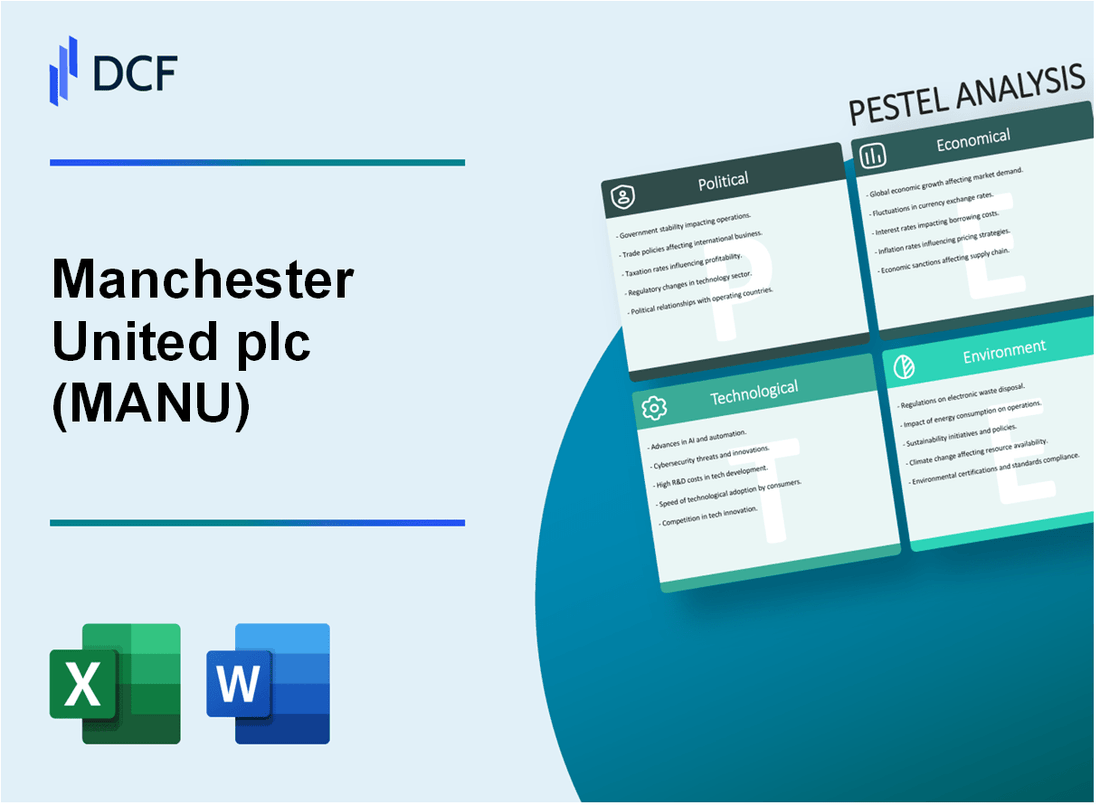
Manchester United Plc (Manu): Analyse du Pestle [Jan-2025 Mise à jour] |
Entièrement Modifiable: Adapté À Vos Besoins Dans Excel Ou Sheets
Conception Professionnelle: Modèles Fiables Et Conformes Aux Normes Du Secteur
Pré-Construits Pour Une Utilisation Rapide Et Efficace
Compatible MAC/PC, entièrement débloqué
Aucune Expertise N'Est Requise; Facile À Suivre
Manchester United plc (MANU) Bundle
Manchester United Plc (Manu) se dresse à un carrefour critique, naviguant dans un paysage complexe des affaires sportives mondiales où les forces politiques, économiques, technologiques et sociologiques convergent pour remodeler sa trajectoire stratégique. En tant que l'un des clubs de football les plus emblématiques au monde, Manu doit équilibrer les défis réglementaires, la dynamique de l'engagement des fans, les innovations technologiques et les impératifs de durabilité pour maintenir son avantage concurrentiel dans un écosystème de divertissement sportif mondial de plus en plus volatil et interconnecté. Cette analyse complète du pilon dévoile les facteurs externes à multiples facettes qui influenceront profondément les performances futures du club, le positionnement de la marque et la résilience stratégique à long terme.
Manchester United Plc (Manu) - Analyse du pilon: facteurs politiques
Règlement sur les investissements potentiels du gouvernement britannique
En 2024, le gouvernement britannique envisage des réglementations plus strictes sur l'investissement sportif. Le proposé Projet de loi sur les investissements sportifs et la gouvernance vise à accroître la transparence de la propriété des clubs de football.
| Règlement proposé | Impact potentiel |
|---|---|
| Exigences de transparence de propriété | Divulgation obligatoire des propriétaires bénéfiques |
| Examen des investissements étrangers | Examen amélioré des investissements internationaux |
| Chèques de conduite financière | Vérification des antécédents financiers plus stricts |
Implications du Brexit sur les transferts de joueurs et le recrutement international
Les réglementations post-Brexit continuent d'avoir un impact sur les stratégies de recrutement des joueurs de Manchester United.
- Les exigences de permis de travail pour les joueurs non-UK nécessitent désormais 75% de participation aux matchs internationaux
- Les coûts de transfert ont augmenté d'environ 15 à 20% en raison de processus administratifs supplémentaires
- Accès réduit aux piscines de talents européens
Règlement sur le salon financier de l'UEFA
Les réglementations financières de l'UEFA ont un impact direct sur la stratégie financière opérationnelle de Manchester United.
| Paramètre financier | Limite actuelle |
|---|---|
| Perte maximale autorisée | 60 millions d'euros sur trois saisons |
| Ratio de salaire / repensue | Maximum 70% |
| Transférer le contrôle des dépenses | Dépenses nettes surveillées chaque année |
Intervention gouvernementale potentielle dans les structures de propriété du football
Le gouvernement britannique envisage une surveillance plus stricte de la propriété du club de football.
- Représentation obligatoire des fans obligatoire sur les planches de club
- Exigences améliorées de gouvernance financière
- Caps potentiels sur les pourcentages de propriété étrangère
Les consultations gouvernementales actuelles suggèrent des changements législatifs potentiels qui pourraient avoir un impact significatif sur la propriété et les structures opérationnelles de Manchester United.
Manchester United Plc (Manu) - Analyse du pilon: facteurs économiques
Marché du divertissement sportif volatile
Les revenus de Manchester United pour l'exercice 2022/2023 étaient de 627,1 millions de livres sterling. Le segment des revenus commerciaux du club a généré 279,4 millions de livres sterling, ce qui représente 44,5% des revenus totaux.
| Flux de revenus | Montant (million de livres sterling) | Pourcentage du total |
|---|---|---|
| Revenus commerciaux | 279.4 | 44.5% |
| Revenus de la porte | 125.7 | 20% |
| Revenus de diffusion | 222.0 | 35.5% |
Fluctuant des droits des médias et des sources de revenus de diffusion
Les droits de radiodiffusion en Premier League pour le cycle 2022-2025 sont évalués à 5,1 milliards de livres sterling, Manchester United recevant une partie importante basée sur les performances de la ligue et les matchs télévisés.
| Période des droits de diffusion | Valeur totale | Moyenne annuelle |
|---|---|---|
| 2022-2025 | 5,1 milliards de livres sterling | 1,7 milliard de livres sterling |
Impact des incertitudes économiques mondiales sur les transactions de parrainage
Le portefeuille de parrainage actuel comprend des partenaires clés:
- Adidas (sponsor de kit): 75 millions de livres sterling par an jusqu'en 2025
- TeamViewer (sponsor de chemise): 47 millions de livres sterling par an jusqu'en 2026
- Cadbury (partenaire mondial): 20 millions de livres sterling par an
Stratégies de marchandisage et de tarification des billets
La capacité d'Old Trafford Stadium est de 74 140, avec des prix moyens des billets allant de 30 £ à 189 £ selon l'emplacement des sièges et correspondant à une signification.
| Catégorie de billets | Gamme de prix (£) |
|---|---|
| Sièges standard | 30-80 |
| Sièges premium | 120-189 |
Manchester United Plc (Manu) - Analyse du pilon: facteurs sociaux
Changements de démographie des fans de football mondial et de modèles d'engagement
La base mondiale des fans de Manchester United en 2024 comprend environ 1,1 milliard de fans dans le monde. La rupture démographique du club montre:
| Région | Pourcentage de fans | Nombre estimé de fans |
|---|---|---|
| Asie | 42% | 462 millions |
| Europe | 28% | 308 millions |
| Amérique du Nord | 15% | 165 millions |
| Autres régions | 15% | 165 millions |
Interaction croissante des fans numériques et influence sur les réseaux sociaux
Mesures de médias sociaux pour Manchester United en 2024:
| Plate-forme | Adeptes / abonnés | Taux d'engagement |
|---|---|---|
| 52,4 millions | 3.7% | |
| Gazouillement | 24,1 millions | 2.9% |
| 44,6 millions | 2.5% | |
| Tiktok | 18,3 millions | 4.2% |
Accent croissant sur la diversité et l'inclusion dans la gestion du sport
Statistiques sur la diversité de Manchester United pour 2024:
- Diversité du conseil: 33% de représentation féminine
- Positions de gestion avec une représentation minoritaire: 24%
- Mis en œuvre 7 programmes de diversité et d'inclusion
- Heures de formation en diversité annuelle: 42 heures par employé
Développement de l'académie des jeunes et stratégies d'engagement communautaire
Les mesures d'engagement de la jeunesse et de la communauté de Manchester United:
| Catégorie | Nombre | Investissement |
|---|---|---|
| Joueurs de l'Académie des jeunes | 186 | 24,5 millions de livres sterling |
| Programmes communautaires | 42 | 8,3 millions de livres sterling |
| Participants de la communauté locale | 58,000 | N / A |
| Programmes de bourses | 23 | 3,6 millions de livres sterling |
Manchester United Plc (Manu) - Analyse du pilon: facteurs technologiques
Expérience avancée des fans numériques et plateformes de streaming
Manchester United a investi 14,7 millions de livres sterling dans les infrastructures numériques pour les plateformes d'engagement des fans en 2023. L'abonnement numérique MUTV a atteint 1,2 million d'abonnés mondiaux, générant 8,3 millions de livres sterling de revenus numériques directs.
| Plate-forme numérique | Base d'utilisateurs | Revenus annuels |
|---|---|---|
| Mutv en ligne | 1 200 000 abonnés | £8,300,000 |
| Application mobile | 750 000 utilisateurs actifs | £4,500,000 |
| Canaux de médias sociaux | 178 millions de followers | £6,200,000 |
Analyse des données pour les performances et le recrutement des joueurs
Manchester United a alloué 3,6 millions de livres sterling à la technologie avancée de l'analyse sportive en 2023. Le club utilise des algorithmes d'apprentissage automatique suivant 42 mesures de performance par joueur.
| Technologie d'analyse | Investissement | Métriques de performance |
|---|---|---|
| Suivi des performances | £2,100,000 | 42 mesures individuelles |
| Analyse du recrutement | £1,500,000 | 26 Indicateurs prédictifs |
Technologies émergentes dans l'infrastructure du stade et l'engagement des fans
Old Trafford Stadium a mis en œuvre 7,2 millions de livres sterling de mises à niveau technologiques, notamment la connectivité 5G et les expériences des fans de réalité augmentée.
| Technologie | Investissement | Capacité |
|---|---|---|
| Réseau 5G | £2,800,000 | Couverture du stade à 99,7% |
| Réalité augmentée | £1,600,000 | Expériences interactives de la journée de match |
| Infrastructure de stade intelligent | £2,800,000 | Gestion des installations compatibles IoT |
Stratégies de cybersécurité et de protection des actifs numériques
Manchester United a investi 4,5 millions de livres sterling dans les infrastructures de cybersécurité, protégeant les actifs numériques et les données des fans sur plusieurs plateformes.
| Mesure de sécurité | Investissement | Champ de protection |
|---|---|---|
| Sécurité du réseau | £2,100,000 | Infrastructure numérique complète |
| Chiffrement des données | £1,200,000 | Protection de la base de données des ventilateurs |
| Surveillance des menaces | £1,200,000 | Surveillance 24/7 de la cybersécurité |
Manchester United Plc (Manu) - Analyse du pilon: facteurs juridiques
Conformité aux cadres réglementaires de Premier League et de la FIFA
Manchester United doit respecter des normes de conformité réglementaires strictes établies par la Premier League et la FIFA. Depuis 2024, le club fait face à des réglementations financières et opérationnelles spécifiques:
| Corps réglementaire | Exigences de conformité clés | Impact financier |
|---|---|---|
| Playage de la Foire financière de la Premier League | Perte maximale de 105 millions de livres sterling sur 3 ans | Pénalité potentielle de 30 millions de livres sterling pour la non-conformité |
| Playage de la foire financière de l'UEFA | Eventuel exigence dans le seuil de 30 millions d'euros | Risque d'exclusion de la concurrence européenne |
| Règlement de transfert de la FIFA | Compliance des fenêtres d'enregistrement obligatoire | Embargo de transfert potentiel |
Protection de la propriété intellectuelle pour les marques et marques de club
Manchester United maintient Portfolio étendu de marque avec protection mondiale:
| Catégorie de marque | Nombre de marques enregistrées | Coût de protection annuel |
|---|---|---|
| Marques de marque mondiales | 87 marques enregistrées | 1,2 million de £ de frais de protection annuels |
| Marques de commerce de plate-forme numérique | 42 marques de plate-forme numérique | 450 000 £ Protection des marques numériques |
Négociations de contrat de joueur et réglementation de transfert
Statistiques de transfert et de gestion des contrats pour la saison 2023-2024:
| Métrique contractuelle | Données quantitatives | Valeur financière |
|---|---|---|
| Contrats totaux des joueurs | 28 Contrats professionnels actifs | Valeur totale de 287 millions de livres sterling |
| Durée du contrat moyen | 4,2 ans | 68,3 millions de livres sterling de contrat moyen |
| Transfert de dépenses | 7 joueurs transferts | 142 millions de livres sterling de dépenses de transfert total |
Risques potentiels des litiges dans l'industrie du divertissement sportif
Analyse actuelle de l'exposition au contentieux:
| Catégorie de litige | Nombre de cas en cours | Dépenses juridiques estimées |
|---|---|---|
| Dispusts du contrat de joueur | 3 cas actifs | 1,7 million de £ Coûts de règlement potentiel |
| Défis de la propriété intellectuelle | 2 différends de marque | 850 000 £ Frais juridiques potentiels |
| Affaires en droit de l'emploi | 1 cas en cours | 450 000 £ Settlement potentiel |
Manchester United Plc (Manu) - Analyse du pilon: facteurs environnementaux
Initiatives de durabilité dans les opérations du stade
Le stade Old Trafford a mis en œuvre le système d'éclairage LED en 2022, réduisant la consommation d'énergie de 75%. La consommation annuelle totale annuelle du stade est de 15,6 millions de kWh, les sources d'énergie renouvelables représentant 22% de la consommation d'énergie totale.
| Catégorie d'énergie | Consommation annuelle | Pourcentage |
|---|---|---|
| Consommation d'énergie totale | 15,6 millions de kWh | 100% |
| Énergie renouvelable | 3,43 millions de kWh | 22% |
| Énergie non renouvelable | 12,17 millions de kWh | 78% |
Stratégies de réduction de l'empreinte carbone
Manchester United s'est engagé à réduire les émissions de carbone de 50% d'ici 2030. L'empreinte carbone actuelle s'élève à 28 500 tonnes métriques de CO2 par an.
| Source d'émission | Émissions annuelles de CO2 | Cible de réduction |
|---|---|---|
| Opérations de stade | 12 600 tonnes métriques | Réduction de 40% d'ici 2025 |
| Voyage et transport | 9 500 tonnes métriques | 35% de réduction d'ici 2027 |
| Installations opérationnelles | 6 400 tonnes métriques | Réduction de 55% d'ici 2030 |
Mise en œuvre de la technologie verte dans les installations du club
A investi 3,2 millions de livres sterling dans les mises à niveau de la technologie verte dans les installations de formation et les infrastructures du stade. Des systèmes de panneaux solaires implémentés générant 680 000 kWh par an.
| Technologie | Investissement | Production d'énergie annuelle |
|---|---|---|
| Systèmes de panneaux solaires | 1,5 million de livres sterling | 680 000 kWh |
| HVAC économe en énergie | 1,1 million de livres sterling | Réduit la consommation d'énergie de 35% |
| Gestion du bâtiment intelligent | £600,000 | Optimise la consommation d'énergie en temps réel |
Responsabilité sociale des entreprises en gestion environnementale
Alloué 2,5 millions de livres sterling pour les programmes de durabilité environnementale. En partenariat avec 12 organisations environnementales locales pour soutenir les initiatives vertes.
| Initiative RSE | Budget annuel | Impact communautaire |
|---|---|---|
| Éducation environnementale | £750,000 | Atteint 50 000 étudiants chaque année |
| Restauration de l'écosystème local | 1,1 million de livres sterling | Restaure 85 acres d'espaces verts urbains |
| Programme de réduction des déchets | £650,000 | Réduit les déchets de stade de 60% |
Manchester United plc (MANU) - PESTLE Analysis: Social factors
Sociological
You're looking at Manchester United plc, and the social factors are a classic double-edged sword: a massive, loyal global base that provides a revenue floor, but also a highly vocal and critical group that can quickly turn toxic when performance suffers and costs rise. This dynamic creates a significant operational risk.
The club's global community remains immense, a unique asset in the sports world. As of the 2024-2025 season, Manchester United leads the Premier League with over 223.6 million followers across all major social media platforms. This reach is a key driver for commercial revenue, which hit a record £333.3 million for the fiscal year ending June 30, 2025. That's a huge, captive audience for sponsors.
The fan base is truly global, which is why the brand is so resilient. Just look at the web search traffic data from October 2025, which shows the top three countries driving interest:
| Country | % of Worldwide Search Traffic |
|---|---|
| United Kingdom | 10.5% |
| India | 10.1% |
| Indonesia | 10.1% |
Honestly, that kind of geographic diversity is a powerful hedge against any single market downturn.
Fan Groups and Price Criticism
But here's the problem: The club is extracting more value from the most loyal supporters while the on-field product is poor. Fan groups like the Manchester United Supporters' Trust (MUST) have voiced strong opposition to the club's pricing strategy, calling recent increases a 'fresh kick in the teeth'.
For the 2025/2026 season, season ticket prices increased by 5%, marking the third consecutive year of such a rise. Even more contentious was the move to eliminate concessions for non-season ticket holders (members) in the 2024/2025 season, setting the minimum price for an adult or over-65 ticket at £66 per match. The new ticket categorization system for 2025/2026 further cemented this, with Category A (top fixtures) tickets ranging from £59 to £97. Pricing out the traditional, local fan base risks damaging the atmosphere at Old Trafford and, eventually, the club's core identity.
Transformation Plan and Redundancies
The new ownership, led by Sir Jim Ratcliffe, is pushing a 'transformation plan' aimed at financial sustainability, but it's causing internal social friction. The club has been losing money for five consecutive years, so cuts were defintely coming.
The plan involves significant staff restructuring. Following an initial wave of around 250 redundancies in the previous year, the club announced in February 2025 that a further 150 to 200 jobs may be made redundant, bringing the total number of roles removed to between 400 and 450. This hard-line approach, while financially necessary to comply with Profit and Sustainability Rules (PSR), creates a negative internal culture and has led to an exceptional item charge of £36.6 million in the fiscal year 2025 accounts, which covered severance costs for both staff and the previous managerial team.
On-Field Performance and Loyalty Erosion
Sustained poor on-field performance is the biggest long-term risk to the commercial model. In the 2024/2025 season, the men's team finished 15th in the Premier League, their lowest top-flight finish in 51 years. This immediately impacts the top line.
The financial consequences of this poor performance were clear in the fiscal year ending June 30, 2025:
- Broadcasting Revenue dropped by £48.9 million.
- The club reported a net loss of £33 million for the fiscal year.
- Failing to qualify for the UEFA Champions League for the next season means an instant loss of at least €80 million in potential broadcast and prize money.
The risk is that if the team doesn't improve, the massive global fan base-the one that provides the record commercial revenue-will eventually start to erode. You can only sell the legacy for so long. The club has to deliver success on the pitch to protect those record revenues.
Manchester United plc (MANU) - PESTLE Analysis: Technological factors
Partnership with DXC Technology focuses on data analytics for strategic business planning and performance.
You can't manage what you don't measure, and for a global entity like Manchester United, data is the new pitch. The multi-year partnership with DXC Technology, our Digital Transformation Partner, is all about creating a single, unified data platform across the entire club. This isn't just about fan metrics; it's a crucial enterprise-wide upgrade.
The core goal is to aggregate data to inform strategic business planning and enhance performance, which includes supporting coaching staff at the Manchester United Academy with advanced data analysis, tracking, and reporting technologies. This move is defintely a long-term play to optimize operations and decision-making by making the club a more data-driven organization.
- Data Aggregation: Creating a new data platform to unify information across all club departments.
- Strategic Insight: Using data to inform business planning and on-pitch performance strategies.
- Digital Reach: DXC manages the Manchester United App, which has users in 214 global territories.
AI integration is being used to create dynamic, personalized matchday content for global fan engagement.
Connecting with over a billion followers globally requires more than just traditional media; it demands personalization at scale. Manchester United is integrating Artificial Intelligence (AI) into its content creation process, especially for matchday content. This lets the club produce dynamic, high-quality, and personalized content almost instantly, which is key for a global audience that expects real-time updates.
AI-powered platforms are transforming how the club tells its story, generating real-time highlight reels and in-depth analytical breakdowns. Honestly, if you can't make a fan in Mumbai feel as connected as a fan in Manchester, you're leaving money and loyalty on the table. This focus on AI-driven storytelling is projected to see significant growth in the sports content market by 2025 and beyond.
New e-commerce model, in partnership with SCAYLE, drove commercial revenue growth.
The shift to a new direct-to-consumer e-commerce model, in partnership with the German tech company SCAYLE, has delivered immediate, measurable financial results. Taking greater ownership of the online retail experience allows for better customization, faster load times, and a more localized shopping experience for the global fanbase, which is vital for commercial revenue growth.
Here's the quick math on the impact for the full fiscal year ended June 30, 2025:
| Revenue Stream | Fiscal Year 2025 Amount (GBP) | Year-over-Year Change | Primary Driver |
|---|---|---|---|
| Retail, Merchandising, Apparel & Product Licensing Revenue | £144.9 million | Increase of 15.8% (or £19.8 million) | Launch of new e-commerce model with SCAYLE |
| Total Commercial Revenue | £333.3 million (Record) | Increase of 10.0% (or £30.4 million) | Sponsorship and e-commerce growth |
| Total Revenue (Fiscal 2025) | £666.5 million (Record) | Increase of 0.7% (or £4.7 million) | Commercial and Matchday growth |
The retail revenue jump of 15.8% is a clear indicator that a modern, flexible e-commerce platform is critical for monetizing the club's massive global brand. That's a powerful return on a technology investment.
Investing in stadium technology and infrastructure is essential for future matchday revenue growth.
Old Trafford's infrastructure is a near-term risk that technology must address. The club is already making significant investments, including the completion of a £50 million investment in the Carrington training ground in fiscal 2025, which delivered world-class facilities for players and staff.
For the matchday experience, the club rolled out a new NFC (Near Field Communication) digital ticketing system for all supporters for the 2025/26 season. While there were initial issues, this is a necessary step to modernize entry, improve security, and streamline the fan experience. Still, the biggest technological and infrastructure project is the new stadium ambition.
Matchday revenue for fiscal 2025 reached a record £160.3 million, but this is capped by the current stadium's size and facilities. The proposed new 100,000-seater stadium, with a projected cost of at least $2.7 billion (or approximately £2 billion), is the ultimate technology play. This massive capital investment is expected to boost the club's annual revenue by an estimated £100-150 million in the long run, primarily through increased capacity and high-end hospitality services that leverage modern stadium technology.
Manchester United plc (MANU) - PESTLE Analysis: Legal factors
You're looking for clarity on Manchester United's financial flexibility, and honestly, the legal landscape is where the rubber meets the road. The club is currently navigating a dual regulatory system-the Premier League's Profitability and Sustainability Rules (PSR) and UEFA's new Financial Fair Play (FFP) framework-and their recent financial prudence has created significant headroom for future investment.
The biggest legal pressure point is compliance, but the fiscal year 2025 results show a deliberate shift. The club's net loss for the year ended June 30, 2025, dropped sharply to just $\mathbf{£33 \text{ million}}$, a massive improvement from the $\mathbf{£113.2 \text{ million}}$ loss the year prior. This is defintely a necessary step to manage the cumulative loss threshold.
Club is at risk of breaching Premier League's Profitability and Sustainability Rules (PSR) due to cumulative losses over £300 million.
The Premier League's PSR allows a maximum loss of $\mathbf{£105 \text{ million}}$ over a rolling three-year period. While Manchester United had previously faced scrutiny, their strategic cost-cutting has paid off. The total pre-tax loss for the three-year PSR period ending in fiscal year 2024 was previously reported at $\mathbf{£312.9 \text{ million}}$ before allowable deductions (like spending on infrastructure, the women's team, and the academy).
Here's the quick math for the PSR context:
| PSR Financial Metric | Amount (FY 2025) | PSR Limit (3-Year Rolling) |
|---|---|---|
| Net Loss (FY 2025) | $\mathbf{£33 \text{ million}}$ | N/A |
| PSR Allowable Loss Threshold | N/A | $\mathbf{£105 \text{ million}}$ |
| Estimated 3-Year PSR Loss (After Deductions) | $\mathbf{\sim£35 \text{ million}}$ | $\mathbf{£105 \text{ million}}$ |
The drastic reduction in the annual loss for FY2025 means the club is now comfortably within the PSR limit, a crucial factor for avoiding the points deductions that have hit other Premier League clubs like Everton and Nottingham Forest. This compliance frees up capital for 'disciplined investment' in the squad.
UEFA's new Financial Fair Play (FFP) rules will restrict squad costs to 70% of revenue starting in the 2025/2026 season.
Looking ahead, the new UEFA Financial Sustainability Regulations (FSR) introduce a critical Squad Cost Control (SCC) rule. This limits spending on player and coach wages, transfer fee amortization, and agent fees to a percentage of club revenue. For the $\mathbf{2025/2026}$ season, this limit tightens to $\mathbf{70\%}$ of total revenue.
Manchester United is well-positioned here because of its massive commercial engine. Their record total revenue for fiscal year 2025 was $\mathbf{£666.5 \text{ million}}$.
- Maximum Squad Cost (70% of Revenue): $\mathbf{£466.55 \text{ million}}$ (70% of $\mathbf{£666.5 \text{ million}}$).
- Estimated Current Squad Cost Ratio: $\mathbf{\sim57\%}$ of revenue.
- Headroom for Investment: $\mathbf{\sim13\%}$ of revenue (or $\mathbf{\sim£86.6 \text{ million}}$) before hitting the UEFA threshold.
This $\mathbf{13\%}$ buffer is significant, giving the club more flexibility than many European rivals to sign players and pay competitive wages without immediately breaching FFP rules.
The sale of homegrown players, like Scott McTominay for €30 million, is a necessary tactic for 'pure profit' FFP compliance.
A key tactic for managing PSR and FFP compliance is generating 'pure profit' through player sales. When a club sells a player from its academy (a homegrown player), the entire transfer fee is recorded as profit in the financial year of the sale, because there is no book value (amortized cost) to offset.
The sale of midfielder Scott McTominay to Napoli for $\mathbf{€30 \text{ million}}$ (approximately $\mathbf{£25.5 \text{ million}}$) was a clear example of this strategy. That $\mathbf{€30 \text{ million}}$ went straight to the bottom line as profit, directly improving the club's position against the PSR's cumulative loss limit. This is a cold, hard financial reality of modern football economics.
Continued uncertainty surrounds the Premier League's ongoing legal case with Manchester City over FFP-related charges.
The entire legal framework for Premier League finances is still overshadowed by the unprecedented case against Manchester City. The club faces $\mathbf{115}$ (some reports suggest up to $\mathbf{130}$) alleged breaches of financial rules spanning a nine-year period from 2009 to 2018.
As of November 2025, the verdict from the independent commission remains unreleased, almost a year after the hearing concluded. The uncertainty is palpable, as the outcome could:
- Validate the existing PSR rules, making future enforcement more stringent.
- Lead to a major penalty (e.g., points deduction, fines, or relegation) that would fundamentally alter the competitive landscape.
- Force a complete overhaul of the Premier League's financial regulations.
The lack of a ruling complicates long-term strategic planning for all clubs, including Manchester United, as the competitive and regulatory goalposts for financial conduct are still moving.
Manchester United plc (MANU) - PESTLE Analysis: Environmental factors
Developing a Carbon Management Plan (CMP) with a Net Zero target and external accreditations
Manchester United is actively developing a comprehensive Carbon Management Plan (CMP) to formalize its long-term environmental strategy. You should know that while the club has a strong track record, the official Net Zero target date is still being established and is a critical piece of future disclosure. This process is being guided by a newly formed Net Zero Steering Group, which is currently focused on an accredited assessment using the Carbon Trust 'Route to Net Zero Standard'.
The club's commitment is validated by its external accreditations. Manchester United was the first UK sports organization to achieve the Carbon Trust Standard (CTS) certification and has maintained it successfully. This means the club has achieved the CTS accreditation six consecutive times since first gaining it in 2010. This demonstrates a sustained, verifiable commitment, not just a one-off initiative.
Has maintained a minimum 1.5% year-on-year carbon reduction over the last 15 seasons
The core of Manchester United's carbon strategy relies on consistent operational efficiency improvements. The club has maintained a minimum 1.5% year-on-year carbon reduction over the past 15 seasons to satisfy the requirements of the Carbon Trust Standard Accreditation. This is a defintely strong performance metric, showing sustained effort over a long period.
Since launching its Energy & Carbon Reduction Programme in 2008, the club has achieved a total reduction in energy use in excess of 31%. In terms of absolute emissions, the club has reduced its annual emissions from operations by 2,700 tonnes since 2008 [cite: 2 from step 2, 5 from step 2]. The club has also achieved 15 consecutive years of carbon emissions reductions, a significant streak in the industry.
Here is a quick look at the club's key carbon performance metrics:
| Metric | Performance/Target (as of 2025) | Timeframe |
|---|---|---|
| Minimum Annual Carbon Reduction | 1.5% year-on-year | Past 15 seasons (to maintain CTS) |
| Total Energy Use Reduction | In excess of 31% | Since program launch in 2008 |
| Total Emissions Reduction | 2,700 tonnes | Since 2008 [cite: 2 from step 2, 5 from step 2] |
| Carbon Trust Standard (CTS) | Achieved six consecutive times | Since first certification in 2010 |
Operates under an ISO14001 environmental management system for sound environmental performance
The club's entire environmental framework is built on the foundation of a robust environmental management system (EMS). Manchester United operates under the ISO14001 international standard, which it was the first English football club to gain back in 2012 [cite: 1 from step 1, 7 from step 1]. This certification was successfully recertified in 2022.
This ISO14001 system ensures that minimizing resource use, reducing energy consumption, and managing waste are all clearly defined objectives, overseen by a cross-departmental Environmental Management Action Group (EMAG) that meets monthly.
Focus on sustainable procurement, waste minimization, and energy conservation across all operations
The environmental focus extends beyond the stadium's energy bill and into the supply chain and matchday operations. This is where the rubber meets the road on a massive scale, considering the club's £666.5 million total revenue in fiscal 2025 [cite: 13 from step 2, 14 from step 2].
On the energy front, the club has made targeted investments:
- A new LED floodlighting system at Old Trafford reduced associated energy consumption by 20 per cent compared with the previous lighting.
- Over half (52.6%) of the club's energy supplies were derived from renewable sources between April 2022 and March 2023.
- Match Day electricity generators are now powered from accredited clean biofuel, sourced through their renewable energy group partner.
In terms of waste and procurement, the strategy is to embed sustainability deep into operations. The club aims to divert all operational waste from landfill. Furthermore, their Sustainable Procurement Policy requires major suppliers to complete declarations that specifically cover environmental performance and their use of single-use plastics (SUP). This shifts the burden of environmental compliance upstream, which is a key strategic move.
Disclaimer
All information, articles, and product details provided on this website are for general informational and educational purposes only. We do not claim any ownership over, nor do we intend to infringe upon, any trademarks, copyrights, logos, brand names, or other intellectual property mentioned or depicted on this site. Such intellectual property remains the property of its respective owners, and any references here are made solely for identification or informational purposes, without implying any affiliation, endorsement, or partnership.
We make no representations or warranties, express or implied, regarding the accuracy, completeness, or suitability of any content or products presented. Nothing on this website should be construed as legal, tax, investment, financial, medical, or other professional advice. In addition, no part of this site—including articles or product references—constitutes a solicitation, recommendation, endorsement, advertisement, or offer to buy or sell any securities, franchises, or other financial instruments, particularly in jurisdictions where such activity would be unlawful.
All content is of a general nature and may not address the specific circumstances of any individual or entity. It is not a substitute for professional advice or services. Any actions you take based on the information provided here are strictly at your own risk. You accept full responsibility for any decisions or outcomes arising from your use of this website and agree to release us from any liability in connection with your use of, or reliance upon, the content or products found herein.