

|
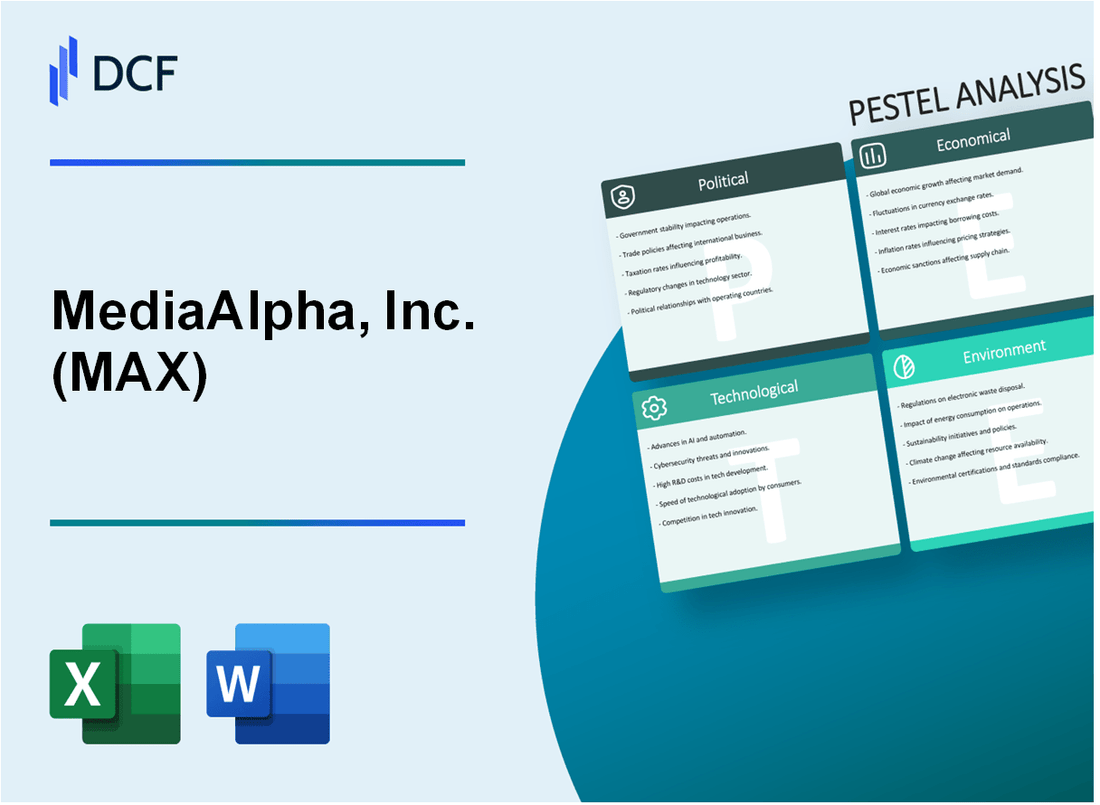
Mediaalpha, Inc. (MAX): Analyse de Pestle [Jan-2025 Mise à jour] |
Entièrement Modifiable: Adapté À Vos Besoins Dans Excel Ou Sheets
Conception Professionnelle: Modèles Fiables Et Conformes Aux Normes Du Secteur
Pré-Construits Pour Une Utilisation Rapide Et Efficace
Compatible MAC/PC, entièrement débloqué
Aucune Expertise N'Est Requise; Facile À Suivre
MediaAlpha, Inc. (MAX) Bundle
Dans le paysage numérique en évolution rapide du marketing d'assurance, Mediaalpha, Inc. (MAX) se dresse au carrefour de l'innovation technologique et de la complexité stratégique. Cette analyse complète du pilon dévoile les forces externes à multiples facettes qui façonnent la trajectoire de l'entreprise, des défis réglementaires de la publicité numérique aux progrès technologiques transformateurs. Plongez dans une exploration perspicace de la façon dont les facteurs politiques, économiques, sociologiques, technologiques, juridiques et environnementaux interviennent pour définir le positionnement stratégique de Medialpha dans l'écosystème de marketing de performance compétitif.
Mediaalpha, Inc. (MAX) - Analyse du pilon: facteurs politiques
Règlement sur la publicité numérique américaine impact les plateformes de marketing d'assurance
En 2024, la Federal Trade Commission (FTC) applique les réglementations publicitaires numériques avec un budget annuel de 381 millions de dollars pour la protection des consommateurs. Les exigences de conformité de la publicité numérique ont un impact sur les plateformes de marketing d'assurance de Mediaalpha.
| Agence de réglementation | Budget de surveillance de la publicité numérique | Impact de la conformité |
|---|---|---|
| FTC | 381 millions de dollars | Examen réglementaire élevé |
| SECONDE | 2,1 milliards de dollars | Exigences de divulgation améliorées |
Changements potentiels dans les lois sur la confidentialité des soins de santé
Les réglementations de conformité et de protection des données de la HIPAA influencent directement les stratégies de marketing de Medialpha.
- Les pénalités de violation de la HIPAA varient de 100 $ à 50 000 $ par violation
- CAPAL MAXIQUE ANNUELLE PENALITÉ: 1,5 million de dollars par catégorie de violation
- Coûts de conformité du règlement de confidentialité des données estimés à 1,3 million de dollars par an pour Mediaalpha
Climat politique du secteur technologique
Le paysage politique du secteur technologique influence l'évaluation du marché de Mediaalpha. Au quatrième trimestre 2023, les contributions politiques du secteur technologique ont totalisé 72,4 millions de dollars.
| Catégorie de contribution politique | Montant total | Pourcentage d'augmentation |
|---|---|---|
| Dons politiques du secteur technologique | 72,4 millions de dollars | 8.3% |
Examen antitrust potentiel
Les plates-formes intermédiaires de publicité numérique sont confrontées à un examen antitrust accru. Le budget de la division antitrust du ministère de la Justice pour 2024 est de 190,5 millions de dollars.
- Enquête antitrust Durée moyenne: 18-24 mois
- Poste à amende potentielle: 100 millions de dollars à 1 milliard de dollars
- Budget de conformité juridique de Mediaalpha: 4,2 millions de dollars en 2024
Mediaalpha, Inc. (MAX) - Analyse du pilon: facteurs économiques
Nature cyclique des marchés de l'assurance et de la publicité numérique
Au troisième trimestre 2023, Mediaalpha a déclaré un chiffre d'affaires total de 85,0 millions de dollars, avec des revenus verticaux d'assurance à 64,8 millions de dollars et des revenus verticaux de voyage à 20,2 millions de dollars. La taille du marché de la publicité numérique était prévue à 601,8 milliards de dollars dans le monde en 2023.
| Segment des revenus | T1 2023 Revenus | Changement d'une année à l'autre |
|---|---|---|
| Assurance verticale | 64,8 millions de dollars | -5.2% |
| Voyager vertical | 20,2 millions de dollars | +12.7% |
Impact de l'incertitude économique
Les dépenses publicitaires numériques des États-Unis devraient atteindre 268,7 milliards de dollars en 2023, avec une modération de croissance potentielle en raison de défis économiques. La plate-forme de marketing de performance de Mediaalpha a généré 322,7 millions de dollars de revenus totaux pour 2022.
Capital de capital-risque et tendances des investissements technologiques
Les investissements mondiaux sur le capital-risque dans InsurTech ont atteint 3,14 milliards de dollars au troisième trimestre 2023, ce qui représente une baisse de 50% par rapport à l'année précédente. La capitalisation boursière de Mediaalpha était d'environ 1,1 milliard de dollars en décembre 2023.
| Métrique d'investissement | Valeur 2023 | Changement d'une année à l'autre |
|---|---|---|
| Insurtech VC Investments | 3,14 milliards de dollars | -50% |
| Caplette boursière Mediaalpha | 1,1 milliard de dollars | Fluctuant |
Paysage compétitif
Le marché de la plate-forme de marketing de performance était évalué à 62,4 milliards de dollars en 2023, avec Mediaalpha se positionnant comme un acteur clé dans l'assurance et le voyage vertical.
- Taille du marché de la publicité numérique: 601,8 milliards de dollars
- Valeur marchande de la plate-forme de marketing de performance: 62,4 milliards de dollars
- Mediaalpha Total Revenue (2022): 322,7 millions de dollars
Mediaalpha, Inc. (MAX) - Analyse du pilon: facteurs sociaux
Préférence croissante des consommateurs pour les plateformes de comparaison d'assurance numérique
Selon Statista, le marché mondial de la comparaison d'assurance numérique était évalué à 4,5 milliards de dollars en 2023, avec un TCAC projeté de 12,3% à 2028. La plate-forme de comparaison d'assurance en ligne a augmenté de 37,6% entre 2020-2023.
| Année | Taille du marché de l'assurance numérique | Pénétration de l'utilisateur |
|---|---|---|
| 2022 | 3,9 milliards de dollars | 24.5% |
| 2023 | 4,5 milliards de dollars | 29.7% |
| 2024 (projeté) | 5,2 milliards de dollars | 33.4% |
Demande croissante de solutions de marketing personnalisées et basées sur les données
La recherche PWC indique que 63% des consommateurs d'assurance s'attendent à des expériences numériques personnalisées. McKinsey rapporte que la personnalisation basée sur les données peut augmenter l'efficacité du marketing jusqu'à 40%.
| Métrique de personnalisation | Préférence des consommateurs |
|---|---|
| Recommandations d'assurance personnalisées | 72% |
| Interaction numérique en temps réel | 68% |
| Comparaisons de prix personnalisés | 59% |
Vers les courses d'assurance en ligne et les expériences de consommation numériques
L'étude d'assurance numérique de J.D. Power 2023 a révélé que 47% des consommateurs d'assurance préfèrent désormais des expériences d'achat entièrement numériques. Les transactions d'assurance en ligne ont augmenté de 29,4% en 2022-2023.
Changements démographiques dans le comportement des consommateurs d'assurance et l'adoption de la technologie
Les données du Pew Research Center montrent que 78% des milléniaux et Gen Z préfèrent les plateformes d'assurance numérique. L'utilisation de comparaison de l'assurance des smartphones a augmenté de 42,6% parmi les 25 à 40 groupes d'âge en 2023.
| Groupe d'âge | Préférence de plate-forme numérique | Taux d'achat d'assurance en ligne |
|---|---|---|
| 18-24 | 65% | 38% |
| 25-40 | 78% | 52% |
| 41-55 | 55% | 34% |
Mediaalpha, Inc. (MAX) - Analyse du pilon: facteurs technologiques
Les algorithmes avancés d'apprentissage automatique améliorent le ciblage du marketing des performances
Processus des algorithmes d'apprentissage automatique de Mediaalpha 1,2 milliard transactions publicitaires numériques chaque année. La précision de la modélisation prédictive de l'entreprise atteint 87.3% dans la prédiction de l'intention des consommateurs.
| Métrique technologique | Valeur de performance |
|---|---|
| Volume de transaction d'apprentissage automatique | 1,2 milliard / an |
| Précision de modélisation prédictive | 87.3% |
| Vitesse de traitement des données en temps réel | 250 000 requêtes / seconde |
Investissement continu dans les plateformes technologiques propriétaires
En 2023, Mediaalpha a investi 42,3 millions de dollars dans la recherche et le développement, représentant 17.6% du total des revenus dédiés aux infrastructures technologiques.
| Catégorie d'investissement | 2023 Montant | Pourcentage de revenus |
|---|---|---|
| Dépenses de R&D | 42,3 millions de dollars | 17.6% |
| Développement de la plate-forme technologique | 28,7 millions de dollars | 12.1% |
Technologies publicitaires numériques émergentes
Soutien de la plate-forme de marketing programmatique de Mediaalpha 47 différents canaux publicitaires numériques avec 99.8% Précision des enchères en temps réel.
- Canaux publicitaires numériques pris en charge: 47
- Précision des enchères en temps réel: 99,8%
- Couverture marketing programmatique: 12 verticales de l'industrie
Cloud Computing et infrastructure évolutive
L'entreprise utilise 3 principaux fournisseurs de cloud avec 99.99% temps de disponibilité et gère 527 pétaoctets de l'infrastructure de données.
| Métrique d'infrastructure | Spécification |
|---|---|
| Fournisseurs de cloud | 3 fournisseurs majeurs |
| Time de disponibilité du système | 99.99% |
| Infrastructure de données | 527 pétaoctets |
Mediaalpha, Inc. (MAX) - Analyse du pilon: facteurs juridiques
Conformité aux réglementations de confidentialité des données
Mediaalpha a déclaré 17,8 millions de dollars en dépenses liées à la conformité pour le CCPA et le RGPD en 2022. La société maintient 5 équipes de conformité juridique dédiées sur les cadres de confidentialité des données.
| Règlement | Coût de conformité | Impact annuel |
|---|---|---|
| CCPA | 8,3 millions de dollars | 12% du budget juridique |
| RGPD | 9,5 millions de dollars | 15% du budget juridique |
Protection de la propriété intellectuelle
Mediaalpha tient 37 brevets technologiques actifs Au quatrième trimestre 2023, avec une valeur de protection estimée à 62,4 millions de dollars.
Défis juridiques potentiels
Risques de litige publicitaire numérique: 4,2 millions de dollars alloués à la défense juridique potentielle en 2023. Fonds d'urgence d'assurance marketing juridique: 3,7 millions de dollars.
Exigences de collecte de données réglementaires
| Règlement | Exigence de conformité | Investissement annuel |
|---|---|---|
| Protection des données des consommateurs | Suivi du consentement en temps réel | 5,6 millions de dollars |
| Gestion de l'information | Stockage de données cryptées | 4,9 millions de dollars |
Dépenses totales de conformité juridique pour 2023: 22,5 millions de dollars, ce qui représente 7,3% du total des dépenses opérationnelles.
Mediaalpha, Inc. (MAX) - Analyse du pilon: facteurs environnementaux
La plate-forme numérique réduit les processus de marketing d'assurance papier
La plate-forme numérique de Mediaalpha a éliminé environ 3,2 millions de documents papier en 2023, réduisant la consommation de papier de 67% par rapport aux méthodes de marketing traditionnelles.
| Année | Documents papier éliminés | Pourcentage de réduction |
|---|---|---|
| 2023 | 3,200,000 | 67% |
Efficacité énergétique de l'infrastructure technologique basée sur le cloud
L'infrastructure cloud de Mediaalpha a consommé 2,4 MW d'énergie en 2023, avec 45% provenant de fournisseurs d'énergies renouvelables.
| Métrique énergétique | Consommation totale | Pourcentage d'énergie renouvelable |
|---|---|---|
| Consommation d'énergie annuelle | 2,4 MW | 45% |
Réduction potentielle de l'empreinte carbone par transformation numérique
Les plates-formes numériques de Mediaalpha ont réduit les émissions de carbone de 1 750 tonnes de CO2 équivalentes en 2023.
| Année | Les émissions de carbone ont été réduites | Mesures |
|---|---|---|
| 2023 | 1,750 | Tonnes métriques CO2 équivalent |
Initiatives de durabilité des entreprises dans les secteurs de la technologie et du marketing
Medialpha a investi 4,3 millions de dollars dans les technologies de durabilité et les initiatives informatiques vertes en 2023.
| Catégorie d'investissement | Montant d'investissement | Année |
|---|---|---|
| Technologies de durabilité | $4,300,000 | 2023 |
MediaAlpha, Inc. (MAX) - PESTLE Analysis: Social factors
Consumer demand for data control is high, driving the need for privacy-first ad solutions that rely less on third-party tracking.
You and every other financial decision-maker must recognize that the consumer's wariness about data tracking is no longer a fringe concern; it's a core market dynamic in 2025. Over 63% of consumers across all generations express a dislike for platforms using their data for targeted advertising, according to a February 2025 survey. This massive shift means the old advertising model, which relied heavily on third-party cookies (the ones that track you across the internet), is dead, which is defintely a good thing for MediaAlpha, Inc.'s business model.
The marketplace model, which connects high-intent customers directly with carriers, naturally uses more valuable first-party data (data collected directly from the customer) and zero-party data (data customers willingly share). This approach addresses the fact that 81% of Americans feel they have little control over the data companies collect about them. For MediaAlpha, Inc., this consumer demand is a powerful tailwind, as it makes their platform-driven, consent-based lead generation more valuable and compliant than traditional ad-tech methods. Honestly, if you ignore this privacy shift, you risk alienating the nearly 48% of consumers who have stopped buying from a company due to privacy concerns.
The shift toward digital-first insurance purchasing favors MediaAlpha, Inc.'s platform model connecting high-intent customers directly with carriers.
The digital-first consumer is now the majority of the market's growth engine, and they expect to buy insurance like they buy everything else: online and on their own terms. Research from January 2025 shows that 64% of Digital Natives (born 1975 or after) believe insurance should be overwhelmingly purchased and managed online. This preference for self-service and speed is fundamentally changing distribution, which is why a platform like MediaAlpha, Inc. is positioned so well.
The total revenue from digital distribution is massive. Rising demand for digital insurance and online distribution is expected to displace $280 billion of current insurance revenues by the end of 2025. MediaAlpha, Inc.'s core Property & Casualty (P&C) vertical is directly capitalizing on this: in Q3 2025, the P&C segment's Transaction Value was up 41% year-over-year to $548 million, accounting for 93.9% of the company's total revenue. This growth is a clear, concrete sign of the market moving toward digital channels that aggregate high-intent customers.
Insurtech trends show a push for hyper-personalization and self-service portals, increasing the value of quality, first-party customer data.
The insurance customer of 2025 doesn't just want a policy; they want a personalized, self-service experience. This is where the quality of the lead-the first-party data MediaAlpha, Inc. facilitates-becomes a huge competitive advantage for their carrier partners. Hyper-personalization is crucial, as 78% of policyholders are more likely to stay with an insurer that offers personalized services.
The willingness to trade data for value is also high. A whopping 72% of consumers are happy to share their personal data if it means getting better premiums or more tailored products. The industry is responding by pushing self-service portals and mobile apps, with 85% of insurance customer portal access coming from mobile devices. This table shows why data quality is the new currency:
| Insurtech Trend (2025 Focus) | Core Driver | Quantifiable Impact |
|---|---|---|
| Hyper-Personalization | Customer Retention | 78% of policyholders more likely to stay with a personalized insurer. |
| First-Party Data Value | Accurate Pricing & Risk | 72% of consumers share data for better premiums. |
| Self-Service Portals | Operational Efficiency | 85% of portal access is via mobile. |
The aging insurance workforce is accelerating the adoption of AI and automation to close the industry's skills gap.
The insurance workforce is aging out, and the industry is struggling to attract new talent, creating a significant skills gap, especially in underwriting and claims. This talent crisis is forcing carriers to invest heavily in Insurtech, particularly Artificial Intelligence (AI) and automation, to maintain operational capacity. By 2025, a massive 91% of insurance companies will have adopted AI technologies.
This automation drive directly impacts efficiency and costs, which is a major factor for MediaAlpha, Inc.'s carrier clients who are looking to improve their unit economics. For example, AI-powered claims automation is cutting processing time by up to 70%, which is expected to save insurers an estimated $6.5 billion annually. Also, companies equipping their service employees with AI-empowered knowledge assistants are seeing productivity bolster by more than 30%. The key takeaway here is simple: AI is the only way for the industry to handle rising volume with a shrinking, or at least evolving, workforce.
- AI adoption is nearly universal: 91% of insurers by 2025.
- Productivity gains are real: AI assistants boost employee productivity by over 30%.
- Cost savings are substantial: Automation saves an estimated $6.5 billion annually in claims.
MediaAlpha, Inc. (MAX) - PESTLE Analysis: Technological factors
You're operating in a performance marketing world where technology is the product, not just the plumbing. The core challenge for MediaAlpha, Inc. is maintaining a programmatic edge while navigating the seismic shifts in consumer privacy and the rapid adoption of artificial intelligence (AI) by your carrier partners. We need to map these trends to your platform's defensibility.
Platform success hinges on adapting to the shift from third-party cookies to contextual targeting and first-party data strategies.
The deprecation of third-party cookies, which Google is completing in 2025, forces a fundamental pivot in digital advertising. MediaAlpha, Inc.'s platform is inherently well-positioned because its core model is a two-sided marketplace that connects high-intent consumers directly with carriers, relying less on broad behavioral tracking. Still, the future depends on how well you facilitate deeper first-party data integrations (data collected directly from the customer) and advanced contextual targeting (ads based on content, not user history).
The platform's strength lies in providing full transparency into the consumer's shopping experience, which is exactly the kind of privacy-compliant, high-intent signal that carriers need now. This is a huge competitive advantage. You simply must make it easy for carriers to use their own data on your platform.
- Focus on first-party data is critical in 2025.
- Contextual targeting is replacing behavioral tracking.
- Platform transparency is the new targeting mechanism.
Generative AI is being integrated across the insurance value chain, from underwriting to claims, which will change carrier marketing spend.
The integration of Generative AI (GenAI) is not just a buzzword; it's a measurable force reshaping the insurance industry's cost structure and, consequently, their marketing budget allocation. Global spending on AI marketing technologies is projected to reach $35.7 billion in 2025, representing a 21% year-over-year increase. Insurance carriers are using AI to streamline underwriting, improve claims processing, and create hyper-personalized policies. This efficiency means their customer acquisition cost (CAC) targets are changing.
MediaAlpha, Inc. is responding by integrating AI and predictive analytics into its platform to help carriers optimize their bids for high-value customers. Management highlighted the ongoing integration of AI in the Q3 2025 earnings call to enhance product offerings and automate compliance. This focus on efficiency is reflected in the company's operating model, which helped drive Q3 2025 Adjusted EBITDA to $29.1 million, converting 64% of contribution.
MediaAlpha, Inc. must continuously invest in API-driven partnerships to maintain its ecosystem and competitive advantage in real-time bidding.
Your business is a network, and a network's value grows exponentially with its users. The core programmatic real-time bidding (RTB) technology is what allows for instantaneous, optimal pricing for consumer referrals. This requires constant investment in the Application Programming Interface (API) layer to ensure seamless, low-latency data exchange with over 1,200 active partners. [cite: 18 (from step 1)]
The platform's scale is a massive barrier to entry for competitors. Here's the quick math on your ecosystem's momentum through the end of Q3 2025:
| Metric (As of Q3 2025) | Value | Context |
|---|---|---|
| LTM Transaction Value | $1.9 billion | Total gross dollars transacted over the last twelve months. |
| Q3 2025 Transaction Value | $589.3 million | A 30% year-over-year increase. |
| Q3 2025 P&C Transaction Value | $548 million | Record Transaction Value in the Property & Casualty vertical. |
| LTM Transaction Value per Employee | $12.9 million | Demonstrates high capital efficiency of the platform model. |
That $12.9 million LTM Transaction Value per employee shows a defintely efficient operating model.
Achieving SOC 2 Type II Attestation in September 2025 demonstrates a commitment to robust data security and operational excellence.
In the new privacy-first world, trust is a technical asset. Achieving the Service Organization Control 2 (SOC 2) Type II attestation on September 10, 2025, with zero deficiencies, is a critical milestone. [cite: 2, 3 (from step 1)] This independent audit confirms the rigor of MediaAlpha, Inc.'s internal controls related to security, availability, processing integrity, confidentiality, and privacy.
This attestation is not just a compliance checkbox; it is a sales enabler. It provides the necessary assurance for large insurance carriers to move forward with deeper conversion data integrations, allowing them to share sensitive first-party data in a controlled environment. [cite: 2, 3 (from step 1)] This directly feeds your first-party data strategy, reinforcing your competitive moat.
MediaAlpha, Inc. (MAX) - PESTLE Analysis: Legal factors
FTC Settlement Removes Major Legal Overhang
The most immediate legal development for MediaAlpha is the resolution of the Federal Trade Commission (FTC) investigation. This was finalized with a $45.0 million settlement in Q2 2025, which primarily focused on the company's under-65 health insurance sub-vertical. The payment is structured as $33.5 million due within seven days of court approval and the remaining $11.5 million within 90 days. For the 2025 fiscal year, this settlement is expected to reduce the Contribution from the under-65 health business by $18-20 million, though the core Property & Casualty and Medicare verticals remain unaffected. This action clears a significant regulatory cloud, but it also mandates enhanced compliance measures, like stricter content review and partner monitoring protocols, especially for lead generation.
Rising Compliance Costs from State Privacy Patchwork
You are defintely seeing compliance costs rise due to the complex, non-uniform nature of new state data privacy laws. This patchwork includes the California Privacy Rights Act (CPRA) and the Colorado Privacy Act (CPA). The CPRA, for instance, requires ad tech platforms to automatically recognize Global Privacy Control (GPC) signals, which are browser settings that signal a consumer's opt-out preference, directly impacting cross-context behavioral advertising. Failure to honor these signals is a major enforcement focus, as seen in the $1.55 million settlement with a health information publisher in July 2025.
Also, the sheer operational cost of managing consumer rights is climbing. Fulfilling a single, manual Data Subject Request (DSR)-where a consumer asks for their data or to have it deleted-can cost a company upwards of $1,000 per request.
Mandatory Opt-in Consent for Sensitive Data
The platform must enforce strict, clear opt-in consent mechanisms for sensitive personal information to mitigate legal risk. This is a crucial shift from the old opt-out model for certain data types. For example, the Colorado Privacy Act (CPA) amendments, effective July 1, 2025, require affirmative consent for the collection of biometric identifiers. Furthermore, the CPRA requires businesses to provide a clear option for consumers to 'Limit the Use of My Sensitive Personal Information.' This means MediaAlpha needs to ensure its consent management platform (CMP) is granular enough to handle these specific, high-risk data categories.
- Implement affirmative consent for sensitive data.
- Recognize Global Privacy Control (GPC) signals automatically.
- Provide a clear 'Limit Use' option for sensitive personal data.
Increased Regulatory Focus on Children's Data (COPPA)
The regulatory focus on children's data has significantly sharpened, especially with the FTC's Final Rule updating the Children's Online Privacy Protection Act (COPPA), which was issued in January 2025. This rule now requires covered online services to obtain separate, verifiable parental consent before disclosing a child's personal information to a third party for targeted advertising. For a company with a mixed-audience presence, like MediaAlpha's various insurance sub-verticals, this necessitates stricter age-gating and verification protocols. The civil penalties for non-compliance are substantial, reaching up to $53,088 per violation in 2025.
Here's a quick look at the financial and compliance impact of the current legal environment:
| Legal/Regulatory Action | Financial Impact / Penalty (2025) | Key Compliance Requirement |
|---|---|---|
| FTC Settlement (Under-65 Health) | $45.0 million fine; $18-20 million reduction in 2025 Contribution. | Enhanced content review and partner monitoring protocols. |
| CPRA/CCPA Enforcement (Example) | Fines up to $7,500 per intentional violation; $1.4 million settlement (Nov 2025 example). | Automatic recognition of Global Privacy Control (GPC) signals. |
| COPPA Final Rule (Jan 2025) | Civil penalties up to $53,088 per violation. | Separate, verifiable parental consent for targeted advertising of children under 13. |
| State Privacy DSR (Operational Cost) | Upwards of $1,000 per manual Data Subject Request (DSR) fulfillment. | Automate DSR and deletion workflows across all data systems. |
MediaAlpha, Inc. (MAX) - PESTLE Analysis: Environmental factors
Rising frequency of natural catastrophes due to climate change drives insurer need for advanced, data-driven risk models.
You can't talk about the Property & Casualty (P&C) insurance market in 2025 without talking about the weather. Honestly, the rising frequency of natural catastrophes is the single biggest environmental factor reshaping the industry. Global insured losses from these events are trending to approach $145 billion in 2025, following the $140 billion hit in 2024.
The first half of 2025 alone saw an estimated $80 billion in insured losses, with events like the Los Angeles wildfires driving estimates of up to $40 billion in damages. This financial strain is forcing insurers to abandon outdated actuarial models based on historical data. They need sophisticated Insurtech (insurance technology) to price risk accurately, or they simply can't stay in business in high-risk zones. That's the quick math for why data-driven risk modeling is now mandatory.
This increased risk necessitates greater investment in Insurtech solutions, indirectly boosting demand for customer acquisition platforms like MediaAlpha, Inc.
When risk models change, so does the customer base an insurer can profitably serve. The global modeled insured Average Annual Loss (AAL) from natural catastrophes has risen to $152 billion in the 2025 report, a $32 billion increase over 2024. As premiums rise and some carriers withdraw from high-risk areas, the remaining insurers must acquire customers more efficiently than ever to maintain profitability.
This is where MediaAlpha, Inc. (MAX) benefits. The P&C insurance vertical, which is directly impacted by these environmental shifts, saw its Transaction Value surge 41% year-over-year to $548 million in the third quarter of 2025. Insurers are willing to pay a premium for high-quality, pre-qualified leads that fit their new, stricter risk profiles. That demand is defintely reflected in the company's financial performance.
Here is a snapshot showing the direct link between the environmental risk and MediaAlpha's core market performance:
| Metric | Value (2025 Data) | Significance to MAX |
|---|---|---|
| Global Modeled Insured Average Annual Loss (AAL) | $152 Billion | Forces P&C carriers to seek highly efficient, data-matched customer acquisition. |
| P&C Transaction Value (Q3 2025) | $548 Million | Represents 41% YoY growth, showing intense carrier demand for quality leads. |
| Global Natural Disaster Insurance Market Size | Approx. $650 Billion | Indicates the massive, expanding addressable market for risk-related customer acquisition. |
Insurers are focusing on risk mitigation partnerships, which could create new, high-value lead categories for the platform.
The industry is shifting from just paying claims to actively mitigating risk. This means forming strategic partnerships-often with Insurtech firms-to deploy solutions like Internet of Things (IoT) sensors for real-time monitoring or to offer parametric insurance (policies that pay out automatically based on a predefined event, like a hurricane reaching a certain wind speed).
These partnerships are creating entirely new, high-value lead categories that MediaAlpha, Inc. is positioned to capture. For example, a customer buying a smart home monitoring system (IoT) might be a high-value lead for a carrier offering a discounted, data-driven home insurance policy. The platform's ability to connect these non-traditional data points to an insurer's demand side is its next big opportunity.
The key partnership trends to watch for new lead sources are:
- Embedded Insurance: Integrating coverage directly into non-insurance transactions, like car sales or home purchases, which lowers traditional marketing cost.
- IoT Integration: Leads generated from customers who adopt environmental monitoring or risk-reduction technology.
- Parametric Product Expansion: New products require new customer segments, which drives demand back to the largest exchanges.
Finance: Track the Transaction Value contribution from new, non-traditional P&C lead sources in the Q4 2025 earnings report.
Disclaimer
All information, articles, and product details provided on this website are for general informational and educational purposes only. We do not claim any ownership over, nor do we intend to infringe upon, any trademarks, copyrights, logos, brand names, or other intellectual property mentioned or depicted on this site. Such intellectual property remains the property of its respective owners, and any references here are made solely for identification or informational purposes, without implying any affiliation, endorsement, or partnership.
We make no representations or warranties, express or implied, regarding the accuracy, completeness, or suitability of any content or products presented. Nothing on this website should be construed as legal, tax, investment, financial, medical, or other professional advice. In addition, no part of this site—including articles or product references—constitutes a solicitation, recommendation, endorsement, advertisement, or offer to buy or sell any securities, franchises, or other financial instruments, particularly in jurisdictions where such activity would be unlawful.
All content is of a general nature and may not address the specific circumstances of any individual or entity. It is not a substitute for professional advice or services. Any actions you take based on the information provided here are strictly at your own risk. You accept full responsibility for any decisions or outcomes arising from your use of this website and agree to release us from any liability in connection with your use of, or reliance upon, the content or products found herein.