

|
Mediaalpha, Inc. (MAX): Análise de Pestle [Jan-2025 Atualizada] |
Totalmente Editável: Adapte-Se Às Suas Necessidades No Excel Ou Planilhas
Design Profissional: Modelos Confiáveis E Padrão Da Indústria
Pré-Construídos Para Uso Rápido E Eficiente
Compatível com MAC/PC, totalmente desbloqueado
Não É Necessária Experiência; Fácil De Seguir
MediaAlpha, Inc. (MAX) Bundle
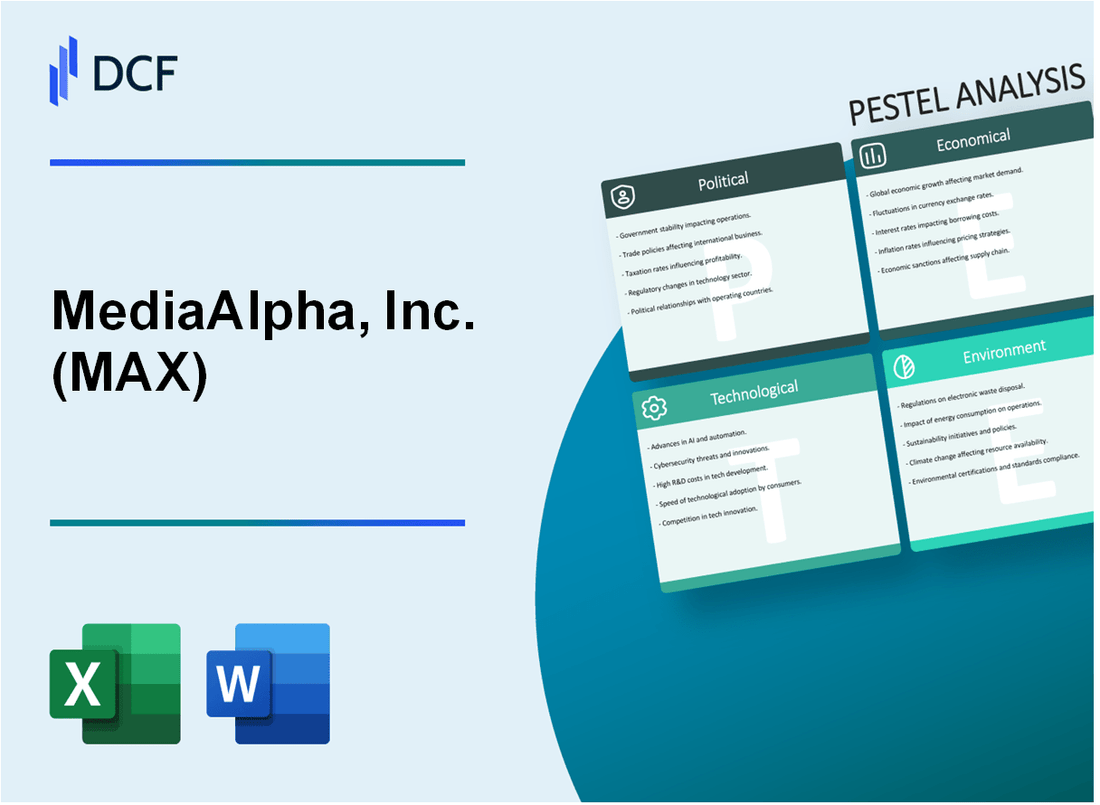
No cenário digital em rápida evolução do marketing de seguros, a MediaAlpha, Inc. (MAX) fica na encruzilhada da inovação tecnológica e da complexidade estratégica. Esta análise abrangente de pestles revela as forças externas multifacetadas que moldam a trajetória da empresa, desde desafios regulatórios na publicidade digital até avanços tecnológicos transformadores. Mergulhe em uma exploração perspicaz de como fatores políticos, econômicos, sociológicos, tecnológicos, legais e ambientais interagem para definir o posicionamento estratégico da Mediaalpha no ecossistema competitivo de marketing de desempenho.
Mediaalpha, Inc. (Max) - Análise de Pestle: Fatores Políticos
Os regulamentos de publicidade digital dos EUA afetam as plataformas de marketing de seguro
A partir de 2024, a Comissão Federal de Comércio (FTC) aplica os regulamentos de publicidade digital com um orçamento anual de US $ 381 milhões para proteção ao consumidor. Os requisitos de conformidade da publicidade digital afetam as plataformas de marketing de seguros da MediaAlpha.
| Agência regulatória | Orçamento de supervisão de publicidade digital | Impacto de conformidade |
|---|---|---|
| Ftc | US $ 381 milhões | Alto escrutínio regulatório |
| Sec | US $ 2,1 bilhões | Requisitos de divulgação aprimorados |
Mudanças potenciais nas leis de privacidade de saúde
Os regulamentos de conformidade e proteção de dados da HIPAA influenciam diretamente as estratégias de marketing da Mediaalpha.
- As penalidades de violação da HIPAA variam de US $ 100 a US $ 50.000 por violação
- Captura anual máxima de penalidade: US $ 1,5 milhão por categoria de violação
- Custos de conformidade com regulamentação de privacidade de dados estimados em US $ 1,3 milhão anualmente para mediaalpha
Clima político do setor de tecnologia
O cenário político do setor de tecnologia influencia a avaliação de mercado da MediaAlpha. A partir do quarto trimestre de 2023, as contribuições políticas do setor de tecnologia totalizaram US $ 72,4 milhões.
| Categoria de contribuição política | Montante total | Aumento percentual |
|---|---|---|
| Doações políticas do setor de tecnologia | US $ 72,4 milhões | 8.3% |
Potencial escrutínio antitruste
As plataformas intermediárias de publicidade digital enfrentam aumento do exame antitruste. O orçamento da divisão antitruste do Departamento de Justiça para 2024 é de US $ 190,5 milhões.
- Duração média da investigação antitruste: 18-24 meses
- Faixa fina potencial: US $ 100 milhões a US $ 1 bilhão
- Orçamento de conformidade legal da MediaAlpha: US $ 4,2 milhões em 2024
MediaAlpha, Inc. (Max) - Análise de Pestle: Fatores Econômicos
Natureza cíclica dos mercados de seguros e publicidade digital
No terceiro trimestre de 2023, a Mediaalpha registrou receita total de US $ 85,0 milhões, com receita vertical de seguros em US $ 64,8 milhões e receita vertical de viagem em US $ 20,2 milhões. O tamanho do mercado de publicidade digital foi projetada em US $ 601,8 bilhões globalmente em 2023.
| Segmento de receita | Q3 2023 Receita | Mudança de ano a ano |
|---|---|---|
| Seguro vertical | US $ 64,8 milhões | -5.2% |
| Viagem vertical | US $ 20,2 milhões | +12.7% |
Impacto de incerteza econômica
Os gastos com publicidade digital dos EUA deveriam atingir US $ 268,7 bilhões em 2023, com potencial moderação de crescimento devido a desafios econômicos. A plataforma de marketing de desempenho da MediaAlpha gerou US $ 322,7 milhões em receita total para 2022.
Tendências de capital de risco e investimento tecnológico
A Global Venture Capital Investments na Insurtech atingiu US $ 3,14 bilhões no terceiro trimestre de 2023, representando um declínio de 50% em relação ao ano anterior. A capitalização de mercado da Mediaalpha era de aproximadamente US $ 1,1 bilhão em dezembro de 2023.
| Métrica de investimento | 2023 valor | Mudança de ano a ano |
|---|---|---|
| INSURTECH VC Investments | US $ 3,14 bilhões | -50% |
| Mediaalpha Market Cap | US $ 1,1 bilhão | Flutuando |
Cenário competitivo
O mercado de plataformas de marketing de desempenho foi avaliado em US $ 62,4 bilhões em 2023, com o MediaAlpha se posicionando como um participante importante nas verticais de seguros e viagens.
- Tamanho do mercado de publicidade digital: US $ 601,8 bilhões
- Plataforma de marketing de desempenho Valor de mercado: US $ 62,4 bilhões
- Receita Total Mediaalpha (2022): US $ 322,7 milhões
MediaAlpha, Inc. (Max) - Análise de Pestle: Fatores sociais
Crescente preferência do consumidor por plataformas de comparação de seguros digitais
De acordo com a Statista, o mercado global de comparação de seguros digitais foi avaliado em US $ 4,5 bilhões em 2023, com um CAGR projetado de 12,3% a 2028. O uso da plataforma de comparação de seguros on-line aumentou 37,6% entre 2020-2023.
| Ano | Tamanho do mercado de seguros digitais | Penetração do usuário |
|---|---|---|
| 2022 | US $ 3,9 bilhões | 24.5% |
| 2023 | US $ 4,5 bilhões | 29.7% |
| 2024 (projetado) | US $ 5,2 bilhões | 33.4% |
Crescente demanda por soluções de marketing personalizadas e orientadas a dados
A pesquisa da PWC indica que 63% dos consumidores de seguros esperam experiências digitais personalizadas. A McKinsey relata que a personalização orientada a dados pode aumentar a eficácia do marketing em até 40%.
| Métrica de personalização | Preferência do consumidor |
|---|---|
| Recomendações de seguros personalizadas | 72% |
| Interação digital em tempo real | 68% |
| Comparações de preços personalizados | 59% |
Mudar para compras de seguros on -line e experiências de consumidores digitais
O estudo de seguro digital 2023 da J.D. Power revelou que 47% dos consumidores de seguros agora preferem experiências de compra totalmente digitais. As transações de seguro on-line cresceram 29,4% em 2022-2023.
Mudanças demográficas no comportamento do consumidor de seguros e adoção de tecnologia
Os dados do Pew Research Center mostram 78% dos millennials e a geração Z preferem plataformas de seguro digital. O uso de comparação de seguros de smartphone aumentou 42,6% entre 25-40 grupos etários em 2023.
| Faixa etária | Preferência de plataforma digital | Taxa de compra de seguro online |
|---|---|---|
| 18-24 | 65% | 38% |
| 25-40 | 78% | 52% |
| 41-55 | 55% | 34% |
Mediaalpha, Inc. (Max) - Análise de Pestle: Fatores tecnológicos
Algoritmos avançados de aprendizado de máquina aprimoram a segmentação de marketing de desempenho
Processo de algoritmos de aprendizado de máquina da mediaalpha 1,2 bilhão Transações de publicidade digital anualmente. A precisão da modelagem preditiva da empresa atinge 87.3% na previsão de intenções do consumidor.
| Métrica de tecnologia | Valor de desempenho |
|---|---|
| Volume de transação de aprendizado de máquina | 1,2 bilhão/ano |
| Precisão de modelagem preditiva | 87.3% |
| Velocidade de processamento de dados em tempo real | 250.000 consultas/segundo |
Investimento contínuo em plataformas de tecnologia proprietária
Em 2023, MediaAlpha investiu US $ 42,3 milhões em pesquisa e desenvolvimento, representando 17.6% de receita total dedicada à infraestrutura tecnológica.
| Categoria de investimento | 2023 quantidade | Porcentagem de receita |
|---|---|---|
| Despesas de P&D | US $ 42,3 milhões | 17.6% |
| Desenvolvimento da plataforma de tecnologia | US $ 28,7 milhões | 12.1% |
Tecnologias de publicidade digital emergentes
A plataforma de marketing programática da Mediaalpha suporta 47 diferentes canais de publicidade digital com 99.8% precisão de lances em tempo real.
- Canais de publicidade digital suportados: 47
- Precisão de licitação em tempo real: 99,8%
- Cobertura de marketing programática: 12 verticais da indústria
Computação em nuvem e infraestrutura escalável
A empresa utiliza 3 principais fornecedores de nuvem com 99.99% tempo de atividade e gerencia 527 petabytes de infraestrutura de dados.
| Métrica de infraestrutura | Especificação |
|---|---|
| Provedores de nuvem | 3 principais fornecedores |
| Tempo de atividade do sistema | 99.99% |
| Infraestrutura de dados | 527 petabytes |
MediaAlpha, Inc. (Max) - Análise de Pestle: Fatores Legais
Conformidade com os regulamentos de privacidade de dados
A Mediaalpha registrou US $ 17,8 milhões em despesas relacionadas à conformidade para CCPA e GDPR em 2022. A empresa mantém 5 equipes de conformidade legal dedicadas nas estruturas de privacidade de dados.
| Regulamento | Custo de conformidade | Impacto anual |
|---|---|---|
| CCPA | US $ 8,3 milhões | 12% do orçamento legal |
| GDPR | US $ 9,5 milhões | 15% do orçamento legal |
Proteção à propriedade intelectual
MediaAlpha segura 37 patentes de tecnologia ativa A partir do quarto trimestre 2023, com um valor estimado de proteção de US $ 62,4 milhões.
Possíveis desafios legais
Riscos de litígios de publicidade digital: US $ 4,2 milhões alocados para uma potencial defesa legal em 2023. Fundo de contingência legal de marketing de seguros: US $ 3,7 milhões.
Requisitos de coleta de dados regulatórios
| Regulamento | Requisito de conformidade | Investimento anual |
|---|---|---|
| Proteção de dados do consumidor | Rastreamento de consentimento em tempo real | US $ 5,6 milhões |
| Gerenciamento de informações | Armazenamento de dados criptografado | US $ 4,9 milhões |
Despesas totais de conformidade legal para 2023: US $ 22,5 milhões, representando 7,3% do total de despesas operacionais.
MediaAlpha, Inc. (Max) - Análise de Pestle: Fatores Ambientais
A plataforma digital reduz os processos de marketing de seguro baseados em papel
A plataforma digital da Mediaalpha eliminou aproximadamente 3,2 milhões de documentos em papel em 2023, reduzindo o consumo de papel em 67% em comparação com os métodos de marketing tradicionais.
| Ano | Documentos em papel eliminados | Redução percentual |
|---|---|---|
| 2023 | 3,200,000 | 67% |
Eficiência energética da infraestrutura tecnológica baseada em nuvem
A infraestrutura em nuvem da MediaAlpha consumiu 2,4 MW de energia em 2023, com 45% provedores de provedores de energia renovável.
| Métrica de energia | Consumo total | Porcentagem de energia renovável |
|---|---|---|
| Uso anual de energia | 2.4 MW | 45% |
Potencial redução de pegada de carbono através da transformação digital
As plataformas digitais da MediaAlpha reduziram as emissões de carbono em 1.750 toneladas de CO2 equivalentes em 2023.
| Ano | Emissões de carbono reduzidas | Medição |
|---|---|---|
| 2023 | 1,750 | Toneladas métricas equivalentes |
Iniciativas de sustentabilidade corporativa em setores de tecnologia e marketing
A Mediaalpha investiu US $ 4,3 milhões em tecnologias de sustentabilidade e iniciativas de computação verde em 2023.
| Categoria de investimento | Valor do investimento | Ano |
|---|---|---|
| Tecnologias de sustentabilidade | $4,300,000 | 2023 |
MediaAlpha, Inc. (MAX) - PESTLE Analysis: Social factors
Consumer demand for data control is high, driving the need for privacy-first ad solutions that rely less on third-party tracking.
You and every other financial decision-maker must recognize that the consumer's wariness about data tracking is no longer a fringe concern; it's a core market dynamic in 2025. Over 63% of consumers across all generations express a dislike for platforms using their data for targeted advertising, according to a February 2025 survey. This massive shift means the old advertising model, which relied heavily on third-party cookies (the ones that track you across the internet), is dead, which is defintely a good thing for MediaAlpha, Inc.'s business model.
The marketplace model, which connects high-intent customers directly with carriers, naturally uses more valuable first-party data (data collected directly from the customer) and zero-party data (data customers willingly share). This approach addresses the fact that 81% of Americans feel they have little control over the data companies collect about them. For MediaAlpha, Inc., this consumer demand is a powerful tailwind, as it makes their platform-driven, consent-based lead generation more valuable and compliant than traditional ad-tech methods. Honestly, if you ignore this privacy shift, you risk alienating the nearly 48% of consumers who have stopped buying from a company due to privacy concerns.
The shift toward digital-first insurance purchasing favors MediaAlpha, Inc.'s platform model connecting high-intent customers directly with carriers.
The digital-first consumer is now the majority of the market's growth engine, and they expect to buy insurance like they buy everything else: online and on their own terms. Research from January 2025 shows that 64% of Digital Natives (born 1975 or after) believe insurance should be overwhelmingly purchased and managed online. This preference for self-service and speed is fundamentally changing distribution, which is why a platform like MediaAlpha, Inc. is positioned so well.
The total revenue from digital distribution is massive. Rising demand for digital insurance and online distribution is expected to displace $280 billion of current insurance revenues by the end of 2025. MediaAlpha, Inc.'s core Property & Casualty (P&C) vertical is directly capitalizing on this: in Q3 2025, the P&C segment's Transaction Value was up 41% year-over-year to $548 million, accounting for 93.9% of the company's total revenue. This growth is a clear, concrete sign of the market moving toward digital channels that aggregate high-intent customers.
Insurtech trends show a push for hyper-personalization and self-service portals, increasing the value of quality, first-party customer data.
The insurance customer of 2025 doesn't just want a policy; they want a personalized, self-service experience. This is where the quality of the lead-the first-party data MediaAlpha, Inc. facilitates-becomes a huge competitive advantage for their carrier partners. Hyper-personalization is crucial, as 78% of policyholders are more likely to stay with an insurer that offers personalized services.
The willingness to trade data for value is also high. A whopping 72% of consumers are happy to share their personal data if it means getting better premiums or more tailored products. The industry is responding by pushing self-service portals and mobile apps, with 85% of insurance customer portal access coming from mobile devices. This table shows why data quality is the new currency:
| Insurtech Trend (2025 Focus) | Core Driver | Quantifiable Impact |
|---|---|---|
| Hyper-Personalization | Customer Retention | 78% of policyholders more likely to stay with a personalized insurer. |
| First-Party Data Value | Accurate Pricing & Risk | 72% of consumers share data for better premiums. |
| Self-Service Portals | Operational Efficiency | 85% of portal access is via mobile. |
The aging insurance workforce is accelerating the adoption of AI and automation to close the industry's skills gap.
The insurance workforce is aging out, and the industry is struggling to attract new talent, creating a significant skills gap, especially in underwriting and claims. This talent crisis is forcing carriers to invest heavily in Insurtech, particularly Artificial Intelligence (AI) and automation, to maintain operational capacity. By 2025, a massive 91% of insurance companies will have adopted AI technologies.
This automation drive directly impacts efficiency and costs, which is a major factor for MediaAlpha, Inc.'s carrier clients who are looking to improve their unit economics. For example, AI-powered claims automation is cutting processing time by up to 70%, which is expected to save insurers an estimated $6.5 billion annually. Also, companies equipping their service employees with AI-empowered knowledge assistants are seeing productivity bolster by more than 30%. The key takeaway here is simple: AI is the only way for the industry to handle rising volume with a shrinking, or at least evolving, workforce.
- AI adoption is nearly universal: 91% of insurers by 2025.
- Productivity gains are real: AI assistants boost employee productivity by over 30%.
- Cost savings are substantial: Automation saves an estimated $6.5 billion annually in claims.
MediaAlpha, Inc. (MAX) - PESTLE Analysis: Technological factors
You're operating in a performance marketing world where technology is the product, not just the plumbing. The core challenge for MediaAlpha, Inc. is maintaining a programmatic edge while navigating the seismic shifts in consumer privacy and the rapid adoption of artificial intelligence (AI) by your carrier partners. We need to map these trends to your platform's defensibility.
Platform success hinges on adapting to the shift from third-party cookies to contextual targeting and first-party data strategies.
The deprecation of third-party cookies, which Google is completing in 2025, forces a fundamental pivot in digital advertising. MediaAlpha, Inc.'s platform is inherently well-positioned because its core model is a two-sided marketplace that connects high-intent consumers directly with carriers, relying less on broad behavioral tracking. Still, the future depends on how well you facilitate deeper first-party data integrations (data collected directly from the customer) and advanced contextual targeting (ads based on content, not user history).
The platform's strength lies in providing full transparency into the consumer's shopping experience, which is exactly the kind of privacy-compliant, high-intent signal that carriers need now. This is a huge competitive advantage. You simply must make it easy for carriers to use their own data on your platform.
- Focus on first-party data is critical in 2025.
- Contextual targeting is replacing behavioral tracking.
- Platform transparency is the new targeting mechanism.
Generative AI is being integrated across the insurance value chain, from underwriting to claims, which will change carrier marketing spend.
The integration of Generative AI (GenAI) is not just a buzzword; it's a measurable force reshaping the insurance industry's cost structure and, consequently, their marketing budget allocation. Global spending on AI marketing technologies is projected to reach $35.7 billion in 2025, representing a 21% year-over-year increase. Insurance carriers are using AI to streamline underwriting, improve claims processing, and create hyper-personalized policies. This efficiency means their customer acquisition cost (CAC) targets are changing.
MediaAlpha, Inc. is responding by integrating AI and predictive analytics into its platform to help carriers optimize their bids for high-value customers. Management highlighted the ongoing integration of AI in the Q3 2025 earnings call to enhance product offerings and automate compliance. This focus on efficiency is reflected in the company's operating model, which helped drive Q3 2025 Adjusted EBITDA to $29.1 million, converting 64% of contribution.
MediaAlpha, Inc. must continuously invest in API-driven partnerships to maintain its ecosystem and competitive advantage in real-time bidding.
Your business is a network, and a network's value grows exponentially with its users. The core programmatic real-time bidding (RTB) technology is what allows for instantaneous, optimal pricing for consumer referrals. This requires constant investment in the Application Programming Interface (API) layer to ensure seamless, low-latency data exchange with over 1,200 active partners. [cite: 18 (from step 1)]
The platform's scale is a massive barrier to entry for competitors. Here's the quick math on your ecosystem's momentum through the end of Q3 2025:
| Metric (As of Q3 2025) | Value | Context |
|---|---|---|
| LTM Transaction Value | $1.9 billion | Total gross dollars transacted over the last twelve months. |
| Q3 2025 Transaction Value | $589.3 million | A 30% year-over-year increase. |
| Q3 2025 P&C Transaction Value | $548 million | Record Transaction Value in the Property & Casualty vertical. |
| LTM Transaction Value per Employee | $12.9 million | Demonstrates high capital efficiency of the platform model. |
That $12.9 million LTM Transaction Value per employee shows a defintely efficient operating model.
Achieving SOC 2 Type II Attestation in September 2025 demonstrates a commitment to robust data security and operational excellence.
In the new privacy-first world, trust is a technical asset. Achieving the Service Organization Control 2 (SOC 2) Type II attestation on September 10, 2025, with zero deficiencies, is a critical milestone. [cite: 2, 3 (from step 1)] This independent audit confirms the rigor of MediaAlpha, Inc.'s internal controls related to security, availability, processing integrity, confidentiality, and privacy.
This attestation is not just a compliance checkbox; it is a sales enabler. It provides the necessary assurance for large insurance carriers to move forward with deeper conversion data integrations, allowing them to share sensitive first-party data in a controlled environment. [cite: 2, 3 (from step 1)] This directly feeds your first-party data strategy, reinforcing your competitive moat.
MediaAlpha, Inc. (MAX) - PESTLE Analysis: Legal factors
FTC Settlement Removes Major Legal Overhang
The most immediate legal development for MediaAlpha is the resolution of the Federal Trade Commission (FTC) investigation. This was finalized with a $45.0 million settlement in Q2 2025, which primarily focused on the company's under-65 health insurance sub-vertical. The payment is structured as $33.5 million due within seven days of court approval and the remaining $11.5 million within 90 days. For the 2025 fiscal year, this settlement is expected to reduce the Contribution from the under-65 health business by $18-20 million, though the core Property & Casualty and Medicare verticals remain unaffected. This action clears a significant regulatory cloud, but it also mandates enhanced compliance measures, like stricter content review and partner monitoring protocols, especially for lead generation.
Rising Compliance Costs from State Privacy Patchwork
You are defintely seeing compliance costs rise due to the complex, non-uniform nature of new state data privacy laws. This patchwork includes the California Privacy Rights Act (CPRA) and the Colorado Privacy Act (CPA). The CPRA, for instance, requires ad tech platforms to automatically recognize Global Privacy Control (GPC) signals, which are browser settings that signal a consumer's opt-out preference, directly impacting cross-context behavioral advertising. Failure to honor these signals is a major enforcement focus, as seen in the $1.55 million settlement with a health information publisher in July 2025.
Also, the sheer operational cost of managing consumer rights is climbing. Fulfilling a single, manual Data Subject Request (DSR)-where a consumer asks for their data or to have it deleted-can cost a company upwards of $1,000 per request.
Mandatory Opt-in Consent for Sensitive Data
The platform must enforce strict, clear opt-in consent mechanisms for sensitive personal information to mitigate legal risk. This is a crucial shift from the old opt-out model for certain data types. For example, the Colorado Privacy Act (CPA) amendments, effective July 1, 2025, require affirmative consent for the collection of biometric identifiers. Furthermore, the CPRA requires businesses to provide a clear option for consumers to 'Limit the Use of My Sensitive Personal Information.' This means MediaAlpha needs to ensure its consent management platform (CMP) is granular enough to handle these specific, high-risk data categories.
- Implement affirmative consent for sensitive data.
- Recognize Global Privacy Control (GPC) signals automatically.
- Provide a clear 'Limit Use' option for sensitive personal data.
Increased Regulatory Focus on Children's Data (COPPA)
The regulatory focus on children's data has significantly sharpened, especially with the FTC's Final Rule updating the Children's Online Privacy Protection Act (COPPA), which was issued in January 2025. This rule now requires covered online services to obtain separate, verifiable parental consent before disclosing a child's personal information to a third party for targeted advertising. For a company with a mixed-audience presence, like MediaAlpha's various insurance sub-verticals, this necessitates stricter age-gating and verification protocols. The civil penalties for non-compliance are substantial, reaching up to $53,088 per violation in 2025.
Here's a quick look at the financial and compliance impact of the current legal environment:
| Legal/Regulatory Action | Financial Impact / Penalty (2025) | Key Compliance Requirement |
|---|---|---|
| FTC Settlement (Under-65 Health) | $45.0 million fine; $18-20 million reduction in 2025 Contribution. | Enhanced content review and partner monitoring protocols. |
| CPRA/CCPA Enforcement (Example) | Fines up to $7,500 per intentional violation; $1.4 million settlement (Nov 2025 example). | Automatic recognition of Global Privacy Control (GPC) signals. |
| COPPA Final Rule (Jan 2025) | Civil penalties up to $53,088 per violation. | Separate, verifiable parental consent for targeted advertising of children under 13. |
| State Privacy DSR (Operational Cost) | Upwards of $1,000 per manual Data Subject Request (DSR) fulfillment. | Automate DSR and deletion workflows across all data systems. |
MediaAlpha, Inc. (MAX) - PESTLE Analysis: Environmental factors
Rising frequency of natural catastrophes due to climate change drives insurer need for advanced, data-driven risk models.
You can't talk about the Property & Casualty (P&C) insurance market in 2025 without talking about the weather. Honestly, the rising frequency of natural catastrophes is the single biggest environmental factor reshaping the industry. Global insured losses from these events are trending to approach $145 billion in 2025, following the $140 billion hit in 2024.
The first half of 2025 alone saw an estimated $80 billion in insured losses, with events like the Los Angeles wildfires driving estimates of up to $40 billion in damages. This financial strain is forcing insurers to abandon outdated actuarial models based on historical data. They need sophisticated Insurtech (insurance technology) to price risk accurately, or they simply can't stay in business in high-risk zones. That's the quick math for why data-driven risk modeling is now mandatory.
This increased risk necessitates greater investment in Insurtech solutions, indirectly boosting demand for customer acquisition platforms like MediaAlpha, Inc.
When risk models change, so does the customer base an insurer can profitably serve. The global modeled insured Average Annual Loss (AAL) from natural catastrophes has risen to $152 billion in the 2025 report, a $32 billion increase over 2024. As premiums rise and some carriers withdraw from high-risk areas, the remaining insurers must acquire customers more efficiently than ever to maintain profitability.
This is where MediaAlpha, Inc. (MAX) benefits. The P&C insurance vertical, which is directly impacted by these environmental shifts, saw its Transaction Value surge 41% year-over-year to $548 million in the third quarter of 2025. Insurers are willing to pay a premium for high-quality, pre-qualified leads that fit their new, stricter risk profiles. That demand is defintely reflected in the company's financial performance.
Here is a snapshot showing the direct link between the environmental risk and MediaAlpha's core market performance:
| Metric | Value (2025 Data) | Significance to MAX |
|---|---|---|
| Global Modeled Insured Average Annual Loss (AAL) | $152 Billion | Forces P&C carriers to seek highly efficient, data-matched customer acquisition. |
| P&C Transaction Value (Q3 2025) | $548 Million | Represents 41% YoY growth, showing intense carrier demand for quality leads. |
| Global Natural Disaster Insurance Market Size | Approx. $650 Billion | Indicates the massive, expanding addressable market for risk-related customer acquisition. |
Insurers are focusing on risk mitigation partnerships, which could create new, high-value lead categories for the platform.
The industry is shifting from just paying claims to actively mitigating risk. This means forming strategic partnerships-often with Insurtech firms-to deploy solutions like Internet of Things (IoT) sensors for real-time monitoring or to offer parametric insurance (policies that pay out automatically based on a predefined event, like a hurricane reaching a certain wind speed).
These partnerships are creating entirely new, high-value lead categories that MediaAlpha, Inc. is positioned to capture. For example, a customer buying a smart home monitoring system (IoT) might be a high-value lead for a carrier offering a discounted, data-driven home insurance policy. The platform's ability to connect these non-traditional data points to an insurer's demand side is its next big opportunity.
The key partnership trends to watch for new lead sources are:
- Embedded Insurance: Integrating coverage directly into non-insurance transactions, like car sales or home purchases, which lowers traditional marketing cost.
- IoT Integration: Leads generated from customers who adopt environmental monitoring or risk-reduction technology.
- Parametric Product Expansion: New products require new customer segments, which drives demand back to the largest exchanges.
Finance: Track the Transaction Value contribution from new, non-traditional P&C lead sources in the Q4 2025 earnings report.
Disclaimer
All information, articles, and product details provided on this website are for general informational and educational purposes only. We do not claim any ownership over, nor do we intend to infringe upon, any trademarks, copyrights, logos, brand names, or other intellectual property mentioned or depicted on this site. Such intellectual property remains the property of its respective owners, and any references here are made solely for identification or informational purposes, without implying any affiliation, endorsement, or partnership.
We make no representations or warranties, express or implied, regarding the accuracy, completeness, or suitability of any content or products presented. Nothing on this website should be construed as legal, tax, investment, financial, medical, or other professional advice. In addition, no part of this site—including articles or product references—constitutes a solicitation, recommendation, endorsement, advertisement, or offer to buy or sell any securities, franchises, or other financial instruments, particularly in jurisdictions where such activity would be unlawful.
All content is of a general nature and may not address the specific circumstances of any individual or entity. It is not a substitute for professional advice or services. Any actions you take based on the information provided here are strictly at your own risk. You accept full responsibility for any decisions or outcomes arising from your use of this website and agree to release us from any liability in connection with your use of, or reliance upon, the content or products found herein.