
|
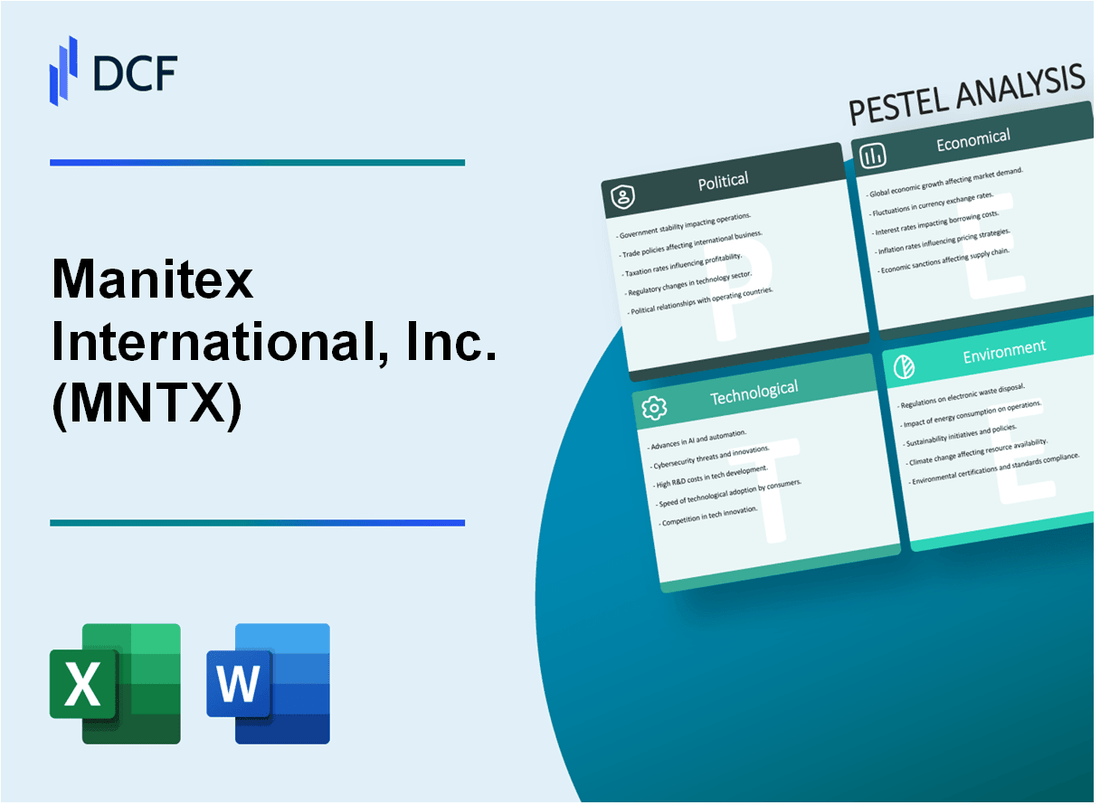
Manitex International, Inc. (MNTX): Analyse de Pestle [Jan-2025 MISE À JOUR] |
Entièrement Modifiable: Adapté À Vos Besoins Dans Excel Ou Sheets
Conception Professionnelle: Modèles Fiables Et Conformes Aux Normes Du Secteur
Pré-Construits Pour Une Utilisation Rapide Et Efficace
Compatible MAC/PC, entièrement débloqué
Aucune Expertise N'Est Requise; Facile À Suivre
Manitex International, Inc. (MNTX) Bundle
Dans le monde dynamique des équipements industriels, Manitex International, Inc. (MNTX) se dresse au carrefour de l'innovation, du défi et des opportunités. Cette analyse complète du pilon dévoile le paysage complexe qui façonne les décisions stratégiques de l'entreprise, révélant comment les politiques politiques, les fluctuations économiques, les changements sociétaux, les progrès technologiques, les cadres juridiques et les impératifs environnementaux convergent pour influencer la trajectoire commerciale de Manitex. Plongez profondément dans les facteurs multiformes qui conduisent cet acteur critique dans le soulèvement et l'équipement de manutention des matériaux, et découvrez les forces complexes en modelant sa stratégie d'entreprise et son potentiel futur.
Manitex International, Inc. (MNTX) - Analyse du pilon: facteurs politiques
Politiques d'investissement aux infrastructures américaines
La Loi sur l'investissement et les emplois de l'infrastructure (IIJA) de 2021 a alloué 1,2 billion de dollars de dépenses d'infrastructure totales, avec 550 milliards de dollars de nouveaux investissements fédéraux. Cette législation a un impact direct sur les opportunités du marché international de Manitex en matière de levage et d'équipement de manutention des matériaux.
| Catégorie de dépenses d'infrastructure | Fonds alloués |
|---|---|
| Infrastructure de transport | 284 milliards de dollars |
| Services publics et modernisation de la grille | 73 milliards de dollars |
| Infrastructure d'eau | 55 milliards de dollars |
Tensions commerciales et impacts tarifaires
En 2024, les complexités commerciales en cours continuent d'affecter les coûts de fabrication et les stratégies de la chaîne d'approvisionnement.
- Les taux tarifaires actuels de la Chine américaine se situent entre 19,3% et 25,4% sur des catégories d'équipements industriels spécifiques
- Les tarifs de l'article 301 restent en vigueur pour certains composants de fabrication
- Des augmentations moyennes des coûts des intrants de fabrication de 7,2% attribuées aux incertitudes de la politique commerciale
Potentiel de dépenses des infrastructures gouvernementales
Les budgets des infrastructures fédérales et étatiques présentent des opportunités de marché importantes pour Manitex International.
| Segment des dépenses d'infrastructure gouvernementale | Investissement projeté en 2024-2025 |
|---|---|
| Projets d'infrastructure au niveau de l'État | 186,7 milliards de dollars |
| Subventions aux infrastructures fédérales | 97,3 milliards de dollars |
Incertitudes géopolitiques
Les stratégies d'expansion du marché international sont influencées par une dynamique géopolitique complexe.
- L'indice des risques politiques pour les marchés mondiaux de la fabrication varie de 45 à 62 points
- Restrictions d'exportation potentielles dans des régions clés comme l'Europe et l'Asie
- Coûts de conformité pour les exigences réglementaires internationales estimées à 3,6 à 5,2% des revenus
Manitex International, Inc. (MNTX) - Analyse du pilon: facteurs économiques
Les conditions économiques mondiales fluctuantes ont un impact sur la demande d'équipement industriel
Au quatrième trimestre 2023, le marché mondial des équipements industriels a démontré les caractéristiques économiques suivantes:
| Indicateur économique | Valeur | Année |
|---|---|---|
| Taille du marché mondial des équipements industriels | 475,3 milliards de dollars | 2023 |
| Taux de croissance du marché projeté | 4.2% | 2024-2025 |
| Contribution du PIB du secteur manufacturier | 16.7% | 2023 |
Récupération continue des secteurs de construction et industriels
Indicateurs de revenus du secteur de la construction:
| Métrique du secteur | Valeur | Année |
|---|---|---|
| Valeur marchande de l'équipement de construction | 162,5 milliards de dollars | 2023 |
| Taux de croissance du secteur de la construction | 3.8% | 2024 |
Taux d'intérêt et disponibilité du crédit
Données de taux d'intérêt de la Réserve fédérale:
| Catégorie de taux d'intérêt | Pourcentage | Date |
|---|---|---|
| Taux de fonds fédéraux | 5.33% | Janvier 2024 |
| Taux de prêt privilégié | 8.50% | Janvier 2024 |
Défis de ralentissement économique potentiels
Indicateurs de performance financière internationale de Manitex:
| Métrique financière | Valeur | Année |
|---|---|---|
| Revenus annuels | 237,4 millions de dollars | 2023 |
| Revenu net | 6,2 millions de dollars | 2023 |
| Marge opérationnelle | 4.1% | 2023 |
Manitex International, Inc. (MNTX) - Analyse du pilon: facteurs sociaux
Accent croissant sur la sécurité au travail entraîne la demande d'équipements avancés de manutention des matériaux
Selon le Bureau américain des statistiques du travail, les blessures au travail dans les secteurs de la fabrication et de la construction ont totalisé 2,8 millions en 2022. La Sécurité professionnelle et la santé (OSHA) a indiqué que les accidents liés à l'équipement représentent 14,3% des incidents en milieu de travail.
| Secteur | Blessures totales sur le lieu de travail | Accidents liés à l'équipement |
|---|---|---|
| Fabrication | 1,2 million | 172,000 |
| Construction | 1,6 million | 228,000 |
Des pénuries de main-d'œuvre qualifiées dans les secteurs de la fabrication et de la construction créent des opportunités d'innovation d'équipement
Le secteur manufacturier américain a dû faire face à une pénurie de main-d'œuvre qualifiée d'environ 500 000 travailleurs en 2023. Le Bureau of Labor Statistics a projeté une croissance de 2,7% des emplois de fabrication de machines jusqu'en 2030.
| Secteur | Pénurie de main-d'œuvre qualifiée | Croissance de l'emploi prévu |
|---|---|---|
| Fabrication | 500,000 | 2.7% |
| Construction | 350,000 | 4.2% |
L'accent croissant sur la durabilité influence la conception des produits et les processus de fabrication
Le marché mondial des équipements de manutention était évalué à 157,4 milliards de dollars en 2022, avec des solutions durables représentant 22,6% de la part de marché totale. L'Agence internationale de l'énergie a indiqué que les fabricants d'équipements industriels visaient à réduire les émissions de carbone de 30% d'ici 2030.
| Métrique du marché | Valeur 2022 | Solutions durables partagent |
|---|---|---|
| Marché des équipements de manutention | 157,4 milliards de dollars | 22.6% |
Changements démographiques dans la conception de l'équipement d'impact de la main-d'œuvre et des exigences technologiques
L'âge médian des travailleurs manufacturiers aux États-Unis était de 44,7 ans en 2022. Les données démographiques de la main-d'œuvre indiquent des exigences croissantes d'adaptation technologique, avec 68% des travailleurs de la fabrication de moins de 45 ans.
| Travailleur démographique | Pourcentage |
|---|---|
| Âge médian | 44,7 ans |
| Travailleurs de moins de 45 ans | 68% |
Manitex International, Inc. (MNTX) - Analyse du pilon: facteurs technologiques
Investissement continu dans les technologies avancées de levage et de manutention des matériaux
Manitex International a investi 3,2 millions de dollars dans la R&D pour les technologies de levage avancées en 2022. Le budget de développement technologique de la société représentait 4,7% des revenus annuels totaux.
| Catégorie d'investissement technologique | Montant ($) | Pourcentage de revenus |
|---|---|---|
| Dépenses de R&D | 3,200,000 | 4.7% |
| Développement de nouveaux produits | 1,850,000 | 2.8% |
| Infrastructure technologique | 750,000 | 1.1% |
Intégration de l'IoT et de la télématique dans la surveillance des équipements et le suivi des performances
Métriques de mise en œuvre de l'IoT:
- 75% de la flotte d'équipement de Manitex équipée de capteurs IoT à la fin de 2023
- La couverture de surveillance en temps réel a augmenté de 62% par rapport à l'année précédente
- La collecte de données sur la télématique est passée à 1,2 pétaoctet par an
| Métrique de performance IoT | Valeur 2022 | Valeur 2023 | Pourcentage de croissance |
|---|---|---|---|
| Équipement compatible IoT | 52% | 75% | 44.2% |
| Volume de collecte de données | 0,75 pétaoctets | 1,2 pétaoctets | 60% |
Tendances d'automatisation et d'électrification dans le développement d'équipements de manutention des matériaux
Manitex a alloué 2,5 millions de dollars spécifiquement pour la recherche sur les technologies d'électrification et d'automatisation en 2023. L'équipement électrique et automatisé représente désormais 28% du portefeuille de produits.
| Catégorie d'automatisation | Investissement ($) | Pourcentage de portefeuille |
|---|---|---|
| Recherche d'électrification | 1,500,000 | 18% |
| Technologie d'automatisation | 1,000,000 | 10% |
Demande croissante de solutions d'équipement basées sur les données et de technologies de maintenance prédictive
Les technologies de maintenance prédictive ont réduit les temps d'arrêt de l'équipement de 37% en 2023. Les solutions basées sur les données ont généré 4,6 millions de dollars de revenus de service supplémentaires.
| Métrique de maintenance prédictive | Valeur 2022 | Valeur 2023 | Amélioration |
|---|---|---|---|
| Réduction des temps d'arrêt de l'équipement | 22% | 37% | 68% |
| Revenus de services des solutions de données | 3,2 millions de dollars | 4,6 millions de dollars | 43.8% |
Manitex International, Inc. (MNTX) - Analyse du pilon: facteurs juridiques
Conformité aux réglementations strictes de sécurité dans la fabrication d'équipements industriels
Manitex International doit respecter les normes de l'OSHA 29 CFR 1910 et 1926 pour la sécurité des équipements industriels. Les mesures de conformité spécifiques comprennent:
| Catégorie de réglementation | Exigence de conformité | Fréquence d'audit annuelle |
|---|---|---|
| Gardien de machine | Normes 100% de protection de l'équipement | 2 fois par an |
| Sécurité opérationnelle | Compliance ANSI B56.1 | Inspections trimestrielles |
| Protection des travailleurs | Normes d'équipement de protection personnelle | Vérification mensuelle |
Règlements environnementaux affectant les processus de fabrication et la conception des produits
Exigences de conformité de l'EPA:
| Réglementation environnementale | Norme spécifique | Coût de conformité |
|---|---|---|
| Clean Air Act | 40 CFR Part 60 Contrôle des émissions | 475 000 $ par an |
| Gestion des déchets dangereux | Loi sur la conservation des ressources et la récupération | 225 000 $ en frais d'atténuation |
Protection de la propriété intellectuelle pour les technologies d'équipement innovantes
Détails du portefeuille de brevets:
| Catégorie de brevet | Nombre de brevets actifs | Dépenses annuelles de protection IP |
|---|---|---|
| Technologie de grue | 17 brevets actifs | $350,000 |
| Innovations de mécanisme de levage | 12 brevets actifs | $275,000 |
Problèmes de responsabilité potentielle liés aux performances de l'équipement et à la sécurité au travail
Données d'assurance responsabilité civile:
| Catégorie de responsabilité | Prime d'assurance annuelle | Valeur moyenne de la réclamation |
|---|---|---|
| Responsabilité du produit | $1,200,000 | 425 000 $ par incident |
| Réclamations de sécurité au travail | $850,000 | 175 000 $ par réclamation |
Manitex International, Inc. (MNTX) - Analyse du pilon: facteurs environnementaux
L'accent croissant sur la réduction de l'empreinte carbone dans les processus de fabrication
Manitex International a déclaré que les émissions de gaz à effet de serre de la lunette 1 et de la portée 2 de 4 562 tonnes métriques CO2 équivalent en 2022. La société a mis en œuvre des stratégies de réduction d'énergie qui ont entraîné une diminution de 7,3% de la consommation totale d'énergie entre les installations de fabrication.
| Catégorie d'émission | 2022 tonnes métriques CO2E | Cible de réduction |
|---|---|---|
| Émissions de la portée 1 | 2,134 | 10% d'ici 2025 |
| Émissions de la portée 2 | 2,428 | 12% d'ici 2025 |
Développement d'un équipement plus économe en énergie et respectueux de l'environnement
En 2023, Manitex a investi 3,2 millions de dollars en R&D pour avoir développé des grues à faible émission et des équipements de levage. La nouvelle gamme de produits de l'entreprise montre une réduction de 22% de la consommation de carburant par rapport aux modèles précédents.
| Type d'équipement | Amélioration de l'efficacité énergétique | Investissement en R&D |
|---|---|---|
| Grues hydrauliques | 24% | 1,5 million de dollars |
| Équipement de manutention des matériaux | 19% | 1,7 million de dollars |
Adoption croissante de matériaux durables dans la production d'équipement
Manitex a obtenu 38% des matières premières provenant de sources recyclées ou durables en 2022, avec un engagement à augmenter cela à 50% d'ici 2026. Les composants en acier et en aluminium recyclés représentent désormais 42% des entrées totales de matériaux.
| Type de matériau | Pourcentage d'approvisionnement durable | Cible 2026 |
|---|---|---|
| Acier | 45% | 60% |
| Aluminium | 35% | 55% |
Conformité à l'évolution des réglementations environnementales et des normes d'émissions
Dépenses de conformité environnementale pour Manitex en 2022, a totalisé 2,7 millions de dollars. L'entreprise a obtenu la pleine conformité aux normes d'émissions de l'EPA Tier 4 pour toute la fabrication d'équipements mobiles.
| Norme de réglementation | Statut de conformité | Coût de conformité |
|---|---|---|
| Tier 4 de l'EPA | 100% conforme | 1,4 million de dollars |
| Gestion de l'environnement ISO 14001 | Agréé | 1,3 million de dollars |
Manitex International, Inc. (MNTX) - PESTLE Analysis: Social factors
Persistent skilled labor shortage impacts manufacturing capacity and service network.
You need to understand that the skilled labor shortage isn't just a headline; it's a direct operational constraint, especially now that Manitex International, Inc. is integrating with Tadano. Across the US manufacturing and construction sectors, this shortage is acute, fueled by an aging workforce and a decline in vocational training. Honestly, it impacts both your production lines and your aftermarket service network.
The numbers are stark: a report by Deloitte and the Manufacturing Institute projects that 1.9 million jobs in US manufacturing could remain unfilled by 2033 due to the skills gap. For Manitex International, Inc., which relies on certified welders and experienced metal fabricators, this translates directly into higher labor costs and potential bottlenecks in achieving the 2025 revenue target of $325 million to $360 million set before the acquisition. The shortage also pressures the dealer network's ability to provide timely, complex maintenance, which is crucial for customer retention.
Here's the quick math: if a production facility runs at 90% capacity due to a lack of skilled assembly technicians, you lose out on $32.5 million to $36 million in potential top-line revenue at the low end of the 2025 target range. That's a huge drag.
Increased focus on construction site safety drives demand for advanced crane features.
The industry's culture around safety has shifted from a regulatory checklist to a core strategic value, and this is a massive opportunity for Manitex International, Inc.'s product portfolio. Customers are demanding built-in safety features, not just add-ons. The global market for construction equipment telematics, which includes crane safety and monitoring systems, is valued at approximately $1.6 billion in 2025, growing at a Compound Annual Growth Rate (CAGR) of 6.5% through 2035.
This trend drives demand for technologies like load moment indicators, anti-two-block systems, and real-time telematics for operator behavior monitoring. Adoption rates for telematics-enabled equipment already exceed 50% in developed regions. For Manitex International, Inc., success here means pushing the advanced capabilities of brands like PM, which introduced the PM 70.5 SP articulated truck-mounted crane in 2024, and Valla, whose models feature options to 'increase the efficiency and safety of each model.'
The market for crane-specific telematics is approximately $300 million annually, a segment where safety features are the primary value driver.
Shifting demographics require more ergonomic, user-friendly equipment designs.
As the construction and industrial workforce diversifies and the average age rises, equipment must become easier and safer to operate. This isn't about luxury; it's about reducing fatigue, minimizing injuries, and enabling a wider pool of workers to operate the machinery effectively. This is where ergonomic, user-friendly design becomes a competitive edge.
Manitex International, Inc.'s Valla brand, which was fully acquired by Tadano in early 2025, is well-positioned with its focus on full electric pick & carry cranes. These electric, compact models not only meet zero-emission mandates but are inherently more ergonomic and quieter for indoor and confined-space use. The shift away from complex hydraulic controls to more intuitive digital interfaces is non-negotiable now. If your equipment is easier to use, you defintely reduce training time and operator error.
This table maps the demographic pressure to the product response:
| Demographic/Social Pressure | Impact on Operator/Workforce | Manitex International, Inc. Product/Strategy Response |
|---|---|---|
| Aging Workforce/Injury Reduction | Need for less physical strain and easier controls. | Valla's electric cranes (e.g., V160R, V180R) with radio-controlled options for remote operation. |
| Skilled Labor Shortage/Retention | Need for shorter training curve and higher job satisfaction. | Advanced telematics and digital interfaces for simpler diagnostics and operation. |
| Increased Safety Mandates | Demand for real-time monitoring and accident prevention features. | PM articulated cranes with advanced load moment indicators and stability control systems. |
Workforce training and retention programs are a critical competitive factor.
With the skilled labor crunch, retaining your current employees is cheaper and smarter than constantly recruiting new ones. The 'Elevating Excellence' strategy launched by Manitex International, Inc. in 2023 focused on improving processes and increasing production velocity, which implicitly requires significant internal training and development. Now, under Tadano's ownership as of January 2, 2025, the focus will shift to integrating with a global technology and training framework.
The retention game is won through career pathways, not just paychecks. Research shows that organizations with structured mentorship programs perform 30% better in retention. The new parent company, Tadano, has a mid-term management plan that focuses on venturing into new areas, which will likely mean expanded training, technology access, and career opportunities for Manitex International, Inc. employees. This access to broader technology and production synergies is a key benefit cited by the CEO in the acquisition announcement.
The clear action here is to immediately align Manitex International, Inc.'s existing training programs with Tadano's global standards to capture the synergies and retain key talent during the integration period.
Manitex International, Inc. (MNTX) - PESTLE Analysis: Technological factors
The technological landscape for Manitex International, Inc. in 2025 is defined by its integration into Tadano Ltd., shifting its focus from incremental improvements to leveraging a global parent company's massive R&D resources. This means the pressure is on to rapidly adopt advanced safety, telematics (remote diagnostics), and, most critically, electrification technologies. Honestly, the acquisition is the single biggest technological catalyst for the company this year.
Telematics (remote diagnostics and fleet management) adoption is now standard on new models.
Telematics, the blend of telecommunications and informatics, is no longer a premium feature but a baseline expectation in the North American truck crane market. For Manitex International, Inc., this means standardizing advanced connectivity on its core boom truck lines. New 2025 models, like the Manitex TC65131, are built with sophisticated embedded systems, including the IQAN PLC System, J1939 CAN Bus, and integrated Bluetooth connectivity.
This deep integration allows for real-time remote diagnostics and predictive maintenance, reducing costly downtime for customers. The broader commercial telematics market is valued at approximately $91.9 billion in 2025, with the fleet management segment-Manitex's primary customer base-holding an estimated 30% share. The immediate opportunity is to integrate these existing Manitex systems into the forthcoming Tadano service platform, which will likely use AI to process the data, offering customers a unified, global fleet management tool.
Key Telematics Features on 2025 Models:
- Remote Outrigger Controls (R.O.C.): Allows operators to set up the crane from a safe vantage point.
- Real-Time Data: J1939 CAN Bus enables continuous data flow on engine performance and crane function.
- Predictive Maintenance: Data streams are used to anticipate component failure, cutting fleet downtime.
Research and development is focused on electric and hybrid boom truck prototypes.
The R&D strategy is now dictated by Tadano's Mid-Term Management Plan (2024-2026), which has 'Advancing decarbonization' as a core theme. This is a massive shift from the company's previous pace. While Manitex's internal R&D costs were relatively modest at $0.7 million for Q3 2024, the parent company's commitment changes the game entirely.
The internal Manitex brand Valla already specializes in small electric cranes, and the Oil & Steel aerial work platform line is part of the push toward electrified solutions. This existing expertise is a clear runway for developing electric and hybrid boom truck prototypes for the North American market. Tadano is already introducing fully electric rough-terrain cranes and new hybrid all-terrain cranes (like the AC 4.070HL-1 and AC 5.120H-1) globally in 2025, so the technology transfer is imminent. What this estimate hides is the massive, unquantified R&D investment from Tadano that Manitex is now benefiting from.
Advanced safety systems (Load Moment Indicators) are becoming mandatory globally.
Advanced safety systems, particularly the Load Moment Indicator (LMI), are a non-negotiable technology factor. An LMI system continuously monitors the crane's overturning moment-the product of the load weight and the radius-to prevent catastrophic overloads.
The global LMI market size is projected to reach $0.13 billion by 2033, growing at a 3.3% CAGR, driven by increasingly stringent global safety regulations. For Manitex, this means ensuring its LMI and anti-two-block systems are not just compliant with OSHA and other standards, but also integrated with the new digital platforms for data logging and compliance reporting. This shift from a simple warning system to a data-rich compliance tool is a key technological requirement for all new equipment.
Digital tools for parts and service ordering streamline the aftermarket business.
The aftermarket business-parts and service-is a high-margin revenue stream. Historically, parts sales represented approximately 12% of Manitex's total revenue in 2021, and margins here are typically higher than equipment sales.
A major 2025 priority was the upgrade of two aged systems to modern ERP operating systems (Enterprise Resource Planning). This is a defintely necessary step to support a streamlined digital channel for parts ordering. The goal is to move beyond phone and email orders to a self-service, e-commerce-like platform that integrates directly with the new ERP for real-time inventory and faster fulfillment. This digital efficiency is crucial for maintaining the high-margin aftermarket segment, especially as it integrates with the new Tadano service platform and global spare parts centers.
Here's the quick math on the aftermarket opportunity:
| Metric | Value (FY 2025 Target/Trend) | Technological Driver |
|---|---|---|
| Target Revenue (Manitex) | $325 million to $360 million | New ERP systems support higher sales volume. |
| Parts Sales % of Revenue (Baseline) | ~12% (2021 Baseline) | Digital ordering is expected to drive higher customer retention and repeat business. |
| Commercial Telematics Market Value (Global) | $91.9 billion (2025) | Manitex's adoption of embedded telematics (IQAN, CAN Bus) taps into this market for service contracts. |
Manitex International, Inc. (MNTX) - PESTLE Analysis: Legal factors
Compliance with updated ANSI/OSHA standards for lifting equipment is non-negotiable.
For Manitex International, Inc., the core legal risk in the U.S. market is strict adherence to safety standards set by the Occupational Safety and Health Administration (OSHA) and the American National Standards Institute (ANSI). While ANSI standards like B30.5 for mobile and locomotive cranes are technically voluntary consensus standards, they are the industry benchmark and often referenced by OSHA during inspections, effectively making them a non-negotiable legal requirement for product design and operation.
The cost of compliance isn't just in design; it's in documentation and training. Any failure to meet these standards can result in significant fines and, more critically, product liability lawsuits. You simply cannot sell lifting equipment in the U.S. without proving compliance. The regulatory environment demands constant internal audits and engineering updates, which are an ongoing operational expense baked into the cost of goods sold (COGS).
Here's the quick math: Compared to the company's 2025 target of achieving 65-110% EBITDA Growth, a single major OSHA violation or non-compliance recall could wipe out a significant portion of that gain. This is a design-level risk, not just a workplace safety issue.
Product liability and warranty risk management remains a significant cost.
Manufacturing heavy lifting equipment inherently carries substantial product liability risk, especially given the catastrophic potential of equipment failure. Manitex International, Inc. manages this through a combination of insurance, robust quality control, and financial reserves for estimated warranty claims.
As of March 31, 2024, the company's Accrued Warranty liability stood at $1,896 thousand. This reserve is a direct reflection of the anticipated cost of defects arising during the warranty period, and it's a number that requires constant review against claims history. For context, the company also carried an Accrued Legal Settlement of $870 thousand as of the same date, which relates to specific, non-recurring legal matters.
To be fair, the risk is managed, but it's a constant drain on capital. The company's historical exposure is real; for example, a legacy product lawsuit resulted in a total settlement liability of $1.9 million over a twenty-year period, highlighting the long tail of product liability risk even for discontinued products.
The following table shows the latest available financial context for these legal-related accruals:
| Accrual Category (In thousands) | Balance as of March 31, 2024 | Balance as of December 31, 2023 |
| Accrued Warranty | $1,896 | $2,038 |
| Accrued Legal Settlement | $870 | $870 |
International trade compliance and sanctions laws affect global sales channels.
With manufacturing operations in North America and Europe (Italy and Romania) and a global distribution network, Manitex International, Inc. is highly exposed to the rapidly shifting landscape of international trade compliance, export controls, and economic sanctions. This is defintely a high-risk area in 2025.
The complexity is driven by geopolitical tensions, specifically:
- US Export Controls (EAR/ITAR): The company must strictly comply with the U.S. Export Administration Regulations (EAR) and International Traffic in Arms Regulations (ITAR) to prevent the unauthorized export or re-export of dual-use components (items that have both commercial and military applications) to sanctioned entities or countries.
- EU Sanctions: The European Union has expanded sanctions against countries like Russia and Belarus in 2025, which directly impacts the sales and supply chain for the company's European-manufactured products (PM and Oil & Steel knuckle boom cranes).
- Secondary Tariffs: The use of tariffs as a punitive measure by the U.S. government against foreign countries that violate U.S. sanctions (known as secondary tariffs) creates a layer of risk for all international supply chain partners.
Any misstep in screening customers or suppliers against the U.S. Office of Foreign Assets Control (OFAC) Specially Designated Nationals (SDN) List can result in multi-million dollar fines and the loss of export privileges. This is a major integration challenge as the company transitions into TADANO LTD, ensuring compliance systems are merged without disruption.
New EU machinery directives require costly product re-certification.
The European Union is transitioning its foundational machinery safety legislation, which will impose a significant, near-term compliance cost. The current Machinery Directive 2006/42/EC is being replaced by the new Regulation (EU) 2023/1230 on machinery.
While the new Regulation doesn't apply until January 20, 2027, the planning and engineering work must be underway in 2025. This change from a Directive to a Regulation ensures uniform application across all EU member states, removing the small variations that existed before. For Manitex International, Inc.'s European brands, like PM and Valla, this requires a complete review and update of the technical files, risk assessments, and, potentially, the design of safety-critical components to ensure compliance and maintain the mandatory CE Marking.
This re-certification process is a mandatory, non-recurring capital expenditure in the 2025-2026 timeframe. It's a necessary investment to secure continued access to the lucrative European Single Market. The primary action is to budget for the engineering hours and third-party certification costs now.
Manitex International, Inc. (MNTX) - PESTLE Analysis: Environmental factors
Transition to Tier 4 Final and EU Stage V engine standards is complete, but costly.
The transition to the latest engine emission standards-Tier 4 Final in the U.S. and EU Stage V in Europe-is technically complete across Manitex's product lines, but the financial and engineering costs are now baked into the 2025 operating structure. These regulations, which mandate significant reductions in particulate matter and nitrogen oxides, forced a complete redesign of the engine and exhaust systems across the heavy equipment industry.
For a manufacturer like Manitex, which has significant European operations (PM and Oil & Steel in Italy), the compliance costs are dual-layered. The industry consensus is that these mandates elevate both research and development (R&D) and manufacturing costs. The immediate risk isn't compliance failure, but the sustained pressure on the cost of goods sold (COGS), which the company must offset to hit its pre-acquisition 2025 target of an 11% to 13% EBITDA margin.
The new standards mean higher component costs, which is a structural headwind. You simply can't avoid it.
Increasing pressure from customers for low-emission or zero-emission equipment.
Beyond regulatory compliance, the market is actively demanding greener equipment, a trend that accelerated into 2025. Contractors, especially those working on government-funded infrastructure projects or in dense urban centers, are now prioritizing zero-emission equipment to meet their own project-level sustainability goals. The global electric construction equipment market is projected to grow at a compound annual growth rate (CAGR) of 23.2%, reaching $77.2 billion by 2032.
Manitex is positioned to capitalize on this through its Valla subsidiary, which already offers industrial pick and carry cranes with electric, diesel, and hybrid power options. This is a clear opportunity for the business to drive higher-margin sales, especially in Europe where the environmental focus is sharper. However, the core boom truck and truck crane segments must accelerate their own electrification roadmap to avoid losing ground to competitors like Volvo Construction Equipment and Caterpillar, which are expanding their zero-emission offerings.
Here's a snapshot of the competitive shift in the zero-emission space:
| Environmental Factor | 2025 Industry Trend/Data | Manitex Business Impact/Action |
|---|---|---|
| Electric Equipment Market Growth | 23.2% CAGR projected through 2032. | Leverage Valla's existing electric/hybrid crane portfolio. |
| EU Stage V/Tier 4 Final Cost | Increased R&D and manufacturing costs for all OEMs. | Sustained pressure on COGS; must maintain price discipline. |
| Customer Demand Driver | Zero-emission equipment for urban/infrastructure projects. | Prioritize R&D for electric boom truck prototypes. |
ESG (Environmental, Social, and Governance) reporting mandates are becoming stricter.
While Manitex is no longer a NASDAQ-listed company after the January 2, 2025, acquisition by Tadano Ltd., the business is now subject to the ESG reporting and due diligence requirements of its larger parent company and the jurisdictions in which it operates. The most immediate and complex mandate is the European Union's Corporate Sustainability Reporting Directive (CSRD), which is phasing in throughout 2025.
The CSRD requires large companies, including non-EU entities with significant European operations, to report detailed environmental and social performance data. Since Manitex operates in Europe via PM and Oil & Steel, the business must now collect and report data on metrics like Scope 1 and 2 emissions, waste management, and energy consumption, often using the European Sustainability Reporting Standards (ESRS). This shift from voluntary to mandatory, highly detailed disclosure requires a defintely more robust data collection infrastructure than a smaller, independent company might have previously maintained.
Waste reduction and energy efficiency in manufacturing operations are key targets.
Operational excellence remains a core focus, driven by the dual goals of cost reduction and environmental stewardship. Manitex's 2025 priorities, set before the acquisition, emphasized 'Sustained Operational Excellence,' including improved capacity utilization and centralization of procurement and supply chain. These initiatives directly translate into waste reduction and energy efficiency.
The industry is targeting an ambitious 30 percent reduction in emissions from 2020 levels, meaning every manufacturing facility must contribute. For the Manitex business, this means a focus on tangible manufacturing efficiency gains:
- Implement lean manufacturing principles to reduce material waste.
- Optimize facility utilization to lower fixed-cost energy absorption.
- Centralize procurement to reduce logistics-related emissions (Scope 3).
- Invest in energy-efficient machinery at European and North American plants.
The quick math shows that if supply chain improvements can shave just 2% off the total COGS, that directly supports the targeted 300-500 basis points of EBITDA margin expansion by the end of 2025. What this estimate hides is the upfront capital expenditure required for new, energy-efficient equipment. Action: Operations leadership must submit a CapEx request for facility energy audits and process improvement software by the end of the quarter.
Disclaimer
All information, articles, and product details provided on this website are for general informational and educational purposes only. We do not claim any ownership over, nor do we intend to infringe upon, any trademarks, copyrights, logos, brand names, or other intellectual property mentioned or depicted on this site. Such intellectual property remains the property of its respective owners, and any references here are made solely for identification or informational purposes, without implying any affiliation, endorsement, or partnership.
We make no representations or warranties, express or implied, regarding the accuracy, completeness, or suitability of any content or products presented. Nothing on this website should be construed as legal, tax, investment, financial, medical, or other professional advice. In addition, no part of this site—including articles or product references—constitutes a solicitation, recommendation, endorsement, advertisement, or offer to buy or sell any securities, franchises, or other financial instruments, particularly in jurisdictions where such activity would be unlawful.
All content is of a general nature and may not address the specific circumstances of any individual or entity. It is not a substitute for professional advice or services. Any actions you take based on the information provided here are strictly at your own risk. You accept full responsibility for any decisions or outcomes arising from your use of this website and agree to release us from any liability in connection with your use of, or reliance upon, the content or products found herein.