

|
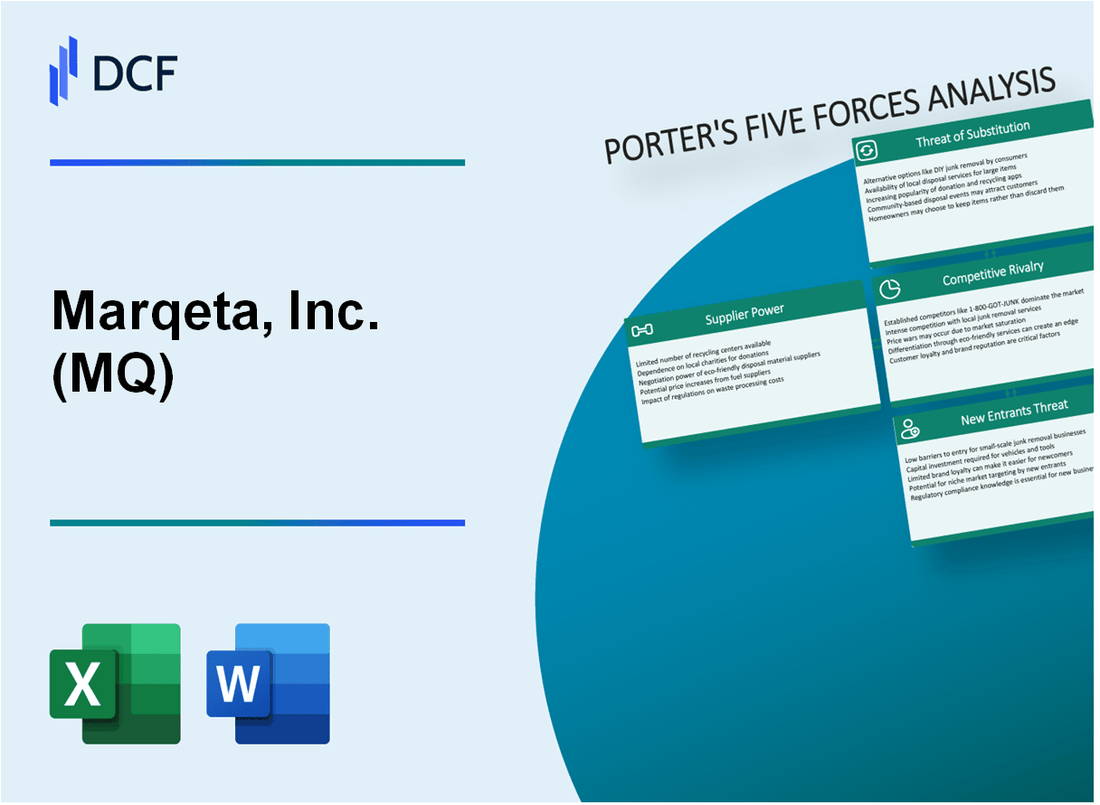
Marqeta, Inc. (MQ): 5 Analyse des forces [Jan-2025 MISE À JOUR] |
Entièrement Modifiable: Adapté À Vos Besoins Dans Excel Ou Sheets
Conception Professionnelle: Modèles Fiables Et Conformes Aux Normes Du Secteur
Pré-Construits Pour Une Utilisation Rapide Et Efficace
Compatible MAC/PC, entièrement débloqué
Aucune Expertise N'Est Requise; Facile À Suivre
Marqeta, Inc. (MQ) Bundle
Dans le paysage rapide en évolution de la finance intégrée, Marqeta, Inc. se dresse au carrefour de l'innovation technologique et de la dynamique du marché. En tant que plate-forme de paiement pionnière axée sur l'API, la société navigue dans un écosystème complexe où 5 Forces compétitives critiques façonner son positionnement stratégique. Des relations complexes avec les fournisseurs et les clients aux pressions concurrentielles incessantes et aux menaces technologiques émergentes, le parcours de Marqeta révèle une bataille nuancée pour la domination du marché dans la révolution des paiements numériques.
Marqeta, Inc. (MQ) - Porter's Five Forces: Bargaining Power of Fournissers
Nombre limité de technologies de base et d'infrastructures cloud
Au quatrième trimestre 2023, Marqeta s'appuie sur un marché concentré de fournisseurs d'infrastructures cloud:
| Fournisseur de cloud | Part de marché | Revenus annuels |
|---|---|---|
| Amazon Web Services (AWS) | 32% | 80,1 milliards de dollars (2022) |
| Microsoft Azure | 23% | 60,4 milliards de dollars (2022) |
| Google Cloud | 10% | 23,2 milliards de dollars (2022) |
Dépendance aux principaux réseaux de paiement
Le traitement des paiements de Marqeta dépend de manière critique de:
- Visa: 61,5% de part de marché mondiale
- MasterCard: 31,3% de part de marché mondiale
- Volume annuel des transactions réseau: 16,9 billions de dollars (2022)
Coûts de commutation pour les technologies de traitement des paiements
Dépenses de migration technologique pour les plates-formes de paiement spécialisées:
| Catégorie de coût de migration | Dépenses estimées |
|---|---|
| Intégration technique | 500 000 $ - 2,5 millions de dollars |
| Certification de conformité | $250,000 - $750,000 |
| Recyclage du personnel | $100,000 - $350,000 |
Concentration des fournisseurs dans la finance intégrée
Concentration du marché de la plate-forme financier intégrée:
- Les 3 meilleurs fournisseurs contrôlent 62% de part de marché
- Taille du marché financier intégré total: 264,5 milliards de dollars (2023)
- Taux de croissance projeté: 16,4% par an
Marqeta, Inc. (MQ) - Porter's Five Forces: Bargaining Power of Clients
L'effet de négociation des clients de grandes entreprises
Depuis le quatrième trimestre 2023, Marqeta dessert 702 clients d'entreprise, avec les meilleurs clients, notamment Doordash, Instacart, Square et Affirm. Les 10 principaux clients représentaient 34% des revenus totaux en 2022, indiquant une concentration importante des clients.
| Segment de clientèle | Nombre de clients | Contribution des revenus |
|---|---|---|
| Entreprenants | 702 | 34% des revenus totaux |
| Clients du marché intermédiaire | 1,258 | 22% des revenus totaux |
| Startups | 2,145 | 44% des revenus totaux |
Comparaison des solutions de paiement de l'API
Dans le marché des finances intégrées concurrentiels, les clients peuvent évaluer plusieurs solutions de paiement basées sur des API avec des structures et des fonctionnalités de prix variables.
- Stripe: Frais de transaction allant de 2,9% + 0,30 $ par transaction
- Carré: frais de transaction entre 2,6% et 3,5% + 0,10 $ par transaction
- Marqeta: prix personnalisés en fonction du volume et de la complexité des transactions
Pression de tarification sur le marché des finances intégrées
Le marché mondial de la finance intégrée était évalué à 54,3 milliards de dollars en 2022 et devrait atteindre 248,4 milliards de dollars d'ici 2032, créant une dynamique de prix compétitive intense.
Demande des clients pour une infrastructure de paiement flexible
Marqeta a traité 225,3 milliards de dollars de volume de paiement total en 2022, 81% des clients nécessitant des solutions de paiement personnalisables.
| Exigence d'infrastructure de paiement | Pourcentage de clients |
|---|---|
| Solutions entièrement personnalisables | 81% |
| Intégration de l'API standard | 12% |
| Personnalisation limitée | 7% |
Marqeta, Inc. (MQ) - Five Forces de Porter: rivalité compétitive
Paysage compétitif Overview
Depuis le quatrième trimestre 2023, Marqeta opère sur un marché des technologies de paiement hautement concurrentiel avec les principaux concurrents suivants:
| Concurrent | Évaluation du marché | Revenus annuels |
|---|---|---|
| Bande | 65 milliards de dollars | 1,2 milliard de dollars (2022) |
| Addyen | 38,4 milliards de dollars | 1,1 milliard de dollars (2022) |
| Marqeta | 1,8 milliard de dollars | 401,3 millions de dollars (2022) |
Métriques d'intensité compétitive
Indicateurs de concurrence du marché pour les plates-formes de paiement:
- Nombre de concurrents de technologie de paiement mondial: 47
- Taille totale du marché adressable: 127,3 milliards de dollars d'ici 2025
- Taux de croissance annuel du marché: 13,7%
Facteurs de différenciation technologique
Le positionnement concurrentiel unique de Marqeta:
| Fonctionnalité technologique | Avantage concurrentiel |
|---|---|
| Infrastructure d'API en temps réel | Fiabilité de disponibilité à 99,99% |
| Solutions de paiement personnalisables | 250+ clients d'entreprise |
| Plate-forme d'émission de carte moderne | Traitement 190 milliards de dollars par an |
Marqeta, Inc. (MQ) - Five Forces de Porter: menace de substituts
Systèmes de traitement des paiements traditionnels
Depuis le quatrième trimestre 2023, les systèmes de traitement des paiements traditionnels représentent une menace de substitut significative pour Marqeta. PayPal a traité 1,36 billion de dollars de volume de paiement total en 2022. Stripe a géré 817 milliards de dollars de paiements au cours de la même période.
| Processeur de paiement | Volume total de paiement 2022 | Part de marché |
|---|---|---|
| Paypal | 1,36 billion de dollars | 42% |
| Bande | 817 milliards de dollars | 25% |
| Carré | 456 milliards de dollars | 14% |
Technologies de paiement de blockchain et de crypto-monnaie
Les technologies de paiement des crypto-monnaies présentent un mécanisme de substitut émergent. Bitcoin a traité 8,9 billions de dollars de volume de transactions en 2022. Ethereum a géré 5,7 billions de dollars au cours de la même période.
- Volume de transaction Bitcoin: 8,9 billions de dollars (2022)
- Volume des transactions Ethereum: 5,7 billions de dollars (2022)
- Crypto-monnaie mondiale capitalisation boursière: 1,1 billion de dollars (décembre 2023)
Open Banking Plateformes
Les plates-formes bancaires ouvertes ont généré 15,3 milliards de dollars de revenus mondiaux en 2022. Le marché mondial de la banque ouverte devrait atteindre 123,7 milliards de dollars d'ici 2030.
Infrastructure de carte bancaire héritée
Visa a traité 14,3 billions de dollars de volume de paiement total en 2022. MasterCard a traité 6,8 billions de dollars au cours de la même période.
| Réseau de cartes | Volume total de paiement 2022 | Compte de transactions mondiales |
|---|---|---|
| Visa | 14,3 billions de dollars | 192 milliards de transactions |
| MasterCard | 6,8 billions de dollars | 118 milliards de transactions |
Marqeta, Inc. (MQ) - Five Forces de Porter: menace de nouveaux entrants
Faible exigence de capital initial pour les plateformes de paiement numérique
En 2024, les coûts d'infrastructure cloud pour les plates-formes de paiement numériques ont diminué à environ 5 000 $ à 15 000 $ par mois pour la configuration initiale. Le développement minimum de produits viables varie entre 50 000 $ et 250 000 $.
| Catégorie de coûts | Plage estimée |
|---|---|
| Infrastructure cloud | 5 000 $ - 15 000 $ / mois |
| Développement MVP | $50,000-$250,000 |
| Pile technologique initiale | $10,000-$30,000 |
Investissement en capital-risque dans la fintech
Les investissements mondiaux de capital-risque fintech ont atteint 51,4 milliards de dollars en 2023, indiquant une accessibilité substantielle du marché.
- 2023 Fintech VC Financement: 51,4 milliards de dollars
- Round à graines moyen: 2,5 millions de dollars
- Série A fourchette de financement: 5 à 15 millions de dollars
Exigences d'expertise technologique
L'infrastructure de paiement complexe exige des compétences techniques importantes. Salaire moyen des développeurs seniors en fintech: 145 000 $ - 195 000 $ par an.
| Rôle technique | Gamme de salaires annuelle |
|---|---|
| Ingénieur logiciel senior | $145,000-$195,000 |
| Spécialiste de la cybersécurité | $120,000-$180,000 |
| Expert en architecture cloud | $160,000-$220,000 |
Obstacles à la conformité réglementaire
Les coûts de conformité réglementaire pour les nouveaux participants fintech varient de 100 000 $ à 500 000 $ par an.
- Logiciel de conformité: 30 000 $ - 75 000 $ / an
- Consultation juridique: 50 000 $ - 150 000 $ / an
- Frais de licence: 20 000 $ - 275 000 $
Marqeta, Inc. (MQ) - Porter's Five Forces: Competitive rivalry
You're looking at a market where the pace of innovation is forcing everyone to run faster just to stay in place. The competitive rivalry in the modern card issuing space is definitely heating up, especially with well-funded peers making serious noise. We see Galileo, for instance, being crowned 'Best in Class' for Digital Issuance by Javelin Strategy & Research in their 2025 scorecard, even surpassing established players like FIS. And let's not forget Adyen, which remains a major competitor in the broader payment processing category.
The underlying market expansion is what's fueling this aggressive posture. The Modern Card Issuing Platforms Market is set to grow from an estimated $1.8bn in total transaction value in 2025 to over $4.2bn by 2030. That's a 129% expansion over five years, which naturally attracts and sustains intense competition among vendors trying to capture that new volume.
Marqeta, Inc. shows strong scale, reporting a Total Processing Volume (TPV) of $98 billion in Q3 2025. That TPV represented a 33% year-over-year increase for the quarter. However, looking at the broader trend, Marqeta's average TPV growth over the last four quarters was 29.4% year-on-year, while net revenue grew 27.6% in Q3 2025. Here's a quick look at Marqeta's recent scale versus the market growth projection:
| Metric | Value |
|---|---|
| Marqeta, Inc. Q3 2025 TPV | $98 billion |
| Marqeta, Inc. Q3 TPV YoY Growth | 33% |
| Modern Card Issuing Platforms Market Value (2025 Est.) | $1.8bn |
| Modern Card Issuing Platforms Market Value (2030 Proj.) | $4.2bn |
This TPV growth outpacing revenue growth hints at potential pricing pressure, which is the core of commoditization risk as card issuing APIs become more accessible. When volume grows faster than the dollar value you collect from it, your take rate is compressing. Marqeta maintained a Gross Profit Margin of 70% in Q3 2025, showing they are still managing unit economics well for now. Still, the risk is that the API layer becomes a utility.
The competitive set isn't just the modern fintechs, either. You have to account for the incumbents modernizing their legacy platforms. The fact that a digital-first provider like Galileo is outperforming legacy vendors like FIS in key 2025 evaluations shows that the modernization race is on, and it's a direct threat to Marqeta, Inc.'s differentiation story.
You should track these competitive dynamics closely, especially around pricing power:
- Galileo's 'Best in Class' rating in the 2025 Javelin Digital Issuance Provider Scorecard.
- The 129% projected growth of the modern issuing market by 2030.
- Marqeta's Q3 2025 Net Revenue growth of 28% year-over-year.
- The potential for declining take rates given TPV growth outpaced sales growth.
- Marqeta's Gross Profit Margin holding at 70% in Q3 2025.
Finance: draft a sensitivity analysis on a 50 basis point take-rate compression by end of 2026 by Friday.
Marqeta, Inc. (MQ) - Porter's Five Forces: Threat of substitutes
You're looking at the competitive landscape for Marqeta, Inc. (MQ) as of late 2025, and the substitutes are definitely a real concern, even with the company posting strong results. For instance, Marqeta reported Q3 2025 revenue of $163 million, a 28% increase year-over-year, and guided for full-year 2025 net revenue growth of 22%. Still, we have to look at what could pull volume away from the card rails Marqeta sits on.
Traditional bank-led issuing remains a substitute, especially for incumbent financial institutions modernizing internally. While Marqeta, Inc. is capturing growth in the modern card issuing space, many large, established banks are pouring capital into their own internal core modernization projects. They aim to offer comparable flexibility without relying on a third-party modern issuing platform layer. This is particularly true for their largest, most established corporate clients who might have the scale and technical resources to build in-house or leverage direct relationships with card networks.
Alternative payment methods like P2P apps and direct bank transfers bypass card networks and Marqeta's platform entirely. The sheer size of these direct transfer ecosystems represents a significant substitution threat for general-purpose card spend. The global P2P payment market size is projected to hit approximately $3.63 trillion in 2025. Furthermore, P2P payments allow users to send money directly from one person's account to another without going through a traditional banking institution or card network.
The rise of Buy Now Pay Later (BNPL) is a substitute for traditional credit cards, although Marqeta, Inc. also powers many BNPL card programs. This is a classic double-edged sword. Consumers are increasingly favoring BNPL over traditional credit, with 76% of US adults holding at least one credit card in 2025. The global BNPL market, measured by Gross Merchandise Volume (GMV), is valued at approximately $560.1 billion in 2025, with US spending alone forecast to reach $97.25 billion in 2025. Marqeta, Inc.'s management noted that lending, including BNPL solutions, is fueling their Total Processing Volume (TPV) growth, which hit $91 billion in Q2 2025, a 29% year-over-year increase. If a customer chooses a pure-play BNPL installment plan that doesn't involve a Marqeta-issued card, that's a direct substitution.
Direct integration with card networks for large enterprises is an option, bypassing the modern issuing platform layer. For the biggest spenders, the value proposition of a modern platform like Marqeta, Inc. must clearly outweigh the cost and complexity of managing direct connections or using a different type of infrastructure provider. Marqeta, Inc. processed nearly $300 billion in annual payments volume in 2024, showing they handle scale, but the option to bypass the middle layer always exists for the largest players.
Embedded finance is a trend, but other infrastructure providers can also facilitate it. Marqeta, Inc. is a leader in this space, but they are not the only one offering the underlying plumbing. Other infrastructure providers can also facilitate embedded finance, meaning a potential customer looking to embed a card program can choose a competitor for the BIN sponsorship or program management layer. Marqeta is expanding its capabilities, such as acquiring TransactPay to strengthen its program management in the UK and EU through EMI licenses, but the competitive field in infrastructure remains active.
Here's a quick look at the scale of the substitutes versus Marqeta, Inc.'s recent performance context:
| Metric | Value (Late 2025 Estimate/Actual) | Source Context |
|---|---|---|
| Marqeta, Inc. Full Year 2025 Gross Profit Growth Guidance | 23% | Marqeta Full Year 2025 Guidance |
| Global P2P Payment Market Size (2025 Estimate) | $3.63 trillion | P2P Market Size |
| Global BNPL Market GMV (2025 Estimate) | $560.1 billion | BNPL Market Size |
| US Credit Card Ownership (2025) | 76% of US adults | Credit Card Ownership Rate |
| Marqeta, Inc. Q2 2025 Total Processing Volume (TPV) | $91 billion | Q2 2025 Financials |
| Marqeta, Inc. Q3 2025 Total Processing Volume (TPV) Growth | 33% year-over-year | Q3 2025 Performance |
You should watch for these specific areas where substitution pressure is most acute:
- BNPL adoption outpacing traditional credit card usage among younger demographics.
- Large enterprises opting for direct network integration to cut platform costs.
- Fintechs choosing competing infrastructure providers for embedded finance builds.
- Direct bank-led modernization projects reducing the need for modern issuing platforms.
If onboarding takes 14+ days, churn risk rises, especially when a faster substitute is available.
Finance: draft 13-week cash view by Friday.
Marqeta, Inc. (MQ) - Porter's Five Forces: Threat of new entrants
The barrier to entry for new players in Marqeta, Inc.'s space is structurally high, primarily due to the intricate web of regulatory compliance and the necessity of securing formal bank sponsorship.
New entrants must navigate significant compliance burdens, including Know Your Customer (KYC), Anti-Money Laundering (AML), PCI DSS, SOC1, SOC2, and SSAE 18 requirements. Marqeta, Inc. has built an end-to-end platform that smooths this path, reducing a client's time-to-market for compliant offerings to as little as 8 weeks, compared to an estimated 8 months for building custom risk rules without expert support.
Building a truly scalable, global, cloud-native processing platform demands substantial initial capital. Marqeta, Inc. demonstrated its financial footing as of late 2025, reporting over $830 million in Cash and Short-term Investments. This level of liquidity is often necessary to sustain the long development cycles required before achieving profitability in this sector.
The established ecosystem of Issuing Bank and Card Network partnerships Marqeta, Inc. maintains is not easily replicated. These relationships are governed by strict Card Network rules, including PCI DSS, and involve complex coordination for card issuance and underwriting standards. Marqeta, Inc.'s strategic move to acquire TransactPay, for instance, immediately provided program management and EMI license support across the UK/EU, accelerating their ability to capture larger, cross-Atlantic opportunities.
New entrants face the hurdle of overcoming the high switching costs Marqeta, Inc. embeds through deep customer integration. When a customer relies on Marqeta, Inc.'s open API platform for core payment logic, migrating away involves rebuilding those connections. One client noted that alternative platforms required well over six months to a year for market readiness, whereas Marqeta, Inc. enabled their launch in less than six months.
The financial scale required to compete effectively is underscored by Marqeta, Inc.'s own trajectory toward sustained profitability. The company's guidance for the full-year 2025 Adjusted EBITDA margin is between 14% and 15%, which equates to over $85 million in Adjusted EBITDA for the year.
Here is a comparison of the time and resource investment implied by platform maturity:
| Factor | Marqeta, Inc. (Established Platform) | Hypothetical New Entrant (Build from Scratch) |
| Time to Market (Client Launch) | As fast as 8 weeks | Potentially 8 months or more |
| Platform Scale (Cash Position Q3 2025) | Over $830 million in Cash and Short-term Investments | Requires significant, sustained capital infusion |
| FY 2025 Adjusted EBITDA Guidance | Over $85 million | Profitability delayed until scale is achieved |
| Regulatory Burden Management | Compliance embedded; reduces client burden | Must build or secure complex, ongoing compliance functions |
The operational complexity that Marqeta, Inc. manages for its clients creates stickiness, which translates into barriers for new entrants. These complexities include:
- Managing compliance across global fragmentation.
- Implementing real-time fraud monitoring and dynamic spend controls.
- Maintaining required certifications like PCI DSS and SOC 2.
- Coordinating approvals with Issuing Banks and Card Networks.
Disclaimer
All information, articles, and product details provided on this website are for general informational and educational purposes only. We do not claim any ownership over, nor do we intend to infringe upon, any trademarks, copyrights, logos, brand names, or other intellectual property mentioned or depicted on this site. Such intellectual property remains the property of its respective owners, and any references here are made solely for identification or informational purposes, without implying any affiliation, endorsement, or partnership.
We make no representations or warranties, express or implied, regarding the accuracy, completeness, or suitability of any content or products presented. Nothing on this website should be construed as legal, tax, investment, financial, medical, or other professional advice. In addition, no part of this site—including articles or product references—constitutes a solicitation, recommendation, endorsement, advertisement, or offer to buy or sell any securities, franchises, or other financial instruments, particularly in jurisdictions where such activity would be unlawful.
All content is of a general nature and may not address the specific circumstances of any individual or entity. It is not a substitute for professional advice or services. Any actions you take based on the information provided here are strictly at your own risk. You accept full responsibility for any decisions or outcomes arising from your use of this website and agree to release us from any liability in connection with your use of, or reliance upon, the content or products found herein.