

|
Oatly Group AB (OTLY): VRIO Analysis [Mar-2026 Updated] |
Entièrement Modifiable: Adapté À Vos Besoins Dans Excel Ou Sheets
Conception Professionnelle: Modèles Fiables Et Conformes Aux Normes Du Secteur
Pré-Construits Pour Une Utilisation Rapide Et Efficace
Compatible MAC/PC, entièrement débloqué
Aucune Expertise N'Est Requise; Facile À Suivre
Oatly Group AB (OTLY) Bundle
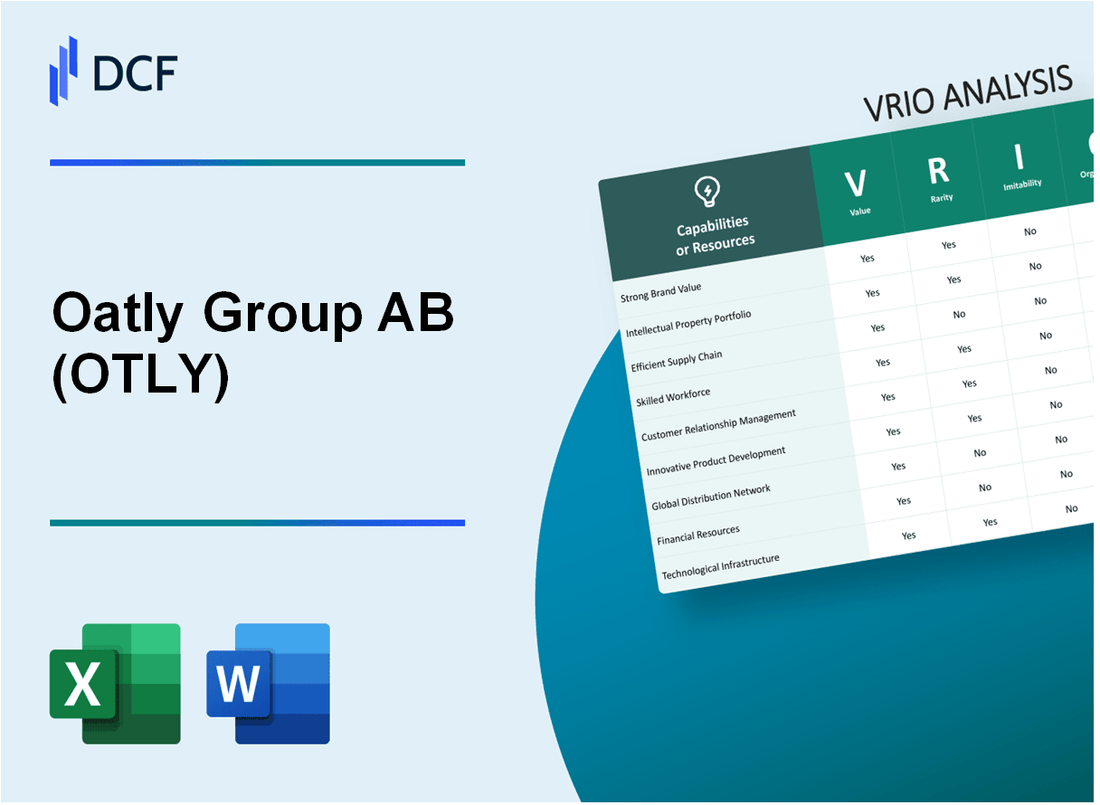
Unlocking the secrets to Oatly Group AB (OTLY)'s long-term success starts here: our rigorous VRIO analysis distills whether its core assets truly deliver sustainable competitive advantage through Value, Rarity, Inimitability, and Organization. Discover the critical strengths - and potential weaknesses - that define Oatly Group AB (OTLY)'s market position by reading the full breakdown below.
Oatly Group AB (OTLY) - VRIO Analysis: 1. Pioneering Oat-Based Processing Technology
You’re looking at Oatly Group AB’s core engine: that specific way they turn oats into a liquid base. This isn't just mixing oats and water; it’s the proprietary enzymatic hydrolysis process that lets them scale quality.
Value: This technology is the bedrock allowing Oatly Group AB to offer a wide product line, from their core oat drink to newer items like ice cream and cooking creams. It’s what makes the breadth of their offerings possible, which is a clear value driver for the consumer base.
Rarity: Honestly, while other companies are trying, Oatly Group AB’s scaled-up, high-quality enzymatic hydrolysis process remains relatively rare in the mass-market space. Competitors have oat milk, sure, but replicating the efficiency and texture at their scale is tough.
Imitability: It’s moderately difficult to copy. The underlying science isn't a secret, but the specific optimization - the 'secret sauce' in the process engineering - that drives their gross margin is hard to reverse-engineer quickly. It takes time and specific know-how.
Organization: Yes, they are organized around it. You see this in their product development pipeline; this core tech lets them quickly adapt the base for new formats. For instance, their Q3 2025 Research and development expenses were reported at only $4.5 million, showing they are managing R&D spend while still supporting this platform.
Competitive Advantage: Right now, it’s a temporary advantage. It’s sustained because they keep investing, even if that spend is managed down - like that $4.5 million in Q3 2025 R&D. If they stop innovating on the process, competitors will eventually catch up.
Here’s the quick math on where this resource stands:
| VRIO Dimension | Assessment | Implication for Advantage |
| Value | Yes | Competitive Parity or Better |
| Rarity | Yes | Temporary Competitive Advantage |
| Inimitability | Costly to Imitate | Temporary Competitive Advantage |
| Organization | Organized to Exploit | Temporary Competitive Advantage |
What this estimate hides is the brand equity built on top of this technology, which is a separate, perhaps stronger, advantage. Still, the tech itself needs continuous, focused support to maintain its edge.
- Technology underpins product breadth.
- Scaled efficiency is the hard part to copy.
- Q3 2025 R&D spend: $4.5 million.
- Advantage requires ongoing investment.
Finance: draft 13-week cash view by Friday.
Oatly Group AB (OTLY) - VRIO Analysis: 2. Global Brand Equity and Irreverent Positioning
Value
The brand equity supports premium positioning, evidenced by financial performance metrics that reflect consumer willingness to pay a premium or choose Oatly over competitors.
| Metric | Value (Q3 2024) | Comparison (Q3 2023) |
|---|---|---|
| Revenue (USD) | $208,000,000 | $187,595,000 |
| Gross Profit (USD) | $62.0 million | $32.6 million |
| Gross Profit Margin | 29.8% | Up 1,240 basis points |
For the nine months ended September 30, 2024, Total Revenue was $823.7 million, a 5.1% increase from $783.3 million in the prior year period.
Rarity
The unconventional tone is distinct within the plant-based sector, which is reflected in its market standing among key competitors.
- Oatly held an estimated 17% market share in the U.S. plant-based milk market as of 2024.
- Oat Milk as a category accounted for an estimated 13% of U.S. plant-based milk sales in 2024.
Imitability
Direct imitation is challenging due to the deep cultural integration of the brand voice, which the company explicitly plans to continue leveraging.
The CEO stated the intent to 'continue to invest behind our unique brand voice to recruit more consumers to our brand and further stimulate demand' following Q3 2024 results.
Organization
Consistent application of the brand identity across operational and strategic areas supports the brand's differentiation.
- North America segment achieved positive Adjusted EBITDA of $5 million in 2024, marking a significant operational alignment with growth strategy.
- The company narrowed its group-level Adjusted EBITDA loss to $35.3 million for the 12 months ended December 31, 2024, from $158 million in 2023, demonstrating organizational focus on profitability.
- The company is forecasting group-level positive Adjusted EBITDA of $5 million to $15 million in 2025.
Competitive Advantage
The cultural differentiation provides a sustained advantage, though the financial scale of the brand is smaller than some category leaders.
| Metric | Oatly Value (2024 Est.) | Category Leader (Almond Breeze, 2024 Est.) |
|---|---|---|
| U.S. Plant-Based Milk Market Share | 17% | 48% |
Oatly Group AB (OTLY) - VRIO Analysis: 3. European & International Market Dominance
Value: Provides a stable, profitable base, with Q3 2025 revenue hitting about $123.3 million, showing 12.2% growth (as reported).
Rarity: No; many food companies have strong regional bases, but Oatly Group AB’s leadership in the oat sub-segment is notable.
Imitability: Moderately difficult; competitors can enter, but displacing established shelf space and foodservice relationships takes time and capital.
Organization: Yes; the company is clearly organized to execute its playbook effectively here, driving margin improvements.
Competitive Advantage: Temporary; strong performance here offsets weakness elsewhere, but it’s not an insurmountable moat.
| Metric | Europe & International (Q3 2025) | North America (Q3 2025) | Greater China (Q3 2025) |
| Revenue (USD in thousands) | $123,267 | $62,096 | $37,433 |
| Revenue YoY Change (As Reported) | 12.2% | -10.1% | 28.8% |
| Revenue YoY Change (Constant Currency) | 6.0% | -10.1% | 28.7% |
| Volume YoY Change | 8.4% | (Not explicitly stated for Volume YoY Change in Q3 2025 data snippet) | 32.2% |
The strong performance in this segment is evidenced by specific operational metrics:
- Europe & International EBITDA Margin reached 18% in Q3 2025, an improvement of 700 basis points compared to the prior year's Q3.
- Europe & International segment revenue increased 12.0% year-over-year to $118.2 million in Q2 2025, supported by volume growth of 9.4%.
- The Q3 2025 reported revenue growth of 12.2% was driven by a 6.0% constant currency revenue increase.
- The segment's Q3 2025 volume growth was 8.4%.
Oatly Group AB (OTLY) - VRIO Analysis: 4. Scaled, Evolving Supply Chain Network
The supply chain network is a critical operational asset, evolving from a focus on rapid capacity build-out to efficiency and an asset-light model.
Value: Supports the production of 147.6 million liters in Q3 2025 and has delivered operational efficiencies that improved gross margin. The margin stability in Q3 2025 at 29.8% was explained by improvements in supply chain efficiency in Europe & International.
The following table summarizes recent production volumes and gross margin performance:
| Metric | Q3 2025 | Q3 2024 | Q1 2025 |
|---|---|---|---|
| Produced Finished Goods Volume (Million Liters) | 147.6 million liters | 148.0 million liters | 143.1 million liters |
| Gross Profit Margin (%) | 29.8% | 29.8% | 31.6% |
Segment volume data highlights regional dynamics within the network:
- Europe & International Q3 2025 Sold Finished Goods Volume: 83.6 million liters.
- North America Q3 2025 Sold Finished Goods Volume: 34.4 million liters.
Rarity: No; large CPGs have complex supply chains, but Oatly Group AB’s focus on oat sourcing is unique.
Imitability: Difficult; the physical assets and logistics contracts, especially in Europe, are not easily replicated quickly. The company previously opened facilities in Utah, Singapore, and Ma'anshan, China, and planned three new facilities in the U.S., U.K., and China, which were expected to produce 450 million liters of product.
Organization: Yes; the focus on cost-saving programs in the supply chain shows management is actively exploiting this asset. The company is executing a more asset-light supply chain strategy. Adjusted EBITDA improvement in Q3 2025 was driven by continued supply chain productivity.
Competitive Advantage: Temporary; the company is actively pursuing an asset-light strategy, suggesting a shift in how this capability is valued.
Oatly Group AB (OTLY) - VRIO Analysis: 5. Diversified Oat-Based Product Portfolio
The diversification across oat-based products beyond the core oat drink is a strategic element of the portfolio.
Value
Reduces reliance on the core oat drink, with offerings like ice cream and yogurt providing new revenue streams.
| Product Category Mentioned | Relevant Financial/Volume Data Point | Data Value |
|---|---|---|
| Oat Drinks (Core) | Finished Goods Volume (2024) | 563.4 million liters |
| Ice Cream, Yogurt, Spreads | Production Capacity Expectation (2023) | 1.4 billion liters |
| Total Revenue (2024) | Annual Revenue | $823.7 million |
| Q3 2025 Revenue | Total Revenue | $222.8 million |
Rarity
Moderately rare; while many plant-based companies diversify, Oatly Group AB leverages its core oat base across more categories than some rivals.
Portfolio Breadth Context:
- Europe & International Q2 2025 Revenue Contribution: 56.7% ($118.2 million)
- North America Q2 2025 Revenue Contribution: 30.3% ($63.2 million)
- Greater China Q2 2025 Revenue Contribution: 13.0% ($27.0 million)
Imitability
Moderately easy; once the core technology is established, expanding the SKU count is standard for CPGs.
Volume Growth Context:
- Sold Finished Goods Volume Increase (2024 vs 2023): 8.8%
- Produced Finished Goods Volume Increase (2024 vs 2023): 13.8%
Organization
Yes; the technical advancements mentioned allow for this breadth, which is a strategic focus.
Operational Efficiency Data:
- Gross Margin (Q2 2025): 32.5%
- Gross Margin Year-over-Year Increase (Q2 2025): 330 basis points
- Cost of Goods per Liter Reduction (H1 2025 vs prior year): 10%
Competitive Advantage
Temporary; it offers resilience but is not a long-term barrier on its own.
Oatly Group AB (OTLY) - VRIO Analysis: 6. Deep Foodservice Channel Penetration (Barista Focus)
Secures high-volume, high-visibility placements, especially with the Barista blend favored by coffee shops globally.
| Metric | Data Point | Period/Context |
|---|---|---|
| Total Revenue | $823.7 million | Year ended December 31, 2024 |
| Greater China Foodservice Revenue Share | Approx. 62% | Q2 2025 |
| Greater China Foodservice Revenue Share | Approx. 76% | Q1 2025 |
| Barista Edition Fat Content | 3% | Product Specification |
| Barista Edition Climate Footprint | 0.75KG CO2E/KG | Product Specification |
Moderately rare; this deep, specialized B2B relationship is harder to build than general retail distribution.
Difficult; trust and consistency with baristas and coffee chains are built over years.
Yes; the European growth is heavily supported by barista products, showing organizational alignment.
- Europe & International Segment Revenue Growth: 12.2% (Q3 2025)
- Greater China Segment Revenue Growth: 28.8% (Q3 2025)
- North America Revenue Decline: 10.1% (Q3 2025), partially due to foodservice customer sales change
- Revenue Growth in Foodservice Channel: Observed in Q2 2024 vs Q2 2023
Temporary; it’s a strong foothold, but a competitor could target this segment aggressively.
Oatly Group AB (OTLY) - VRIO Analysis: 7. Majority Shareholder Influence and Stability
Value: Provides a stable, long-term anchor shareholder in Nativus Company Limited, which owns 45.4% of the ordinary shares as of the 2025 Annual Report.
Rarity: Yes; this level of concentrated ownership is uncommon for a listed company and can provide governance stability.
Imitability: Impossible; this is a structural fact of ownership, not a replicable operational process.
Organization: Yes; this structure influences major decisions, such as the strategic review of the Greater China business.
Competitive Advantage: Sustained; ownership structure is a fixed, non-imitable characteristic.
The influence of the majority shareholder is evident in strategic corporate actions, such as the review of the Greater China segment, which has seen significant operational changes and financial performance metrics:
- The strategic review of the Greater China business considers options including a potential carve-out to accelerate growth and maximize value.
- The Ma'anshan factory in China has the capacity to produce up to 150 million litres of oat-based products annually at full capacity.
- China segment revenue for the year ended December 31, 2024, totaled $114.9 million.
- The EBITDA loss for the China segment was reduced to $31.1 million in 2024, compared to $65 million in 2023.
- For the first half of 2025, Greater China revenue increased by 12.5% year-on-year to US$56.955 million, with an adjusted EBITDA of US$982,000.
- The closure of the Singapore facility, part of an asset-light strategy, impacted 59 employees at the $30 million site.
Key ownership percentages illustrate the concentration of control:
| Shareholder Entity | Reported Ownership Percentage | Shares Held (Approximate/Specific) | Date/Filing Context |
| Nativus Company Limited | 45.4% | 271,763,953 Ordinary Shares | Annual Report (2025) / Form F-3 (March 2025) |
| Blackstone Group Inc. | 6.72% | 39,778,182 shares | February 2022 Filing |
| China Resources Verlinvest Health Investment Ltd. (Parent of Nativus) | 45.4% | N/A | 2025 Annual Report |
Oatly Group AB (OTLY) - VRIO Analysis: 8. Successful Cost Efficiency Program Execution
Value: Directly translates to operational improvement, evidenced by the Adjusted EBITDA loss shrinking to $3.6 million in Q2 2025 and reaching positive $3.1 million in Q3 2025.
| Metric | Q2 2024 | Q3 2024 | Q2 2025 | Q3 2025 |
|---|---|---|---|---|
| Adjusted EBITDA (Loss)/Profit (in millions USD) | $(11.0) | $(5.0) | $(3.6) | $3.1 |
| Gross Profit Margin | 29.2% | N/A | 32.5% | N/A |
The cost efficiency program has yielded significant financial milestones:
- Adjusted EBITDA loss improvement from $11.0 million in Q2 2024 to $3.6 million in Q2 2025.
- Achievement of positive Adjusted EBITDA of $3.1 million in Q3 2025.
- Gross margin expansion to 32.5% in Q2 2025, a 330 basis point increase year-over-year from Q2 2024's 29.2%.
- SG&A expenses dropped by $22.4 million in Q2 2024 alone, driven by reduced employee costs, marketing spend, and external consulting fees.
- Full-year 2025 Adjusted EBITDA guidance reaffirmed in the range of $5 million to $15 million.
- Capital expenditure expectations reduced to approximately $20 million for the full year 2025.
Rarity: No; all companies pursue cost savings, but achieving this level of turnaround is notable.
Imitability: Easy; competitors can implement similar overhead and supply chain restructuring programs.
Organization: Yes; the company is actively realizing and redeploying these gains into brand building.
The company is executing on its playbook, as evidenced by:
- Redeploying a portion of efficiencies into brand-building investments.
- Europe & International segment revenue increasing by 12.2% to $123.267 million in Q3 2025 as reported.
- North America segment reporting its first full quarter of positive Adjusted EBITDA in Q2 2024.
Competitive Advantage: Temporary; once the easy savings are realized, the advantage fades unless new efficiencies are found.
Oatly Group AB (OTLY) - VRIO Analysis: 9. Global Footprint and Market Access
Value: Products are available in over 50 countries globally, providing optionality for growth and mitigating risk from single-market downturns (like North America in 2025).
Rarity: No; many large food companies have a global reach.
Imitability: Difficult; establishing the necessary import/export logistics and local compliance across 50+ nations is a massive undertaking.
Organization: Yes; the company manages distinct regional strategies for Europe, North America, and Greater China.
Competitive Advantage: Temporary; while the footprint is large, the performance across regions is highly variable (e.g., Europe strong, North America weak).
The global footprint is characterized by significant regional divergence in recent performance:
- Q3 2025 Gross Margin was 29.8%, flat compared to the prior year period.
- Europe and International segment revenue growth was 12% in Q3 2025.
- North America segment revenue declined by 10.1% in Q3 2025.
- Greater China segment revenue grew by 28.7% on a constant currency basis in Q3 2025.
| Geographic Segment | Q3 2025 Revenue Change (Reported) | Q3 2025 Revenue Change (Constant Currency) |
| Total Company | 7.1% Increase | 3.8% Increase |
| Europe & International | Not explicitly stated | 12% Increase |
| North America | Not explicitly stated | -10.1% Decline |
| Greater China | Not explicitly stated | 28.7% Increase |
Finance Memo: Capital Allocation vs. Gross Margin (2025 Projections)
TO: Finance Committee
FROM: Strategy Analysis Unit
DATE: Next Tuesday
SUBJECT: Comparison of 2025 CapEx Budget Range Against Q3 2025 Gross Margin
This memo compares the projected 2025 Capital Expenditure (CapEx) range against the achieved Q3 2025 Gross Margin to assess capital deployment against core profitability.
| Metric | Value/Range | Source Context |
| 2025 Projected CapEx Range | $20 million to $35 million | Reaffirmed guidance is approximately $20 million; earlier projection was $30 million to $35 million. |
| Q3 2025 Gross Margin | 29.8% | Flat compared to prior year Q3. |
| 2025 Full-Year Outlook (Adj. EBITDA) | Positive $5 million to $15 million | Reaffirmed outlook, indicating expected operational profitability leverage from margin stability. |
The CapEx range of $20 million to $35 million for 2025 is being deployed against a backdrop of a stable 29.8% gross margin. The lower end of the CapEx range, $20 million, aligns with the reaffirmed 2025 guidance. The ability to achieve positive Adjusted EBITDA in the range of $5 million to $15 million for the full year, despite regional variability, suggests that capital deployment is intended to support the path to profitability rather than aggressive, margin-diluting expansion.
Disclaimer
All information, articles, and product details provided on this website are for general informational and educational purposes only. We do not claim any ownership over, nor do we intend to infringe upon, any trademarks, copyrights, logos, brand names, or other intellectual property mentioned or depicted on this site. Such intellectual property remains the property of its respective owners, and any references here are made solely for identification or informational purposes, without implying any affiliation, endorsement, or partnership.
We make no representations or warranties, express or implied, regarding the accuracy, completeness, or suitability of any content or products presented. Nothing on this website should be construed as legal, tax, investment, financial, medical, or other professional advice. In addition, no part of this site—including articles or product references—constitutes a solicitation, recommendation, endorsement, advertisement, or offer to buy or sell any securities, franchises, or other financial instruments, particularly in jurisdictions where such activity would be unlawful.
All content is of a general nature and may not address the specific circumstances of any individual or entity. It is not a substitute for professional advice or services. Any actions you take based on the information provided here are strictly at your own risk. You accept full responsibility for any decisions or outcomes arising from your use of this website and agree to release us from any liability in connection with your use of, or reliance upon, the content or products found herein.